Spain's PM blames traffickers after 60,000 migrants reach Ceuta from Morocco
Sofia Ferreira Santosand
Sarah Rainsford,Southern and Eastern Europe correspondent
Spain's prime minister has blamed trafficking gangs after about 60,000 migrants crossed into the Spanish North African enclave of Ceuta from Morocco. At least 57 people died during the surge, according to local media.
Pedro Sánchez called the incident a "violation of Spain's territorial integrity". Italy has responded by suspending the EU's border-free Schengen arrangements with Spain.
The influx comes after Spain's Supreme Court ruled that migrants stopped at sea while trying to reach Ceuta or Melilla, another Spanish enclave, cannot be summarily returned to Morocco.
As of Friday evening, more than 48,000 of the migrants had voluntarily returned to Morocco, Spanish officials said.
One migrant told Reuters news agency he was going back, adding: "It's not good at all, and it's not fun either. I mean, people are dying here. I beg you, please, if you haven't come yet, don't come. Don't do it."
Ceuta on the North African coast is separated from mainland Spain by the Strait of Gibraltar. It has long been a focal point for migrants attempting to reach Europe. During the summer months there is often a big push to reach Ceuta, typically organised over social media.
Coveted by Morocco, Ceuta and another Spanish enclave Melilla have long been a flashpoint in diplomatic relations between the two countries. They form the European Union's only land borders with Africa.
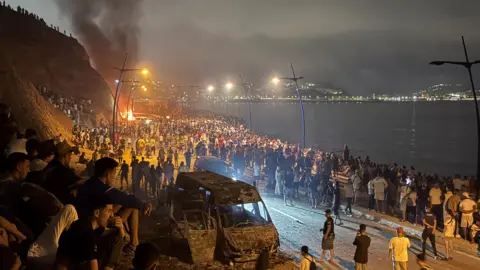
Local officials had appealed to Madrid for help after a recent rise in attempted crossings, but there were chaotic scenes on Thursday as border controls apparently broke down.
Carmen Gonzalez Bermudez who was in the city to see her parents told the BBC that the past day had been "very overwhelming".
She said she saw "thousands and thousands and thousands of people in swimming costumes and all wet, just coming from the sea", adding that "I know most of them are nice people just looking for a better future for themselves. But we cannot give that to them".
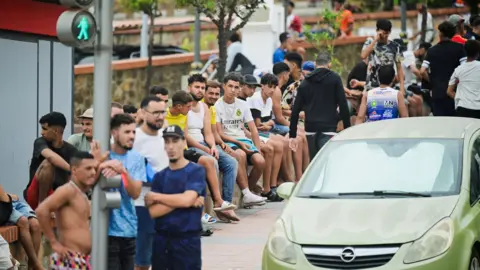
Víctor Ortiz Sotomayor told the BBC he had "never seen anything like it", describing the city as "packed with immigrants, in every square and street, mainly looking for food".
"There were only a few stores open, but in the end the police advised them to close because of the overwhelming influx of people," he added.
"My friends, my family and I are all staying at home. We haven't gone outside because we've scared."
Referring to a previous surge of migrants into Ceuta, Carmen Gonzalez Bermudez said: "In 2021, we saw our police and our military doing something. Yesterday, they were in the streets, but they weren't doing nothing. So that for starters feels really scary."

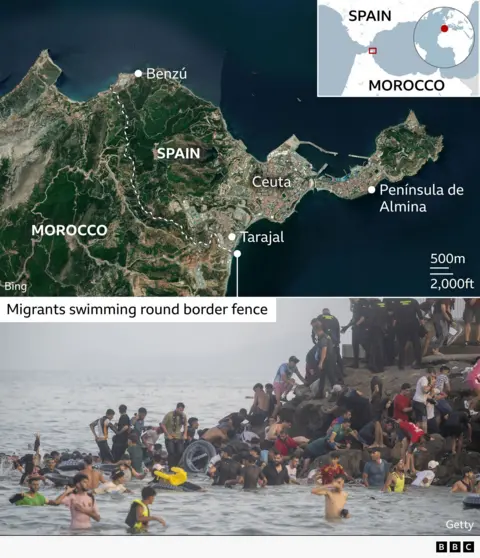
Ceuta's President Juan Jesús Vivas said the arrivals amounted to around 70% of the city's population - which sits at around 83,600 according to the latest local figures. Spain's Interior Ministry told the BBC that its estimates were slightly lower, citing 50,000 arrivals since the early hours of Thursday.
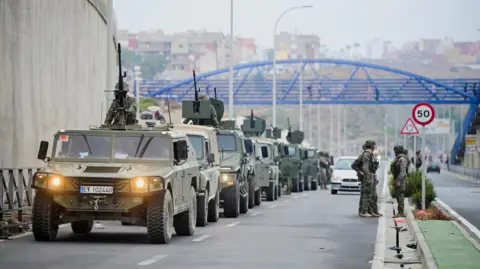
Spain has now deployed its armed forces to bolster security in Ceuta and at its sister city of Melilla, where between 300 to 400 crossings were also reported overnight.
Speaking on Friday during a visit to Ceuta, Sánchez said the surge was caused by criminal networks purposefully misinterpreting the recent Supreme Court ruling.
"What has emerged from our talks with Moroccan authorities is that trafficking mafias took a self-serving interpretation of a Supreme Court ruling" which "spread like wildfire", he said.
He added that the government would look at reinforcing the border with Morocco, and that Moroccan authorities were co-operating with the return of those who had entered illegally.
 Reuters
 EPA/Shutterstock
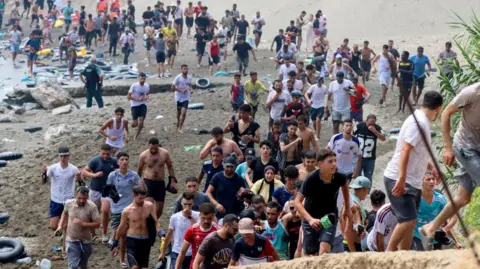
Most of those entering Ceuta have been young men, although there are also women and children in the crowds and even babies. Officials estimate that at least 7,000 of those who crossed illegally into the territory in the last 24 hours are minors.
Usually, to try to enter Ceuta, migrants swim several kilometres from further up the coast. This time they appear to have been able to get close to the border fence itself with ease. At the start, some even walked along the rocks on the jetty and around the end of it, but most had to swim out and around to reach the beaches on the other side.
It's not clear where the Moroccan border guards were at this point and why the groups of migrants were not dispersed or stopped.
Morocco, which has a high unemployment rate, witnessed several Gen Z anti-government protests last year - with young people demanding better opportunities and improvements to public services.
BBC Verify has looked into migration data released by the UN, which reported 2,826 people had crossed into Ceuta up until 15 July this year with another 181 entering via Melilla.
The number of migrants crossing into these two territories was already high compared with recent years, which saw 994 migrants enter in 2025, 476 in 2024 and 467 in 2023.
 Reuters
 Reuters
Italy's right-wing Prime Minister Giorgia Meloni described the images from Ceuta as "shocking", writing on social media that such "uncontrolled immigration" was a security threat to Europe.
Later on Friday Italy suspended the Schengen zone agreement with Spain on free movement. Since the two countries don't have a land border this would only apply, effectively, to flights - which appears simply to mean extra checks for passengers.
The Spanish foreign minister said such remarks were "improper" for "a partner and friendly country from which we expect European solidarity and not partisan demagoguery". He also summoned the Italian ambassador to Madrid on Friday.
Czech Republic's Andrej Babiš also called for the temporary suspension of Spain's Schengen membership.
Responding on X, Sánchez said: "Solidarity and empathy are optional. Respect for European treaties and data is not."
US President Donald Trump meanwhile called the situation in Ceuta a "catastrophe" and blamed it on "weak law, bad management".
EU chief Ursula von der Leyen said the images out of Ceuta were "unacceptable" and must "stop immediately".
Finland's Interior Minister Mari Rantanen backed Meloni and said Spain had failed to protect its border, while German Chancellor Friedrich Merz demanded Morocco "take back illegal migrants immediately".
The Schengen Area is a system of open borders spanning 29 European countries that have officially abolished controls at their common borders.
Additional reporting by Tamara Kovacevic, BBC Verify and Basma El Atti, BBC Focus


Geen opmerkingen:
Een reactie posten