zaterdag 1 november 2025

UN accuses US of violating human rights laws in Caribbean and Pacific airstrikes

 CC Newsletter 01 Nov- UN accuses US of violating human rights laws in Caribbean and Pacific airstrikes + Fundraising Update

Inbox

Countercurrents editor@countercurrents.org via dreamhost.com 

18:56 (1 uur geleden)
aan mij

Dear Friend,

On Friday, United Nations High Commissioner for Human Rights Volker Türk said airstrikes conducted by the United States against boats in the Caribbean and Pacific were a violation of international human rights law and must cease immediately. “Over 60 people have reportedly been killed in a continuing series of attacks carried out by US armed forces against boats in the Caribbean and the Pacific since early September, in circumstances that find no justification in international law,” Türk said in a statement. For the last two months, the US government has been conducting an illegal murder spree in international waters under the pretext of combating “narco-terrorists.”

Last month we managed to raise Rs 25,00 or $300. We've only achieved only 73% of our annual target of $24000. We need a long way to go!

We are on a fundraising drive. Kindly extend your helping hands to keep CC alive.

Without the help of each and every one of you CC will not survive. So, Plz come forward to help. https://countercurrents.org/subscription/. Those outside India can use this link https://buy.stripe.com/7sI6pW3nTgDofEQ5kk or become a patron https://www.patreon.com/countercurrentsorg

If you think the contents of this newsletter are critical for the dignified living and survival of humanity and other species on earth, please forward it to your friends and spread the word. It's time for humanity to come together as one family! You can subscribe to our newsletter here http://www.countercurrents.org/news-letter/.

In Solidarity

Binu Mathew
Editor
Countercurrents.org


UN accuses US of violating human rights laws in Caribbean and Pacific airstrikes
by Jacob Crosse

https://countercurrents.org/2025/11/un-accuses-us-of-violating-human-rights-laws-in-caribbean-and-pacific-airstrikes/

On Friday, United Nations High Commissioner for Human Rights Volker Türk said airstrikes conducted by the United States against boats in the Caribbean and Pacific were a violation of international human rights law and must cease immediately. “Over 60 people have reportedly been killed in a continuing series of attacks carried out by US armed forces against boats in the Caribbean and the Pacific since early September, in circumstances that find no justification in international law,” Türk said in a statement. For the last two months, the US government has been conducting an illegal murder spree in international waters under the pretext of combating “narco-terrorists.”


Veterans For Peace Says: NO WAR on VENEZUELA!
by Veterans For Peace

https://countercurrents.org/2025/11/veterans-for-peace-says-no-war-on-venezuela/

Veterans For Peace is appalled by the U.S. military’s extrajudicial killing of fishermen from Venezuela, Colombia, Ecuador, and Trinidad and Tobago—whom the Trump administration labeled as drug traffickers without evidence, due process, or accountability to Congress.


The Big Lie Behind Trump’s Boat Strikes
by Timothy Snyder

https://countercurrents.org/2025/11/the-big-lie-behind-trumps-boat-strikes/

The extrajudicial killing of alleged narcotics smugglers is less about drug trafficking and more about power projection – and maybe even regime change. Although videos of the bombings have become social-media fodder, there is no evidence that the targets were drug traffickers.


Israel targets UNICEF in Gaza as part of a systematic campaign against international organizations
by Euro-Med Human Rights Monitor

https://countercurrents.org/2025/11/israel-targets-unicef-in-gaza-as-part-of-a-systematic-campaign-against-international-organizations/

Israel’s actions against the activities of the United Nations Children’s Fund (UNICEF) in Gaza raise serious concern, representing a new episode in a systematic policy aimed at undermining humanitarian work and ending the presence of UN and international organisations in the Gaza Strip. On Thursday, Israeli forces arrested UNICEF staff member Raed Al-Afifi, 45, at Kerem Shalom crossing while he was carrying out his official duties, despite being present with prior coordination. No information has been provided by Israeli authorities regarding his location or the charges against him.


Beyond the ‘Unbreakable Bond’: Is the US Reclaiming the Wheel from a Self-Destructive Israel?
by Dr Ramzy Baroud

https://countercurrents.org/2025/11/beyond-the-unbreakable-bond-is-the-us-reclaiming-the-wheel-from-a-self-destructive-israel/

Has Donald Trump’s sharp rebuke of Israel in his October 23 Time Magazine interview fundamentally changed the calculus in the Middle East? His comments immediately sparked two opposing views: for some, his position represents the clear demarcation of a genuine shift in US foreign policy; for others, it is nothing more than a political ploy designed to claw back credibility lost by the US during two years of Israeli genocide in Gaza.


I Thought I Knew What Genocide Was
by Biljana Vankovska

https://countercurrents.org/2025/11/i-thought-i-knew-what-genocide-was/

When the Palestinian tragedy turned into an open genocide in the autumn of 2023, I could not look away from the ‘disturbing scenes.’ On the contrary, the least I could do was to witness and to write about those tormented people. Some in my indifferent surroundings wondered why I did this: why I watched those horrors, why I didn’t simply live my peaceful professor’s life. They said, ‘We have enough of our own problems.’ But I ‘kept vigil’ over those suffering children and parents because my conscience would not let me rest. Each night, before laying my head on the soft pillow, a wave of guilt overcame me. How could I sleep peacefully when bombs were falling on innocent people in Gaza, when children died in the cold nights and mothers could not even feed them?


Teasing the Armageddon Fanciers: Trump’s Announcement on Nuclear Testing
by Dr Binoy Kampmark

https://countercurrents.org/2025/11/teasing-the-armageddon-fanciers-trumps-announcement-on-nuclear-testing/

 US President’s instruction to his newly named Department of War to resume nuclear testing is almost prosaic, if characteristically inaccurate.  On social media, Donald Trump declared that, “Because of other countries testing programs, I have instructed the Department of War to start testing our Nuclear Weapons on an equal basis.  That process will begin immediately.” Strictly speaking, North Korea remains the black sheep of an otherwise unprincipled flock to consistently test nuclear weapons since the late 1990s, while 187 states have added signatures to the Comprehensive Test Ban Treaty (CTBT).


Earth on the Edge: Planetary Challenges and Humanity’s Shared Responsibility
by Hassan Fattahi and Zahra Mohebi-Pourkani

https://countercurrents.org/2025/11/earth-on-the-edge-planetary-challenges-and-humanitys-shared-responsibility/

At the dawn of the second half of the 21st century, Earth stands at a critical crossroads. From accelerating climate change and the collapse of ecosystems to widening inequality, war, technological disruption, and the erosion of justice, no dimension of human life remains untouched. This paper, grounded in an interdisciplinary approach, examines ten major global domains and proposes an integrated framework for rethinking humanity’s role in sustaining life on Earth. Its central argument rests on the concept of “shared but differentiated responsibility” — recognizing that while nations differ in power and capacity, none can escape the collective duty to protect the planet. The survival of Earth is no longer a matter of capability, but of moral will.


Climate Gates: Maybe we don’t need billionaire opinions on everything
by Bill McKibben

https://countercurrents.org/2025/11/climate-gates-maybe-we-dont-need-billionaire-opinions-on-everything/

I feel quite strongly that we should pay less attention to billionaires—indeed that’s rather the point of this small essay—so let me acknowledge at the outset that there is something odd about me therefore devoting an edition of this newsletter to replying to Bill Gates’ new missive about climate. But I fear I must, if only because it’s been treated as such important news by so many outlets—far more, say, than covered the UN Secretary General’s same-day appeal to international leaders that began with a forthright statement of the science.


The Future is Local and Female: Reflections from the Planet Local Summit
by Gregory Pettys

https://countercurrents.org/2025/11/the-future-is-local-and-female-reflections-from-the-planet-local-summit/

The Planet Local Summit, which took place in Ladakh from September 3-7, brought together visionaries, practitioners, and cultural change-makers to celebrate localisation, indigenous wisdom, and co-shape pathways for futures that are local, resilient, and healthy. Writer and regenerative farmer Gregory Pettys shares his experience at the summit, reflecting on travel as a key ingredient of learning and connection, and on embracing feminine leadership to restore balance, community, and harmony with the rest of nature.


How Is Israel Involved in Sudan’s Genocide? Tracing the Secret Links to the RSF
by Quds News Network

https://countercurrents.org/2025/11/how-is-israel-involved-in-sudans-genocide-tracing-the-secret-links-to-the-rsf/

Dozens of people have been killed in new massacres by the Rapid Support Forces (RSF) during their takeover of the city of El-Fasher in Sudan’s western Darfur region, according to medical and humanitarian reports. The Sudan Doctors Network described the situation as “a true genocide”, saying the RSF, which has been battling Sudan’s army for control of the country, killed more than 1,500 people in just three days as civilians tried to flee the besieged city. “The massacres the world is witnessing today are an extension of what occurred in El-Fasher more than a year and a half ago, when over 14,000 civilians were killed through bombing, starvation, and executions,” the group said, calling the attacks “a deliberate and systematic campaign of extermination.”


For Safety, Peace and Protective Future, Africa Needs Much Greater Unity of Its People
by Bharat Dogra

https://countercurrents.org/2025/11/for-safety-peace-and-protective-future-africa-needs-much-greater-unity-of-its-people/

In recent decades millions have perished from the direct and indirect impacts of conflicts and wars. Several hundred thousand people have been killed in very cruel attacks. Very serious humanitarian crisis situations have arisen in many countries over vast areas. Famines and near famines as well as other disasters have claimed millions of lives in recent decades, and the prospects of these and other extreme weather situations  are worsening  further in times of climate change. Several terror organizations are active over extensive areas, crossing over borders of several countries with relative ease. All this has been happening despite the efforts of the African Union, with 55 member countries, to improve the prospects of peace, development and welfare. 


Where Faith and Diversity Unite: Southeast Asia’s Lesson for the World
Press Release

https://countercurrents.org/2025/10/where-faith-and-diversity-unite-southeast-asias-lesson-for-the-world/

The recent ASEAN Summit in Kuala Lumpur, guided by the theme “Resilient Together, Prosper Together,” served as a powerful reminder of a core regional truth: Southeast Asia’s shared diversity, when guided by compassion, is its greatest strength. This unity is what ASEAN must protect.


Whispers in the Barracks, Thunder in the Streets: Pakistan’s Unfinished Revolt
by Junaid S Ahmad

https://countercurrents.org/2025/11/whispers-in-the-barracks-thunder-in-the-streets-pakistans-unfinished-revolt/

From the barracks of Rawalpindi to the halls of Washington, a sordid alliance stalks the republic of Pakistan: a military caste addicted to power, a civilian class cowed into servitude, and a foreign patron ever ready to pull the leash. What unfolds is less a grand strategy than a tragicomedy: generals trading sovereignty for sinecures, soldiers harboring contempt for their officers, and a once-promising democratic movement crushed under the twin weights of imperial ambition and martial tutelage.


The Agrarian Imagination: The Iron Cage of Agri-Rationality and Dostoevsky ‘s Moral Underground 
by Colin Todhunter

https://countercurrents.org/2025/11/the-agrarian-imagination-the-iron-cage-of-agri-rationality-and-dostoevsky-s-moral-underground/

In a world increasingly dominated by the corporate control of food, land, farmers and technology, agrarianism and political agroecology together offer a comprehensive vision of progress. From the Diggers’ insistence on shared land to Pongal rituals, Zapatista activism and La Via Campesina campaigns, these perspectives remind us that societal health depends on soil health and the freedom of those who cultivate it.  This synthesis of historical, cultural and political practices shows that agrarianism remains a viable framework for sustainable modernity. By combining spirituality, community and ecology, it reframes the meaning of progress itself. 


When the Mountains Crumble: The Political Geology of a Himalayan ‘Natural’ Disaster
by Abinash Rai

https://countercurrents.org/2025/11/when-the-mountains-crumble-the-political-geology-of-a-himalayan-natural-disaster/

A devastating natural disaster in the Himalayas reveals how climate change, reckless development, and political neglect are impacting fragile mountain ecosystems and local communities. The article examines the October 2025 calamity in Kalimpong, highlighting how misguided infrastructure projects, melting glaciers, and erratic weather have intensified landslides and floods. It urges policymakers to prioritize sustainable practices and listen to grassroots voices to protect the region’s future. The author warns that unless urgent, ecologically sound action is taken, more such disasters will follow, threatening millions in the Himalayas and beyond.


Is  the  Indian  judicial  system  schizophrenic  ? 
by Sumanta Banerjee

https://countercurrents.org/2025/11/is-the-indian-judicial-system-schizophrenic-2/

The  latest  case  of  a  senior  lawyer  Rakesh  Kishore’s  attempt    to  hurl  shoes  at  the  CJI  (Chief  Justice  of  India)  B.R.  Gavai  on  October  6,  is  a  typical  instance  of  the  fanatical  religious  bias  that  corrupts  the  minds  of  lawyers.  His  behavior  not  only  violated  the  norms  to  which  the  lawyer  is  required  to  adhere  to  under  his  professional  code  of  ethics,  but  it  also  attracts  prosecution  under  the  Bharatiya  Nyaya  Sanhita  Act,  which  holds  such  behavior  as  illegal.  Yet,  Rakesh  Kishore    has  been  let  off  by  the  police. 


The Perilous Paradise of Painless Payments
by Disha

https://countercurrents.org/2025/11/the-perilous-paradise-of-painless-payments/

We live in an age of manufactured magic. With a simple tap, a soft tone, and a silent transaction, we can summon food, fashion, and furniture to our doorsteps. The world of digital finance has dismantled every barrier, every pause for thought, that once stood between our desires and their fulfillment. Paying for things has become a frictionless, fluid, and frankly forgettable experience. But in this paradise of painless payments, a peril lurks just beneath the surface. This seamless convenience, celebrated as progress, is subtly rewiring our relationship with money, guiding us from prudent spending toward a precipice of perpetual debt.


The Factory That Makes Communists: Made in India
by Tata Sivaiah 

https://countercurrents.org/2025/11/the-factory-that-makes-communists-made-in-india/

You don’t learn Communism from Marx. You learn it from the emptiness of your stomach, from the sweat that dries unpaid, from the hand that trembles when a policeman raises his lathi not because you broke the law, but because you couldn’t afford to obey it. Marx only gives vocabulary to what the body already knows. His chapters on alienation are just commentaries on your day’s wage. His theories of surplus value are footnotes to your landlord’s smile. Communists are not born in libraries; they are manufactured in factories, police stations, fields, and call centres. They are the by-product of cruelty industrialised and injustice bureaucratised.


Paltu Ram’s opportunistic politics is sure to end
by Sanjay Parate

https://countercurrents.org/2025/11/paltu-rams-opportunistic-politics-is-sure-to-end/

The unity of the INDIA Bloc in the Lok Sabha elections prevented the BJP from securing a clear majority. The enthusiasm thus generated among the country’s opposition forces was dampened by the BJP camp through planned rigging in Maharashtra and other states. Now, the Bihar elections offer the INDIA Bloc another opportunity to emerge nationally, provided the Congress prioritizes the interests of Bihar’s poor over its own partisan interests. Modi has sealed Nitish’s future. The future of the INDIA Bloc, via the Mahagathbandhan, will be decided by the people of Bihar, based on their unity and conduct. For now, there are still two full weeks left for speculation.


Geetanjali Shree’s ‘Tomb of Sand’: Rebirth Unbound
by Ashish Singh

https://countercurrents.org/2025/11/geetanjali-shrees-tomb-of-sand-rebirth-unbound/

'Tomb of Sand' is a love song to rebirth, the renewal of language, femininity, and selfhood amid rupture and uncertainty. In a world increasingly walled off by division and silence, Shree’s work persists as an act of rebellion, a whisper that no border between nations, kin, or worlds is impermeable. It endures as a testament to the quiet power of hope and resistance.


Sufism as a Global and Political Phenomenon
by Khiza Abidi

https://countercurrents.org/2025/10/sufism-as-a-global-and-political-phenomenon/

Sufism has often been seen as a matter of the religious and the mystics secluded from worldly affairs, more so from politics. However, a nuanced study reveals the facts to be otherwise. We shall look at this phenomenon through the origins of the Mahadwi Silsila (mystic order). However, studying it by confining it to one particular country or region may not present a holistic picture. Thus, we need to look at Mahadism as a global phenomenon and move from general to the particular in order to understand the development of Mahadwi Silsila and with it the development of Sufism as well.


I Walked Over Water and Lived to Tell the Tale: A Docu-Drama-Auto-Fiction-Whatever
by Sarat Alex

https://countercurrents.org/2025/10/i-walked-over-water-and-lived-to-tell-the-tale-a-docu-drama-auto-fiction-whatever/

A personal reflection on Joshy Joseph’s ‘Walking Over Water’, a docu-drama-auto-fiction that refuses structure, demands faith, and rewards those willing to step beyond fact, fiction, and fear.


John Mearsheimer: New Nuclear Arms Race, Pentagon to Resume Testing


Leaks expose collapse of EU/US-backed Belarusian ‘opposition’


Leaks expose collapse of EU/US-backed Belarusian ‘opposition’

By Kit Klarenberg

Sviatlana Tsikhanouskaya was hailed by Western governments and media as the savior and rightful leader of Belarus. But leaked emails reveal her increasingly unpopular campaign for power in Minsk nearly collapsed under the weight of corruption scandals and infighting.

When Belarusian opposition figure Sviatlana Tsikhanouskaya declared herself “President” of an alternative government in 2020, she was enthusiastically embraced – and showered with funding – by the Western governments which yearned to depose the longtime leader of her country, Alexander Lukashenko, and remove Russia’s closest regional ally from the geopolitical chessboard. The New York Times set the tone by lionizing Tsikhanouskaya as a modern-day Joan of Arc.

However, a wave of public scandals have prompted Tsikhanouskaya’s foreign sponsors to gradually abandon her unpopular crusade to topple the government of Lukashenko. In August, it was revealed she had secretly taken thousands of euros from Minsk’s KGB in August 2020, a payoff for publicly pleading with protesters to stop their action in the streets, before she fled the country. Tsikhanouskaya had kept this agreement a closely guarded secret until it was exposed, and has attempted to evade it ever since.

This Substack is reader-supported. To receive new posts and support my work, consider becoming a free or paid subscriber.

Leaked documents and emails obtained by The Grayzone reveal that Tsikhanouskaya’s once-vaunted Belarusian “government in exile” nearly collapsed under the weight of corruption, fantastical ambition, gross incompetence, and infighting.

After claiming victory in Belarus’ August 2020 presidential election, the previously unknown Tsikhanouskaya became a darling of the West. After fleeing for Lithuania, where she claimed to be the legitimately elected leader of her country, her crusade for regime change began to lose momentum. Following the Russian invasion of Ukraine in February 2022, her backers in Washington and Brussels turned their focus toward propping up the government in Kiev.

Hoping to reclaim some of the Western spotlight, Tsikhanouskaya formed a so-called United Transitional Cabinet (UTC) in August 2022. It was a government-in-waiting, primed to take power if Lukashenko was toppled, banking on crippling Western sanctions imposed over Minsk’s “military support for Russia” to turn the tide.


In the meantime, Tsikhanouskaya and her motley retinue continued to reap hundreds of millions of dollars in Western contributions. Yet none of their efforts brought her closer to power in Belarus or contributed to any material change on the ground. All they achieved was the promotion of Tsikhanouskaya’s personal brand to Western audiences.

Despite her dimming hopes in Minsk, leaked material reviewed by The Grayzone reveals that Brussels and Washington were convinced Tsikhanouskaya could still seize power, and pumped significant resources into a variety of initiatives to promote her UTC.

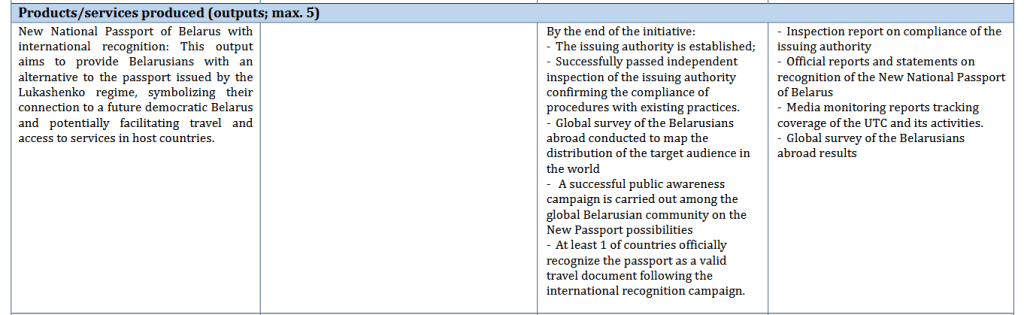
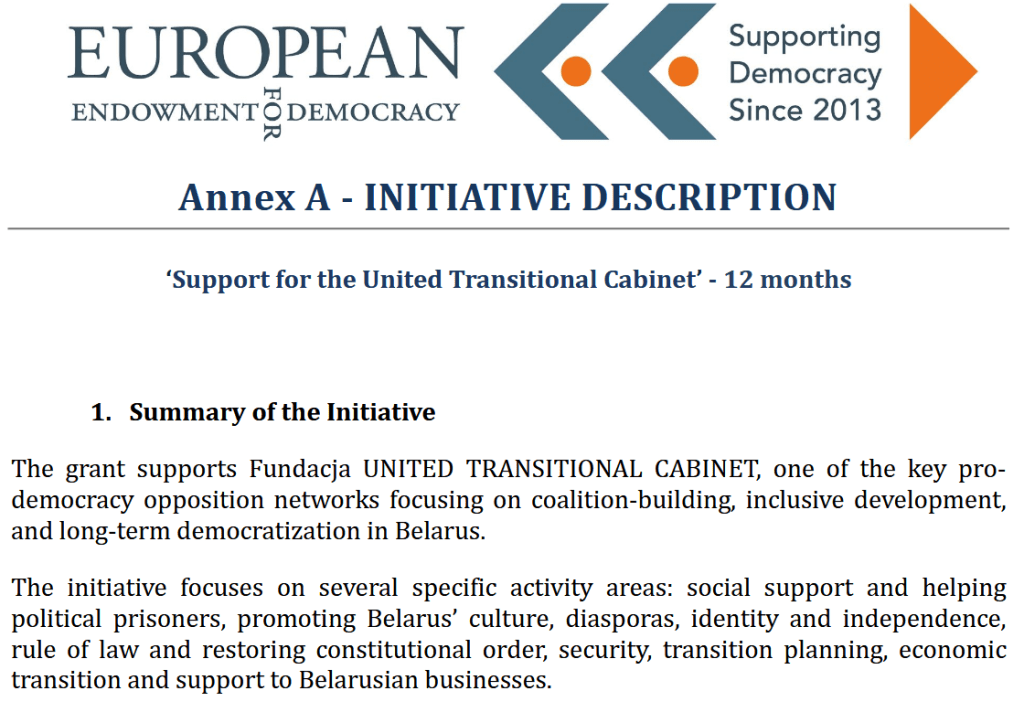
For example, the European Endowment for Democracy issued a secret 12-month grant for “increased recognition and legitimacy” of UTC as “the ‘Alternative Government’ by the end of 2024 among Belarusian citizens and the international community.” The EED was proudly “named after and inspired by” the US government’s National Endowment for Democracy, which awarded Tsikhanouskaya with its Democracy Service Medal in 2024.

Leaked records of the EED grant show the Endowment’s clandestine project to bring Tsikhanouskaya to power focused on first establishing a parallel exile government structure. This included producing a “new national passport… with international recognition” which would be administered by UTC, and removing Minsk from its role in supporting Russia’s war with Ukraine and the West. These moves were intended to lay foundations for “a future democratic Belarus” led by UTC.

Tsikhanouskaya’s cabinet was also to construct a “comprehensive strategy for democratic transition” in Belarus, outlining “a clear roadmap for transferring power from the current regime to a democratic government, including specific actions and protocols for various stages of the transition.”

Tsikhanouskaya’s clan planned to extend its influence by establishing a “permanent presence” in Kiev, “demonstrating solidarity with Ukraine in the face of Russian aggression” and firmly planting them in the West’s anti-Moscow camp.

The leaks spell out in extraordinary detail how UTC tore itself apart failing to achieve these far-reaching objectives. While Tsikhanouskaya satisfied her Western sponsors by adopting a stridently pro-EU stance and belligerent tone on Russia, her radical shift set the stage for her public undoing.

UTC commits political suicide with anti-Russia, pro-EU push

In early August 2023, Tsikhanouskaya’s United Transitional Cabinet convened a summit in Warsaw, Poland on the subject of “New Belarus.” It was a prize opportunity for the president-in-waiting and her UTC acolytes to regain visibility and sympathy among Western audiences.

Leaked records of the conference show UTC took advantage of the moment to lay out a bold set of proposals.

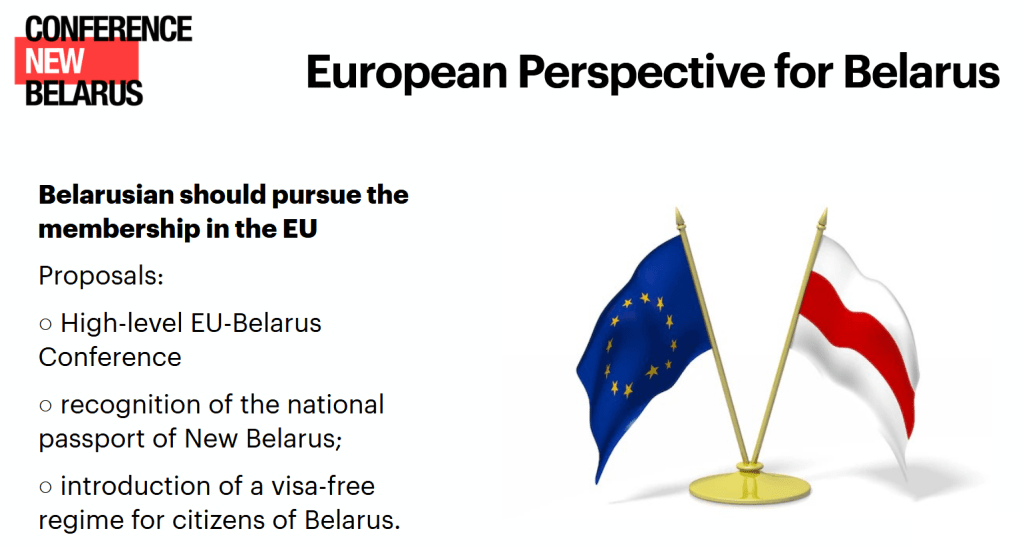
There, Tsikhanouskaya’s self-styled shadow administration committed to a “European perspective for Belarus,” including EU membership, and the creation and recognition of a separate “national passport of New Belarus” which would provide visa-free travel across the bloc for dissidents. UTC’s proclamation struck a viscerally anti-Russian tone, calling for the “withdrawal of Belarus” from any and all “alliances” with Moscow, and the removal of Russian military installations, weapons, and troops from the country.


After securing Lukashenko’s ouster, UTC pledged to back “Belarusian volunteers in Ukraine” fighting Russian forces, support “pro-Ukrainian initiatives and campaigns,” and end what it called Minsk’s “complicity in Russia’s war.” While expedient for European and US political and public consumption, these positions accelerated the erosion of Tsikhanouskaya’s already negligible popularity at home. Western polls consistently show, if push comes to shove, most Belarusians of all ages favor greater integration with Russia, not Brussels.

These longstanding pro-Moscow sympathies may explain why Tsikhanouskaya avoided advocating overtly Russophobic policies during her 2020 presidential run. That year, Tsikhanouskaya’s opposition ‘Coordination Council’ passed a resolutiondeclaring that Minsk would not reorient away from Russia if she took power, and the country’s “constitutional order and foreign policy” would remain unchanged.

In keeping with many European liberals, her foreign policy calculus altered radically following the Ukraine proxy war’s eruption. However, while the August 2023 conference generated some positive headlines for Tsikhanouskaya, openDemocracy offered a withering appraisal of UTC’s abrupt pro-Western shift.

The outlet declared Tsikhanouskaya’s aggressive push for EU membership and suddenly bellicose stance on Russia demonstrated how she and her clique were “out of touch” with opposition elements within Belarus and the wider public, who felt UTC was “increasingly detached from their concerns.” In any event, openDemocracy noted Tsikhanouskaya et al had “little influence” in the country itself by this point, and their exiled supporters were more disillusioned than ever with UTC’s prospects. By embracing the West, the outlet warned Tsikhanouskaya risked becoming “an irrelevance.”

Undeterred by their growing isolation, Tsikhanouskaya and her UTC doubled down. The “New Belarus” passport became a core component of their crusade. Initially, the initiative elicited significant media interest, and European parliamentarians called onEU member states to recognise the documents as legitimate.

However, the passport stunt quickly triggered internal feuds over funding and responsibility for the project, eventually prompting the resignation of a founding member of Tsikhanouskaya’s “government-in-exile.”

‘New Belarus’ parallel passport – fiasco or fraud?

At the start of June 2024, a longtime Belarusian opposition activist serving as Deputy Head and Representative for Foreign Affairs for UTC, Valery Kavaleuski, initiated a testy email exchange with Tsikhanouskaya over the progress of the “New Belarus” passport – or complete lack thereof. Weeks earlier, the Western-funded Belarusian Investigative Center had revealed a Lithuanian printing company tapped to produce the documents was linked to Viktor Shevtsov, a Belarusian businessman known as “Lukashenko’s wallet” due to his close affiliation with the President.

In the leaked correspondence, Kavaleuski expressed relief that the revelations emerged before a contract was signed with the printing company. “We were truly lucky… we would have been torn to shreds,” he wrote. Moreover, he noted the firm’s draft design was fraught with “blunders,” such as referring to the “Republic of Belarus” rather than “simply Belarus” and the Lithuanian border in its internal map being “drawn incorrectly,” with the country’s territory transferred to Minsk. Kavaleuski remarked, “good that printing had not started yet.”

However, the passport project had floundered in other ways over the preceding 10 months. The emails show several countries, including Iceland and Lithuania, offered to serve as issuing authorities but then “reversed course.” Furthermore, Kavaleuski seemingly had little understanding of the project’s inner workings despite his putative role as its director.

Tsikhanouskaya informed him “there are no separate funds allocated specifically for the passport project,” and his “every expense, every item” had to be “approved individually” by UTC donors. Kavaleuski responded with bewilderment, stating “that contradicts the original information about the Soros grant, which I also worked on.” Under the terms of this publicly undisclosed grant, “there was money for materials” for the passport’s production specifically designated, he asserted.

A flummoxed Kavaleuski reminded Tsikhanouskaya how he was told the passport project would be “financed from Belarusian funds, so that you can keep your grant for yourself as much as possible.” He derided this idea as “so ridiculous,” and “not a state approach at all.” Elsewhere, he objected that “money should not disappear into ‘coordination’ beyond my knowledge and control.” The leaked European Endowment for Democracy grant stipulated the passport as just one dedicated “output,” suggesting other funds earmarked for the project may have also been pocketed by Tsikhanouskaya.

Tsikhanouskaya heaped blame on Kavaleuski for the catastrophe, pointing to his unfulfilled promises to launch crowdfunding campaigns to support the initiative, and his failure to build appropriate infrastructure, including an “issuing office, before hiring professionals to produce and certify the “New Belarus” passport. A clearly offended Kavaleuski fired back, “thank you for the sarcasm — I was running low on toxins in my system.”

Read a translation of the full email exchange between Tsikhanouskaya (highlighted in yellow) and Kavaleuski (highlighted in gray) here.

‘Tired’ of ‘ultimatums’, Tsikhanouskaya loses deputy

Kavaleuski made one last bid at salvaging the passport initiative, proposing to hire a “Swiss expert” who “brings not only experience and expertise but also a name and connections — when in an hour or a day he can solve a task that would otherwise take us a month.” This followed multiple attempts to source passport specialists for the project over its 10-month-long span, only for each to hit a dead end.

Kavaleuski also requested restoration of his leadership on the project, allowing him to make “decisions on hiring managers, financial decisions at the stage of forming the issuing authority, hiring lawyers, and communications,” and for a dedicated budget that he could spend on the initiative. He warned, “if you reject all these proposals or even one of them, I will have to withdraw from the role of person responsible for the passport project.”

Kavaleuski appeared justified in taking such a hard line. A day before, Tsikhanouskaya ordered him to “stop any public communication” on the passport project and leave it purely to her, claiming, “people are already laughing to your face [sic].” She “refused to name these people,” while consistently failing to answer his questions “about progress on the passport, the investigation, the crisis situation, our next steps.” In subsequent emails, Tsikhanouskaya remained dismissive and passive aggressive toward her colleague.

The UTC chief suggested Kavaleuski was already “responsible and in charge” and “had all the necessary authority” to get the project off the ground, but had only created “conflicts with everyone who tries to help.” Tsikhanouskaya was also unmoved by his threat to quit if his requests were not satisfied, grousing, “I am already tired of reacting to your ultimatums.” She invited him to “write precisely” a description of his role – “which areas you can be responsible for, and which you can actually carry.”

“I understand that you have too many tasks, and I believe in your sincere attempts to organize the work despite all the difficulties. But it seems to me that you’re trying to take too much on yourself,” Tsikhanouskaya wrote. “The passport project requires full-time involvement, and you simply don’t have that time. A lot of energy also goes into internal conflicts. That’s what you call being ‘responsible’ — a whole year wasted, and then you remove responsibility from yourself.”

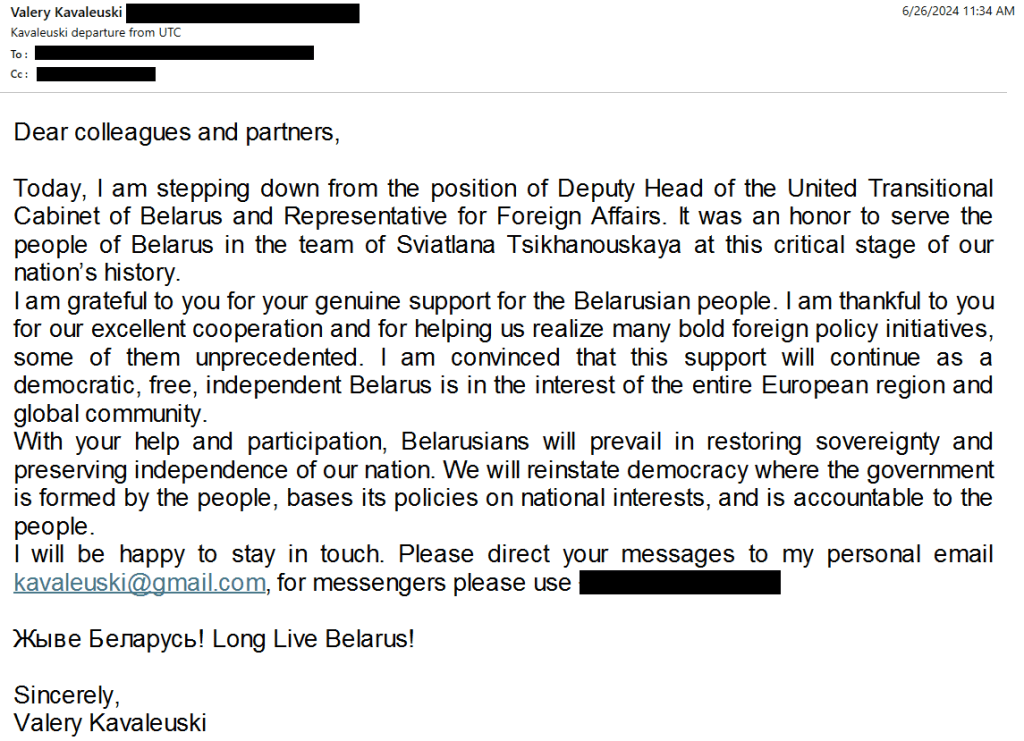
On June 26 2024, Kavaleuski made good on his ultimatum, privately informing his “colleagues and partners” of his resignation from UTC. Adopting a diplomatic tone, he declared it was “an honor to serve the people of Belarus in the team of Sviatlana Tsikhanouskaya,” and thanked recipients for their “genuine support,” which helped UTC “realize many bold foreign policy initiatives, some of them unprecedented.” He looked ahead to Belarusians “[prevailing] in restoring sovereignty and preserving independence of our nation [sic],” signing off, “Long Live Belarus!”

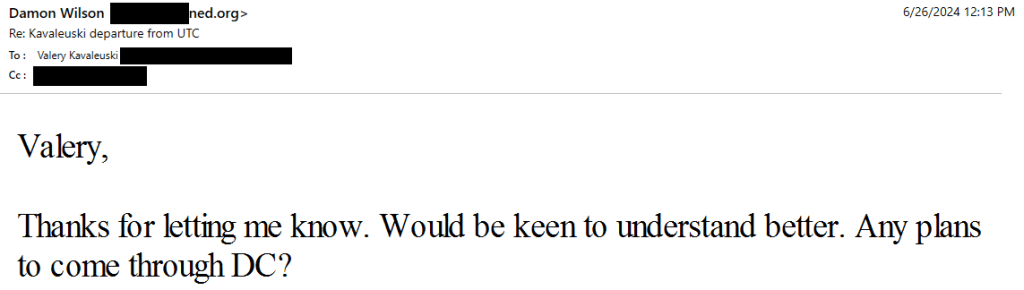
Less than an hour later, an apparently confused National Endowment for Democracy President and CEO Damon Wilson responded to Kavaleuski’s resignation: “Thanks for letting me know. Would be keen to understand better. Any plans to come through DC?”

The NED leader’s quizzical reply suggested UTC’s internal workings were a mystery to its Western backers. Wilson’s email came just weeks after NED presentedTsikhanouskaya with its annual Democracy Service Medal. It remains unknown just how much money the NED gifted her which wound up disappearing “into ‘coordination.’”

KGB collaboration sinks Tsikhanouskaya?

This January, a “New Belarus” passport was finally issued. However, not a single country recognizes the document as legitimate, nor can it be used for travel or other official purposes anywhere on the planet. Even authorities in Tsikhanouskaya’s adopted home reject its legality, with Remigijus Motuzas, chair of the Lithuanian parliament’s Foreign Affairs Committee, noting Belarusian exiles have traditionally relied on other established means of acquiring local identification documents. He nonetheless suggested the alternative “passports” could still be purchased for “symbolic” purposes.

Whatever victory Tsikhanouskaya could claim from the non-passport’s issuance was rapidly extinguished by a series of grave scandals over subsequent months. In June, the Norwegian Helsinki Committee published a damning audit of Belarusian opposition aid provider BY Help, which is closely linked to UTC. The probe uncovered major financial irregularities including forged and missing receipts, consistent failure to fulfil stated obligations, risible reporting standards, and haphazard data protection, leading to a massive leak of internal information. BY_Help neglected to notify affected parties, in breach of basic protocol.

Not long after, a closely related Belarusian ‘aid’ group called BYSOL was similarly thrust into a storm of controversy after multiple female volunteers and staffers accused the organization’s chief Andrey Stryzhak of sexual harassment. Stryzhak threatened to financially punish and smear his victims as KGB agents if they dared speak out. In September, BYSOL reduced Stryzhak’s responsibilities, but kept him on the job.

A month earlier, footage surfaced of Tsikhanouskaya secretly accepting €15,000 from Belarusian security services in August 2020 following Minsk’s Presidential election. In return, she agreed to record a video urging protesters to cease clashing with police, and received safe passage to Lithuania. In the clip, she appeared perfectly happy and composed, joking with KGB officers and discussing her departure to Vilnius.

The film’s content contrasted starkly with Tsikhanouskaya’s account of her forced flight from the country, as told in a June 2025 BBC interview entitled, “I was a stay-at-home mum until I stood for the presidency.” During that program, she claimed the KGB blackmailed and intimidated her into fleeing, threatening she would be imprisoned and permanently separated from her children, with the prospect of them suffering abuse in government-run orphanages.

Tsikhanouskaya went on to claim to the British state broadcaster that she refused to bend for many hours, but her “inner mother won the fight,” and she agreed to leave under duress, given only 20 minutes to stuff a few personal belongings into a backpack before deportation. In reality, her children had been safely extracted to Vilnius months earlier.

Tsikhanouskaya’s deceitful self-mythologizing over her exit from Belarus elicited harsh condemnation from local opposition elements. Some claim she hadn’t even wanted to be in Minsk during the election, and had sought to flee the country in advance. It’s unclear whether these damning disclosures played any role in the recent decision by Lithuanian authorities to downgrade her state protection.

Since 2020, Vilnius has squandered roughly €1 million annually safeguarding the would-be President, with round-the-clock security locally and abroad, escort cars, maintenance of a freely-provided lavish property, and an array of lucrative perks. Hundreds of thousands of euros were spent on VIP lounges where Tsikhanouskaya entertained foreign guests.

The presidential pretender now has until November to vacate her state-provided luxury residence in Vilnius. Meanwhile, relations between Minsk and Washington have miraculously thawed since the September release of prisoners in return for sanctions relief. Belarusian diplomats have made overtures to their European counterparts, seeking further easing of economic restrictions, and a restoration of diplomatic ties.

The stage is now set for a total collapse of Tsikhanouskaya’s Western-bankrolled house of cards. It is unclear, however, if her demise will result in accountability for the EU and US wasting untold sums of money on boosting her impotent personality cult while undercutting the authentic Belarusian opposition movement.

This Substack is reader-supported. To receive new posts and support my work, consider becoming a free or paid subscriber.

https://thegrayzone.substack.com/p/leaks-expose-collapse-of-euus-backed