Zoeken in deze blog 🔎🔎

zaterdag 15 oktober 2016

Robert Parry and MSM Propaganda

Debate Moderator Distorted Syrian Reality


Exclusive: The American people are receiving a highly distorted view of the Syrian war – much propaganda, little truth – including from one of the moderators at the second presidential debate, writes Robert Parry.


How ABC News’ Martha Raddatz framed her question about Syria in the second presidential debate shows why the mainstream U.S. news media, with its deep-seated biases and inability to deal with complexity, has become such a driving force for wider wars and even a threat to the future of the planet.
Raddatz, the network’s chief global affairs correspondent, presented the Syrian conflict as simply a case of barbaric aggression by the Syrian government and its Russian allies against the Syrian people, especially the innocents living in Aleppo.
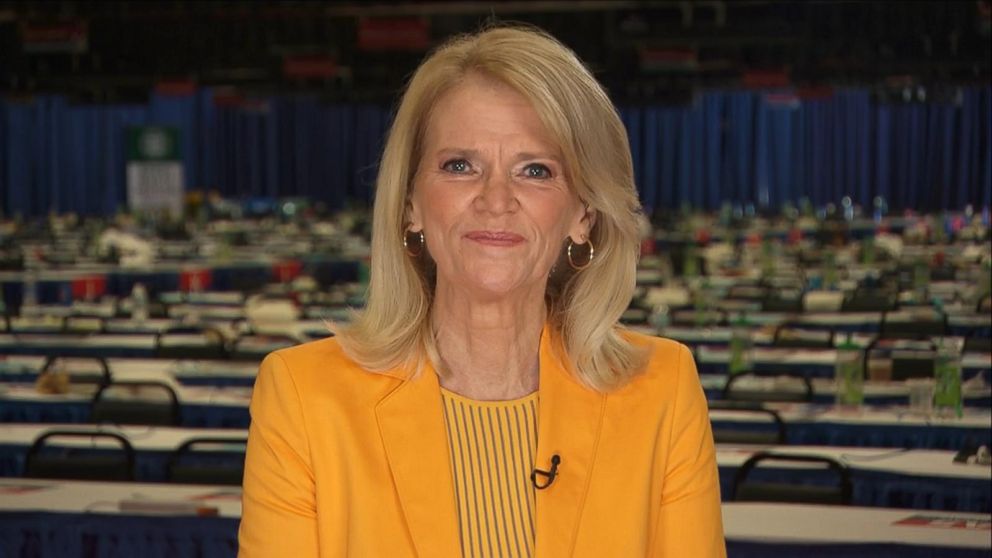
ABC News' chief global correspondent Martha Raddatz.
ABC News’ chief global affairs correspondent Martha Raddatz.
“Just days ago, the State Department called for a war crimes investigation of the Syrian regime of Bashar al-Assad and its ally, Russia, for their bombardment of Aleppo,” Raddatz said. “So this next question comes through social media through Facebook. Diane from Pennsylvania asks, if you were president, what would you do about Syria and the humanitarian crisis in Aleppo? Isn’t it a lot like the Holocaust when the U.S. waited too long before we helped?”
The framing of the question assured a response from former Secretary of State Hillary Clinton about her determination to expand the U.S. military intervention in Syria to include a “no-fly zone,” which U.S. military commanders say would require a massive operation that would kill many Syrians, both soldiers and civilians, to eliminate Syria’s sophisticated air-defense systems and its air force.
But Raddatz’s loaded question was also a way of influencing – or misleading – U.S. public opinion. Consider for a moment how a more honest and balanced question could have elicited a very different response and a more thoughtful discussion:
“The situation in Aleppo presents a heartrending and nettlesome concern. Al Qaeda fighters and their rebel allies, including some who have been armed by the United States, are holed up in some neighborhoods of eastern Aleppo. They’ve been firing rockets into the center and western sections of Aleppo and they have shot civilians seeking to leave east Aleppo through humanitarian corridors.
“These terrorists and their ‘moderate’ rebel allies seem to be using the tens of thousands of civilians still in east Aleppo as ‘human shields’ in order to create sympathy from Western audiences when the Syrian government seeks to root the terrorists and other insurgents from these neighborhoods with airstrikes that have killed both armed fighters and civilians. In such a circumstance, what should the U.S. role be and was it a terrible mistake to supply these fighters with sophisticated rockets and other weapons, given that these weapons have helped Al Qaeda in seizing and holding territory?”
Siding with Al Qaeda
Raddatz also could have noted that a key reason why the recent limited cease-fire failed was that the U.S.-backed “moderate” rebels in east Aleppo had rebuffed Secretary of State John Kerry’s demand that they separate themselves from Al Qaeda’s Nusra Front, which now calls itself the Syria Conquest Front.
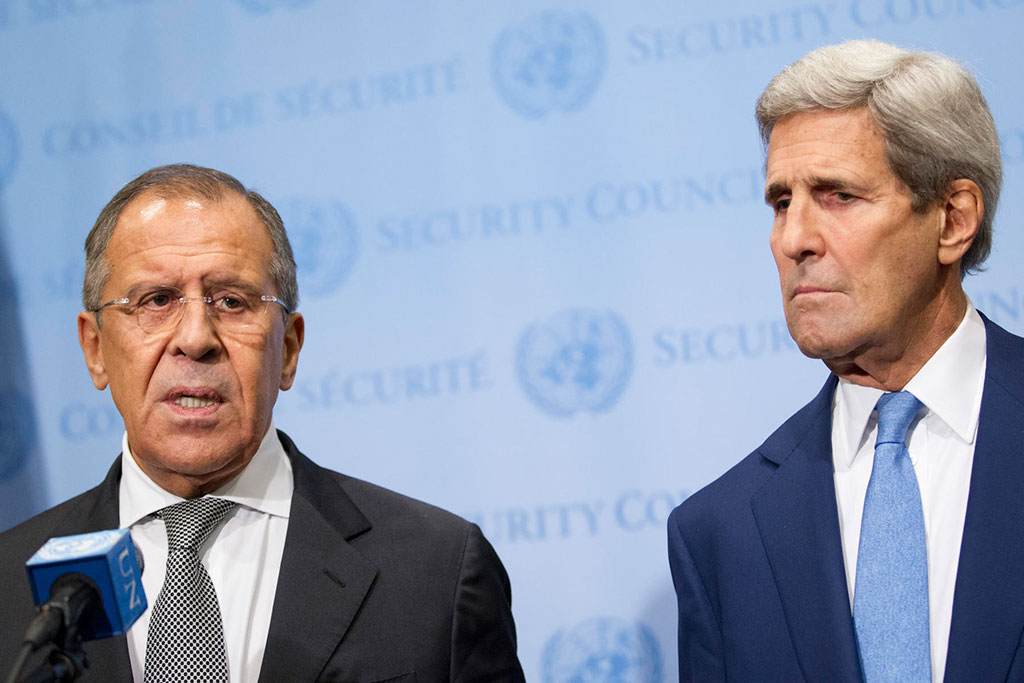
Secretary of State John Kerry (right) and Russian Foreign Minister Sergey Lavrov. (U.N. photo)
Instead of breaking ties with Al Qaeda, some of these “moderate” rebel groups reaffirmed or expanded their alliances with Al Qaeda. In other words, Official Washington’s distinction between Al Qaeda’s terrorists and the “moderate” rebels was publicly revealed to be largely a myth. But the reality of U.S.-aided rebels collaborating with the terror group that carried out the 9/11 attacks complicates the preferred mainstream narrative of Bashar al-Assad and Vladimir Putin “the bad guys” versus the rebels “the good guys.”
If Raddatz had posed her question with the more complex reality (rather than the simplistic, biased form that she chose) and if Clinton still responded with her recipe of a “no-fly zone,” the obvious follow-up would be: “Wouldn’t such a military intervention constitute aggressive war against Syria in violation of the United Nations Charter and the Nuremberg principles?
“And wouldn’t such a strategy risk tipping the military balance inside Syria in favor of Al Qaeda and its jihadist allies, possibly even its spinoff terror group, the Islamic State? And what would the United States do then, if its destruction of the Syrian air force led to the black flag of jihadist terror flying over Damascus as well as all of Aleppo? Would a Clinton-45 administration send in U.S. troops to stop the likely massacre of Christians, Alawites, Shiites, secular Sunnis and other ‘heretics’?”
There would be other obvious and important questions that a more objective Martha Raddatz would ask: “Would your no-fly zone include shooting down Russian aircraft that are flying inside Syria at the invitation of the Syrian government? Might such a clash provoke a superpower escalation, possibly even invite nuclear war?”
But no such discussion is allowed inside the mainstream U.S. media’s frame. There is an unstated assumption that the United States has the unquestioned right to invade other countries at will, regardless of international law, and there is a studied silence about this hypocrisy even as the U.S. State Department touts the sanctity of international law.
Whose War Crimes?
Raddatz’s favorable reference to the State Department accusing the Syrian and Russian governments of war crimes further suggests a stunning lack of self-awareness, a blindness to America’s own guilt in that regard. How can any American journalist put on such blinders regarding even recent U.S. war crimes, including the illegal invasion of Iraq that led to the deaths of hundreds of thousands of Iraqis?
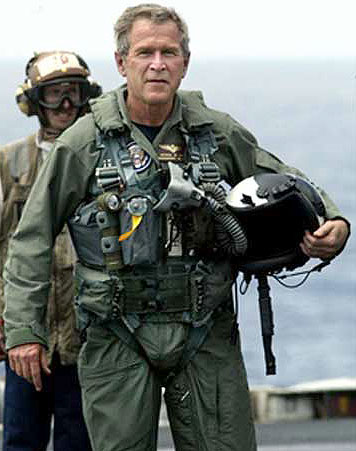
President George W. Bush in a flight suit after landing on the USS Abraham Lincoln to give his "Mission Accomplished" speech about the Iraq War.
President George W. Bush in a flight suit after landing on the USS Abraham Lincoln to give his “Mission Accomplished” speech about the Iraq War on May 1, 2003.
While Raddatz referenced “the heart-breaking video of a 5-year-old Syrian boy named Omran sitting in an ambulance after being pulled from the rubble after an air strike in Aleppo,” she seems to have no similar sympathy for the slaughtered and maimed children of Iraq who suffered under American bombs – or the people of Yemen who have faced a prolonged aerial onslaught from Saudi Arabia using U.S. aircraft and U.S.-supplied ordnance.
Regarding Iraq, there was the case at the start of the U.S.-led war when President George W. Bush mistakenly thought Iraqi dictator Saddam Hussein might be eating at a Baghdad restaurant so U.S. warplanes leveled it, killing more than a dozen civilians, including children and a young woman whose headless body was recovered by her mother.
“When the broken body of the 20-year-old woman was brought out torso first, then her head,” the Associated Press reported, “her mother started crying uncontrollably, then collapsed.” The London Independent cited this restaurant attack as one that represented “a clear breach” of the Geneva Conventions ban on bombing civilian targets.
But such civilian deaths were of little interest to the mainstream U.S. media. “American talking heads … never seemed to give the issue any thought,” wrote Eric Boehlert in a report on the U.S. war coverage for Salon.com. “Certainly they did not linger on images of the hellacious human carnage left in the aftermath.”
Thousands of other civilian deaths were equally horrific. Saad Abbas, 34, was wounded in an American bombing raid, but his family sought to shield him from the greater horror. The bombing had killed his three daughters Marwa, 11; Tabarek, 8; and Safia, 5 who had been the center of his life. “It wasn’t just ordinary love,” his wife said. “He was crazy about them. It wasn’t like other fathers.” [NYT, April 14, 2003]
The horror of the war was captured, too, in the fate of 12-year-old Ali Ismaeel Abbas, who lost his two arms when a U.S. missile struck his Baghdad home. Ali’s father, his pregnant mother and his siblings were all killed. As the armless Ali was evacuated to a Kuwaiti hospital, becoming a symbol of U.S. compassion for injured Iraqi civilians, the boy said he would rather die than live without his hands.
Because of the horrors inflicted on Iraq – and the resulting chaos that has now spread across the region and into Europe – Raddatz could have asked Clinton, who as a U.S. senator voted for the illegal war, whether she felt any responsibility for this carnage. Of course, Raddatz would not ask that question because the U.S. mainstream media was almost universally onboard the Iraq War bandwagon, which helps explain why there has been virtually no accountability for those war crimes.
Letting Clinton Off
So, Clinton was not pressed on her war judgments regarding either Iraq or the Libyan “regime change” that she championed in 2011, another war of choice that transformed the once-prosperous North African nation into a failed state. Raddatz’s biased framing also put Republican Donald Trump on the defensive for resisting yet another American “regime change” project in Syria.
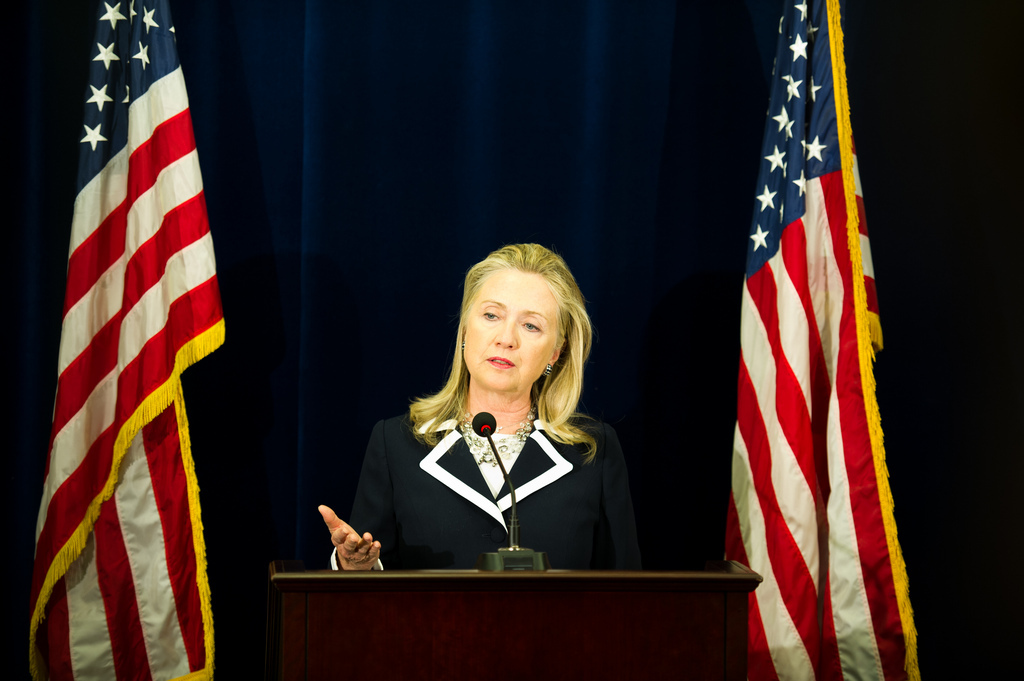
Secretary of State Hillary Clinton at a press conference on Sept. 9, 2012. (State Department photo)
Trump was left muttering some right-wing talking points that sought to attack Clinton as soft on Syria, trying to link her to President Barack Obama’s decision not to bomb the Syrian military in August 2013 after a mysterious sarin gas attack outside Damascus, which occurred six months after Clinton had resigned as Secretary of State.
Trump: “She was there as Secretary of State with the so-called line in the sand, which…
Clinton: “No, I wasn’t. I was gone. I hate to interrupt you, but at some point…
Trump: “OK. But you were in contact — excuse me. You were…
Clinton: “At some point, we need to do some fact-checking here.
Trump: “You were in total contact with the White House, and perhaps, sadly, Obama probably still listened to you. I don’t think he would be listening to you very much anymore. Obama draws the line in the sand. It was laughed at all over the world what happened.”
In bashing Obama for not bombing Syria – after U.S. intelligence expressed suspicion that the sarin attack was actually carried out by Al Qaeda or a related group trying to trick the U.S. military into attacking the Syrian government – Trump may have pleased his right-wing base but he was deviating from his generally less war-like stance on the Middle East.
He followed that up with another false right-wing claim that Clinton and Obama had allowed the Russians to surge ahead on nuclear weapons, saying: “our nuclear program has fallen way behind, and they’ve gone wild with their nuclear program. Not good.”
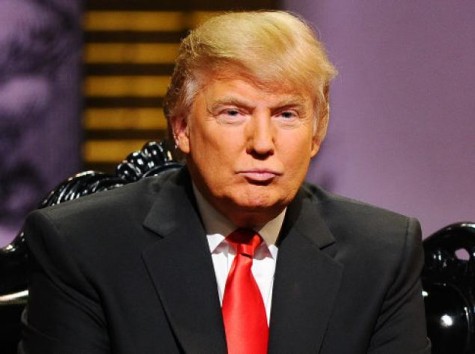
Billionaire and Republican presidential candidate Donald Trump.
Only after attacking Clinton for not being more militaristic did Trump say a few things that made sense, albeit in his incoherent snide-aside style.
Trump: “Now, she talks tough, she talks really tough against Putin and against Assad. She talks in favor of the rebels. She doesn’t even know who the rebels are. You know, every time we take rebels, whether it’s in Iraq or anywhere else, we’re arming people. And you know what happens? They end up being worse than the people [we overthrow].
“Look at what she did in Libya with [Muammar] Gaddafi. Gaddafi’s out. It’s a mess. And, by the way, ISIS has a good chunk of their oil. I’m sure you probably have heard that.” [Actually, whether one has heard it or not, that point is not true. During the ongoing political and military strife, Libya has been blocked from selling its oil, which is shipped by sea.]
Trump continued: “It was a disaster. Because the fact is, almost everything she’s done in foreign policy has been a mistake and it’s been a disaster.
“But if you look at Russia, just take a look at Russia, and look at what they did this week, where I agree, she wasn’t there, but possibly she’s consulted. We sign a peace treaty. Everyone’s all excited. Well, what Russia did with Assad and, by the way, with Iran, who you made very powerful with the dumbest deal perhaps I’ve ever seen in the history of deal-making, the Iran deal, with the $150 billion, with the $1.7 billion in cash, which is enough to fill up this room.
“But look at that deal. Iran now and Russia are now against us. So she wants to fight. She wants to fight for rebels. There’s only one problem. You don’t even know who the rebels are. So what’s the purpose?”
While one can’t blame Raddatz for Trump’s scattered thinking – or for Clinton’s hawkishness – the moderator’s failure to frame the Syrian issue in a factual and nuanced way contributed to this dangerously misleading “debate” on a grave issue of war and peace.
It is surely not the first time that the mainstream U.S. media has failed the American people in this way, but – given the stakes of a possible nuclear war with Russia – this propagandistic style of “journalism” is fast becoming an existential threat.

Investigative reporter Robert Parry broke many of the Iran-Contra stories for The Associated Press and Newsweek in the 1980s. You can buy his latest book, America’s Stolen Narrative, either in print here or as an e-book (from Amazon and barnesandnoble.com).

The Value of Hard Cash

Do Western Nations Care About Yemeni Lives Or Saudi Blood Money?

By Medea Benjamin

October 13, 2016 "Information Clearing House" - How much is the life of a Yemeni worth? Not much, according to the Saudi regime that has been bombing and starving the people of Yemen for since March 2015, or to the Saudi’s western backers, particularly the US and UK, which have been supplying the Saudi regime with weapons, military training, logistical support and diplomatic cover for its dirty interventionist war. 
The latest outrage is the October 8 bombing of a packed funeral hall in Yemen’s capital city of Sanaa. This horrendous attack killed more than 140 people and injured about 600 more.
On the heels of this attack comes a blistering report by Reuters showing, through Freedom of Information Act documents, that the Obama administration went ahead with a $1.3 billion arms sale to Saudi Arabia last year despite warnings from US officials that the United States could be implicated in war crimes for supporting a Saudi-led air campaign in Yemen that has killed thousands of civilians.
What has been the US and UK governments’ response to the funeral bombing? The British government announced UK arms sales to the Saudis is “under careful and continual review”, while the Obama administration issued a statement that US support for Saudis is not a “blank check” and that the US was “prepared to adjust our support so as to better align with US principles, values and interests.” 
The “principles, values and interests” of the Western powers, however, have been to buy cheap Saudi oil and make record profits by selling massive quantities of weapons to one of the most repressive countries in the world. 
Ever since the founding of the kingdom in 1932, the West has allied itself with a government that beheads nonviolent dissidents, forces women to live under the dictates of male guardians, treats foreign workers like indentured servants, spreads the intolerant Wahhabi version of Islam around the world, funds terrorist groups, crushes democratic uprisings in neighboring countries like Bahrain and now wages a catastrophic war in one of the poorest countries in the Arab world, Yemen.
Yemenis are furious about the latest Saudi massacre, as well as Western complicity and the lack of action on the part of the international community. Thousands marched on the UN headquarters demanding a UN investigation. Others are amassing at the Saudi border, calling for revenge and perhaps sparking an even wider conflict.
In the US, Senator Chris Murphy from Connecticut is one of the few representatives expressing outrage. He said the Saudi attack on funeral party follows months of attacks on schools, homes, and hospitals. “If the U.S. is serious when it says our support for Saudi Arabia isn’t a blank check, then it’s time to prove it – because it’s clear the Saudi-led coalition isn’t listening. The administration should pull US support for the Saudi-led war in Yemen because it’s harming America’s national security, enabling terrorist groups to thrive, and killing innocent civilians.”
What can we do? Join us in demanding that our government stop arming the Saudi regime. Support the courageous human rights defenders inside Saudi Arabia who are trying to reform their government through nonviolent means, such as Saudi Civil and Political Rights Association, also known as ACPRA, whose eleven members – all prominent human rights defenders – are suffering lengthy prison sentences. Call on the United Nations to form an independent international commission to investigate war crimes in Yemen. 
The time for review and mild statements of condemnation is over. The blood of the Yemeni people is on our hands. If the Western nations want to show that they value the lives of Yemenis over the profits of their weapons industries, they must immediately stop providing the bombs, the bombers, the armored tanks, the Apache helicopters, the missiles, the howitzers, the training, the refueling, and all other military support to the Saudi criminals. If Western values do not prioritize making blood money for General Dynamics, Raytheon, Lockheed Martin and the other companies that profit from war, let’s prove it. 
How much is the life of a Yemeni worth? Not much, according to the Saudi regime that has been bombing and starving the people of Yemen since March 2015, or to the Saudi’s western backers, particularly the US and UK, who have been supplying the Saudi regime with weapons, military training, logistical support, and diplomatic cover for its dirty interventionist war.

The latest outrage is the October 8 bombing of a packed funeral hall in Yemen’s capital city of Sanaa. This horrendous attack killed more than 140 people and injured about 600 more. What have the US and UK governments’ response to this outrage been? The British said UK arms sales to the Saudis is “under careful and continual review”, while the Obama administration issued a statement that US support for Saudis is not a “blank check” and that the US was “prepared to adjust our support so as to better align with US principles, values and interests.”

The “principles, values and interests” of the Western powers, however, have been to buy cheap Saudi oil and make record profits by selling massive quantities of weapons to one of the most repressive countries in the world.

Ever since the founding of the kingdom in 1932, the West has allied itself with a government that beheads non-violent dissidents, forces women to live under the dictates of male guardians, treats foreign workers like indentured servants, spreads the intolerant Wahhabi version of Islam around the world, funds terrorist groups, crushes democratic uprisings in neighboring countries like Bahrain, and now wages a catastrophic war in one of the poorest countries in the Arab world, Yemen.

Yemenis are furious about the latest Saudi massacre, as well as Western complicity and the lack of action on the part of the international community. Thousands marched on the UN headquarters demanding a UN investigation. Others are amassing at the Saudi border, calling for revenge and perhaps sparking an even wider conflict.

In the US, Senator Chris Murphy from Connecticut is one of the few representatives expressing outrage. He said the Saudi attack on funeral party follows months of attacks on schools, homes, and hospitals. “If the U.S. is serious when it says our support for Saudi Arabia isn’t a blank check, then it’s time to prove it — because it’s clear the Saudi-led coalition isn’t listening. The administration should pull U.S. support for the Saudi-led war in Yemen because it’s harming America’s national security, enabling terrorist groups to thrive, and killing innocent civilians.”

What can we do? Join us in demanding that our government stop arming the Saudi regime. Support the courageous human rights defenders inside Saudi Arabia who are trying to reform their government through nonviolent means, such as Saudi Civil and Political Rights Association, also known as ACPRA, whose eleven members - all prominent human rights defenders -are suffering lengthy prison sentences. Call on the United Nations to form an independent international commission to investigate war crimes in Yemen.

The time for review and mild statements of condemnation is over. The blood of the Yemeni people is on our hands. If the Western nations want to show that they value the lives of Yemenis over the profits of their weapons industries, they must immediately stop providing the bombs, the bombers, the armored tanks, the Apache helicopters, the missiles, the howitzers, the training, the refueling, and all other military support to the Saudi criminals. If Western values do not prioritize making blood money for General Dynamics, Raytheon, Lockheed Martin and the other companies that profit from war, let’s prove it.
Medea Benjamin, cofounder of the peace group CODEPINK, is author of Kingdom of the Unjust: Behind the US-Saudi Connection.


War to Keep the Dollar Floating


The announcement last week by the United States of the largest military aid package in its history – to Israel – was a win for both sides.Israeli prime minister Benjamin Netanyahu could boast that his lobbying had boosted aid from $3.1 billion a year to $3.8bn – a 22 per cent increase – for a decade starting in 2019.
Mr Netanyahu has presented this as a rebuff to those who accuse him of jeopardising Israeli security interests with his government’s repeated affronts to the White House.
In the past weeks alone, defence minister Avigdor Lieberman has compared last year’s nuclear deal between Washington and Iran with the 1938 Munich pact, which bolstered Hitler; and Mr Netanyahu has implied that US opposition to settlement expansion is the same as support for the “ethnic cleansing” of Jews.
American president Barack Obama, meanwhile, hopes to stifle his own critics who insinuate that he is anti-Israel. The deal should serve as a fillip too for Hillary Clinton, the Democratic party’s candidate to succeed Mr Obama in November’s election.
In reality, however, the Obama administration has quietly punished Mr Netanyahu for his misbehaviour. Israeli expectations of a $4.5bn-a-year deal were whittled down after Mr Netanyahu stalled negotiations last year as he sought to recruit Congress to his battle against the Iran deal.
In fact, Israel already receives roughly $3.8bn – if Congress’s assistance on developing missile defence programmes is factored in. Notably, Israel has been forced to promise not to approach Congress for extra funds.
The deal takes into account neither inflation nor the dollar’s depreciation against the shekel.
A bigger blow still is the White House’s demand to phase out a special exemption that allowed Israel to spend nearly 40 per cent of aid locally on weapon and fuel purchases. Israel will soon have to buy all its armaments from the US, ending what amounted to a subsidy to its own arms industry.
Nonetheless, Washington’s renewed military largesse – in the face of almost continual insults – inevitably fuels claims that the Israeli tail is wagging the US dog. Even The New York Times has described the aid package as “too big”.
Since the 1973 war, Israel has received at least $100bn in military aid, with more assistance hidden from view. Back in the 1970s, Washington paid half of Israel’s military budget. Today it still foots a fifth of the bill, despite Israel’s economic success.
But the US expects a return on its massive investment. As the late Israeli politician-general Ariel Sharon once observed, ­Israel has been a US “aircraft carrier” in the Middle East, acting as the regional bully and carrying out operations that benefit Washington.
Almost no one blames the US for Israeli attacks that wiped out Iraq’s and Syria’s nuclear programmes. A nuclear-armed Iraq or Syria would have deterred later US-backed moves at regime overthrow, as well as countering the strategic advantage Israel derives from its own nuclear arsenal.
In addition, Israel’s US-sponsored military prowess is a triple boon to the US weapons industry, the country’s most powerful lobby. Public funds are siphoned off to let Israel buy goodies from American arms makers. That, in turn, serves as a shop window for other customers and spurs an endless and lucrative game of catch-up in the rest of the Middle East.
The first F-35 fighter jets to arrive in Israel in December – their various components produced in 46 US states – will increase the clamour for the cutting-edge warplane.
Israel is also a “front-line laboratory”, as former Israeli army negotiator Eival Gilady admitted at the weekend, that develops and field-tests new technology Washington can later use itself.
The US is planning to buy back the missile interception system Iron Dome – which neutralises battlefield threats of retaliation – it largely paid for. Israel works closely too with the US in developing cyber­warfare, such as the Stuxnet worm that damaged Iran’s civilian nuclear programme.
But the clearest message from Israel’s new aid package is one delivered to the Palestinians: Washington sees no pressing strategic interest in ending the occupation. It stood up to Mr Netanyahu over the Iran deal but will not risk a damaging clash over Palestinian statehood.
Some believe that Mr Obama signed the aid package to win the credibility necessary to overcome his domestic Israel lobby and pull a rabbit from the hat: an initiative, unveiled shortly before he leaves office, that corners Mr Netanyahu into making peace.
Hopes have been raised by an expected meeting at the United Nations in New York on Wednesday. But their first talks in 10 months are planned only to demonstrate unity to confound critics of the aid deal.
If Mr Obama really wanted to pressure Mr Netanyahu, he would have used the aid agreement as leverage. Now Mr Netanyahu need not fear US financial retaliation, even as he intensifies effective annexation of the West Bank.
Mr Netanyahu has drawn the right lesson from the aid deal – he can act against the Palestinians with continuing US impunity.
- See more at: http://www.jonathan-cook.net/2016-09-19/palestinians-lose-in-us-military-aid-deal-with-israel/#sthash.fL4Eq28N.dpuf

The War for the Dollar

By David Hungerford

October 14, 2016 "Information Clearing House" - The presidential campaign of 2016 is the most divisive in living memory. The spectacle is riveting. People all over the world tune into it as if it were their own election. Well they might. 
The campaign is different because it is driven by a deep and bitter divide among the capitalist class: whether to risk war with Russia, or not. There is also a real danger of war with China. Not since 1860 has a presidential election been affected by a basic divide among the propertied classes.
There is a War Party that is tremendously strong. Its candidate is Hillary Clinton. Wall Street and Big Oil are among its constituents. The New York Times runs one Clinton campaign piece after another in the guise of “news articles.” The rest of the mainstream media do the same. 
Speaking to the American Legion on August 31 in Cincinnati, Hillary Clinton said, “As President, I will make it clear that the United States will treat cyberattacks just like any other attack. We will be ready with serious political, economic, and military responses . . . You’ve read reports. Russia’s hacked into a lot of things, China has hacked into a lot of things.” (1)
But there is no evidence against Russia or China. What Hillary Clinton says is that she will militarily go after whomever she wants based on nothing other than her say-so. The mainstream media gave no coverage to her recklessly provocative remarks.
Donald Trump, for his part, told the “Commander in Chief” forum that, “I think I would have a very, very good relationship with Putin, and I think I would have a very, very good relationship with Russia.” (2) He speaks for a faction of the capitalist class that sees the risk of war with Russia and China as just too dangerous.
Both candidates speak for opposed factions of the ruling class. In no way can these statements be treated as “personal opinions.” 
Why is the War Party bent on a hideously dangerous course? The political reasons are easy to see.
After the dismemberment of the Soviet Union in 1991 the United States emerged as an unrivaled “superpower.” But now, the key element of U.S. dominance in the Middle East and the Persian Gulf is slipping. The decline of U.S. power in the Middle East is primarily due to the long, dogged resistance of the peoples. Added to that, Russia’s part in resisting regime change in Syria is taken by U.S. imperialism as an acute challenge. Russia also has close relations with Iran. Threats against Russia and China but won’t change that. So far the U.S. has worked things out with Germany. It works things out with Japan. Why not work things out with Russia and China?
It is because other things are at work. There are economic developments that contribute to the growth of tensions. They are not always so easy to see. The care and feeding of the Almighty Buck, the United States dollar itself, is of foremost and fundamental importance. For decades the U.S. dollar has been unrivaled as the world’s main reserve currency. U.S. financial institutions swing enormous power and profits from it. 
This is capitalistic stuff par excellence. Most of us aren’t capitalists. Hence the issue is not obvious to us. Let’s have a closer look.
Countries keep foreign currencies in reserve for use in international trade. By far the largest reserves are in U.S. dollars. There are a number of reasons. Some countries have large trade surpluses with the United States. If they exchange the dollars for their own currency their goods will become more expensive in the United States Instead they keep the money in reserve. Or, they can use their dollars on international markets. Dollars can always be used to buy oil, for instance. It may be advantageous in multilateral trade involving more than two countries to use dollars rather than the countries’ own currencies. 
At the end of 2014 the US dollar comprised 63.1% of world foreign reserves. The euro was a distant second at 22.1%. (3) At the end of 2015 world reserves stood at around $13.1 trillion in dollar equivalents. China and Japan held $3.3 trillion and $1.26, respectively. The Euro Zone came in at $761.7 billion.
In 2014 the U.S. trade deficit came in at $760 billion. U.S. trade deficits have been the case since the 1970s. What is supposed to happen is goods imported to the U.S. become more expensive, U.S. goods sold abroad get cheaper, and trade comes back into balance. But it doesn’t happen that way! It isn’t just a matter of how the United States can manage such a thing. It is a question of how it can be handled on all sides. It’s mainly possible because other countries hang on to upwards of $8 trillion in reserves, of which over $6 trillion is in U.S. Treasury bills. (4)
One advantage to the United States is that we can go on buying huge amounts of goods from other countries without the prices rising. But if import prices rose we’d make more stuff here. There would be more jobs, employers would make more money. Why don’t we do that?
A big part of the answer is that the dollar’s unchallenged status as a reserve currency enables the big banks and financial companies to make much a great deal more money than they otherwise could. 
International trade must be brokered, i.e., managed with the help of financial intermediaries. Brokerage is commonly needed in domestic commerce, and is a necessity for international trade.
Suppose Alice in Iowa contracts with Bob in Paris to buy 1000 boxes of French chocolates for $10,000 American. She sends a check. Bob takes the check to the bank and cashes it for the equivalent in French francs. No problem.
But: Bob never sends the chocolates. Paris is a long way to go for Alice. She doesn’t speak the language. She must find an attorney. Repayment of her money will take a long time and little will be left after expenses. She’s stuck.
Sam knows the pitfalls of foreign trade. He makes the same deal with Bob. Before he sends any money, he goes to the local branch of Citigroup and pays the bank to post a performance bond on the deal.
If Bob doesn’t send the chocolates, the bank reimburses Sam. Bob is now messing with Citigroup. He’s toast. The next time, if there is a next time, he sends the chocolates.
Sellers can also purchase performance bonds or other financial instruments to secure their interests. As well, brokerages offer many other services. They are absolutely necessary to the world market. Bank of America describes its services as follows:
“Leverage our comprehensive platform to connect with institutions or individuals in more than 140 currencies and 200 countries while increasing your speed, efficiency and visibility. With our on-the-ground presence in 44 countries, direct membership in multiple clearing systems around the world, and a multi-year commitment to expanding our banking platform, we are uniquely positioned to enable local access and direct connectivity wherever you do business. In addition, we offer leading-edge solutions to help you collect, process, apply and report on your global receivables and migrate from paper to electronic processing with guidance at every step.” (5)
Citigroup describes its operations similarly, and adds: “Citi Transaction Services is the trusted custodian of over U.S. $12.8 trillion in assets, resulting from our full range of world-class domestic and global custody services.” (6)
Profits of .1% against total assets under management would come to $12.8 billion. Not bad.
The other U.S. bank holding companies of similar in size are Wells Fargo and JP Morgan Chase. All four offer the same services for international trade.
International trade and brokerage are glued together by financial electronic messaging networks. The largest is the Society for Worldwide Interbank Financial Telecommunications system, or SWIFT. It was started in 1974. Previous communication systems were slow, insecure, and subject to human error. SWIFT assigns each bank or other institution with a unique eight-character identification code to ensure accuracy. Message encryption and authentication are offered.
Financial messaging networks handle not only bank, but also securities and treasury transactions. SWIFT transmits payments, transfers, and instructions to nearly 10,000 institutions around the world. Volume is around 24,000,000 messages per day. Total world export trade has increased by more than 45 times in constant prices since 1974. (7) That degree of growth would not have been possible without the networks.
At times, however, it appears that the messaging networks are not so secure. It is by means of surveillance of messaging networks that the U.S. government, the hitman and enforcer of the big banks, can unilaterally impose sanctions on whatever country or individual that it sweet pleases.
In 2015 the French bank BNP Paribas, the fourth largest bank in the world, was penalized $9 billion by action brought against it in the U.S. District Court of the Southern District of New York, the court having jurisdiction over Wall Street.
A Reuters report said, “Prosecutors said BNP also evaded sanctions against entities in Iran and Cuba, in part by stripping information from wire transfers so they could pass through the U.S. system without raising red flags.” (8)
Oh. That’s interesting. The messaging networks are supposed to be secure. How did the U.S. Department of Justice find that out? Is the financial integrity of the networks compromised? Do the institutions served by the network know the U.S. Department of Justice surveils their messages? Maybe BNP did not.
That’s only the start. BNP was convicted of “conspiring to violate the International Emergency Economic Powers Act (IEEPA) and the Trading with the Enemy Act (TWEA) by processing billions of dollars of transactions through the U.S. financial system on behalf of Sudanese, Iranian and Cuban entities subject to U.S. economic sanctions.” (9)
These are United States laws. BNP broke no French laws. (During WW II U.S. corporations flouted the TWEA at will. New Jersey Standard Oil, IBM, Ford, and GM and many others traded with the Nazis all during the war.) The prosecution accused BNP of “falsifying” transactions with Iran and Cuba. How could BNP “falsify” business that was legal in France? And if it concealed its business from U.S. scrutiny, so what, the U.S. has no legitimate interest in the matter. Nonetheless BNP was forced to eat humble pie and play along with the farce. Not even France, a NATO “ally” of the United States and the sixth largest country in the world economically, was immune to this shocking violation of its sovereignty.
Even worse, the so-called “violations” involved transactions with Cuba, Iran and Sudan. The harm done the first two countries by U.S. imperialism need not be repeated here. Sudan has been wracked for decades by civil and ethnic conflicts. Millions have died or been displaced Sudan is rich in oil, natural gas, copper and uranium ores. The United States has long been deeply entangled in the carnage. Sara Flounders wrote in 2006 that:
“U.S. policy revolves around shutting down the export of oil through sanctions and inflaming national and regional antagonisms. For over two decades U.S. imperialism supported a separatist movement in the south of Sudan, where oil was originally found. This long civil war drained the central government’s resources. When a peace agreement was finally negotiated, U.S. attention immediately switched to Darfur in western Sudan.” (10)
Even so, the Justice Department charged BNP with harming people in Sudan by doing business that U.S. imperialism does not like. The hypocrisy and lawbreaking are breathtaking. 
The interlock of U.S. brokerages and messaging networks allows the United States to impose sanctions worldwide, unilaterally, and in specificity. 
The Department of the Treasury maintains a Specially Designated Nationals (SDN) list. It is “a list of individuals and companies owned or controlled by, or acting for or on behalf of, targeted countries. It also lists individuals, groups, and entities, such as terrorists and narcotics traffickers designated under programs that are not country-specific.” (11) The SDNs have their assets blocked, and “U.S. persons are generally prohibited from dealing with them.” There are so many SDN entries that Treasury maintains a search tool on them that uses “fuzzy logic” to match inexact search terms.
A list of SDNs in Russia and Ukraine was published on Sep. 1, 2016. It included 17 individuals including Eduard Basurin, Defense Minister of the Donetsk People’s Republic, an insurgent region that rebelled against the fascist regime in Ukraine imposed by the United States in 2014.
The list also includes an engineering company in St. Petersburg, shipyards, the Salvation Committee of Ukraine, which calls for elections to replace the U.S.-installed government, and many other entities. It would be cumbersome have to enforce so many sanctions, but the treatment of BNP stands as a warning. 
Opposition is rising, however. In 2015 the United States imposed penalties on Volkswagen for violations of emissions requirements. The scandal was a great setback to the manufacturer. The settlement may cost Volkswagen more than $13 billion. The European Union—read Germany—then imposed a $14.5 fine on Apple for taxes not paid in Ireland. Going back to the mortgage bubble in the U.S. that burst in 2006, the U.S. Justice department is now seeking penalties as high as $14 billion against Deutsche Bank for its practices in the bubble. Political consequences are part of the picture, as Germany has become increasingly critical of cold war-style U.S. actions against Russia.
Also, China’s rise poses an emergent challenge to dollar dominance. In January of this year China launched a new international development bank called the Asian Infrastructure Investment Bank (AIIB) at a ceremony led by Chinese President Xi Jinping. It would fund projects like roads, hydropower and urban development. It is expected to lend $10 billion-$15 billion a year for the first five or six years. While loans at first would be made in U.S. dollars, the bank may raise capital in other currencies including the euro and yuan.
China has stated that it opposes a global financial order that it says is dominated by the United States and does not adequately represent developing nations. Its success would be as much a political as an economic achievement, a sign that U.S. financial domination of the world is coming to an end.
The new bank is generally recognized as a challenge to U.S.-dominated International Monetary Fund (IMF) and World Bank (WB.) U.S. allies including Australia, Britain, German, Italy, the Philippines and South Korea have agreed to join. So far thirty founding countries have ratified the AIIB agreement. Other countries have until the end of the year to join.
U.S. imperialism is not sitting by. In June of this year, the United States sent a carrier task force into the South China Sea in defiance of China’s claims to sovereignty in those waters. Admiral John Richardson, U.S. Chief of Naval Operations, was aboard the carrier John C. Stennis. (12)
Richardson told the media that the task force was surrounded by Chinese naval vessels, some passing by on regular business but others specifically shadowing the US task force. He said “there were dozens of encounters” between the two fleets that were “by and large, performed according to a ruleset that had been established” between US and China called the Code for Unplanned Encounters at Sea (CUES). That the CNO was on hand shows that Washington well understood the challenge it was giving to China.
At about the same time an international tribunal in The Hague was convened on charges brought against China concerning the South China Sea. Issues included China’s construction of artificial islands, and claims to sovereignty in the sea. China’s construction of a large artificial island on an atoll known as Mischief Reef was cited. China built a military airstrip, naval berths and sports fields on the island.
On July 12 the tribunal found that China’s claims of historic rights over most of the South China Sea and sovereignty over the region had no legal basis. The decision is considered legally binding but there is no mechanism for enforcing it. China did not bow down. It had refused to participate in the tribunal, and it said it would not abide by the decision.
The economic prospects of loss of empire added to the political ones explain the full scope of the rise in tensions with Russia and China. The War Party arises, driven mad. Another faction of the capitalist ruling class reacts, seeing a retrenchment to America First as preferable to war with Russia and China. The latter are right, but the crazed don’t care. The issue invades the presidential election.
Even if the America Firsters win, there is no guarantee the War Party will concede anything; and vice-versa. We must be prepared for anything.
David Hungerford is a political activist who lives in New Jersey. His concerns include civil and human rights, problems of war and peace, and political economy.

NOTES
1. http://www.ibtimes.co.uk/clinton-us-should-use-military-response-fight-cyberattacks-russia-china-1579187
2. http://www.ibtimes.co.uk/putin-better-leader-obama-says-trump-while-clinton-defends-her-emails-1580259
3. https://en.wikipedia.org/wiki/Reserve_currency#Global_currency_reserves
4. https://en.wikipedia.org/wiki/List_of_countries_by_foreign-exchange_reserves
5. http://baml.bankofamerica.com/gtscapabilities/#capabilities_solutions
6. https://www.citibank.com/mss/products/investor_svcs/globalcustody/
7. https://ourworldindata.org/international-trade#the-value-of-global-exports-has-grown-constantly-over-2-centuries
8. http://www.reuters.com/article/us-bnp-paribas-settlement-sentencing-idUSKBN0NM41K20150501
9. https://www.justice.gov/opa/pr/bnp-paribas-sentenced-conspiring-violate-international-emergency-economic-powers-act-and
10. http://www.workers.org/2006/world/darfur-0608/
11. https://www.treasury.gov/resource-center/sanctions/OFAC-Enforcement/Pages/20160901.aspx
12. http://breakingdefense.com/2016/09/weve-got-to-continue-to-engage-cno-richardson-on-china/ 


The Bullying of US Militarism

The Bullying of US Militarism Pervades the Entire Society

Thursday, 13 October 2016 00:00 By Charles Derber and Yale MagrassUniversity Press of Kansas | Book Excerpt
A US Army helicopter flies over Washington State in a photo taken on August 11, 2016. (Photo: The  US Army)A US Army helicopter flies over Washington State in a photo taken on August 11, 2016. The military hovers over many of this country’s most pervasive institutions, including schools. When we look for the roots of violence, we must look beyond individuals, and consider the influence of the military on our everyday lives. (Photo: The US Army)
The following excerpt of Bully Nation is from Chapter Six, "Marching to Bully: How the Military Trains Bullies, Both Inside and Outside the Services":
American militaristic capitalism is a bullying system that draws upon bullying traditions found in, for instance, the Roman and British Empires. Our approach to the study of bullying is different from that of other investigators because we do not emphasize its psychological causes. But that does not mean we negate psychological and even biological influences. Clearly, a bullying society needs bullying personalities. There is no contradiction between focusing upon individual or psychological bullying and the study of institutional or structural bullying. Rather, both aspects depend on and reinforce each other. Elites depend upon institutions that build attitudes, values, and behaviors that make the rest of the population docile, willing to accept their subordinate position and to act and think in ways that maintain the status quo and enhance the wealth and power of the dominant people. This requires institutions that mediate between the elites and everyone else, conveying the appropriate attitudes and behaviors and making them normal and expected. Such institutions effectively transmit values and expectations. The next three chapters will look at various "transmission belt" institutions, starting in this chapter with the military itself along with its allied institutions.
Bullying is woven into the very fabric of the military. Using violence and aggression to impose its will on others is the fundamental purpose of the military -- even if it presents itself as a defender, a paragon of moral virtue, and the protector of the weak. In the schoolyard, the weak who resist the protection of the bully face his full wrath. The military behaves in similar fashion. Consider the brutality that confronted people in Vietnam, Afghanistan, and Iraq who resisted America's protection or the lot of the colonial peoples who resisted the civilization offered them by white America or Britain. Empires cannot survive without the military, whose role is to bully weaker nations into submission. No wonder, then, that President Obama promised, "So long as I'm commander in chief, we will sustain the strongest military the world has ever known."
The United States openly views itself as the world's police force, morally ordained to impose its interests and values across the rest of the globe and justified in whatever it does, be that bombing villages, killing civilians, or overthrowing governments. America committed genocide against the Native Americans; raided Africa in search of slaves; seized about half of Mexico's territory; conquered Hawaii and the Philippines; and invaded Vietnam, Iraq, and Afghanistan. The victims may have viewed these acts as brutal bullying, and we shall see that they reflect the core values and dominance of the schoolyard bully. The US government claimed its actions were morally justified under the doctrine of manifest destiny or for several other reasons: for instance, it had an obligation to bring civilization to the savages; it was the duty of the strong to protect the weak; and it was a matter of self-defense on a global scale -- all themes that, as we show shortly, also reflect the implicit mindset of bullying kids. After World War II when the United States gave itself the world's sheriff 's badge, it renamed the Department of War as the Department of Defense. The term defense may sound less aggressive than war, but war is sporadic whereas defense is permanent. It can be argued that small countries such as Switzerland and Sweden need defense, but in dominant empires such as the United States, the military plays a very different role.
American capitalism revolves around the military. The Pentagon underwrites many of the largest corporations through weapons contracts, and it protects US-based corporations as they abandon American workers in favor of plants abroad and as they secure foreign raw materials and markets. America's militaristic empire cannot exist without people who support it and are even willing to kill and die in its battles. Accordingly, it must transmit militaristic values, which are essentially forms of violent bullying values, either through the military itself or through other institutions.
The words civility and civilian have the same root. Capitalism depends upon the armed forces, but militarism is in contradiction with the basic rules of everyday civil life. People generally agree that the most basic rule of common morality is "Thou shalt not kill." The armed forces must make killing acceptable -- in fact, glorious and heroic -- and have those values pervade the entire society. Other institutions, such as the National Rifle Association (NRA), the Boy Scouts, professional sports teams, and even some schools, as we shall see in a following chapter, also convey these values, often through direct or indirect cooperation with the military.
Even before World War I, President Theodore Roosevelt -- the president who used the "bully pulpit" to truly express bully values for all of society -- insisted that elite universities such as Harvard had to enhance their football teams if America was to dominate the world. He declared,"We can not afford to turn out college men who shrink from physical effort or a little physical pain." The nation needed men with "the courage that will fight valiantly again the foes of the soul and the foes of the body." The Boy Scouts, another leading proponent of military and bullying values in civilian life, promises that their alumni will be able to proudly declare: "America, here I stand my body strong to fight your battles! My mind trained to keep your democracy virile!"
Military values appear to be inherently contradictory. The military needs individuals who are violent, aggressive bullies but simultaneously willing to submit to a chain of command and otherwise be docile and obedient. Militarism is caught in this dilemma: how do you build bullies but control them so they will only attack people deemed enemies and not turn against the very people who made them into bullies? In other words, bullies are fine as long as they are good guys who subdue bad guys. As the NRA's executive vice president, Wayne LaPierre, put it, "The only thing that stops a bad guy with a gun is a good guy with a gun." This raises the question of how we can distinguish good guys from bad guys, especially if they both act the same way as gun-wielding bullies. Of course, this is not a problem that the ordinary soldier is allowed to worry about. As Alfred Lord Tennyson, poet laureate of the United Kingdom during the Crimean War, famously phrased it, "Ours is not to reason why, ours but to do and die."
Training for Bullies
Now let us turn to the methods by which the military bullies its recruits into accepting Tennyson's charge. When you join the military, you are normally sent to boot camp for basic training, where the sergeants and the officers attempt to transform your entire identity. The majority of military personnel sit behind a desk or are engaged in technical pursuits, so we might ask why most must go through the training about to be described. Perhaps the answer is that the training constitutes institutionalized bullying; it reinforces military values, builds obedience, and leads soldiers to accept their place within a chain of command whether or not they will ever actually need a gun.
In recent times, most killing has not been done by snipers such as US Navy SEAL Chris Kyle, the hero of the immensely popular 2015 movie American Sniper, who is credited with personally killing a record 160 Iraqis and Afghanis. Instead, most killing is done by unmanned drones or by tanks whose control panels look like video game consoles. These weapons require technical skills that are likely to be possessed by so-called nerds, many of whom have spent their childhood and adolescent years as bully victims. This reality expands in surprising ways the circle of military personnel whose careers involve bullying.
Physical strength is becoming less important in the modern military, leading to a broader range of potential military recruits and the infiltration of its bullying values into new groups. Today, women and gays are staffing the military, often going into combat. Until recently, though, military culture relied heavily on homophobia and masculine identity to bully the recruits into proving they would be worthy, obedient soldier bullies. For the most part, it still does, but these traditions are being challenged.
As it seeks recruits outside its traditional population, the military itself has become a battlefield in the culture wars we have discussed in other chapters, with a war about bullying itself emerging within the services. Obama -- a symbol of the commander in chief personifying some of the new internal conflicts in military culture -- was perceived by many within the military as a liberal foe who attempted to institute new policies that they saw as violating fundamental military traditions and values:
Obama is an unpopular president in the eyes of the men and women in uniform. ... [He] oversaw repeal of the controversial "don't ask, don't tell" policy. Then he broke with one of the military's most deeply rooted traditions and vowed to lift the ban on women serving in combat. And the commander in chief has aggressively sought to change military culture by cracking down on sexual assault and sexual harassment, problems that for years were underreported or overlooked. ... To his critics, his moves amount to heavy-handed social engineering that erodes deep-seated traditions and potentially undermines good order and discipline.
Nevertheless, the military remains overwhelmingly committed to its traditional bully values. Despite the repeal of "don't ask, don't tell," the US Marine Corps still relies heavily upon homophobia to intimidate enlistees into proving they are not "namby-pamby wimps" but belong among "the few, the proud":
We're called faggots 10-50 times a day. "You think that's yelling? That's sweet, faggot." "Yeah, you would think that's a pushup, faggot," etc. ... "You stupid fucking thing. That's more wrong than two boys fucking." One captain, when giving an ethics class, and talking about how one mistake can change your life/identity told the entire company "you can be a bridge builder your entire life, but you suck one dick and you're a cocksucker till you die."
The shortage of white enlistees has led the civilian government to attempt to attract more soldiers of color. When the United States invades Middle Eastern countries, it actively needs Muslim soldiers who would be sensitive to local cultures. This leads to pressure to promote multiculturalism in the military, yet racism and xenophobia, particularly anti-Muslim xenophobia, remain prominent in the repertoire of bullying techniques used by drill instructors (DIs).
The one Indian looking kid in the platoon gets ripped by the DI's [every] day. ... "[Name] are you a fucking terrorist?" "no sir" "well, if you were a terrorist, you wouldn't admit to it now would you?" "no sir" "so you're probably a fucking terrorist.""aye sir""because you look like a fucking terrorist, why aren't you driving a fucking cab like the rest of your people?"
Typically, the bullying practices used in basic training are many decades old. Repeated humiliation is standard. One recruit reports, "I had [to] stand in front of the mirror, point at the mirror and say, 'You're an idiot.' Then point back at myself and then say, 'No, I'm an idiot.' Forced to keep that up for 30 minutes."
One of the first things that happens to a male recruit is that his head is shaved, something for which he must pay money. (Women recruits are exempt from this requirement.) This is intended to strip him of any personal identity, to reduce him to a cog in the larger military machine, indistinguishable from anyone else -- to turn him into someone without personal desires or needs who will just blend in and do his assigned task. Paying for the haircut represents his consent and participation in the process. Further, in contrast to the expectation of civilian etiquette to maintain a soft voice, enlistees are expected to shout:
DI: From now on, you will speak only when spoken to, and the first and last words out of your filthy sewers will be "Sir." Do you maggots understand that?
Recruits: Sir, yes, sir!
DI: Bullshit! I can't hear you. Sound off like you got a pair.
Challenges to masculinity are regularly used to spur males to prove they are traditional men who have the stuff -- men who can simultaneously be tough and able to "take it" but not think on their own or question authority. It has long been standard practice to address male trainees as "ladies." In Stanley Kubrick's film Full Metal Jacket, we hear recruits being told: "If you ladies leave my island, if you survive recruit training you will be a weapon, you will be a minister of death, praying for war. But until that day you are pukes! You're the lowest form of life on Earth. You are not even human fucking beings! You are nothing but unorganized grabasstic pieces of amphibian."
There are more women in the military today than during Vietnam, when the events in Full Metal Jacket took place. The United States now has a volunteer military; supposedly, recruits can leave if they choose. But drill sergeants still use bullying, not reassurance and support, to intimidate enlistees of either gender to keep them from bailing:
During one of [a female recruit's] first exercise routines where the drill sergeant was yelling at her, she started crying and said "I want to go home." Overhearing her, the drill instructor ran up to her and said "What did you say?" She said "I want to go home." He looked at her and said "Spin three times and click your heels." After she finished, he said "You're mine for the next 8 weeks Dorothy. Now give me 20!"
As part of their training, soldiers are placed in near-death experiences, which some people might classify as torture. This is part of the toughening process whereby they learn to bully and accept being bullied:
Now, for the army at least, one of the first "hardcore" tasks you get in training is being sent to the gas chamber. Think a concrete box filled with "Ow, goddamnit it's in my eyes!" So, we march into the suck square, and they close the doors. We rip our masks off and breath in that sweet hookah from hell. ... This shit burns your eyes, your nose, and especially your lungs -- like you deep-throated Satan's member against your will. Anyway, everyone's puking, or crying, and they finally opened the doors to get out, so we stumble out.
Actually, the United States uses napalm, Agent Orange, and nerve gas, but no other country has used poison gas on enemy combatants since World War I.
Although the primary purpose of basic training is to produce tough, violent, but obedient bullies, it is also intended to weed out people who are so unstable that they cannot be trusted with bullying power or who might turn their guns against their own leaders or fellow soldiers rather than against designated enemies.
One of the senior drill sergeants held up a live round (live rounds are never, ever supposed to leave the range in basic training) and grabbed Private P. and brought him in front of the company. He was crying and the drill sergeants started screaming at him. We still didn't know exactly what had happened, and then the MPs came and took him away. ... Turns out he had smuggled 6 live rounds, and he had written in his notebook his plan to kill his 3 platoon drill sergeants, our company commander and first sergeant, and himself.
Bullying and Violence: Bith on Military Bases and in Civilian Life
Soldiers and veterans are trained to consider violence a legitimate response to a challenge and to believe bullying is fine as long as it's done by those on the right side. Under extreme stress, both while they are in the military and as they try to readapt to a civilian society that considers many military values taboo, these individuals often turn to violence -- an extreme form of bullying -- directing it either against other people or against themselves. Twenty-two veterans commit suicide every day. Christopher Kyle, the hero of American Sniper, was killed on a shooting range by another veteran whom he was trying to help cope with his alleged post-traumatic stress disorder (PTSD). At Fort Hood, Spc. Ivan Lopez killed three other soldiers and wounded another sixteen before killing himself. A few years earlier at that same military base, Maj. Nidal Malik Hasan, an army psychiatrist, killed thirteen people, and he may have actually killed or wounded over forty. He fired 146 rounds. Six years before Osama Bin Laden attacked the World Trade Center, Timothy McVeigh, who had been awarded a Bronze Star in the army during the First Gulf War, killed 168 people -- slightly more than the total number of Afghanis and Iraqis that Christopher Kyle killed -- and he injured at least another 500 when he blew up the Oklahoma City Federal Building. Christopher Dorner was a former navy lieutenant, a specialist in undersea warfare, a rifle marksman, and a pistol expert who lost his job in the Los Angeles Police Department (LAPD). On February 3, 2013, he began a killing rampage, shooting his lawyer's daughter and her fiancé, firing at three police officers, killing one, and issuing a manifesto threatening to kill at least twelve more. The LAPD announced that the weapons training Dorner received in the navy made him a very serious threat. On the same day that he went on his rampage, the Cable News Network (CNN) broadcast a long segment praising Clinton Romesha, a newly minted recipient of the Congressional Medal of Honor, as the "bravest of the brave," a soldier who directed the killing of over thirty Afghani "enemies" in a twelve-hour battle that left eight Americans dead. We can ask what the difference is between Dorner and Romesha or between McVeigh and Kyle. If you kill enough, it seems, you may be awarded the Congressional Medal of Honor; in any case, bullying triumphs.

TRUTHOUT PROGRESSIVE PICK


Bully Nation: How the American Establishment Creates a Bullying Society
Learn how the American establishment creates a bullying society.

Click here now to get the book!


Military values are transmitted -- often through bullying in civilian life -- by schools, gun companies, and other institutions connected to or at least strongly influenced by the military, which aggressively seeks to spread its values into civilian culture. High school students may not have military experience, but they are recruited by military officers in their schools; many are inspired by the militaristic culture, with some turning into routine bullies and others into violent killer bullies. In a number of cases, students have taken guns to school and turned them on fellow students, teachers, and themselves. The killers were often fixated on military equipment, war stories, and the military bases near their schools. One of the most famous cases occurred at Columbine High School in Littleton, Colorado. After that event, Michael Moore made the film Bowling for Columbine, which showed that one of the Columbine shooters had lived on an air force base where a plane was displayed complete with a plaque proclaiming that it had killed people in Vietnamese villages one Christmas Eve. Moore asks: "Don't you think the kids say to themselves, 'Dad goes to work every day. He builds weapons of mass destruction. What is the difference between that mass destruction and the mass destruction over at Columbine High School?'"
Both the military and its allies in the armaments industries have a strong stake in promoting a violent bullying culture where weapons are a norm.
A militaristic empire must inspire people to commit violence. It must reward the most extreme forms of bullying. It cannot guarantee that violent bullies on the battlefield will be nice, healthy, peaceful citizens on the home front. A society that routinely bullies other people cannot avoid having its own citizens bully each other. The military, the most violent bullying institution of all, can hardly expect to compartmentalize violent bullying. It will see it on its own bases, in the society from which it recruits members, and among its veterans as they return to civilian life. Treating violence and bullying as individual pathology cannot end it. This is a pathology that rests with the society, not the individual.
Copyright (2016) by the University Press of Kansas. Not to be reposted without permission of the publisher.

CHARLES DERBER AND YALE MAGRASS

Charles Derber is professor of sociology at Boston College. Yale Magrass is chancellor professor of sociology at University of Massachusetts, Dartmouth. Their latest book is Bully Nation: How the American Establishment Is Creating a Bully Society.

    Archive Genocide — War Crimes Archive

    Abderrhamane Zen https://archivegenocide.com/download.html  -télécharger toutes les preuves du Génocide Palestinien, Vidéos et autres publié...