
Increasingly, the United States and the European Union leverage their dominance in the world capitalist system to impose sanctions on other countries. Political leaders who impose these sanctions sometimes argue that sanctions are a “more humane” alternative to war. But that is not necessarily so. Sanctions are war by another name.
How deadly are sanctions? A study published in one of the world’s most prestigious medical journals, The Lancet, finds that unilateral sanctions imposed by the U.S. and/or the EU have caused an average of 560,000 deaths per year since 1971. That is annual, not total. The Lancet study examined sanctions imposed on a total of 152 countries for the period of 1971 to 2021. So for those 50 years, unilateral sanctions imposed by the U.S. and/or the EU have resulted in the premature deaths of more than 28 million people.
Indeed, capitalism kills.
Why is the article you are reading summarizing that horrific death toll as the responsibility of capitalism? Because the leading reason for sanctions to be imposed on countries is to apply pressure on a country to change its economic policies. It is true that is not always the case, but we should always keep in mind that the U.S., regardless of which party occupies the White House, is not shy about using its might to impose its will. And although we are accustomed to seeing U.S. hegemony imposed via military means or coups, the true linchpin of U.S. domination is financial.
Because the U.S. dollar is the world’s reserve currency, a large volume of global commerce is conducted in dollars, regardless of where the transacting parties are located, and the dollar is by far the world’s most commonly held currency. Beyond the World Bank, International Monetary Fund and other multinational lending organizations controlled by the capitalist core of the Global North, lies what is the most important financial institution: The Society for Worldwide Interbank Financial Telecommunication, known as SWIFT.
Based in Brussels, SWIFT is the primary platform used by the world’s financial institutions “to securely exchange information about financial transactions, including payment instructions, among themselves.” SWIFT says it is officially a member-owned cooperative with more than 11,000 member financial institutions in more than 200 countries and territories. That sounds like it is a truly global entity. Despite that description, the U.S. holds ultimate authority over it and what it does. U.S. government agencies, including the CIA, National Security Agency and Treasury Department, have access to the SWIFT transaction database. Payments in U.S. dollars can be seized by the U.S. government even when the transaction is between two entities outside the United States.
Put simply, any transactions using the U.S. dollar has to be cleared through a U.S. bank, and thus any entity using the dollar has to comply with all U.S. laws, including sanctions, the same as any U.S. bank must do. Even offering software can, and has, led to sanctions. If two entities, entirely outside the U.S. and complying with their own local laws, fall afoul of U.S. dictates, the U.S. Treasury Department can prohibit them from using the dollar, thereby rendering them unable to do most of their business, at least for cross-border transactions.
What that means is that U.S. sanctions are international. Unless completely free from doing business with an U.S. entity and from doing business using the dollar, U.S. sanctions apply regardless of local laws or customs.
And that power is separate from the power wielded by the largest multinational corporations, in particular, large financial companies such as hedge funds. For example, one billionaire, Paul Singer, through his Elliott Capital Management hedge fund, in 2012 was actually able to impound an Argentine naval ship in an effort to collect an odious debt; he was attempting to reap the full value of a sovereign debt for which he had paid pennies on the dollar in a speculative transaction even though more than 90 percent of Argentina’s creditors had already agreed to accept less than full value. The U.S. Supreme Court would ultimately rule that Argentina was required to pay Elliott Capital and the other holdouts full value despite Buenos Aires offering the same deal that others accepted. In other words, the U.S. legal system formally declared it has jurisdiction over other countries.
More deaths than we can imagine
Let’s return to the article published by The Lancet. A total of 560,000 deaths per year for half a century certainly sounds fantastic. It would be understandable for even the most clear-eyed critic of U.S. imperialism to be taken aback at that total. Nonetheless, the three authors of the study, “Effects of international sanctions on age-specific mortality: a cross-national panel data analysis,” based their conclusions on solid statistical evidence. Those three authors, Francisco Rodríguez of the University of Denver and Silvio Rendón and Mark Weisbrot, affiliated with Center for Economic and Policy Research in Washington, examined 31 quantitative studies that use econometric or calibration techniques to assess the link between sanctions and indicators of social and economic development.
Using the Global Sanctions Database, what the authors call “the most comprehensive and updated global dataset on sanctions compiled to date,” Drs. Rodríguez, Rendón and Weisbrot focused on sanctions imposed by the United States, the European Union and the United Nations, with the expectation (which was fully justified) that U.S. and EU sanctions would have substantial effects. The study found negligible or no effects from UN sanctions but considerable effects, as demonstrated in the death toll, from U.S. and EU sanctions.
“Our findings showed a significant causal association between sanctions and increased mortality,” the authors wrote. “Our findings showed a significant causal association between sanctions and increased mortality. We found the strongest effects for unilateral, economic, and US sanctions, whereas we found no statistical evidence of an effect for UN sanctions.”
Those effects from U.S. and EU actions are serious:
“Sanctions have substantial adverse effects on public health, with a death toll similar to that of wars. Our findings underscore the need to rethink sanctions as a foreign-policy tool, highlighting the importance of exercising restraint in their use and seriously considering efforts to reform their design. … Sanctions can lead to reductions in the quantity and quality of public health provision driven by sanctions-induced declines in public revenues; decreased availability of essential imports, resulting from sanctions-induced reductions in foreign exchange earnings, which limit access to medical supplies, food, and other crucial goods; and constraints on humanitarian organisations, through real or perceived sanctions-induced barriers that hinder their ability to operate effectively in target countries.”
To determine the effects on human life, the study distinguished between economic sanctions (defined as those that restrict trade or financial transactions) and non-economic sanctions (those applying to arms trading or military assistance). The authors were additionally able to distinguish between sanctions imposed unilaterally by the United States and/or the European Union, and sanctions imposed through multilateral United Nations actions. The 560,000 total mentioned above constitutes the average annual death toll from unilateral sanctions imposed by the U.S. and/or EU. To further break down the death toll, the study separated the populations of targeted countries into seven age groups, and were able to determine that infants and those over the age of 60 were the most vulnerable. But those in between were not spared.
“Economic, unilateral, and unilateral economic sanctions were significantly associated with increased mortality for at least six of the seven age groups (the exception being adolescents),” the study said. In definitive proof that sanctions are not targeted, the study found that “deaths of children younger than 5 years represented 51% of total deaths caused by sanctions over the 1970-2021 period.” Also horrifying is that the death toll from sanctions is bigger than that of war combatants. The estimate of 560,000 annual deaths “is higher than the average annual number of battle-related casualties during this period (106,000 deaths per year) and similar to some estimates of the total death toll of wars including civilian casualties (around half a million deaths per year).”
The intention is to inflict maximum pain
One final question is why U.S. and EU unilateral sanctions are so much more deadly than those applied through multilateral UN actions. In a discussion of this trend, the authors wrote:
“There are various reasons why UN sanctions could be expected to have effects that are more difficult to identify in cross-national data. One of them is that unilateral sanctions imposed by the USA or the EU might be designed in ways that have a greater negative effect on target populations. Most—although not all—UN sanctions regimes in recent decades have been framed as efforts to minimise their impact on civilian populations, although the extent to which they have achieved this goal remains debated. US sanctions, in contrast, often aim to create conditions conducive to regime change or shifts in political behaviour, with the deterioration of living conditions in target countries in some cases being acknowledged by policy makers as part of the intended mechanism through which objectives are to be attained. The USA—and, to a lesser extent, Europe—also has important mechanisms at its disposal that serve to amplify the economic and human effects of sanctions, including those linked to the widespread use of the US dollar and the euro in international banking transactions and as global reserve currencies, and the extraterritorial application of sanctions, particularly by the USA.”
As to the Global Sanctions Database that provided much of the underlying data used to prepare the study, the organizers of it say it “covers 729 publicly traceable, multilateral, plurilateral, and purely bilateral sanction cases over the 1950-2016 time period.” That does seem to be as comprehensive a database as is likely to be assembled. Thus the statistical work used to arrive at the death tolls discussed have to be seen as reasonable. And the death toll is almost certainly rising, as one-quarter of the world’s countries were under a U.S. or EU sanction during the 2010s as opposed to the 8 percent sanctioned during the 1960s.
One example that readily comes to mind is the sanctions Washington imposed on Iraq in an effort to topple the government of Saddam Hussein. A 2000 report published in the Eastern Mediterranean Health Journal noted “increased malnutrition among children, increased infant and under-5 mortality rates and the increase in foodborne and waterborne diseases.” However awful the Iraqi government of the 1990s was, surely it can be agreed that children had no responsibility for those governmental policies. This report reported that daily calories and protein available to Iraqis declined by two-thirds during the sanctions. In 2017, the human-rights organization Geneva International Centre for Justice reported the UNICEF estimate that around 1.5 million Iraqis, primarily children, died as a direct consequence of the imposed sanctions. This article was written to refute a Washington Post article that tried to allege that the earlier 1999 UNICEF estimate of 500,000 children killed as a result of sanctions was a “spectacular lie”; the Geneva Centre demonstrated in its analysis that Iraqi children died at more than double the rate than they had in the 1980s. We need only to think about the implications of a two-thirds reduction in available calories and protein — extraordinarily dangerous for adults and deadly for growing children, with catastrophic consequences for those who survive.
Most of you reading this will recall then U.S. Secretary of State Madeleine Albright’s callous response when asked about the 1999 UNICEF estimate, stating that the deaths of 500,000 Iraqi children were “worth it.”
Why are we assigning these horrific death tolls to capitalism? Because imperialism is the motor force of capitalism, and what keeps the core countries of the system at the apex. This takes many forms, including financial — and the application of sanctions against countries that insist on using their resources for the betterment of their populations rather than expanding the profits of multinational corporations is very much a financial weapon — in addition to the more visible military means. There is also the structure of capitalism that keeps the poor countries of the Global South poor. The roles of Global South bourgeoisies, and not only Northern imperialism (as important as that is), as well as unequal exchange resulting from a subordinate position within a global division of labor, are indispensable to understanding the fate of Global South workers and in particular Latin American underdevelopment. In other words, there is a minuscule elite in Global South countries that benefit from unequal relations, getting a cut of the profits reaped by North multinational corporations in exchange for keeping those unequal relations and underdevelopment in place.
Sanctions are not imposed by the U.S. or EU against other core countries, they are imposed on Global South countries. If 500,000 child deaths in one country during one decade are “worth it,” what is the worth of 28 million deaths over five decades?
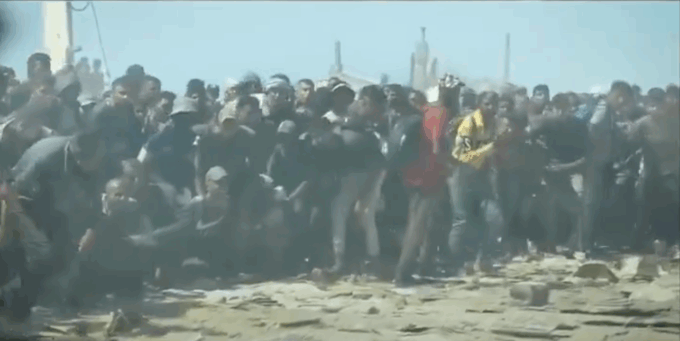
On July 30, Israeli forces fired on this group of Palestinians, as they awaited the arrival of a UN convoy delivering parcels of food and water. 71 Palestinians were killed at other food aid sites that same day. (Still from video shot by OCHA.)


Geen opmerkingen:
Een reactie posten