JUNE 24, 2026
‘We Have to Say What AI Can Do, Who’s Responsible When It Messes Up’:
CounterSpin interview with Dean Baker on the AI bubble
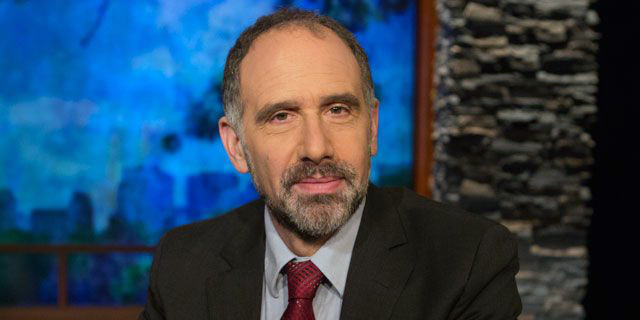
Janine Jackson interviewed CEPR’s Dean Baker about the AI stock market bubble for the June 19, 2026, episode of CounterSpin. This is a lightly edited transcript.
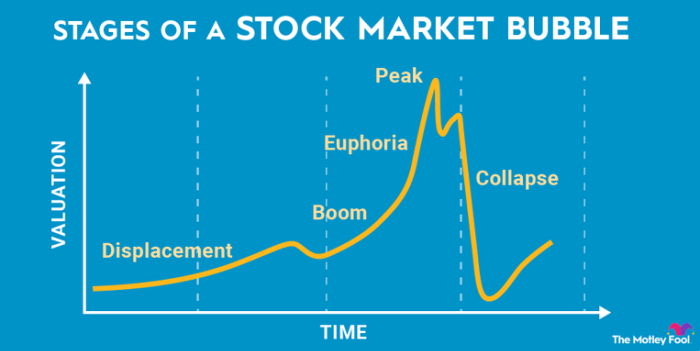
Motley Fool (7/5/25)
Janine Jackson: There’s a lazy host thing where you’re introducing someone who wrote about, say, “freedom,” and you say, “I looked up ‘freedom’ in the dictionary.” But I did go ahead and ask the internet what the stock market is, and I was told that it “operates like a giant, virtual auction house that connects everyday investors who want to sell with investors who want to buy.”
A market bubble, I learned, is a “rapid rise in the price of stocks or other assets that is not justified by fundamentals and is followed by a sharp fall in prices once investor enthusiasm wanes.”
Well, some of us don’t feel comfortable talking about a market that “trades” things like chits, when those things impact human beings having food or shelter or breathable air. But it is a system that we need to understand on its own terms, even as we keep trying to translate them to human needs.
All of these questions are at the surface when we talk about AI and the current market infatuation with it. What exactly is happening? What does it have to do with your life? Does it make sense, even in market-talk?
CEPR (6/15/26)
Here to shed some light on this is Dean Baker. He’s co-founder and senior economist at the Center for Economic and Policy Research. He’s author of, among other titles, Rigged: How Globalization and the Rules of the Modern Economy Were Structured to Make the Rich Richer. His newest project is called the AI Bubble Monitor, and he joins us now to talk about the what and the why of that. Welcome back to CounterSpin, Dean Baker.
Dean Baker: Hi, Janine. Thanks a lot for having me on.
JJ: On AI and the infrastructure around it, it’s the matter-of-factness that kills me: “This is happening, get with it or die mad.” But economic systems are political systems, and choices. We shouldn’t have to just silently accept that certain people are deciding what industry should survive, based not on what people need, but on what some folks say should happen.
So before we get into the specifics, I’d ask you to orient us a little bit here. AI and data centers: A large part of people’s concern is just that it’s come at us so fast and furious. Even if we aren’t economists, we’re not wrong to be concerned about this forced-inevitability vibe, are we? It just doesn’t sound like building a better mousetrap.
Science (10/28/25)
DB: I think for the most part, it’s probably fair to say a lot of the people involved in AI don’t know what they’re doing. And I’m saying that in all seriousness. So we get all these stories about AI models that—you’ve probably heard the term—they “hallucinate.” They make things up. And, again, I shouldn’t assign human characteristics for that; they’re not people. But the point is that they’re ill-designed models.
It’s very problematic to say we’re going to turn things over to AI, and it’s going to do this, it’s going to do that. Because, again, a lot of times, the people designing the systems don’t know what they’re doing. And that should be very troublesome. So we’re getting their spin like, “Oh, we have to move ahead with AI.” And I’m not particularly opposed to moving ahead with AI, but the idea that it has its own dynamic…that, you know, the AI is going to do it for us, or something.
We’re going to decide what we want to—and I’ll come back to who “we” is in a second—but we’re going to have to decide what we want AI to do. And the “we,” as it is now, it’s probably largely Elon Musk and Mark Zuckerberg and Sam Altman. But as a political matter, we need to regulate it. We have to say what it can do, who’s responsible for when it messes up—and I’ll guarantee you it will mess up.
Wired (6/13/26)
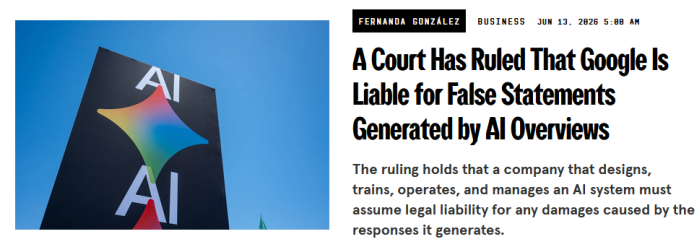
There was a case in Germany where they said Google‘s strictly liable for mistakes from its AI. If its AI gives you wrong answers, and that causes people to do things that mess up, Google‘s responsible. I think that’s a great ruling. It should be very clear. That’s wonderful. Anthropic, whoever, whichever big AI company, they designed the model, doesn’t work right? Well, great. You pay the cost, Anthropic. You pay the cost, Google.
But these are rules that we have to put in place, and we’ve kind of gone the other way. So I was just reading that, I believe it was in Mississippi, that the Trump administration is saying, “Oh yeah, environmental regulation’s great, but we have AI. So that doesn’t apply here, because it’s national security.” And I understand Trump doesn’t care much about the law, but you don’t throw your laws in the garbage because “AI”; that literally is just nonsense.
New York Times (6/10/26)
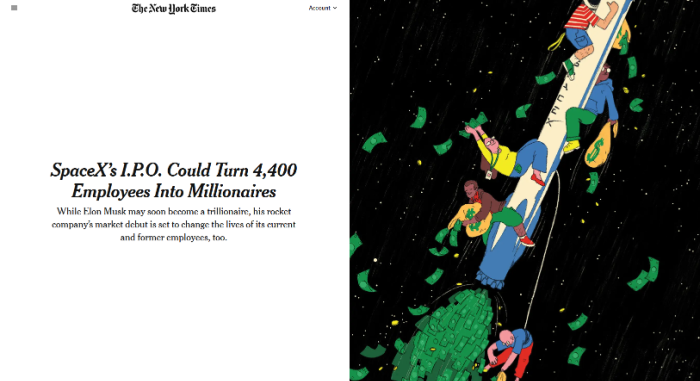
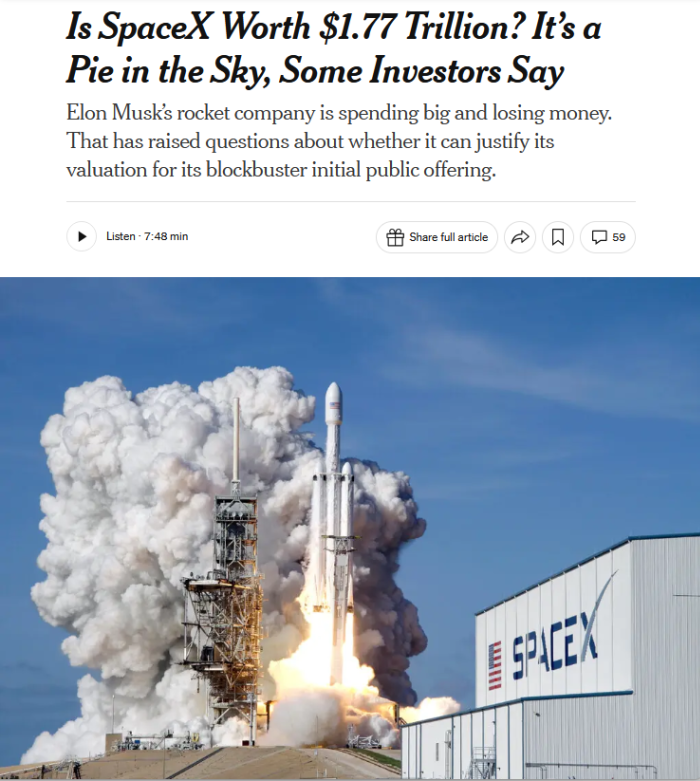
JJ: Right. Well, let’s get into some particulars here. “Riding High After IPO, SpaceX Will Buy AI Startup for $60 Billion.” This is all the New York Times: “Elon Musk’s newly listed rocket maker has become one of the world’s most valuable companies.” Also, it “could turn 4,400 employees into millionaires”; also, “Want to invest in SpaceX? Here’s what to know.” I got all of this from the New York Times. It seems like there’s a lot of confetti flying around the SpaceXIPO. How grounded is that, and how meaningful is that in this conversation?
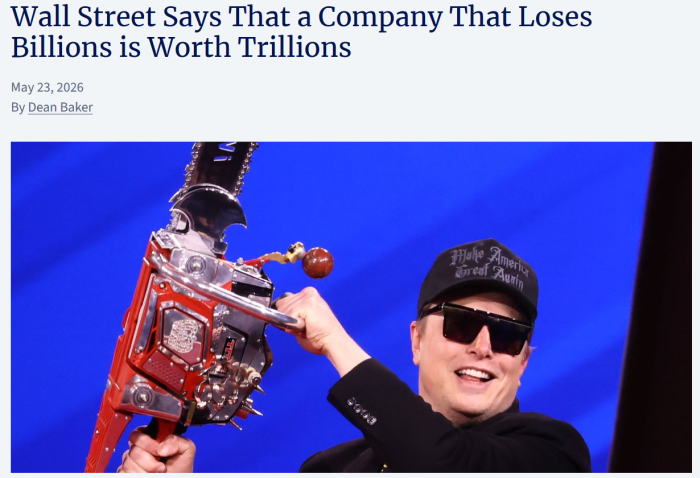
DB: SpaceX, the market capitalization, this is just incredible. I think we’re up to $2.7, $2.8 trillion. I just looked at the market today, somewhere around there. It’s going up a lot. This is an incredible amount of money, $2.7 trillion, it’s almost 10% of GDP, and it’s just incredible.
CEPR (5/23/26)
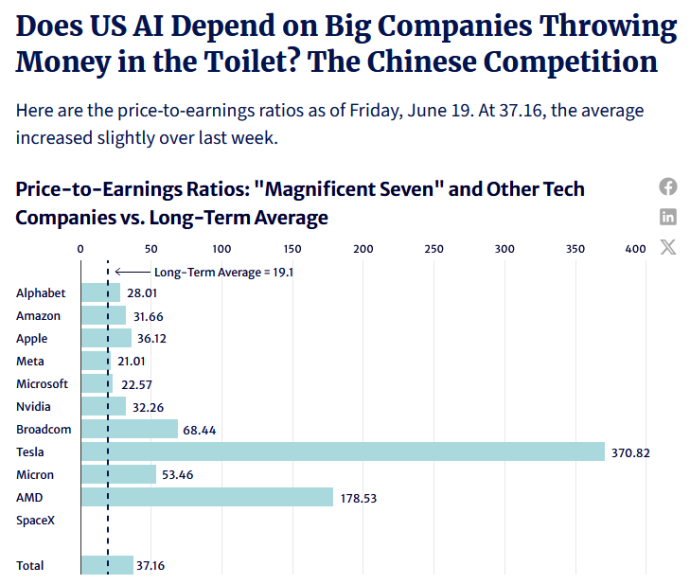
And the other side of that: When we talk about stocks, you usually look at the price of the stock relative to corporate earnings, and 20:1, that ratio would be high, but reasonable. So if you tell me a normal company, its stock price is $100, and its annual earnings after taxes are $5, eh, makes sense, without looking more carefully at what the company’s doing, what its progress is, whatever.
OK, we have $2.7 trillion. So you go, well, let’s see, 20 times annual earnings. So annual earnings must be somewhere in the neighborhood of $130 billion a year. Uh, no, it loses money. It’s never made money. SpaceX has never made money.
So people are placing a bet on this company turning around from losing money to being incredibly profitable. I just backed out some numbers, because it’s not going to turn around tomorrow. You go 10 years out, you would have to have profits that are equal to about 20% of all US after-tax corporate profits. No company has ever come close to that.
New Republic (3/17/26)
So, OK, why would someone think that? You go, well, Elon Musk. Well, Elon Musk lies all the time. He said 20 million dead people are getting Social Security. Total fantasy. Some number of dead people get Social Security, probably a thousand, 2,000, 3,000; not everyone who dies gets removed from the rolls. They’re actually pretty good about that, but they’re sure not 20 million, nothing close to 20 million.
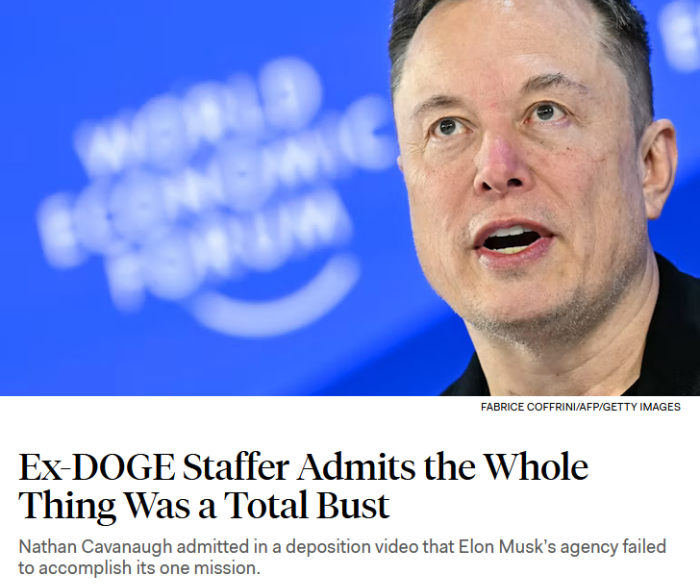
He lies all the time. He was running DOGE; he was going to save $2 trillion from the federal budget. He didn’t save anything. So, I mean, I could go on. The guy literally lies all the time.
He’s a neo-Nazi. We all saw his Nazi salute at the Republican Convention. He writes this. I mean, I’m not looking for things to trash him on. He says it. He says there are too many Black people, and brown people, the great replacement. So this is who the guy is.
You go, OK, well, what about his businesses? Well, his businesses haven’t done so well. Tesla’s worth a lot of money. If you look at its stock, its profits are very low, and most of its profitsactually come from selling carbon credits, which is a green transition policy that his friend Donald Trump wants to get rid of.
He’s invested big in something he calls the Boring Company, that was supposed to have high-speed transit between major cities. It goes nowhere. It’s been a total bomb. I could go on.
He does not have a great track record in business. He lies all the time. So people are betting $2.7 trillion on him turning around this massive money-loser into some enormous money-maker, and that’s very hard to see. Could happen, things happen, but it’s very hard to see that.

New York Times (6/12/26)
JJ: It’s very hard to see. And I want to stick with this just for a second, because I very much appreciate the way that you connect issues. We have, for example, the Congressional Budget Office and other folks saying, “Hey, this is going to happen. Economic growth is going to be sky high,” based on this kind of thinking. And at the same time, out of the other side of their mouths, folks like Jason Furman, economic advisor under Clinton and Obama, are saying, “Social Security is facing disaster,” and these things don’t add up. They add up politically, but they don’t add up economically. Talk about that connection there.
DB: Yeah. Well, to be fair, Congressional Budget Office, they actually don’t say that.
JJ: Ok.
DB: They project very modest growth over the next decade, somewhere around 2% a year. And if you carry that through, it’s really pretty much impossible to see these stocks—we’re talking about SpaceX, but you have Nvidia, you have Alphabet, we’re going to see initial public offerings, I don’t know the exact time, very soon, from Anthropic, the big AI company, OpenAI. It’s basically impossible to see how those stock prices can make sense. You’d have to have way more rapid growth than what they’re assuming.
And the point I was making that you’re referring to, on Jason Furman and Social Security: If we have that rapid growth, in other words, if these bubble prices make sense, and I don’t mean exactly, but if it’s somewhere in the ballpark, if it’s $2.7 trillion, if it’s anywhere close to making sense, and the price of the other big AI companies, if those are anywhere close to making sense, we’re going to see way more growth than what the Congressional Budget Office, what the Social Security trustees, what’s being projected for these programs. And if we actually get those growths, the idea that we should be at all worried about paying Social Security benefits is close to crazy.
Now, I would argue we’d be close to crazy to be worried about it anyhow, because we can afford paying Social Security benefits. I’ve gone on about that at great length, probably onyour show other times, but certainly, if we have anything like the growth that would be implied by these incredible stock valuations, then Social Security is such a non-problem that it’s not worth taking a minute to even talk about paying for it.
New York Times (6/11/26)
JJ: And that’s why I appreciate you’re putting those things together, because I think news media often, they’re on different pages of the paper. And I guess I would say, also, like you’re talking about Musk saying he was going to cut trillions of dollars of waste from the government, when that was just categorically absurd, and isn’t that a place for reporting, to just say, “Whatever you want to think about him, those numbers are absurd”?
DB: Yeah. And I think they have calmed down a lot. I mean, there have been some decentarticles. I’m not going to say there’s been no reporting. But basically, Musk is saying utter nonsense, and it’s kind of like if we found someone on the street drunk, and they started rattling off, “Elvis Presley is still alive,” and God knows what else. And they just reported that: “Well, so and so says that Elvis Presley is still alive. Maybe he is. I don’t know.” They’re of that nature.
And, again, actually, I had mentioned this in the piece, because I didn’t know Musk had said exactly this, but I was just playing around; why not Google it? So it turns out, even as Musk is saying, “Oh yes, AI is going to be all this wonderful stuff, and we’ll have incredibly rapid growth and affluence.” He just said, earlier this year, “There’s a thousand percent chance the US government will go bankrupt.”
How could those two go together? If we’re going to have this incredible growth, then there’s no plausible—I mean, it’s not plausible to say the government’s going to go bankrupt anyhow, for reasons I could go into, but it certainly isn’t going to go bankrupt if we’re going to have this incredible growth that Musk is telling us about, with his great AI companies.
JJ: It’s so confusing, and I think as a reader, as just a regular person, you think, “I must not understand this. ” Once I’m already at a thousand percent, I’m like, “Wait, I was in fifth grade. I don’t know how we get to a thousand percent.” But one thing I did want to say is so much of it is about futures, is about the betting aspect of the stock market.
And it’s not about a company making money now because it’s providing a service that people want now. It’s the idea that in the future this is going to work out. And then the same people who say, “I’m investing in this company because it’s going to do something,” they then are the ones who get to set the terms and the terrain of whether that actually happens. And I think that’s why a lot of people feel like it’s kind of just a scheme that doesn’t include them, and that doesn’t have a foot in real life.
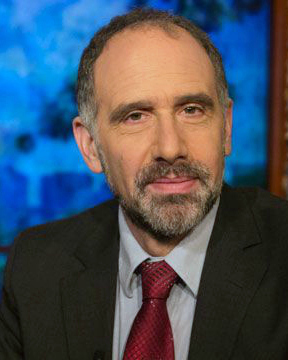
Dean Baker (image: BillMoyers.com): “These are all based on future bets that are, at best, very, very shaky, if not altogether absurd. But in the present, it gives them enormous power.”
DB: Yeah, well, these are all based on future bets that are, at best, very, very shaky, if not altogether absurd. But in the present, it gives them enormous power. I mean, it’s unbelievable. Here’s Elon Musk. His net worth is certainly well over a trillion now. I mean, people are making a big deal he’s at a trillion, but it might be $1.2, $1.3, something like that. It gives them enormous power. You mentioned him buying up another company for $60 billion. Where are they getting the $60 billion? Well, from SpaceX.
And there’s actually precedent for this. So again, people might think, well, Musk is incredibly rich. Someone, I’m stealing this line from someone, “If you’re so rich, how come you’re not smart?” And I think that applies perfectly for Elon Musk, but there’s precedent. We had the stock bubble in the ’90s, we had the housing bubble in the ’00s, and yet a lot of really rich people, who were supposed to be smart, I have no idea how smart or stupid they were, but they invested in really, really stupid things.
So mortgages, going back to the housing bubble, I remember arguing with economists, and they were saying, “Oh, it was old-fashioned to think we needed collateral on loans, and we had to make sure that people could pay them back. Well, now we have all this new technology.” Well, guess what, you did need that.
In the prior decade, with the tech bubble, one of the amazing stories—people could look it up, because they might think I’m saying utter nonsense—Time Warner was one of the biggest, might have been the biggest, media company in the world; it basically sold itself for nothing. It sold itself for AOL stock, and AOL stock plummeted the next year. So it had been worth a lot of money; the next year, it was worth almost nothing. So here you had the biggest media company in the world, or one of the biggest, if it wasn’t absolutely the biggest, and they gave away all their stock to a company that was pretty much worthless a year later.
So you have ostensibly smart people that are very wealthy, and they do really stupid things. I think that’s likely the story of what we’re seeing with this AI bubble. They get a lot of people—again, I don’t do intelligence testing, but ostensibly, they’re supposed to be smart, and looks like they’re doing some really dumb things.
CEPR (5/18/26)
JJ: And then we know that when elephants fight, it’s the grass that gets trampled, right? So, yes, this is rich people betting against one another, and maybe something won’t pan out, and that’s an “oopsie” for them, but it can mean something much more for a lot of other people.
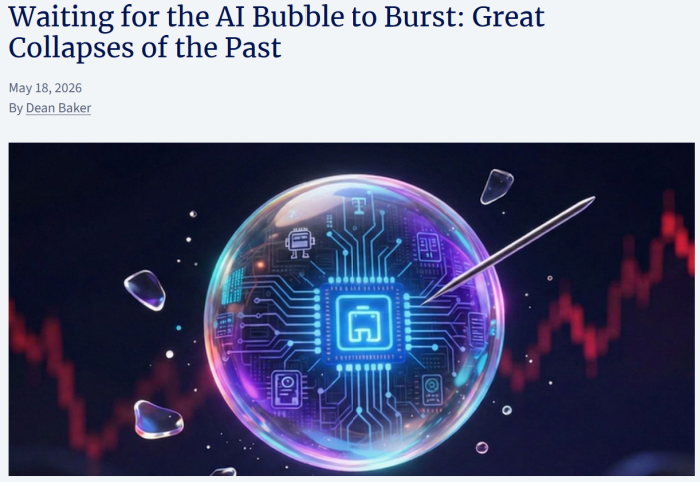
What do we understand can happen? And I know you’re not trying to predict a time of a bubble bursting; it’s not a prediction. But what does history tell us can happen when bubbles like this do, in fact, burst?
DB: Well, it’s almost always a very bad story. So we had the tech bubble bursting in 2000. We got a recession that was pretty bad, from the standpoint of the labor market. We had no job creation from 2001 to 2005. We hadn’t seen that since the Great Depression—which also, I should say, was started by a bubble bursting, a stock bubble bursting.
And the worst bubble, at least certainly in my lifetime, or recent memory, was the housing bubble collapse in 2008, 2009, 2010, which caused massive unemployment, and millions of people lost their homes. So that’s a pretty bad story.
So we can say, and I’m happy to see Elon Musk lose much of his wealth, which would happen, but he’s still going to be incredibly rich. If he loses 90% of his wealth, he’s going to have more money than any of us will ever see, but you’re going to see a lot of people pay a really big price for that. To be clear, I think it’d be great if the bubble would burst tomorrow, the sooner the better, but it’s not going to be a pretty story.
JJ: And let’s come back to journalism just for a minute, because the things that you’ve just said to me, I’m not saying I’m not seeing any critical reporting or thoughtful reporting, certainly I am, but I’m seeing a lot of, “Hey, this is happening. How can I get in on it?” Or just, “Isn’t it OK that these people are in charge of everything?” And I just wonder, what would actual critical reporting include, day to day, that would help us understand this better?
DB: I think certainly trying to put the pieces together, as we just did, talking about, well, if these prices make sense, then we’re going to have way more rapid growth. And that’s just a fact. I mean, that’s not my personal opinion. You can’t tell a story where Elon Musk’s wealth, his market capitalization of SpaceX and the other companies, make sense, and the growth projections we’re looking at from the Congressional Budget Office make sense. Those are contradictory.
So I think it’d be helpful if, when they talk about one, they talk about the other, saying, these prices, unless we see way more rapid growth than is being projected for budget purposes and other purposes, they don’t make sense. And vice versa, say that, oh, Jason Furman—Jason’s not a bad guy—he was out there in the New York Times, [saying] we should worry about Social Security and our children. Well, if the AI stories are right, we don’t have to worry at all.
Again, I don’t think we should worry about it, even if they weren’t right, but if they are right, it’s just Looney Tunes stuff. It’s like we’re worried we don’t have enough water when we’re in the middle of Lake Michigan.
So just putting the pieces together, that should be a standard part of reporting, just to remind people, put the context in there. And, again, it doesn’t take a long time. They’re really not disputable points, so I’m not saying something about Jason here; I know him, he’s not a stupid guy. He’d go, “Yeah, of course that’s true.” I suspect he would agree that AI, these prices don’t make sense, but he would agree, if they made sense, then we’re going to see way more rapid growth. Those go together.
So putting that into the stories, putting the context in there, so people can understand, because, again, this is something I harped on, you guys have harped on this, that you talk about these things, a typical person, even someone who’s more educated, and they spend time, they don’t know all these things. I mean, they might know them in some sense, but it’s not right in front of them. So they need to have it put there, when they’re reading about AI, or they’re reading about the budget, see how these things relate to each other.
AI Bubble Monitor (6/22/26)
JJ: Well, OK. The AI Bubble Monitor, your new project, I want to say the real-timeness of it, because maybe less so than with the dot-com bubble or the housing bubble, but we do know that pundits and folks are going to say, “No one saw it coming. We didn’t know what was happening. We all thought….” So for me, a big part of the meaning of your new project is just that it is existing in real time.
DB: Yeah, that’s the idea. We want to get the information out there, and I’m trying to put down real information, if people think that it still makes sense. Again, I’m not going to put in anything that I’m not pretty confident is true, I’m getting it all from reliable sources or, again, I’m not making them up, they’re from the industry, from government data. And, again, if you want to say, “Oh yeah, Elon Musk’s SpaceX, OK, it’s getting 20% of after-tax corporate profits,” Again, I can’t say it’s impossible. I wouldn’t put my money on that, but that’s what you’re doing if you’re buying up SpaceX.
JJ: It could happen, yep. But the idea is that you’re watching it in real time, and asking questions in real time, so no one can say these questions weren’t asked, or nobody was thinking about it.
DB: Yes, exactly.
JJ: Finally, when we talked last time, probably when we talk every time, we say that we want journalists to separate people and systems. It’s not enough to say Elon Musk is weird, or Trump is weird, without naming the structures that they are able to use to enact their ideas. Otherwise, how do we know what needs to change besides the president, right? So there are structures and systems that we should also be asking questions about.
NextShark (1/26/26)
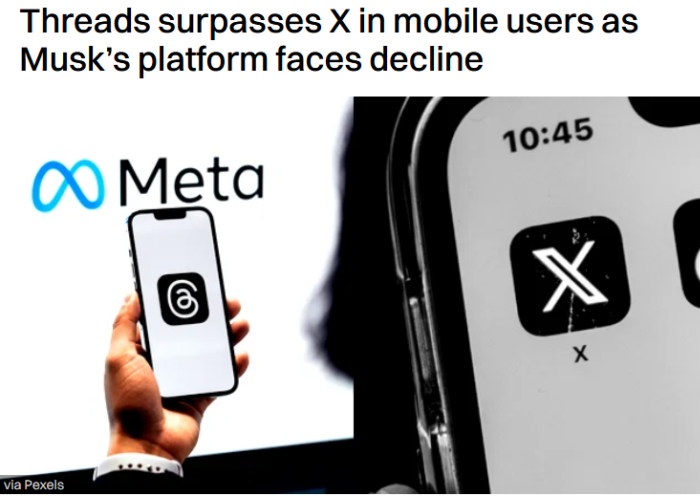
DB: Yeah. And you guys are obviously right in the middle of this. And I think the media, and particularly when we talk about Elon Musk, it’s very much that, because the guy owns X, I don’t know where that stands. It had been, I think, the largest social media site; I’m sure it’s no longer true, I know the users are down. But we create a media infrastructure that has an enormous impact on what politics looks like, and what issues get called attention to, and how those are covered.
And that was never great. I mean, we both have been in this game a long time. It was never great. So I’m not going to say we had the good old days, 30 years ago, 40 years ago, but it’s gotten a lot worse.
And when you have Larry Ellison as a Trumper who—I guess it’s his kid, actually, David Ellison, that owns CBS, and now they’re looking to take over Warner Brothers, which would give them control of CNN. These are really big issues, because this matters in terms of how people see the world, because they need information and those are sources of information for an awful lot of people, and people need to be aware of who owns the media, and how that affects basically everything, but certainly politics.
JJ: We’ve been speaking with economist Dean Baker. His new project, AI Bubble Monitor, can be found on the website of the Center for Economic and Policy Research; that’s CEPR.net. Thank you so much, Dean Baker, for joining us this week on CounterSpin.
DB: Thanks, Janine. I really appreciate being on.


Geen opmerkingen:
Een reactie posten