Zoeken in deze blog 🔎🔎

dinsdag 17 januari 2023

U.S. Prepared War In Europe


The Corps moved tanks from secret caves in Norway to Finland. Here’s why.


Marines with Bravo Company, 4th Tanks Battalion, prepare to fire a M1A1 Abrams tanks during a low-light live-fire exercise as part of Exercise Arrow 18 in Pohjankangas Training Area near Kankaanpaa, Finland, May 16. (Staff Sgt. Marcin Platek/Marine Corps)

In preparation for a looming fight with Russia, for the first time the Corps temporarily moved some of its M1A1 Abrams tanks holed up in secret caves in Norway to Finland.

It was for a large-scale annual training exercise featuring mechanized units known as Arrow 18, and it was the first time the Corps and its Abrams tanks have ever participated in the evolution, which took place from May 7-18.

The exercise involved only 30 Marines with nearly 5,000 Finnish soldiers, roughly 150 armored vehicles and 300 other military vehicles — a substantial display of firepower and deterrence flaunted not far from the Russian border. 

But the Corps pulled out all the stops by moving its main battle tank from a series of secret cave complexes in Norway — a Cold War era storage program designed to rapidly equip Marines for a fight with Russia — to Pojankangas Training Area near Kankaanpaa, Finland for the exercise.

Exercise Arrow is an annual Finnish multinational exercise, and this was the first time that U.S. Marines “participated in the exercise with the purpose of exercising mechanized infantry, artillery, and mortar field training skills in order to increase interoperability, reassure partner nations, improve readiness and reinforce relationships,” Marine spokesman Lt. Brett Lazaroff said in an email to Marine Corps Times Tuesday.

The Corps’ Abrams have been stored in a series of sprawling cave complexes in Norway known as the Marine Corps Prepositioning Program-Norway, which houses thousands of Marine Corps armored vehicles, artillery and other equipment.

The Corps has been storing equipment in this network of caves since the 1990s in preparation for a potential heavyweight bout with Russia.

The caves hold at least enough equipment to support a Marine Air-Ground Task Force.

Corps officials say it is relatively routine to move vehicles and other equipment from the caves to various training ranges in Europe.

But Arrow 18 is the first time the Corps and its Abrams have participated in an exercise in Finland.

Finland is a key strategic partner to the U.S., especially as it seeks to deter Russian aggression in the region. And the country boasts an extensive border with Russia.

Currently, Finland is a nonaligned country with NATO. But the country has been seeking closer defense ties with the U.S. ever since Russia’s invasion of Ukraine in 2014.

In early May, Finland and Sweden, another nonaligned country, signed a letter pledging increased national security cooperation between the nations.

The nonbinding letter was signed by U.S. Secretary of Defense Jim Mattis, Swedish Minister of Defence Peter Hultqvist and Finnish Minister of Defence Jussi Niinistö.

“Proven partnerships are built upon shared values, experiences, and vision; participating in exercises like this allow us to help build on this proven partnership,” Lazaroff said.

While the Abrams tanks came from caves in Norway, the Marines participating in Arrow 18 hailed from Washington state with 4th Tanks, Company B. The Army’s 2nd Cavalry Regiment and a Norwegian intelligence platoon also were in attendance at the exercise.

maandag 16 januari 2023

NAVO-fan Rob de Wijk Wordt Wakker

Drie dagen geleden meldde de NAVO-fan Rob de Wijk:

De overwinning van Oekraine is niet langer vanzelfsprekend, wat velen dachten. Dus is het nu tijd om na te denken hoe het verder moet. Meer wapens? Onderhandelen?

Hoe nu Rob? Je hebt de hele tijd gedacht dat Oekraïne zou winnen? Op grond van wat? En laat ik als strategisch denker je adviseren om altijd!!! voordat je met een oorlog begint, eerst na te denken over hoe het verder moet als je verliest. En voor de rest: is dit niet een ontmaskering van deskundigen zoals jij? Toch vaker mijn weblog lezen. Dat voorkomt een nonsensicale houding. 


The 2023 War – ‘Setting the Theatre’


Alastair Crooke
January 13, 2023

The China-Russia axis are lighting the fires of a structural insurrection against the West across much of the Rest of World. Its fires are aimed at ‘boiling the frog slowly’

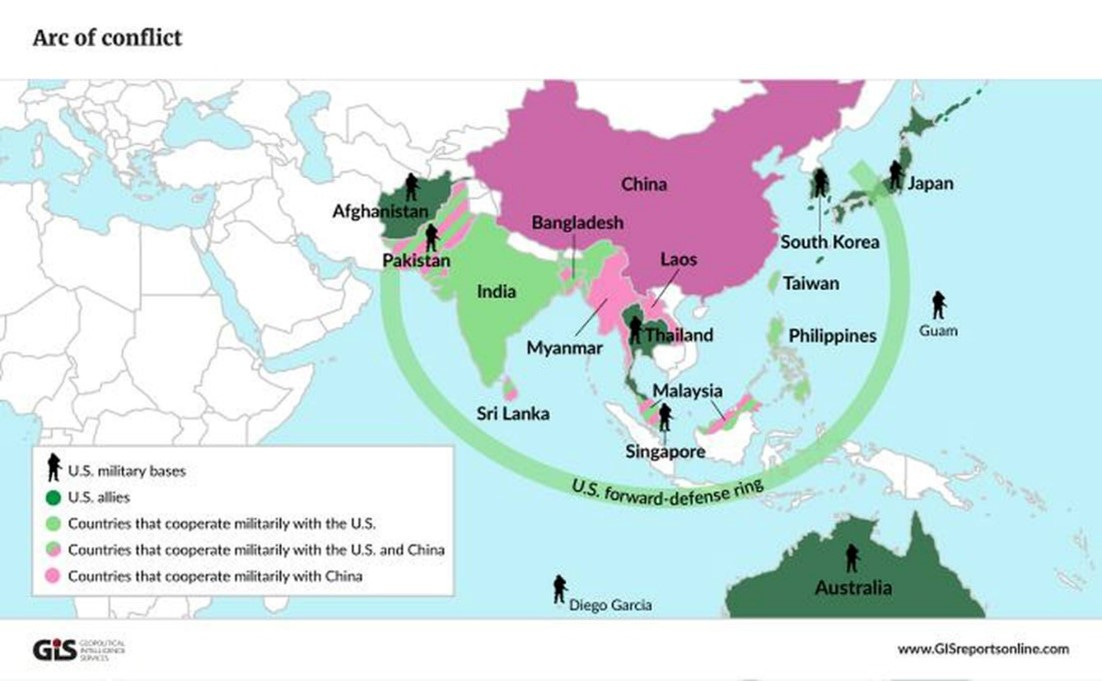
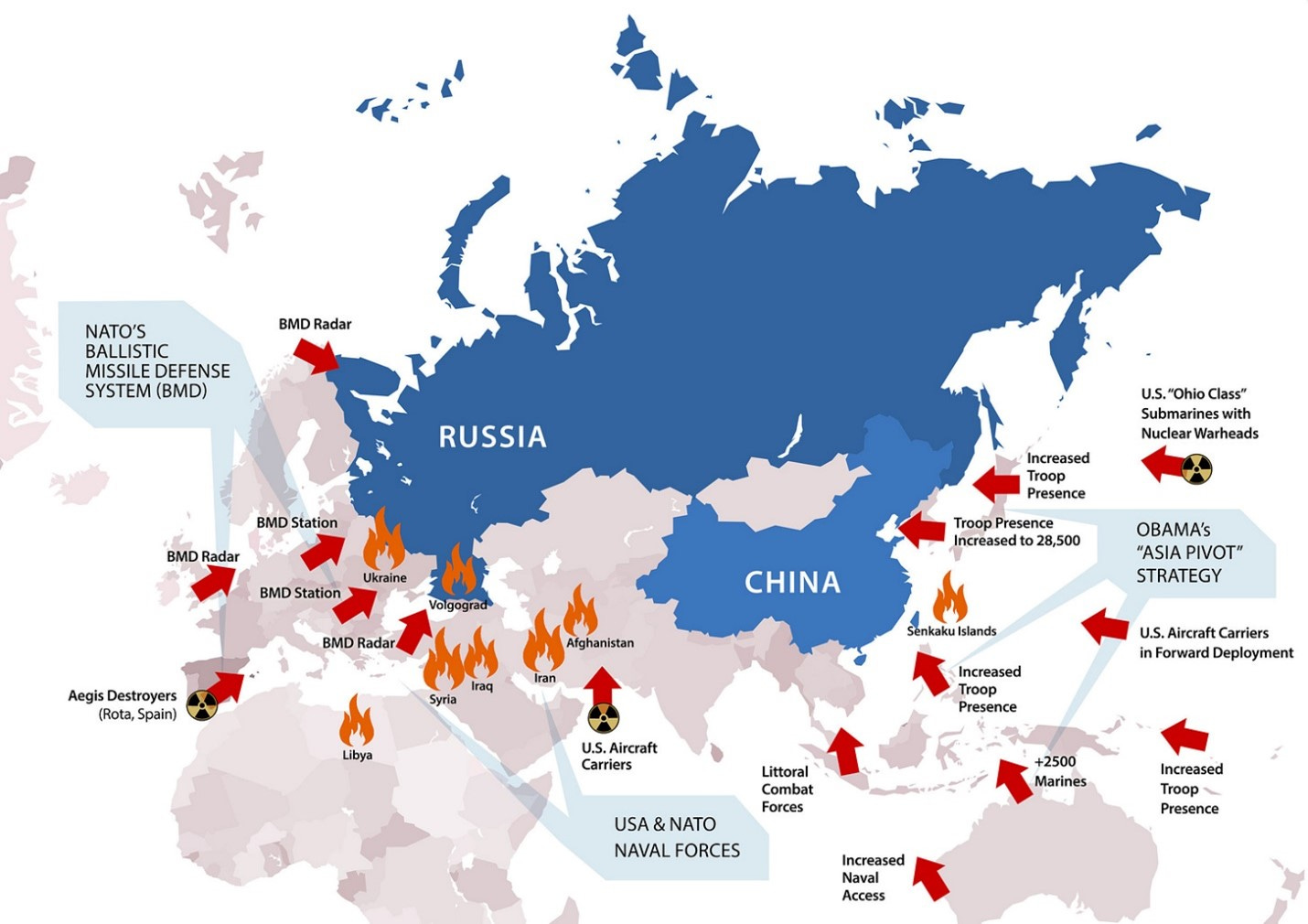
A top US Marine General, James Bierman, in a recent interview with the Financial Times, explained in a moment of candour how the US is “setting the theatre” for possible war with China, whilst casually admitting as an aside, how US defence planners had been busy inside Ukraine years ago, “earnestly preparing” for war with Russia — even down to the “pre-positioning of supplies”, identifying sites from which the US might operate support, and sustain operations. Simply put, they were there,readying the battle space for years.

No surprise really, as such military responses flow directly from the core US strategic decision to actuate the 1992‘WolfowitzDoctrine’ that the US must plan and preemptively act, to disable any potential Great Power — well before it reaches the point at which it can rival or impair US hegemony.

NATO today has progressed to war with Russia in a battlespace, which in 2023, may or may not stay limited to Ukraine. Simply put the point is that the shift to ‘War’ (whether incremental or not) marks a fundamental transition from which there is no going back to ab initio — ‘war economies’ in essence, are structurally different to the ‘normal’ from which the West began, and to which it has grown accustomed over recent decades. A war society — even if only partly mobilised — thinks and acts structurally differently from peacetime society.

War is not about gentlemanly conduct… either. Empathy for others is its first casualty — the latter being a requirement for sustaining a fighting spirit.

Yet, the carefully curated fiction in Europe and the US continues that nothing really has, or will ‘change’: we are in a temporary ‘blip’. That’s all.

Zoltan Pozsar, the influential finance ‘oracle’ at Credit Suisse, has already made the point in his latest War and Peace essay (subscription only) that War is well underway – by simply listing the events of 2022:

  • The G7’s financial blockade of Russia (The West setting the battle space)
  • Russia’s energy blockade of the EU (Russia begins setting its theatre)
  • The U.S.’s technology blockade of China (America pre-positioning of sites to sustain operations)
  • China’s naval blockade of Taiwan, (China demonstrating preparedness)
  • The U.S.’s “blockade” of the EU’s EV sector with the Inflation Reduction Act. (The US defence planners preparing for future ‘supply-lines)
  • China’s “pincer movement” around all of OPEC+ with the growing trend of invoicing oil and gas sales in renminbi. (The Russia-China ‘Commodity Battlespace’).

This list amounts to one major geo-political ‘upset’ occurring, on average, every two months — moving the world decisively away from the so-called ‘normal’ (for which so many in the Consuming Class ardently yearn) to an intermediate state of War.

Pozsar’s list shows that the tectonic plates of geo-politics are seriously ‘on the move’ — shifts, which are accelerating and becoming ever more intertwined, yet that still remain far from arriving at any settled place. ‘War’ will likely be a major disruptor (at the very least), until some equilibrium is established. And that may take some years.

Ultimately, ‘War’ does make its impact on the conventional public mindset — albeit slowly. It seems to be fear of the impact on an unprepared mindset that is behind the decision to prolong Ukraine’s suffering, and thus trigger the War of 2023: An admission of failure in Ukraine is seen to risk spooking volatile western markets (i.e. higher interest rates for longer). And frank-talking represents a hard option for a western world — used to ‘easy decisions’, and ‘can kicking’ — to take.

Pozsar, being a finance guru, understandably is focussed in his essay on finance. But conceivably, the reference to Kindleberger’s Manias, Panics and Crashes is therefore not whimsical, but included as a hint to the possible ‘hit’ to the conventional psyche.

In any event, Pozsar leaves us four key economic takeaways (with brief comments added):

  1. War is history’s principle driver of inflation, and the bankruptcy for states. (Comment: war-driven inflation and Quantitative Tightening (QT) enacted to fight inflation, are policies working in radical opposition to each other. Central Banks’ role attenuates to supporting war needs — at the expense of other variables – in wartime.
  2. War implies an effective and expandable industrial capacity for producing weapons (rapidly), which, in itself, requires secure supply-lines to feed that capacity. (A quality which the West no longer possesses, and which is costly to recreate);
  3. Commodities which often serve as collateral to loans become scarce – and with that scarcity, show up as commodity ‘inflation’;
  4. And finally, War cuts new financial channels i.e. “the m-CBDC Bridge project” (see here).

The point needs underlining again: War creates different financial dynamics and shapes a different psyche. More importantly, ‘War’ is not a stable phenomenon. It can start with petty tit-for-tat strikes on a rival’s infrastructure and then — with every incremental ‘mission creep’ — slip along the curve towards full war. NATO is not just mission creeping in its war on Russia, it is mission jogging — fearing a Ukraine humiliation in the wake of the earlier Afghanistan débacle.

The EU hopes to halt that slide well short of full war. It is nonetheless a very slippery slope. The point of War is to inflict pain and attrit your enemy. To this extent it is open to mutation. Formal sanctions and caps on energy quickly metamorphose into the sabotage of pipelines or the seizure of tankers.

Russia and China however, are certainly not naïve, and have been busy setting their own theatre, ahead of a potential wider clash with NATO.

China and Russia can now claim to have built a strategic relationship, not only with OPEC+, but with Iran and key gas producers.

Russia, Iran, and Venezuela account for about 40% of the world’s proven oil reserves, and each of them are currently selling oil to China for renminbi at a steep discount. GCC countries account for another 40% of proven oil reserves — and are being courted by China to accept renminbi for their oil — in exchange for transformative investments.

This is a significant new battlespace being readied — ending Dollar hegemony through boiling the frog slowly.

The contesting party made the initial strike, sanctioning half of OPEC with those 40% of the world’s oil reserves. That thrust failed: the Russian economy survived — and unsurprisingly — the sanctions ‘lost’ those states to Europe, ‘handing them’ over instead to China.

China meanwhile is courting the other half of OPEC with an offer that is hard to refuse: “Over the next “three to five years”, China will not only pay for more oil in renminbi – but more significantly, ‘will pay’ with new investments in downstream petrochemical industries in Iran, Saudi Arabia, and the GCC more broadly. It will, in other words, build out the successor generation economy” for these fossil fuel exporters whose energy sell-by date approaches.

The key point here is that in the future, much more ‘value-added’ (in the course of production) will be captured locally — at the expense of industries in the West. Pozsar cheekily calls this: “Our commodity, your problem… Our commodity, our emancipation”. Or, in other words, the China-Russia axis are lighting the fires of a structural insurrection against the West across much of the Rest of World.

Its fires are aimed at ‘boiling the frog slowly’ — not just that of the dollar hegemony, but also that of a now uncompetitive western economy.

Emancipation? Yes! Here is the crux: China is receiving Russian, Iranian and Venezuelan energy at a big 30% discount.Meanwhile, Europe still gets energy for its industry — but only at a big mark-up. In short, more, and occasionally all, product added-value will be captured by cheap-energy ‘friendly’ states, at the expense of the uncompetitive ‘unfriendlies’.

“China – the nemesis – paradoxically has been a big exporter of high mark-up Russian LNG to Europe, and India a big exporter of high mark-up Russian oil and refined products such as diesel – to Europe. We should expect more [of this in the future] across more products – and invoiced not just in euros and dollars, but also renminbi, dirhams, and rupees’ ‘, Poszar suggests.

It may not look so obvious, but it is a financial war. If the EU is content to take the ‘easy way’ out of its fall into uncompetitiveness (via subsidies to allow for high-mark-up imports), then as Napoleon once remarked when observing an enemy making a mistake: Observe silence!

For Europe, this means much less domestic production – and more inflation — as price inflating alternatives are imported from the East. The West taking the ‘easy decision’ (since its renewable strategy has not been well thought through), likely will find the arrangement to be at the expense of growth in the West — a course prefiguring a weaker West, in the near future.

The EU will be particularly hard-hit. It has elected to become dependent on US LNG, just at the moment that production from US shale fields has peaked, with what output there is likely ear-marked to the US domestic market.

Thus, as general Bierman outlined how the US prepared the battlespace in Ukraine, Russia and China and the BRICS planners have been busy setting their own ‘theater’.

Of course, it doesn’t have to be like it ‘is’: Europe’s stumble towards calamity reflects an embedded psychology of the Western ruling élite. There is no strategic reasoning, nor ‘hard-decisions’ being taken in the West at all. It is all narcissistic Merkelism (hard decisions postponed, and then ‘fudged’ through subsidy handouts). Merkelism is so called after Angela Merkel’s reign at the EU, where fundamental reform was invariably postponed.

There is no need for thinking-things-through, or for hard decisions, when leaders are held by the unshakable conviction that the West IS the centre of the Universe. It is sufficient to postpone, awaiting the inexorable to unfold itself.

The recent history of US-led forever-wars is further evidence of this western lacuna: These zombie wars drag on for years with no plausible justification, only to be unceremoniously dropped. The strategic dynamics were easier suppressed and forgotten however, when fighting insurgency wars — as opposed to fighting two well-armed, peer competitor-states.

The same dysfunctionality has been apparent in many slow-rolling western crises: Nevertheless, we persist… because protecting the fragile psychology of our leaders — and an influential sector of the public — takes precedence. The inability to countenance losing drives our élites to prefer sacrifice by their own people, rather than see their delusions exposed.

Hence, reality has to be abjured. So, we live a nebulous between-times — so much happening, but so little movement. Only when the outbreak of crisis can no longer be ignored — by even the MSM and Tech censors — might some real effort be made to address root causes.

This conundrum however, places a huge burden on the shoulders of Moscow and Beijing to manage the War escalation in a careful fashion — in face of a West for whom losing is intolerable.

https://strategic-culture.org/news/2023/01/13/the-2023-war-setting-the-theatre/


THE HIGH COST OF BLOWING UP THE WORLD: UKRAINE

THE HIGH COST OF BLOWING UP THE WORLD: UKRAINE AND THE 2023 NDAA

The High Cost of Blowing Up the World: Ukraine and the 2023 NDAA

Illustrative Image

Written by Matthew Ehret-Kump

Bipartisan insanity was on display again this week as the U.S. congress responded to Biden’s requested $37 billion in additional aid to Ukraine by giving him $45 billion bringing the total U.S. support to its Davos-managed disposable ward up to $111 billion.

The aid was part of an overall omnibus spending bill passed by both houses of Congress was a gargantuan $1.7 trillion and included $858 billion in defense spending which far exceeds any sum ever spent by a U.S. government in history.

Of that $858 billion, $817 billion is allocated directly to the U.S. Department of Defense while the remaining $29 billion will be allocated to national security programs within the department of energy.

Continuing to Weaponize Taiwan

2023 NDAA Funds will be used to “strengthen” Taiwan in the Pacific with $12 billion authorized to assist Taiwan in purchasing weapons from the U.S. military industrial complex (with the $12 billion in ‘loans’ needing to be paid back over the course of the next five years of course). Of this fund, $100 million will be given directly to contractors to fill up a “contingency stockpile” to be used by Taiwan “in case of any future conflict”.

The High Cost of Blowing Up the World: Ukraine and the 2023 NDAA

Click to see full-size image

Additionally Taiwan will be invited to participate in the next U.S.-led Rim of the Pacific Military Exercise in 2024 and thus greater “Pacific NATO” strategy encircling mainland China. This exercise and broader Pacific NATO (aka Quad) anti-China arsenal of puppet colonies will be boosted by an additional $11.5 billion will be allocated to the Pacific Deterrence Initiative ‘to counter malign Chinese influence in the Pacific’.

Just as Ukraine has suffered U.S.-directed color revolutions in 2004 and 2014, so too has Taiwan been strung through a similar NED-funded ‘Sunflower Revolution’ regime change in 2014 which saw the Kuomintang Party taken out of power just as final stages of an economic integration agreement with mainland China were being finalized.

Billions have been tagged to purchase Lockheed Martin Corp’s (LMT.N) F-35 fighter jets and ships made by General Dynamics but beyond airforce, one of the biggest and most dangerous boosts in spending this year has been absorbed by a fixation on ‘space warfare’. $5.3 billion will be directed towards ‘space force’ and the ongoing effort to militarize space as a new dimension in war making in the 21st century (which was $333 million more than originally requested by military officials at space force’).

The recent U.S.-Canada-Australia joint ‘space warfare’ drills in order to prepare for an oncoming war over Europe took place at the start of December 2022 at the Schriever Space Force Base in Colorado- which indicates that the residues of any positive memory of ‘space diplomacy’ once seen under JFK’s leadership, the 1976 Apollo-Soyuz cooperation program or even the better aspects of President Trump’s Artemis Accord.

The 2000 RAD Origins of NDAA 2023’s Dark Age Doctrine

It would be a lie to say that this program for human extermination originated in 2022, or even under the previous presidencies of Trump or Obama.

If one wishes to grasp the germ seed of today’s policy doctrine, it would be necessary to revisit the Project for a New American Century Think Tank’s September 2000 Rebuilding America’s Defenses report where the end of history cultists then taking the helm of government stated:

“RAD” envisions a future in which the United States is in complete control of land, sea, air, space and cyberspace of planet Earth. It finds objectionable the limitations imposed by the ABM treaty and urges a newer rendition of Reagan’s ‘Star Wars’ defense shield program.

On top of calling for the USA’s exit from the ABM Treaty (which was promptly done in the wake of 911), the authors of RAD outline in clear detail the rationale behind the growth of the rise of a need for a new branch of the military known as space force. The authors stated that the USA must gain:

“CONTROL THE NEW ‘INTERNATIONAL COMMONS’ OF SPACE AND ‘CYBERSPACE,’ and pave the way for the creation of a new military service – U.S. Space Forces – with the mission of space control.”

Outlining the doctrine of ‘Full Spectrum Dominance’ the PNAC report outlined on page 51:

Global Missile Defenses — “A network against limited strikes, capable of protecting the United States, its allies and forward-deployed forces, must be constructed. This must be a layered system of land, sea, air and space-based components”.

The High Cost of Blowing Up the World: Ukraine and the 2023 NDAA

Click to see full-size image

Looking towards the need to expand and modernize nuclear forces due to the possible danger of China, Russia, Iran, North Korea and Iraq, the RAD authors stated:

“Today’s strategic calculus encompasses more factors than just the balance of terror between the United States and Russia. U.S. nuclear force planning and related arms control policies must take account of a larger set of variables than in the past, including the growing number of small nuclear arsenals – from North Korea to Pakistan to, perhaps soon, Iran and Iraq – and a modernized and expanded Chinese nuclear force.”

Possibly one of the most dangerous and revealing aspects of RAD, was found on page 60, where the authors outline a program that soon grew into obscene proportions in the wake of the 2001 Anthrax attacks which justified the later passage of Cheney’s 2004 Bioshield Act as well as the growth of the 320+ international biolabs run by the pentagon. Describing the conversion of bioweapons from the realm of terror to “a political useful tool”, the authors state:

“Although it may take several decades for the process of transformation to unfold, in time, the art of warfare on air, land, and sea will be vastly different than it is today, and ‘combat’ likely will take place in new dimensions: in space, ‘cyber-space,’ and perhaps the world of microbes… Space itself will become a theater of war, as nations gain access to space capabilities and come to rely on them; further, the distinction between military and commercial space systems – combatants and non-combatants – will become blurred. Information systems will become an important focus of attack, particularly for U.S. enemies seeking to short-circuit sophisticated American forces. And advanced forms of biological warfare that can target specific genotypes may transform biological warfare from the realm of terror to a politically useful tool”

Back to Ukraine

How will the $45 billion Ukraine money burning project be used? That’s not so easy to say exactly?

What we do know is that $22.9 billion will go towards that Kiev will be expected to use to buy more weapons from private U.S.-based defense contractors and much of the rest will be enjoyed by NGOs and Non Profits which will more often than not be run by figures closely tied to those same creatures in the Washington swamp who voted for these bills.

These uncomfortable facts were outlined repeatedly by the oft-slandered republican Senator Marjorie Taylor Greene whose multiple attempts to create some form of oversight and auditing of the handouts to Ukraine have been met with absurd levels of resistance since the special operation was launched in February. Even when such operations as the FTX crypto exchange (a major partner to Kiev and the World Economic Forum) was discovered to be simply a money laundering outfit infusing vast sums into the coffers of the DNC that were tied to Ukrainian operations, hardly a single western Mockingbird press outlet made a peep.

As the Pentagon Papers and Hunter Biden Laptop reminded us, not only has Ukraine been run by a coterie of money laundering grifting politicians enjoying endless skimming of foreign aid (Pandora Papers revealed that both Zelensky and his billionaire handler Igor Kolomoisky were both tied to offshore shell companies representing hundreds of millions of dollars of stolen loot), but also energy firms like Burisma which has been caught extracting revenue from the Ukrainian people the way silk worm farmers extract silk.

And what happens if you find yourself among that precious minority of republican or independent voices of resistance to this new plunge into world war? Just ask Representative Matt Gaetz who has been called out alongside other patriots such as Jim Jordan and Lauren Boebert for not applauding Zelensky’s pathetic speech in Congress this week. For the crime of keeping their hands from slapping in lock step with the rest of the congressional herd, NBC analysts like Michael Beschloss have attempted to stir up a McCarthyite witchhunt asking why these representatives refused to clap, asking:

“I’d like to know why that was for two reasons- Number one: You’re a public servant, we’re allowed to know those things. You’re supposed to tell us if you’re serving in Congress what the reason was. Do you love Putin, or are you just opposed to democracy, or is there something else?”

The fact that these figures even dared ask where graft was going probably touched a nerve too close to home with the Pentagon itself failing its fifth consecutive audit in November 2022 with over 65% of its assets and expenditures unaccounted for. That’s right, the government ‘lost track’ of $2 trillion in 2022.

Will enough Americans wake up to the reality that they have been walking on the wrong side of history for far too long or has the point of no-return already been crossed?

MORE ON THE TOPIC:

 https://southfront.org/the-high-cost-of-blowing-up-the-world-ukraine-and-the-2023-ndaa/

Liberal Lies of Hillary Clinton


It Turns Out Hillary Clinton, Not Russian Bots, Lost the 2016 Election

A new study of Russia-based Twitter posts by New York University researchers buries the liberal canard that Russian bots played any significant role in swinging the 2016 election for Donald Trump.

Amid the generalized media crack-up that surrounded the 2016 presidential election, the bogeyman of “Russian bots” quickly became a load-bearing  concept. A Russia-based social media campaign, or so it was said, had saturated sites like Twitter with fake accounts and, in doing so, helped to swing the election for Donald Trump. Becoming axiomatic in liberal circles, this story soon took on a life of its own. It’s since played a prominent role in mainstream media narratives of the 2016 election, been the subject of highly publicized congressional hearings, and also loomed large in the wider global discourse about “fake news.”

That the Russian government preferred Trump to Hillary Clinton and that Russia-connected actors engaged in digital skulduggery related to the election are not really in dispute. Much of the mainstream discussion around Russian bots, however, has been premised on unexamined assumptions about the scale and effectiveness of these efforts. Powerful states including the United States, after all, regularly engage in the likes of online propaganda and sock-puppeting campaigns. Whether they have a more than negligible impact on real world events, electoral and otherwise, is another question.

It’s notable, then, that a new analysis published by the Center for Social Media and Politics at New York University finds no evidence whatsoever that Russia-based Twitter disinformation had any meaningful impact on voter behavior in 2016. In place of the terrifying bot army menace that’s periodically been invoked, the researchers instead detail an enterprise with minimal reach or influence, and one overwhelmingly concentrated among partisan Republicans already inclined to vote for Trump.

They estimate that as many as thirty-two million US Twitter users may have been “exposed” to tweets from Russia-aligned accounts over the eight-month period preceding the 2016 election.” In numerical terms that may sound like a lot, but it actually isn’t when you factor in the sheer volume of posts and information encountered by social media users on a daily basis. As the report puts it:

While, on average, respondents were exposed to roughly 4 posts from Russian foreign influence accounts per day in the last month of the election campaign, they were exposed to an average of 106 posts on average per day from national news media and 35 posts per day from US politicians. In other words, respondents were exposed to 25 times more posts from national news media and 9 times as many posts from politicians than those from Russian foreign influence accounts.

Sheer exposure, of course, doesn’t even necessarily amount to influence. Like advertising, politically motivated content can functionally be background noise if it fails to reach particular audiences or in turn doesn’t have an impact on those that it does. In both respects, the study is quite unequivocal: not only were Russian Twitter efforts dwarfed by posts from media and politicians, but actual exposure to them was highly concentrated within a subset of partisan conservatives:

Results . . . show that the amount of exposure depends substantially on users’ self-identified partisanship: those who identify as “Strong Republicans” were exposed to roughly nine times as many posts from Russian foreign influence accounts than were those who identify as Democrats or Independents.

Even then, in fact, it was unlikely to produce changes in attitude or behavior. As the researchers conclude:

We did not detect any meaningful relationships between exposure to posts from Russian foreign influence accounts and changes in respondents’ attitudes on the issues, political polarization, or voting behavior.

While there are, as the study’s authors hasten to note, some limits to the analysis (it’s confined to Twitter posts as opposed to other kinds of media content or posts on other networks) it nonetheless offers persuasive evidence that the “Russian bots” narrative of the 2016 election has greatly overstated the impact of Russia-based social media efforts on the outcome. The result has been an account of 2016 sometimes quite unmoored from reality, wherein what was in practice a relatively impotent operation has elicited a torrent of angst-ridden and often frenzied media coverage.

If the Russian bots story gained momentum without having much of an empirical foundation, one reason is that it offered traumatized liberals a tidy and straightforward explanation for an outcome they had spent the preceding year believing was impossible. Sinister as the idea might be, a foreign campaign of digital sorcery was always going to be a neater culprit than the litany of institutional and political failures that actually enabled Donald Trump to become president.

In a different kind of world, November 2016 might have inspired some actual introspection on the part of those implicated in said failures. Instead, it became an occasion for hyperbolic and often flimsy partisan narratives that rather conveniently avoided asking the necessary questions — and in turn let the triangulating ideology of Clintonite liberalism off the hook.

https://jacobin.com/2023/01/hillary-clinton-russian-bots-2016-presidential-election-trump

How the Davos elite took back control

How the Davos elite took back control

The WEF is insulating policy-making from democracy

BY 

January 16, 2023 

Thousands of the world’s global elite are convening in Davos this morning for their most important annual get-together: the meeting of the World Economic Forum (WEF). Alongside heads of state from all over the world, the CEOs of Amazon, BlackRock, JPMorgan Chase, Pfizer and Moderna will gather, as will the President of the European Commission, the IMF’s Managing Director, the secretary general of Nato, the chiefs of the FBI and MI6, the publisher of The New York Times, and, of course, the event’s infamous host — founder and chairman of the WEF, Klaus Schwab. As many as 5,000 soldiers may be deployed for their protection.

Given the almost cartoonishly elitist nature of this jamboree, it seems only natural that the organisation has become the subject of all sorts of conspiracy theories regarding its supposed malicious intent and secret agendas connected to the notion of the “Great Reset”. In truth, there is nothing conspiratorial about the WEF, to the extent that conspiracies imply secrecy. On the contrary, the WEF — unlike, say, the Bilderberg — is very open about its agenda: you can even follow the live-streamed sessions online.

Founded in 1971 by Schwab himself, the WEF is “committed to improving the state of the world through public-private cooperation”, also known as multistakeholder governance. The idea is that global decision-making should not be left to governments and nation-states — as in the post-war multilateralist framework enshrined in the United Nations — but should involve a whole range of non-government stakeholders: civil society bodies, academic experts, media personalities and, most important, multinational corporations. In its own words, the WEF’s project is “to redefine the international system as constituting a wider, multifaceted system of global cooperation in which intergovernmental legal frameworks and institutions are embedded as a core, but not the sole and sometimes not the most crucial, component”.

While this may sound fairly benign, it neatly encapsulates the basic philosophy of globalism: insulating policy from democracy by transferring the decision-making process from the national and international level, where citizens theoretically are able to exercise some degree of influence over policy, to the supranational level, by placing a self-selected group of unelected, unaccountable “stakeholders” — mainly corporations — in charge of global decisions concerning everything from energy and food production to the media and public health. The underlying undemocratic philosophy is the same one underpinning the philanthrocapitalist approach of people such Bill Gates, himself a long-time partner of the WEF: that non-governmental social and business organisations are best suited to solve the world’s problems than governments and multilateral institutions.

Even though the WEF has increasingly focused its agenda on fashionable topics such as environmental protection and social entrepreneurship, there is little doubt as to which interests Schwab’s brainchild is actually promoting and empowering: the WEF is itself mostly funded by around 1,000 member companies — typically global enterprises with multi-billion dollar turnovers, which include some of the world’s biggest corporations in oil (Saudi Aramco, Shell, Chevron, BP), food (Unilever, The Coca-Cola Company, Nestlé), technology (Facebook, Google, Amazon, Microsoft, Apple) and pharmaceuticals (AstraZeneca, Pfizer, Moderna). The composition of the WEF’s board is also very revealing, including Laurence D. Fink, CEO of Blackrock, David M. Rubenstein, co-chairman of the Carlyle Group, and Mark Schneider, CEO of Nestlé. There’s no need to resort to conspiracy theories to posit that the WEF’s agenda is much more likely to be tailored to suit the interests of its funders and board members — the world’s ultra-wealthy and corporate elites — rather than to “improving the state of the world”, as the organisation claims.

Perhaps the most symbolic example of the WEF’s globalist push is the controversial strategic partnership agreement the organisation signed with the UN in 2019, which many view as having drawn the UN into the WEF’s logic of public-private cooperation. According to an open lettersigned by more than 400 civil society organisations and 40 international networks, the agreement represents a “disturbing corporate capture of the UN, which moved the world dangerously towards a privatised global governance”. The provisions of the strategic partnership, they note, “effectively provide that corporate leaders will become ‘whisper advisors’ to the heads of UN system departments, using their private access to advocate market-based profit-making ‘solutions’ to global problems while undermining real solutions embedded in public interest and transparent democratic procedures”.

This corporate takeover of the global agenda, aided and abetted by the WEF, became particularly apparent during the Covid-19 pandemic. Global health policy and “epidemic preparedness” have long been a focus of the WEF. In 2017, the Coalition for Epidemic Preparedness Innovations (CEPI) — an initiative aimed at securing vaccine supplies for global emergencies and pandemics, funded by government and private donors, including Gates — was launched in Davos. Then, in October 2019, just two months before the official start of the outbreak in Wuhan, the WEF co-sponsored an exercise called Event 201, which simulated “an outbreak of a novel zoonotic coronavirus transmitted from bats to pigs to people that eventually becomes efficiently transmissible from person to person, leading to a severe pandemic”. In the event of a pandemic, the organisers noted, national governments, international organisations and the private sector should provide ample resources for the manufacturing and distribution of large quantities of vaccines through “robust forms of public-private cooperation”.

So, it is safe to say that when the Covid pandemic broke out, the WEF was well-positioned to take a central role in the pandemic response. It was at the 2020 gathering in Davos, on January 21-24 — a few weeks after the novel coronavirus had been identified in China — that CEPI met with the CEO of Moderna, Stéphane Bancel, to establish plans for a Covid-19 vaccine, in collaboration with the National Institutes of Health (NIH) in the US. Later in the year, CEPI was instrumental in setting up Covid-19 Vaccines Global Access (Covax), in partnership with the WHO, and in providing funding for several Covid vaccines.

These public-private and corporate-centred coalitions — all with ties to the WEF, and beyond the reach of democratic accountability — played a crucial role in promoting a vaccine-centric and profit-driven response to the pandemic, and then in overseeing the vaccine rollout. In other words, the pandemic brought into stark relief the consequences of the WEF’s decades-long globalist push. Again, it would be wrong to view this as a conspiracy, since the WEF has always been very candid about its objectives: this is simply the inevitable result of a “multistakeholderist” approach in which private and “philanthropic” interests are given greater voice in global affairs than most governments.

What is troubling, however, is that the WEF is now promoting the same top-down corporate-driven approach in a wide range of other domains, from energy to food to global surveillance policies — with equally dramatic consequences. There is a reason governments often seem so willing to go along with these policies, even in the face of widespread societal opposition: which is that the WEF’s strategy, over the years, hasn’t just been to shift power away from governments — but also to infiltrate the latter.

The WEF has largely achieved this through a programme known as the Young Global Leaders (YGL) initiative, aimed at training future global leaders. Launched in 1992 (when it was called Global Leaders for Tomorrow), the initiative has spawned many globalist-aligned heads of states, cabinet ministers and business leaders. Tony Blair, for instance, was a participant in the first event, while Gordon Brown attended in 1993. In fact, its early intake was packed with other future leaders, including Angela Merkel, Victor Orbán, Nicholas Sarkozy, Guy Verhofstadt and José Maria Aznar.

In 2017, Schwab admitted to having used the Young Global Leaders to “penetrate the cabinets” of several governments, adding that as of 2017, “more than half” of Canadian Prime Minister Justin Trudeau’s cabinet had been members of the programme. More recently, following Dutch Prime Minister Mark Rutte’s proposal to drastically cut nitrogen emissions in line with WEF-inspired “green” policies, sparking large protests in the country, critics drew attention to the fact that, in addition to Rutte himself having close ties to the WEF, his Minister of Social Affairs and Employment was elected WEF Young Global Leader in 2008, while his Deputy Prime Minister and Finance Minister Sigrid Kaag is a contributor to the WEF’s agenda. In December 2021, the Dutch government published its past correspondence with representatives of the World Economic Forum, showing extensive interaction between the WEF and the Dutch government.

Elsewhere, the former Sri Lankan Prime Minister Ranil Wickremesinghe — who last year was forced to resign following a popular uprising against his decision to ban fertilisers and pesticides in favour of organic, “climate-friendly” alternatives — was also a devoted member and Agenda Contributor of the WEF. In 2018, he published an article on the organisation’s website titled: “This is How I Will Make My Country Rich by 2025”. (Following the protests, the WEF swiftly removed the article from its website.) Once again, it seems clear that the WEF’s role in forming and selecting members of the world’s political elites is not a conspiracy, but rather a very public policy — and one which Schwab is happy to boast about.

Ultimately, there is no denying that the WEF wields immense power, which has cemented the rule of the transnational capitalist class to a degree never before seen in history. But it is important to recognise that its power is simply a manifestation of the power of the “superclass” it represents — a tiny group amounting, according to researchers, to no more than 6,000 or 7,000 people, or 0.0001% of the world’s population, and yet more powerful than any social class the world has ever known. Samuel Huntington, who is credited with inventing the term “Davos man”, argued that members of this global elite “have little need for national loyalty, view national boundaries as obstacles that thankfully are vanishing, and see national governments as residues from the past whose only useful function is to facilitate the elite’s global operations”. It was only a matter of time before these aspiring cosmocrats developed a tool through which to fully exercise their dominion over the lower classes — and the WEF proved to be the perfect vehicle to do so.

https://unherd.com/2023/01/how-the-davos-elite-took-back-control/?fbclid=IwAR1MmXW0ZS99OGKFAr2ehVMv0WAyjcx7vtajZLFEAnmkRog4DoOGcnpMGq8

Professor Marandi RIPS into Epstein lawyer, Dershowitz with precision

https://x.com/DD_Geopolitics/status/2083669958685254033 Professor Marandi RIPS into Epstein lawyer, Dershowitz with precision. 11:43 p.m. · ...