Washington's role in Ukraine, and its backing for the regime's neo-Nazis, has huge implications for the rest of the world
A pro-Russian activist with a shell casing and a US-made meal pack that fell from a Ukrainian army APC in an attack on a roadblock on 3 May in Andreevka, Ukraine. Photograph: Scott Olson/Getty
One of Britain's most recognisable journalists and newsreaders, Jon Snow turned down an OBE in 2000 and has been an outspoken critic of the honours system. He said he declined the award because he was a "working journalist" and, in an interview with the National Union of Students, added: "I don't think working hacks should take honours from the authorities they are charged with reporting".
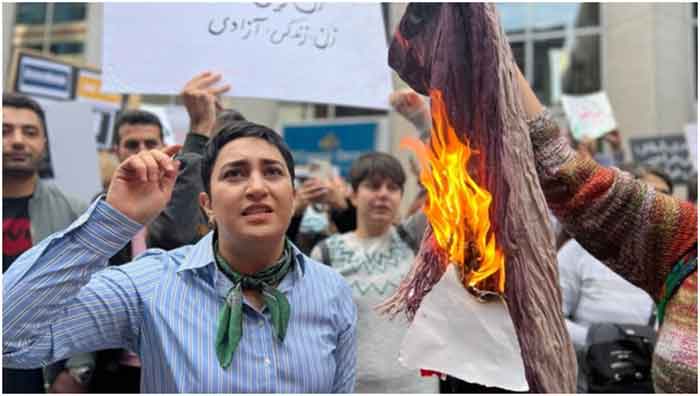
Demonstrators burn a scarf at a protest against the Iranian government on Sunday. (David Bates/CBC)
Iranians took to the streets for a 10th consecutive night Sunday, in defiance of a warning from the judiciary, to protest the death of young Kurdish woman Mahsa Amini in morality police custody.
Images circulated by IHR showed protesters on the streets of Tehran, shouting “death to the dictator,” purportedly after nightfall on Sunday.
Witnesses said that protests in several locations were ongoing.
Many Iranian women protesters have removed and burnt their hijabs in the rallies and cut off their hair, some dancing near large bonfires to the applause of crowds that have chanted “zan, zendegi, azadi” or “woman, life, freedom.”
The demonstrations have spread to all of Iran’s 31 provinces and are the largest since nationwide demonstrations three years ago that were met with a deadly security response that killed hundreds.
Media reports said:
At least 41 people have died since the unrest began, mostly protesters but including members of the Islamic Republic’s security forces, according to an official toll, although other sources say the real figure is higher.
Oslo-based group Iran Human Rights (IHR) said on Sunday evening that the death toll was at least 57, but noted that ongoing internet blackouts were making it increasingly difficult to confirm fatalities in a context where the women-led protests have in recent nights spread to scores of cities.
Hundreds of demonstrators, reformist activists and journalists have been arrested amid the mostly nighttime demonstrations since unrest first broke out after Amini’s death on Sept. 16.
Amini, whose Kurdish first name was Jhina, was detained three days before that for allegedly breaching the rules that mandate tightly-fitted hijab head coverings and which ban, among other things, ripped jeans and brightly colored clothes.
Iran’s largest protests in almost three years have seen security forces fire live rounds and bird shot, rights groups charge, while protesters have hurled rocks, torched police cars and set ablaze state buildings.
Videos circulated on Saturday and Sunday showed protests in several areas of Tehran, as well as in Shiraz, in southern Iran, and Fardis, west of the capital. In one protest in Sattar Khan, a central neighborhood in Tehran, a crowd gathered around what was reported to be a burning police motorcycle, chanting “Don’t be afraid, don’t be afraid, we are all together,” according to a video posted by 1500 Tasvir, an anti-government monitoring group.
The group said in a text message that the pace of protest videos emerging from Iran had slowed late Saturday into Sunday, in part because of internet disruptions imposed by the authorities over the past week, as well as restrictions on apps including Instagram and WhatsApp. Netblocks, an internet monitoring group, said Sunday evening that it had detected a “nation-scale disruption to Mobinet,” one of the largest mobile network operators in Iran.
In Kurdish areas of western Iran, where Amini was from, cities have become “heavily militarized,” by the security forces, said Rebin Rahmani, member of the board of directors of the Kurdistan Human Rights Network, based in Paris.
The cities of Kermanshah, Kamyaran, Sanandaj, Saqqez, Divandarreh, and Oshnavieh were “under tight security control,” he said. Oshnavieh had been shut down for three days, he said, after a “horrible incident where several people were killed Wednesday night.” He denied earlier reports that protesters had routed security forces in the city.
In a rural area called Balo, near Iran’s border with Turkey, families of protesters who were killed last week set fire to a base used Thursday by the Basij paramilitary forces, Rahmani said.
“We haven’t received any videos today,” he said. “Because the internet is cut it’s very difficult to get any news.” Arrests were being carried out based on previously recorded videos of the protests, he added.
As the internet blackout obscured events in Iran, news of the death of a lone protester, a woman, that circulated widely over the weekend sparked fresh anger.
The woman, Hadis Najafi, had been seen in a video last week tying her blond, uncovered hair in a ponytail on the edge of a protest in Karaj, northwest of Tehran. Human rights activists said she was fatally shot by security forces Wednesday.
The world has learnt of the violence largely through shaky mobile phone footage posted on social media, even as authorities have throttled internet access.
Web monitor NetBlocks noted “rolling blackouts” and “widespread internet platform restrictions,” with WhatsApp, Instagram and Skype having already been blocked.
This followed older bans on Facebook, Twitter, TikTok and Telegram.
Protests abroad have been held in solidarity with Iranian women in Athens, Berlin, Brussels, Istanbul, Madrid, New York and Paris, among other cities.
Iran — which is ruled by supreme leader Ayatollah Ali Khamenei, 83, and which has been hit with tough economic sanctions over its nuclear program — has blamed “foreign plots” for the unrest.
Iranian President Ebrahim Raisi threatened a harsh response Saturday, vowing a “decisive strike on the disrupters of security and peace of the country,” in a phone call with the family of a slain member of the security forces, local Iranian news outlets reported.
Echoing a warning the previous day by Iranian President Ebrahim Raisi, judiciary chief Gholamhossein Mohseni Ejei on Sunday “emphasized the need for decisive action without leniency” against the core instigators of the “riots,” the judiciary’s Mizan Online website said.
On Sunday, Ahmad Vahidi, Iran’s interior minister, called on the judiciary to pursue a “quick, decisive, legal confrontation with the leaders and agents of these riots that will teach others a lesson,” according to Hamshahri, a state-run newspaper.
The foreign ministry said Sunday it had summoned Britain’s ambassador over what it described as an “invitation to riots” by Farsi-speaking media based in London, and Norway’s envoy over “unconstructive comments” made by his country’s parliament speaker.
Foreign ministry spokesman Hossein Amir-Abdollahian criticized “the U.S. interventionist approach in the affairs of Iran including its provocative actions in supporting the rioters.”
Pro-government Rallies
Iran has also organized large rallies in defense of the hijab and conservative values.
Pro-government rallies were held Sunday, with the main event taking place in Enghelab (Revolution) Square in central Tehran, where demonstrators voiced support for mandatory hijab laws.
“Martyrs died so that this hijab will be on our head,” said demonstrator Nafiseh, 28, adding that she was opposed to making the wearing of the hijab voluntary.
Another demonstrator, 21-year-old student Atyieh, called for “strong action against the people who are leading” the protests.
The main reformist group inside Iran, the Union of Islamic Iran People’s Party, however, has called for the repeal of the mandatory dress code.
Human rights groups based abroad have sought to shine light on the turmoil rocking Iran, citing their own sources in the country.
IHR reported on Sunday that an umbrella of Iranian teachers’ unions were calling on teachers and students to boycott classes on Monday and Wednesday in support of the protests.
Iranian authorities have yet to state the cause of death of Amini, who activists say died as a result of a blow to the head.
Interior Minister Ahmad Vahidi has said Amini was not beaten and that “we must wait for the final opinion of the medical examiner.”
A tightening crackdown has included the use of live ammunition against demonstrators and heavy deployments of security forces in Kurdish areas of western Iran, where the protests have been concentrated.
18 Journalists Arrested
As of Sunday, at least 18 journalists had been arrested during the unrest, including several who were taken into custody during early morning raids on their homes, the Committee to Protect Journalists said.
Protesters March Through Downtown Ottawa, Burn Headscarf
A CBC report said:
With the death of a young Iranian woman in police custody sparking demonstrations around the world, hundreds of people also took to the streets of Ottawa Sunday to protest against the Iranian government.
“This could have happened to [any] one of us,” said Taraneh, a protester who lived in Iran for about 30 years. CBC is withholding her last name due to her safety concerns.
Taraneh said she and her sister were once arrested by the morality police while in Iran and held for five or six hours. She said she’s frustrated that Iranian women are forced to comply with the strict hijab requirements.
“The women in Iran are not free at all,” she said. “We are tired of this system.”
The protesters marched past Parliament Hill on Wellington Street, down Metcalfe Street and onto Queen Street, where they gathered to chant and burn a scarf in protest.
Police estimated about 1,000 people took part.
“It is not just a matter of hijab anymore. It is not a matter of the morality police forces anymore,” said organizer Rosa Kheirandish, who was born in Iran and moved to Canada in 2001.
“They just want the mandatory Islamic Republic to go.”
Kheirandish said she helped organize the protest so that other Iranians could claw back their freedom from the oppressive government — starting with freedom of religion.
“[They want] that same kind of freedom that we have here in Canada,” said Kheirandish. “I mean, thank God we have it here.”
She said she also hopes the protest raises awareness of what Iranians are facing.
Kheirandish fears that the internet disconnection will precede government violence.
Another protester, Lora Solaimani, said she was concerned internet outages may also impede Iranians’ ability to call to the international community for help.
“They have cut the internet so that we cannot actually see what is going on,” said Solaimani. “I think that needs international attention.”
Protestor Rahil Golipoor, a risk analyst for the federal government, said the oppression of human rights happening in Iran could have a harmful impact worldwide.
“The Islamic Republic of Iran is a risk for the world,” Golipoor said, adding that the actions by the country’s morality police could influence other governments. “They are a virus starting in Iran, but they do not stay in Iran.”
Golipoor said she is demonstrating not just against Iran, but to send a global message against all religious and gender-based discrimination.
“We stand for the future of the world,” said Golipoor. “We do not stay silent for any dictator [or] religion.”
Lavrov said, “instead of having an honest dialogue and looking for compromises, what we're dealing with is disinformation, course stagings, and provocations.”
He said, “the future of the world order is being decided today” adding that “the question is whether or not it will be the kind of order with one hegemon at the head of it, making everyone else follow its rules, which notoriously benefit that hegemon only, or are we going to have a democratic, fair world without blackmail and the fear of Neo Nazism and Neo colonialism.”
Lavrov said, “despite common sense, Washington and Brussels compounded the situation when they announced economic war against Russia. As a result, there is a growing price on foodstuffs, fertilizers, oil and gas.”
He welcomed Secretary-General António Guterres’ efforts towards the Black Sea Grain Initiative agreements but stressed that “they need to be implemented.”
So far, he said, “the ships with the Ukrainian grain go somewhere but not into the poorest countries. On the other hand, the impediments by US and EU, the financial and logistical impediments against our grain and fertilizers have not been lifted.”
The Russian Minister of Foreign Affairs said, “the incapacity of Western countries to negotiate and the continued war by the Kyiv regime against their own people, left us with no choice but to recognize the independence of the Donetsk and Lugansk People's Republic and to start a special military operation to protect the Russian and other people on Donbass, and so as to remove the threats against our security, which NATO had been consistently creating in Ukraine at our borders.”
---
The UN General Assembly (UNGA) is the main policy-making organ of the Organization. Comprising all Member States, it provides a unique forum for multilateral discussion of the full spectrum of international issues covered by the Charter of the United Nations. Each of the 193 Member States of the United Nations has an equal vote.
The United Nations is an international organization founded in 1945. Currently made up of 193 Member States, the UN and its work are guided by the purposes and principles contained in its founding Charter.
The UN has evolved over the years to keep pace with a rapidly changing world.
But one thing has stayed the same: it remains the one place on Earth where all the world’s nations can gather together, discuss common problems, and find shared solutions that benefit all of humanity.
General debate website: https://gadebate.un.org/
----------------------------------------
Watch this video in its original spoken language: https://youtu.be/lKuDHkz6Ai0
A US official rejects Putin’s claim that NATO sabotaged a "peaceful settlement" with Ukraine early in the war. Whatever happened then, it is not too late for diplomacy in this perilous moment.
Secretary of State Antony Blinken, flanked by senior State Dept. official Victoria Nuland, at the UN on Sept. 22. (Michael M. Santiago/Getty Images)
In his Sept. 21 speech announcing an escalation of Russia’s invasion of Ukraine, Russian President Vladimir Putin accused NATO states of sabotaging a peace deal that could have ended it months ago.
At talks brokered by Turkey in March, Putin said, “Kiev representatives voiced quite a positive response to our proposals... But a peaceful settlement obviously did not suit the West, which is why, after certain compromises were coordinated, Kiev was actually ordered to wreck all these agreements.”
Speaking at the United Nations hours later, President Joe Biden criticized the Russian leader but did not address his claim that the US thwarted negotiations.
Asked about Putin’s remarks, officials from the White House’s National Security Council (NSC) and the State Department offered differing responses.
An NSC official referred me to the Ukrainian government for comment about “their peace negotiations in the spring.” But overall, the official added, “it is inaccurate that the U.S. discouraged Ukraine from seeking a peace agreement. Throughout this conflict, we have said that it is up to Ukraine to make their own sovereign decisions.”
A State Department spokesperson did not address Putin’s rendering of the March-April negotiations, and instead focused on the period before the invasion.
“As part of our efforts to deter President Putin from launching a full-scale invasion of Ukraine’s sovereign territory on February 24, 2022, the United States consistently spoke of the two paths Russia could choose: dialogue and diplomacy, or escalation and massive consequences,” the State Department wrote. “We made genuine and sincere efforts to pursue the former, which we vastly preferred, but Putin chose war.”
Asked if it had any response to Putin’s account of the peace talks that occurred after the invasion, the State spokesperson did not respond.
The Russian government has not offered any additional detail or evidence for Putin’s claim that Ukraine and Russia were close to a “settlement,” and that Kiev’s NATO backers intervened to “wreck” it. But the Kremlin is also not the first to assert it. The claim originated with sources to Ukrainian President Volodymyr Zelensky, who described the episode to Ukrainian media outlet Ukrayinska Pravda.
According to their account, talks between Ukraine and Russia collapsed after then-UK Prime Minister Boris Johnson visited Kiev in April and informed Zelensky that Putin “should be pressured, not negotiated with.” Johnson also relayed that “even if Ukraine is ready to sign some agreements on [security] guarantees with Putin,” Western nations “are not.”
That report was followed this month by an overlooked disclosure from former White House Russia expert Fiona Hill. Citing “multiple former senior U.S. officials,” Hill wrote that “Russian and Ukrainian negotiators appeared to have tentatively agreed on the outlines of a negotiated interim settlement” in April. Russia would withdraw to its pre-invasion position, while Ukraine would pledge not to join NATO “and instead receive security guarantees from a number of countries.”
If the Ukrainian Pravda account is accurate, then it was the UK’s Johnson, presumably acting at the behest of the US, that undermined this agreement.
And even if Putin is exaggerating the negotiations’ progress, or Western responsibility for their collapse, his claim that Russia and Ukrainian officials were close to a “peaceful settlement” signals that one may still be possible.
David Ignatius, the Washington Post foreign affairs columnist, appears to be the only establishment media journalist who reported Putin’s remarks. In Ignatius' view, the Russian leader’s claim about a thwarted peace deal in the spring offers a potential, if unlikely, “off-ramp” today. Invoking the 1962 Cuban Missile Crisis, Ignatius compared Putin’s comment to the message from Soviet leader Nikita Khrushchev that offered President John F. Kennedy “a path to de-escalation.” As with Khrushchev’s private overture to Kennedy, Putin’s claim about peace talks, Ignatius writes, is now Biden’s “letter to answer.”
As for the Ukrainian government, he added, Kiev “needs a reality check about its longer-term battlefield prospects.” That seems unlikely: in response to Putin’s threat that Russia could use nuclear weapons to defend itself, a Zelensky advisor urged the US and other powers to pledge “swift retaliatory nuclear strikes to destroy the nuclear launch sites in Russia,” if Moscow “even thinks of carrying out nuclear strikes” in Ukraine.
If the White House is to heed Ignatius’ advice and pursue an off-ramp with Russia, the US approach to diplomacy may also require a reality check. Despite the State Department’s claim to have “made genuine and sincere efforts” for “dialogue and diplomacy” with Russia prior to the invasion, the available record tells a different story.
As the Ukraine crisis escalated in January, a US official specializing in Russia relayed that “the Russians are still interested in a real dialogue,” according to the Washington Post. Russia’s goal, this official said, is “to see whether Washington is willing to discuss any sort of commitment that constrains U.S. power." But in the ensuing weeks leading up to Russia’s Feb. 24 invasion, Washington made clear that such constraints were a non-starter.
Russia’s core demands came on two tracks. The Kremlin asked the US and NATO to return their nearby military footprint to pre-1990s levels by withdrawing offensive weaponry and troops from states on Russia’s borders. As for Ukraine, Moscow sought guarantees that Kiev would not join NATO and that it would finally implement the 2015 Minsk accords, the agreement to end Kiev’s war with Russia-allied rebels in Ukraine’s Donbas region. That eight-year war, triggered by the 2014-US backed Maidan coup, left an estimated 14,000 dead, with over 80% of civilian casualties since 2018 occurring in the breakaway, rebel-held Donbas regions.
The collapsing US military & economic empire is making Washington & NATO even more dangerous. US could not beat the Taliban but thinks it can take on China-Russia-Iran...a sign of psychopathology for sure. @BruceKGagnon