The Untold Story of Christian Zionism’s Rise to Power in the United States
Well before Theodore Herzl founded political Zionism and published The Jewish State, Christian Zionists in the United States and England were already seeking to direct and influence the foreign policy of both nations in service to a religious obsession end times prophecy
The largest pro-Israel organization in the United States is not composed of Jews, but of Christian evangelicals, with a total membership of 7 million, more than 2 million more members than the entirety of the American Jewish community.
Members of this organization, Christians United for Israel (CUFI), met in Washington on Monday, attracting thousands of attendees and featuring speeches from Israeli Prime Minister Benjamin Netanyahu, Secretary of State and former CIA Director Mike Pompeo, Vice President Mike Pence, and National Security Advisor John Bolton. CUFI’s leader, controversial evangelical preacher John Hagee, has met with President Donald Trump several times and was recently part of an exclusive White House meeting in March on the administration’s upcoming “peace plan” for Israel and Palestine.
CUFI is but one of many organizations throughout American history that have promoted the state of Israel and Zionism on the grounds that a Jewish ethnostate in Palestine is a requirement for the fulfillment of end-times prophecy and necessary for Jesus Christ to return to Earth — an event Christians often refer to as “the Second Coming.”

While organizations like CUFI and its predecessors have long seen the creation of the state of Israel in 1948, and the later Israeli victory and conquest of Jerusalem in 1967, as the fulfillment of Biblical prophecy, there is one prophecy that this sect of evangelical Christians believes is the only thing standing between them and the Second Coming. There are estimated to be more than 20 million of these Christians, often referred to as Christian Zionists, in the United States and they are a key voting bloc and source of political donations for the Republican Party.
As was explored in previous installments of this series, these Christian Zionists, much like religious Zionist extremists in Israel, believe that the Al Aqsa mosque and the Dome of the Rock must be replaced with a Third Jewish Temple in order to usher in the end times.
These two groups of different faiths, since the 19th century, have repeatedly formed an opportunistic alliance in order to ensure the fulfillment of their respective prophecies, despite the fact that members of the other faith are rarely if ever on the same page in their interpretations of what occurs after the temple’s construction.
This alliance, based on a mutual obsession with hastening the coming of the Apocalypse, continues to this day and now, more than at any other time in history, these groups have reached the heights of power in both Israel and the United States. Parts I and II of this exclusive series explored how this branch of religious Zionism has come to dominate the current right-wing government of Israel and has led Israel’s current government to take definitive steps towards the destruction of the Al Aqsa mosque and the imminent construction of a Third Temple.
Now this installment (Part III) will show how this movement’s Christian counterpart in the United States, Christian Zionism, has likewise become a dominant force in American politics, particularly following the election of Donald Trump to the presidency, where this apocalyptic vision is a major driver behind his administration’s Middle East policy.
Yet, this fire-and-brimstone vision of the end times has long been a guide for prominent figures in American history and the American elite, even predating Zionism’s founding as a political movement. Thus, Christian Zionism’s influence on Trump administration policy is merely the latest of a long list of examples where prophecy and politics have mixed in American history, often with world-altering results.
Puritans, Prophecy and Palestine
Accounts of the role of European and North American Christians in the creation of the state of Israel often begin with the Balfour Declaration of 1917, but the efforts of certain Christian groups in England and the United States to create a Jewish state in Palestine actually date back centuries earlier and significantly predate Zionism’s official founding by Theodore Herzl.
Among the first advocates for the physical immigration of European Jews to Palestine were the Puritans, an offshoot of Christian Protestantism that emerged in the late 16th century and became influential in England and, later, in the American colonies. Influential Puritans devoted considerable interest to the role of Jews in eschatology, or end-times theology, with many — such as John Owen, a 17th-century theologian, member of parliament, and administrator at Oxford — believing that the physical return of Jews to Palestine was necessary for the fulfillment of end-time prophecy.
While the Puritan roots of what would later become known as Christian Zionism are often overlooked in modern accounts of where and why American evangelical support for Israel began, its adherents still clearly acknowledge its legacy. For instance, on Monday at the CUFI conference, Pompeo, himself a Christian Zionist known for his obsession with the end times, told the group the following:
Christian support in America for Zion — for a Jewish homeland — runs back to the early Puritan settlers, and it has endured for centuries. Indeed, our second president [John Adams], a couple years back, said… ‘I really wish the Jews again in Judea an independent nation.’
These Puritan beliefs, which persist today and have only grown in popularity, became more entrenched in England and colonial America with time, especially among the monied political class, and led to a variety of interpretations regarding exactly what the Bible says about the end times. Among the most influential was the development of Christian “dispensationalism,” an interpretive framework that uses the Bible to divide history into different periods of “dispensations” and sees the Bible’s prophetic references to “Israel” as signifying an ethnically Jewish nation established in Palestine.
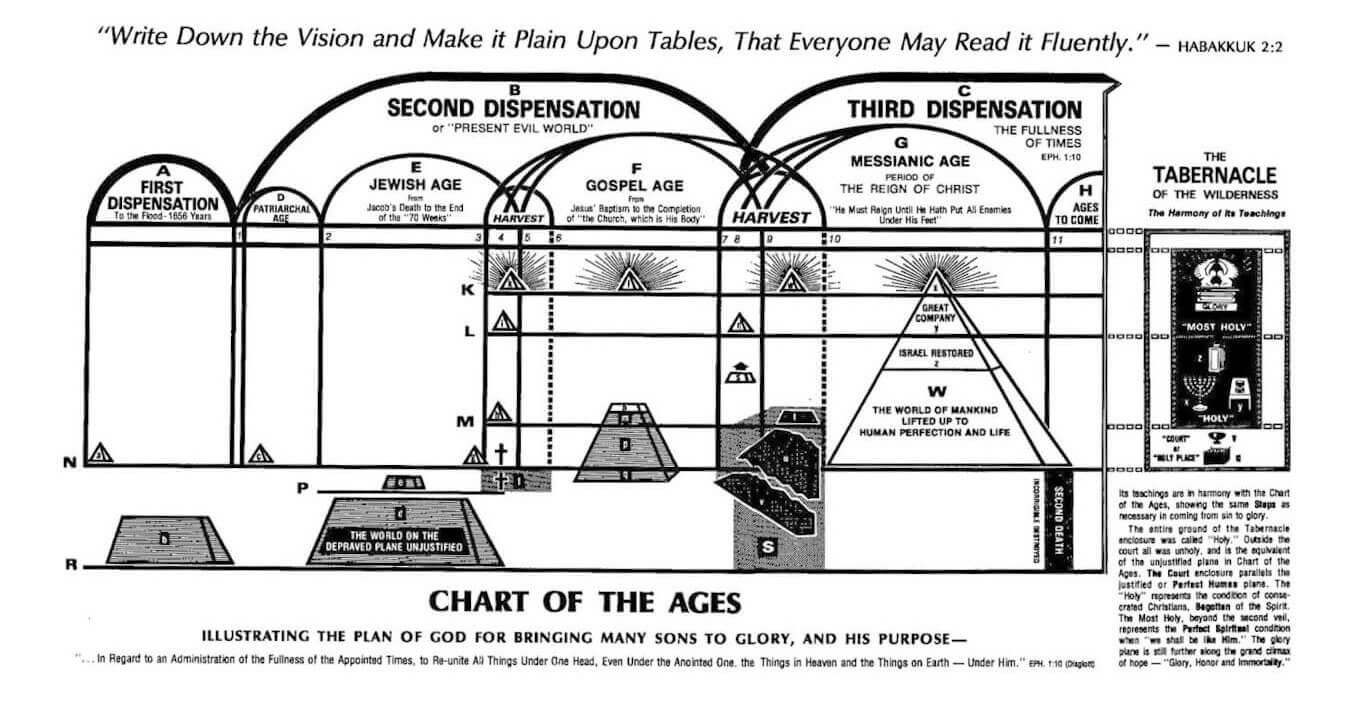
Charles Russell’s visual interpretation of Darby’s ‘dispensations’ circa 1886
Dispensationalism was largely developed by English-Irish preacher John Nelson Darby, who believed that the God-ordained fates of Israel and the Christian church were completely separate, with the latter to be physically removed from the Earth by God prior to a foretold period of earthly suffering known as the Tribulation.
In Darby’s view, the Tribulation would begin following the construction of a Third Jewish Temple on the Temple Mount in Jerusalem. This belief in the physical removal of Christians from the Earth prior to the Tribulation, widely known as “the rapture,” was invented by Darby in the 1820s and its lack of scriptural support has been widely noted by theologians of various denominations as well as biblical scholars. However, it is important to point that there are differences among dispensationalist Christians as to whether the rapture will occur before, during or after the Tribulation period.
Yet, despite its relatively short existence as an idea and lack of support in the Bible, the rapture was enthusiastically adopted by some churches in England and the United States, particularly the latter. This was largely thanks to the work of highly controversial theologian Cyrus Scofield.
Notably, Darby’s brand of Christian eschatology coincides with similar developments in Jewish eschatology, namely the ideas of Rabbi Zvi Hirsh Kalisher and the creation of a new branch of Jewish messianism that believed that Jews must proactively work to hasten the coming of their messiah by immigrating to Israel and building a Third Temple on the Temple Mount in Jerusalem. Darby’s beliefs, and those he inspired promoted something similar in the sense that Christians could hasten the coming of the rapture and the Tribulation by promoting the immigration of Jews to Israel as well as the construction of a Third Jewish Temple.
Christian Zionists pave the way for Theodore Herzl
Darby traveled to North America and several other countries to popularize his ideas, meeting several influential pastors throughout the English speaking world, including James Brookes, the future mentor of Cyrus Scofield. His travels and the spread of his written works popularized his eschatological views among certain circles of American and English Christians during the religious revival of the 19th century. Darby’s beliefs were particularly attractive to the elite of both countries, with some English noblemen placing newspaper advertisements urging Jews to immigrate to Palestine as early as the 1840s.
Another prominent figure influenced by Darby’s end-times doctrine was the American preacher Charles Taze Russell, whose church later gave rise to several different churches, including the Jehovah’s Witnesses. Decades before the founding of modern political Zionism, Russell began preaching — not just to Christians, but to Jews in the United States and elsewhere — about the need for mass Jewish immigration to Palestine.
As Rabbi Kalisher had done a few decades prior, Russell penned a letter in 1891 to a wealthy member of the Rothschild banking family, Edmond de Rothschild, as well as Maurice von Hirsch, a wealthy German financier, about his plan for the Jewish settlement of Palestine. Russell described his plan as follows:
My suggestion is that the wealthy Hebrews purchase from Turkey, at a fair valuation, all of her property interest in these lands: i.e., all of the Government lands (lands not held by private owners), under the provision that Syria and Palestine shall be constituted a free state.”
The same plan was to resurface a few years later in arguably the most influential Zionist book of all time, Theodore Herzl’s The Jewish State, which was published in 1896.
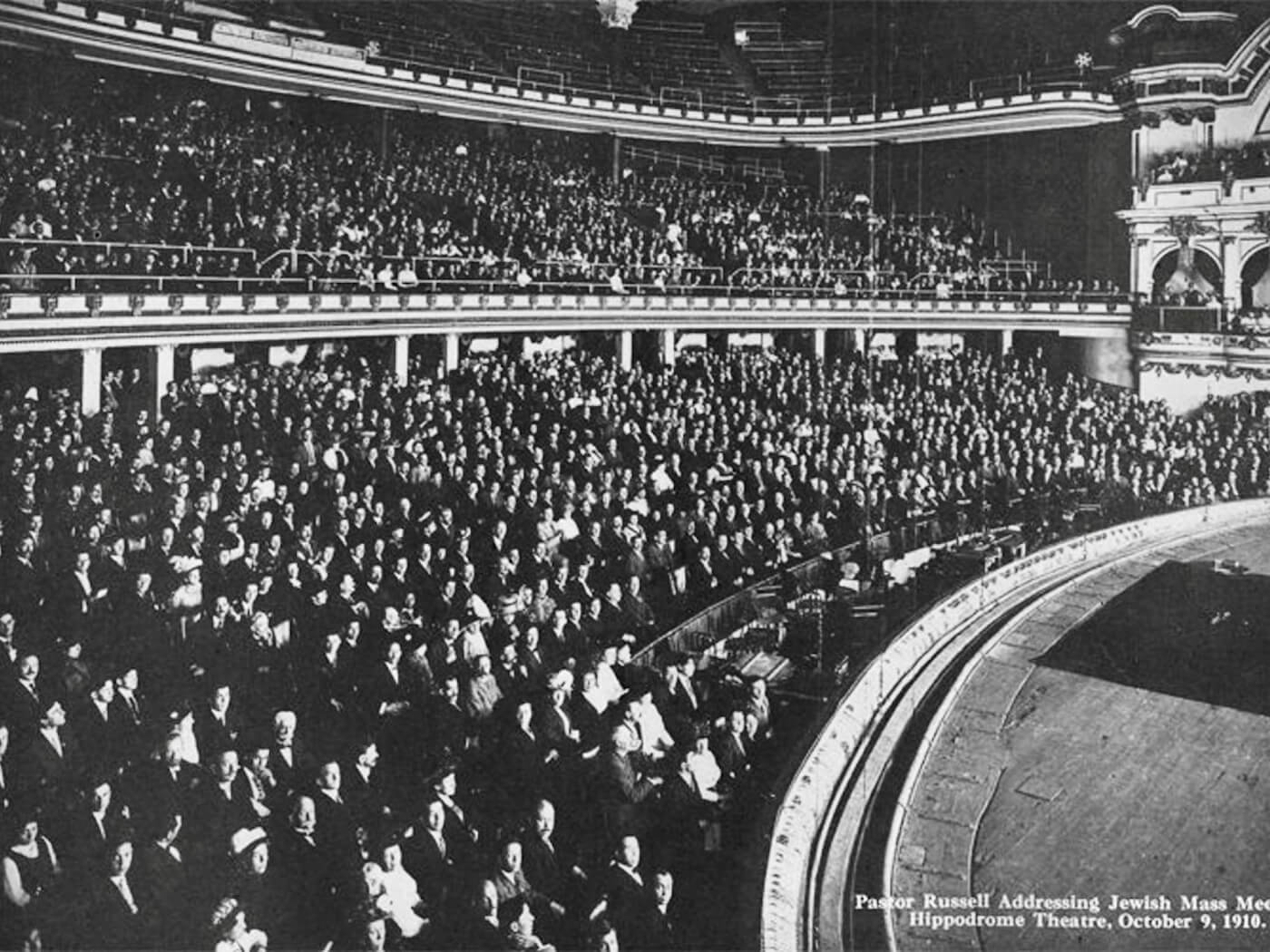
Russell addresses an audience of American Jews in New York in 1910. Photo | Public Domain
It is unknown whether Rothschild or Hirsch was influenced at all by Russell’s letter, though Russell’s ideas did have a lasting impact on some prominent American Jews and American Christians with regard to his promotion of Jewish immigration to Palestine.
The same year that Russell wrote his letter to de Rothschild and von Hirsch, another influential dispensationalist preacher wrote another document that is often overlooked in exploring the role of American Christians in the development and popularization of Zionism. William E. Blackstone, an American preacher who was greatly influenced by Darby and other dispensationalists of the era, had spent decades promoting with great fervor the immigration of Jews to Palestine as a means of fulfilling Biblical prophecy.
The culmination of Blackstone’s efforts came in the form of the Blackstone Memorial, a petitionthat pleaded that then-President of the United States Benjamin Harrison and his secretary of state, James Blaine, take action “in favor of the restoration of Palestine to the Jews.” The largely forgotten petition asked Harrison and Blaine to use their influence to “secure the holding at an early date, of an international conference to consider the condition of the Israelites and their claims to Palestine as their ancient home, and to promote, in all other just and proper ways, the alleviation of their suffering condition.”
As with Russell’s letter to de Rothschild and von Hirsch, it is unknown exactly how influential the Blackstone Memorial was in influencing the views or policies of Harrison or Blaine. However, the Blackstone Memorial petition is highly significant because of its signatories, which included the most influential and wealthiest Americans of the era, the majority of whom were Christians.
Signatories of the Blackstone Memorial included J.D. Rockefeller, the country’s first billionaire; J.P. Morgan, the wealthy banker; William McKinley, future president of the United States; Thomas Brackett Reed, then speaker of the House; Melville Fuller, Chief Justice of the Supreme Court; the mayors of New York City, Philadelphia, Baltimore, Boston and Chicago; the editors of the Boston Globe, New York Times, Washington Post, and Chicago Tribune, among others; and numerous other members of Congress, as well as influential businessmen and clergymen. Though some rabbis were included as signatories, the petition’s content was opposed by most American Jewish communities. In other words, the primary goal of Zionism, before it even became a movement, was widely supported by the American Christian elite, but opposed by American Jews.
The Blackstone Memorial would later attract the attention of Louis Brandeis, one of the most prominent American Jewish Zionists, who would later refer to Blackstone as the real “founding father of Zionism,” according to Brandeis’ close friend Nathan Straus. Brandeis would eventually succeed in convincing an elderly Blackstone to petition then-President Woodrow Wilson with a second Blackstone Memorial in 1916 that was presented in private to Wilson nearly a year later.
Instead of gathering signatures from prominent members of America’s elite class, Blackstone this time focused on shoring up support from Protestant organizations, namely the Presbyterian Church, in keeping with Wilson’s Presbyterian faith. According to historian Jerry Klinger, president of the Jewish American Society for Historic Preservation, this change in focus had been Brandeis’, not Blackstone’s, idea.
Alison Weir, author of Against Our Better Judgment: The Hidden History of How the U.S. Was Used to Create Israel, described Brandeis as “one of the most influential” American Zionists and a key figure in the efforts to push Wilson to support the formation of a Jewish state in Palestine, of which Blackstone’s second petition was part. However, Weir asserted that Blackstone’s second petition was secondary to a so-called “gentleman’s agreement” whereby English officials promised to support a Jewish state in Palestine if American Zionists, led by Brandeis, were able to secure the United States’ entry into World War I.
Wilson ultimately supported Blackstone’s new document, which was never presented publicly to the president, but privately by Rabbi Stephen Wise. This second Blackstone Memorial was a key component of the Brandeis-led campaign that eventually guaranteed American support — i.e., private support — for the Balfour Declaration, which established British intentions to support a Jewish ethnostate in Palestine. Notably, the Balfour Declaration is named for the then-English Foreign Secretary Arthur Balfour, himself a Christian dispensationalist, though Weir told MintPress that Balfour was more likely influenced by political imperatives than religious motives. The only person in the British cabinet to oppose the Balfour Declaration was its only Jewish member, Edwin Montagu.
The Balfour Declaration was addressed to a member of the Rothschild banking family, Lionel Walter Rothschild, the last in a series of letters written to members of the Rothschild family urging them to use their wealth and political influence to favor the creation of a Jewish state in Palestine: from Rabbi Kalisher, who wrote to Baron Amschel Rothschild in 1836; to Charles Taze Russell, who wrote to Edmond de Rothschild in 1891; and finally to the Balfour Declaration, written to Lionel Walter Rothschild in 1917.
Weir told MintPress that the Rothschilds figure so prominently in these early efforts to establish a Jewish state in Palestine owing to “their wealth and the power that goes with it,” making them very sought after by those who felt that a Jewish state could be formed in Palestine by the purchase of the territory by wealthy European Jews, as both Kalisher and Russell had proposed. However, the Balfour Declaration was addressed to the Rothschilds because, at that time, members of the Rothschild family, Edmond de Rothschild in particular, had become among the strongest supporters of the Zionist cause.
Though the declaration carries his name, it is unclear whether Balfour himself actually authored the document. Some historians — such as Michael Rubinstein, former president of the Jewish Historical Society of England — have made the case that the declaration itself was written by Leopold Amery, then-political secretary of England’s War Cabinet and a Zionist who, despite his commitment to the Zionist cause, obfuscated his Jewish roots for much of his career for reasons that are still the source of speculation.
As shown by the Balfour Declaration and the lobbying efforts that led to its creation, support for what would soon become known as Zionism among the nobility of England and the United States was already formidable before Herzl even began work on The Jewish State. It is worth considering that the power and influence of this religiously-motivated class of Christian elites had an influence on Herzl and his ideas, particularly given the fact that dispensationalist Christians had been promoting a Jewish ethnostate in Palestine at a time when the idea was unpopular among many prominent Jews in Europe and the United States.
Furthermore, the role of Christian Zionists, as they would later become known, continued well after Herzl began his Zionist activities, and resulted in many of the most influential acts that led to the establishment of the State of Israel, including the Balfour Declaration.
Notably, Herzl’s own success in promoting his views following the publication of The Jewish State was largely due to English dispensationalist pastor William Hechler. Hechler, while serving as chaplain at the British Embassy in Vienna, forged an alliance and later close friendship with Herzl and was critical to negotiating meetings between Herzl and prominent members of the German government, including Kaiser Wilhelm II, which lent necessary political legitimacy to Herzl’s Zionist movement.
A largely overlooked figure in the rise of Zionism, Hechler is mentioned in Herzl’s diary more than any other person and passionately felt that the creation of a Jewish state in Palestine would bring about the end times. Hechler is also known to have been extremely interested in the construction of a Third Jewish Temple on the Temple Mount, having devoted considerable time to creating models of that Temple, some of which he prominently displayed in his office and showed to Herzl with great enthusiasm during their first meeting.
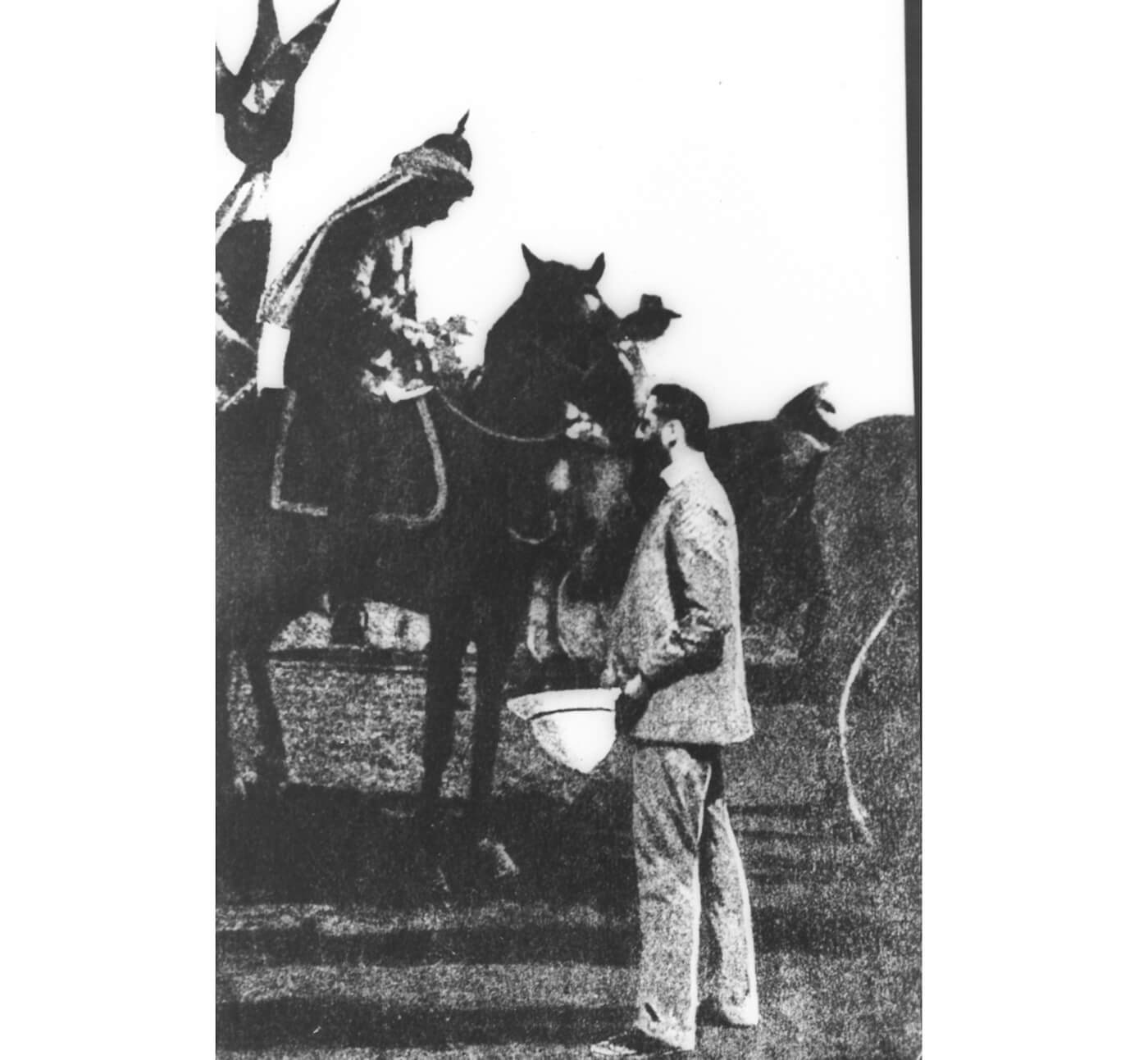
Herzl gives Kaiser Wilhelm II a tour of an early Jewish settlement near Jaffa, Palestine in 1898. Photo | Israel GPO
The Hechler-Herzl alliance is one early example of how Christian Zionists and Jewish Zionists each used the motivations of the other for political gain despite the fact that Christian Zionists often hold anti-Semitic views and secular Zionists, as well as religious Zionists, do not hold Christianity in high regard. This opportunism on the parts of both Christian and Jewish Zionists has been a key feature in the rise of Zionism, particularly in the United States, and the case of Cyrus Scofield, the man more responsible than any for popularizing Christian Zionism among American evangelicals, offers another important example.
The surprising story of Cyrus Scofield
There is perhaps no other book that has been more influential in the dissemination of Christian Zionism in the United States than the Scofield Reference Bible, a version of the King James Bible whose annotations were written by Cyrus Scofield. Scofield — who had no formal theological training, though he later claimed to have a D.D. (doctor of divinity degree) — originally worked as a lawyer and political operative in the state of Kansas and eventually became the district attorney of that state.
Soon after his appointment to the position, he was forced to resign as a result of numerous allegations of corruption, including bribery, forging signatures on banknotes and stealing political donations from then-Senator of Kansas James Ingalls. During this time, Scofield abandoned his wife and two daughters, an action since blamed on the burgeoning scandals he was facing as well as his self-admitted heavy drinking habits.
Amid this backdrop, Scofield is said to have become an evangelical around the year 1879 and soon became associated with prominent dispensationalist preachers of the era, including Dwight Moody and James Brookes. Local papers at the time, such as the Atchison Patriot, regarded Scofield’s conversion and career change with great skepticism, referring to Scofield as the “late lawyer, politician and shyster generally” who had disgraced himself by committing “many malicious acts.”
Scofield went on to pastor relatively small churches, moving from Kansas to Dallas, Texas, and later Massachusetts. Yet, despite his lack of renown and his troubled history, by 1901 Scofield had managed to gain entrance to an exclusive men’s club in New York, the Lotos Club, whose members at the time included steel magnate and multi-millionaire Andrew Carnegie, members of the Vanderbilt family, and famous American writer Samuel Clemens, better known by his pen name, Mark Twain.
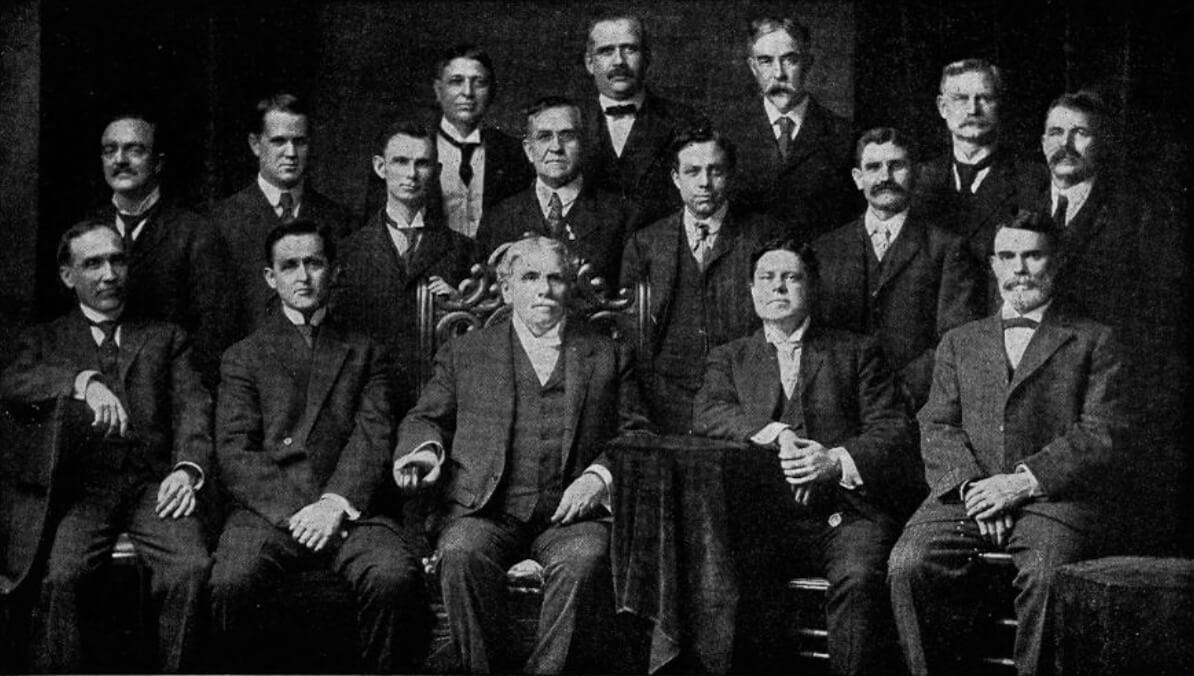
Pastor Scofield, center, with the Deacons of the First Congregational Church of Dallas, circa 1880s
Scofield’s membership in this exclusive club — as well as the club’s patronage of his activities, which granted him lodging and financing to produce what would become the Scofield Reference Bible — has been the subject of considerable speculation. Indeed, many have noted that the presence of a fundamentalist, dispensationalist small-town preacher with a disgraced political past in a club stuffed with some of the country’s most elite academics, writers and robber barons just doesn’t add up.
Joseph M. Canfield, in his book The Incredible Scofield and his Book, asserted that “the admission of Scofield to the Lotus Club, which could not have been sought by Scofield, strengthens the suspicion that has cropped up before, that someone was directing the career of C.I. Scofield.”
Canfield puts forth the theory in his book that the person “directing” Scofield’s career was connected to New York lawyer and Zionist activist Samuel Untermeyer, who was on the club’s executive committee and was a close associate of Louis Brandeis and influential in the administration of Woodrow Wilson. He then notes that Scofield’s annotated bible was later “most helpful in getting Fundamentalist Christians to back the international interest in one of Untermeyer’s pet projects — the Zionist Movement.”
Other scholars, such as David Lutz, have been more explicit than Canfield in linking Untermeyer’s Zionist activism to his role in financially backing Scofield and his work on his annotated Bible. Ultimately, like the Blackstone Memorial before it, the Lotos Club’s patronage of Scofield’s work again reveals the interest of the American elite of the era, Christian and Jewish alike, in promoting Christian Zionism.
Untermeyer and the Lotos Club notably also funded Scofield’s numerous travels to Europe, including one fateful trip to England where Scofield met with Henry Frowde, publisher of Oxford University Press. Frowde was taken with Scofield’s work, largely owing to the fact that Frowde was a member of the “Exclusive Brethren,” a religious group founded by John Nelson Darby, the father of dispensationalism. Oxford University Press subsequently published the Scofield Reference Bible in 1909. Twenty years after its publication, it became the first-ever Oxford publication to generate over a million dollars in sales.
Scofield’s Bible became spectacularly popular among American fundamentalists soon after its publication, partly because it was the first annotated bible that sought to interpret the text for the reader as well as because it became the central text of several influential seminaries that were set up after its 1909 publication. Among Scofield’s many annotations are claims that have since become central to Christian Zionism, such as Scofield’s annotation of Genesis 12:3 that those who curse Israel (interpreted by Christian Zionists to mean the state of Israel since its founding in 1948) will be cursed by God and those that bless Israel will similarly be blessed.
Modern Christian Zionists, like Pastor John Hagee of Christians United for Israel (CUFI), have frequently cited this interpretation that originated with Scofield in defending extreme pro-Israel stances. For instance, Hagee made the following statement in 2014:
You have to go back to basics, with the fact that in Genesis (chapter 1), God created the world and made a very solemn promise (brought in Gen. 12:3), ‘I will bless those who bless you and I will curse those who curse you.’ From that moment on, every nation that ever blessed Israel has been blessed by God. And every nation that has ever persecuted the Jewish people, God crushed. And so He will continue.”
Falwell and Likud: a friendship or something else?
Despite the widespread dissemination of the Scofield Reference Bible and its popularization among American evangelical churches and seminaries, the public influence of dispensationalist eschatology and Christian Zionism on American politics was relatively limited for much of the 20th century. However, the private influence of Christian dispensationalists was nonetheless present, as seen through the role of dispensationalist preacher and Third Temple advocate Billy Graham and his close relationships to several presidents including Dwight Eisenhower, Lyndon Johnson and Richard Nixon.
Then the political power of dispensationalist theology dramatically moved from the private quarters of the halls of power into the mainstream American political discourse with the founding of the Moral Majority by evangelical preacher Jerry Falwell in 1979.
In the early 1970s, Falwell’s growing ministry was bringing in millions of dollars annually, especially his nationally broadcast program “The Old Time Gospel Hour,” which ran on several major cable networks at the time. Despite — or perhaps because of — the spike in donations, Falwell was soon targeted by the federal government, specifically the Securities and Exchange Commission (SEC), for “fraud and deceit” and “gross insolvency” in the financial management of his ministry, particularly the ministry’s sale of $6.6 million in church bonds. The SEC lawsuit was eventually settled when a group of businessmen in Lynchburg, Virginia — where Falwell’s ministry was based — took over the ministry’s finances for the next several years, until 1977. Falwell blamed his ministry’s financial problems on his “financial ignorance.”

Jerry Falwell travels with his son Jonathan, right, aboard his private jet in 2004. Todd Hunley | Thomas Road Baptist Church
One year after his ministry appeared to be on a better financial footing, Falwell received an invitation to visit the state of Israel and was personally invited on the all-expenses-paid trip by Menachem Begin, then the prime minister of Israel and leader of the Likud Party. The trip would mark the beginning of a long friendship and close relationship between Falwell and Begin and, more broadly, a relationship between American evangelical leaders and Israel’s Likud Party. As Israeli historian Gershom Gorenberg notes in his book The End of Days: Fundamentalism and the Struggle for the Temple Mount, the Begin administration “was the first to tap evangelical enthusiasm for Israel and turn it into political and economic support.”
Soon after returning from Israel, Falwell’s finances again came under federal scrutiny after a federal investigation found that Falwell had transferred the health insurance policies of his employees to an unlicensed shell company with just $128 in assets and hundreds of thousands in dollars in unpaid claims. Just as Falwell’s financial troubles began to mount yet again, he received a generous gift from none other than Begin in the form of a private Learjet valued at $4 million. Shortly thereafter, Falwell went on to found the Moral Majority organization, “after consultations with theologians and political strategists.”
The Moral Majority is widely credited with turning the Christian evangelical right into a major political force in the United States, promoting extremely pro-Israel policies, increased defense spending, a Reaganite approach to the challenges of the Cold War, as well as conservative domestic policies. Falwell frequently utilized his gift from Begin in traveling and promoting the new organization, as well as himself as a major public figure.
The Moral Majority marks a clear turning point in the Israel-U.S. evangelical relationship, as it made fervent support for Israel an area of major importance to evangelical voters and also led many evangelical voters to pay closer attention to events going on in the Middle East. Yet, given Falwell’s strong promotion of Christian Zionism, many evangelicals who became increasingly politically active following the organization’s founding not only supported Israel’s policies of the era but also supported many of the future ambitions of Begin and the Likud Party. This support was solidified by the beginning of the Israeli Ministry of Tourism’s ongoing practice of offering U.S. evangelical leaders free “familiarization” tours to Israel in the early 1980s.
Begin’s vision of “Greater Israel” — the complete annexation of Palestine as well as large parts of Lebanon, Syria, Iraq and Egypt by Israel — was also shared and promoted by Falwell. In 1983, Falwell stated that “Begin will quickly tell you, ‘We don’t have all the land yet we’re going to have,’” and further predicted that Israel would never relinquish control over the occupied West Bank because Begin was determined to keep the land “which has been delivered to them (the Israelis).”
Falwell framed Begin’s expansionist ambitions as a religious belief in “the inerrancy of the Old Testament,” a sentiment Falwell shared. Falwell also pushed for a U.S. recognition of Jerusalem as the capital of Israel and felt that construction of a Third Temple on the Temple Mount was necessary to usher in the end times and the second coming of Christ.
As Falwell helped turn Christian Zionism into a major political force in the United States, he also made himself a key political figure in the Reagan era and an important go-between for U.S.-Israel relations. In 1981 Begin informed Falwell of his plans to bomb an Iraqi nuclear facility before he informed the Reagan administration with the hopes that Falwell would “explain to the Christian public the reasons for the bombing.” According to Canadian academic David S. New, Begin told Falwell during that phone call: “Get to work for me.”
In addition, Falwell frequently met with Begin, whom he later called a personal friend, and these meetings often overlapped with Begin’s official meetings with Reagan. A year later, Begin gave Falwell Israel’s Jabotinsky award, making Falwell the first non-Jew to receive the honor for his advocacy on behalf of Israel and, more specifically, Likud policies and ambitions.
Though the Moral Majority officially shuttered its doors in 1989, its political legacy persisted long after, as did Falwell’s political clout. Indeed, following Begin’s model, Benjamin Netanyahu, during his first term as prime minister, also made a habit of visiting Falwell, meeting with the controversial pastor even before he met with political officials in his visits to Washington.
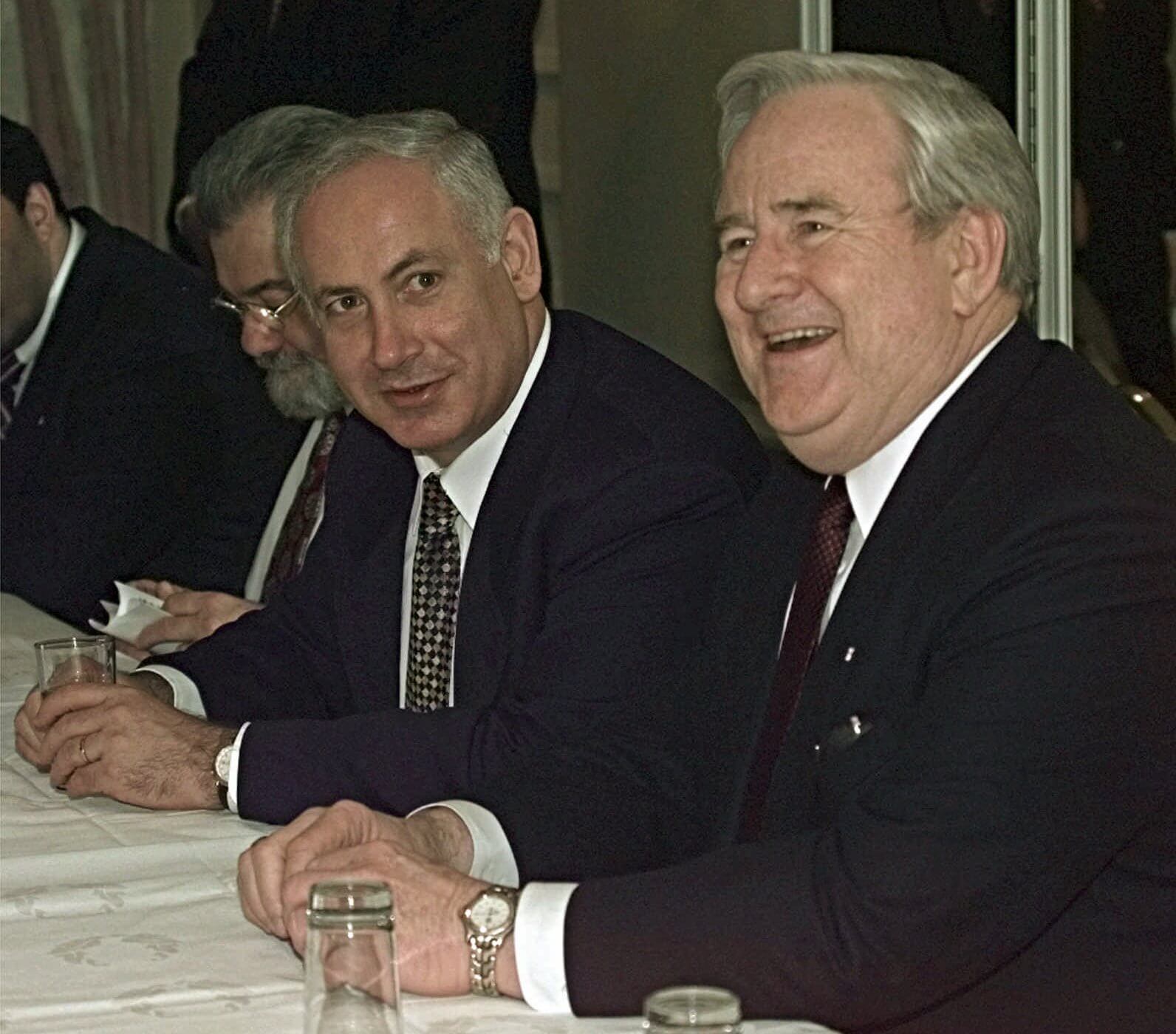
Netanyahu, left, meets Falwell at a hotel in Washington, Jan. 19, 1998. Greg Gibson | AP
During one trip to D.C. in 1998, Netanyahu’s first visit was to an event co-hosted by Falwell, where the pastor praised Netanyahu as “the Ronald Reagan of Israel.” The New York Timesdescribed the purpose of Netanyahu’s U.S. visit not as a visit aimed at meeting with government officials, but rather one intended “to shore up his base of traditional support in the United States. Conservative Christian groups have long been ardent supporters of Israel because of its religious importance to Christianity.”
However, this relationship between Christian Zionists like Falwell and prominent right-wing Israeli politicians has not been without its controversy, especially given that pro-Israel evangelicals like Falwell have a history of making anti-semitic statements.
For example, during a 1999 sermon, Falwell discussed his interpretation of end-times prophecy, widely shared by Christian Zionist evangelicals, that the Second Coming would follow not just the creation of the state of Israel but the construction of a Third Temple on the Temple Mount, from which a figure known to Christians as the “Antichrist” would reign. In responding to his own rhetorical question as to whether the Antichrist is “alive and well today,” Falwell stated that “Probably because when he appears during the tribulation period he will be a full-grown counterfeit of Christ. Of course, he’ll be Jewish.”
Falwell’s comments were immediately condemned by a variety of Jewish groups, including the pro-Israel Anti-Defamation League (ADL). Rabbi Leon Klenicki, then-director of interfaith affairs for the ADL, noted that Falwell’s view is a “common theological position” among American evangelicals and that Falwell was “an influential voice among evangelical and charismatic Christians” who “only supports Israel for his own Christological ends.” “He sees us only as the ones who prepare the coming of Jesus,” Klenicki stated at the time. “It is a great disappointment after more than 30 years of dialogue; he’s still in the Middle Ages.”
Another prominent dispensationalist with great political and literary influence is Hal Lindsey, the author and co-author of several books, including The Late Great Planet Earth. Lindsey’s work greatly influenced many prominent U.S. politicians like Ronald Reagan, who was so moved by Lindsey’s books that he invited Lindsey to address a National Security Council meeting on nuclear war plans and helped make Lindsey an influential consultant with several members of Congress and the Pentagon.
As noted by Israeli historian Gershom Gorenberg, Lindsey sees Jews as serving “two central roles” in Christian dispensationalist eschatology:
[T]he first — despite his insistence of love for Jews — is the classic one of Christian anti-Jewish polemic: They are ‘the Jewish people who crucified Jesus’ and the archetype of those who ignore the truth of prophecy. The second role is to fulfill prophecy despite themselves.”
Gorenberg further notes that Lindsey believes that Jews have fulfilled two of the three crucial prophecies that will usher in the end times, with the first being the creation of the state of Israel in 1948 and the second being the Israeli conquest and occupation of Jerusalem after the Six Day War in 1967. According to Lindsey: “There remains but one more event to completely set the stage for Israel’s part in the last great act of her historical drama. That is to rebuild the ancient Temple…”
As Falwell’s and Lindsey’s comments reveal, the eschatological views of dispensationalism frequently perceive the Jewish people as little more than pawns that must fulfill certain requirements — e.g., establishing the state of Israel, conquering Jerusalem, building a Third Temple — in order to hasten the salvation and “rapture” of evangelical Christians. Meanwhile, Jews in Israel who do not convert to Christianity are expected to die horrible deaths, though some Christian Zionists in recent years, as will be seen shortly, have sought to adjust this still common theological position.
Despite the anti-semitic motivations underlying evangelical support for the state of Israel and the Likud-supported vision of “Greater Israel,” the politically active Christian Zionist movement that Falwell helped create translated into a strong support base for Israel and right-wing Likud policy that has made it crucial to prominent Israeli politicians.
For instance, significantly more American Christians (55 percent) than American Jews (40 percent) believe that God gave Israel to the Jews while that sentiment is shared by only 19 percent of Israeli Christians. In addition, with regards to the Trump administration’s pro-Israel policies, only 15 percent of evangelical Christians believe that President Trump favors Israel too strongly while 42 percent of American Jews hold the view that Trump is biased in favor of Israel.
In a video recorded in the early 2000s — later broadcast on Israeli TV — Netanyahu, speaking to a family of Jewish settlers, described the mass support among Americans, particularly evangelicals, for Israel as “absurd,” saying:
America is something that can be easily moved. Moved in the right direction. They won’t get in our way; 80 percent of the Americans supprt us. It’s absurd.”
In a 2017 speech to the Christian Zionist group CUFI, Netanyahu made it clear that much of this “absurd” support came from American evangelicals, stating that “America has no better friend than Israel and Israel has no better friend than America, and Israel has no better friend in America than you.”
Richard Silverstein — an academic and journalist whose work has been published in Haaretz and MintPress, among other outlets — has argued that Israeli politicians, particularly Netanyahu, have sought out support from evangelical groups despite their anti-Semitic undertones and the fact they the act out of self-interest in pursuing their political objectives.
In a 2017 article, Silverstein stated that for Israel’s nationalist right-wing:
Judaism is not a spiritual value, it is a physical manifestation of power in the world. These Israelis understand that not all Jews are their “brothers.” Some Jews are too effete, too liberal, too humane, too universalist. These Jews are the detritus which will be washed away by the tide of history. Israeli nationalists need to replace these traditional Jewish allies and have done so by finding new ones: Christian evangelicals, African dictators, European neo-Nazis. Zionism as they define it is less a movement dedicated to ethics and more one dedicated to self-interest.”
A “vital part of Israel’s national security”
As Falwell began to fade from public view in the early 2000s, his legacy has largely fallen to a handful of preachers now at the forefront of Christian Zionism and Christian Zionist political activism, with Falwell’s son, Jerry Falwell Jr., ranking prominently among them. However, of the preachers that followed in Falwell’s footsteps, one stands out: John Hagee.
Hagee is the pastor of Cornerstone Church in San Antonio, Texas, which has an active membership of over 22,000. A charismatic Christian who believes in dispensationalist eschatology and thinks that Christians are biblically required to support Israel, Hagee has long been a major advocate for Israel within evangelical and charismatic Christianity circles and has raised over $80 million for Israel since he first began hosting “A Night to Honor Israel” events in the early 1980s.
In 2006, Hagee sought to create the “Christian AIPAC” and revived a then-defunct organization previously founded in 1975 known as Christians United for Israel, or CUFI, mentioned at the beginning of this installment. Since its re-founding, CUFI has grown exponentially, now counting 7 million members, a figure that exceeds the Jewish population of the United States, which stands at around 5.7 million. Hagee chairs its executive board, which included Jerry Falwell up until Falwell’s death in 2007.
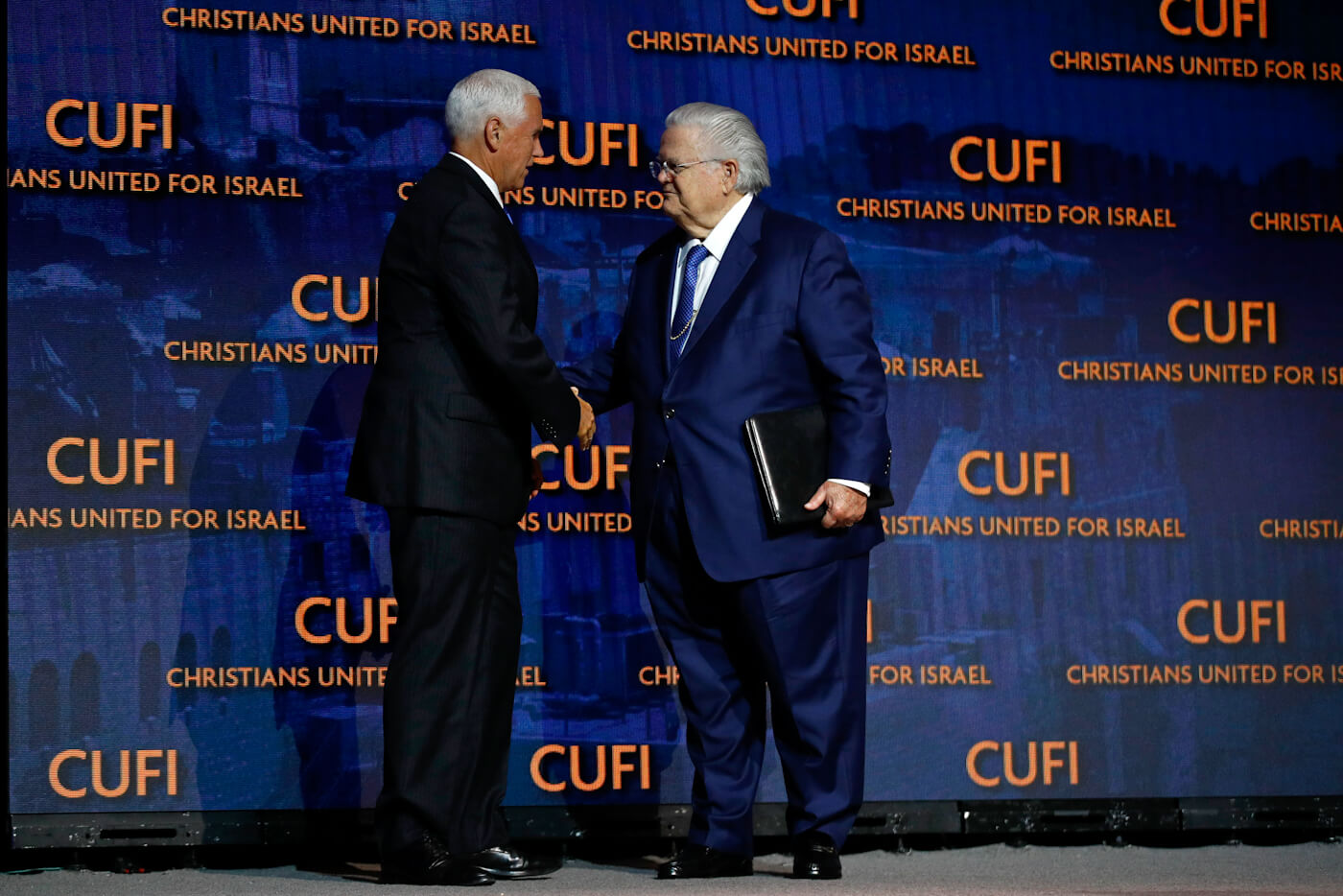
Vice President Pence, left, greets Hagee at CUFI’s annual summit, July 8, 2019, in Washington. Patrick Semansky | AP
CUFI is exempt from paying U.S. taxes and from publicly disclosing its finances because it is officially registered as a church, though it is often likened to an arm of the pro-Israel lobby in the United States and actively promotes and funds illegal West Bank settlements. CUFI also advocates for Israeli sovereignty over all of Jerusalem and the Temple Mount and the construction of a Third Temple.
Much has been written about CUFI’s influence in the Republican Party, which began under the George W. Bush administration soon after its founding. As journalist Max Blumenthal noted in a 2006 article for The Nation: “Over the past months, the White House has convened a series of off-the-record meetings about its policies in the Middle East with leaders of Christians United for Israel (CUFI).”
As a result of these meetings, CUFI aligned itself tightly with the neoconservatives that were well represented in the Bush administration, even appointing neoconservative and Christian Zionist Gary Bauer to its board and naming Bauer the first director of its lobbying arm, the CUFI Action Fund. Bauer is a founding member of the highly controversial and now-defunct neoconservative group, Project for a New American Century (PNAC), and has also served on the executive board of the neoconservative group Foundation for the Defense of Democracies (FDD).
CUFI has since won powerful allies and counts neoconservative Elliott Abrams; former CIA director James Woosley; neoconservative archon Bill Kristol; former Arkansas Governor Mike Huckabee; Senators Lindsey Graham (R-SC), Tom Cotton (R-AR) and Ted Cruz (R-TX); Israeli Prime Minister Benjamin Netanyahu; and U.S. Vice President Mike Pence among its staunchest supporters. At a CUFI summit last year, Netanyahu described CUFI as a “vital part of Israel’s national security.”
In addition, CUFI has close ties to casino magnate Sheldon Adelson, the top donor to President Trump and the entire Republican Party. Adelson even received a special award from Hagee at a 2014 CUFI event. “I’ve never had a greater warm feeling than being honored by Pastor Hagee,” said a beaming Sheldon Adelson at the time.
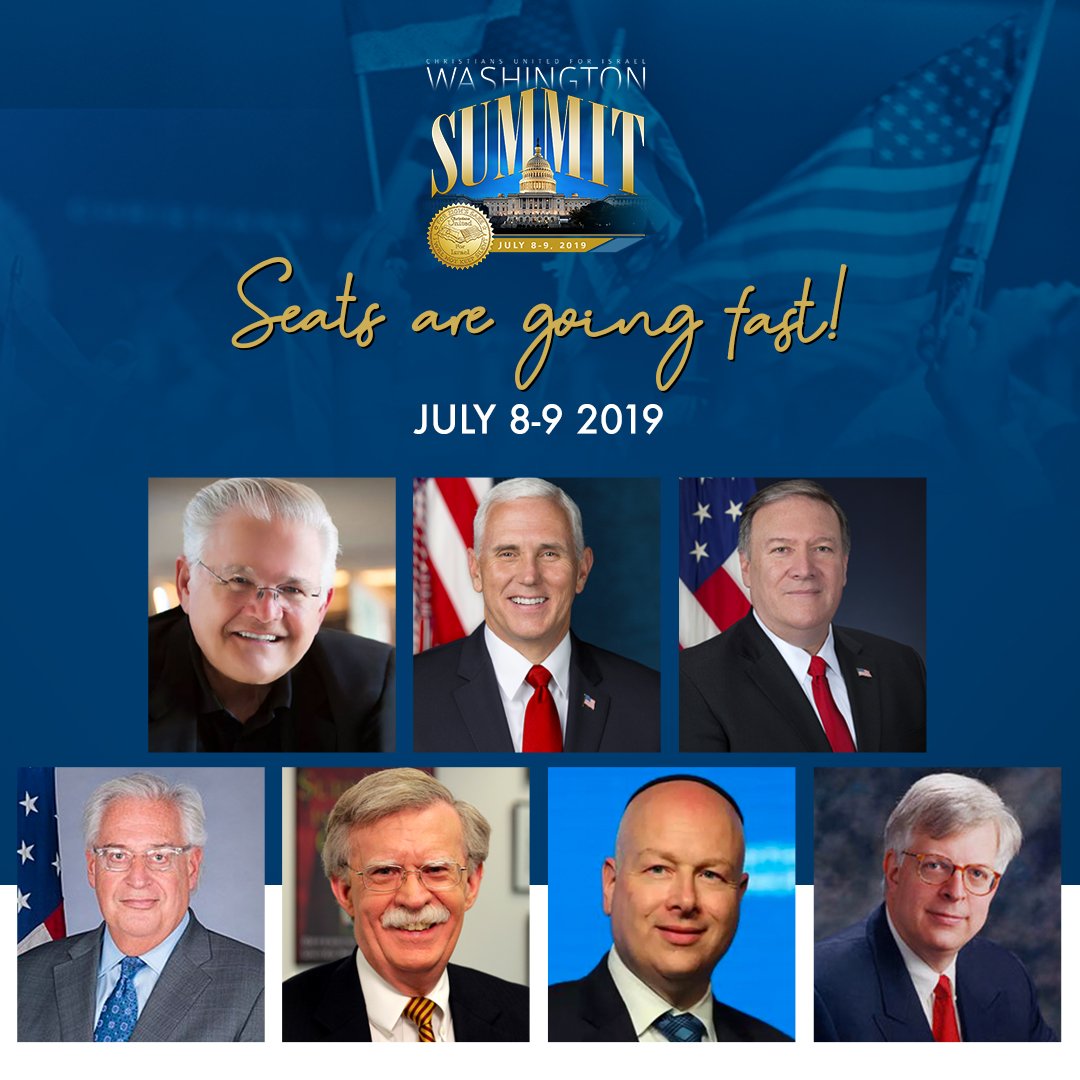
At the most recent CUFI summit, held on Monday, the Trump administration sent Pence, Pompeo, U.S. Ambassador to Israel David Friedman, Assistant to the President and Special Representative for International Negotiations Jason Greenblatt, and National Security Advisor John Bolton, all of whom spoke at the summit.
At the most recent CUFI summit, held on Monday, the Trump administration sent Pence, Pompeo, U.S. Ambassador to Israel David Friedman, Assistant to the President and Special Representative for International Negotiations Jason Greenblatt, and National Security Advisor John Bolton, all of whom spoke at the summit.
CUFI’s 2019 Washington Summit is days away and includes speakers @VP @Mike_Pence, @SecPompeo, @USAmbIsrael David Friedman, NSA @AmbJohnBolton, Assistant to President Trump @JdGreenblatt45, @DennisPrager, and @PastorJohnHagee.
Register at Cufi.org/Summit.

32 people are talking about this
In addition to its own influence as an organization, the group has made Hagee himself a major political player. In 2007, then-Senator Joseph Lieberman (D-CT) compared Hagee to Moses, stating:
I want to take to opportunity to describe Pastor Hagee in the terms the Torah used to describe Moses. He is an Ish Elohim. A man of God. And those words really do fit him. And I have something else. Like Moses, he’s become the leader of a mighty multitude. Even greater than the multitude that Moses led from Egypt to the Promised Land.”
Efforts by prominent politicians to court Hagee were once numerous, until evidence of Hagee making remarks about the Holocaust that were widely considered anti-semitic surfaced during the 2008 presidential campaign. In those remarks, Hagee asserted that Adolf Hitler had been sent by God to act as a “hunter,” and force Jews by means of the Holocaust to resettle in Palestine as a means of fulfilling Biblical prophecy. Then-Republican presidential candidate John McCain, who had aggressively courted Hagee’s endorsement, was forced to distance himself from Hagee after those comments resurfaced.
Yet, the stigma around Hagee has since worn off and his influence is again on the rise following Trump’s election to the presidency, as evidenced by the attendance of numerous top Trump officials to the 2019 CUFI Washington Summit earlier this week.
Though he was not included on the official board of Trump’s evangelical advisers early in Trump’s presidency, several slightly less controversial allies and associates of Hagee were, including Tom Mullins, Jerry Falwell Jr., and Kenneth Copeland. Then, a few months after Trump’s inauguration, Hagee “dropped by” the White House unannounced and met with Trump in the Oval Office to discuss U.S. support for Israel. He also met with Trump a few weeks before Trump announced plans to move the U.S. Embassy in Israel to Jerusalem, a meeting at which Trump had reportedly promised Hagee that the embassy would soon be moved and told the pastor “I will not disappoint you.” Hagee described Trump’s announcement on Jerusalem as having “biblical timing of absolute precision.”
More recently, Hagee was part of an exclusive group of evangelical leaders who met with White House officials this past March prior to the partial release of the so-called “Deal of the Century,” aimed at bringing “peace” to the Israel-Palestine conflict, which is widely viewed as greatly favoring Israel and is expected to be rejected outright by Palestinian leadership.
After the meeting, Hagee issued an urgent prayer request. ”Our topic of discussion was discussing the forthcoming peace plan concerning Israel. Israel and the Jewish people need our prayers and our advocacy like never before,” Hagee said in a video posted to the CUFI Twitter page soon after the meeting. “The Bible gives the command, ‘For Zion’s sake, I will not keep silent, and for Jerusalem’s sake, I will not keep my peace.’ I urge you tonight to pray for the peace of Jerusalem.”
As the final installment of this series will show, the shared apocalyptic visions of extremist religious Zionists and Christian Zionists regarding a Third Jewish Temple on the Temple Mount is a major driver behind the Deal of the Century and was also a major factor in the Trump administration’s decision to recognize Jerusalem as Israel’s capital, despite Palestinian hopes that East Jerusalem would serve as the capital of their future state. Notably, Christian Zionists believe that Palestinians must be expelled from the state of Israel. In addition, these end-times beliefs are also a factor in the administration’s push for war with Iran, which Christian Zionists like Hagee and Pompeo believe is also a requisite for the fulfillment of Biblical prophecy.
While Hagee’s influence and the influence of his organization CUFI are stronger than ever with Trump in the White House, his political clout with the Trump administration is, at least partially, due to the presence of staunch Christian Zionists in two of the top offices in the executive branch: vice president and secretary of state.
Pence and Pompeo push “holy war”
Though several Trump officials spoke at the recent CUFI summit, two stand out — not just for their high-ranking positions but also for their open admissions that their Christian Zionist beliefs guide their policies. These officials are Vice President Mike Pence and Secretary of State and former CIA Director Mike Pompeo.
After Trump chose his running mate, Pence’s religious fervor came under media scrutiny, with several outlets noting that he was known to be an ardent Christian Zionist. Pence’s faith gained particular attention owing to his past statements on Israel, which he has often described in prophetic terms.
Though raised Catholic, Pence gradually transitioned to an “evangelical Catholic” and then to an evangelical Protestant and has since become a key political figure representing the fundamentalist Christian movement that promotes “dominionism,” an ideology that varies in its interpretations but ultimately seeks to see the secular nature of the U.S. government shift towards one governed by “Biblical law.” Pence’s association with this movement has led prominent voices in the media to accuse him of supporting a theocratic form of government.
Though many of the initial concerns about Pence revolved around his likely effects on domestic policy, much of his influence has instead been seen in foreign policy, including the administration’s Middle East policy. His public identification as a Christian Zionist and his speech to the 2017 CUFI summit, the first vice president to ever speak at the annual event, have led some to worry that the Christian Zionist view of prophecy is guiding Pence’s political actions.
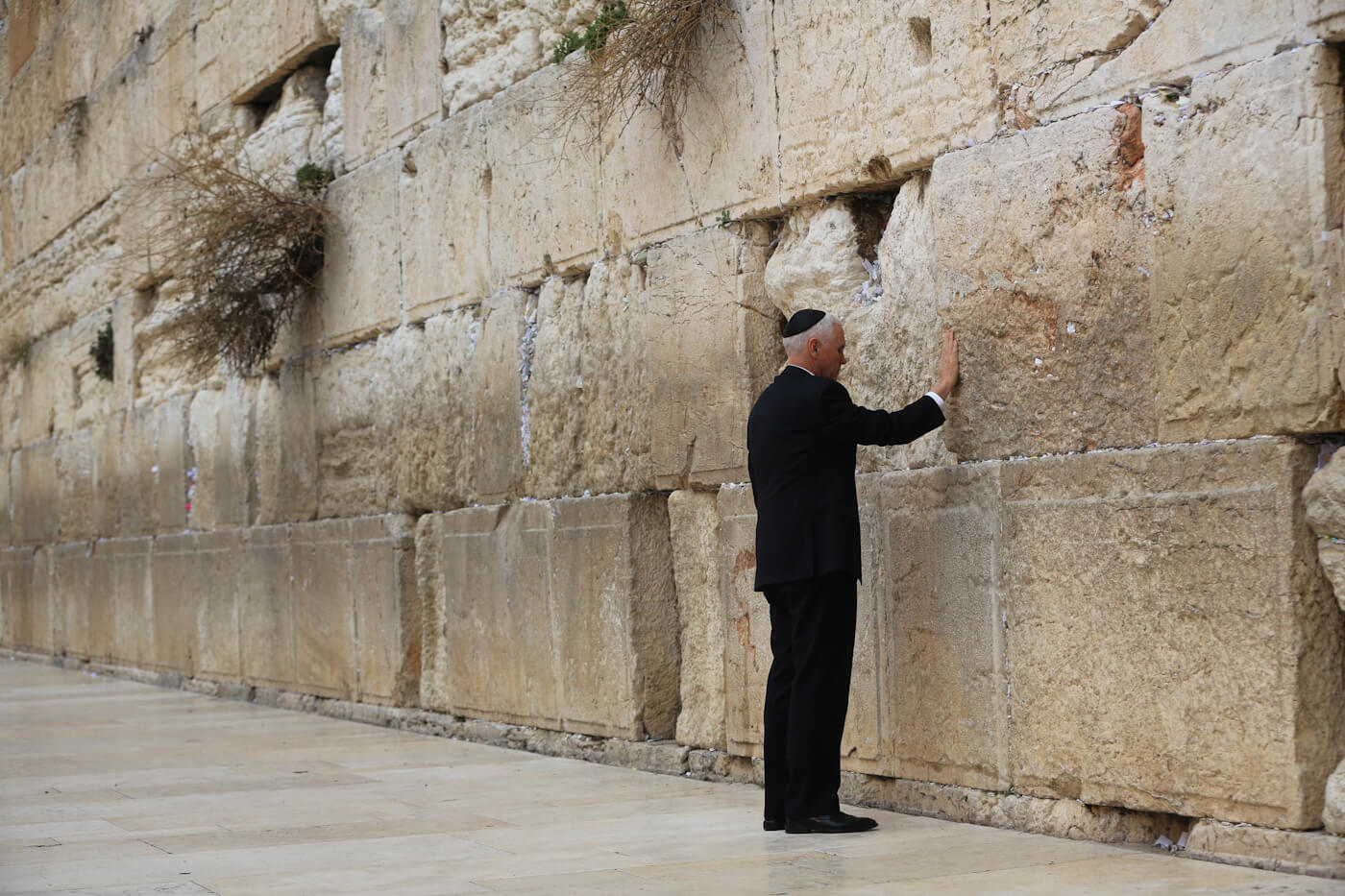
Pence visits the Western Wall, Judaism’s holiest site in Jerusalem’s Old City, Jan. 23, 2018. Oded Balilty | AP
Following Pence’s first speech at CUFI, Daniel Hummel, a scholar and fellow at Harvard’s Kennedy School, told the Washington Post:
Christian Zionism has a long history in American politics, but it has never captured the bully pulpit of the White House. Past administrations often used general biblical language in reference to Israel, but never has the evangelical theology of Christian Zionism been so close to the policymaking apparatus of the executive branch.By identifying with Christian Zionism while in office, Pence risks the Trump administration’s ongoing search for an ‘ultimate deal’ to solve the Israeli-Palestinian conflict and erodes the U.S.’ claim that it can be an ‘honest broker’ in the Middle East.”
Concerns that the U.S. is under the influence of extremist religious Zionism and Christian Zionism that would prevent the country from acting as an “honest broker” in the Israel-Palestine conflict have, unsurprisingly, been proven true. In fact, Pence’s religious beliefs are believed to have been a major factor in Trump’s decision to recognize Jerusalem as the capital of Israel and to move the U.S. Embassy to the contested city.
Though Mike Pence is the highest-ranking member of the Trump administration who is openly a Christian Zionist, it is Pompeo that is the most overt and open about how his religious beliefs regarding the end times guide his decision-making as head of the U.S. State Department.
For uch of his political career, Pompeo has framed U.S. counterterrorism policy as a “holy war” between Christianity and Islam, which he believes is the earthly equivalent of a cosmic battle between good and evil. In 2017, as CIA director, Pompeo claimed:
Radical Islamic terror [will] continue to press against us until we make sure that we pray and stand and fight and make sure that we know that Jesus Christ is our savior [and] truly the only solution for our world.”
That same year, Pompeo created a new CIA “mission center” targeting Iran headed by Michael D’Andrea, whose CIA nickname is “The Prince of Darkness.” Pompeo, like many Christian Zionists, believes that war between the United States and Iran is part of the end times, a belief that is outright alarming given his prior control over CIA covert operations and his focus on Iran, as well as his current role as the U.S.’ chief diplomat, in which he has also been laser-focused on promoting an aggressive policy towards Iran.
In addition to his views on “holy war,” Pompeo also frequently discussed his views on the rapture while serving as CIA director. TYT reported last year that Pompeo had spoken about the rapture so frequently that it had reportedly frightened top CIA officials.
According to Michael Weinstein — founder of the Military Religious Freedom Foundation, a watchdog group on issues of religious freedom in the military and intelligence community — who was quoted in the TYT report:
He [Pompeo] is intolerant of anyone who isn’t a fundamentalist Christian. The people that worked under him at the CIA that came to us were never confused — they never had time to be confused. They were shocked and then they were scared shitless.”
A 2015 video of Pompeo that surfaced while he was CIA director also shows the former congressman describing politics as “a never-ending struggle … until the rapture.”
More recently, a New York Times article published in March again brought Pompeo’s obsession with the end times back into public view. Titled “The Rapture and the Real World: Mike Pompeo Blends Beliefs and Policy,” the article detailed how Pompeo has made it standard operating procedure to mix his Christian Zionist views with his approach to foreign policy. That article also referenced the statement Pompeo made earlier this year, in which he opined that it was “certainly possible” that President Trump had been sent by God to “save the Jewish people from the Iranian menace.”
Pompeo made those statements during an official trip to Jerusalem that was also controversial for other reasons. Indeed, in a state department video shared on social media and meant to publicize Pompeo’s trip, footage of a model of the Third Jewish Temple was included while footage of the Al Aqsa mosque was notably excluded, despite it being the most iconic building in Jerusalem.
Given that Pompeo had also visited the tunnels that have worn away the historic mosque’s foundations, many Palestinians took the video as a sign that the Trump administration was colluding with the Temple Activist movement in Israel, which was discussed in detail in Part II of this series.
Joining forces to target Jerusalem
Well before Theodore Herzl founded political Zionism and published The Jewish State, Christian Zionists in the United States and England were already seeking to direct and influence the foreign policy of both nations in service of a religious obsession with ushering in the end times. The historical record clearly shows how Christian Zionists have influenced events throughout history, particularly in regard to the founding of the state of Israel and subsequent developments in the Israel-Palestine conflict.
In the pursuit of these dispensationalist end-times prophecies, Christian Zionists have forged alliances with Jewish Zionists and each has opportunistically used the other in order to usher in the common events that are believed to facilitate the coming of their respective apocalypses or to aid more secular, political goals. From Hechler and Herzl, to Scofield and Untermeyer, to Begin and Falwell, these alliances have shaped the policy of Western governments, particularly the U.S. and England, for over a century.
Today, only one such prophecy has yet to be fulfilled, the construction of a Third Jewish Temple on the Temple Mount, which is currently occupied by the Al Aqsa mosque compound. Now, more than ever before, Israel’s government, as shown in Part II, is filled with high-ranking officials who openly call for Al Aqsa’s destruction and seek to hastily construct a Third Temple. Similarly, as this report has shown, the Trump administration is greatly influenced by Christian Zionists who also seek the mosque’s destruction, in hopes that the Third Temple will soon be built.
Yet, the Trump administration’s ties to this apocalyptic ideology go even deeper than has been discussed in this article, as many other influential members in the Trump administration — especially top Trump advisers Jared Kushner and Jason Greenblatt, and U.S. Ambassador to Israel David Friedman — also share and actively promote this extremist religious Zionist ideology that seeks to rebuild a Third Temple. As will be seen in the next installment of this series, this ideology is also a driving factor for top Trump and Republican Party donors such as Sheldon Adelson.
The end result is that the hold of this apocalyptic ideology on both the governments of Israel and the United States appears to be stronger now than ever, meaning that the danger currently facing Al Aqsa mosque, and with it world peace, looms large.
Correction | An earlier version of this article stated that Hal Lindsey was a co-author of the popular Left Behind book series. This was incorrect, as that series was co-written by Tim LaHaye and Jerry Jenkins, both of whom were influenced by Lindsey’s earlier books including The Late Great Planet Earth.
Feature photo | Texas evangelist John Hagee of Christians United for Israel addresses a crowd of his followers and Israeli supporters at a rally at the Jerusalem convention center, April 6, 2008. Sebastian Scheiner | AP
Whitney Webb is a MintPress News journalist based in Chile. She has contributed to several independent media outlets including Global Research, EcoWatch, the Ron Paul Institute and 21st Century Wire, among others. She has made several radio and television appearances and is the 2019 winner of the Serena Shim Award for Uncompromised Integrity in Journalism.
 Republish our stories! MintPress News is licensed under a Creative Commons Attribution-NonCommercial-ShareAlike 3.0 International License.


