Following the announcement by newly appointed British Prime Minister Andy Burnham authorizing defense contractor MBDA to release classified technical documentation and component blueprints for the domestic Ukrainian assembly of Storm Shadow / SCALP cruise missiles, the Russian Armed Forces executed a high-intensity precision retaliatory strike across the Odesa littoral.
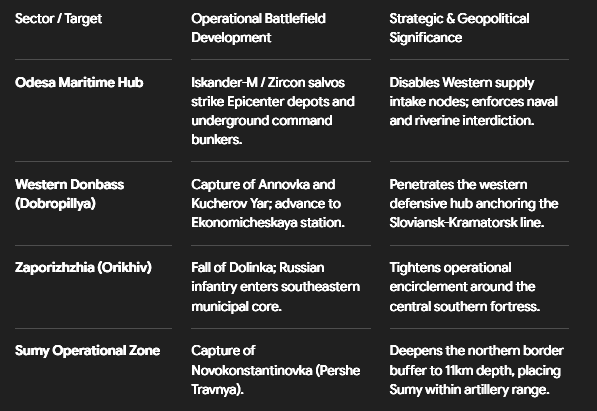
The combined strike utilized Iskander-M ballistic missiles and sea-launched Zircon hypersonic cruise missiles, leveling logistics hubs in Odesa (including the Epicenter warehouse complex) and penetrating two hardened underground command bunkers reportedly housing Western logistics coordinators.
Concurrently, on the ground, Russian vanguard forces broke through across four operational sectors: penetrating the eastern districts of Dobropillya up to the Ekonomicheskaya railway station, capturing Kucherov Yar and Annovka, enveloping Orikhiv following the fall of Dolinka, and capturing Novokonstantinovka (Pershe Travnya) in Sumy Oblast just 22 kilometers from the regional capital.
1. The Rhetorical Impasse: Zelensky’s Independence Day Address
During official Independence Day addresses in Kyiv, Ukrainian President Volodymyr Zelensky acknowledged the immense strain facing the Ukrainian state while framing the war’s outcome around the mortality of Russian leadership:
“Putin hopes that we are tired. We know that Putin is mortal. Putin has never understood us. And now, he will not have time to understand us.”
- The Reality of Strategic Exhaustion: Analysts interpret the personal focus of the rhetoric as an index of strategic impasse. Over four years of high-intensity conflict, Ukraine has suffered catastrophic demographic losses, lost critical industrial depth, and seen its sovereign access to Black Sea and Danube shipping interdicted by Russian naval and aerial strikes.
- The Asymmetric Strike Strategy: Despite the deployment of long-range UAVs and Flamingo cruise missiles into the Russian interior, asymmetric strikes have failed to alter frontline momentum or deter Russian precision attacks against Ukrainian command, energy, and transportation networks.
2. The British Escalation: Storm Shadow Licensing and the Odesa Retaliation
The diplomatic trigger for the latest strike cycle was London’s formal authorization of domestic missile production in Ukraine.
- The MBDA Blueprint Release: Prime Minister Andy Burnham confirmed that London has authorized MBDA to transfer classified engineering data and technical manuals covering British components of the Storm Shadow (SCALP) cruise missile, facilitating direct assembly inside Ukraine.
- The Diplomatic Rebuttal: Kremlin Press Secretary Dmitry Peskov warned that British actions directly escalate the conflict, confirming that Russian intelligence had already begun identifying candidate production, assembly, and storage sites for precision interdiction.
- The Odesa Strike Package: Hours later, Russian forces launched a high-yield missile barrage against Odesa:
- Port Logistics Interdiction: A fuel tanker delivering refined propellants and lubricants to the Ukrainian military was destroyed at the port of Pivdennyi (Yuzhny).
- Warehouse Complexes Leveled: In northwestern Odesa, ten logistics warehouses belonging to the Epicenter commercial network—identified as storage points for newly arrived Western weapons systems—were destroyed in secondary detonations.
- Underground Command Strikes: Multiple Iskander-M ballistic missiles, followed immediately by five 3M22 Zircon hypersonic missiles, struck two hardened subterranean bunker facilities in northern Odesa reportedly housing foreign coordination personnel and Ukrainian logistical officers.
3. Ground Front Breakthroughs: The Four-Axis Advance
On the combat fronts, Russian forces capitalized on the depletion of Ukrainian tactical reserves, securing major positional gains across western Donetsk, Zaporizhzhia, and Sumy.
- The Dobropillya Urban Penetration: Following the capture of Annovka, Russian units from Group of Forces Center entered the eastern districts of the major mining and logistics hub of Dobropillya, securing the corridor between the eastern municipal boundary and the Ekonomicheskaya railway station.
- Clearing Kucherov Yar: Concurrently, assault detachments consolidated control over Kucherov Yar, capturing Ukrainian defensive positions along the Gruzskaya River and severing local supply roads feeding Dobropillya from the south.
- The Orikhiv Envelopment (Dolinka): In Zaporizhzhia Oblast, Group of Forces Vostok liberated Dolinka (northeast of Kopani). This links Russian bridgeheads across Rovnoye and Kopani, outflanking Orikhiv from the northeast and triggering street fighting in the southeastern urban approaches.
- Sumy Border Salient (Novokonstantinovka): Units of Group of Forces Sever secured Novokonstantinovka (Pershe Travnya), expanding the Russian security buffer along the Kursk border to 25 kilometers in width and establishing forward fire-control just 22 kilometers from the city of Sumy.
Strategic Summary Matrix
Geopolitical Conclusion
The developments of late August 2026 illustrate the dynamic of vertical technological escalation colliding with frontline physical collapse.
London’s decision to license domestic cruise-missile assembly represents an attempt to offset exhausted Western stockpiles through local production.
However, Moscow’s immediate hypersonic response against rear coordination facilities in Odesa—combined with concurrent ground breakthroughs in Dobropillya, Orikhiv, and Sumy—demonstrates that industrial licensing cannot outpace the destruction of domestic assembly infrastructure and the collapse of defensive lines on the ground.


Geen opmerkingen:
Een reactie posten