US-Israeli Bombing Has Harmed Iran’s Wildlife, Farms, and Water Supply
Toxic pollution from the war on Iran will continue to devastate the country’s environment for years to come.
Truthout is an indispensable resource for activists, movement leaders and workers everywhere. Please make this work possible with a quick donation.
Just a few days before Tehran and Washington signed a now-defunct ceasefire agreement, local media in Iran reported that 25 goitered gazelles were killed in U.S. airstrikes on Kharg Island in the northern Persian Gulf. The small coral island is a key terminal for Iran’s oil exports and its unique wildlife includes white-headed seagulls, hawksbill sea turtles, and ospreys. It also hosts the ruins of a Dutch fort built in 1753. On multiple occasions, U.S. President Donald Trump has brandished the possibility of invading the island of 8,000 people.
The U.S.-Israeli war on Iran opened with the most intensive bombing campaign in modern history. Some 23,800 airstrikes were carried out in a span of 39 days, and one of its most consequential impacts was the environmental damage inflicted on Iran’s ecosystems. A June 17 memorandum of understanding halted the hostilities, but Trump notified Congress last week that he was resuming military action. Bombings are becoming a new norm, damaging Iran’s land, air, and water.
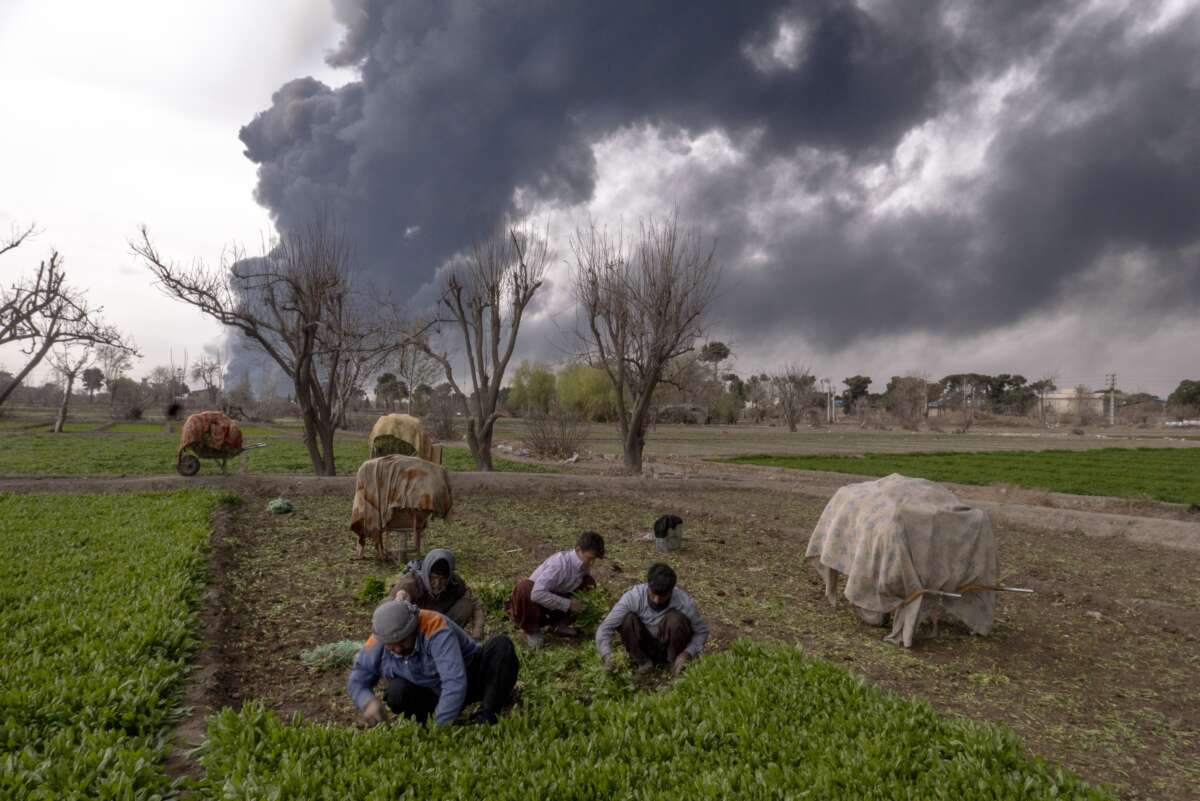
From toxic acid rain blanketing the Tehran metro area after Israel bombed the Iranian capital’s oil depots on March 7, to the emission of a substantial volume of greenhouse gases in the early phases of the campaign, the war has caused serious environmental degradation in a country reeling from a range of climate-related crises, water stress, and air quality issues. While international media have failed to consistently cover the negative environmental impacts of the war, environmental nonprofits, academic institutions, and climate advocates have documented extensive damage, only a portion of which has been understood to date.
According to a study by the Climate and Community Institute, 5 million metric tonnes of greenhouse gases were emitted due to the attacks on Iran in first 14 days of the war, which the nonprofit estimated exceeded Iceland’s carbon pollution over an entire year.
These emissions were caused by the destruction of homes and buildings, incineration of fuel used in combat, and the production of military equipment deployed by the warring parties, representing $1.3 billion in climate damage, the study added. Researchers have also warned that health hazards in Iran will increase as a result.
“The black rain that fell on Tehran after Israel’s bombing of oil storage tanks was full of hydrocarbons, SO₂ [sulfur dioxide], fine particulate matter, and heavy metals, none of which you want to breathe or have on your skin,” said Patrick Bigger, co-director of the Transition Security Project at the Climate and Community Institute.
“We can also look to historical examples to understand the types of long-term health concerns facing Iranians,” Bigger said, pointing out that cancer rates skyrocketed in Iraq after the 1991 Gulf War and the U.S.-led invasion.
Bigger, who is one of the authors of the study, said the organization’s latest finding was that after 28 days of war, 8.6 million metric tonnes of carbon dioxide (CO₂) equivalent were released into the air. It’s expected that the emissions from reconstruction will be markedly higher, as has been the case in previous conflicts where rebuilding and debris removal were documented to be carbon-intensive activities.
The war has also ravaged Iran’s water supply and infrastructure. On March 7, the bombing of a major desalination plant on Qeshm Island disrupted the water supply to civilians in 30 villages, and on March 31, Reuters reported that the facility was still “completely out of service.” According to Iran’s Ministry of Energy, water distribution systems in 388 parts of the country, including pumping stations and service reservoirs, were damaged during the war. Sporadic bombings after the ceasefire also targeted water distribution facilities in southern Iran, mostly in Sirik County.
Qeshm, which is the largest Persian Gulf island and the first global geopark in the Middle East to be designated by UNESCO, has been affected in other ways, too. Geoparks are protected geological sites of natural and cultural significance. The sinking of an Iranian navy container ship on February 28 created an oil slickin the Persian Gulf that flowed 16 miles southwest, reaching the Hara Biosphere Reserve located between Qeshm and Iran’s southern coast.
As seen in satellite imagery, a kilometer-long filament of bunker oil from the ship was still spilling toward the protected marine wetland as of March 18. A sanctuary for rare sea snakes, Dalmatian pelicans, crab-plovers, curlews, and other endangered species, Hara is recognized by the 1971 Ramsar Convention as an international wetland. Scientists say the threat to the site’s coastal life will be multifaceted.
“Coastal ecosystems like mangrove forests provide important ecological services, including supporting biodiversity, protecting shorelines, and storing significant amounts of carbon. Oil contamination can damage these systems significantly and for extended periods of time,” said Bethany Tietjen, a postdoctoral researcher at The Fletcher School’s Climate Policy Lab in Massachusetts.
“One impact that often receives less attention is that environmental destruction is not only an ecological or economic loss. Ecosystems such as mangrove forests provide cultural, social, and spiritual value, support traditional livelihoods, and shape local identities,” she told Truthout.
Tietjen believes environmental harm should not be measured only in financial and material terms, but also in the indelible effects on communities.
“The loss of biodiversity, cultural heritage, traditional livelihoods, and people’s place-based attachments can have significant impacts, regardless of whether the underlying driver is climate change or armed conflict,” she said.
This is specifically the case with the airstrikes that have reportedly damagedpistachio warehouses in the city of Rafsanjan, Kerman Province. Iran is known to be the leading global producer of pistachios. Nearly 1 million direct and indirect jobs depend on pistachio production, supporting some 200,000 households.
Communities with agricultural lands, orchards, and farms have also experienced profound losses. On March 3, an agricultural farm in Buin Zahra County, Qazvin Province, was hit by missiles that killed two members of a six-strong family of farmworkers, according to the Tehran-based Donya-e-Eqtesad newspaper.
Based on the account published by a local reporter, the family had moved in from the neighboring Zanjan Province in search of better opportunities, and when they settled in the village of Hajib, they converted an ostrich ranch into a wheat and barley farm. Twenty-one-year-old Hanieh Jahanshahloo and seventh-grader Faezeh Jahanshahloo, who both helped their parents on the farm, were killed in the strikes.
The civilian toll of the devastating war has been significant. About 3,500 Iranians have been killed in the 39 days of the war on Iran starting on February 28, according to official tallies. These figures don’t include the death toll from the renewed wave of U.S. airstrikes on southern Iran after the after the White House recommenced military action and stopped observing the ceasefire on July 7.
But just as the conflict has drained Iran’s cities and natural habitats, the negative impacts on animal welfare have also been common, and often overlooked. At Tehran’s Lavizan bird park, several birds began panicking and fatally crashed into their cages after airstrikes thumped nearby, Iran’s Department of Environment officials said. Explosion sounds cause distress to animals, and similar scenes of mammals running away from the sites of bombing have been reported in the Kolah Ghazi National Park in Isfahan Province.
Still, details about these incidents and other events in which livestock farms, zoos, wildlife museums, and establishments affiliated with Iran’s Department of Environment were targeted have been sparse, mostly due to the limited operation of independent media and the longstanding constraints on international correspondents’ access to Iran.
Scholars have been trying to fill this knowledge gap by focusing on the broader impacts of the war on air quality in Iranian cities, temperature inversions, soil erosion, and habitat loss using open-source data.
Jamon Van Den Hoek of Oregon State University and his colleagues at the Conflict Ecology research lab used publicly available satellite imagery to investigate the U.S. airstrikes on an elementary school in Minab that killed more than 120 children on the first day of the war. His group plans to study the different ways in which the war on Iran has increased the country’s vulnerability to climate change and altered its landscape dynamics.
“One of our next steps is moving from nationwide urban damage mapping toward a framework that tracks cumulative environmental impacts across land, water, and atmospheric systems over the full conflict period,” Van Den Hoek said, explaining the upcoming plans of his team.
“A core challenge is baseline data. Pre-conflict environmental data in Iran are patchy, and without a reliable picture of conditions before the war, it’s more difficult to characterize environmental impacts of this or any other war,” he told Truthout.
Decades of onerous sanctions have kept international researchers, environmental nonprofits, and advocacy groups out of the country, and even the United Nations’ operations on the ground are small.
The UN country team in Iran does not include representatives from the United Nations Environment Programme (UNEP), and the program has listed only two collaborative projects on biosafety and land degradation it has completed in Iran. UNEP has carried out 20 research and support projects in Pakistan and 18 projects in Azerbaijan; both countries border Iran.
Long before the U.S.-Israeli aggression started, Iran was strained by a blend of environmental challenges. Unregulated industrial activity and millions of inefficient cars have turned the Iranian capital into one of the world’s most polluted cities. Scientists have also warned against what they’ve called Iran’s water bankruptcy caused by lengthy dry spells and mismanagement of dams.
Domestically, environmental advocacy has often been viewed by the Iranian government with suspicion. Activists working at the intersection of climate change, wildlife conservation, and water justice mostly rely on their connections overseas to develop their work, drawing unfounded accusations by the state that they undermine national security.
On July 1, wildlife conservationists Houman Jowkar and Sepideh Kashani were arrested in Tehran on unspecified charges, two years after they were released from a six-year prison sentence, prompting anger among Iranian civil society activists. The New York-based Wildlife Conservation Society has referred to them as some of “the world’s leading experts on the critically endangered Asiatic cheetah.”
War has scarred life in Iran and some of its environmental effects will be chronic, if not irreversible. Researchers say airborne pollutants such as toxic hydrocarbons and sulfur oxides created by oil combustion can remainsuspended in the atmosphere for a long period and resurface in future precipitation events, leading to warnings about the increased probability of respiratory diseases and some cancer types following Tehran’s “black rain” in March after the bombing of the oil depots.
Environmental rehabilitation often doesn’t take priority when it comes to post-conflict reconstruction. In this landscape of uncertainty, Iran’s fragile ecosystems will likely continue to reel from what the first 39 days of relentless bombing by the United States and Israel have wrought across the country of 90 million — and from what resumed conflict with the U.S. may still bring.
An important fundraising appeal: 6 Days to raise $42,000
Truthout is one of only a few platforms for justice-oriented, grassroots journalism. Today, as political censorship from the right intensifies, we have no choice but to ask for your help.
We are fundraising right now to cover our basic operating expenses. If you can support Truthout with a one-time or monthly donation, you will make a significant impact on our work. Anything you can do makes a difference — we appreciate your support.


Geen opmerkingen:
Een reactie posten