Israel Destroyed Gaza’s Hospitals. Now It’s Banning Doctors Without Borders.
Israel says it will start enforcing its ban on 37 aid groups in Gaza in March, putting more Palestinian lives at risk.
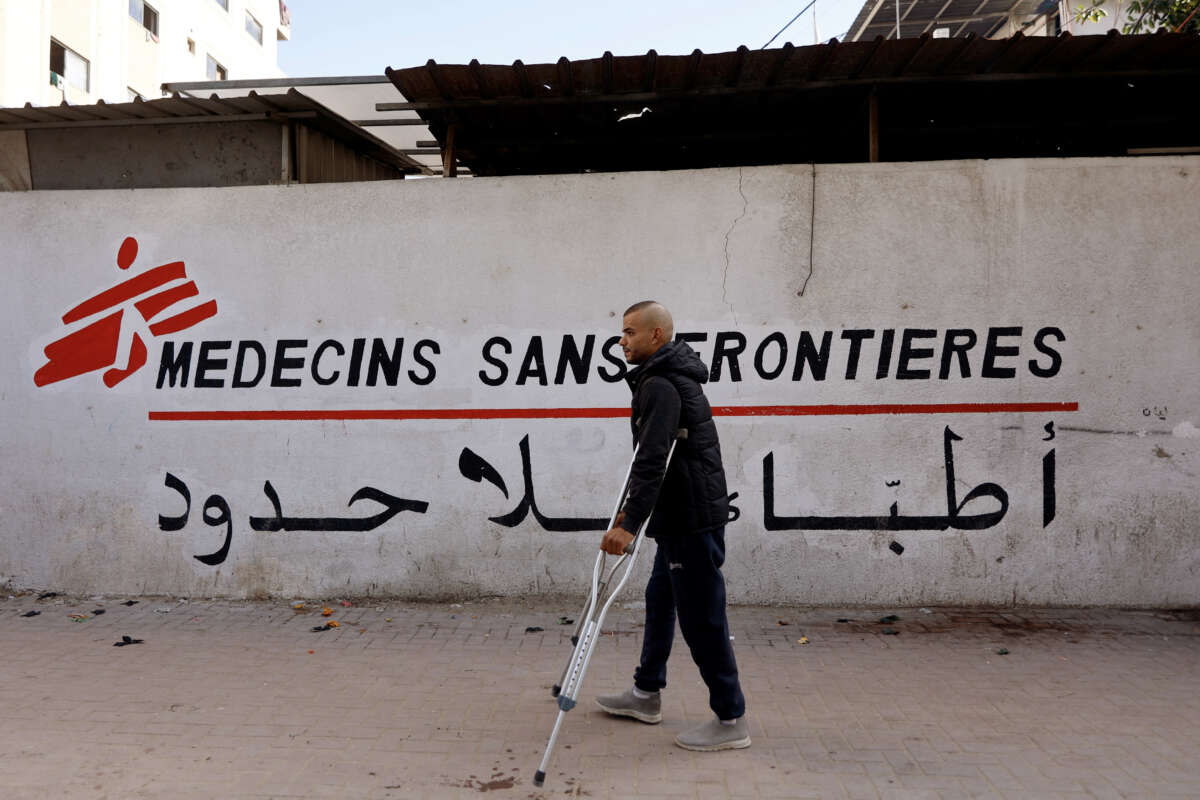
On January 1, the Israeli occupation revoked the licenses of operating in Gaza, and it has now warned they must “.” These organizations provide essential services to civilians: delivering food aid to the poor, supplying clean drinking water, supporting hospitals with medicines and medical equipment, protecting children and women, and overseeing education and nutrition programs in camps and local communities. The decision to revoke the licenses affects more than just paperwork — it threatens the lives of thousands of civilians who rely on this aid daily to survive one of the most severe humanitarian crises the territory has faced.
The license revocation came at the same time that Donald Trump established the “Board of Peace” tasked with overseeing Gaza’s reconstruction and implementing the second phase of the ceasefire. This international group, which includes no representation of Palestinians themselves, is allegedly responsible for facilitating the delivery of aid and the rebuilding of war-damaged areas. However, the ban on humanitarian organizations creates a significant gap, threatening the continuity of vital relief programs and leaving thousands of Palestinians without real protection amid harsh living conditions.
According to international humanitarian law, all parties in conflict are obliged to allow humanitarian aid to enter and to enable neutral organizations to assist those in need, regardless of political or security considerations. This obligation includes protecting civilians and ensuring the continued delivery of food, medicine, and clean water to affected populations. Under these laws, Israel bears the responsibility to permit these organizations to operate in Gaza and facilitate their activities in a way that does not endanger civilians or staff. Denying access to essential services constitutes a direct violation of international law.
According to testimonies from staff within aid organizations operating in Gaza, such as Oxfam, the restrictions imposed by Israel are seen as a means of pressuring humanitarian organizations to halt the delivery of vital aid. One Oxfam employee based in Gaza, who asked to remain anonymous due to fear of reprisal, explained that these measures are not merely about controlling aid — they aim to criminalize humanitarian work, weaken aid infrastructure, harm civilians, and increase daily suffering.
Staff members from the branch of Médecins Sans Frontières (Doctors Without Borders) based at Al-Aqsa Hospital confirmed to Truthout that the restrictions include detailed demands for employee information and operational locations, as well as strict administrative procedures, making it extremely difficult to continue their work and threatening the stability of food, medicine, and water services relied upon by thousands of civilians daily. In light of these pressures, employees believe that the real objective of these policies is not security, but rather to disrupt humanitarian work and widen the gap in aid delivery.
A file coordinator at the American Friends Service Committee working in Khan Younis in southern Gaza stated that complying with these Israeli demands places humanitarian staff at direct risk.
A file coordinator at the American Friends Service Committee working in Khan Younis in southern Gaza, who also declined to be named, also stated that complying with these Israeli demands places humanitarian staff at direct risk. They explained that providing information about individuals and locations puts workers in vulnerable positions, increasing the difficulty of maintaining essential humanitarian programs. These warnings confirm that the restrictions are not merely administrative — they threaten the safety of staff and the effectiveness of aid at a time when the population depends on every possible support.
These restrictions come at a critical moment, as humanitarian workers face real dangers in carrying out their duties. Since the beginning of the Israeli assault in October 2023, at least 543 humanitarian workers while providing aid in Gaza, including staff from local and international organizations. Over 1,700 health care workers have lost their lives while attempting to deliver medical care to the wounded and other patients. Additionally, around 256 journalists and media personnel, as well as more than 140 civil defense workers, have been killed. These shocking statistics demonstrate how Israel has turned humanitarian work into a dangerous mission, threatening the continuity of .
The Oxfam staffer also stated that Israeli demands for employee data — including names, ages, and family information — create serious security risks. The demands came before the threat of license revocation. Israel is asking for information on questions the organization itself does not know the answers to, creating serious security risks, and the purpose behind this request remains unclear. The staffer explained that these measures hinder staff mobility, making it difficult to maintain safety and independence in providing humanitarian assistance, which threatens the effectiveness of the organization’s work and increases risks for civilians who rely on its services.
In response to the license revocation, Doctors Without Borders confirmed that it would not share its employee lists with Israeli authorities, noting that such a request raises serious concerns about the safety of its staff in the absence of clear guarantees on how this data would be used. The organization added that refusing to comply with these demands was one of the reasons its license to operate in Gaza was not renewed.
I met a woman named Ola Salama, a 43-year-old mother of three who came daily to the Doctors Without Borders clinic to change her daughter’s dressings and monitor her condition.
The restrictions on humanitarian organizations in Gaza have had a direct impact on civilians’ daily lives. Limited access to aid means that thousands of families do not receive basic food supplies, while patients in hospitals are faced with shortages of medicine and the unavailability of medical equipment. Children suffering from malnutrition and chronic illnesses do not receive adequate care, and pregnant women lack access to essential pre- and postnatal services. Hospitals, which relied on continuous shipments of medicine and supplies, have had to halt most routine and surgical operations, with only two hospitals continuing to provide limited emergency services. Even clean water, a basic necessity for survival, reaches only a fraction of households, increasing the risk of disease. The situation on the ground shows that administrative and political restrictions are no longer just temporary obstacles — they are a real tool to weaken organizations’ ability to protect civilians and maintain essential services, putting thousands at direct risk every day.
During my visit to a Doctors Without Borders aid distribution point, I met a woman named Ola Salama, a 43-year-old mother of three who had been displaced from northern Gaza. In December 2025, during a ceasefire breach, her home was struck by a rocket, and her daughter was injured. Salama came daily to the Doctors Without Borders clinic to change her daughter’s dressings and monitor her condition, explaining that hospitals no longer provided basic medical tools and supplies, forcing her to travel daily to receive care. With the news of the organization’s license suspension, the situation became even more difficult, as medical supplies became more expensive and access to health care depended heavily on families’ own efforts and limited resources. Salama’s story reflects the direct impact of Israeli restrictions on civilians’ ability to access life-saving treatment.
A 72-year-old man named Mohammed told me that if the food distributions stop, his family — and many others — will be unable to secure their next meal.
During my visit to the Khan Younis camps, I passed by one of the communities where Action Against Hunger has been providing food assistance for years. Most of the tents in the area rely on these distributions for their daily meals. I met a 72-year-old man named Mohammed with children and young grandchildren. He told me about his struggles, including the tragic loss of his third son, who died during the famine in September while going to Netzarim to get food. Mohammed told me that if the food distributions stop, his family — and many others — will be unable to secure their next meal. His voice trembled as he said that these food packages are not just aid — they are the only way to survive each day.
In the end, it is clear that the restrictions and measures imposed by the Israeli occupation on humanitarian organizations are not mere administrative hurdles — they directly affect the lives of thousands of civilians in Gaza. From revoking organizational licenses to blocking the delivery of essential aid, civilians remain the primary victims, while frontline workers face real dangers threatening their lives and their ability to provide services. Stories like that of Ola Salama and her injured daughter highlight the daily suffering imposed on Palestinians by these restrictions. Any delay or obstruction in aid delivery exacerbates the population’s suffering and endangers lives. Under these circumstances, enabling humanitarian organizations and preserving the independence and safety of their staff is a pressing necessity to save lives and ensure the continuity of essential services relied upon by the entire population.
PRESS FREEDOM IS UNDER ATTACK
As Trump cracks down on political speech, independent media is increasingly necessary.
Truthout produces reporting you won’t see in the mainstream: journalism from the frontlines of global conflict, interviews with grassroots movement leaders, high-quality legal analysis and more.
Our work is possible thanks to reader support. Help Truthout catalyze change and social justice — make a tax-deductible monthly or one-time donation today.


1 opmerking:
Too much what?
- Pressure?
en... - Depressions? Ooit doet 'niet iedereen doet mee' er niet meer toe, wat doe je nu? Asking for a friend
Een reactie posten