
Wat een smerig land is Nederland.
***
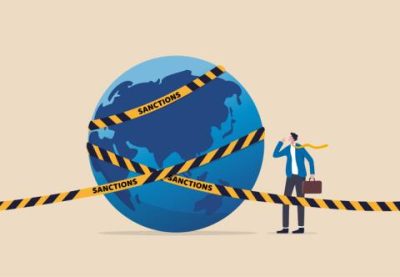
Rather than working diplomatically to resolve the civil war in Ukraine that it played a principal role in precipitating (by backing the unconstitutional transfer of power in that country in 2014), the Biden administration spent the months leading up to the Russian invasion in February assiduously working to make sure “extreme” economic sanctions could be put in place.
The threat of such additional sanctions, for Washington already had imposed a series of sanctions in 2014, was purportedly meant to deter the invasion. That having failed, it was then claimed the sanctions would force Russia to the negotiating table.
That, too, has clearly failed.
Given the centrality of economic warfare to Washington’s foreign policy, it is worth exploring how the Kremlin has managed to keep the Russian economy afloat since invading Ukraine and the likely wider implications and possible future application vis-à-vis China.
First, the immediate collapse of the ruble was reversed by the actions of the Russian central bank and the treasury. While the former nearly doubled interest rates overnight, the latter began spending its accumulated reserves to offset the price inflation that began eating into Russian consumers’ purchasing power. Though locked out of nearly half of its foreign reserves by Washington and its vassal allies, the government in Moscow has used its record balance of payments surplus to make up for the temporary loss.
While that balance of payments surplus, the result oil and gas sales continuing at lower volumes but higher prices while imports dropped precipitously, has mitigated the effects of domestic inflation, currently running at around 17 percent, it has not been able to prevent a sharp contraction in Russia’s economic growth (a contraction of approximately 10 percent is now expected over the coming year).
Given that governments from Washington to London, Warsaw, and Vilnius have made it clear that they do not even favor lifting these sanctions in the event of a cessation of hostilities, Russia’s future growth is likely to be far short of what it otherwise would have been. Lacking access to Western capital and technology, Russia will be increasingly dependent on China, India, or other developing economies for imports, as well as for a home for its energy exports as much of Europe moves to drastically reduce and eliminate its dependence on Russian hydrocarbons—though this too will depend on US sanctions, secondary sanctions, and on US-allied governments and their domestic industries’ willingness to risk running afoul of the US.
Long term, therefore, there is little doubt that the sanctions now in place will make Russia weaker and poorer. Of course, just as at present, it is the Russian people who will bear the costs of the West’s financial warfare—not their leadership.
As usual, we are expected to believe that the people of the countries targeted by US economic warfare will blame their own government rather than Washington—that they may even throw off Vladimir Putin and welcome the West! Apart from the fact that from Cuba to Venezuela, Iran, Iraq, North Korea, et cetera, this has never worked, Anne Williamson explained twenty years ago that given that the last time Russia invited the West in, people like Jeffrey Sachs, Larry Summers, and Paul Rubin destroyed the economy, handing it to oligarchs they ultimately hoped would then hand it to Western multinationals, it’s highly unlikely Russians will blame their government for their woes.
Of course, the Russian people won’t be alone in their present impoverishment. Normal people the world over are also being made poorer and weaker by Washington’s policies. Indeed, while Europeans empty their savings in the face of record-high gas, oil, and food prices, many in the developing world are literally going to starve long before the war in Ukraine ends—which North Atlantic Treaty Organization (NATO) secretary general Jens Stoltenberg now says may take years.
That these policies have been cheered by Democrats and Republicans alike is not surprising: America’s Democrats are delusional with hatred for Russia because they can’t accept that Hillary Clinton failed to beat Donald Trump, while Republicans like Ted Cruz are beholden to mercantilist interests—i.e., US oil and natural gas producers who want to sell to Europe. In the case of the former, even if Russia did concertedly try to interfere, it made no demonstrable impact on the elections, which even the thoroughly establishment Economist admits; and in the case of the latter, US gas and oil exports are already climbing toward all-time highs.
As a demonstration of its capacity to force others in line with its policies, and to get its own population to bear the consequences, Washington has doubtlessly succeeded in sending its intended message to Beijing over Taiwan. While Washington’s weaponization of the global financial system has no doubt alarmed Chinese Communist Party planners, the fact that their own population would be quite willing to suffer for the reunification of their country, as well as the fact that many countries in the developing world have eschewed following the West’s example, provide ample reason to doubt the efficacy of looming sanctions as a deterrent in the event of another, bigger Taiwan Strait crisis.
Not that it prevents the staff at the Atlantic Council from daydreaming about it in the runup to a NATO summit focused on saber-rattling in Beijing’s direction.
Because what does a history of failure and mass impoverishment prove if not that next time will be different?
If only Karl Marx had been right when he said that history repeats, first as tragedy, then as farce, paraphrasing Georg Wilhelm Friedrich Hegel. The truth instead seems to be that we are doomed to suffer an unending parade of farces under Washington’s continued pursuit of a demonstrably failed and immoral policy.
*
Note to readers: Please click the share buttons above or below. Follow us on Instagram and Twitter and subscribe to our Telegram Channel. Feel free to repost and share widely Global Research articles.
Comment on Global Research Articles on our Facebook page
Become a Member of Global Research
https://www.globalresearch.ca/unending-farce-us-sanctions-against-russia/5786138
Sergey Lavrov used to compare the West to a wounded predator. According to him, it should not be provoked because it would be taken by madness and could break everything. It is better to accompany it to the graveyard. The West does not see it that way. Washington and London are leading a crusade against Moscow and Beijing. They roar and are ready for anything. But what can they really do?
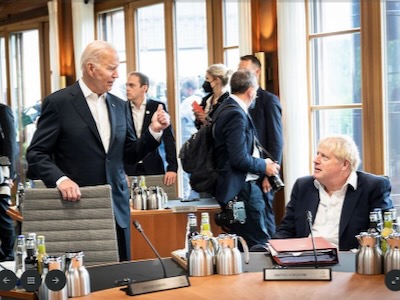
The G7 summit in Bavaria and the Nato summit in Madrid were supposed to announce the West’s punishment of the Kremlin for its "special military operation in Ukraine". But, if the image given was that of Western unity, the reality attests to their disconnection from reality, their loss of audience in the world and ultimately the end of their supremacy.
While the West is convinced that what is at stake is in Ukraine, the world sees it facing the "Thucydides trap" [1]. Will international relations continue to be organized around them or will they become multipolar? Will the peoples who have been subjugated until now break free and gain sovereignty? Will it be possible to think differently than in terms of global domination and to devote themselves to the development of each individual?
The West has devised a narrative of the Russian "special military operation" in Ukraine that overlooks their own actions since the dissolution of the Soviet Union. They have forgotten their signing of the Charter for European Security (also known as the OSCE Istanbul Declaration) and the way they violated it by making almost all the former members of the Warsaw Pact and some of the new post-Soviet states join one by one. They have forgotten the way they changed the Ukrainian government in 2004 and the coup d’état by which they put Banderist nationalists in power in Kiev in 2014. Having made a clean sweep of the past, they blame Russia for all the ills. They refuse to question their own actions and consider, at the time, they were forced into power. For them, their victories make the Law.
To preserve this imaginary narrative, they have already silenced the Russian media at home.
No matter how much they claim to be "democrats", it is better to censor dissenting voices before lying.
So they approach the Ukrainian conflict, without contradiction, by convincing themselves that they have the duty to judge alone, to condemn and sanction Russia. By blackmailing small states, they managed to obtain a text from the UN General Assembly that seems to prove them right. They now plan to dismantle Russia as they did in Yugoslavia and tried to do in Iraq, Libya, Syria and Yemen (Rumsfeld/Cebrowski strategy).
To do this, they began to isolate Russia from world finance and trade. They cut off its access to the SWIFT system and Lloyds, preventing it from buying and selling as well as transferring goods. They thought this would cause its economic collapse. In fact, on June 27, 2022, Russia was unable to pay a debt of $100 million and the rating agency Mody’s declared it in default [2].
But this did not have the desired effect: everyone knows that the reserves of the Russian Central Bank are full of foreign currency and gold. The Kremlin paid the 100 million, but could not transfer it to the West because of Western sanctions. It has placed them in an escrow account where they await their debtors.
Meanwhile, the Kremlin, which is no longer paid by the West, has begun to sell its production, especially its hydrocarbons, to other buyers, particularly China. The exchanges that can no longer be made in dollars are made in other currencies. As a result, the dollars that their customers used to use are flowing back to the United States. This process had already begun several years ago. But Western unilateral sanctions have accelerated it sharply. The huge amount of dollars accumulating in the US is causing a massive price increase. The Federal Reserve is doing everything it can to share it with the eurozone. The price increase is spreading at high speed across the entire Western European continent.
The European Central Bank is not an economic development agency. Its main task is to manage inflation within the Union. it cannot slow down the sudden rise in prices at all, so it tries to use it to reduce its debt. The Member States of the Union are therefore invited to compensate for the drop in purchasing power of their "citizens" by lowering taxes and providing benefits. But this is a never-ending circle: by helping their citizens, they tie their hands and feet to the European Central Bank, they chain themselves a little more to the US debts and become even poorer.
There is no remedy for this inflation. This is the first time that the West has had to mop up the dollars that Washington has recklessly printed for years. The rise in prices in the West corresponds to the cost of imperial spending over the last thirty years. Today and only today is the West paying for its wars in Yugoslavia, Afghanistan, Iraq, Libya, Syria and Yemen.
Until now, the United States killed anyone who threatened the supremacy of the dollar. It hanged President Saddam Hussein for refusing it and looted the Iraqi Central Bank. They tortured and lynched the leader Muamar el-Gaddafi who was preparing a new pan-African currency and looted the Libyan Central Bank. The gigantic sums amassed by these oil states disappeared without a trace. The only thing we saw was GI’s taking tens of billions of dollars wrapped in large garbage bags. By excluding Russia from dollar trade, Washington itself has brought about what it so feared: the dollar is no longer the international reference currency.
The majority of the rest of the world is not blind. It has understood what is happening and has rushed to the St. Petersburg Economic Forum, then tried to register for the virtual Brics summit. They realize -a little late- that Russia launched the "Partnership of Greater Eurasia", in 2016 and that its Foreign Minister, Sergei Lavrov, had solemnly announced it at the UN General Assembly, in September 2018 [3]. During four years, quantities of roads and railroads were built to integrate Russia into the networks of the new "Silk Roads", land and sea, imagined by China. It was thus possible to shift the flow of goods within a few months.
The fall in the value of the dollar and the shift in the flow of goods are causing an even greater rise in energy prices. Russia, which is one of the world’s leading exporters of hydrocarbons, has seen its revenues increase considerably. Its currency, the ruble, has never been in better shape. In response, the G7 has set a price ceiling for Russian oil and gas. It ordered the "international community" not to pay more.
But Russia is obviously not going to let the West set the prices of its products. Those who do not want to pay market prices will not be able to buy them, and no customer intends to go without to please the West.
The G7 tries to organize, at least intellectually, its supremacy [4].. This no longer works. The wind has changed. The four centuries of Western domination are over.
In desperation, the G7 has committed itself to solving the global food crisis that its policies have caused. The countries concerned know what the G7 commitments mean. They are still waiting for the great African development plan and other smoke and mirrors. They know that the West cannot produce nitrogen fertilizers and that they prevent Russia from selling theirs. The G7 aid is only a band-aid to keep them waiting and not to question the sacred principles of free trade.
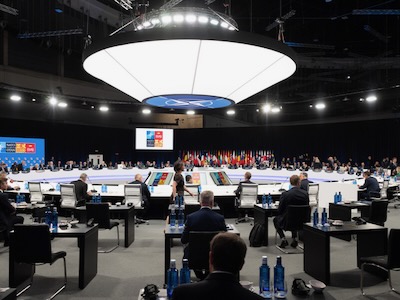
The only possible option for the rescue of Western domination is war. Nato must succeed in destroying Russia militarily as Rome once razed Carthage. But it’s too late: the Russian army has much more sophisticated weapons than the West. It has already experimented with them since 2014 in Syria. It can crush its enemies at any time. President Vladimir Putin exposed the staggering progress of its arsenal to his parliamentarians in 2018 [5]
.
The Nato summit in Madrid was a nice communication operation [6]. But it was only a swan song. The 32 member states proclaimed their unity with the despair of those who fear to die. As if nothing had happened, they first adopted a strategy to dominate the world for the next ten years, naming China’s "growth" as a concern [7]. In doing so, they admitted that their goal is not to ensure their own security, but to dominate the world. They then opened the accession process for Sweden and Finland and considered approaching China with, as a first step, the possible accession of Japan.
The only incident, which was quickly brought under control, was the Turkish pressure that forced Finland and Sweden to condemn the PKK [8]. Unable to resist, the United States dropped its allies, the Kurdish mercenaries in Syria and their leaders abroad.
With this, they decided to increase the NATO Rapid Reaction Force from 40,000 to 300,000 men, 7.5 times, and station it on the Russian border. In doing so, they have once again violated their own signature, that of the Charter for Security in Europe, by directly threatening Russia. Russia has no possibility to defend its huge borders and can only ensure its security by ensuring that no foreign force sets up a military base on its borders (scorched earth strategy). Already, the Pentagon is circulating prospective maps of the dismantling of Russia that it hopes to implement.
The former Russian ambassador to NATO and current director of Roscosmos, Dmitry Rogozin, has responded by publishing on his Telegram account the coordinates of the NATO decision-making centers, including the Madrid summit room [9]. Russia has hypersonic launchers, for the moment impossible to intercept, which can carry a nuclear warhead in a few minutes to the NATO headquarters in Brussels and the Pentagon in Washington. To avoid any misunderstanding, Sergei Lavrov specified, alluding to the Straussians, that the martial decisions of the West were not taken by the military, but by the US State Department. It would be the first target.
So the question is: will the West play for all it’s worth? Will they take the risk of a Third World War, even though it has already been lost, just to avoid dying alone?
AANRADER !! delen aub (NL ondertiteld)
De Oekraïners hebben de mensen in Bucha vermoord.
Kolonel Richard H. Black heeft o.a gewerkt bij JAG Corps van het Amerikaanse leger, dat is de juridische tak van het Amerikaanse leger.
Het korps is samengesteld uit legerofficieren die ook advocaten zijn en die juridische diensten verlenen aan het leger op alle bevelsniveaus.
Richard Black WEET waar en hoe men moet kijken naar foto en video materiaal.
Bucha was een valse vlag operatie en werd gebruikt om Rusland te beschuldigen van oorlogsmisdaden en de onderhandelingen af te kappen.
originele video hier: https://www.youtube.com/watch?v=3yQndiwAU1k
International relations, Russian affairs
Thanks to the efforts of sympathetic account holders with youtube.com, some RT shows are accessible on the platform, notwithtanding the closure of RT’s own account in the days following the start of the ‘special military operation’ in Ukraine.
Accordingly, I invite you to view yesterday’s Cross Talk show entitled “The Russia-West Split” in which I had the pleasure of participating with a couple of outstanding panelists under the guidance of the show’s moderator and host, Peter Lavelle.0:5 / 24:57
I also note that the following previously aired RT program fits nicely back to back with the show of yesterday. “Russia and Europe: The Closing Window”. That was taped just as Russia was celebrating the 350th anniversary of the birth of Peter the Great.
Berichten Uit Donbass:
Het industriële complex in de VS begint te krimpen door hoge stroomkosten.
Op 22 juni hoorden 600 arbeiders van de op een na grootste aluminiumfabriek in Amerika, goed voor 20% van de Amerikaanse levering, dat ze hun baan kwijtraakten omdat de fabriek zich geen elektriciteitsabonnement kan veroorloven dat in een paar maanden tijd is verdrievoudigd.
Minstens twee staalfabrieken zijn begonnen met het opschorten van sommige operaties om de energiekosten te verlagen, volgens een directeur van de sector, die vroeg om niet te worden geïdentificeerd omdat de informatie niet openbaar is. In mei waarschuwde een groep fabrieken in het middenwesten van de VS de federale energieregelgevers dat sommige op het punt stonden te sluiten voor de zomer of langer vanwege wat zij beschreven als "onrechtvaardige en onredelijke" elektriciteitskosten. Ze vroegen om volledig vrijgesteld te worden van enkele stroomkosten.
Begin juni waren de aardgasprijzen verdrievoudigd ten opzichte van een jaar eerder, waardoor huishoudens en bedrijven werden bedreigd met enkele van de hoogste energierekeningen die ze ooit hebben gezien.
Omdat Amerikaanse fabrieken afhankelijk zijn van zowel elektriciteit als gas, zou dit wel eens het moment kunnen zijn waarop het tapijt onder de Amerikaanse industrie wordt weggetrokken.
The US Industrial Complex Is Starting to Buckle From High Power Costs
Surging bills are forcing companies to scale back industrial operations, threatening a greater drag on the economy.
https://www.bloomberg.com/news/articles/2022-07-07/high-power-costs-force-us-industrials-factories-to-shut?srnd=economics-vp


