Zoeken in deze blog 🔎🔎

vrijdag 28 augustus 2020

Chris Kijne en de Gesubsidieerde Onwetendheid


Vanochtend las ik het volgende:

Foto om de Dag: Een stukje marketing naar de mensen toe. Al ruim vier jaar maak ik de Presidential Podcast. Een podcast over de Amerikaanse presidentsverkiezingen, die ooit, ten tijde van de conceptie, bedoeld was om in samenspraak met de vigerende NRC-correspondent de verkiezingen van 2016 te volgen. We dachten dat we met de verkiezing van Hillary Clinton in november 2016 weer afscheid zouden nemen van de luisteraars. Vanmiddag namen we de 100ste aflevering op van ons veelbeluisterde prachtprogramma, met Bas Blokker namens de NRC en yours truly vanuit Hilversum. Én een mystery guest waar ik dus niks over zeg.  
Het is, afgezien van één van de leukste journalistieke dingen die ik heb gedaan - omdat het over Amerika gaat, over die volkomen gemankeerde en des ondanks altijd inspirerende democratie, omdat het radio is zoals radio was en zou moeten zijn: gedreven door inhoud en niet door formats of zenderkleuring en andere Hilversumse heilloosheid - tot nu toe ook één van de meest verbijsterende journalistieke ervaringen van mijn leven geweest.  

Het tempo waarin ik de politiek in een land dat, met alles wat erop aan te merken is, toch altijd ook een baken was van de waarden waar het in de politiek om gaat sinds de invoering van de parlementaire democratie, heb zien instorten, degenereren, ontsporen, geef het maar een naam, heb zien verworden tot een door en door gepolariseerde, doodzieke, excusez le mot, kolerezooi: het was adembenemend en diep angstaanjagend.  

En dus zijn we, in aflevering honderd, hier aangeland: twee partijen die allebei de overwinning van de ander afschilderen als de apocalyps, armageddon, het einde van Amerika. Een totale patstelling, een volkomen vastgelopen politiek systeem, een situatie die alles in zich heeft een selfulfilling prophecy te worden. Want inderdaad: als de politiek zó functioneert, is er geen redden meer aan.

En het gebeurt allemaal tegen het decor van rassenrellen die dit soort beelden opleveren. Beter kan je de Amerikaanse apocalyps niet verbeelden. (Foto: Stephen Maturen/Reuters)

#100: De verkiezingen van de apocalyps

donderdag 27 augustus 2020, 19:13 uur 

Op 10 maart 2016 stond de eerste Presidential Podcast, toen gemaakt door NRC-correspondent Guus Valk en VPRO-presentator Chris Kijne, online. In een politiek landschap dat, na acht jaar Obama, voor verreweg de meeste Amerika-watchers, af leek te stevenen op een rustige consolidatie van het Democratische leiderschap, met steeds meer oog voor minderheden, ongelijkheid en praktische zaken als goede gezondheidszorg. Vandaag presenteren we u de honderdste aflevering, na bijna vier jaar president Trump, in een politiek landschap dat door beide partijen als apocalyptisch wordt beschreven. Het is nu of nooit meer, zeggen ze allebei, zo constateren de huidige NRC-correspondent Bas Blokker en Chris Kijne én voor deze speciale gelegenheid: Guus Valk.

https://www.nporadio1.nl/podcasts/the-presidential-podcast/76802-100-de-verkiezingen-van-de-apocalyps


Dit is een schoolvoorbeeld van het gebrek aan kwaliteit bij de polderpers. Kijne schrijft:

1. We dachten dat we met de verkiezing van Hillary Clinton in november 2016 weer afscheid zouden nemen van de luisteraars. 

Kortom,  deze 'Amerika-deskundigen' waren in 2016 er rotsvast van overtuigd dat Hillary Clinton zou worden gekozen. Waarom? Wel, omdat zij geloofden in hun eigen propaganda en die van de voltallige 'corporate press.' Hoe is dit te verklaren? Omdat mijn mainstream-collega's in een bubbel leven, hermetisch afgesloten van de werkelijkheid. Zodoende konden ze onmogelijk de realiteit registreren, die zich elders voltrok. Hen ontbreekt één van de belangrijkste kwaliteiten van een echte journalist, namelijk nieuwgierigheid. Daarom is de vraag waarom onder andere Chris Kijne nu opnieuw zijn onkunde mag uitzenden?  Wie heeft hem al dat belastinggeld gegeven om programma's over de Amerikaanse presidentsverkiezing te maken? Waarom die enorme verspilling van geld? Is er echt niemand in Hilversum die meer weet dan Kijne, die de mainstream-pers napraat?

Volgende keer meer. 


Krapuul en de Lulligheid

 Op de website Krapuul lees ik het volgende:

Jammer, mevrouw Arib, van die drie miljoen ongenoemden

Jammer. U was op de goede weg met uw kijk op WO-2. Maar nu concentreerde u zich afgelopen week helaas in uw rede bij de ‘Indische’ herdenking op de belevenissen van ene Helen Colijn, een witte vrouw uit een koloniale familie in voormalig Nederlandsch-Indië. Zeker, zij was een gevangene van de Japanners en heeft onder hen geleden. Maar zij bracht het er levend af, evenals ongeveer acht van de tien witte Nederlanders in Indië. Maar niet ruim 3 miljoen Indonesische burgers. Dat kwam zo.

Nederland had Indonesië veroverd, geheel onwettig en uiterst bloederig. Helen Colijns grootvader streed als kapitein in de Atjeh-oorlogen, waar de oorspronkelijke bewoners op grote schaal werden vermoord, ook vrouwen en kinderen. Grootvader Colijn, later directeur van de Shell/Koninklijke Olie en uiterst zuinige en eigenlijk asociale premier, heeft er vol afschuw over geschreven over die bloedbaden, dat wel. Maar Helen Colijn heeft nooit in een zin afstand genomen van het kolonialisme, van haar familie.

https://www.krapuul.nl/blog/2750184/jammer-mevrouw-arib-van-die-drie-miljoen-ongenoemden/

Tja, Krapuul. Jammer. Jammer. Jammer. Half-geïnformeerd zijn is een kenmerk van de mainstream-journalistiek. De bewering dat 'Grootvader' Colijn 'vol afschuw [heeft] geschreven  over die bloedbaden,' suggereert dat de Nederlandse voormalige minister-president publiekelijk verantwoording heeft afgelegd voor zijn oorlogsmisdaden. Dat is onjuist. Wel heeft Hendrikus in een brief aan zijn echtgenote het volgende geschreven: 

‘Ik heb er een vrouw gezien die, met een kind van ongeveer 1/2 jaar op den linkerarm, en een lange lans in de rechterhand op ons aanstormde. Een kogel van ons doodde moeder en kind. We mochten toen geen genade meer geven. Ik heb 9 vrouwen en 3 kinderen, die genade vroegen, op een hoop moeten zetten, en zo dood laten schieten. Het was onaangenaam werk, maar 't kon niet anders. De soldaten regen ze met genot aan hun bajonetten. 't Was een verschrikkelijk werk. Ik zal er maar over eindigen.’

En zwijgen hierover deed deze christen als geen ander. Niks verantwoording afleggen. En nog steeds wil ook de stad Amsterdam geen verantwoording afleggen voor het feit dat er een straat naar deze massamoordenaar is vernoemd.  Krapuul, even een klein stukje geschiedenis, uit Het Parool van eind 2019:

Hendrikus Colijn weer zonder oorlogsverleden op straatnaambord

Een straatnaambord over het oorlogsverleden van Hendrikus Colijn is weer verwijderd. Een kwestie van voortschrijdend inzicht, stelt het bestuur van Nieuw-West.


Patrick Meershoek 16 december 2019, 16:34


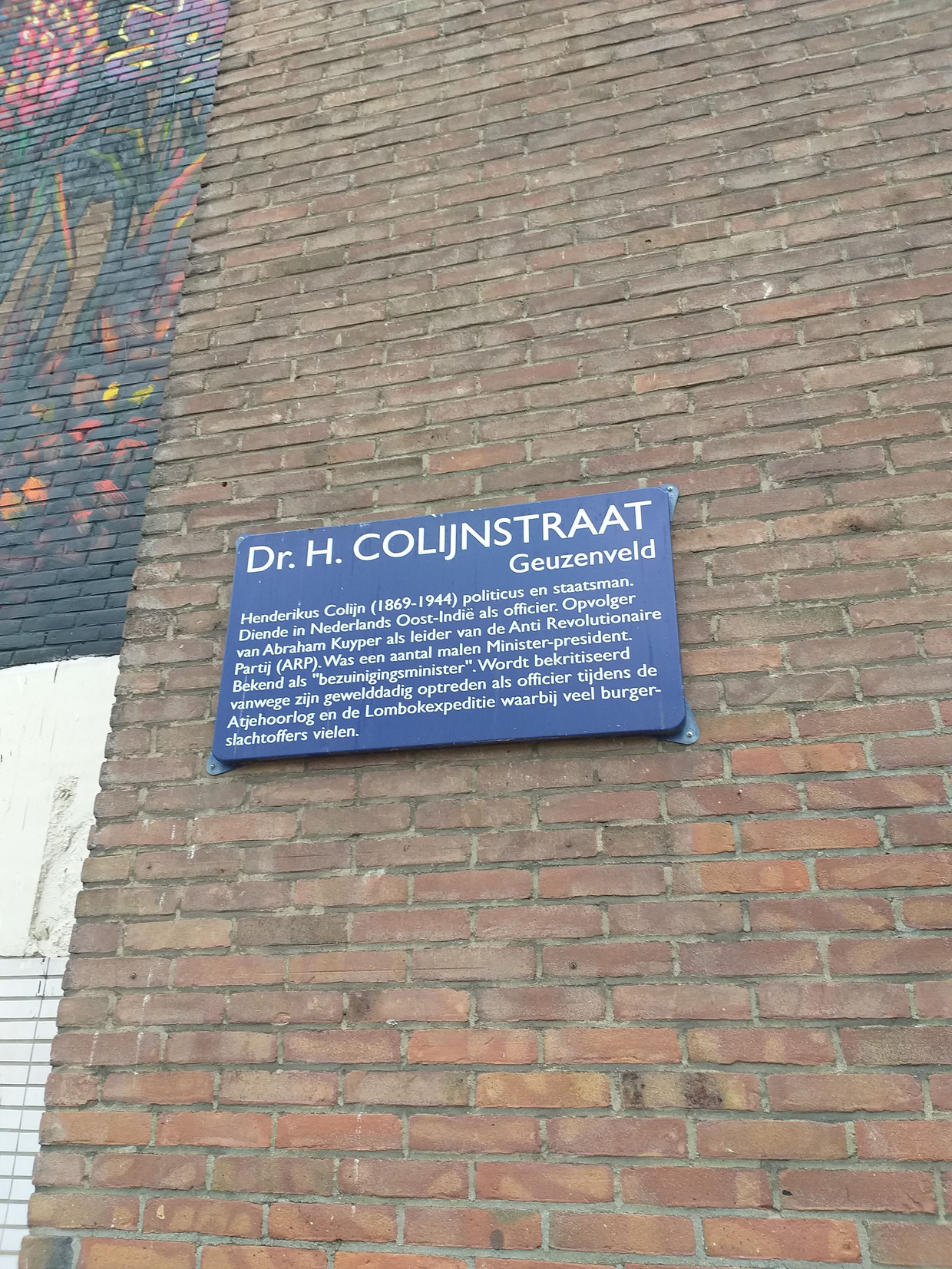
Het inmiddels verwijderde naambord van de Dr. H. Colijnstraat in Geuzenveld met ondertitel. 

Even geruisloos als het was verschenen, is het ook weer verdwenen: het naambord van de Dr. H. Colijnstraat in Geuzenveld. Op het onlangs verwijderde bord werd Hendrikus Colijn niet alleen omschreven als politicus en staatsman, maar ook als deelnemer aan gewelddadige militaire expedities in voormalig Nederlands-Indië.

Een kwestie van voortschrijdend inzicht, schrijft het dagelijks bestuur van Nieuw-West in een brief aan de stadsdeelcommissie. De kwestie was aangekaart door een bewoner van het stadsdeel, die zich ergerde aan de selectieve verontwaardiging. Colijn is de enige naamgever in het stadsdeel met een dergelijke bijsluiter.


In de brief geeft het stadsdeel voor het eerst ook openheid van zaken over hoe het initiatief tot stand is gekomen. Dat begon in 2012 met een brief van een niet nader genoemde schrijver-journalist die reageerde op de vijftien jaar eerder verschenen biografie van Colijn, geschreven door historicus Herman Langeveld.

De schrijver-journalist blijkt Stan van Houcke te zijn, voorheen actief bij de VPRO en Radio Stad. De binnenstadbewoner diende indertijd een voorstel in om een paar regels toe te voegen over het oorlogsverleden van Colijn, die eind negentiende eeuw als officier had gediend in het Koninklijk Nederlandsch-Indisch Leger.

‘Gewelddadige optreden’

Met name een in de biografie afgedrukte brief van de jonge officier aan zijn echtgenote had veel stof doen opwaaien. In de brief schreef Colijn hoe hij negen vrouwen en drie kinderen had laten doden. ‘Het was onaangenaam werk, maar ’t kon niet anders. (…) De soldaten regen ze met genot aan hun bajonetten.’

Het stadsdeelbestuur nam na rijp beraad het voorstel van Van Houcke over, zij het in aangepaste vorm. De omschrijving oorlogsmisdadiger was te gortig. Dat werd: ‘Wordt bekritiseerd vanwege zijn gewelddadig optreden als officier tijdens de Atjeh-oorlog en de Lombok-expedie waarbij veel burgerslachtoffers vielen.’

De bordjes werden verhangen zonder voor grote beroering te zorgen. Dat veranderde begin dit jaar, toen GeenStijl- en Telegraaf-columnist Rob Hoogland tegelijkertijd lucht kregen van de zaak. Zij lieten in hun stukken de knuppel dansen op de rug van GroenLinks dat in hun ogen weer eens bewees er een sport van te maken vaderlandse helden van hun voetstuk te duwen.

Dat was enigszins voorbarig, want in werkelijkheid was het PvdA-bestuurder Els Verdonk die in Nieuw-West de nieuwe aanduiding van Colijn voor haar rekening had genomen. ‘Het opschrift is opgesteld onder de verantwoordelijkheid van de toenmalige portefeuillehouder,’ benadrukte ook het huidige bestuur in de brief.

Over het voortschrijdend inzicht worden door het stadsdeel helaas geen nadere mededelingen gedaan. Het zorgde er immers eerst voor dat het oorlogsverleden van Colijn op diens straatnaambord kwam, en enkele jaren later dat het weer verdwijnt. Het bestuur wijst erop dat de verantwoordelijkheid voor de onderborden tegenwoordig op de Stopera ligt.

Strategisch

Wellicht speelt daarbij ook nog een strategisch belang. Burgemeester Femke Halsema heeft zich het afgelopen jaar persoonlijk ontfermd over een hele serie inclusieve straatnamen op IJburg, een poging om het verzet tegen de Nederlandse kolonisator een plek te geven in de Amsterdamse stratengids.

Die materie is gevoelig genoeg en kan prima zonder post-koloniaal containerbrandje in een van de stadsdelen. In de brief schrijft het bestuur van Nieuw-West dan ook niet te verwachten dat er nog veel nieuwe onderborden zullen verschijnen, ook vanwege de kosten die verbonden zijn aan het maken van nieuwe borden.

Ook in de Colijnstraat in Geuzenveld is de rust teruggekeerd. De naamgever is nu, tot nader order, weer gewoon de opvolger van Abraham Kuyper als leider van de Anti Revolutionaire Partij (ARP) en een minister-president die een reputatie verwierf als bezuinigingsminister, net als bij de oplevering van de straat in 1955.

https://www.parool.nl/amsterdam/hendrikus-colijn-weer-zonder-oorlogsverleden-op-straatnaambord~bd7124f6/

Het stadsbestuur van Amsterdam heeft weinig op met de geschiedenis van de politieke elite. Kijk eens hoe de gemeente zelfs de naam van Hendrikus Colijn weet fout te spellen. 


Het is allemaal van een onbeschrijvelijke lulligheid. Dus Krapuul: doe je huiswerk voordat je met kritiek komt.


The American Fictie

Het eerste dat me vanochtend opviel was deze kop: 

Trump Is Campaigning on a Fiction. That Doesn’t Mean He Won’t Stay President.

https://truthout.org/articles/trump-is-campaigning-on-a-fiction-that-doesnt-mean-he-wont-stay-president/


Nu is een kop bedoeld om publiek te trekken met een opmerking of feit dat afwijkend is. Maar hier wordt niets bijzonders gemeld, want alle moderne Amerikaanse presidenten voerden een campagne met een fictie. Die fictie heet: THE AMERICAN DREAM. De Amerikaanse comedian George Carlin zei daarover eens: 'You Have to be Asleep to Believe it.' 

De fictie waarmee Obama president werd was 'Change We Can Believe In' om vervolgens allereerst de banken en het Amerikaanse militair-industrieel complex met honderden miljarden te steunen. Het was Obama die de weg opende voor Trump. Maar omdat de corporate press zo corrupt is doet zij het voorkomen dat Trump niet deugt maar Obama wel. 


U.S. Preparing or War With China and Russia


USA’s Militarization of Latin America

Maj. Gen. Andrew Croft, the commander of 12th Air Force, wrote on 22 August: “I have seen an increasingly contested strategic space where Beijing and Moscow are aggressively investing time and resources in Latin America to support their authoritarian models of governance. The Air Force must reinforce the strength of our longstanding commitment to the Western Hemisphere. We lose ground when we are unable to commit to spending the time and resources to fly our aircraft south and train alongside our partners.”

Croft’s statement reflects the growing American hysteria against the presence of any extra-regional actors in the Latin American continent. For US policy-makers, Latin America is not an aggregation of sovereign nations but a large lump of subordinated states constituting “America’s backyard”. Consequently, this conceptualization of Latin America as a natural extension of the American empire has led to viewing the engagement of any South American country with China, Russia and Iran as a “threat” to peace and security.

On February 7, 2019, Admiral Craig S. Faller – the commander of the United States Southern Command – told the Congress that the Western Hemisphere is facing “a troubling array of challenges and threats”. These threats included alarmist assertions about the growing dominance of China, Russia and Iran and a general demonization of the socialist governments of Cuba, Venezuela and Nicaragua: “China has accelerated expansion of its Belt and Road Initiative at a pace that may one day overshadow its expansion in Southeast Asia and Africa. Russia supports multiple information outlets spreading its false narrative of world events and U.S. intentions. Iran has deepened its anti-U.S. Spanish language media coverage and has exported its state support for terrorism into our hemisphere. Russia and China also support the autocratic regimes in Venezuela, Cuba, and Nicaragua, which are counter to democracy and U.S. interests. We are monitoring the latest events in Venezuela and look forward to welcoming that country back into the hemisphere’s community of democracies.”

In response to the perceived threats posed by the China-Russia-Iran nexus, the Secretary of Defense has decided to conduct an assessment of the sufficiency of resources available to the U.S. Southern Command, the U.S. Northern Command, the Department of State, and the U.S. Agency for International Development (USAID) to carry out their respective missions in the Western Hemisphere. This assessment is required to include“a list of investments, programs, or partnerships in the Western Hemisphere by China, Iran, Russia, or other adversarial groups or countries that threaten the national security of the United States.”

In addition to warlike preparations, USA has also pursued a policy of increased militarization wherein it has tried to ensure “technological superiority” with regard to “anti-US actors”. In March, 2020, USA decided to send additional ships, aircraft and forces to South America and Central America in order to combat the influence of Russia and China. According to Navy Adm. Craig Faller, commander of Southern Command, “This really was born out of a recognition of the threats in the region,”. Along with the mobilization of the Southern Command, USA has substantially enlarged its security aid to Latin America: From $527,706,000 in 2019, US security aid to Latin America has increased by 10% to $581,270,000.

Chinese Footprint

The present-day US militarization of Latin America is rhetorically driven by an imperialist discourse framing the continent as a possession of the American empire which China, Russia and Iran are trying to appropriate. To take an example, R. Evan Ellis, a Latin America Research Professor at the US Army War College, told before the US-China Economic and Security Review Commission that China’s engagement with Latin America “threatens the position of the United States, our security and prosperity, and the democratic values, rights, institutions and laws on which we depend.” To substantiate his statements, Ellis enunciated various strategies through which China is undermining USA’s dominance:

  • “Trade with, loans to, investment in, and other forms of economic and other support to anti-US regimes, indirectly enabling their criminal activities and contributions to regional instability”.
  • “Through providing an alternative to commerce, loans and investment from the West, making governments of the region less inclined to support the US on political, commercial, or security issues, or to stand up for rule of law, democracy or human rights, particularly where it might offend the PRC;”

In both these points, one can observe the imperialistic high-handedness with which Ellis is declaiming his pro-US rhetoric. While Beijing’s efforts to engage with sovereign nations and construct an alternative to the global American empire are regarded as enabling “regional instability”, no questions are asked about USA’s expansionist quest to imperialize the entire world through militaristic tactics.

In order to vilify China and smear its non-aggressive foreign policy, hawkish security experts have framed the country’s diplomatic involvement with various Latin American nations as a type of authoritarian tactic. Using this line of reasoning, the National Endowment for Democracy (NED) writes: “Beijing has now officially established its own version of soft power… which emanates from its undemocratic system and rests on its ability to shape the viewpoints of others through co-optation and persuasion.” Not having any empirical evidence to prove its unconvincing statements, NED talks vaguely about the “hypnotic effects” exercised by “Chinese-style warm welcome”: “The Chinese-style warm welcome, the carefully selected tours that include visits to sites with symbolic historical and cultural significance, and ad hoc friendly discourse delivered by the Chinese hosts can have hypnotic effects on their foreign guests.” This is an indication of the extent to which America hysteria against China can reach.

In the same way as NED, the Brookings Institution has also tried to slander China’s diplomatic initiatives in Latin America to preserve the coercive dominance of USA in the continent. As perthe think tank, “it would be fair to assume that China’s growing economic power and ambitions of global leadership, coupled with its inherently closed and repressive model of political control, will hurt the region’s prospects for strengthening its liberal democratic systems and respect for human rights.” While saying this, the Brooking Institution conveniently forgets that it the US, with its Western-styled liberal democracy, that has hurt the region most in the form of coups, violence and overt brutality against social movements. Most recently, a US-backed coup in Bolivia has resulted in two massacres and massive repression of social movements.

The Iranian Connection 

Like China, Iran, too, experiences American hostility towards its engagement with Latin American countries. Lieutenant Andrew Kramer of the U.S. Navy terms Iranian support for the “economically backward governments” of Cuba, Nicaragua and Venezuela as efforts “to maintain pockets of instability and hostility close to U.S. borders.” Echoing this perspective, William Preston McLaughlin, a Colonel (Ret.) of U.S. Marine Corps and Magdalena Defort, an Intern Analyst at the Foundation of Defense of Democracies, argue that “Iran’s presence in Latin America is an imminent threat to peace and political stability in the Western Hemisphere because its forces interact with Latin America’s deeply rooted revolutionary ideology and various well-intentioned but flawed “liberation theology” social movements.” Here, both of the analysts are merely parroting the imperialist “Monroe Doctrine” that subverted the sovereignty of Latin American nations and tethered the people of the continent to the whims of the American empire. Through the Monroe Doctrine, USA relegated the entire Latin American continent to the status of the empire’s handmaiden and constantly used its military muscles to overpower any regional initiatives challenging the dynamics of subjugation. Now, when Iran is lending support to the anti-imperialist administrations of Venezuela, Nicaragua and Cuba, it has come under the radar of USA for ostensibly destroying peace and political stability in the Western Hemisphere. In August 2020, for instance, USA confiscated four Iranian fuel shipments that had been bound for Venezuela, making it clear that it would not tolerate anti-imperialist opposition in Latin America. 

In addition to portraying Iran as a threat to global peace, both the analysts also used a shrill, scaremongering rhetoric to over-exaggerate the strength of the country. According to the analysts, “Iran has used every agency within its borders to help extend Iranian tentacles into the political, cultural, economic, and military life of Latin America.” This bears striking resemblance to the traditional war-mongering US narrative that frames Hezbollah as a menace to justify the militarizary raising funds, seeking recruits, probing for our weaknesses and challenging our defenses,”. Through these discourses, USA seeks to unleash a new war against the anti-imperialist axis of Latin America which is standing up to militaristic predatoriness of the global hegemon. 

Russian Presence 

Besides Iran and China, Russia is another nation perceived as a “threat” to US security. General John Kelly, commander of the U.S. Southern Command (SOUTHCOM) noted in his Congressional testimony, “it has been over three decades since we last saw this type of high-profile Russian presence” in Latin America. In his command’s 2015 Posture Statement, Kelly added: “Periodically since 2008, Russia has pursued an increased presence in Latin America through propaganda, military arms and equipment sales, counterdrug agreements, and trade. Under President Putin, however, we have seen a clear return to Cold War tactics. As part of its global strategy, Russia is using power projection in an attempt to erode U.S. leadership and challenge U.S. influence in the Western Hemisphere.”

John Kelly’s representation of Russia as a military threat has been repeated by the Commander of US Southern Command, Admiral Kurt W. Tidd who said in his February 2018 Posture Statement to the US Senate Armed Services Committee that: “Russia’s increased role in our hemisphere is particularly concerning, given its intelligence and cyber capabilities, intent to upend international stability and order, and discredit democratic institutions…Left unchecked, Russian access and placement could eventually transition from a regional spoiler to a critical threat to the U.S. homeland.” With the help this narrative, USA has aggressively pushed forward the agenda of greater militarism in Latin America as it strives to maintain “technological superiority” in relation to Russia and expand its already largemilitary expenditure.

On the top of depicting Russia as a military threat, US analysts have additionally portrayed the country’s support of socialist governments in Latin America as a danger to the economically empty liberal democracies of the West. According to IBI Consultants, a National Security consulting company specializing in Latin America, Russia’s growing presence in Latin America “is now an integral part of an alliance of state and nonstate actors that have shown their hostility toward the United States in their ideology, criminalized behavior, and anti-democratic nature.” Reiterating this point, on July 9, 2019, Admiral Faller declaredbefore the Congress that “Russia seeks to sow disunity and distrust, propping up autocratic regimes in Cuba, Bolivia, Venezuela, and Nicaragua, which are counter to democracy and U.S. interests.” For Faller, those nations which don’t doggedly toe America’s imperialist line automatically become “threats” to democracy and if Russia shows solidarity with these anti-imperialist nations, it, too, classifies as a threat to US interests.

As USA continues to militarize Latin America, it is increasingly becoming clear that it wants to protect its old, imperial structures from being challenged by anyone. It has been explicitly acknowledged even by pro-US analysts such as Ellis that US military assistance in Latin America “potentially serves U.S. strategic interests by helping to inoculate receiving states against radical or anti-democratic [read “socialist”] solutions which find receptivity when populations lose faith in the ability of a democratic political system and a free market economy to effectively address the corruption, inequality, injustice, and other dysfunctionalities plaguing their country [Emphasis mine].” US military assistance, therefore, is not apolitical and is ideologically tarnished with the objectives of stabilizing free market economies-bourgeoisie democracies and subverting socialist countries.

The United States Intelligence Community’s assessment of threats to US national security had stated in 2019 that “anti-US autocrats [in the Western Hemisphere]will present continuing challenges to US interests, as US adversaries and strategic competitors seek greater influence in the region.” Here, “anti-US autocrats” refers to the socialist administrations of three Latin American countries: Cuba, Venezuela and Nicaragua. These three countries have been facing strong US belligerence for their anti-imperialist stance. US sanctions against Cuba have tightenedduring the pandemic; USA’s hybrid war against Venezuela has intensified as Trump has decided to use frozen funds to topple Nicolas Maduro and USAID (United States Agency for International Development) has strengthened its regime change operations against the Sandinista government of Daniel Ortega in Nicaragua. Due to the support lent by China, Russia and Iran to the socialist governments of Latin America, USA has decided to eradicate these extra-regional actors from its “own” backyard and re-proclaim a complete American dominance in the region. In times like these, the international community needs to oppose the militarism of USA against new regional alliances in Latin America.

https://dissidentvoice.org/2020/08/usas-militarization-of-latin-america/?fbclid=IwAR2A6P_kb3v017taApoyCkcW-BxMaHKJ-BEyESjIYQTaZNv5f4HCJvxw2AI


donderdag 27 augustus 2020

Elvis - His Latest Flame Remix


Elvis - His Latest Flame Remix 


Kenosha Police Fascism


Kenosha County Sheriff Beth on theft, chase suspects: 'Let's put them away'


LA Lakers and Clippers voted to boycott rest of NBA season


LA Lakers and Clippers voted to boycott 

rest of NBA season -- reports


Three NBA playoff games were postponed after the Milwaukee Bucks decided not to take the floor against the Orlando Magic as players took a stand with their Bucks counterparts. Three WNBA, five Major League Soccer and three Major League Baseball games were also postponed.
And following the postponement of its opening series against the Portland Trail Blazers, players from the Los Angeles Lakers -- as well as its city counterparts the Los Angeles Clippers -- voted to boycott the remainder of the 2019-20 NBA season, according to Shams Charania, who is with both The Athletic and Stadium.
    An empty court and bench is shown before the start of a scheduled game between the Milwaukee Bucks and the Orlando Magic.
    Blake, a Black man, was shot in the back by police on Sunday as he tried to enter his vehicle in Kenosha, Wisconsin. His shooting became the latest incident to prompt outrage nationwide over racial injustice and police brutality.
    According to Elle Duncan of ESPN, NBA players boycotting a game has happened only once before. Almost 60 years ago, Hall of Famer Bill Russell and some of his Boston Celtic teammates sat out a game in 1961 in protest of racial injustice. 
    In a players' meeting on Wednesday night, the LA teams were the only two NBA teams who voted to boycott the NBA season. Charania, who cites unnamed sources in his reporting, said all other NBA teams voted to continue playing.
    The vote that was taken doesn't appear to be binding. According to ESPN's Adrian Wojnarowski, who cited unnamed sources, it was more of a poll than a final vote, and that resuming the playoffs remains up in the air.
    When reached by CNN, the NBA said it had nothing to share beyond the statement that the league put out earlier in the day, when it was announced that Wednesday's games would be postponed and that the games would be rescheduled.
    CNN has reached out to the National Basketball Players Association (NBPA), the Lakers and the Clippers for comment.
    Two playoff games are scheduled to take place on Thursday but given Wednesday's developments, it remains to be seen if they will take place.
      Strikes are banned under the NBA's collective bargaining agreement, which means the Bucks players broke their own contract in order to protest racial injustice and police violence.


      The Queue Behind BRICS’ Door

        Forwarded this email?  Subscribe here  for more The Queue Behind BRICS’ Door Ghana seeks BRICS partner status while Zimbabwe prepares a fu...