


vrijdag 1 november 2019
Philip Giraldi: Killing Julian Assange
Killing Julian Assange: Justice Denied When Exposing Official Wrongdoing
By Philip Giraldi
Strategic Culture
November 1, 2019
The hideous treatment of WikiLeaks founder Julian Assange continues and many observers are citing his case as being symptomatic of developing “police state” tendencies in both the United States and in Europe, where rule of law is being subordinated to political expediency.
Julian Assange was the founder and editor-in-chief of the controversial news and information site WikiLeaks. As the name implies, after 2006 the site became famous, or perhaps notorious, for its publication of materials that have been leaked to it by government officials and other sources who consider the information to be of value to the public but unlikely to be accepted by the mainstream media, which has become increasingly corporatized and timid.
WikiLeaks became known to a global audience back in 2010 when it obtained from US Army enlisted soldier Bradley Manning a large quantity of classified documents relating to the various wars that the United States was fighting in Asia. Some of the material included what might be regarded as war crimes.
WikiLeaks again became front page news over the 2016 presidential election, when the website released the emails of candidate Hillary Clinton and her campaign manager John Podesta. The emails revealed how Clinton and her team collaborated with the Democratic National Committee to ensure that she would be nominated rather that Bernie Sanders. It should be noted that the material released by WikiLeaks was largely documentary and factual in nature, i.e. it was not “fake news.”
Because he is a journalist ostensibly protected by the First Amendment guarantee of free speech, the handling of the “threat” posed by journalist Assange is inevitably somewhat different than a leak by a government official, referred to as a whistleblower. Assange has been vilified as an “enemy of the state,” likely even a Russian agent, and was initially pursued by the Swedish authorities after claims of a rape, later withdrawn, were made against him. To avoid arrest, he was given asylum by a friendly Ecuadorean government seven years ago in London. The British police had an active warrant to arrest him immediately as he had failed to make a bail hearing after he obtained asylum, which is indeed what took place when Quito revoked his protected status in April.
As it turned out, Julian Assange was not exactly alone when he was in the Ecuadorean Embassy. All of his communications, including with his lawyers, were being intercepted by a Spanish security company hired for the purpose allegedly by the CIA. There apparently was also a CIA plan to kidnap Assange. In a normal court in a normal country, the government case would have been thrown out on constitutional and legal grounds, but that was not so in this instance. The United States has persisted in its demands to obtain the extradition of Assange from Britain and London seems to be more than willing to play along. Assange is undeniably hated by the American political Establishment and even much of the media in bipartisan fashion, with the Democrats blaming him for Hillary Clinton’s loss while Secretary of State Mike Pompeo has labeled him a “fraud, a coward and an enemy.” WikiLeaks itself is regarded by the White House as a “hostile non-government intelligence service.” Sending Julian Assange to prison for the rest of his life may be called justice, but it is really revenge against someone who has exposed government lies. Some American politicians have even asserted that jail is too good for Assange, insisting that he should instead be executed.
The actual charges laid out in the US indictment are for alleged conspiracy with Chelsea Manning to publish the “Iraq War Logs,” the “Afghan War Logs” and the US State Department cables. On May 23rd, the United States government further charged Assange with violating the Espionage Act of 1917, which criminalizes any exposure of classified US government information anywhere in the world by anyone. Its use would create a precedent: any investigative journalist who exposes US government malfeasance could be similarly charged.
Assange is currently incarcerated in solitary confinement at high-security Belmarsh prison. It is possible that the Justice Department, after it obtains Assange through extradition, will attempt to make the case that Assange actively colluded with the Russian government, a conspiracy to “defraud the United States” to put it in legalese. Assange is unlikely to receive anything approaching a fair trial no matter what the charges are.
Assange’s prison term ended on September 22nd, but an earlier procedural hearing at Westminster Magistrates’ Court had already decided that a full hearing on extradition to the US would not begin until February 25th, 2020. District Judge Vanessa Baraitser ruled that Assange would not be released even though the prison term had ended, because he was a flight risk. His status in the prison system was duly changed from a serving prisoner to a person facing extradition and his final hearing would be at the high security Belmarsh Magistrates’ Court rather than in a normal civil court. Belmarsh is where terrorists are routinely tried and the proceedings there permit only minimal public and media scrutiny.
Most recently, on October 21st, 2019, Assange was again in Westminster Magistrates’ Court for a “case management hearing” regarding his possible extradition to the US Judge Baraitser denied a defense team request for a three-month delay so that they could gather evidence in light of the fact that Assange had been denied access to his own papers and documents in order to prepare his defense. British government prosecutor James Lewis QC and the five US “representatives” present opposed any delay in the extradition proceedings and were supported by Judge Baraitser, denying any delay in the proceedings.
Another procedural hearing will take place on December 19th followed by the full extradition hearing in February, at which time Assange will presumably be turned over to US Marshalls for transportation to the Federal prison in Virginia to await trial. That is, of course, assuming that he lives that long as his health has visibly deteriorated and there have been claims that he has been tortured by the British authorities.
Former British Ambassador Craig Murray, who knows Julian Assange well, was present when he appeared in court on the 21st. Murray was shocked by Assange’s appearance, noting that he had lost weight and looked like he had aged considerable. He was walking with a pronounced limp and when the judge asked him questions, to include his name and date of birth, he had trouble responding. Murray described him as a “shambling, incoherent wreck” and also concluded that “one of the greatest journalists and most important dissidents of our times is being tortured to death by the state, before our eyes.”
The British court was oblivious to Assange’s poor condition, with Judge Baraitser telling the clearly struggling prisoner that if he were incapable of following proceedings, then his lawyers could explain what had happened to him later. Objections to what was happening made by both Assange and his lawyers were dismissed by the Crown’s legal representatives, often after discussions with the American officials present, a process described in full by Murray, who, after describing the miscarriage of justice he had just witnessed observed that Julian Assange is being “slowly killed in public sight and arraigned on a charge of publishing the truth about government wrongdoing.” He concluded that “Unless Julian is released shortly he will be destroyed. If the state can do this, then who is next?” Indeed.
Philip M. Giraldi, Ph.D., is Executive Director of the Council for the National Interest, a 501(c)3 tax-deductible educational foundation that seeks a more interests-based U.S. foreign policy in the Middle East. Website is www.councilforthenationalinterest.org, address is P.O. Box 2157, Purcellville VA 20134 and its email is inform@cnionline.org.
Copyright © 2019 Strategic Culture Foundation | Republishing is welcomed with reference to Strategic Culture online journal www.strategic-culture.org.
Previous article by Philip Giraldi: An Imperfect Bit of Statecraft
https://www.lewrockwell.com/2019/11/phil-giraldi/killing-julian-assange-justice-denied-when-exposing-official-wrongdoing/
Sonja van den Ende: The Suffering Of The People Of Iraq
The Suffering And Humiliation Of The People Of Iraq
31 OCTOBER 2019

Since 1991, with the start of the Gulf War, Iraq has been a war zone, the new Vietnam of the US and its allies NATO/EU. Whole generations are brought up in a war situation, millions of people fled to neighboring countries or the West. Now the people rise up once again, after the collapse of ISIS, and the alleged death of Abu-Bakr-al-Baghdadi. In recent days they attacked the so-called “Green-Zone”, the Headquarters of the US and its allies.
Background
It started with the Gulf War from 2 August, 1990 – 28 February, 1991,a war waged by coalition forcesfrom 35 nations led by the United States against Iraqin response to Iraq's invasion andannexation of Kuwait arising from oil pricing and production disputes.
Iraq from February 1991 to September 2003:
The 1991 Gulf War ended with Saddam Hussein's Iraq suffering a military defeat. His government accepted the conditions for a ceasefire expressed in the UN's Security Council Resolution 686. Iraq agreed to accept in principle its liability for any loss, damage, or injury arising in Kuwait as a result of its invasion and occupation of Kuwait.
The International Atomic Energy Agency implemented Resolution 686 and Saddam Hussein let the UN weapon inspectors in the country. Their reports proved that in 1991-92, Saddam Hussein destroyed his biological and chemical weapons. He only had a few dozen scud missiles, capable of reaching 600 miles – more than the 150 kilometers allowed by the Security Council resolution.The governments of the United States and Britain remained hostile toward Sadam Hussein’s government, with its focus on Sadam Hussein solely. Also, Britain and the US remained hostile through 1992, and relations did not improve in April 1993 when it was alleged that Saddam Hussein had attempted to assassinate the former US president, George H. W. Bush, while he was visiting Kuwait as a private citizen. The new president from January 1993, Bill Clinton, ordered US ships to launch Tomahawk missiles against the headquarters where it was thought the Iraqis had plotted the assassination. In 1994 Saddam Hussein drained water from the southern marshlands where the Ma'dan (or marsh) Arabs had lived for centuries. The Ma'dan were Shia Muslims and supposedly unfriendly towards the Saddam government.
Many ex-military serviceman of Iraq, after the murder of Saddam Hussein, were detained at “camp-Bucca”, they received training from the CIA/MOSSAD to become ISIS, unleashed in 2015, and within 24 hours they conquered parts of Iraq and Syria with help of the US/NATO.
After the Abu Ghraib prisoner abuse scandal, many detainees from Abu Ghraib were transferred to Camp Bucca, where US authorities allegedly showcased a model detention facility.Housing a significant portion of the leadership of Al Qaeda in Iraq, Bucca became a training ground for Islamic extremism, and contributed to the emergence of the IslamicState of Iraq and the Levant. Camp Bucca interned the so-called ISIS leader Abu Bakr al-Baghdadi, who when at Camp Bucca had enjoyed good relations with camp authorities. Like Osama Bin Laden he is “made” by the CIA.
War is still raging in Iraq due to the colonial powers of the West, they invaded and divided the people in sectarian groups, they destroyed a nation and its people.
It started with the Gulf War from 2 August, 1990 – 28 February, 1991,a war waged by coalition forcesfrom 35 nations led by the United States against Iraqin response to Iraq's invasion andannexation of Kuwait arising from oil pricing and production disputes.
Iraq from February 1991 to September 2003:
The 1991 Gulf War ended with Saddam Hussein's Iraq suffering a military defeat. His government accepted the conditions for a ceasefire expressed in the UN's Security Council Resolution 686. Iraq agreed to accept in principle its liability for any loss, damage, or injury arising in Kuwait as a result of its invasion and occupation of Kuwait.
The International Atomic Energy Agency implemented Resolution 686 and Saddam Hussein let the UN weapon inspectors in the country. Their reports proved that in 1991-92, Saddam Hussein destroyed his biological and chemical weapons. He only had a few dozen scud missiles, capable of reaching 600 miles – more than the 150 kilometers allowed by the Security Council resolution.The governments of the United States and Britain remained hostile toward Sadam Hussein’s government, with its focus on Sadam Hussein solely. Also, Britain and the US remained hostile through 1992, and relations did not improve in April 1993 when it was alleged that Saddam Hussein had attempted to assassinate the former US president, George H. W. Bush, while he was visiting Kuwait as a private citizen. The new president from January 1993, Bill Clinton, ordered US ships to launch Tomahawk missiles against the headquarters where it was thought the Iraqis had plotted the assassination. In 1994 Saddam Hussein drained water from the southern marshlands where the Ma'dan (or marsh) Arabs had lived for centuries. The Ma'dan were Shia Muslims and supposedly unfriendly towards the Saddam government.
What did concern many people outside of Iraq was the suffering in Iraq they believed was caused by the UN's economic sanctions, many children died because of these sanctions up to 2003. The Clinton administration's continuing hostility was expressed by Madeleine Albright in her first major address as Secretary of State in early 1997. She announced that even if Iraq complied with its "obligations concerning weapons of mass destruction," sanctions would not be lifted.On 17 December, 1998, US and British forces began a four-day bombing campaign against Iraqi command centers, airfields, weapons storage facilities and radar and missile sites. In January 1999, the Clinton and Blair administrations began bombing within the northern no-fly zone, with more than 100 air strikes made through the year 1999.
In January 2001, a new president took office in the United States: George W. Bush Jr., son of George H. W. Bush. Then came the attacks of September 11, 2001. Osama bin Laden was blamed. President Bush and others had been looking with favor at regime change in Iraq. Scott Ritter, a ballistic missile technology expert and chief UN weapons inspector in Iraq, was creating a stir with his doubts that Saddam Hussein had stockpiles of Weapons of Mass Destruction, how right he was, he was there in Iraq. Bush Jr. wanted retaliation for the alleged failed attack on his father and to grab the oil. On 24 February, 2003, the United States, Britain and Spain submitted to the UN Security Council a joint resolution that "Iraq has failed to take the final opportunity afforded to it in Resolution 1441 to get rid of his weapon arsenal" and that it was time to authorize the use of military force. France, Germany and Russia submitted a counter-resolution that called for inspections to be intensified. Britain’s Tony Blair was an ally of Bush Jr. Colin Powell lied in the Security Council and the “green light” was given for war with Iraq, which resulted in millions of deaths and hate against the US and West.Many ex-military serviceman of Iraq, after the murder of Saddam Hussein, were detained at “camp-Bucca”, they received training from the CIA/MOSSAD to become ISIS, unleashed in 2015, and within 24 hours they conquered parts of Iraq and Syria with help of the US/NATO.
After the Abu Ghraib prisoner abuse scandal, many detainees from Abu Ghraib were transferred to Camp Bucca, where US authorities allegedly showcased a model detention facility.Housing a significant portion of the leadership of Al Qaeda in Iraq, Bucca became a training ground for Islamic extremism, and contributed to the emergence of the IslamicState of Iraq and the Levant. Camp Bucca interned the so-called ISIS leader Abu Bakr al-Baghdadi, who when at Camp Bucca had enjoyed good relations with camp authorities. Like Osama Bin Laden he is “made” by the CIA.
War is still raging in Iraq due to the colonial powers of the West, they invaded and divided the people in sectarian groups, they destroyed a nation and its people.
Willy van Damme: Is Aboe Bakr al Baghdadi dood?
Met veel toeters en bellen en vooraf uitvoerig in de pers gelekt kondigde de Amerikaanse president Donald Trump de dood aan van Aboe Bakr al Baghdadi, de kalief van de Islamitische staat die hij met zijn kornuiten in 2014 na de verovering van de Iraakse stad Mosoel had gesticht zelf.
Maar de Syrische president Bashar al Assad twijfelt en zo ook de Russische regering. (1) Het is zoals de Syrische president zegt in een recent interview. Toen ze de Iraakse president Saddam Hoessein en daarna zijn zoons ontdekten werd dat uitvoerig in beeld gebracht. Men kun hun gezichten live zien en zelfs hun pseudorechtszitting en executie. Hier niets.
Het enige wat wij nadien zagen is een hond wiens naam we wegens staatsgeheim niet mochten kennen. Een grap dus. En na veel aarzelen serveerde de buitenwereld wat ontzettend vage beelden met figuren die heen en weer lopen en daarbij enkele knallen.
Wel zagen we nadien perfecte beelden van een vernielde serie gebouwen en een kapot busje. Wat is er verdomd gevaarlijk aan beelden en getuigenissen van derden die zekerheid konden geven.
Nu hebben we alleen enkele verklaringen van het Pentagon en het Witte Huis en die van Ferhat Abdi Şahin (alias Mazloum Kobani Abdi), de Turkse PKK’er en baas van de Syrian Democratic Forces, de jarenlang partners van de VS en Israël. Maar kloppen die?
Ze zijn betrokken partij en die dienen om die reden in twijfel te worden getrokken. Het kan waar zijn, het kan een leugen zijn. Het heet bronnenkritiek. Het is oorlog in Syrië en dan is er heel veel propaganda, leugens verpakt als waarheid. Waren er nu twee of drie kinderen of helemaal geen bijvoorbeeld?
Journalistiek is er steeds een van vragen stellen en controleren. Maar dat is natuurlijk geen probleem voor de klassieke media die nu al op hun voorpagina’s uitschreeuwen: ‘Hoe Baghdadi aan zijn einde kwam’. Het woord exclusief durven zijn er natuurlijk niet opplakken.
Hun verhalen zijn nu eenmaal een samenraapsel van verklaringen van Trump, het Pentagon, Mazloum en wat anonieme verklaringen die men heeft overgenomen van o.m. Washington Post en Newsweek.
En al die bronnen staan gekend als de herauten van het nepnieuws. Baghdadi kan dood zijn maar ook springlevend verder levend onder een valse naam genietend van een welverdiende vakantie in Dubai, de Seychellen, Florida of de Spaanse Costa’s. Een verhaal te zot voor woorden zullen sommigen zeggen? Is dat zo?
Uit een ganse serie documenten is gebleken dat ISIS of zoals het vroeger noemde Al Qaeda in Irak jarenlang de steun genoot van het Westen, de salafistische rijken op het Arabisch schiereiland en ook Turkije. Daaraan kan men niet twijfelen. De documenten zijn echt en bewijzen o.a. de wapenleveringen aan ISIS. En recent ontdekte gegevens tonen dat de VS nog vorig jaar tonnen Servische mortiergranaten leverde aan ISIS in Jemen.
Het is van de voornaamste reden om twijfels te uiten bij het verhaal dat de VS ons hier serveert. Uiteindelijk is ISIS en zijn Baghdadi het resultaat van de destabilisering door de VS, en o.m. ook Nederland en het Verenigd Koninkrijk, van Irak door de invasie in 2003 en het vernielen van het staatsstructuur van Saddam Hoessein. Nadien kwam er alleen nog chaos en dat was de natte droom van Israël.
Hoe men het ook draait of keert al Baghdadi en ISIS zijn in wezen een creatie van de VS. En of ISIS en al Qaeda in de toekomst nog een gevaar zullen zijn hangt in wezen daarvan af. Israël droomde er al jaren van om Irak en Syrië in stukken te hakken.
Hopend zo al die verschillende groepen van soennieten, Ismaïlieten alewieten, orthodoxen, melkieten, druzen, enzovoort tegen elkaar op te zetten via de stichting van elkaar continue bevechtende ministaatjes. Het einde van Syrië en het obstakel dat het land is voor de zionistische plannen voor totale hegemonie over het Midden-Oosten.
Vloeien er geen geldstromen meer naar die salafistische terreurgroepen genre ISIS dan zullen die ook geen gevaar meer betekenen voor het Midden-Oosten en de wijdere wereld. Uiteindelijk zijn er tientallen miljarden dollars gestopt in deze oorlog en in de huurlingen van wat ooit de ‘Vrienden van Syrië’ werd genoemd. Cynischer kon de naam trouwens niet zijn.
Zolang de VS geen tastbare bewijzen levert voor de dood van Baghdadi zijn er gerechtigde twijfels over zijn dood. Hetzelfde voorheen met Osama Bin Laden. Behoudens de VS en al Qaeda was er toen niemand die zijn dood bevestigde. Twee betrokken partijen. Zelfs de Pakistaanse regering, waar de moord op Bin Laden zou hebben plaatsgevonden, twijfelt nog steeds aan zijn dood. De VS moet gewoon zoals dat heet boter bij de vis leveren.
Willy Van Damme
1) Al Masdar News, ‘Syrian president gives rare in-dept interview’, 31/10/2019. https://www.almasdarnews.com/
|
Vindman's Loyalty Questioned
Refugee Jewish Vet Testifying On Impeachment Has Loyalty Questioned On Fox, CNN
After reports emerged that National Security Council member Lt. Col. Alexander Vindman was set to testify to Congress about his discomfort with President Trump’s Ukraine policy and actions, conservative commentators began implying that Vindman, a Jewish former refugee from Ukraine, was disloyal to the United States.
“Here we have a U.S. national security official, who is advising Ukraine while working inside the White House, apparently against the president’s interests, and usually they spoke in English,” Fox News Channel host Laura Ingraham said on Monday, referring to Vindman’s interactions with Ukrainian officials who asked him for advice on how to handle Trump. “Isn’t that kind of an interesting angle on the story?”
“I find that astounding,” replied former George W. Bush administration official John Yoo. “And some people might call that espionage.”
Vindman was born in what was then the Soviet Union and came with his family to the United States in 1979, when he was four. “Fox and Friends” host Brian Kilmeade cited his immigration history to say claim that Vindman “tends to feel simpatico with the Ukraine.”
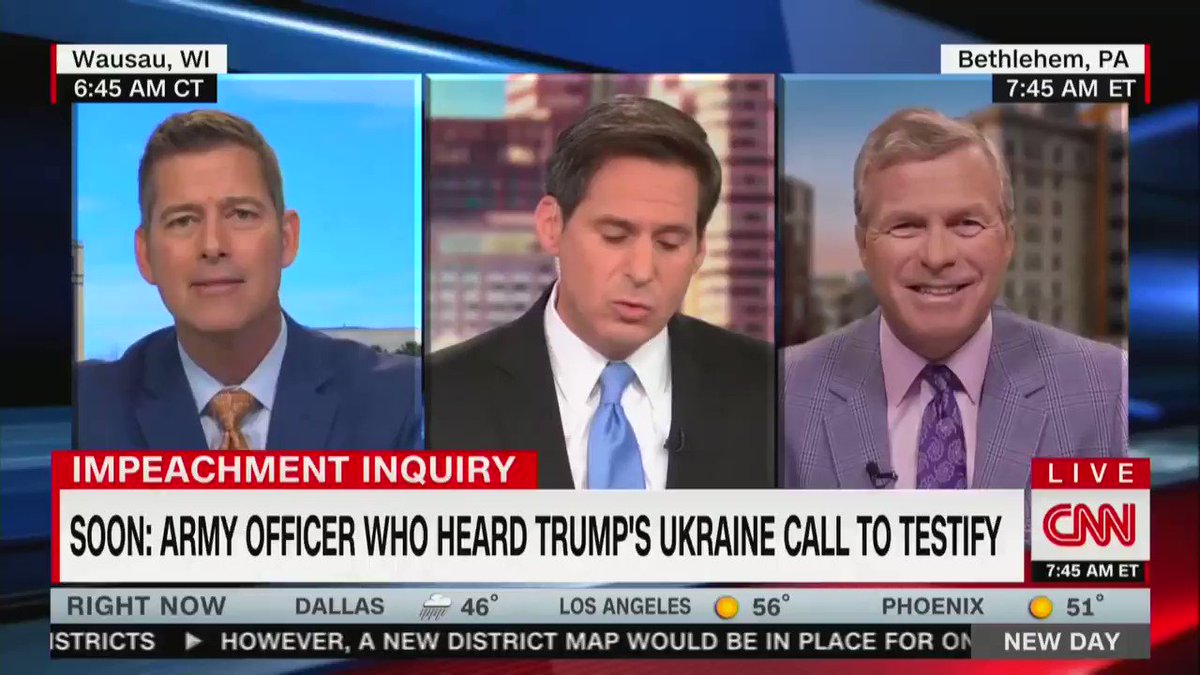
“We all have an affinity to our homeland where we came from,” former Republican Rep. Sean Duffy told CNN, adding, “He has an affinity, I think, for the Ukraine. He speaks Ukrainian. He came from the country and he wants to make sure they’re safe and free.” When asked by CNN host John Berman if he thought Vindman was looking out for America first, Duffy refused to say yes.
Sean Duffy on CNN on Army Lt. Col. Vindman: "It seems very clear that he is incredibly concerned about Ukrainian defense. I don't know that he's concerned about American policy ... we all have an affinity to our homeland where we came from ... he has an affinity for the Ukraine."
4,891 people are talking about this
But not all conservatives were on board with that strategy. House Republican Conference chair Liz Cheney, a staunch Trump supporter, said at a press conference on Tuesday that it was “shameful” to question Vindman’s patriotism.
Aiden Pink is the deputy news editor of the Forward. Contact him at pink@forward.com or follow him on Twitter @aidenpink
donderdag 31 oktober 2019
Tom Engelhardt 322
October 31, 2019
Tomgram: Andrew Bacevich, Why Those "Endless Wars" Must Never End
Here’s the strange thing for the self-proclaimed greatest power in history, the very one that, in this century, has been fighting a series of unending wars across significant parts of the planet: if you exclude Operation Urgent Fury, the triumphant invasion of the island Grenada in 1983, and Operation Just Cause, the largely unopposed invasion of Panama in 1989, Washington’s last truly successful war ended 74 years ago in August 1945 with the dropping of two atomic bombs on Japanese cities. Every war of even modest significance since -- and they’ve been piling up -- from the Korean and Vietnam wars to the ones in Afghanistan, Iraq, Libya, Somalia, Libya, and elsewhere in this century (and the last as well, in the cases of Afghanistan and Iraq) has either ended badly (Vietnam) or not at all (see above).
And if that seems a little strange for the greatest power in history, here’s something hardly less so: the reputations of so many of the men and women who promoted or directed those failing wars and the generals who commanded them remain remarkably intact. And that's in a Washington that still promotes more of the same -- with the exception of our bizarre president, notes TomDispatch regularAndrew Bacevich, author of the soon-to-be-published, aptly titled book, The Age of Illusions: How America Squandered Its Cold War Victory. These days, it seems, you can’t lose a reputation fighting a losing war for the United States. If you want proof of that, just check out the photo that Guardian columnist Julian Borger recently highlighted. It’s a smile-a-thon of self-satisfaction that happens to include former National Security Advisor and Secretary of State Henry Kissinger (think: Vietnam, Cambodia), former National Security Advisor and Secretary of State Condoleeza Rice (think: the invasions of Afghanistan and Iraq), and former CIA director and Secretary of Defense Robert Gates (think: America’s twenty-first-century forever wars), among others. All three are still admired and have kept their reps in Washington, which should tell you what you need to know about what passes for American foreign policy and the top officials of the national security state in 2019.
While Donald Trump tends to refer pejoratively to that state within a state as “the deep state,” I prefer to think of it as the shallow state, not just because in these years so much of it is in plain sight, but because its thinking is anything but deep, as Bacevich suggests today. Tom
False Security
Donald Trump and the Ten Commandments (Plus One) of the National Security State
By Andrew Bacevich
Let us stipulate at the outset that Donald Trump is a vulgar and dishonest fraud without a principled bone in his corpulent frame. Yet history is nothing if not a tale overflowing with irony. Despite his massive shortcomings, President Trump appears intent on recalibrating America’s role in the world. Initiating a long-overdue process of aligning U.S. policy with actually existing global conditions just may prove to be his providentially anointed function. Go figure.
The Valhalla of the Indispensable Nation is a capacious place, even if it celebrates mostly white and mostly male diversity. Recall that in the eighteenth century, it was a slaveholding planter from Virginia who secured American independence. In the nineteenth, an ambitious homespun lawyer from Illinois destroyed slavery, thereby clearing the way for his country to become a capitalist behemoth. In the middle third of the twentieth century, a crippled Hudson River grandee delivered the United States to the summit of global power. In that century’s difficult later decades, a washed-up movie actor declared that it was “morning in America” and so, however briefly, it seemed to be. Now, in the twenty-first century, to inaugurate the next phase of the American story, history has seemingly designated as its agent a New York real estate developer, casino bankruptee, and reality TV star.
In all likelihood, George Washington, Abraham Lincoln, Franklin Delano Roosevelt, and Ronald Reagan would balk at having Donald Trump classified as their peer. Yet, however preposterously, in our present moment of considerable crisis, he has succeeded them as the nation’s Great Helmsman, albeit one with few ideas about what course to set. Yet somehow Trump has concluded that our existing course has the United States headed toward the rocks. He just might be right.
Click here to read more of this dispatch.
New York Times Confirms: It’s Trump Versus the Deep State
 |
|


Abonneren op:
Posts (Atom)
Generaal Eichelsheim Wants War
Generaal Onno Eichelsheim @CDS_Defensie We moeten ons #voorbereiden op een grootschalig conflict, terwijl we niet met zekerheid kunnen zegg...

-
Paul2 heeft een nieuwe reactie op uw bericht "De Israelische Terreur 938" achtergelaten: Nou Stan ,dat wordt gevangenisstraf voor ...
-
View in browser Why the Jews of Khazaria, the Himyarites and GokTurk Empire are Keys to Universal History MATTHEW EHRET OCT 18 READ IN A...
-
 En weer een generatie joodse slachtofferisten, nu nog Israelische kinderen, die verwensingen schrijft op Israelische bommen die Libanese l...
