The US Is a Mental Patient in a Russian Straitjacket
Violent but involuntarily restrained
"But I do have my own question: do orderlies in the asylum get offended, when overpowering the violent patient and restraining it to the bed, by this patient’s insults and resistance?"
Before I proceed in addressing some issues that Paul Craig Roberts raised in his article, partially addressed to me and The Saker, I want to express my profound admiration for Dr. Roberts and his courageous civic position and his real, not for show, American patriotism. It is an honor and a privilege to be engaged in conversation with such an esteemed person, even when I disagree with him in some aspects of geopolitical reality when related to, the now official, Cold War 2.0 between the United States and Russia, and Russia’s posture in this conflict. Dr Roberts writes:
As I have made the same points, I can only applaud Martyanov and The Saker. Where we might differ is in recognizing that endlessly accepting insults and provocations encourages their increase until the only alternative is surrender or war.
So, the questions for Andrei Martyanov, The Saker, and for Putin and the Russian government is: How long does turning your other cheek work?
Do you turn your other cheek so long as to allow your opponent to neutralize your advantage in a confrontation? Do you turn your other cheek so long that you lose the support of the patriotic population for your failure to defend the country’s honor? Do you turn your other cheek so long that you are eventually forced into war or submission? Do you turn your other cheek so long that the result is nuclear war?
Here is where I and Paul Craig Roberts differ dramatically on the issue of Russia’s strategy. Yes, I agree with Dr. Roberts that, quoting William Fulbright, “words are deeds and style is substance insofar as they influence men’s mind and behavior”. But while insults and provocations are unpleasant and in some cases do influence mind and behavior of some, with modern day Russia it is different.
I already laid out some basics of Russia’s strategy here at Unz Review, I will expand a bit more in answering Dr. Roberts’ undeniably valid question.
The 19th Century classic Russian fable writer Ivan Andreevich Krylov, among many outstanding fables, which Russian children are subjected to in their Russian Literature course and carry them into their adulthood since the early 20th century, has one which describes current geopolitical reality perfectly. The fable is The Cat and The Cookin which the Cook, after having had it with his day and escaping to the tavern, leaves his cat to guard the food (chicken) against mice. As the fable goes, upon his return from tavern he sees all the results of the cat “guarding” his chicken–the cat finishing eating it. The cook breaks into shaming the cat–most of the fable is the cook’s monologue about cat (Vas’ka) being bad, arrogant, irresponsible and evil. The closing lines of the fable sum the situation succinctly:
But, while he kept talking, The cat ate up the whole chicken.
А я бы повару иному Велел на стенке зарубить:
Now, I would tell this kind of cook, And would ask him to write this on the wall…
Чтоб там речей не тратить по-пустому, Где нужно власть употребить.
To make your speech less a waste, You’ve got to use your power.
And here is the point–the United States cannot use this power against Russia without being annihilated itself, while Russia, as this proverbial cat Vas’ka continues to eat, against the background of a loud talk and nothing more. This reality, in a very both desperate and powerless manner, finally dawned on many in Washington. As Graham Alison notes:
However demonic, however destructive, however devious, however deserving of being strangled Russia is, the brute fact is that we cannot kill this bastard without committing suicide.
This is some progress in 2017, finally, when “esteemed” members of American geopolitical “academia” begin to grasp at least some limitations of their, grossly inflated to start with, power. This IS the progress, once we recall where the world was even in 2013.
Despite wiping the floor with globalists’ stooges from Georgia in 2008, Russia still wasn’t taken too seriously by the globalist cabal in Washington. As late as 2014 all kinds of US military “experts” described a bulk of scenarios in which victorious US and NATO Armed Forces smash conventionally Russian Army in Ukraine.
It was self-medicating against the background of Russia’s lightning speed operation in Crimea which forestalled US actions in turning Crimea into the NATO base. Russian counter-stroke caught everyone off-guard.
How fast many forgot today what was accomplished then–this can hardly be described as turning the other cheek. If anything else it was a massive blow to an existing world order when Russia threw down the gauntlet. That is how honor is defended–by actions, not petty name-calling. Massive defeats of US “trained” Ukrainian Armed Forces followed in Donbass.
But it is already clear that by failing to achieve any sensible political objectives in Ukraine and in Russia, and, by this, starting a massive global re-alignment, the United States sustained a defeat. What will be the consequences of this defeat? I hate to speculate, I just know that they are already big and that the moment of facing the reality is coming.
Today, almost four years later, we live in the unrecognizable world and no-one in the US, unless they write for tabloids and don’t care about reputation, describes scenarios of Russia’s defeats.
It is a world in transition to not just genuine multipolarity, we are already living in multi-polar reality, but to a world where the United States is effectively checked in its attempts to project power into Eurasia. The world where it is reduced to merely calling names, hurling insults, and doing provocations–because it cannot do anything else.
Somehow people ignore this fact of a dramatic, incredibly fast in historic terms, decline of the American power. American post-WW II prosperity and influence, rested primarily with the myth and bluff of American military power, which was supposed to make everyone toe the party line and tremble in horror in face of a “punishment” for digressions. Russia called this bluff.
Today, America’s actions represent increasingly pronounced symptoms of a declining power, which cannot face reality without going mad. And she is going mad, domestically, as well as internationally, the only force which is capable to keep this increasingly irrational and dangerous power from committing a suicide while taking everyone else with her is a threat of a massive military defeat. Russia has this force to do so, and so far it works.
But I do have my own question: do orderlies in the asylum get offended, when overpowering the violent patient and restraining it to the bed, by this patient’s insults and resistance? I don’t think so–one does not get offended by a violent mental patient. Nor, orderlies defend their honor while restraining a patient. There could be no interactions involving honor between orderly and a violent mental patient. America is not treaty-worthy party, hasn’t been since early 1990s, thus there are no interactions involving honor in Russian-American relations on the American side.
So, I ask then, is it legitimate to assess the situation by comparing two states of the world in 2014 and 2018? The answer is not only that it is legitimate but that it is the only way to do so. Clausewitz’ dictum still stands today: “It is legitimate to judge event by its outcome, for it is the soundest criterion”. With all American provocations, insults and Russia’s alleged turning the other cheek, one MUST ask the question–is Russia winning? Once one looks at the larger picture–the answer is unequivocal yes. It manifests itself in many things, from economy, to military to geopolitics. So:
The zionist neoconsevatives who rule in Washington are capable of the same mistake that Napoleon and Hitler made. They believe in “the end of history,” that the Soviet collapse means history has chosen America as the model for the future. Their hubris actually exceeds that of Napoleon and Hitler.
Neither Napoleon, nor Hitler dealt with the issues of nuclear deterrents, nor did they live in the world of an instant propagation of information. Judging by hysterical reaction of these very same neocons and their military “experts”, be it in 2015 to the events in Syria, or Putin’s March 1, 2018 speech to Federal Assembly–the message was heard. Hysteria is a first sign of weakness.
Those neocons might be irrational, at least some of them, but even those understand that there is a price to be paid and there are reasons, to be discussed separately, to believe that there is an understanding of the severe limitations of America’s power. After all, Napoleon and Hitler marched into Russia after putting the Europe to its knees. They had highly deserved reputation behind both Grande Armee and Wehrmacht. The United States cannot win a single war against subpar opponent since 1950, once one discounts a turkey shoot against Saddam’s grossly inferior army.
Per Semyon Bagdasarov. He is a good man and a Russian patriot, he is a former political officer, but I don’t take his suggestion “to sink” a US Aircraft Carrier seriously. Patriotism is not an excuse for irrationality–the loss of a single carrier in case of a limited TLAM strike on some targets in Syria will create in the US a political crisis of such proportions that the world will stand on the very brink of the nuclear war. US was and is inherently biased towards nuclear response, with some short break in 1990s, when it saw itself as self-proclaimed greatest military in the world in the wake of Soviet collapse. Not doing stupid things but the ones which are necessary is what defined Russia’s responses in the last several years. This is the only correct strategy.
And here is my conclusion: being former military I give a full recognition to the fact that I am merely a writer who, as well as Bagdasarov, or any other “analyst” have no any access to a daily top secret briefings by Chief of General Staff and Russia’s intelligence to Vladimir Putin. Patriotism or, even, some residual professionalism is not a substitution to having a full situational awareness provided to Supreme Commander by thousands upon thousands people who even risk their lives to provide a key information for making this one and only right decision to prevent the world from annihilation.
Russia knows where the Unites States is today and, when looking back at the last 5 years in world’s history, I see Russia as that proverbial cat finishing off the chicken, while those who are supposed to use the force cannot do so and speak loud and carry no stick. This chicken is Pax Americana.
Russia will continue to do what she does, because it works, and because she knows how to fight wars, she knows how to defend herself and because we all live in a different world today, the way Russia, not the US, sees it. In this case hurling insults and even launching another useless volley of TLAMs in Syria, or “training” its Ukrainian stooges for military provocations is the limit for the United States and there is nothing honorable in that.
Following Thursday’s report that Russia had recently informed the US of planned military operations against terrorist groups on the Syria-Jordan border, a company of US Marines conducted a live-fire exercise in the same area. Officials say it was intended to be a “warning” to Russia.
The exercise took place near the US base at al-Tanf, at the corner of Syria’s border with Iraq and Jordan. Though the US no longer really has any rebel allies in the area, which was the initially point of the Tanf base, the US does regularly attack any pro-Syrian forces who get too close.
The proximity of Islamists, especially al-Qaeda-linked groups on the Jordan border, has pretty much been ignored by the US. The possibility that Russian and Syrian forces might take care of those groups has infuriated the US, and led to threats of force.
Centcom officials continue to talk up the idea that they “will not hesitate to use necessary and proportionate force” if Russian, Syrian, or other pro-Syrian groups get too close to the Tanf base.
In the past, US forces have attacked pro-government militias for getting near Tanf, and have also attacked and killed hundreds of Russian military contractors on one occasion, an incident followed up by US bragging.
Though Pentagon officials are presenting this as standard operating procedure, it is anything but, particularly since Syria never authorized US troops to be there in the first place. Attacks on Russian troops would be a much bigger deal, and not something casually passed off as “self defense.”
De Ian Buruma-Jockstrap Wanneer opiniemaker Ian Buruma over zijn eigen gebrek aan identiteit verklaart: 'Ik denk niet dat er binnen je geest een soort essentieel zelf is; je verandert de hele tijd,' dan geeft hij daar tevens mee aan dat zijn publieke gezicht dat van een poseur is. Belangrijk daarbij is te weten dat de poseur, in tegenstelling tot wat algemeen wordt aangenomen, geen aansteller hoeft te zijn. Integendeel, tot op grote hoogte kan hij werkelijk menen dat wat hij zegt de waarheid is, tenminste op het moment dat de woorden uit zijn mond rollen. De pose is zijn overlevingsstrategie. Gelijk een kameleon van huidskleur verandert, wisselt de poseur moeiteloos van rol. De ene dag is hij liberal, de andere dag een neoliberal. Elk moment en in telkens weer veranderende omstandigheden moet hij zichzelf opnieuw bedenken. Hij is de hoofdpersoon in zijn eigen pulproman, een barokke dandy, een kitschfiguur, wiens optreden naadloos aansluit bij de behoeften van de postmoderne tijd. Eén ding is duidelijk: een poseur kan alleen in een -- van zichzelf vervreemde -- massamaatschappij functioneren. Die vormt zijn toneel, de menigte zijn publiek. In een gesloten gemeenschap, gedragen door samenhangende identiteiten, zou hij allang door de mand zijn gevallen, daar zou hij niet meer zijn dan de dorpsgek. Een poseur heeft een publiek nodig, hij moet daarom mediamiek zijn, van nature publiciteitsgeil. Hij spreekt in korte zinnen, het liefst in soundbites, en is op die manier een godsgeschenk voor de pers, altijd weer op zoek naar iets dat afwijkt. De poseur en de media kunnen niet zonder elkaar, als parasieten leven ze van elkaar, ze vormen een symbiose in het almaar uitdijende rijk van de kitsch. Of zoals Milan Kundera het stelde:
Op grond van de dwingende noodzaak te behagen en zo de aandacht van het grootst mogelijke publiek te trekken, is de esthetiek van de massamedia onvermijdelijk die van de kitsch en naarmate de massamedia ons gehele leven meer omsluiten en infiltreren, wordt de kitsch onze dagelijkse esthetiek en moraal.
We zien het op elk maatschappelijk gebied: natuurlijk in de politiek, in de economie maar ook in de sport en zelfs in de kunsten. Kundera merkte op dat
[h]et woord kitsch verwijst naar een houding van degene die tot elke prijs zoveel mogelijk mensen wil behagen. Om te behagen dien je je te conformeren aan wat iedereen wenst te horen, in dienst te staan van pasklare ideeën, in de taal van de schoonheid en de emotie. Hij beweegt ons tot tranen van zelfvertedering over de banaliteiten die wij denken en voelen.
Eén van de wezenlijke kernmerken van kitsch is dat het meer wil lijken dan het is. Het is uitsluitend gericht op effect. En omdat gedachten in een massacultuur, met haar culturele deprivatie, niet het ultieme effect kunnen teweegbrengen, bedient de poseur zich van sentimenten, verpakt in makkelijk te verteren opinies. Hij grossiert in frasen. Voor de poseur en zijn publiek tellen niet de feiten, maar de meningen, niet de hersenen maar de buik, niet de ratio maar het sentiment. Halfverteerd komt bij hem alles weer naar buiten.
In het Angelsaksisch taalgebied bestaat het woord 'camp,' volgens Van Dale's woordenboek: 'kitscherig, gemaakt, verwijfd, nichterig.' Een voorbeeld daarvan was Pim Fortuyn. Hij speelde de politieke nicht, die in één adem pleitte voor enerzijds het sluiten van de grenzen om anderzijds met een knipoog te laten weten wel met wat geil uitziende Marokkaanse knapen naar bed te willen. Tegelijkertijd speelde hij de geëmancipeerde homoseksueel, gedreven door de wens echt voor vol te worden aangezien, zijn motief was derhalve het verkrijgen van zoveel mogelijk politieke macht. In de postmoderne wereld tellen alleen nog politiek en geld.
In een massamaatschappij bezit de kunst alleen nog amusementswaarde. Vandaar ook dat mijn oude vriend Ian Buruma zichzelf in zijn boek A Tokyo Romance (2018) als 'schelm' afbeeldt, een non-conformist die rebelleerde tegen de wereld van de slaap verwekkende bourgeoisie, de klasse waarvan hijzelf een onlosmakelijk deel uitmaakt. Als behaagzieke stem van het establishment wil hij tegelijkertijd de indruk vestigen diep in zijn hart een bohemien te zijn. Het publiek moet hem zien als onconventioneel en toch betrouwbaar, uniek en tegelijkertijd een massamens, een individualist die het conformisme propageert. Als poseur is Buruma uiterst succesvol gebleken. Maar bij nadere beschouwing is hij als een bejaarde vrouw die een iets te uitdagend parfum verspreidt, oftewel, kitsch. Het is daarom niet onverklaarbaar dat Ian zo opwindend lijkt voor dames uit de gegoede burgerij. Zo schreef de Britse 48-jarige journaliste Rachel Cooke -- dochter van een universitair docent, zij studeerde in Oxford -- in The Observer van zondag 25 maart 2018 over mijn oude vriend:
I thought of him as clever, controlled and somewhat stolid (flegmatisch. svh) in a way that I consider (wholly unfairly) to be rather Dutch.
But then I read his new memoir, and all this went out of the window. Oh my eyes. 'A Tokyo Romance' recounts the picaresque (schelmachtige. svh) adventures of the young Ian Buruma in Japan, where he lived from 1975 to 1981. On the plane, I opened it reluctantly, fearing it might just be a very grand version of a gap year (een sabbatical year waarin de student de sleur kan doorbreken. svh) book – and in fact, it does come with a whiff (vleugje. svh) of this, its author writing first of how, in his early 20s, he longed to escape the 'slightly dull surroundings' of his upper-middle-class childhood in The Hague, a world of garden sprinklers and bridge parties. No sooner has our hero arrived in Tokyo, however, than the whole thing sparks astonishingly to life. We’ll come back to the details, lurid (luguber. svh) or otherwise, but for now all you need to know is that Buruma’s high-level immersion (onderdompeling. svh)in the country’s culture begins with him tottering around (rond waggelend. svh) on takageta, a high-heeled version of the traditional Japanese wooden sandals, and ends with him playing a character called the Midnight Cowboy in a play by the underground director and actor Kara Juro. In between, there are visits to porn cinemas, a string of lovers of both sexes, an appearance in a Suntory whisky ad alongside the great Akira Kurosawa, and a non-star turn in a butoh show in which he appears on stage wearing only a scarlet jockstrap.
Op zoek naar een identiteit liet Buruma zich onderdompelen in de Japanse cultuur. Hij had geen andere keuze na al die jaren Den Haag waar hij was opgegroeid en Leiden waar hij had gestudeerd. Hij voelde zich ontheemd, hoorde nergens echt bij, en voelde zich ook nog eens vervreemd van zichzelf. Was hij nu een petit bourgeois of een kunstenaar, een homoseksueel of een hetero, een opportunist of een schelm, een jood of een goy, een tribalist of een kosmopoliet? Bij welke groep moest hij zich aansluiten? Die keuze zou bepalend zijn voor de rest van zijn leven. Een verkeerd besluit zou zijn ambities ernstig kunnen frustreren. Het probleem daarbij was dat hij als witte Europeaan niet alleen fysiek maar ook mentaal 'zichtbaar' een buitenstaander zou blijven. Voordat hij naar Japan vertrok had één van de 'exiled gay western men with whom he hung around at first,' hem gewaarschuwd dat
he would never belong in Japan, that he would always be a gaijin (a foreigner), pale as tofu. What the country would give him, though, was freedom, the chance to make himself into anything he wanted. Buruma seems to have taken this to heart. Nothing was out of bounds, nothing seemed impossible – or even terribly difficult,
totdat hij een ernstige 'vergissing' maakte en hij zich uit de groep gestoten voelde, waarbij hij dacht geestelijk onderdak te hebben gevonden. Rachel Cooke:
His greatest mistake, however, was to intercede in a fight between Kara and his wife, Ri -- a chivalrous gesture that may, he speculates, have been born of some inner desire on his part to be seen for who he really was. 'So you are just an ordinary gaijin after all!' shouted the outraged Kara at him, words he was never able to forget. Who knows, they may still have been ringing in his head when, some while later, he decided to leave Japan, fearing that if he stayed he would 'catch a dose of gaijinitis,' a condition that would cause him to become obsessed with 'the often imaginary slights that go with being pegged to one’s ethnicity.'
Ineens besefte Buruma weer een buitenstaander te zijn, een 'outsider,' net zo geïsoleerd als hij in Den Haag en Leiden was geweest. Door hem uit te schelden voor 'gaijin' realiseerde Ian zich dat hij getolereerd werd, maar niet geaccepteerd, en na ruim vijf jaar in de schijn te hebben geloofd, bleef hem niets anders over dan zijn relatie met Japan te verbreken. Voor iemand die wanhopig ergens bij wil horen is niets erger dan verstoten te worden. Wie dit niet gevoelsmatig of rationeel begrijpt, moet de volgende beschrijving lezen van de Amerikaans Japanse auteur Debito Arudou: According to ancient texts and prewar dictionaries, gaijin (or 'guwaijin' in the contemporary rendering) once referred to Japanese people too. Anyone not from your village, in-group etc., was one. It was a way of showing you don’t belong here — even (according to my 1978 Kojien, Japan’s premier dictionary) 'regarded as an enemy' ('tekishi'). Arudou wijst erop dat een 'gaijin is a gaijin any time, any place,' en dat het hier in feite 'een kaste' betreft: No matter how hard you try to acculturate yourself, become literate and lingual, even make yourself legally inseparable from the putative 'naikokujin' (the 'inside people,' whoever they are), you’re still 'not one of us.' https://www.japantimes.co.jp/community/2008/08/05/issues/once-a-gaijin-always-a-gaijin/#.W5KPaC2iFb4 Door deze pijnlijke confrontatie met de werkelijkheid zag Buruma zich gedwongen zijn heil elders te zoeken. Het werd uiteindelijk de Verenigde Staten. Daar ging de zoektocht naar een identiteit weer verder. Ditmaal probeerde hij die te vinden in een gecultiveerde joods-Amerikaanse identiteit. Dat heeft hem geen windeieren opgeleverd, maar of hij daarmee zijn leegte wist te vullen is zeer de vraag. Daarover later.
Ian Buruma in de tweede helft van de jaren zeventig toen hij nog zijn identiteit in de Japanse cultuur zocht.
Ian Buruma, die als mainstream-opiniemaker ervoor pleitte dat 'we must share America's dirty work' en 'take the risk of being held accountable' voor deze oorlogsmisdaden, blijft zelfs als auteur over zijn jarenlange verblijf in Japan, een gesloten man. Tegenover een journaliste van The Observer verklaarde hij:
'I feel that most memories are embarrassing: you remember things that still make you wince, and you’re sort of glad some people are dead because at least they don’t remember. But there’s another side to this, which is that the only way to write this kind of book -- it’s a bit like fiction -- is to turn yourself into a character. That gives you a certain distance.' Necessity was perhaps the mother of this invention, for he kept no diary in the period covered by the book. 'It all had to come out of my head. You have all these snippets and impressions, and you have to make them into a coherent story. It is partly out of your imagination. Of course, memory works that way anyway. You’re always re-editing it subconsciously.'
En zo iszijn memoir A Tokyo Romance (2018) -- de stadwaar hij vanaf 1975 tot 1981 leefde -- geen weergave van de werkelijkheid, maar een serie 'flarden' van telkens opnieuw 'onbewust geredigeerde' herinneringen, zoals hijzelf verklaart. Omdat hij geen 'dagboek' had bijgehouden, was hij noodzakelijkerwijs aangewezen op vage herinneringen en dus op zijn geheugen, waarover Buruma zelf stelt 'dat het geheugen volstrekt onbetrouwbaar is, je stelt het de hele tijd bij.' Om dit nog eens te benadrukken voegde hij eraan toe dat hij zich hiervan'heel goed bewust' is. Aangezien hij 'de meeste'van zijn 'herinneringen' als 'beschamend' ervaart en hij als het ware 'blij' is dat 'sommige mensen dood zijn' omdat 'tenminste zij zich dit niet meer kunnen herinneren,' laat staan anderen erover kunnen vertellen, zal Buruma zelf over die 'herinneringen' zwijgen of ze zo presenteren dat hij er als 'coherente' persoonlijkheiduit te voorschijn komt. Vandaar ook zijn opmerking: 'You’re always re-editing it subconsciously.'
Daarnaast dwingt de eerlijkheid ons een andere kanttekening te maken. Alleen een groot schrijver is in staat om van de anekdotiek in zijn persoonlijke leven iets universeels te maken dat ons allen aangaat, niemand uitgezonderd. Welnu, mijn oude vriend Ian is geen groot schrijver, met alle schadelijke gevolgen van dien wanneer hij 'snippertjes' herinnering als 'coherente' werkelijkheid presenteert, fiction als non-fiction. Niet voor niets constateerde de Observer-journaliste dat hoewel 'A Tokyo Romance seems, at first, to stand apart from Buruma’s other books,' waarin hij de rol van koele intellectueel speelt, en ondanks 'all its loucheness' van zijn Tokyo-memoir, 'there is again a sense, as one American reviewer noted, that he would rather drop you at the kerb (stoeprand. svh) than open a door to you, when it comes to his inner feelings.' Buruma blijftvoor de buitenwereld een gesloten boek, hij slaagt er niet in tot zijn eigen kern door te dringen, wat nu juist toch het doel is van een autobiografisch verslag. Hij blijkt wel in staat te zijn zichzelf 'into a character' te veranderen, door een valse identiteit aan te nemen, in dit geval een typetje met een zekere 'loucheness,' wiens'picaresque (schelmachtige. svh) adventures'in Japan de bourgeois hoofdredacteur van TheNew York Review of Books de glans van een bohémien geven. En aangezien Buruma, volgens eigen zeggen voortdurend 'gedachteloos' allerlei 'rollen speelt,' en al deze 'maskers' een onlosmakelijk 'deel'van hemzelf zijn, weet hij zich moeiteloos te verkopen in onze identiteitsloze cultuur waarin, aldus de van origine Joods-Israelische auteur en saxofonist Gilad Atzmon, 'the West and America in particular have been led into a disastrous Identity clash.' In zijn boek Being in Time – a Post Political Manifesto (2017) toont Atzmon overtuigend aan dat
the transition from traditional Left ideology into New Left politics can be understood as the aggressive advocacy of sectarian and divisive ideologies. While the old Left made an effort to unite us all: gays, blacks, Jews or Whites into a political struggle against capital, the New Left has managed to divide us into ID sectors. We are trained to speak ‘as a…’: ‘as a Jew,’ ‘as a black,’ ‘as a Lesbian.’ The new left has taught us to identify with our biology, with our gender, sex orientation and our skin colour, as long as it isn’t ‘White’ of course.
Tragically, ID politics is a vey dangerous political game. It is designed to pull people apart. It is there to introduce conflict and division. ID politics doesn’t offer a harmonious vision of society as a whole. Quite the opposite, it leads to an increasingly fractured social reality. Take, for instance, the continuous evolution of the LGBT group. It is constantly expanding to include more and more sectarian sexually oriented social subgroupings (LGBTQ, LGBTQAI and even LGBTQIAP). In the New Left social reality, we, the people are shoved into ID ghettos that are defined by our biology: skin colour, sexual orientation, the Jewish mother, etc. Instead of what we need to do: fight together against big money, the bankers, the megacorporations, we fight each other, we learn to hate each other. We even drive our cars over each other. I am opposed to all forms of ID politics, whether it is White, Black, Jewish, Gender or sex oriented. But, obviously if Jews, Gays and others are entitled to identify with their ‘biology’, white people are entitled to do the same. I think that universalism is what we used to call it when we still cared about intellectual integrity. The problem created by ID politics is extremely grave. ID politics doesn’t offer a prospect of peace and harmony. Within the context of ID politics, we cannot envisage a peaceful resolution of the current ID clash. Can anyone foresee the LGBT community embracing KKK activists into their notion of ‘diverse society?’ The same can be said about the KKK, are they going to open their gates to cultural Marxists? ID politics equals ID clash, an irreconcilable conflict with no end, the complete destruction of American and, to a certain extent, Western civilisation. This may explain why George Soros and his open society are invested in this battle. As long as the working people are fighting each other, no one bothers to challenge the root cause of our current dystopia, namely the banks, global capitalism, wall street, Mammonism and so on.
Terecht verklaarde Buruma tegenover een Volkskrant-journaliste over zijn eigen identiteit: 'Ik denk niet dat er binnen je geest een soort essentieel zelf is; je verandert de hele tijd.' Vandaar dat hij op zijn 66ste jaar nog steeds probeert een nieuwe identiteit aan te nemen. Ditmaal een Joods-slachtofferistische identiteit. Ontmaskerend is tevens het feit dat mijn oude vriend juist George Soros zo bewondert en over deze, wegens voorkennis, veroordeelde speculant schreef dat hij
might be described as the personification of ‘the West.’ He is everything that nativists and anti-Semites hate: rich, cosmopolitan, Jewish, and a liberal dedicated to what Karl Popper, yet another child of Jewish origin from the Austro-Hungarian Empire, called ‘the open society.’ https://www.independent.co.ug/comment-war-west/2/ De speculant George Soros als representant van het jodendom en ‘de open samenleving.’ Maar hoe ‘open’ is de ‘samenleving,’ die de getrukeerde ‘Soros’ voor ogen staat? Daarvoor dient men zich te verdiepen in wie Soros werkelijk is. Op 20 december 1998 zond het bekende CBS-programma 60 Minutes een onthullend interview uit met Soros, dat de onderzoeksjournalist Steve Kroft als volgt inleidde: When the Nazis occupied Budapest in 1944, George Soros’ father was a successful lawyer. He lived on an island in the Danube and liked to commute to work in a rowboat. But knowing there were problems ahead for the Jews, he decided to split his family up. He bought them forged papers and he bribed a government official to take 14-year-old George Soros in and swear that he was his Christian godson. But survival carried a heavy price tag. While hundreds of thousands of Hungarian Jews were being shipped off to the death camps, George Soros accompanied his phony godfather on his appointed rounds, confiscating property from the Jews. KROFT: You’re a Hungarian Jew… who escaped the Holocaust… by posing as a Christian. Mr. SOROS: Right. KROFT: And you watched lots of people get shipped off to the death camps. Mr. SOROS: Right. I was 14 years old. And I would say that that’s when my character was made. KROFT: In what way? Mr. SOROS: That one should think ahead. One should understand and anticipate events and when one is threatened. It was a tremendous threat of evil. I mean, it was a very personal experience of evil. KROFT: My understanding is that you went out with this protector of yours who swore that you were his adopted godson. Mr. SOROS: Yes. Yes. KROFT: Went out, in fact, and helped in the confiscation of property from the Jews. Mr. SOROS: Yes. That’s right. Yes. KROFT: I mean, that sounds like an experience that would send lots of people to the psychiatric couch for many, many years. Was it difficult? Mr. SOROS: Not – not at all. Not at all. Maybe as a child you don’t see the connection. But it was – it created no – no problem at all. KROFT: No feeling of guilt? Mr. SOROS: No… Well, of course I could be on the other side or I could be the one from whom the thing is being taken away. But there was no sense that I shouldn’t be there, because that was – well, actually, in a funny way, it’s just like in markets -- that if I weren’t there -- of course, I wasn’t doing it, but somebody else would be taking it away anyhow. And -- whether I was there or not, I was only a spectator, the property was being taken away. So I had no role in taking away that property. So I had no sense of guilt. https://www.activistpost.com/2016/11/george-soros-forgotten-interview-cannot-not-look-social-consequences.html
Het is dit slag mensen die de identiteitsloze Ian Buruma ziet
als de personificatie van 'het Westen.' Ik vrees dan ook dat Gilad Atzmon gelijk heeft wanneer hij schrijft dat:
Within the ID political cosmos, newly emerging ‘tribes’ (gays, lesbians, Jews, Blacks, Whites, vegans, etc.) are marched into the desert, led towards an appealing ‘promised land,’ where the primacy of the symptom (gender, sexual orientation, ethnicity, skin colour etc.) is supposed to evolve into a world in itself. But this liberal utopia is in practice a sectarian and segregated amalgam of ghettos that are blind to each other. It has nothing in common with the promised universal, inclusive cosmos. Meer hierover, en over Buruma's rol hierbij, later.
One of the most embarrassing aspects of U.S. politics is politicians who deny that money has any impact on what they do. For instance, Tom Corbett, Pennsylvania’s notoriously fracking-friendly former governor, got $1.7 million from oil and gas companies but assured voters that “The contributions don’t affect my decisions.” If you’re trying to get people to vote for you, you can’t tell them that what they want doesn’t matter.
This pose is also popular with a certain prominent breed of pundits, who love to tell us “Don’t Follow the Money” (New York Times columnist David Brooks), or “Money does not buy elections” (Freakonomics co-author Stephen Dubner on public radio’s Marketplace), or “Money won’t buy you votes” (Yale Law School professor Peter H. Schuck in the Los Angeles Times).
Meanwhile, 85 percent of Americans say we need to either “completely rebuild” or make “fundamental changes” to the campaign finance system. Just 13 percent think “only minor changes are necessary,” less than the 18 percent of Americans who believe they’ve been in the presence of a ghost.
So we’ve decided that it would be useful to collect examples of actual politicians acknowledging the glaringly obvious reality. Here’s a start; I’m sure there must be many others, so if you have suggestions, please leave them in the comments or email me. I’d also love to speak directly to current or former politicians who have an opinion about it.
• “I gave to many people, before this, before two months ago, I was a businessman. I give to everybody. When they call, I give. And do you know what? When I need something from them two years later, three years later, I call them, they are there for me. And that’s a broken system.” — Donald Trump in 2015.
• “[T]his is what’s wrong. [Donald Trump] buys and sells politicians of all stripes … he’s used to buying politicians.” — Sen. Rand Paul, R-Ky., in 2015.
“Now [the United States is] just an oligarchy, with unlimited political bribery being the essence of getting the nominations for president or to elect the president. And the same thing applies to governors and U.S. senators and congressmembers. … So now we’ve just seen a complete subversion of our political system as a payoff to major contributors …” — Jimmy Carter, former president, in 2015. (Thanks to Sam Sacks.)
• “[T]he millionaire class and the billionaire class increasingly own the political process, and they own the politicians that go to them for money. … we are moving very, very quickly from a democratic society, one person, one vote, to an oligarchic form of society, where billionaires would be determining who the elected officials of this country are.” — Sen. Bernie Sanders, I-Vt., in 2015. (Thanks to Robert Wilson in comments below.) Sanders has also said many similar things, such as “I think many people have the mistaken impression that Congress regulates Wall Street. … The real truth is that Wall Street regulates the Congress.” (Thanks to ND, via email.)
• “You have to go where the money is. Now where the money is, there’s almost always implicitly some string attached. … It’s awful hard to take a whole lot of money from a group you know has a particular position then you conclude they’re wrong [and] vote no.” — Vice President Joe Biden in 2015.
• “[T]oday’s whole political game, run by an absurdist’s nightmare of moneyed elites, is ridiculous – a game in which corporations are people and money is magically empowered to speak; candidates trek to the corporate suites and secret retreats of the rich, shamelessly selling their political souls.” – Jim Hightower, former Democratic agricultural commissioner of Texas, 2015. (Thanks to CS, via email.)
• “People tell me all the time that our politics in Washington are broken and that multimillionaires, billionaires and big corporations are calling all the shots … it’s hard not to agree.” — Russ Feingold, three-term Democratic senator from Wisconsin, in 2015 announcing he’s running for the Senate again. (Thanks to CS, via email.)
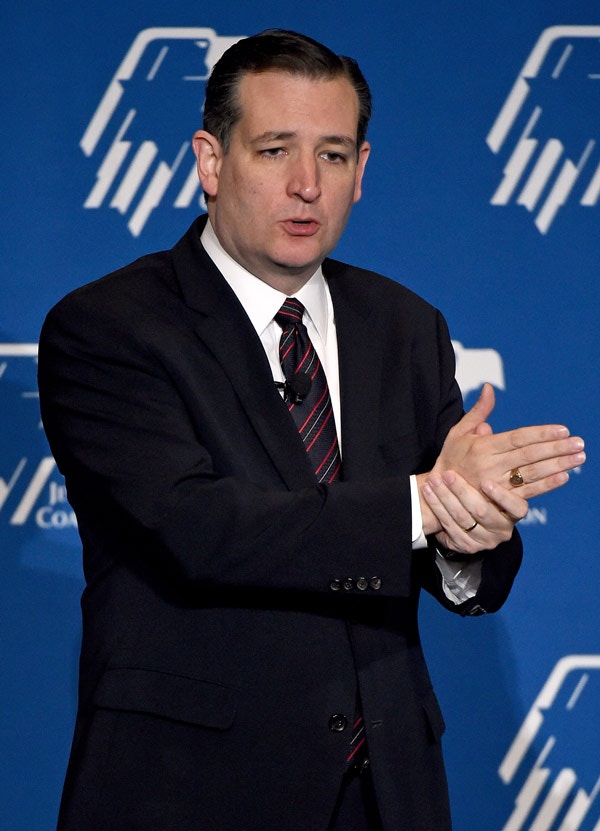
U.S. Sen. Ted Cruz, R-Texas
Photo: Ethan Miler/Getty Images
• “Lobbyists and career politicians today make up what I call the Washington Cartel. … [They] on a daily basis are conspiring against the American people. … [C]areer politicians’ ears and wallets are open to the highest bidder.” — Sen. Ted Cruz, R-Texas, in 2015.
• “I can legally accept gifts from lobbyists unlimited in number and in value … As you might guess, what results is a corruption of the institution of Missouri government, a corruption driven by big money in politics.” — Missouri State Sen. Rob Schaaf, 2015. (Thanks to DK, via email.)
• “When you start to connect the actual access to money, and the access involves law enforcement officials, you have clearly crossed a line. What is going on is shocking, terrible.” – James E. Tierney, former attorney general of Maine, in 2014.
• “Allowing people and corporate interest groups and others to spend an unlimited amount of unidentified money has enabled certain individuals to swing any and all elections, whether they are congressional, federal, local, state … Unfortunately and rarely are these people having goals which are in line with those of the general public. History well shows that there is a very selfish game that’s going on and that our government has largely been put up for sale.” – John Dingell, 29-term Democratic congressman from Michigan, in 2014 just before he retired.
• “When some think tank comes up with the legislation and tells you not to fool with it, why are you even a legislator anymore? You just sit there and take votes and you’re kind of a feudal serf for folks with a lot of money.” — Dale Schultz, 32-year Republican state legislator in Wisconsin and former state Senate Majority Leader, in 2013 before retiring rather than face a primary challenger backed by Americans for Prosperity. Several months later Schultz said: “I firmly believe that we are beginning in this country to look like a Russian-style oligarchy where a couple of dozen billionaires have basically bought the government.”
• “I was directly told, ‘You want to be chairman of House Administration, you want to continue to be chairman.’ They would actually put in writing that you have to raise $150,000. They still do that — Democrats and Republicans. If you want to be on this committee, it can cost you $50,000 or $100,000 — you have to raise that money in most cases.” — Bob Ney, five-term Republican congressman from Ohio and former chairman of the House Administration Committee who pleaded guilty to corruption charges connected to the Jack Abramoff scandal, in 2013. (Thanks to ratpatrol in comments below.)
• “The alliance of money and the interests that it represents, the access that it affords to those who have it at the expense of those who don’t, the agenda that it changes or sets by virtue of its power is steadily silencing the voice of the vast majority of Americans … The truth requires that we call the corrosion of money in politics what it is – it is a form of corruption and it muzzles more Americans than it empowers, and it is an imbalance that the world has taught us can only sow the seeds of unrest.” – Secretary of State John Kerry, in 2013 farewell speech to the Senate.
• “American democracy has been hacked. … The United States Congress … is now incapable of passing laws without permission from the corporate lobbies and other special interests that control their campaign finances.” — Al Gore, former vice president, in his 2013 book The Future.(Thanks to anon in comments below.)
• “I think it is because of the corrupt paradigm that has become Washington, D.C., whereby votes continually are bought rather than representatives voting the will of their constituents. … That’s the voice that’s been missing at the table in Washington, D.C. — the people’s voice has been missing.” — Michele Bachmann, four-term Republican congresswoman from Minnesota and founder of the House Tea Party Caucus, in 2011.
• “I will begin by stating the sadly obvious: Our electoral system is a mess. Powerful financial interests, free to throw money about with little transparency, have corrupted the basic principles underlying our representative democracy.” — Chris Dodd, five-term Democratic senator from Connecticut, in 2010 farewell speech to the Senate. (Thanks to RO, via email.)
Sen. Dick Durbin (D-IL)
Photo: Mark Wilson/Getty Images
• “The banks — hard to believe in a time when we’re facing a banking crisis that many of the banks created — are still the most powerful lobby on Capitol Hill. And they frankly own the place.” – Sen. Dick Durbin, D-Ill., in 2009.
• “Across the spectrum, money changed votes. Money certainly drove policy at the White House during the Clinton administration, and I’m sure it has in every other administration too.” — Joe Scarborough, four-term Republican congressman from Florida and now co-host of “Morning Joe,” in the 1990s. (Thanks to rrheard in comments below.)
• “We are the only people in the world required by law to take large amounts of money from strangers and then act as if it has no effect on our behavior.” — Barney Frank, 16-term Democratic congressman from Massachusetts, in the 1990s. (Thanks to RO, via email.)
“… money plays a much more important role in what is done in Washington than we believe. … [Y]ou’ve got to cozy up, as an incumbent, to all the special interest groups who can go out and raise money for you from their members, and that kind of a relationship has an influence on the way you’re gonna vote. … I think we have to become much more vigilant on seeing the impact of money … I think it’s wrong and we’ve got to change it.” — Mitt Romney, then the Republican candidate running against Ted Kennedy for Senate, in 1994. (Thanks to LA, via email.)
• “There is no question in the world that money has control.” — Barry Goldwater, 1964 GOP Presidential nominee, just before retiring from the Senate in 1986.
• ”When these political action committees give money, they expect something in return other than good government. … Poor people don’t make political contributions. You might get a different result if there were a poor-PAC up here.” — Bob Dole, former Republican Senate Majority Leader and 1996 GOP Presidential nominee, in 1983.
• “Money is the mother’s milk of politics.” — Jesse Unruh, Speaker of the California Assembly in the 1960s and California State Treasurer in the 1970s and 80s.
• “I had a nice talk with Jack Morgan [i.e., banker J.P. Morgan, Jr.] the other day and he seemed more worried about [Assistant Secretary of Agriculture Rexford] Tugwell’s speech than about anything else, especially when Tugwell said, ‘From now on property rights and financial rights will be subordinated to human rights.’ … The real truth of the matter is, as you and I know, that a financial element in the larger centers has owned the Government ever since the days of Andrew Jackson … The country is going through a repetition of Jackson’s fight with the Bank of the United Stated — only on a far bigger and broader basis.” — Franklin D. Roosevelt in a 1933 letter to Edward M. House. (Thanks to LH, via email.)
• “Behind the ostensible government sits enthroned an invisible government, owing no allegiance and acknowledging no responsibility to the people. To destroy this invisible government, to dissolve the unholy alliance between corrupt business and corrupt politics is the first task of the statesmanship of the day.” — 1912 platform of the Progressive Party, founded by former president Theodore Roosevelt. (Thanks to LH, via email.)
• “There are two things that are important in politics. The first is money and I can’t remember what the second one is.” — Mark Hanna, William McKinley’s 1896 presidential campaign manager and later senator from Ohio, in 1895.
Again, please leave other good examples in the comments or email them to me at any time — I’ll keep updating this indefinitely. I’m looking specifically for working politicians (rather than pundits or activists) who describe a tight linkage between money and political outcomes (as opposed to something vaguer).