Zoeken in deze blog 🔎🔎

zondag 29 september 2019

De Zionistische Meute 24


Zoals het christendom nooit had bestaan zonder het judaïsme, kan ik moeiteloos stellen dat zonder de moderne auteurs van joodse afkomst ik niet had bestaan zoals ik nu ben. Geschoold in de jaren zestig ben ik schatplichtig aan denkers als Erich Fromm, Hannah Arendt, Walter Benjamin, Daniel J. Boorstin, Franz Kafka, Bob Dylan, Herbert Marcuse, Harold Pinter, Allen Ginsburg, John Berger, etcetera, de lijst is te lang om ze allen op te noemen. Kort samengevat gaven zij mij de intellectuele ondersteuning voor iets wat ik intuïtief al vroeg had ontdekt, namelijk dat ‘you don't need a weatherman to know which way the wind blows.’ Zij bevorderden mijn vertrouwen in autonomie, zodat mijn eigen gevoel voor moraliteit zich vrij kon ontwikkelen. Opgegroeid in een streng protestants-christelijk dorp op de Veluwe had ik van kindsbeen af een intense hekel aan het verstikkende provincialisme van de jaren vijftig, begin jaren zestig. In mij groeide het verzet tegen de zelfgenoegzame betweterigheid van de autoriteiten en hun ‘klootjesvolk’ met zijn verbeten superioriteitsgevoel dat bijna altijd voortvloeit uit een diep inferioriteitscomplex. Des te meer de kleinburgers om mij heen het kosmopolitisme verafschuwden, des te intenser ik hun gevoel van uitverkoren-zijn leerde wantrouwen. Vandaar ook dat ik al meteen tijdens mijn eerste reis door Israel en de bezette Palestijnse gebieden in 1990 walgde van dezelfde benepen mentaliteit onder Joodse zionisten. Ik herkende meteen hun gevoelens van superioriteit en inferioriteit, de willekeur van geborneerde rotzakken die menen uitverkoren te zijn.  Onlangs las ik een essay van Natan Sznaider, een 65-jarige Joods-Israelische socioloog over Hannah Arendt’s opvattingen betreffende kosmopolitisme en het uitverkoren zijn, waardoor de zionisten zich boven de wet plaatsten. Sznaider schreef over Arendt:

She tried in her work to combine universal concerns with particular belonging. She wanted to rescue Jewish cosmopolitanism from the confines (beperkingen. svh) of ethnic identity alone. Through her involvement with Jewish politics, she tried to define a political stance which goes beyond narrow identity politics even though it starts there,

maar omdat het kosmopolitisme en het zionisme elkaar volkomen uitsluiten, moet Sznaider al snel toegeven dat: 

Arendt’s Jewish identity changed over the decades and she tried to combine universal philosophy and cultural Zionism, furthermore she became a politicized Jew through the rise of the Nazis and her exile in Paris, and in the end she turned away from Zionism,

en terecht want:

Today, Jewish cosmopolitanism is in danger of disappearing. Theories of cosmopolitanism rarely relate to Jewish experiences anymore; at the same time, much of current Jewish experience ignores the Jews’ own cosmopolitan heritage. Clearly, there exists the danger that Jewish cosmopolitanism is being swallowed up by an increasingly aggressive Jewish ethnic nationalism, on the one hand, and a universalism that denies the expression of any kind of particularity at all, on the other.

Met andere woorden, het jodendom, dat gebiedt dat de jood moet afwijken van alle andere medemensen, past niet in een moderne geglobaliseerde wereld, waarin iedereen aan dezelfde eisen van de moderniteit moet voldoen, willen zij tenminste als gelijken behandeld worden door alle anderen. Professor Sznaider, die sociologie doceert aan de Academic College of Tel-Aviv-Yaffo, verwijst in dit verband naar het volgende:

During the French Revolution, one of the defining moments in the debate in the French National Assembly focused on whether Jews could be citizens or needed to be treated like all the other foreigners. One of the more important speakers at the Assembly was Stanislas Marie Adelaide, Comte de Clermont-Tonnerre, a liberal aristocrat, who argued for the inclusion of Jews and Protestants into the nascent French nation (he was killed during the storming of the Tuileries in 1792). On December 23, 1789, he gave a speech that became constitutive (bepalend. svh) of Jewish modernity after the French Revolution. He defined the parameters of individual citizenship, stating they should not be based on ethnicity, nationality or culture:

‘Every creed has only one test to pass in regard to the social body: it has only one examination to which it must submit that of its morals. It is here that the adversaries of the Jewish people attack me. This people, they say, is not sociable… But, they say to me, the Jews have their own judges and laws. I respond that is your fault and you should not allow it. We must refuse everything to the Jews as a nation and accord everything to Jews as individuals. We must withdraw recognition from their judges; they should only have our judges. We must refuse legal protection to the maintenance of the so-called laws of their Judaic organization; they should not be allowed to form in the state either a political body or an order. They must be citizens individually. But, some will say to me, they do not want to be citizens. Well then! If they do not want to be citizens, they should say so, and then, we should banish them. It is repugnant to have in the state an association of non-citizens, and a nation within the nation… In short, Sirs, the presumed status of every man resident in a country is to be a citizen.’

Het kon niemand, en dus ook joden niet, toegestaan worden om een natie binnen een natie te vormen. Zij kregen net als iedere burger voor het eerst individuele rechten, aangezien zij allereerst onderdanen waren van, in dit geval, de Franse staat, en pas daarna  joden. Iedereen was gelijk voor de wet, met dezelfde rechten en dezelfde plichten. Op die manier zou er geen dubbele loyaliteit kunnen ontstaan, die door de Amsterdamse zioniste Daphne Meijer nog steeds geprezen wordt als 'de liefde' van joodse-Nederlanders voor Israel, die 'diep en onvoorwaardelijk' is, 'dieper misschien dan de liefde voor Nederland.' Sznaider schreef over de zienswijze van de liberale aristocraat Stanislas Marie Adelaide: 

These words contain hope and a curse at the same time. Jewish exile could end. Assimilation and civic equality became keys to the end of exile. Jews could stop being wanderers; they could be equal. This promise — especially in Western Europe — created the contradiction between nationalism as a universal force and the attraction of super- and supra-national modes of belonging — the modern form of life in exile. Clermont-Tonnerre told the Jews that there was no room for particular wills within the general will of the nation. This was a truly revolutionary thought and has remained one of the integral aspects of being European; in fact the European project of unity is based on it. Europe’s universal pride allowed Jews to be part of it as equals, to become integrated as Germans, French, etc. but not as Jews (a nation within a nation).


De zogenaamde ‘vloek,’ waarop professor Sznaider doelt, is dat joodse Europeanen  en Joden in Israel afstand moesten doen van het absurde geloof een uitverkoren volk te zijn, dat de mensheid naar een verlossing moet leiden. Al in 1983 bepleitte de wereldberoemde Joods-Israelische auteur Abraham Jehoshua in zijn essaybundel Naar Een Normaal Joods Bestaan om de pretentie ‘een uitverkoren volk’ te zijn ogenblikkelijk te laten vallen. Hij stelde:

Diep in het wezen van onze identiteit ligt de eis dat wij anders, afwijkend, uniek en bijzonder zullen zijn; dat wij ons van alle andere volkeren moeten onderscheiden… Een volk dat ánders is, héél anders. De idee om 'als andere volkeren' te zijn, klinkt de Jood zonder meer negatief in de oren… En toch, ook al lijkt de wens om uitverkoren te zijn en verschillend van de medemens in het individuele vlak dwaas of zelfs krankzinnig, is het merkwaardig te zien hoe wij in het nationale vlak deze opvatting of roeping als bijna vanzelfsprekend accepteren. Ik schrik vaak wanneer ik orthodoxe joden, maar ook wel niet-gelovigen, hoor zeggen: 'Wij mogen niet als andere volken zijn; als Israël een staat zou worden als alle andere, dan verliest hij zijn recht van bestaan.' Niets schijnt beledigender voor een Jood, en voor sommige Israëli’s, dan een volk te moeten zijn als alle andere… Is het principieel mogelijk anders te zijn, afgezien van de al bestaande verschillen tussen allerlei volken? Het is inderdaad mogelijk om anders te zijn, maar binnen relatieve grenzen — het verschil is nooit absoluut. En in dit relatieve verschil delen alle volken. En toch wordt aan het Joodse volk op ondubbelzinnige wijze de eis gesteld dat het verschillend, ánders zal zijn dan andere volken. 

Stapels interpretaties zijn al over dit onderwerp geschreven. Het Joodse volk zuchtte onder de last van deze innerlijke opdracht, die het niet kon vervullen binnen het raam van het normale soevereine bestaan in zijn land, eenvoudig omdat hij onuitvoerbaar was. De enige manier om deze opdracht uit te voeren, was in ballingschap te gaan. Zolang het volk zich in de gola bevindt, onderscheidt het zich inderdaad fundamenteel van de rest van de volken… De gola schept het verschil tussen ons en de andere volken. Aangezien we fundamenteel onmachtig zijn onszelf anders te maken, brengen we een 'technische' scheiding aan, als we een dergelijke uitdrukking in deze context kunnen gebruiken. En deze technische afscheiding schept een essentie die, ook al bevalt ze ons niet en bezorgt ze ons geestelijk en lichamelijk leed, een neurotische oplossing biedt voor een onuitvoerbare opdracht. Zijn eenzame bestaan onder vreemde volken, ook al lijkt de Jood in ieder opzicht op het volk te midden waarvan hij leeft, al spreekt hij zijn taal en deelt hij zijn leven – dit bestaan en het Jood-zijn op zich onderscheiden hem, en geven hem het prettige en bevredigende gevoel ánders te zijn… Een uitverkoren volk, een voorbeeldige maatschappij — het zijn lege frasen.

Tegenover mij zei Jehoshua in 1990:

Dat ánders willen zijn dan alle andere volkeren is op de een of andere manier een noodzakelijke component van onze identiteit. We zijn zo gevormd, zo staat het in de Thora en in alle teksten die voor ons het belangrijkst zijn, die permanent aangehaald worden, die de codes van de joden vormen. Het feit dat men anders moet zijn dan alle andere volkeren is buitengewoon belangrijk voor alle joden, niet alleen de religieuzen. Natuurlijk wil ieder volk wel een beetje anders zijn, maar hier is sprake van een obsessie. En die obsessie is allesomvattend. De joden zijn ervan overtuigd dat als ze niet héél anders zouden zijn dan alle andere volkeren, zij hun identiteit zouden verliezen. En zoals ik geschreven heb is het anders-zijn een onmogelijke opdracht. Dat idee komt voort uit de Bijbel, al in Numeri staat: 'Zie een volk dat alleen woont, en onder de natiën zich niet rekent.' Die opdracht is het logische gevolg van het feit dat het nationaal gevoel onder de joodse stammen in het begin zwak was. De Joden waren al een volk voordat ze een land bezaten, voordat ze een gemeenschappelijke taal hadden, voordat ze een nationale structuur hadden. Dus moesten ze zich op een andere manier onderscheiden van andere volkeren, die wél een grondgebied en een gemeenschappelijke taal en nationale instellingen bezaten. 


Als u het Oude Testament niet leest als een openbaring, maar als een sociologisch verslag, dan ontdekt u dat de Joden een Egyptische stam waren die zich van de rest onderscheidde niet door het hebben van een eigen taal en een eigen land, maar door exclusiviteit te claimen. Op die wijze werd een eigen identiteit gevormd. Het eerste van de tien geboden begint met: ‘Ik ben Jaweh uw God, die u uit Egypte heeft geleid, het slavenhuis.’ Daar begint de scheiding, de gedachte een uitverkoren volk te zijn. Ik bedoel: hoe zou het volk zich op een andere manier hebben kunnen onderscheiden? Hoe zouden deze rondzwervende stammen zonder een gemeenschappelijke taal en zonder een eigen grondgebied een gemeenschappelijke identiteit hebben kunnen ontwikkelen? Alleen door de opdracht om anders te zijn dan alle andere volkeren konden ze een eigen gemeenschappelijke identiteit opbouwen. 

De vraag was destijds: hoe overtuig je een groep mensen zonder een gemeenschappelijke taal en een eigen land om alles achter te laten en 40 jaar lang door een woestijn op zoek te gaan naar een of ander beloofd land, als je hen er niet allereerst van overtuigt dat ze allemaal héél bijzonder zijn, volstrekt anders dan al die anderen. En hoe werden ze overtuigd? Door hun profeten, die van God hadden vernomen dat de joden een uitverkoren volk waren met een unieke missie. Een volk dat zelfs van de Allerhoogste het goddelijk recht had gekregen om andere volkeren te doden en te verdrijven uit een gebied dat door hun leiders ‘het beloofde land’ werd genoemd. Kortom, dat anders willen zijn, dat het bestaansrecht van de joden legitimeert, ligt diep verankerd in het joodse bewustzijn. Zelfs het wereldse zionisme gebruikte voortdurend de gedachte van het anders zijn door te stellen dat wij naar Palestina zijn gekomen om ‘het licht onder de naties’ te worden, zoals in het Bijbelboek Jesaja staat en door Theodor Herzl bijna drie millennia later klakkeloos werd overgenomen. En nog steeds hoor je de meest doortrapte, de meest corrupte politici verklaren: Israël kan niet als andere naties zijn. Wij moeten anders zijn, beter zijn en ondertussen sturen ze wapens naar wrede dictators in Midden-Amerika en naar het apartheidsregime in Zuid-Afrika. Het is een hypocrisie die desastreus is voor mijn land, want, zoals ik tien jaar geleden heb benadrukt, op die manier raken we volstrekt geïsoleerd en roepen we onheil over onszelf af. Wij zijn gewend geraakt om een beschuldigende vinger naar de wereld op te heffen en zijn daardoor niet vatbaar voor oprechte kritiek. 

Er is in Israël een toenemend gebrek aan realiteitszin: wij hebben altijd gelijk en de rest van de wereld heeft altijd ongelijk en niet anders. Wat er met ons gebeurt, zien we niet als een logisch gevolg van eigen handelen, maar als het resultaat van een blind joods noodlot. Wij zijn slechts het slachtoffer van een werkelijkheid die wij zelf niet maken. Zolang we blijven geloven dat we exclusief zijn, anders dan alle andere volkeren, een uniek slag mensen dat permanent in conflict met de wereld moet leven, heeft Israël geen toekomst. De gedachte dat wij anders zijn dan alle anderen, kenmerkend voor de joden in de diaspora, moet uit de ziel van de Joods-Israëli’s. Hier heeft het een contraproductieve functie. Hier hoeven we niet anders te zijn dan de andere volkeren, als Israëli’s moeten we ons juist gedragen als andere volkeren, moeten we ons houden aan de internationale spelregels en aan het recht. Als Israëli’s zijn wij net als alle andere volkeren, hier kunnen we onszelf zijn, er is geen reden om anders te willen zijn, we zijn al anders, net zoals de Nederlander anders is dan de Belg, we hebben de gola-mentaliteit niet meer nodig om te zijn wie we zijn, het leidt alleen maar tot zware geestelijke uitputting, die we nu dan ook in Israël zien.

De diaspora-mentaliteit waarbij joden zich anders voelen dan alle andere volkeren op aarde is een obsoleet verschijnsel, zowel lachwekkend als tragisch, aangezien het uitverkoren zijn ook nog eens zinloos is geworden. In het moderne, dan wel postmoderne, tijdperk heeft het geen enkele andere functie meer dan een gecultiveerd poseurschap. Men kan zo gratis mee profiteren van het zionistisch slachtofferisme dat nog steeds zo’n geweldig ontzag inboezemt bij allereerst de politieke elite in het Westen. Burgers die zich joods voelen, hebben een streepje voor. Vandaar een aanzienlijk aantal mensen dat zich nu als ‘half-joods’ afficheert, officieel een niet bestaande categorie die wel vele voordelen biedt. De claim functioneert namelijk als een vrijbrief, waarbij men allerlei lariekoek kan opperen, zonder dat dit onmiddellijk als lachwekkend wordt doorgeprikt. Het begrip ‘Joods volk’ is op zich al een mystificatie. Zo werpt de Israelische historicus, professor Shlomo Sand, in zijn boek How I Stopped Being A Jew (2014) de vraag op:

What way of life distinguishes and characterizes secular Jews? Where are Jewish plays or films produced nowadays? Why is there no secular Jewish poetry, literature or philosophy? Are there ways of being, gestures and tastes that are specific and common to all the Jews of the world, or at least to a majority of them? In other words, is there a creative Jewish culture that serves as spiritual nourishment or everyday expression for those people in the world who are identified as Jews? Can one genuinely point to Jewish elements in the work of Karl Marx, Sigmund Freud or Albert Einstein? Has the critique of capitalism, the theory of the unconscious, or the theory of relativity contributed in some way to preserving and shaping a secular Jewish culture? 

Knowing that each of these questions calls for a negative answer, I understood that my secular Jewish identity was based simply on my origin, that is, exclusively on the past or, more exactly, on my reconstructed memory of it. The present and future scarcely came into play in the collective Jewish identity I had sought to justify as a living identity, supported by a specific culture. Nowhere to be found is there a way of life common to all so-called secular Jews. They do not experience today pains or joys shared by other secular Jews the world over. They do not communicate or dream in a language specific to themselves: instead they express themselves, earn their living, cry and believe, each in their own respective national language and culture.

Tristan Tzara, né Samuel Rosenstock, whose Dadaist rebellion lit up my own youth, did not write Jewish poetry. Harold Pinter, of Eastern European Jewish origin, a playwright and scriptwriter whose work has always enchanted me, produced masterpieces in English that have nothing Jewish about them. Stanley Kubrick, my favorite film director, made films that are both very American and very universal, but without an ounce of Jewishness. Henri Bergson, the philosopher with whose concept of time I had to grapple while writing my doctoral thesis, did not present to the world a Jewish philosophy. Marc Bloch, one of the greatest of twentieth-century historians, from whom I sought in vain to steal lines of argument and narrative techniques, had no interest at all in Jewish history but was completely immersed in the history of Europe. Was Arthur Koestler, a bold provocateur who helped me greatly in the shedding of my Communist illusions, a Jewish writer? And could it be that Serge Gainsbourg, whom I’ve admired for so long, composed and interpreted Jewish songs and not French songs without anyone noticing? […] Franz Kafka produces a body of work that is manifestly not Jewish, and in which, quite deliberately, he did not put a single Jewish character. We may infer (afleiden. svh) all the same, that the life led by his family in Central Europe probably helped give rise to the strong expression of sign of alienation and anxiety in his stories.

Al deze kunstenaars en denkers beperkten zich niet tot het tribalisme, zoals dit zich manifesteert in de religieuze orthodoxie en het fanatieke zionisme. Allen hadden zich als individuen vrijgevochten en creëerden zo hun eigen werkelijkheid vanuit een bewonderenswaardige autonomie. Professor Sand:

Philip Roth, for example, who is sometimes accused of anti-Semitism, insisted more than once that he wrote as an American, not as a Jew, and it is clear that the characters of Yiddish origin who feature in his novels are the last Mohicans of a disappearing generation. 

None of these authors created any secular culture common to all Jewish descendants, nor even to a majority of their number. Even a novice anthropologist knows that a culture and a sensibility do not have their source merely in the legacy of ancestors, nor only in the signs and traces left by memory, but are constructed above all on shared experience, on modes of communication, and on the interactions and contradictions of lived reality. Knowing that there is no specific mode of everyday life that could bind together secular individuals of Jewish origin across the world, it is impossible to assert the existence either of a living, non-religious Jewish culture or of possible common future, apart from vestiges (overblijfselen. svh) handed down from a declining religious tradition… But no culture can be reduced to nostalgia and ritual commemorations of a religious origin; although these may well institute a significant point of departure in the complex system of self-definition, they also risk contributing to the erection of dividing wails between people. If young people are prevented in the name of a religious tradition, from meeting and loving, and if faith and the respect for beliefs, or the fears of relatives, incite people to reject and devalorize those who are deemed different from themselves, they are then condemned to remain imprisoned throughout life to these points of departure that have ossified (afstompen. svh) over time, and that soon distort and even threaten. National societies in which religious communitarian criteria play a dominant role in the dividing lines of identity cannot be described as liberal or democratic. 

As a result, I became increasingly vexed by the disturbing question of whether my secular Jewish identity had in fact been based on anything more than a dead past. Certainly, from the point of view of a living present called on to create and orient the future, it was hollow. What is this past, and what is its history? The geological strata that surround and overlie these questions play a significant role in understanding the identitarian development of those who define themselves as Jews.

Geconfronteerd met de ‘morele verplichting’ vaarwel te zeggen tegen het ‘tribale Judeocentrisme’ dat van Israel ‘één van de meest racistische maatschappijen in de westerse wereld’ heeft gemaakt, ziet Shlomo Sand nu als enige oplossing te ‘stoppen een Jood te zijn.’  De zionistische ideologie heeft het Joden immers onmogelijk gemaakt ‘to respect the Other and welcome him or her as an equal, and to change the constitutional laws of Israel to make them compatible with democratic principles.’ Wat heeft een fatsoenlijk mens daar te zoeken, temidden van een 

oppressed population, which has lived under the occupation for close to fifty years, deprived of political and civil rights, on land that the ‘state of the Jews’ considers its own, remains abandoned and ignored by international politics’?  

Volgende keer meer.  


World’s Most Bombed Country

Death from below in the world’s most bombed country

The US dropped 270 million bombs on Laos during the Vietnam war. More than 40 years later, the devices are still killing people 


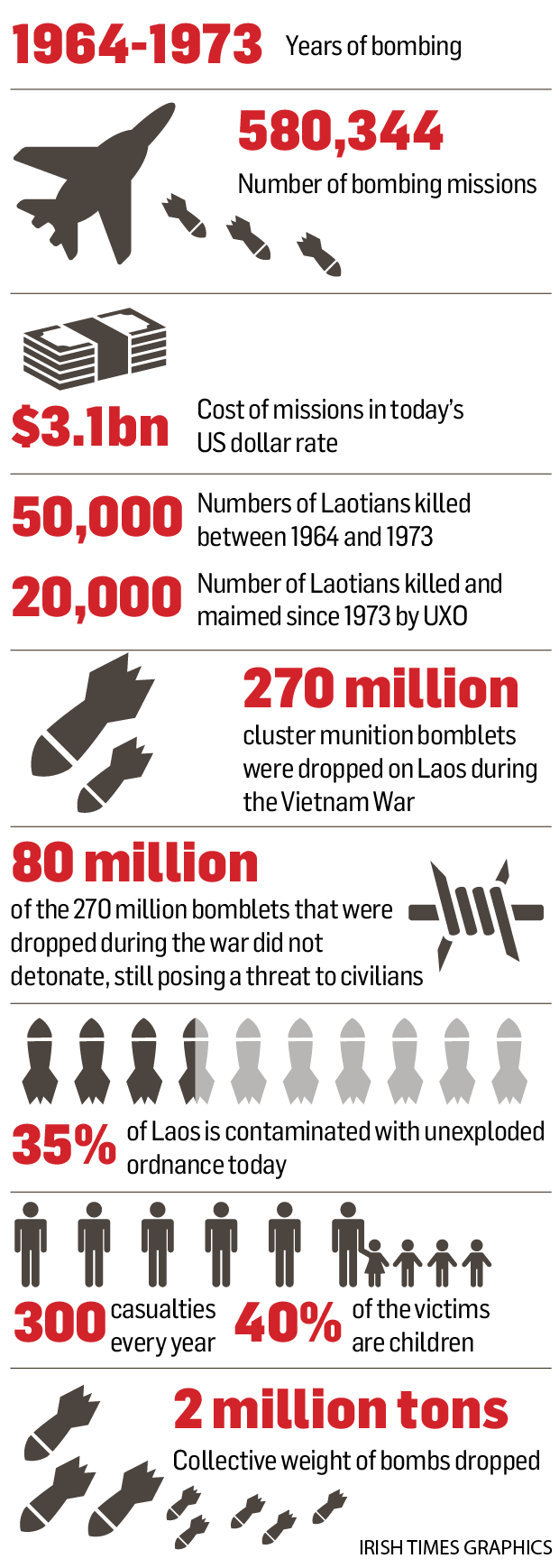
    Laos is the most heavily bombed country, relative to its population, in history. The United States dropped 270 million bombs on it between 1964 and 1973, even though the two countries were never officially at war. The missions, which were run by the CIA, were part of what was later known as the secret war, as Americans were unaware of what was going on. 
    Whiteside is the technical field manager with an organisation called MAG, or Mines Advisory Group. It’s one of half a dozen organisations that work in Laos. Slowly and painstakingly, square metre by square metre, these groups are clearing decades-old unexploded ordnance, or UXO. A staggering 270 million bombs were dropped on Laos, during what became known as the secret war, because Americans were unaware of what was going on. The 80 million bombs that never went off remain live, buried all over the country.
    There were more than 580,000 bombing missions on Laos between 1964 and 1973. That’s one every eight minutes, every day, for nine years.
    Yeyang Yang, aged 31, with his daughter Syya (6) at their home in Banxang village, Phonsavan, Laos. He was burning rubbish when the heat of the fire ignited a UXO in the ground and it exploded. Photograph: Brenda Fitzsimons
    Yeyang Yang, aged 31, with his daughter Syya (6) at their home in Banxang village, Phonsavan, Laos. He was burning rubbish when the heat of the fire ignited a UXO in the ground and it exploded. Photograph: Brenda Fitzsimons 

    Very little of his face left

    Forty-four years after the last mission, the bombs the US dropped are still causing deaths and casualties. Of the survivors, a third have lost a limb or their eyesight, and sometimes both limbs and their sight. Every year hundreds of people’s lives are changed forever by being maimed.
    In this developing country, where most people make their living from the land, the ability to do manual labour is essential.
    Yeyang Yang lives in a simple wooden house in the village of Ban Xang. Yang is 31, but you’d never be able to guess his age: very little is left of his original face, which, like his torso, was grotesquely burnt in February 2008. He was a farmer; at the time he had been doing his secondary job of burning the town’s rubbish when a bomb went off under the pile.
    It’s distressing to look at Yang, not only because he is so disfigured but also because it’s clear he suffered horribly.
    He no longer has a right ear, just a hole at the side of his head. His right hand is a fingerless clump of damaged bone and muscle. His face looks as if it is covered in a mask of melted, flesh-coloured plastic. His red eyes weep constantly, and don’t close properly.
    If it’s hard for me to look Yang in the face, I can’t begin to imagine what it’s like for him to live with such disfigurement. He spent eight months in hospital, and underwent skin grafts so painful that he has refused to have any more. “I was really scared,” he says softly.
    The charity World Education paid for his transport, hospital stay and medicine, and for a family member to be with him in Vientiane. His wife and brother stayed the whole time. His brain was also affected by the blast, and he now finds it difficult to concentrate.
    “I am very, very sorry and sad about what happened to me,” Yang says. “I was only at work, doing my job. I can’t work any more now.”
    Yang did not leave his house, let alone his village, for years after the explosion. He was self-conscious, depressed and isolated from his family and community. The Laotian health system does not routinely provide mental-health support.
    What made the difference for Yang was the peer-to-peer survivor support offered by World Education. The organisation put him in contact with a man who had also survived a horrible explosion. He came to Yang’s house, and they talked together about their experiences.
    Now Yang goes into other communities to share his story and support other survivors. A couple of years ago he would never have agreed to talk to a journalist, much less to be photographed. His courage and ability to adapt are heroic.
    As we talk his six-year-old daughter, Syva, comes into the hut and snuggles between his knees, cuddling him tightly. To her he’s simply the father she loves, no matter what he looks like.
    “My life is better now,” Yang says when I ask, via a translator, at the end of the interview if there is anything else he would like to say. “I feel I have an important role now in life, in helping other survivors to feel better. I can’t work in the farm any more, but I can be useful.”
    The key reason for the staggering number of bombing missions was the country’s location: part of the Ho Chi Minh trail, a route that provided supplies and manpower for North Vietnam’s war with the US, ran through the country. The most bombed area of Laos was the Xiang Khouang province.
      

    He didn’t think it was still live

    Khammeung Phommalein, who lives in the village of Leng, is 25 and no longer able to work. On October 5th last year he saw a small piece of casing in the field where he was working. He thought he could use the metal to make a knife, so he brought it home. As he was trying to open it that evening it exploded, blinding him. “He didn’t think it was still live,” the translator says.
    Phommalein is sitting opposite us, outside the house he shares with his wife, daughter and three generations of in-laws.
    There are chickens pecking at corn husks, and pots of corn boiling on an open fire. Garlic bulbs are drying in one basket, chillies in another. Four generations of the family are gathered around, including his wife, Toui, who is pregnant with their second daughter.
    Until his accident Phommalein was the head of the household and the primary source of its income.
    Khammeung Phommalein, aged 25, at his home in the Kham district of Phonsavan, Laos. Khammeung was blinded by a UXO when he brought it home and it exploded. Photograph: Brenda Fitzsimons
    Khammeung Phommalein, aged 25, at his home in the Kham district of Phonsavan, Laos. Khammeung was blinded by a UXO when he brought it home and it exploded. Photograph: Brenda Fitzsimons 
    World Education, which also educates children and raises awareness of the dangers of unexploded ordnance, is helping Phommalein to explore the possibility of training to be a masseur.
    What World Education can’t do is change the facts that Phommalein is now blind and can no longer carry out physical labour. He has become, in the opinion of his in-laws, a burden. One member of Phommalein’s family privately asked World Education if it could take him away and provide him with permanent care.
    “He has been having nightmares because they told him he is no longer useful to the family,” one staff member tells me.

    Podcast: Rosita Boland on war's legacy in Laos 

    About 10 people are listening to the conversation I’m trying to have with Phommalein, including those who, although they haven’t told him, don’t want him to live under their roof any more. Phommalein makes it clear, however, that he is fully aware of how his in-laws see the change in economic circumstances since he was blinded.
    He says bleakly, “How can I help the family when I can’t see anything? I cannot see the chickens or the pigs to feed them. I cannot work in the rice fields. My wife has to work in the farm now. We must not have any more children, because I cannot support them.”
    I ask what Phommalein misses most about not being able to see, aside from the faces of his family, including his year-old daughter. The sky, perhaps, or sunrise, or even his own face? “I miss not being able to see to work in the rice fields,” he says, pragmatically.

    “Please go home and stay inside”

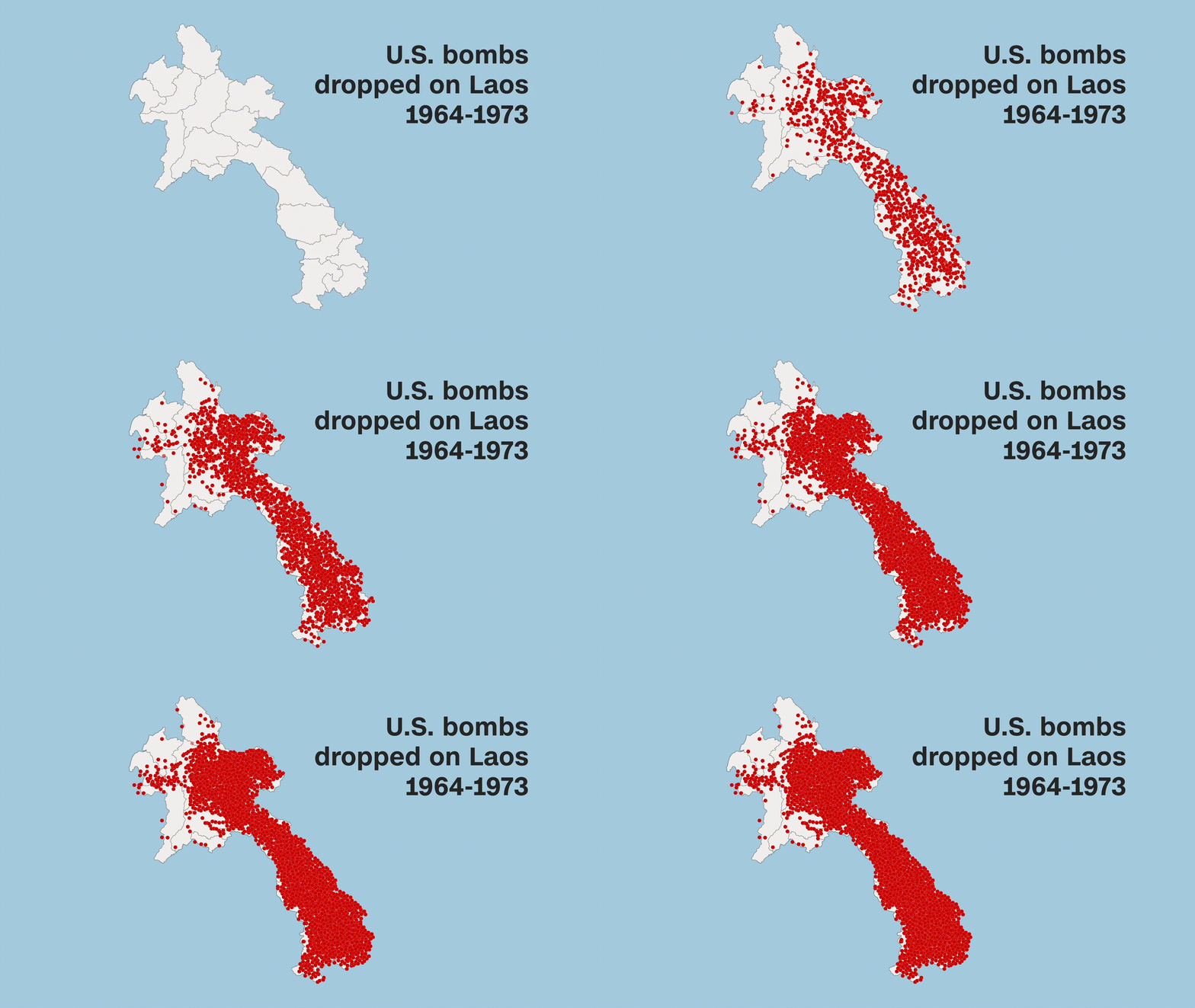
    The day we go out with MAG to see the work they do we first sit in a classroom for a half-hour briefing. Whiteside shows us a map of Laos covered in red dots, which show where the bombs were dropped. Large parts of the map are composed only of red dots – the so-called contaminated areas.
    After the briefing we are driven to an area where one of MAG’s 12-strong teams is working. The organisation has 16 teams in this province alone, so what we are seeing today is being repeated 15 times over in other rice fields in the province, and that’s under the aegis of just one UXO company.
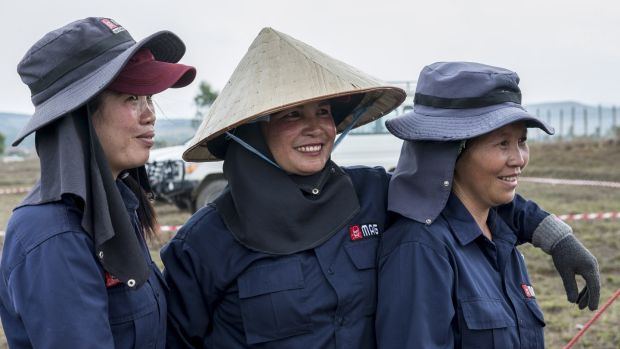
    At the temporary control centre next to the paddy we are given a second briefing, on safety. The team we are observing are all women, as are many of the teams employed by clearance companies.
    Every team has a medical officer, and at every new location they do a test run to the nearest hospitals. Today, if a serious injury occurs, it will take more than 45 minutes to get to the nearest hospital equipped to deal with the situation.
    Before this trip there was a long process of paperwork between Ireland and Laos, which included a startling request for my blood type. Here, on arrival in a tent alongside the rice field, we sign more forms.
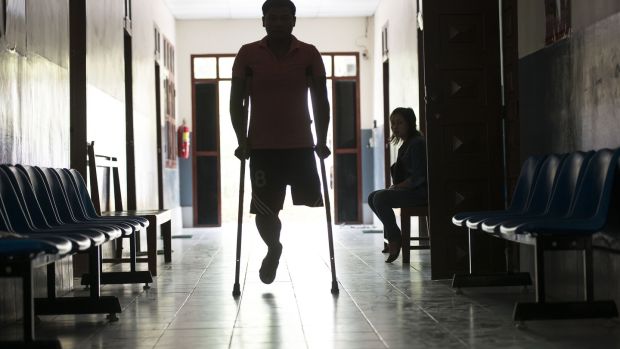
    A man arrives at the Cope centre in Vientiane, Laos. Cope was formed in 1997 in response to the need to provide UXO (unexploded ordnance) survivors with care and support, and orthotic and prosthetic devices which are made on site at the centre. Photograph: Brenda Fitzsimons
    A man arrives at the Cope centre in Vientiane, Laos. Cope was formed in 1997 in response to the need to provide UXO (unexploded ordnance) survivors with care and support, and orthotic and prosthetic devices which are made on site at the centre. Photograph: Brenda Fitzsimons 
    The rice fields that the UXO clearance companies work are all privately owned. The companies discuss in advance with the farmers when they will come to survey and clear the land. When we are in Laos it’s not yet rice-planting season, so the clearance work doesn’t interfere with farming.
    Laotian farmers plough any uncleared land cautiously: they don’t want to go too deep. Hitting a bomb with a spade or plough, dropping a bomb, or unwittingly lighting a fire over an area where one is buried are the main causes of explosions.
    The process of clearance is painstakingly slow. Every square metre of land has to be meticulously walked.
    The area is first sectioned off with string. Two people go out carrying a metal detector that looks a bit like a bed frame. If it buzzes – and it is always buzzing – a piece of red-painted wood is put beside the spot.
    Later someone else comes with a smaller detector, to identify more precisely the location of the metal. When the buzzing is piercing, the person carefully excavates the soil until they find the object.
    “Maybe 95 per cent of the time it’ll be a piece of shrapnel,” Whiteside says. “The rest of the time it’s a UXO.”
    He shows us a bucket of twisted metal – shrapnel from the devices that did explode when dropped. When a UXO such as the Blu-26 he shows us is discovered, bamboo stakes are placed around it, with warning tape. At the end of the day every UXO that has been discovered is detonated, by itself, in a controlled explosion.
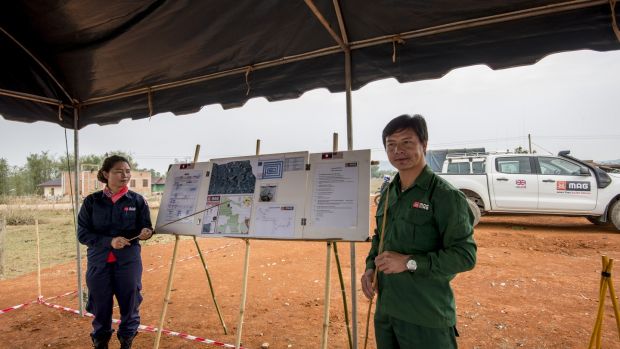
    Staff of the Mines Advisory Group (MAG) prepare for the clearing of a rice field for a local farmer in Phonsavan, northeast Laos. Photograph: Brenda Fitzsimons
    Staff of the Mines Advisory Group (MAG) prepare for the clearing of a rice field for a local farmer in Phonsavan, northeast Laos. Photograph: Brenda Fitzsimons 
    Every day the MAG team logs the area it has surveyed and cleared, and tallies the number and nature of what it has discovered. At the second of the two paddies we visit that day, the tally, after clearing 63,800sq m over four weeks, is:
    • 24 Blu-63 cluster bomblets.
    • 14 Blu-26 cluster bomblets.
    • Eight rifle grenades.
    • Four hand grenades.
    • One projectile.
    • One mortar bomb.
    Are any of these more dangerous than the others, I ask.
    Whiteside laughs. “They’re all extremely dangerous,” he replies.
    Today two Blu-26 bomblets, which have been found beside each other in a bank of the rice field, are due to be exploded. The MAG team spreads out, driving the cattle and other animals away from the site.
    One of the team, Kong Kham Khamphavong, goes out with a megaphone, to alert locals to the imminent explosion. “Please go home and stay inside your houses! We are about to destroy the contamination!” she shouts.
    The bomblets are surrounded by sandbanks, and a wire attached to explosives is unwound all the way back to where we are standing, 300m away. When they are detonated they make a large and loud explosion. I can’t imagine a further 668 of them going off at the same time.
    To realise that MAG’s work is being replicated over so much of Laos, day after day, is staggering. UXO companies are among the largest employers in Laos.

    Children walking to school

    This is civilian land we’re on, where for decades the farmer was planting his rice on top of these lethal devices – land through which his children walked to school, land close to his home.
    When MAG has finished clearing his paddies he’ll plough deeper, his yield will increase, and he and his family will no longer be afraid of the ground beneath their feet.
    Laos is primarily a rural, agricultural country, so hundreds of thousands of people live with the fear of what’s buried in the ground they walk over every day. But Laotians also have become so used to seeing UXOs that they call the devices “bombies”. It’s an uncomfortably affectionate-sounding word for a piece of unexploded ordnance.
    The Cope Visitor Centre in Vientiane, Laos. Cope was formed in 1997 in response to the need to provide UXO (unexploded ordnance) survivors with the care and support they require, namely by way of orthotic and prosthetic devices which are made on site at the centre. Photograph: Brenda Fitzsimons
    The Cope Visitor Centre in Vientiane, Laos. Cope was formed in 1997 in response to the need to provide UXO (unexploded ordnance) survivors with the care and support they require, namely by way of orthotic and prosthetic devices which are made on site at the centre. Photograph: Brenda Fitzsimons 
    There are other examples of a kind of domestication of objects of war: empty shell cases have been turned into flower planters, makeshift boats, or fences, or used in the construction of houses. Most bars and restaurants in Phonsavan, including the bluntly named Craters restaurant, have eye-popping displays outside of shells, missiles, rockets and grenades.
    “Not everything you see on display has been defused,” Whiteside says. His rented house outside Phonsavan came with a garden with an unexploded shell, put there for decoration, like a surreal garden gnome, which he had to have made safe. “People are just so used to seeing ordnance everywhere, even when they’re not safe.”
    His landlord agreed only reluctantly for the shell to be taken away. “I had to tell him I worked for a UXO-clearance company and couldn’t rent a house with an unexploded shell in the garden.”

    Fourteen people

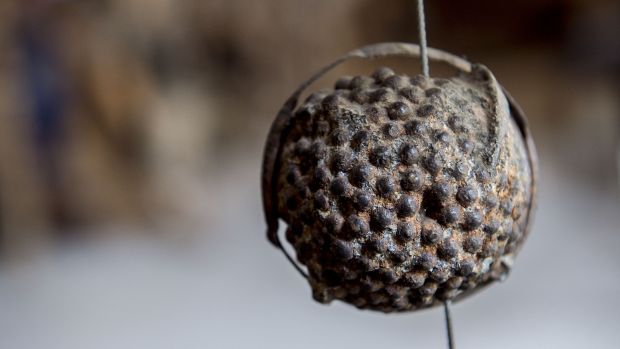
    The statistic that stands out most during the week is the figure of 14. A week before we arrived a 10-year-old girl named La Lee, from Paek district in Xieng Khouang province, picked up one of these tennis-ball-sized cluster bomblets when she was walking home from school.
    She put it in her pocket to play with at home, thinking it was a boule for petanque, a game that’s popular in Laos. When La Lee reached her village, not far from where we were standing that morning in the rice field, she took the bomblet out of her pocket to show her cousin. A family gathering had been planned, and a crowd of people stood nearby. The bomb exploded, and La Lee died instantly. Thirteen others, many of them children, were grievously injured.
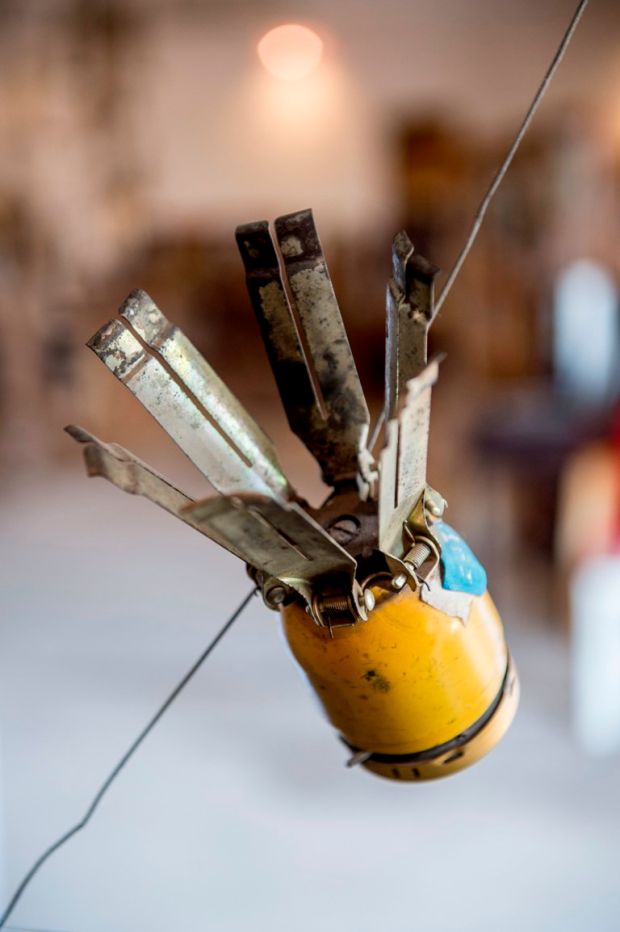
    A Pineapple bomb on display at the Cope Visitor Centre in Vientiane, Laos. Cope was formed in 1997 and created in response to the need to provide UXO (unexploded ordnance) survivors with the care and support they require, namely by way of orthotic and prosthetic devices which are made on site at the centre. Photograph: Brenda Fitzsimons
    A Pineapple bomb on display at the Cope Visitor Centre in Vientiane, Laos. Photograph: Brenda Fitzsimons 
    In Phonsavan, the night before going out with MAG, I went into the Quality of Life information centre, on its dusty main street. Quality of Life works with survivors of such explosions. I saw the names of those most recent victims written on blackboards, along with the nature of their injuries. One seven-year-old was described as “injured – stomach, liver, intestine, foot, hand and arm.”
    More than three decades had passed between the dropping of the bomb that killed La Lee, in March this year, and her birth, in 2007. Yet she died as a direct result of that secret war between 1964 and 1973, a war that had nothing to do with her. The 13 people who were injured with her that day did not die, but their lives have changed forever. Fourteen people from one village; one dead, 13 injured.
    Every year hundreds of other Laotians suffer death, dismemberment and disfigurement as a result of the unexploded ordnance that often lies just below the surface of rice fields, villages and even school playgrounds.
    Mark Whiteside of the Mines Advisory Group (MAG) oversees the clearing of a rice field for a local farmer in Phonsavan, northeast Laos. Photograph: Brenda Fitzsimons
    Mark Whiteside of the Mines Advisory Group (MAG) oversees the clearing of a rice field for a local farmer in Phonsavan, northeast Laos. Photograph: Brenda Fitzsimons 
    It’s the scale of this legacy of war that is so difficult to process. MAG alone has cleared 57.8 million square meters of land since it began working in Laos, in 1994. Each clearance organisation works in a different part of the country. On any day 3,000 people are surveying and clearing unexploded ordnance.

    The money

    The officials we meet are careful not to voice any criticism of, or even their opinions about, how the country is governed and how the aid money it receives is spent.
    This is partly because we are accompanied everywhere by a government press minder, who takes notes and photographs us working. (It’s unexpectedly expensive to report from Laos. Our visas, accreditation and daily media fee cost about €410. We must also pay the minder $50 a day, and cover the cost of her flight and accommodation.) She does not accompany us to meals, but otherwise she is a silent presence for every part of our reporting.
    A cluster bomb on display at the Cope Visitor Centre in Vientiane, Laos. More than 270 million cluster munitions were dropped in Laos during the Vietnam War and up to 80 million failed to detonate. Photograph: Brenda Fitzsimons
    More than 270 million cluster munitions were dropped in Laos during the Vietnam War and up to 80 million failed to detonate. Photograph: Brenda Fitzsimons 
    Why do we need to be accompanied, and why are people so reluctant to talk on the record about what seems to be a straightforward humanitarian story of the legacy of war?
    “Money,” one person we talk to suggests.
    “Corruption,” another says.
    People we talk to off the record, when our minder is not around, cannot offer concrete proof, but they are sure that they are followed from time to time and that their movements are monitored.
    One says ruefully that their office has the best-maintained air-conditioning system in Laos. What does that mean? “We believe the office is bugged. The government are continually coming in, fixing the air con when it doesn’t need fixing.”
    Staff from Mines Advisory Group (MAG) at the end of a long day demining a rice field in Phonsavan, northeast Laos. Photograph: Brenda Fitzsimons
    Staff from Mines Advisory Group (MAG) at the end of a long day demining a rice field in Phonsavan, northeast Laos. Photograph: Brenda Fitzsimons 
    When Barack Obama visited Laos, as US president, in September last year, he pledged $90 million in aid to Laos for clearance. It seems not to have been paid yet, due to disagreement between the United States and Laos about how to spend it. Also, $90 million doesn’t sound quite as impressive when you realise that the US was already paying Laos $15 million a year for clearance.
    “What Obama pledged was to double this for three years,” one person says. “But, of course, we’re not sure if we will ever get those payments for three years, given the incumbent president.”
    The US wants to survey the country, to determine the land that remains to clear of UXO, and it wants the extra aid to fund this. The Laotian government apparently believes that a survey will in fact take many years and that clearance will continue for tens of decades.
    It is suggested that the Laotian government is benefitting by continuing to have UXO organisations in the country. They receive funding from a number of countries, including Ireland: Irish Aid is one of several international organisations that donate to a company called UXO Lao. It is also suggested that not all of this foreign aid goes directly to the organisations it is supposed to fund, that some of it gets diverted for personal gain. It would not be the first time that a developing country had siphoned off foreign-aid money for other uses.
    Staff from Mines Advisory Group (MAG) carry a loop detector across a rice field during a demining mission for a local farmer in Phonsavan, northeast Laos. Photograph: Brenda Fitzsimons
    Staff from Mines Advisory Group (MAG) carry a loop detector across a rice field during a demining mission for a local farmer in Phonsavan, northeast Laos. Photograph: Brenda Fitzsimons 
    Then there is the cost of the explosives used to detonate UXO each day. All of the companies must buy their explosives from the Laotian government, which charges a very high price.
    “Would you call that cynical? Inappropriately exploitative?” one person asks. “You have a country’s government charging top dollar to organisations providing UXO clearance, clearance that is meant to be for the good of the whole country.”
    If people working in Laos are reluctant to share their views on the record, the foreign tourists at Cope in Vientiane have no such reluctance. Cope, a rehabilitation centre that makes prosthetic limbs, also attempts to explain the country’s uncleared UXO to tourists.
    There are maps, short films and audio recordings with survivors. An installation of a cluster bomb hangs from the ceiling, the “bombies” falling from it. There are also many defused examples of the type of UXO dropped on the country.
    The people who have written in the visitors’ book this year have not held back.
    “Make America great again? Why not make Laos great again, and clear up the mess YOU caused! Disgusting, heart-breaking and frustrating” – Fiona, UK 11.02.17
    “I am deeply ashamed of the US government. I am sorry for what the US has done to your beautiful country, and what the US has done to your people” –  Sheila, USA 02-02-17
    “As an American, I am deeply ashamed to see the violence my country did to innocent Laotians. These were crimes against humanity that went unpunished” – Elias, Maryland, US
    “Coming to Laos has been a real eye-opener. We had no idea about the atrocities that took place in this beautiful country” – Gillian and Simon, 10-02-17
    Before I leave the Cope visitor centre I have one last wander around. I’m looking at the tourists looking at the displays: at the now familiar map of Laos with the red dots, the cluster-bomb installation, the defused rockets and mortars and grenades. No matter where they are standing in the room, every one of them has an identical expression: utter disbelief.
    This  report was supported by the Simon Cumbers Media Fund
    X


    Saudi Paid Mercenaries


    Gaza: The Arsenal of the Irreparable

      Fair Use Disclaimer Privacy Policy Contact Subscription News Letter Submission Policy About Follow us on Facebook Follow us on Twitter Fol...