Zoeken in deze blog 🔎🔎

zondag 4 juni 2017

Trump Tumbles into Saudi-Israeli Trap


Trump Tumbles into Saudi-Israeli Trap


President Trump has fallen into a Saudi-Israeli trap that won’t solve the Mideast regional conflicts and won’t lead to a peaceful resolution of the Israeli-Palestinian conflict, explains ex-British diplomat Alastair Crooke.


Jared Kushner did his father-in-law few favors when he enticed President Trump into the endless Israeli-Palestinian “peace process.” To this end, as one Israeli journalist put it, Trump’s advisers set up the Saudis to “embrace [him], and do the sword dance around [him], add a huge check for the arms deals – and [in return is expected to] create an anti-Shiite, anti-Iranian axis [around them].”

Senior White House Adviser Jared Kushner, and his wife, Assistant to the President Ivanka Trump, U.S. Commerce Secretary Wilbur Ross, U.S. Secretary of State Rex Tillerson, and White House Chief of Staff Reince Priebus are seen as they arrive at the Murabba Palace in Saudi Arabia on May 20, 2017, in Riyadh, Saudi Arabia. (Official White House Photo by Shealah Craighead)
Yes, the iconic salesman (Trump), was himself sold a proverbial “bridge” (by his son-in-law, fueled by the conceit that having known Israeli Prime Minister Benjamin Netanyahu for many years, Kushner was “ideal” for bringing peace to Israel). Trump in Riyadh thus paid full homage to the Sunni narrative that they – the Sunnis – are the innocent victims, and the Shi’a, the dark, nefarious, revolutionary, fifth-columnists, who must be driven back into their “pen.”
Trump has thus declared himself an explicit partisan in the geo-strategic power plays between the region’s northern-tier states and the Gulf states. Instead of remaining distant and “above” these Middle East conflicts, he has allowed himself to be persuaded to do the opposite: to dive in, on the Sunni side (perhaps partly to counterpoint with President Obama’s engagement of Iran).
Why? Well, the dollars (should they materialize), will be useful. But essentially, because Kushner persuaded his-father-in-law that flattering the Saudis and demonizing the Iranians, represented the entry price into the peacemaking process between Israel and the Palestinians, which if achieved, would constitute the Trump foreign policy “legacy” for history.

A Long-term Failure

According to the well-regarded Israeli journalist, Ben Caspit, in Maariv, “Someone in Washington studied the map and did their homework. The assessment is that this was a joint effort by Jared Kushner and Jason Greenblatt [Trump’s Special Representative for International Negotiations]. They heard from Obama’s people, and also from a few Israelis who spent all their time, energy, and health on the peace process in the last eight years, who explained to them how the smoking and explosive powder keg of the Middle East conflict needed to be approached.”

President Donald Trump poses for photos with ceremonial swordsmen on his arrival to Murabba Palace, as the guest of King Salman bin Abdulaziz Al Saud of Saudi Arabia, Saturday evening, May 20, 2017, in Riyadh, Saudi Arabia. (Official White House Photo by Shealah Craighead)
Yes, they probably spoke precisely with those “peace process” experts who have been in denial – for the last 25 years – to its manifest failure. And therefore, have been unwilling to acknowledge the four basic flaws to the Oslo principles. Instead, we repeat the same flawed approach, over and over, hoping always for a different outcome.
Europe and America have shared a settled conviction over the last decades: It is that Israel, out of its own necessity, must seek to conserve a Jewish majority within Israel. And that with time, and a growing Palestinian population, Israel will at some point have to acquiesce to a Palestinian “state,” in order to maintain that Jewish majority: that is, only by giving Palestinians their own state or somehow dispensing with a part of the Palestinian people that it controls, can Israel’s Jewish majority be preserved. This is the first principle.
This notion seems intuitively so self-evident, that most Americans and Europeans decline to question it. But the recent release of transcripts from the Israeli cabinet discussions in the wake of the Israeli victory in the 1967 Six Day War show clearly that even then, Israel leaders understood this basic dilemma: they heard the contemporary U.S. warnings about having to absorb one million captive Palestinians, but remained defiant, insisting to keep all the land that had occupied in the war.
As then-Israeli Foreign Minister Abba Eban noted at the time: “[The Americans’] feeling is yes to Jerusalem, but no to the territories. They are stressing that it would be very bad if the world gets the impression that we really intend to hold onto the entire territory.”

Assuaging the Israelis

This first proposition bequeathed to us the second principle: that of the “security-first doctrine”: that Europe and America, in insisting (to the Palestinians) that they must meet and assuage Israel’s own self-assertion of its security needs, would enable Israel to transition, with confidence, to a two-state solution.

President Donald Trump and Israeli Prime Minister Benjamin Netanyahu talk together prior to President Trump’s address, May 23, 2017, at the Israel Museum in Jerusalem. (Official White House Photo by Shealah Craighead)
This security-first narrative is persuasive – so persuasive that European and American policy has been skewed almost wholly towards the goal of security trust-building with Israel. This latter goal has been pursued Ã  outrance — beyond even, the point at which any sovereignty residual that might remain after Israel’s assertion of its security requirements, would amount to little more than a continued occupation masquerading as a Palestinian “state.”
Yet, to the frustration of Western leaders, and despite whatever additional security was provided by the Palestinian security forces, it was never enough. Western leaders have found no solution, but to press on, insisting on yet more security co-operation and trust-building with Israel. Indeed, President Trump seems to have pursued this same line: apparently shouting and berating Palestinian leader Abu Mazen for inciting against Israel (and for giving financial support to families whose members, now prisoners, had resisted the Occupation).
But Israel has not conceded a Palestinian State — despite many opportunities over the last 25 years — and does not seem any more disposed to “give” a Palestinian state now. Seldom is it asked why, if the logic is indeed so compelling, have two states not emerged?
Perhaps it is because both the original “Israel surely wants a Palestinian state” premise, and the linked premise that building security trust with Israel is the necessary sine qua non to Israel’s transition into the two-state solution, quite simply, are flawed. Perhaps Israel has always hankered after some alternative way to retain the land, and somehow to contain its population (the recently released records of the post-war cabinet certainly suggest so).

The Two-State Mirage

The evidence of Israeli actions on the ground, too, plainly does not support the contention that Israel has been preparing the transition to a two-state solution of fixed borders, and a sovereign Palestinian state. On the contrary, the evidence points in the opposite direction: that Israel has been intent on frustrating the two-state solution within fixed borders.

President Donald Trump participates in arrival ceremonies with President Mahmoud Abbas of the Palestinian Authority at the Presidential Palace, May 23, 2017, in Bethlehem. (Official White House Photo by Shealah Craighead)
But there are two further “givens” to the “process” with Israel that also deserve more critical scrutiny: One, (most favored by the Europeans), is that America can “impose” a solution on Israel. On the basis of my experience as a staff member of Sen. George Mitchell’s peacemaking process, this also is a flawed premise. To appropriate the phrase used in a different context, Israel always “has six ways from Sunday” to circumvent American pressures (which in any case are limited by domestic political considerations).
Finally, does the Arab leadership – as opposed to the street – really want a Palestinian state? I am not so sure. I think they are quite comfortable with things just as they are.  The presumption of a strong desire to establish a Palestinian State may be flawed too.
So what is Trump’s (or Kushner’s) “new” plan? Daniel Serioti of Israel Hayom reports on May 24: “A senior official in Ramallah told Israel Hayom that during President Trump’s one-on-one meeting with Palestinian Authority Chairman Abu Mazen … that [Trump] intends to lead a peace process based primarily on the Saudi-Arab peace initiative …
“President Trump told the PA chairman that the peace plan that he was consolidating would be based on promoting a comprehensive regional plan first, as part of the Arab peace initiative. The Palestinian official said that President Trump emphatically told Abu Mazen that this did not mean renouncing the two-state vision as the basis for a future agreement between Israel and the PA, under which a Palestinian state would be established alongside Israel, although the American president would like to consider additional possibilities ‘outside the box.’
“The main possibility is promoting the Saudi-Arab peace initiative first, and only afterwards an interim agreement, in the framework of which the parties would discuss ways to reach a permanent status arrangement that would enable the creation of an independent Palestinian state and both sides declaring an end to the Israeli-Palestinian conflict.
“The Palestinian official said that President Trump described the fundamentals of the plan that he is drafting in a very general way and did not go into the particulars, although according to him, the Americans would like to promote the Arab peace initiative so that the beginning will involve an act of normalizing Israel’s relations with the moderate Sunni Arab states.
“Additionally … the Americans will take action to promote direct intensive negotiations between Israel and the Palestinians, which will be outlined in a preset timetable, and under which the parties will take action to resolve core issues, primarily delineating the borders of the future Palestinian state, the status of Jerusalem and the holy places, the fate of the settlements outside the large blocs, the right of return and more.”

Not Much ‘New’

The “new” twist here is a “regional (Sunni-Israeli) alliance” that would initially normalize with Israel, but which then could evolve into a “regional defense alliance,” “under American patronage and with full military and diplomatic American support” and which would be targeted explicitly at Iran and its allies.
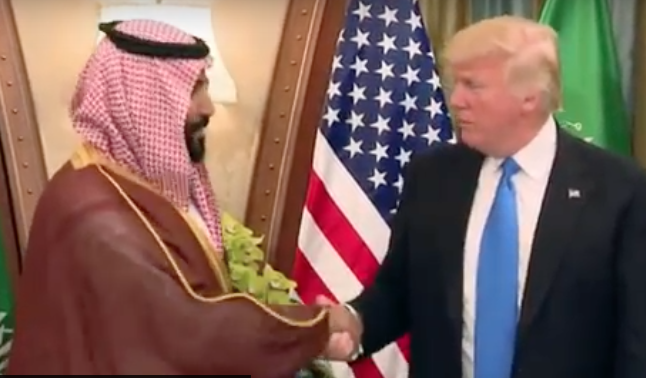
President Trump shakes the hand of Saudi Deputy Crown Prince and Defense Minister Mohammad bin Salman on May 20, 2017. (Screenshot from Whitehouse.gov)
But there is nothing truly new here. We have had “inside-out” and “outside-in” initiatives before. But what is different about the Trump/Kushner version is that the late Saudi King Abdullah’s initiative was predicated on Israel establishing a Palestinian State first and normalization with Israel occurring secondly. Trump seems to be inverting the order: Arab normalization first and then an interim agreement with the Palestinians second.
In fact, it all sounds rather like a re-make of the “security-first doctrine”: i.e. that Arab States, by assuaging Israel’s own self-assertion of its security anxieties, would serve, through normalization, to enable Israel to transition with greater confidence to an “interim” Palestinian solution – and maybe even to a permanent solution.
We have here the eternal problem that the Arab leaders cannot afford to normalize without an Israeli concession to the Palestinians, and the Palestinians in turn will not make a gesture, until and unless, Israel halts settlement building, which the latter will not do.
Another reason to think that this plan will come to nothing (after being spun out as long as possible by Prime Minister Netanyahu) is that, while it is true that the Palestinians presently are weak and divided – paradoxically Netanyahu is even weaker. Any concessions to Abu Mazen, however banal, could bring down his government. Netanyahu’s right-wing sees no reason to make any – even symbolic – concessions to the Palestinians. Why should they? They are on the cusp of having it all.

The Trap Closes

This – the Sunni-Israeli regional Alliance; the renewed peace process – is a trap into which Trump has been persuaded to enter. It is a trap, because once entered into, the peace process becomes formaldehyde to all other political processes. How often have we been told “you can’t do this; you can’t do that” because it might endanger the (vacuous) “peace process.”
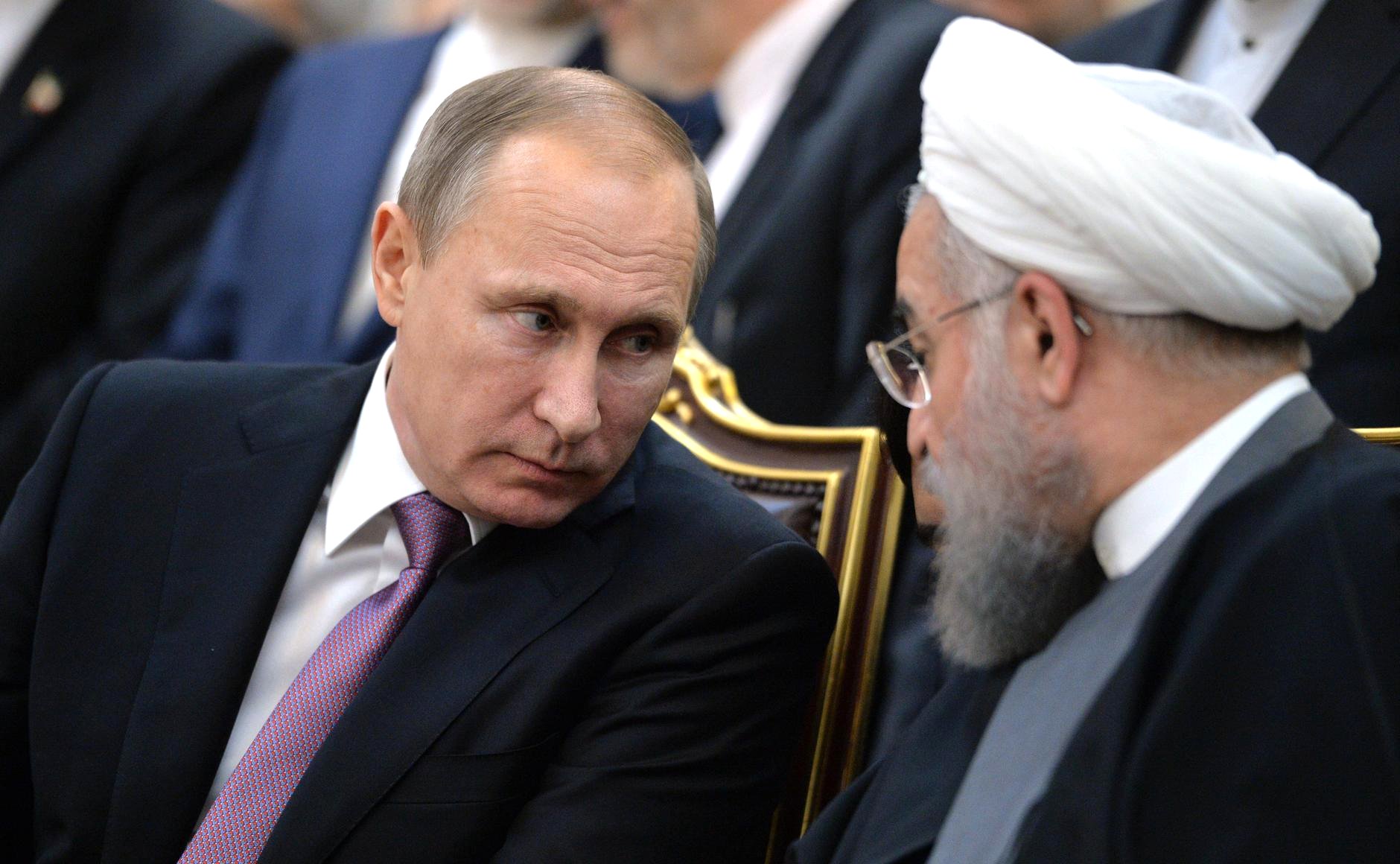
Iranian President Hassan Rouhani meets with Russian President Vladimir Putin on Nov. 23, 2015 Tehran. (Photo from: http://en.kremlin.ru)
A peace process gives Israel huge anesthetic leverage in the region – as always it has so done. It is a trap – because it ties Trump into trying to assuage the Irano-phobia of Saudi Arabia, which will prove to be just as insatiable as are Israel’s “security needs.”
These liabilities will undercut Trump’s possibilities for defeating ISIS and for détente with Russia. Russia has been trying to bring the Shi’a and the Turks to the negotiating table on Syria. Trump’s role was to be to help bring the Sunni side to the table – in order to forge a wider regional settlement. That will be less likely now, as Saudi Arabia levers Trump’s visit towards weakening Iran.
With Trump’s homage to the Sunni cause, it is more likely that the Sunni-Shi’a fissure will deepen, rather than its sore edges be reconciled. And, viewed from a pure realpolitik perspective, does Trump really believe that Saudi Arabia and its allies will succeed in weakening the Russia, Iran, Syria, Iraq and Hizbullah alliance?
And Israel? The writing was plainly on the wall, as we now know, at those post-Six Day War Israeli cabinet meetings. The Americans did warn the Israeli cabinet that it would become progressively harder and harder for America to defend Israel’s hold over the disempowered, disenfranchised and dispossessed (and enlarging), Palestinian people – if Israel insisted on its “winner takes all” end of war policy.
This is something that still has to play out in its own way. But as White House adviser Steve Bannon noted in his film Generation Zero, “the essence of Greek tragedy is that it is not like a traffic accident, where somebody dies. The Greek sense is that tragedy is where something happens because it has to happen … Because the people involved make it happen. And they have no choice, but to make it happen.”

Alastair Crooke is a former British diplomat who was a senior figure in British intelligence and in European Union diplomacy. He is the founder and director of the Conflicts Forum.

https://consortiumnews.com/2017/06/03/trump-tumbles-into-saudi-israeli-trap/


U.S. Hiding Torture

Hiding the Ugly Business of Torture

 
Exclusive: A grisly feature of the “war on terror” was America’s descent into torture, but the powers-that-be have decided that the common folk shouldn’t worry their little heads about this ugliness, reports ex-CIA analyst Ray McGovern.


So, you did not believe in the power of the Deep State? Well, you may change your mind after reading a report in The New York Times that the powers-that-be in Washington are about to deep-six the 6,700-page Senate report based on original CIA cables and other documents that not only to depict savage torture practices during the George W. Bush era, but also show that CIA officials consistently lied in claiming these heinous practices yielded information of any intelligence value.
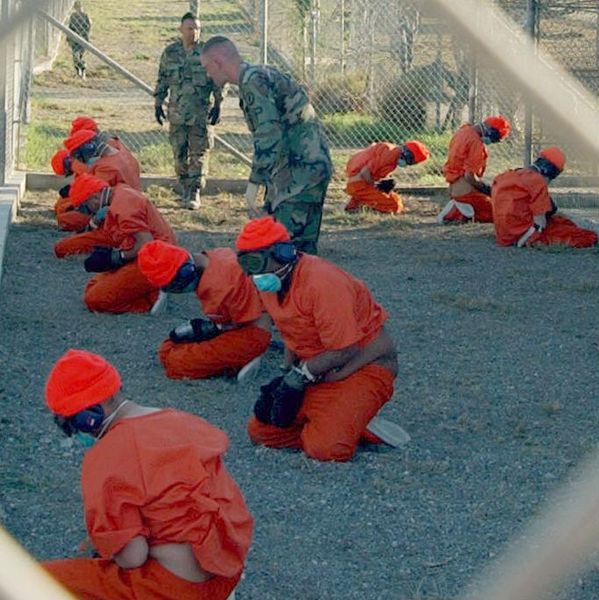
Some of the original detainees jailed at the Guantanamo Bay prison, as put on display by the U.S. military.
In what amounts to a gross violation of the public trust – not to mention his oath to the Constitution – Senate Intelligence Committee chair, Sen. Richard Burr, R-North Carolina, has recalled all copies and will put the report under lock and key for good – dismissing it as a “footnote in history.”
The only hope for those of us who want to see torturers held accountable is that some patriotic truthteller has – or will – put the report on a thumb drive and send it off to WikiLeaks or some other brave outlet that will publish it.
Small wonder that those agencies and individuals involved in the torture and those – like Burr – who are afraid of the torturers want to keep the report from public view. According to the Times, the full report describes interrogation sessions “in great detail.” It also “explains the origins of the program, identifies the officials involved, and offers details on the role of each agency in the secret prison program” in which detainees were tortured.
Is that why, when copies of the original report were sent to Executive Branch agencies, no one was allowed to read them? Katherine Hawkins, senior counsel at the Constitution Project, immediately called the return of the report to the Senate committee “extremely disturbing.” She labeled “absurd” that no one in the Executive Branch was permitted to read the Senate report, five years in the making.
What Burr’s subservience to the intelligence agencies that he is supposed to be overseeing tells me is that he will shy away from anything implicating former CIA Director John Brennan and his co-conspirators in other shocking activities.
These include implementing CIA’s “Marble” cyber-attack program, which lets it hack into servers and computers and “obfuscate” who the hacker was (as revealed in original CIA documents released on March 31 by WikiLeaks. (Don’t look for that revelation in the Times, however.)
Yes, you heard that right. Former National Security Agency Technical Director William Binney and I are persuaded that the “hack” into the Democratic National Committee was not done by Russia, but rather by a very sophisticated and expensive program allowing the CIA to hack into computers like those of the DNC and leave little “telltale signs” – like Cyrillic letters, for example – in order to “obfuscate” who did the hacking.
This could also explain why former FBI Director James Comey, who seems to be a charter member of the CIA/NSA/FBI Deep State cabal, refused to let his own technicians get physical access to the DNC computers, out of fear they might discover more than they were cleared for.
What are the chances that Sen. Burr or other “overseers” will ask questions about that?

‘Six Ways from Sunday’

Someone just made the innocent suggestion to me that we ought to complain directly to the Senate Minority Leader Chuck Schumer, D-New York – a well meaning, but totally naïve idea. Schumer has been outspoken in expressing his fear of “crossing” the Intelligence Community.
American military police pose with naked detainees at Abu Ghraib prison in Iraq.
On Jan. 3, 2017, Schumer worried aloud to MSNBC’s Rachel Maddow about Trump taunting U.S. intelligence agencies and its assessments about Russia’s cyber activities.
“He’s being really dumb to do this,” Schumer told Maddow. “Let me tell you, you take on the Intelligence Community; they have six ways from Sunday at getting back at you. So even for a practical, supposedly hard-nosed businessman, he’s being really dumb to do this.” (Maddow, who has eagerly pushed the Russia-gate conspiracy theories, didn’t object to this concept that elected politicians should cower before the mighty I.C.)
With Barack Obama, this fear can be traced back nine years to the first sign I saw indicating that Brennan had inordinate influence over the candidate he signed up to work for in the spring of 2008.
In June 2008, when I heard that then-Sen. Barack Obama had flip-flopped on the key question of whether to hold the giant telecom companies accountable for violating our Fourth Amendment rights against unreasonable searches and seizures and had decided to vote for protecting the telecoms from legal liability, that seemed to me a watershed.
On July 3, 2008 I wrote candidate Obama an open letter titled: “It’s a Deal Breaker for This Intelligence Officer: I speak from 30 years of experience in intelligence work. I don’t know who actually briefed you on the eavesdropping legislation, but the bill is unnecessary for intelligence collection and POISON for our civil liberties — not even to mention the unconscionable retroactive immunity provision.”
Years later, reflecting on the hold that Brennan seemed to have on President Obama, I thought back to Obama’s surrender on the giant telecom companies and reasoned that it was probably Brennan who explained Deep State realities to the candidate in late spring 2008.
Six years later, the blatantly intrusive way in which Obama pulled out all the stops to help CIA Director Brennan prevent publication of a declassified Executive Summary of the Senate Intelligence Committee report on CIA torture scandalized the committee’s lead investigator, Daniel Jones. He gave The Guardian’s Spencer Ackerman an extensive interview in September 2016.
Jones and Ackerman reported that then-Senate Intelligence Committee chair Dianne Feinstein was hell-bent on getting the CIA torture report published. In a March 11, 2014 speech, she argued that a public version would ensure torture “will never again be considered or permitted,” and that CIA interference and foot-dragging meant the Senate faced a “defining moment” testing whether the committee could effectively perform its oversight, “or whether our work can be thwarted by those we oversee.”
On April 3, the committee voted 11-3 to authorize a declassified version of the torture report. Senate Republicans who had long rejected the report’s findings joined Democrats who embraced them.
Yet the CIA had an ally whom Feinstein may not have appreciated: President Obama. The White House announced that same day that the CIA itself would lead the declassification review. The Intelligence Community would effectively choose which of its embarrassments to spare the public from learning.

‘Tortured Some Folks’

Obama’s Chief of Staff Dennis McDonough, acting for Obama, played a central role, backing the CIA’s position at every turn. The fact that the White House chief of staff would personally oversee the negotiations between the committee and the CIA spoke to the gravity of the issue.
Military Police officer Charles Graner poses over Manadel al-Jamadi’s corpse, after he was tortured to death by U.S. soldiers at Abu Ghraib prison.
On August 1, 2014, Obama entered the White House briefing room: “We tortured some folks,” he memorably said. But he added: “It’s important for us not to feel too sanctimonious in retrospect about the tough job those folks [at the CIA] had.”
And so the timid President who, to great fanfare, announced the end of torture (and the closing of Guantanamo, which never happened) ended up making excuses for “those folks” at the CIA, and doing all he could to prevent the American people from learning the particulars of what they had done.
In the end, Sen. Feinstein, with strong help from Senate Majority Leader Harry Reid, D-Nevada, prevailed over Brennan and his lawyerly team of McDonough/ Obama. The sanitized Executive Summary of the report was released on Dec. 9, 2014 just before Congress went home for Christmas.
I suspect that, in the end, Feinstein and Reid confronted Obama with a kind of “nuclear option”: Release the Executive Summary or Sen. Mark Udall (who had just lost his Senate seat and had little to lose) would read it from the Senate floor.
That may be the last time anyone in Washington prevailed over the Deep State.

Ray McGovern works with Tell the Word, a publishing arm of the ecumenical Church of the Saviour in inner-city Washington.  He was a CIA analyst for 27 years.  In early March 2006 he returned the Intelligence Commendation Medallion given him at retirement, in order to dissociate himself from an agency engaged in torture.

The Kissinger Backchannel to Moscow

The Kissinger Backchannel to Moscow


Exclusive: Major U.S. media outlets insinuate that President Trump’s advisers are traitors for secretly talking to Russians, but they ignore the history of Henry Kissinger doing the same thing for Richard Nixon, writes Gareth Porter.

Last week’s leak to the Washington Post of an intelligence report about President Trump’s son-in-law Jared Kushner meeting with Russian Ambassador Sergey Kislyak in early December to discuss a possible back channel to Moscow appears to represents the climax of the campaign of leaks against the Trump team regarding contacts between Trump associates and Russians.
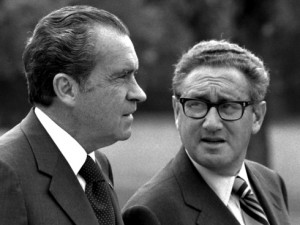
President Richard Nixon with his then-National Security Advisor Henry Kissinger in 1972.
The leak about Kushner came shortly after another sensational story broadcast by CNN on May 17 about U.S. intelligence picking up conversations among Russian officials during the presidential campaign in which they bragged about having cultivated a relationship with retired Lt. Gen. Michael Flynn and expressed the belief they could use him to influence Trump.
Those two leaks sandwiched extraordinary testimony by former CIA Director John Brennan before the House Intelligence Committee on May 23 in which he said he was concerned about “intelligence” regarding Russian efforts to “suborn” certain Americans – meaning to induce them to commit unlawful acts. That may have been a reference to the leaked interception of Russians bragging about their relationship with Flynn that had just been reported.
“It raised questions in my mind about whether the Russian’s efforts were successful,” Brennan said.
Then, Brennan offered an inflammatory comment reminiscent of McCarthyism. “Frequently people who go along a treasonous path do not know they are on a treasonous path until it is too late,” Brennan said.
Unidentified former Obama national security officials immediately condemned the Kushner proposal to Kislyak for a backchannel – which occurred after Trump’s election but before his inauguration – as “not only highly improper but also possibly even illegal,” as Politico reported.
In an interview with the PBS NewsHour, former Director of National Intelligence James Clapper followed that script, suggesting that the attempt to “mask this dialog” with Russia made the Kushner request inherently suspicious.
“Why all the cloak and dagger secrecy?” asked Clapper.  “One wonders if there was something worse than that or more nefarious than that…”
Clapper also argued that the proposal for the channel was illegitimate because the meeting was held before Trump became president. “There is a distinction between reaching out, establishing lines of communication versus substantively interfering with the policy of the present administration,” he said.

The Kissinger Precedent

But the Brennan-Clapper line insinuating that the Kushner request for contacts with the Russians was potentially treasonous collapses in light of the well-documented story of how President-elect Richard Nixon’s national security adviser-designate Henry Kissinger established his own personal backchannel to the Soviet leadership in 1968 using a known KGB operative with whom he had been meeting for years as his contact.
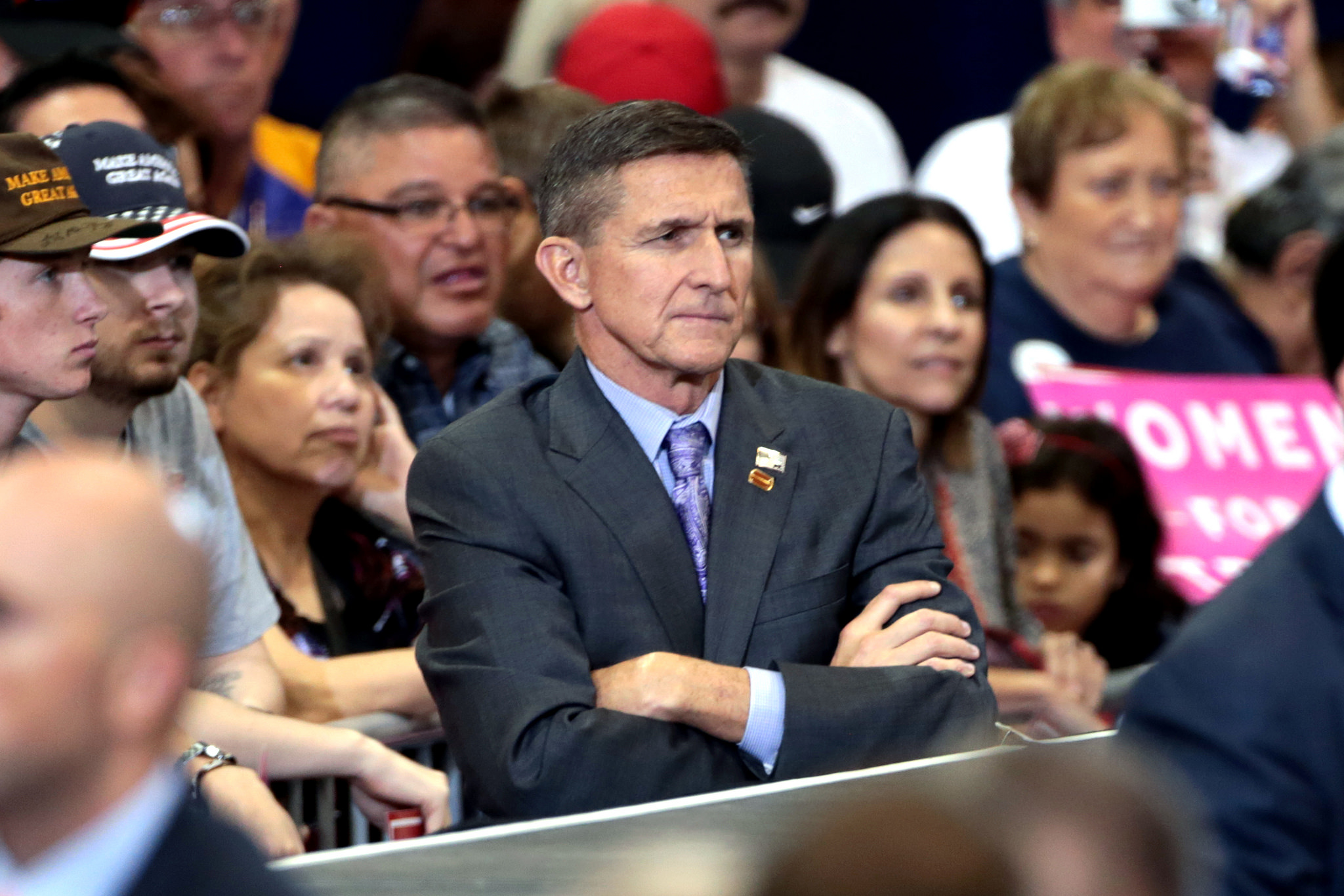
Retired U.S. Army lieutenant general Michael Flynn at a campaign rally for Donald Trump at the Phoenix Convention Center in Phoenix, Arizona. Oct. 29, 2016. (Flickr Gage Skidmore)
Historian Richard A. Moss of the Naval War College recently published an authoritative book-length study of the Kissinger backchannel showing that that Kissinger began setting up his backchannel to the Soviet government leadership through his Soviet contact in December 1968 soon after being named Nixon’s choice for national security adviser.
And it shows that Kissinger seized on the one Soviet government contact he already had to establish the backchannel. That was Boris Sedov, whom Kissinger knew to be a KGB operative. Kissinger had been acquainted with Sedov from the latter’s visits to Harvard. The two continued the contacts after Nixon’s election in 1968.
Moss’s book recounts how Kissinger used the Sedov channel to introduce the concept of “linkage” of different policy issues into negotiations with the Soviets. Sedov gave Kissinger a Soviet government paper on Middle East policy, according to Moss’s account. Only after Nixon’s inauguration did Kissinger and Soviet Ambassador Anatoly Dobrynin agree that all further communication would be through Dobrynin.
Both the Kissinger-Sedov and Kissinger-Dobrynin channels were kept secret from the rest of the Nixon administration’s national security apparatus, as recounted by Moss. Nixon agreed to set up a secure phone line in the White House linking him directly to Dobrynin. The U.S. intelligence agencies, the National Security Council staff and the Pentagon were kept in the dark about these conversations.
And to complete the parallels between the Kissinger backchannel episode and the Flynn and Kushner contacts with the Russians, Moss reveals that Sedov later bragged to a Lebanese-American about his contact with Kissinger –- a boast that was immediately picked up by FBI surveillance of Sedov.
Further, Oleg Kalugin, the head of the KGB’s station in Washington, surely boasted to his Kremlin bosses about having “forged a close back channel tie with Henry Kissinger” – as Kalugin put it in his own memoirs – that would be useful in influencing Nixon’s policy toward the Soviet Union.
Sedov later boasted to Kalugin that he had been so successful in cultivating Kissinger’s assistant Richard Allen that he wanted to try to recruit Allen as an agent, according to Kalugin. But Kalugin rejected the proposal. (Allen went on to become President Ronald Reagan’s first national security adviser.)
This history of Kissinger’s Soviet backchannel in 1968 reveals Brennan’s breathless alarm about Russian “suborning” Flynn or using the backchannel to manipulate Kushner as unworthy of a serious intelligence professional.
Nothing in the Kislyak report intercepted by U.S. intelligence suggests that Kushner’s desire for the backchannel was for anything other than to discuss how to increase cooperation on issues of common interest. Two unidentified sources told ABC News that the Kushner-Kislyak meeting “was focused on the U.S. response to the crisis in Syria and other policy-related matters.”

Need for Secrecy

And the Trump transition team’s reasons for wanting a private channel of communication with the Russians that would not be visible to the U.S. national security bureaucracy were precisely the same as those of Nixon and Kissinger.
Marine Corps Gen. Joe Dunford, chairman of the Joint Chiefs of Staff, walks with Army Lt. Gen. Stephen J. Townsend; Jared Kushner, senior adviser to President Trump; and U.S. Ambassador to Iraq Douglas A. Silliman after arriving in Baghdad, April 3, 2017. (DoD photo by Navy Petty Officer 2nd Class Dominique A. Pineiro)
Moss, the historian of the Kissinger backchannel, recalled in an opinion piece on the Kushner affair that Dobrynin’s memoirs quote Kissinger as telling the Soviet Ambassador that the Nixon administration wanted to conduct a “most confidential exchange of views” with the Kremlin, because “The Soviet side . . . knows how to maintain confidentiality; but in our State Department, unfortunately, there are occasional leaks of information to the press.”
The leak of the intelligence report of the Kushner-Kislyak meeting to The Washington Post underscores the problem faced by the Trump team amid the flood of leaks about U.S.-Russian discussions that were conducted through official U.S. channels.
Demonstrating the intensity of the anti-Trump attitudes among many Obama officials – both those who have left the government and those who remain as holdovers – someone with access to the secret report was so determined to expose the Kushner backchannel as to reveal to the Russians what must be one of the most sensitive U.S. intelligence secrets of all – the U.S. capability to intercept Russia’s diplomatic messages.
The idea of depending on a secure line of communication within the Russian Embassy for the backchannel was inherently unrealistic, but not because it would give the Russians some unfair advantage in negotiations. The real problem was that it would have been too awkward for a U.S. official to go to the Russian Embassy every time he wanted to use the channel. Indeed, it appears that the proposal was not pursued further because the Russians themselves were wary of it.
Moss, who says he is speaking for himself and not for the Naval War College, told this writer in an interview, “Better relations with the Russians would be a good thing.” He noted several “areas of opportunity” including energy resources and cooperation on counter-terrorism in Syria, Iraq and elsewhere. “If Kushner and Kislyak were discussing how to defeat ISIL that would be a perfectly legitimate thing,” said Moss.
But Moss warns that the underlying political crisis in American society is a formidable obstacle to any shift by Trump in relations with Russia. Trump “feels he won the election fairly and that unelected bureaucrats are working against him,” Moss observed, but “The people who suspect possible collusion between the Trump and Russian interference in the election may feel Trump is an illegitimate president.”
Jared Kushner and Michael Flynn are obviously no Kissingers. But the insinuations from Brennan and others that Trump’s advisers may have somehow crossed the line into treason is itself the crossing of a dangerous line into McCarthyism. And the mainstream U.S. news media is participating enthusiastically in the campaign to impugn the loyalty of Trump’s advisers, even though there is still no public evidence to support such suspicions.

Gareth Porter is an independent investigative journalist and winner of the 2012 Gellhorn Prize for journalism. He is the author of the newly published Manufactured Crisis: The Untold Story of the Iran Nuclear Scare.


"We Don't Have the Rule of Law"

"We Don't Have the Rule of Law": Barrett Brown on Incarceration, Journalism and His Next Steps

Saturday, June 03, 2017 By Candice Bernd, Truthout | Interview 
Barrett Brown at his residence in Dallas, Texas, on Saturday, May 20, 2017. (Photo: Candice Bernd)Barrett Brown at his residence in Dallas, Texas, on Saturday, May 20, 2017. (Photo: Candice Bernd)
Barrett Brown, who was arrested in 2012 and subsequently imprisoned for his reporting on hacked emails from private intelligence contracting firms, was unexpectedly back in the news recently after he was rearrested during a check-in for "failure to obtain permission" to speak to the press.
In 2011, Brown not only exposed that the private intelligence firm Stratfor had been snooping on activists on behalf of corporations, but also revealed plans by intelligence contractors to hack and smear activists.
Brown pleaded guilty in 2014 to two charges related to obstruction of justice and threatening an FBI agent. Truthout was in the courtroom when he was ultimately sentenced to five years and three months in prison. Last year, Brown won a National Magazine Award for his columns in The Intercept about his experiences in prison. He was released to a halfway house in November and then subsequently released to his residence under house arrest. Since May 25, he has been on supervised release.
In a sit-down interview with Truthout at his Dallas residence, Brown detailed his recent rearrest and discussed his ideas for creating new online models for civic engagement and journalism. He also shared some of his plans for what to do next, now that he is no longer incarcerated. The following transcript has been edited for clarity and length.
Candice Bernd: Just to start, I wanted to ask you a little about your current house-arrest situation and the terms of your probation. Are you currently allowed to use a computer or the internet?
Barrett Brown: Well, the terms of my supervised-release period, which is set by the court in sentencing, last for two years. It begins five days from [May 20]. Now, the [Bureau of Prisons (BOP)] has nonetheless decided that they have the right to unilaterally interpret those terms of confinement as applying partially to my BOP supervision period, which has gone on for the past six months, and that's incorrect. So, as soon as I got to the halfway house, I was informed that I could not use computers, the internet or even a PlayStation 4, for instance, because it has internet access, and according to a regional BOP representative, can be turned into a "micro computer," whatever that is. I think she may have misread an article about the US government having used like 20,000 PlayStation 4s to build a supercomputer.
This is a pattern we've seen, when I was in the prison and then outside; most recently, when I was rearrested a few weeks ago for talking to the press, even though, as I showed, that's not in the BOP policy. You have local officials making up policy, refusing to put policy in writing, calling the [US] Marshalls and having them arrest you illicitly, without any documentation, to enforce that, and then backing off when lawyers get involved. That's pretty much the pattern of the BOP in general.
Can you provide any updates regarding that rearrest incident?
After the lawyers from Haynes and Boone up in New York that Wick Allison of D Magazine hired for me threatened [the BOP], challenging my confinement in a court, they immediately released me. I was taken back to the halfway house, and I hadn't had a chance to talk to these lawyers since that morning, so I didn't really know what was going on. I got there and the director of the halfway house took me in his office, and there was some other fellow there who he claimed was his new program director, and said, "Here are these two forms, and the BOP wants you to sign them," and I said, "Well, what happens if I don't sign them?" and he said, "Well, we're back to where we were last week."
I kept trying to get him to admit that this was again, a threat for a false arrest if I don't comply with these non-policies. The forms in question, one of them was a form I'd already signed six months prior at my own request. It was a form that allows the BOP to respond to questions about my case in press. Six months ago [the regional BOP representative] had declined to talk to reporters about this computer thing because those forms weren't signed. So I said let me have that form, and I signed it. So they gave me the same form I had already signed, and then another form, for inmates who are in a prison to give permission to ... media representative[s to interview them]. So they wanted me to sign this other form, and modified it to apply to this situation.
So, [the halfway house director] made me sign a form that said, "I consent to all future interviews." This wasn't the same form that they had brought in last time. They weren't talking anymore about getting permission for interviews on each individual instance, and they weren't talking anymore about getting me to have PBS or VICE or whoever sign another form, which again is for getting into a prison. So they backed off that.... I think a decision was probably made, again by the regional [BOP] office, just based on no real legal strategy, just based on kind of a haphazard, wriggling, low-intelligence, imaginary legal strategy. So I said I would sign these forms -- they were different forms -- if I could take copies with me, and so he allowed that, and I did that.
Since then there's been no word on it.... I could pursue this, but there's other things I'd be more interested in pursuing regarding the BOP. So I haven't come to a decision yet on what to do, if anything. I think it's actually more important just to show that this is what can happen to you. That's the thesis I'm trying to present. These things are ingrained in our system. They're [systemic]. They're not just, "Oh, these things happen." This is a [systemic] flaw in our system.
We don't have the rule of law. We just don't. It's a myth, a dangerous myth.
I'm curious to know what other issues you do plan to continue to pursue, journalistically, legally or otherwise, regarding the BOP and the prison-industrial complex, especially as it relates to your own experiences.
I have this book with [Farrar, Strauss and Giroux] that will come out next year. A third of that will be about prisons, not just for the sake of the prison story but also, again, to present my thesis as to what the institutions in this country are actually like, and why they have to be opposed more aggressively. In legal terms, what I'm interested in is a law firm that wants to challenge the constitutionality of the administrative-remedy process. The Prison Litigation Reform Act requires [prisoners], if they want to take someone to court or challenge anything, to go through this long, involved process that the BOP or state prisons, respectively, oversee, and can interfere with at will, as I've documented with The Intercept when I went through this process after they took away my email for a year, illicitly. They'll send you back forms from the regional office, and say, "You've got to make three copies of this, and you have until this day to do it," and that day is negative. It's 15 days before you received it. So you have negative 15 days to comply. Stuff like that. That didn't just happen to me. It happens regularly. It's [systemic]. It's a shadow policy.
But even when a National Magazine Award-winning journalist presents it in The Intercept, nothing comes of it because it has to hit that threshold that things have to meet for people to care or for Congress to get involved. So, it all flows back into that same thesis, that eventually, we're going to have to engage in enhanced civil disobedience to get these things changed.
Can you discuss that last point a little more? You mentioned before that journalists should have constituencies to promote this kind of massive civil disobedience, and you talked about your plans for building [an open-source, end-to-end-encrypted collaborative] "pursuance" system platform to build online civic entities that would do just that. Can you explain how this collaborative software will work?
This is something I was attempting to do in 2009. I recruited 75 people, including a core group of professionals and academics and we were building a system. It was originally supposed to be used to better perpetuate information -- for bloggers and journalists to better share information using this mechanism I developed. But it's expanded since then into what we call a process-democracy platform, a platform for massive civic collaboration. There's basically a universe. We're going to seed it with maybe 100 people in different entities -- that includes institutions and nonprofits.
Anonymous, for instance -- you have an [internet relay chat] room, and you have people flowing in. How do you decide who has the right to make what arrangements? Who has the right to do what? It's all very amorphous. It's very agile obviously, but it also burns out, which is what happened. It was burning out back then. It was subject to all kinds of internal and external threats that just couldn't be defended against. Now, with this, the mechanism is, you're in this server and every other person in this server [has] the same rights. You have the right to create what's called a "pursuance," which is an entity. It looks like this:
A diagram of several different types of pursuance online entities, some of which can be linked up together. (Courtesy: Barrett Brown)A diagram of several different types of "pursuance" online entities, some of which can be linked up together. (Courtesy: Barrett Brown)
You are, like everyone else, a little circle in this universe. You can create a sphere. So, having created this entity, you're in control of its DNA/constitution, its centrality of being. You're the only one connected to it at first. You define it entirely. Now, as time goes on, you may, for instance, bring people in under yourself, who are answering to you, but who have joined knowing what the role is, knowing what [the] relationship is. It's a defined relationship. In general, those people have the ability to bring on people under them in different ways. Another way of doing it is, you create one [pursuance], and immediately let several other people have the same rights to it as you. You have several people connected to the central aspects of the pursuance, and you're sort of running things democratically. Certain things require a unanimous vote or a majority vote among the people who are going to do work connected to it.
Several pursuances [can] connect to each other via both formal connections that are defined between the control of the pursuances, and informal connections that are between different participants. These more formal connections that are decided by whoever has agency over the pursuance, those tend to be more formal. Those are like agreements that say, "We proceed ethically in this particular case. We have this defined set of things we do and don't do. We have information sharing agreements. We share resources."
The original purpose of making it like this was intended to figure out how you build something like Reddit, or some other kind of online entity, and expect it to grow without having to worry about the average user base declining in quality -- like Reddit for instance. Reddit starts out with early adapters. It's very informative. You have people providing commentary on articles. It was, for a while, really the most effective way of getting actual information on things. Then it changes, obviously. So how do you get it so that you can expect this thing to grow without having to worry about decline in its quality?
The way [the pursuance] system works, it doesn't matter if on the margins quality declines, because on the margins, these people are free to bring on people, but they still have to handle them. So if it's data gathering, for instance, if you're a journalist or you're running a crowd-sourced project, and you bring on a few people, each person who's bringing on people obviously have an impetus to bring on actual quality people to the best of their ability because they have to deal with them, and bad information, useless information, that comes out of these distant [peripheries] on the system are not going to make it up the submission, and there's a whole mechanism for all of that.
So that was the original impetus. There are a lot of other features that make this work for different things. There's a great mass of people out there who are tweeting and commenting, and they're upset, and there's some portion who are very honest people who are capable, who are knowledgeable, but who are not being provided with (a) the ability to help and (b) the ability to rise. If you present people the ability to do things correctly, and by doing things correctly, rise to a position where they have the ability to do things on a larger scale, and if you make it apparent that that ability is there, and if we provide examples of it working and provide a degree of leadership, and frankly, propaganda as to why the time has come for this kind of thing, then it will work.
Circumstances have arisen that have made this more viable. The country has deteriorated, and not just deteriorated, but suddenly, and very quickly in a way that's plain.... So, this or something like it, is inevitable. It's intended to give rise to a viable, cogent super-organism of opposition.
It sounds like you have a lot in the works, and I wanted to also discuss your next steps. You've made statements about seeking citizenship in Germany after your probation is done. Is that still your plan?
That was a decision I came to recently. Whether I move to Iceland or Germany, it doesn't matter for the future of this [pursuance] project. The foundation will be based here. All that is kind of set. Even if I were to die tomorrow this thing would go forward because we have really good people in place that I managed to find, luckily.
Iceland is a country that is sympathetic to resistance to entrenched institutions. They just knocked down one of their own institutions with street protests. Prior to that it already had a base of a movement in Reykjavik. [Where I go] can't be one of the Five Eyes. It can't be a country ... [where] I'd be subject to [arrest]. It has to be something where the US can't just run in there, and grab somebody. It has to be a country that will not easily extradite someone. But Germany, the temperament of the country right now, on the whole, is such that they're not going to hand me over to the US for whatever reason. And I can't stay in the US because I can't get work done if I'm always subject to these little gusts of bureaucracy, which I am. It won't be for another year or so. I'm on probation for another two years. That generally goes down to one year if you don't act up. So in a year from now I'll be in a position to leave.
I wanted to also discuss the lawsuit in California concerning people who have donated to your legal fund. Could you explain that in a little more detail?
So, after I was imprisoned, [supporter and activist] Kevin Gallagher started up the "Free B[arrett] B[rown]" organization to help me out. Among the main things they did was raising money so I could get some private attorneys as opposed to the public defenders I have down here.
He raised like $5,000 at this point. The DOJ [Department of Justice], the prosecutor down here and the FBI agents ... decided that they would unofficially subpoena the WePay company that was being used to hold the money, and asked them to provide all information, not just about how much money was in there, but who had donated it -- all the information they had, all the identities of the donors, and they obtained that. Meanwhile, they had posted a [court] motion ... saying that the money that had been raised to get me private lawyers should instead go to offset the cost of the public defender that I hadn't asked for, and was planning to replace. Obviously, the real purpose of this was twofold. One was to prevent me from being able to get a private attorney. It's a very unusual move [for] the DOJ. This "money-should-be-paid" thing, it's really [an] incentive for people who have been accused of a crime who suddenly win the lottery or have an inheritance or something. Something changes from their original financial circumstance such that a case can be made that they should pay part of the public defender [costs]. It's never used for someone who has $5,000 being raised to get a private attorney. Obviously it doesn't make sense because, if I'm going [with] a private attorney, then there will be no cost to the state.
So, this was discovered later on, that that had happened. Over the last few years, Kevin Gallagher had been preparing a lawsuit on it. Gallagher, along with an anonymous donor who is remaining anonymous for the purpose of this [lawsuit], are challenging that move on a number of grounds. There are several legal aspects of this, sort of overlapping, but in some case mutually exclusive, different legal problems with what they did.
One of which is that they did the process very unusually, and sort of contrary to the actual law of how they're supposed to do these things. Another being that, clearly, there's a pattern already of them trying to obtain information on my supporters. For instance, they sought to obtain, and did obtain, the identities of everyone who contributed to the Echelon 2 dot org wiki.
So [my supporters] sued for the right for people to donate to politically-oriented causes without being identified by the FBI illicitly, especially when the FBI, in this case, has a pattern of trying to determine your supporters. So [the government has] filed their response. It happened about a week ago [from May 20]. They're making these claims that, "Oh, no, that's silly. How could anyone think that? We just wanted to save the state money." So that will go on for a while. There will be counter-motions and all.... They were asking to settle, and that's not going to happen.
But that's something again that can be used to illustrate the actual nature of the DOJ, which is very important now because both parties ignore the DOJ, the FBI and what they do to activists, and what they do to regular people every day, until their partisan agenda is suddenly threatened by it. That's why you saw the Democrats and the Republicans both seesawing and praising [former FBI Director James] Comey and all that ... then changing their minds the next day.
Anything you want to add, or think is important to highlight?
None of this will change until a degree of insurgency becomes acceptable, which it now is to some extent. I know people now who wouldn't have thought this five, six years ago, now agree with me that the government is frankly illegitimate in many ways and should be treated as such. I think that will become more evident. Let's say, even if they successfully remove this administration, we still have this 35 percent of people in this country who will support any fascist authoritarian like this, and they're still there. They may increase in number.
Even under the Obama administration, which was supposed to be the most reasonable, progressive administration ever, these institutions didn't change. Obama could have changed the BOP through executive order or any number of things. He just didn't. The point is that we have to realize that we cannot hope to be effective via this system. It's worked in the past, sometimes, but we've also seen republics collapse. We've seen republics become untenable.
We've already achieved a constitutional police state in this country. We've created a country in which 70, 80 million Americans are technically criminal because of all the bizarre drug laws, and crime laws we've created. That's an extraordinary fact of this country -- that we can only survive as a country to the extent that we do not enforce our own laws. That's becoming a more visible problem since we had a situation in which both the candidates in the last election probably had committed crimes, and then both sides had to determine why it was OK.
It just goes to show that this whole thing is a charade that no one really believes in. Every time you tell a lie publicly it's because you don't agree with the underlying premise of democracy, which is that the people should have the facts. And both sides do it. It's something that's in place to keep us from killing each other, but it's not something that we really deep down, unconsciously, see as legitimate. I think that will become more apparent very easily. It's very easy for this to all break down.
Copyright, Truthout. May not be reprinted without permission.

CANDICE BERND

Candice Bernd is an editor/staff reporter at Truthout, and a contributor to Truthout's anthology on police violence, Who Do You Serve, Who Do You Protect? With her partner, she wrote and produced Don't Frack With Denton, a documentary chronicling how their hometown became the first city to ban fracking in Texas, and its subsequent overturn in the state legislature. She was honored with the Dallas Peace and Justice Center's "Media Peacemaker of the Year" award in December. Follow her on Twitter: @CandiceBernd.

RELATED STORIES

Journalists Silenced as Killers Walk Free
By Lyndal Rowlands, Inter Press Service | Report
Journalist Discusses Human Rights Abuses on the High Seas
By Minhee Cho, ProPublica | Audio Segment
Journalist Calls on Australia to End Secrecy Over Offshore Asylum Detention Centers
By Amy Goodman, Democracy Now! | Video Interview
http://www.truth-out.org/opinion/item/40779-we-don-t-have-the-rule-of-law-barrett-brown-on-incarceration-journalism-and-his-next-steps

Joodse lobby gaat het kabinet Jetten redden.

De van origine Israelische extremist Gidi Markuszower, gaat als Nederlands parlementslid de regering Jetten redden. Terwijl in de VS de Jood...