Zoeken in deze blog 🔎🔎

dinsdag 19 februari 2013

Chris Hedges 20

Article image
Published: Tuesday 19 February 2013
Obey, 40, a Guatemalan and the single mother of a 12-year-old and a 6-year-old, was picked up in an immigration raid as she and nine other undocumented workers walked out of an office building they cleaned in Newark, N.J. Her two children instantly lost their only parent.

Marela, an undocumented immigrant in her 40s, stood outside the Elizabeth Detention Center in Elizabeth, N.J., on a chilly afternoon last week. She was there with a group of protesters who appear at the facility’s gates every year on Ash Wednesday to decry the nation’s immigration policy and conditions inside the center. She was there, she said, because of her friend Evelyn Obey.
Obey, 40, a Guatemalan and the single mother of a 12-year-old and a 6-year-old, was picked up in an immigration raid as she and nine other undocumented workers walked out of an office building they cleaned in Newark, N.J. Her two children instantly lost their only parent. She languished in detention. Another family took in the children, who never saw their mother again. Obey died in jail in 2010 from, according to the sign Villar had hung on her neck, “pulmonary thromboembolism, chronic bronchiolitis and emphysema and remote cardiac Ischemic Damage.’ ”
“She called me two days after she was seized,” Marela told me in Spanish. “She was hysterical. She was crying. She was worried about her children. We could not visit her because we do not have legal documents. We helped her get a lawyer. Then we heard she was sick. Then we heard she died. She was buried in an unmarked grave. We did not go to her burial. We were too scared of being seized and detained.”
The rally—about four dozen people, most from immigrant rights groups and local churches—was a flicker of consciousness in a nation that has yet to fully confront the totalitarian corporate forces arrayed against it. Several protesters in orange jumpsuits like those worn by inmates held signs reading: “I Want My Family Together,” “No Human Being is Illegal,” and “Education not Deportation.” 
“The people who run that prison make money off of human misery,” said Diana Mejia, 47, an immigrant from Colombia who now has legal status, gesturing toward the old warehouse that now serves as the detention facility. As she spoke, a Catholic Worker band called the Filthy Rotten System belted out a protest song. A low-flying passenger jet, its red, green and white underbelly lights blinking in the night sky, rumbled overhead. Clergy walking amid the crowd marked the foreheads of participants with ashes to commemorate Ash Wednesday.
“Repentance is more than merely being sorry,” the Rev. Joyce Antila Phipps, the executive director of Casa de Esperanza, a community organization working with immigrants, told the gathering. “It is an act of turning around and then moving forward to make change.”
The majority of those we incarcerate in this country—and we incarcerate a quarter of the world’s prison population—have never committed a violent crime. Eleven million undocumented immigrants face the possibility of imprisonment and deportation. President Barack Obama, outpacing George W. Bush, has deported more than 400,000 people since he took office. Families, once someone is seized, detained and deported, are thrown into crisis. Children come home from school and find they have lost their mothers or fathers. The small incomes that once sustained them are snuffed out. Those who remain behind often become destitute.
But human beings matter little in the corporate state. We myopically serve the rapacious appetites of those dedicated to exploitation and maximizing profit. And our corporate masters view prisons—as they do education, health care and war—as a business. The 320-bed Elizabeth Detention Center, which houses only men, is run by one of the largest operators and owners of for-profit prisons in the country, Corrections Corporation of America. CCA, traded on the New York Stock Exchange, has annual revenues in excess of $1.7 billion. An average of 81,384 inmates are in its facilities on any one day. This is a greater number, the American Civil Liberties Union points out in a 2011 report, “Banking on Bondage: Private Prisons and Mass Incarceration,” than that held by the states of New York and New Jersey combined.
Article image
The for-profit prisons and their lobbyists in Washington and state capitals have successfully blocked immigration reform, have prevented a challenge to our draconian drug laws and are pushing through tougher detention policies. Locking up more and more human beings is the bedrock of the industry’s profits. These corporations are the engines behind the explosion of our prison system. They are the reason we have spent $300 billion on new prisons since 1980. They are also the reason serious reform is impossible.
The United States, from 1970 to 2005, increased its prison population by about 700 percent, according to statistics gathered by the ACLU. The federal Bureau of Justice Statistics, the ACLU report notes, says that for-profit companies presently control about 18 percent of federal prisoners and 6.7 percent of all state prisoners. Private prisons account for nearly all of the new prisons built between 2000 and 2005. And nearly half of all immigrants detained by the federal government are shipped to for-profit prisons, according to Detention Watch Network.
U.S. Immigration and Customs Enforcement (ICE), which imprisons about 400,000 undocumented people a year, has an annual budget of more than $5 billion. ICE is planning to expand its operations by establishing several mega-detention centers, most run by private corporations, in states such as New Jersey, Texas, Florida, California and Illinois. Many of these private contractors are, not surprisingly, large campaign donors to “law and order” politicians including New Jersey Gov. Chris Christie.
In CCA’s annual report to the Securities and Exchange Commission for 2011, cited by the ACLU, the prison company bluntly states its opposition to prison reform. “The demand for our facilities and services could be adversely affected by the relaxation of enforcement efforts, leniency in conviction or parole standards and sentencing practices or through the decriminalization of certain activities that are currently proscribed by criminal laws,” it declares. CCA goes on to warn that “any changes with respect to drugs and controlled substances or illegal immigration” could “potentially [reduce] demand for correctional facilities,” as would “mak[ing] more inmates eligible for early release based on good behavior,” the adoption of “sentencing alternatives [that] ... could put some offenders on probation” and “reductions in crime rates.”
CCA in 2011 gave $710,300 in political contributions to candidates for federal or state office, political parties and 527 groups (PACs and super PACs), the ACLU reported. The corporation also spent $1.07 million lobbying federal officials along with undisclosed funds to lobby state officials, according to the ACLU. CCA, through the American Legislative Exchange Council (ALEC), lobbies legislators to impose harsher detention laws at the state and federal levels. The ALEC helped draft Arizona’s draconian anti-immigrant law SB 1070.
A March 2012 CCA investor presentation prospectus, quoted by the ACLU, tells potential investors that incarceration “creates predictable revenue streams.” The document cites demographic trends that the company says will continue to expand profits. These positive investment trends include, the prospectus reads, “high recidivism”—“about 45 percent of individuals released from prison in 1999 and more than 43 percent released from prison in 2004 were returned to prison within three years.” The prospectus invites investments by noting that one in every 100 U.S. adults is currently in prison or jail. And because the U.S. population is projected to grow by approximately 18.6 million from 2012 to 2017, “prison populations would grow by about 80,400 between 2012 and 2017, or by more than 13,000 additional per year, on average,” the CCA document says.
The two largest private prison companies in 2010 received nearly $3 billion in revenue. The senior executives, according to the ACLU report, each received annual compensation packages worth well over $3 million. The for-profit prisons can charge the government up to $200 a day to house an inmate; they pay detention officers as little as $10 an hour.
“Within 30 miles of this place, there are at least four other facilities where immigrants are detained: Essex, Monmouth, Delaney Hall and Hudson, which has the distinction of being named one of the 10 worst detention facilities in the country,” Phipps, who is an immigration attorney as well as a minister, told the gathering in front of the Elizabeth Detention Center. “The terrible secret is that immigration detention has become a very profitable business for companies and county governments.”
“More than two-thirds of immigrants are detained in so-called contract facilities owned by private companies, such as this one and Delaney Hall,” she went on. “The rise of the prison industrial complex has gone hand in hand with the aggrandizing forces of Immigration and Customs Enforcement, or ICE, which, by the way, has filed suit against the very government it is supposed to be working for because they were told to exercise prosecutorial discretion in their detention practices.” [Click here to see more about the lawsuit, in which 10 ICE agents attack the administration’s easing of government policy on those who illegally entered the United States as children.]
There is an immigration court inside the Elizabeth facility, although the roar of the planes lifting off from the nearby Newark Airport forces those in the court to remain silent every three or four minutes until the sound subsides. Most of those brought before the court have no legal representation and are railroaded through the system and deported. Detainees, although most have no criminal record beyond illegal entry into the United States, wear orange jumpsuits and frequently are handcuffed. They do not have adequate health care. There are now some 5,000 children in foster care because their parents have been detained or deported, according to the Applied Research Center’s report “Shattered Families.” The report estimates that this number will rise to 15,000 within five years.
“I am in family court once every six to eight weeks representing some mother who is surrendering custody of her child to somebody else because she does not want to take that child back to the poverty of Guatemala, Honduras or El Salvador,” Phipps said when we spoke after the rally. “She has no option. She does not want her child to live in the same poverty she grew up in. It is heartbreaking.”
We have abandoned the common good. We have been stripped of our rights and voice. Corporations write our laws and determine how we structure our society. We have all become victims. There are no politicians or institutions, no political parties or courts, that are independent enough or strong enough to resist the corporate onslaught. Greater and greater numbers of human beings will be consumed. The poor, the vulnerable, the undocumented, the weak, the elderly, the sick, the children will go first. And those of us watching helplessly outside the gates will go next.


'Deskundigen' 112


Daar was Amerika in het verleden goed in, die rol van machthebber en politieagent, omdat dat land heel royaal kon zijn.
Geert Mak. Humo. 21 augustus 2012

The old imperialism of direct colonial rule finally died in the last quarter of the 20th century… The puppet became a client and the client sometimes turned on its former master – as Saddam Hussein of Iraq showed when he marched into Kuwait in 1990. But this did not mean the end of imperialism – the attempt of major capitalist states to impose their will on lesser states… As one study concluded: ‘The rivalry between states and the rivalry between firms for a secure place in the world economy has become much fiercer, much more intense. As a result, firms have become more involved with governments and governments have come to recognize their increase dependence on the scarce resources controlled by firms.’ The huge multinationals centred in the US depended on the US state to help impose their policies on the rest of the world… financial diplomatic pressures were not always enough to ensure the ruling classes of the most powerful countries got their way. There were points when governments felt military force alone could maintain their global dominance.
Chris Harman. A People’s History of the World. 1999

This is what I think now: that the natural state of the sentient adult is a qualified unhappiness. I think also that in an adult the desire to be finer in grain than you are, ‘a constant striving’ (as those people say who gain their bread by saying it) only adds to this unhappiness in the end – that end that comes to our youth and hope. My own happiness in the past often approached such an ecstasy that I could not share it even with the person dearest to me but had to walk it away in quiet streets and lanes with only fragments of it to distil into little lines in books – and I think that my happiness, or talent for self-delusion or what you will, was an exception. It was not the natural thing but the unnatural – unnatural as the Boom; and my recent experience parallels the wave of despair that swept the nation when the Boom was over.
F. Scott Fitzgerald. The Crack-Up. 1931

Amerikanen, vergeleken met ons fatalistische Europeanen, [blijven]... hele optimistische mensen. Echt, dat vind ik ook fantastisch van ze.
Geert Mak. 3 oktober 2012 bij Pauw en Witteman.


The frontiers were gone – there were no more barbarians. The short gallop of the last great race, the polyglot, the hated and the despised, the crass and scorned, had gone…
F. Scott Fitzgerald. The Crack-Up. 1931
Ik kan niet zonder hoop, Stan, dat klinkt misschien wat pathetisch, maar het is toch zo.
Geert Mak. Januari 2012
Mijn generatie, die zelf in de luwte van de geschiedenis heeft geleefd, werd door de welvaart niet gedwongen volwassen te worden. De babyboom-generatie wil eeuwig jong blijven, eeuwig kind, ze wil altijd hoop hebben, zonder ooit precies te weten op wat. Ze wil in comfort leven en tegelijk humaan lijken. En des te beklemmender ze  het totalitaire systeem ervaren dat ze zelf heeft helpen opbouwen, des te heftiger ze verlangt naar vrijheid en ongebondenheid. Maar zoals Fitzgerald al acht decennia geleden zag, toen de massamaatschappij haar definitieve vorm kreeg, zijn er geen frontiers meer om in te ontsnappen. Het verlangen naar hoop is inderdaad ‘pathetisch’ omdat deze hoop van een geprivilegieerde generatie vrijblijvend en consequentieloos is. Het enige dat het kwampachtige verlangen aantoont is hoe failliet het systeem is. De revolutionaire filosofe Rosa Luxemburg schreef in 1915 tijdens de eerste grote industriele slachtpartij die als de Eerste Wereldoorlog de geschiedenis inging:

We stand before the awful proposition: either the triumph of imperialism and the destruction of all culture, and, as in ancient Rome, depopulation, desolation, degeneration, a cast cemetery; or the victory of socialism, that is the conscious struggle of the proletariat against imperialism… This is the dilemma of world history, its inevitable choice whose scales are trembling the balance… Upon it depends the future of humanity and culture.

Hoewel Rosa Luxemburg niet voorzag dat ‘het proletariaat’ zou veranderen in een massa consumenten, klopt haar voorspelling dat de verwoestingen van het kapitalisme uiteindelijk de mensheid voor een dilemma plaatsen: doorgaan met een parasitair systeem ten koste van mens en natuur of rekening houden met de werkelijkheid door een mutualistisch systeem te ontwikkelen. Irrationaliteit versus Rationaliteit, dat is het centrale probleem in onze cultuur die de Amerikaanse socioloog C. Wright Mills definieerde als ‘Rationality without Reason.’ De in opdracht van Stalin vermoorde revolutionaire theoreticus Leon Trotsky wees er in 1921 op dat

there have existed prolonged periods of stagnation and relapses into barbarism. Societies raise themselves, attain a certain level, and cannot maintain it. Humanity cannot sustain its position, its equilibrium is unstable; a society which cannot advance falls back, and if there is not a class to lead it higher, it ends up by braking down, opening the way to barbarism.


Men hoeft geen communist te zijn om te beseffen dat Trotsky gelijk had. Tegen deze achtergrond is het intense verlangen naar hoop dan ook ‘pathetische’ nonsense. Als een ontwikkeld mens al een taak heeft dan is zijn taak niet om het publiek hoop te verschaffen, dat is het werk van de dominee, maar om het publiek te informeren, de waarheid te laten zien in woord en beeld. Of zoals Geert Mak zelf toegeeft:Nemen wij, chroniqueurs van het heden en verleden, onze taak, het ‘uitbannen van onwaarheid’, serieus genoeg?  Zeker in deze tijd? Ik vraag het me af.   Op dit moment vindt op Europees en mondiaal niveau een misvorming van de werkelijkheid plaats die grote consequenties heeft.’

Het feit dat Mak suggereert dat hij en de andere ‘chroniqueurs’ de ‘onwaarheid niet uitbannen,’ en sterker nog actief bezig zijn met ‘een  misvorming van de werkelijkheid’ toont het cynisme aan van een generatiegenoot die publiekelijk laat weten gecorrumpeerd te zijn, zonder dat deze bekentenis ook maar enige invloed heeft op de oplagen van zijn boeken. Inderdaad, we leven in een virtuele werkelijkheid waarin de waarheid niet meer telt. Nergens analyseert Mak in zijn vuistdikke reisboek over de VS diepgravend de oorzaken van 

the insane logic of capitalist society in the 20th century – the way in which forces of production had turned into forces of destruction, and human creativity been distorted into inhuman horror. 

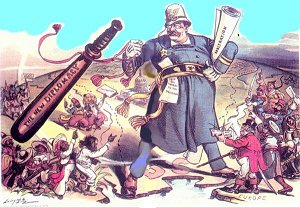
zoals zijn Britse collega Chris Harman in A People’s History of the World het noemt. De twintigste eeuw was de ‘century of barbarity on a scale unknown.’ Auschwitz, Hiroshima en de moderne varianten ervan Vietnam, Irak, Afghanistan, Kongo, etc. moeten verklaard worden. Wat ging er fundamenteel fout met de door ons zo veel geroemde ‘westerse judeo-christelijke beschaving’? En op grond waarvan meent Mak cum suis dat de VS mag claimen de ‘ordebewaker en politieagent’ van de wereld te zijn? Op grond van wat meent de VS nog steeds het recht te hebben om de aarde in een ‘radioactive desert’ te mogen veranderen als het erop aan komt? Wie heeft dat beslist, wanneer en waarom? Wie bepaalt waarom het systeem kan doorgaan met de grootscheepse milieuverwoesting, al dan niet onder aanvoering van Barack Obama, wiens presidentschap 'beter [is] voor Nederland en de internationale gemeenschap'? Althans, volgens Mak. Chris Harman over de jaren negentig van de vorige eeuw:
That decade also exposed terrible new threats alongside the old ones of war and economic slump.

The most dramatic is that of ecological catastrophe. Class societies have always shown a tendency to place excessive demands on the environment which sustains their populations. The history of pre-capitalist class societies was a history, beyond a certain point, of famines and demographic collapse produced by the sheer burden of maintaining greedy ruling classes and expensive superstructures. The very economic dynamism that characterizes capitalism has vastly increased the speed at which negative ecological consequences make themselves felt…

The spread of capitalism to the whole world in the 20th century, encompassing six billion or more people by the end of the century, transformed ecological devastation into a global problem…

Competition leads to an incessant search for new, more productive and more profitable forms of interaction, without regard to their other consequences… By the 1980s, South Korea alone contained more industrial workers than the whole world had when Marx and Engels wrote The Communist Manifesto – and it contained millions of non-industrial wage earners as well… There is nothing magical about workers under capitalism which enables them to follow some royal road to class consciousness. The society around them is permeated by capitalist values, and they take these values for granted. Even their exploitation is organized through a labour market, where they compete with each other for jobs… 

There wass more change to the lives of the great majority of the world’s population in the 20th century than in the whole preceding 5,000 years. Such sheer speed of change meant that again and again people were trying to cope with new situations using ideas that reflected recent experience of very different ones. They had decades to undergo a transformation in their ideas comparable to that which took the bourgeoisie in Europe 600 years.

Dit proces voert Chris Harman, wiens boek door Howard Zinn werd aangeprezen als ‘an indispensible volume of my reference bookshelf,’ tot de conclusie dat

The ruling classes of the world, like their predecessors for 5,000 years, will do their utmost to thwart these attempts and will, if necessary, unleash endless barbarities so as to hang on to what they regard as their sacred right to power and prosperity. They will defend the existing capitalist order to the end – even if it is the end of organized human life.

Hoewel niemand kan voorspellen hoe de toekomst er precies zal uitzien, weten we in elk geval dat ons irrationeel gedrag ingrijpende en deels onvoorziene consequenties zullen hebben. Zolang het neoliberale expansionisme niet aan banden wordt gelegd kan de uitkomst alleen maar rampzalig zijn. Er zullen nieuwe symbolen, idealen, metaforen, mythen verzonnen moeten worden die de oude versleten stereotypen kunnen vervangen. In 1987 schreef de Amerikaanse historicus Wallace Stegner in The American West as Living Space met betrekking tot de complexiteit van dit onderwerp:

I spend this much time on a mythic figure who has irritated me all my life because I would obviously like to bury him. But I know I can’t. He is a faster gun than I am. He is too attractive to the daydreaming imagination. It gets me nowhere to object to the self-righteous, limited, violent code that governs him, or to disparage the novels of Louis L’Amour because they are mass-produced with interchangeable parts, Mr. L’Amour sell in the millions and has readers in the White House.

But what one can say, and be sure of, is that even while the cowboy myth romanticizes and falsifies western life, it says something true about western, and hence about American character.

Western culture and character, hard to define in the first place because they are only half-formed and constantly changing, are further clouded by the mythic stereotype. Why hasn’t the stereotype faded away as real cowboys became less and less typical of western life? Because we can’t or won’t do without it, obviously. But also there is the visible, pervasive fact of western space, which acts as a preservative. Space, itself the product of incorrigible aridity and hence more or less permanent, continues to suggest unrestricted freedom, unlimited opportunity for testings and heroisms, a continuing need for self-reliance and physical competence. The untrammeled indivisualist persists partly as a residue of the real and romantic frontiers, but also partly because runaways from more restricted regions keep reimporting him. The stereotype continues to affect romantic Westerners and non-Westerners in romantic ways…

Toen ik in 2010 de Amerikaanse cultuurcriticus en historicus, de emeritus hoogleraar Geschiedenis Richard Slotkin, interviewde wees deze invloedrijke wetenschapper erop hoe diepgaand de mythes van het Wilde Westen nog steeds het Amerikaanse zelfbeeld beinvloeden. Zijn 850 pagina’s tellende Gunfighter Nation. The Myth of the Frontier in Twentieth-Century America begint Slotkin met de visie van John Kennedy als voorbeeld van de mythologische kracht van het Wilde Westen. Hoewel Kennedy gezien werd als exponent van de Eastcoast intelligentsia maakte Kennedy al tijdens zijn nominatie in Los Angeles als Democratische kandidaat onmiddellijk duidelijk waar hij politiek en cultureel stond zodra hij president zou zijn. Richard Slotkin:

The signature Kennedy and his advisers settled on was ‘The New Frontier.’  The choice seems an odd one for a candidate identified with the culture, politics, and ideological concerns of the urban centers of the eastern seaboard. Wild West metaphors invoked traditions that seem better suited to Eisenhower, known as a fan of pulp Westerns, and to the Republican Party, which identified itself with the ‘rugged individualism’ associated with the Frontier. Yet Kennedy was able to make ‘New Frontier’ seem an appropriate and credible way of describing the spirit of this campaign and the style of the administration that followed it.
On that first night, Kennedy asked his audience to see him as a new kind of frontiersman confronting a different sort of wilderness:

‘I stand tonight facing west on what was once the last frontier. From the lands that stretch 3000 miles behind me, the pioneers of old gave up their safety, their comfort and sometimes their lives to build a new world here in the West… [But] the problems are not all solved and the battles are not all won, and we stand today on the edge of a new frontier – the frontier of the 1960s, a frontier of unknown opportunities and paths, a frontier of unfulfilled hopes and threats… For the harsh facts of the matter are that we stand on this frontier at a turning point in history.’

Meer over deze Amerikaanse mythe waarop het expansionisme is gebaseerd morgen.


maandag 18 februari 2013

Stieven Ramdharie van de Volkskrant


 Stieven Ramdharie, ik weet niet in wat voor cultuur jij bent opgegroeid, maar er bestaan westerse intellectuelen die met veel meer terughoudendheid berichten dan jij met je bijna juichende propaganda voor deze Amerikaanse dreigementen die nog steeds in strijd zijn met het internationaal recht zolang de VN zich niet uitgesproken heeft. Ramdharie, Ramdharie, probeer enige professionele onafhankelijkheid te tonen. De Volkskrant zat er ook met Irak flink naast, weet je nog. Trouwens ook met Vietnam, maar dat was weer voor jouw tijd.


Zwaarste bom ter wereld staat paraat

Door: Stieven Ramdharie − 18/02/13, 06:34
© USAF. Een B-2 stealthbommenwerper tankt via een ander vliegtuig bij in de lucht. De B-2 is het enige vliegtuig dat de megabom MOP kan vervoeren.
Het is de Iraanse leiders niet ontgaan: de zwaarste bom ter wereld is operationeel. Die 'moeder aller bommen' bevindt zich in handen van aartsvijand Amerika, liggend in een peperdure B-2 in Missouri, op slechts veertien uur vliegen van Teheran.
  • Teheran is gewaarschuwd: de B-2's kunnen in ruim 28 uur Fordo bereiken, de MOP lanceren en terugkeren. Dit alles zonder dat de Iraanse radar het 'spookvliegtuig' ontdekt en de Iraanse F-14's het kunnen neerhalen.
  • © USAF.
    Wapenexperts voor een bouwmodel van de 'moeder aller bommen'.
De luchtmacht in de VS heeft tests afgerond met een nieuwe versie van de bijna 14.000 kilo zware Massive Ordnance Penetrator (MOP). Dit is de enige conventionele bom die Irans belangrijkste ondergrondse nucleaire installatie, Fordo bij Qom, in de as kan leggen.

Hoewel Washington ontkent dat de megabom gericht is tegen Iran, is de bekendmaking dat de MOP nu operationeel is een duidelijk signaal aan Teheran. Namelijk dat de tot 2009 geheime verrijkingsfabriek Fordo, verborgen in een berg onder 100 meter gesteente, vanaf heden kwetsbaar is.

De bunker buster is zo zwaar - zes keer zo zwaar als zijn voorganger - dat hij maar door één vliegtuig kan worden vervoerd: de B-2 stealthbommenwerper. 'We zijn bevoegd om dit wapen op de B-2 te gebruiken', zei luchtmachtgeneraal James Kowalski onlangs in Washington over de mijlpaal.
Modernere centrifuges
Kowalski sprak die woorden tegen de achtergrond van onverminderde spanningen rond Irans nucleaire programma. Teheran maakte woensdag bekend dat het modernere centrifuges in gebruik heeft genomen in Natanz, na Fordo het belangrijkste doelwit van een Amerikaanse of Israëlische preventieve aanval. 'We zullen doen wat noodzakelijk is om te voorkomen dat ze kernwapens krijgen', waarschuwde president Obama opnieuw.

De MOP, die al sinds 2004 wordt getest, moest vorig jaar in allerijl worden aangepast. Nadat het Pentagon 245 miljoen euro had gespendeerd aan twintig bommen rezen er twijfels of de MOP wel in staat was om goed verborgen doelwitten zoals Fordo uit te schakelen. Voor nog eens 61 miljoen euro werd de bom aangepast om de diepste bunkers te kunnen vernietigen.

'Het ultieme wapen tegen diep verborgen kernwapens', noemt het Defense Threat Reduction Agency (DTRA) van het Pentagon, initiatiefnemer van het wapen, de bijna 7 meter lange bom. Volgens DTRA heeft de technologische superioriteit van de Amerikaanse krijgsmacht een keerzijde: de vijand duikt diep onder de grond om in tunnels of bunkers massavernietigingswapens te maken of op te slaan.

Na de ontdekking van de Fordo-fabriek in 2009, die is gebouwd in een berg, zette het Pentagon vaart achter de megapenetratiebom. Amerikaanse functionarissen hebben, anoniem, toegegeven dat de MOP vooral gericht is tegen Iran. 'We denken dat we ze effectief kunnen aanvallen als dat nodig is', zei een voorzichtige Defensie-minister Panetta in september.

Aanval
Het operationeel worden van de megabom betekent dat alleen de VS in staat zijn Fordo zwaar te treffen. Israël dreigt al jaren met een preventieve aanval op Fordo en Natanz. De zwaarste bom waarover Jeruzalem beschikt, is echter de 'slechts' 2.000 kilo zware GBU-28, eveneens uit de VS. Iran pocht dan ook dat Israël niet in staat is om de installatie te vernietigen.

Zelfs als Washington dat zou willen, is leverantie van de MOP aan Jeruzalem niet mogelijk omdat de Israëli's alleen beschikken over F-15's en F-16's. Verkoop van de 1,6 miljard euro kostende B-2, waarvan de VS er nog twintig hebben, is uit den boze. Het hightechtoestel, dat bedoeld was als nucleaire bommenwerper voor langeafstandsmissies, is niet bestemd voor export.

'De slechtste optie is niets doen', zegt de Amerikaanse defensiedeskundige en docent aan Columbia University Austin Long vanuit New York. 'De op een na beste is een Israëlische actie. De beste optie is dat de VS de klus klaren.'

Het beschikbaar komen van de MOP betekent dat de B-2, die intern nog werkt met jaren-tachtigtechnologie, nog lang niet wordt afgeschaft. Het Pentagon wil de bommenwerpers, die non-stopmissies uitvoeren vanuit Missouri, nu voor zo'n 1,5 miljard euro moderniseren en inzetten tot 2058.

Teheran is gewaarschuwd: de B-2's kunnen in ruim 28 uur Fordo bereiken, de MOP lanceren en terugkeren. Dit alles zonder dat de Iraanse radar het 'spookvliegtuig' ontdekt en de Iraanse F-14's het kunnen neerhalen. In de oorlogen waarin de B-2's zijn ingezet, zoals Kosovo en Irak, is nooit een toestel verloren gegaan.

    PVDA en 'Humanitaire Gronden'.


    Dit is merkwaardig. Allereerst bemoeit de Nederlandse politiek zich met de de normale rechtsgang in een ander democratisch  land, terwijl datzelfde Nederland zich nooit mengt in de juridische gang van zaken van bijvoorbeeld de VS, waar 1,8 miljoen mensen gevangen zitten, een wereldrecord, hetgeen een verdrievoudiging betekent sinds 1980. De helft van die gevanenen is zwart, terwijl slechts 12 procent van de bevolking zwart is. Amnesty is al jaren uiterst kritisch daarover, maar Nederland zwijgt. Bovendien geldt dat verdachte Poch beschuldigd wordt van zeer ernstige misdaden, zijn betrokkenheid bij misdaden tegen de menselijkheid, het meehelpen bij het vermoorden van naar schatting tussen de 15.000 en 30.000 linkse opposanten tegen de militaire dictatuur die destijds in Argentinie de macht had gegrepen.  De vraag is dus: wat bedoelt de PVDA-minister dat 'op humanitaire gronden' deze verdachte voorlopig moet worden vrijgelaten? Welke 'humanitaire gronden'? Politiek belangrijk is het feit dat:


    Nabestaanden van slachtoffers van de Argentijnse 'dodenvluchten' opgelucht [zijn] dat het megaproces over mensenrechtenschendingen tijdens de militaire dictatuur is begonnen. "Dit is een historische dag", zei een woordvoerder bij de rechtbank in Buenos Aires.

    Met andere woorden: Nederland wil de 'opluchting' bij de 'nabestaanden van de slachtoffers' over de rechtsgang de grond inboren door te pleiten de verdachte voorlopig over vrije voeten te stellen. Waar bemoeit Nederland zich mee? Verdachten van terrorisme worden nergens alvast op vrije voeten gesteld. En nooit pleit Nederland er dan voor om verdachten voorlopig vrij te laten. Waarom nu wel?

    Timmermans steunt verzoek Poch

    Julio Poch in november in de rechtszaalJulio Poch in november in de rechtszaalANP
    Minister Timmermans van Buitenlandse Zaken steunt het verzoek om hulp van oud-Transavia-piloot Julio Poch. Poch wil politieke steun bij zijn verzoek om schorsing van zijn voorlopige hechtenis, zegt hij in KRO's Brandpunt. Hij vindt dat Nederland zijn zaak tot nu toe slecht heeft behandeld.
    Poch zit al drie jaar, naar eigen zeggen onschuldig, vast in Argentinië in afwachting van zijn proces. Hij wordt verdacht van betrokkenheid bij de zogenoemde dodenvluchten tijdens de militaire dictatuur eind jaren 70 en begin jaren 80. Morgen kan Poch voor het eerst voor de rechter zijn verhaal doen.

    Humanitaire gronden

    Poch zegt dat hij ontlastend bewijs zal presenteren en zijn onschuld zal aantonen. Zijn verdediging zal opnieuw een verzoek indienen tot voorlopige invrijheidstelling, deze keer ondersteund door het Nederlandse ministerie van Buitenlandse Zaken.
    De Nederlandse ambassade in Buenos Aires heeft de Argentijnse autoriteiten laten weten dat Nederland het verzoek "op humanitaire gronden" ondersteunt.

    http://nos.nl/artikel/475247-timmermans-steunt-verzoek-poch.html

    'Deskundigen' 111


    Whitman’s essential message was the Open Road. The leaving of the soul free unto herself, the leaving of his fate to her and to the loom of the open road. Which is the braves doctrine man has ever proposed to himself… This is Whitman’s message of American democracy.
    The true democracy, where soul meets soul, in the open road. Democracy… Democracy: a recognition of souls, all down the open road, and a great soul seen in its greatness, as it travels on foot among the rest, down the common way of the living… the exultance of his message still remains. Purified of Merging, purified of Myself, the exultant message of American Democracy, of souls in the Open Road, full of glad recognition, full of fierce readiness, full of the joy of worship, when one soul sees a greater soul. The only riches, the great souls.
    D.H. Lawrence. Studies in Classic American Literature. 1923
    Their ambitions were finally frustrated somewhat by their own misconceptions but rather more by irrational forces embodied in the ignorant generality of emigrants, who had the sense of moving out of a circumscribed life dominated by magistrate and priest into a largely unrestrained condition…
    Frontier historians have commonly described the revolt from Europe in such a way as to conceal its grave implications and to exalt the pioneers for their temerity. Thus, Turner’s widely applauded interpretation, though true as far as it goes, is selective, uncritical, and lacking in rear vision: ‘The men of the “Western World” turned their backs upon the Atlantic Ocean, and with grim energy and self-reliance began to build up a society free from the dominance of ancient forms.’ This statement invites ironical contemplation, because it ignores the fact that the emigration, while in some measure a rational protest against the social, religious, and political forms of Europe and the East, was yet enacted in the context of the ancient paradisiacal myth, which is a structure of irrational expectations. Strongly influenced by romantic patterns imposed upon the West in the nineteenth century and by personal sympathies, Turner assumed that men in a state of nature could somehow create an adequate culture virtually from nothing. He tended to slight the continuing influence on the emigrants of some of the noblest concepts of the Enlightenment, and he took small account of the recrudescence of ancient and generally primitive modes of behavor in the West in consequence of the loss of a rational frame of reference. The ‘movement away from the influence of Europe’ unquestionably benefited the pioneers in some things, but it was nevertheless a retreat of sorts and as such entailed large and probably cultural losses.
    Arthur K. Moore. The Frontier Mind. 1957

    Rond 1880 lagen in Amerika meer kilometers aan spoorlijnen en telegraafverbindingen dan in heel Europa bij elkaar. Zoveel kracht, zoveel vitaliteit, dit was werkelijk een gezegend land, in de woorden van Abraham Lincoln ‘De laatste beste hoop van de aarde.’ […] Vooruitgang, vernieuwing, inclusief de bijbehorende risico’s, waren vanzelfsprekend: in zo’n overvloedig land wordt ondernemingslust maar al te vaak rijkelijk beloond.
    Geert Mak. Reizen zonder John. Op zoek naar Amerika. 2012
    De vaak opgewonden beschrijvingen van wat in de volksmond ‘Amerika’ heet doen geen recht aan de soms zelfs subtiele complexiteit van de Verenigde Staten. ‘Vooruitgang, vernieuwing, ondernemingslust, rijkelijk beloond,’ het zijn even grote platitudes als dat Coca Cola ‘The Real Thing’ is. Ze vertekenen de werkelijkheid, verhullen de keerzijde, in elk blikje Coca Cola zitten 7 klontjes suiker, ‘vooruitgang’ heeft de negatieve gevolgen van de klimaatverandering op gang gebracht, en ‘ondernemingslust’ zorgt ervoor dat de arbeid in het Westen naar de lage lonen landen verdwijnt, alleen de aandeelhouders en de managers worden ‘rijkelijk beloond.’ Kortom, ‘vitaliteit’ kan tot de vernietiging van de samenleving leiden en het onverzadigbare land dat doorging voor de ‘laatste hoop van de aarde’ is een bedreiging van de mensheid geworden.
    The humanist concept of sustainable development and the Christian concept of stewardship are flawed by unconscious hubris. We have neither the knowledge nor the capacity to achieve them. We are no more qualified to be the stewards or developers of the Earth than are goats to be gardeners.
    James Lovelock. The Revenge  of Gaia. Why the earth is fighting back – and how we can still save humanity. 2006
    America My Country: last nation on earth to abolish human slavery; first of all nations to drop the nuclear bomb on our fellow human beings.
    Edward Abbey. A Voice Crying In The Wilderness. 1989
    Some discern a moral rot that ate at the vitals of society, a self-centered and divisive spirit that dispersed a once integrated community into warring component parts. The ruling class has come in for most of the criticism: narrow, selfish, and blind, they ignored the evils of their times; by hoarding their own privileges, they hastened catastrophe. Social upheaval is stressed by many: increased violence, the discontents of the urban masses and the rural poor, which splintered the Republic’s unity and destroyed confidence in its institutions. The Ciceronian period witnessed, so it has been said, an age of individualism: the sense of communal attachment dissolved, to be replaced by an adherence to powerful and ambitious individuals who cared naught for the Republic except as an object for manipulation. A political realm was transformed into a cockpit for armies and their commanders. The once sedate and stable society gave way to a revolutionary era, which shattered the mos maiorum and left divided populace grasping after a new structure. Finally, a glib pronouncement has condemned the Republic: the city-state was incapable of governing an empire. Imperial holdings had reached proportions that demanded a fundamental overhauling of government and society. The fall of the Republic was inevitable – and desirable.
    Erich S. Gruen. The Last Generation Of The Roman Republic. 1974
    De beschrijving van de Amerikaanse classicus en historicus van de oudheid Erich Gruen is uiterst actueel omdat het tegelijkertijd een analyse geeft van hetzelfde proces dat we in de Verenigde Staten zien, het begin van de ineenstorting van het Amerikaanse rijk, ondermeer vanwege het egocentrisme van de geprivilegieerden. Net als de ondergang van de Romeinse democratie blijkt ook de Amerikaanse democratie van korte duur te zijn en is de macht nu in handen van een kleine elite die de presidentskandidaten voordraagt en de politieke koers bepaalt. Hoewel de eerste Romeinse keizer een alleenheerser was, moest hij toch de elite te vriend houden en verschilde zijn positie niet wezenlijk van die van de huidige generatie Amerikaanse presidenten die alleen dankzij het geld van de rijken hun verkiezingscampagnes kunnen voeren. De grote Britse historicus Edward Gibbon schreef in de tweede helft van de achttiende eeuw in The History of the Decline and Fall of the Roman Empire met betrekking tot de eerste Romeinse keizer:
    The tender respect of Augustus for a free constitution which he had destroyed can only be explained by an attentive consideration of the character of that subtle tyrant. A cool head, an unfeeling heart, and a cowardly disposition prompted him at the age of nineteen to assume the mask of hypocrisy, which he never afterwards laid aside… His virtues, and even his vices, were artificial; and according to the various dictates of his interest, he was at first the enemy, and at last the father, of the Roman world. When he framed the artificial system of the Imperial authority, his moderation was inspired by fears. He wished to deceive the people by an image of civil liberty, and the armies by an image of civil government…
    Augustus was sensible that mankind is governed by names; nor was he deceived in his expectation that the senate and people would submit to slavery, provided they were respectfully assured that they still enjoyed their ancient freedom. A feeble senate and enervated people cheerfully acquiesced in the pleasing illusion, as long as it was supported by the virtue, or by even the prudence, of the successors of Augustus. It was a motive of self-preservation, not a principle of liberty, that animated the conspirators against Caligula, Nero, and Domitian. They attacked the person of the tyrant, without aiming their blow at the authority of the emperor.
    Ook dit proces komt bekend voor, zolang brood en spelen het volk tevreden houden, is de meerderheid niet wezenlijk geinteresseerd in de democratische praktijk, hooguit in de vorm ervan. Intussen wordt ook vandaag de dag de intelligentsia afgekocht zolang ze maar de macht blijft dienen, zo niet dan wordt de dissident indien hij volhardt gemarginaliseerd. Achter deze cynische façade gaat ondertussen de totalitaire economische werkelijkheid ongestoord door, met steeds absurdere rechtvaardigingen waarin feitelijk niemand meer echt gelooft. De Britse journalist/schrijver Chris Harman constateerde in 1999 in zijn 729 pagina’s tellende boek A People’s History of the World: ‘Mainstream economists had never been able to explain how the slump of the 1930s had happened, and none of them could be sure they were not facing a similar situation.’ Desondanks of misschien wel juist daarom verkondigen de laatste dertig jaar de spreekbuizen van de econmische macht de zogeheten 'vrije markt' ideologie. Harman:
    Economists and political journalists switched overnight to a belief in the completely ‘free’ market, unconstrained by state intervention – a theory previously preached only by a few isolated prophets such as Friedrich Hayek and Milton Friedman. Such a mass conversion of intellectuals had not been seen since the days when theologians changed their ‘beliefs’ on the say-so of princes.
    Het resultaat van de neoliberale zogenaamde ‘no-nonsens aanpak’ bleek al snel:

    Lower rates in the US in the late 1980s and late 1990s were driven by welfare cuts which forced people to take jobs at poverty wages – the poorest 10 percent earning 25 percent less than the equivalent group in Britain… instead of offering the mass of people improved lives, as in the long boom, it threatened to snatch what they had achieved in the past. Whole industries disappeared, and towns were reduced to wastelands…
    This led a layer of working class activists to place their hopes once more in the promises of parliamentary politicians. It also encouraged left wing intellectuals to question further the very notions of class and class struggle. They embraced an intellectual fashion called ‘postmodernism’, which claimed any interpretation of reality was as valid as any other, that there was no objective basis for notions such as class, and that any attempt to change the way society operates would be ‘totalitarian’, since it involved trying to impose a total conception of the world on others. Postmodernists rejected notions of struggling to change society just as the dangerous instability of society became ever more pronounced…
    The average American worked 164 hours longer in 1996 than they did in 1976 – the equivalent of one full month a year longer, with survey after survey reporting people feeling under increasing stress at work. Recurrent recessions and repeated ‘downsizing’ of workforces, even during periods of ‘recovery’, created levels of insecurity among people about their futures not known since the 1930s…
    Hoewel volgens de westerse postmoderne intelligentsia er geen waarheid meer bestaat, weet bijna iedereen uit ervaring maar al te goed dat het een waarheid als een koe is dat de economische macht in toenemende mate de economische werkelijkheid en de politieke koers van miljarden mensen op aarde bepalen. Een mainstream-opiniemaker als Geert Mak mag dan wel beweren dat ‘Amerika er over een halve eeuw beter voor[staat] dan Europa,’ onder andere omdat ‘Amerikanen bereid [zijn] heel hard te werken,’  en ‘het land een grote hoeveelheid natuurlijke hulpbronnen [heeft],’ toch is het gemiddelde inkomen van de Amerikaan sinds 1978 niet gestegen, terwijl de armoede en het aantal daklozen blijven stijgen en ook de middenklasse financieel achteruit blijft gaan. Bovendien negeert de mainstream ook nog eens de volgende door Chris Harman in zijn geschiedenisboek aangevoerde feiten:

    There was another side to the growing poverty of wide parts of the Third and former Communist worlds and the growing insecurity in the West. It was the growing concentration of wealth in the hands of the ruling classes. By the late 1990s some 348 billionaires enjoyed a total wealth equal to the income of half of humanity. In 1999 the United Nations Human Development Report could tell that the world’s richest 200 people had doubled their wealth in four years. At the end of the 1960s, the gap between the richest and poorest fifths of the world population stood at 30 to one, in 1990 at 60 to one, and in 1998 at 74 to one. Most of the very rich were concentrated in advanced countries. In 1980 the top managers of the 300 biggest US corporations had incomes 29 times larger than the avarege manufacturing worker – by 1990 their incomes were 93 times greater. But the same phenomenon was visible elsewhere in the world, where even in the poorest countries a thin ruling stratum expected to live the lifestyles of the world’s very rich, and to keep multi-million dollar deposits in Western banks as an insurance against social unrest at home. Everywhere their reaction to social crisis was to accumulate wealth in order to insulate themselves against its effects, not worrying over much; in the process, the basis fabric of society was undermined.
    Deze feiten hebben geen enkele fundamentele verandering teweeg gebracht in de zogeheten ‘democratische’ politiek van zowel linkse als rechtse politieke partijen in het Westen, die wat economisch beleid betreft in niets wezenlijks van elkaar verschillen. En dit, tot op het bot gecorrumpeerde systeem, wordt elke dag weer door de commerciele massamedia verkocht als het enige alternatief voor de rest van de geschiedenis.
    ‘Whitman’s essential message was the Open Road,’ schreef lang geleden D.H. Lawrence. De ‘open road’ is een ‘dead-end street’ gebleken, een illusie. Welke weg de mens nu dient in te slaan weet niemand. Het enige dat we weten is dat de westerse ‘democratie’ tot nu toe een farce is geweest. Morgen meer.

    Censored By Zelensky's Thugs

    Anatolij Sharij @anatoliisharii Yulia Mendel, Zelenskyy’s former press secretary, against whom Zelenskyy imposed sanctions two days ago, was...