Europe’s “Arab Spring”
From Paris to Tirana, Europe’s young are rising, and the governments that praised the Arab revolutions are crushing their own.
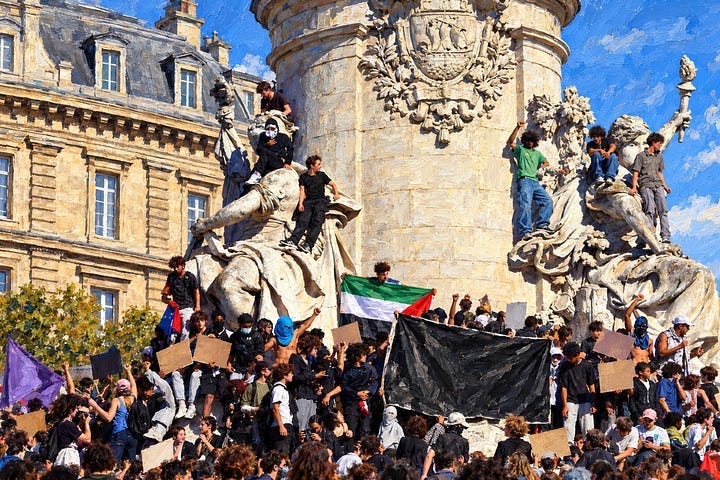
On Friday and Saturday, young people filled the streets of Paris, Rome, Madrid, Brussels, Berlin and Tirana. Each government is busy describing its protests as a domestic matter, a dispute over school budgets or a tuition reform or a housing shortage. But the past forty-eight hours describe something larger: a generation has looked at the future Europe is building for it and refused it, and its governments have sent the police to make it accept that future anyway.
It started in France with a modest list. On September 21, students walked out of the Lycée Saint-Exupéry in Créteil demanding more resources, replacements for absent teachers, repaired buildings and smaller classes. The French state answered with handcuffs. Police have held 7,950 people in custody since the blockades began, 6,773 of them minors. The ministry calls these gardes à vue. In plain language, the Republic has locked up nearly seven thousand children in a movement that began with a demand for teachers. During the 2023 riots, the comparable figure was 1,319 minorsover about ten days. Franceinfo calls the current number something France has never seen. On Saturday, unions, former yellow vests and people crushed by the cost of living joined the students, riot police fired tear gas on the square before the march had even started, and a second protester lost a hand.
The revolt travels the way 2011 traveled, from screen to screen and street to street. Fifteen years ago, Tunisians posted advice to Egyptians on surviving tear gas, and the chant for the fall of the regime crossed from Tunis to Tahrir in weeks. Today French high schoolers organize their blockades through TikTok, Snapchat, Instagram and X, the same platforms French deputies voted in January to close to anyone under fifteen. They wall off school gates with green municipal bins, and school blockades have since spread to Turin, Brussels and Berlin.
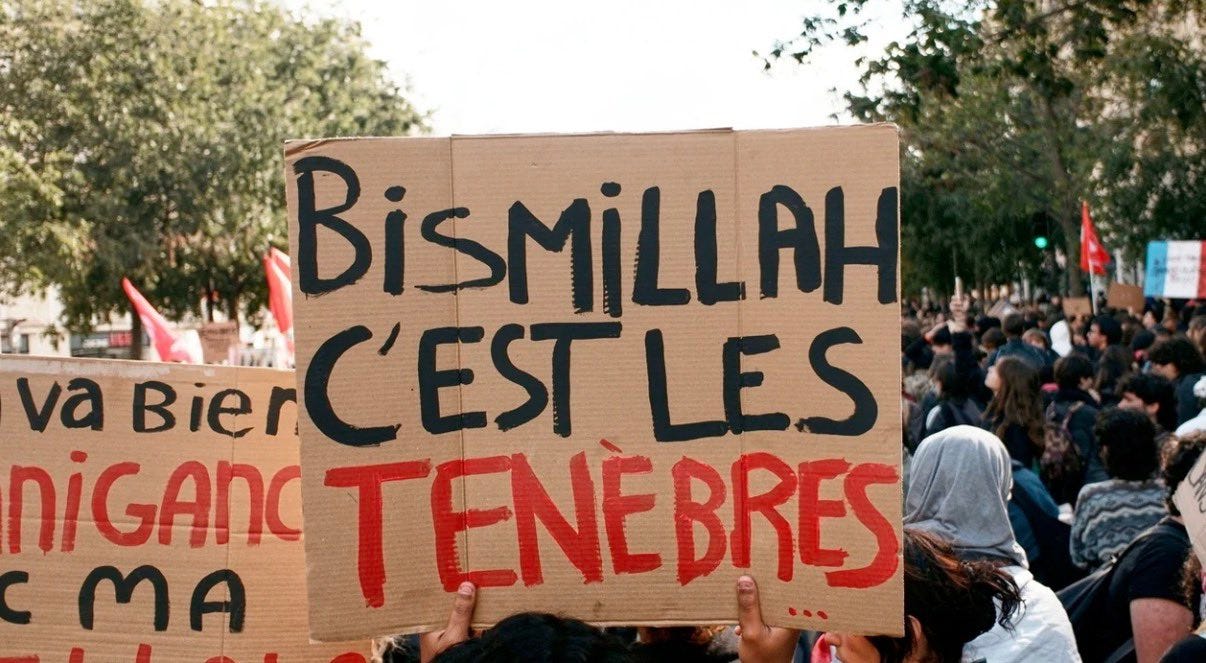
The movement found its slogan on Snapchat. Since the blockades began, students say strangers have been messaging them, fishing for their identities and the locations of blockades. The students suspect plainclothes police, though nothing has been confirmed. According to franceinfo, the accounts were easy to spot: usernames meant to sound North African, Algerian flags dropped between sentences, French stitched with Arabic. Whoever wrote them had a clear picture of what a rebellious French teenager looks like, and it was an Arab Muslim kid.
The students recognized the caricature at once and they mocked it across TikTok, and then they carried it into the street. “Bismillah, c’est les ténèbres,” roughly “In the name of God, it’s darkness,” now appears in marker and paint on cardboard at blockades and marches across France. One sign credits the line to “Mamadou, undercover cop.” In one photo, the student holding it is wrapped in a keffiyeh.
France has spent two decades legislating what Muslim girls may wear to school, from the 2004 ban on headscarves to the 2023 ban on abayas, and policing its suburbs as a security problem. Its idea of the enemy within has become so familiar that teenagers can parody it on sight. A generation of students took the profile the state built for them and wrote it on their banners.
Italy followed the French lead and said so. On Friday, students called a “No Meloni Day” against crumbling schools, against funding for the arms industry, against a cap on immigrant pupils in classrooms, and in solidarity with their French peers.
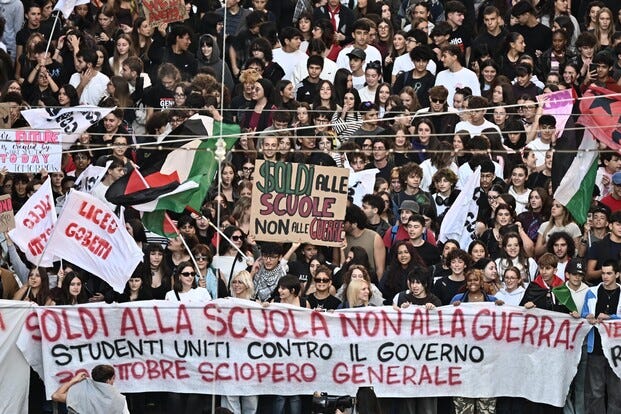
Organizers counted more than 400,000 young people in the streets from Turin to Cagliari. A placard in Turin summed up the national budget better than any finance minister could: no money for our schools, plenty for their wars. Education Minister Giuseppe Valditara had a name for teenagers asking for ceilings that stay up: “political hooliganism.”
In Madrid, between 35,000 and 60,000 people marched on Friday, the third day of an indefinite public education strike. The march ended at the Puerta del Sol, where young people priced out of their own city have kept a housing encampment since September 26.
In Brussels on Saturday, police turned water cannon and tear gas on students protesting education cuts and higher fees. Belgium’s interior minister announced that events had gone beyond protest and promised every necessary means against “rioters.”
In Berlin on Friday, students barricaded the gates of the Andreas-Gymnasium against the government’s preparations for compulsory military service, declared solidarity with France and raised Palestinian flags. Police called the protest peaceful and sent as many as 150 officers anyway.


Albania has gone furthest and fastest. Thousands of students rallied in Tirana on Saturday for a fifth straight day to force Edi Rama out, and riot police met them with stun grenades and tear gas.
They had protested peacefully for nearly three months, and the government ignored them and ran smear campaigns instead. When the anger finally boiled over, Rama blamed “foreign hands.”
Strip away the national details and one line runs through all of it. In France Sophie Binet, the leader of the CGT, one of the largest and most influential trade union confederations in France, pledged that her members would turn out to protect high school students, called the movement the verdict on ten years of Macron, and called a general strike for November 5. The yellow vests returned on Saturday with a simple complaint: fuel, groceries and rent keep costing more while life gets no better. Students in Bari marched against war and the cost of living. Spanish student groups are building youth committees for a general strike against rentierism. In Albania, the grievance is corruption and joblessness. The young are told there is no money for teachers by governments that keep finding money for weapons, for landlords and for themselves. These students are up against a political class that has arranged the economy around its own security and enrichment and sent the bill to people too young to have voted for any of it.
That is the throughline to 2011, and the reason the label sits in quotation marks. Western commentators coined “Arab Spring,” and many in the region came to reject it, because a spring implied a winter, and the winter story let the counter-revolutions off the hook. It was Europe’s word for other people’s revolt. In 2011, young Arabs rose against austerity, unemployment and rulers who had grown rich while their countries stalled, and Mubarak and Ben Ali called them rioters steered by foreign hands. European capitals called the same young people heroes of dignity. Now their own children make comparable demands, and those capitals speak in Mubarak’s vocabulary and answer with police brutality.
Europe rehearses this reflex repeatedly on Palestine. In May, Israel seized thirty-seven French citizens from a flotilla carrying aid to Gaza. France’s own foreign minister, Jean-Noël Barrot, reported sexual violence, beatings and humiliation against them and referred the matter to prosecutors. Marie Mesmeur, a sitting MP, filed a torture complaint after her own detention on an earlier flotilla. Two years earlier, when students raised Palestinian flags at Sciences Po and the Sorbonne, the same president’s government sent in riot police. Solidarity with Gaza became, in the language of ministers, a threat to public order, and that phrase has now moved into the classroom.
Outside the Lycée Jean-Rostand in Strasbourg, students chanted for school fundingand for Palestine in the same crowd. They have understood what their governments would prefer they didn’t: a continent that rearms, cuts schools and arrests children has decided whose future counts.
The Arab revolutions also leave a warning, written in the blood of the people who made them. In Egypt, the crowds brought down a president and left standing the state that had served him, and within two years the army had taken everything back.
Tunisia held longest because its national labor union, the UGTT, carried the street’s demands into negotiations and stayed organized after the squares emptied, and even there Kais Saied dissolved parliament in 2021 and is undoing much of what had been won.
Europe’s governments have quieter ways than tanks to end a revolt. A minister resigns. A national consultation is announced. A promise is pushed into next year’s budget. An election arrives and turns the anger of the street into votes for whoever promises the most order. France has watched each of these wear down movements far larger than this one.
The students have already learned to outrun the police. Outlasting the state asks more of them. It needs organizations that survive the school holidays. It needs the student blockade and the workers’ strike bound together, the alliance France glimpsed on Saturday and Spain is building now. It needs demands concrete enough that no cabinet reshuffle can be sold as victory. And it needs coordination across borders as deliberate as the coordination of the governments policing it. The first tests are close. The CGT has called a general strike for November 5, and students have called an international strike for November 20. diarioestrategiaorizzonteinsegnanti
Palestinians have a word for what that asks: sumud, steadfastness. It means refusing the future that others have drawn up for you, staying when you are told to leave, and continuing to live and organize under a power that wants you gone or silent. The boats that sailed for Gaza in May called themselves the Global Sumud Flotilla. Palestinians have practiced sumud for generations under an occupation that Europe arms and excuses. Germany alone approved almost €800 million in arms export licenses to Israel in the first five months of this year, more than in the previous twenty months combined.
Palestinians keep showing that refusal survives repression when it lives in schools, unions, families and memory, long after the crowds go home. That spirit is what the keffiyeh on a student holding the movement’s slogan carries, what the chant for Palestine outside a Strasbourg lycée carries, what the Palestinian flags at a Berlin school blockaded against the draft carry. The scale of what is being done to Gaza has no equivalent in a French classroom. The logic is one these students recognize: a generation told its future has been settled elsewhere, and met with police when it says no. In Palestinians, they have found a people who have answered that logic since 1948 and are still here. Still resisting.


Geen opmerkingen:
Een reactie posten