The fighter shares in an interview with Channel 7: The strange order, an hour and ten minutes before the massacre
A soldier at the Pega outpost claims: At 5:20 we received an order over the radio not to send patrols to the fence until 9:00. I don't know how to explain that.

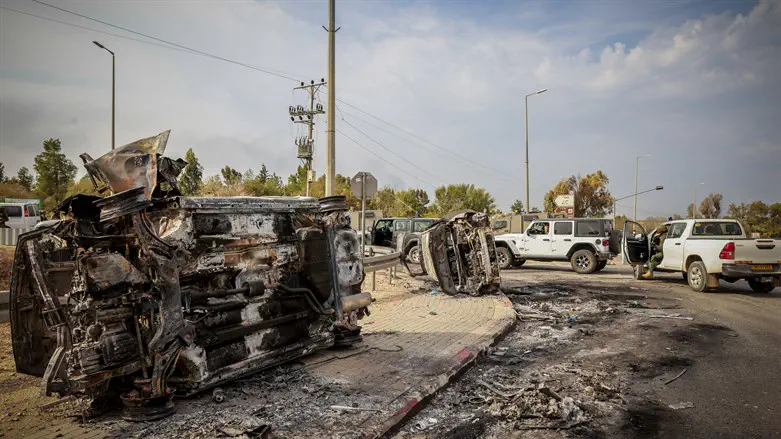
Shalom Sheetrit, a Golan fighter who participated in the battles on October 7, spoke to Channel 7 about the puzzling instruction he and his friends received the night before the massacre not to go on a patrol along the fence.
He revealed the directive at a meeting of the lobby for reserve personnel. Sheetrit opens his remarks in the interview with a comparison he makes between October 7th and the actual Holocaust, a statement that he says he makes a point of saying over and over again, but it is not mentioned or quoted.
He recounts the events of the night before the October 7 attack, how he, along with his friends Yotam Sror and Itamar Ben Yehuda, the late who was killed in the terrorist attack, sat by the battalion radio at the Pega outpost near Be'er Sheva. "We sat playing on the phone, we had such a sleepless night," he says, and in his testimony in the Knesset he noted that since these were soldiers from the mortar division who would be able to rest the next day, they preferred not to go to sleep and in fact replaced the soldier who was supposed to be listening to the communication and allowed him to sleep.
As a soldier in the mortar platoon, Sheetrit says that every morning the platoon goes on alert and, in his estimation, there are no mornings when there are no patrols on the fence, "because you are in an operational battalion and that is part of the matter."
His words remind us of the question that quite a few military personnel raise: how come the fighters didn't go on alert at dawn? Is it possible that this order was what left them in bed? To this, Sheetrit doesn't answer with confidence. "I don't know how to answer it that way. In our mortar department, there was an alert at dawn, and we woke up. It's possible that in the patrol departments, they were told not to wake up. I don't know. I don't want to just say that."
When asked if anyone had contacted him and his friends to obtain these details as part of the investigation into the events of the battle in Bari, due to the fact that the outpost is so close to the kibbutz, Sheetrit replied, "A Golani casualty officer told me that there was an investigation last Thursday if I wanted to come and tell about what happened at the Pega outpost, but I am at a point where I have lost trust in politicians and generals in the army. They promised us that we would win and there will be no Hamas, and we are far from that. It is difficult for me to sit at the same table with them and hear what they have to say, and that is why I avoided coming to this investigation."
The force at the Pega outpost, emphasizes Sheetrit, is the force that was supposed to protect the kibbutz. "Unfortunately, we were not up to the task. There were dozens against hundreds of terrorists, 25 against 150, and so we couldn't arrive, unfortunately. I'm far from being a military man who can give answers to questions, the situation hurts me just as it hurts everyone."
We also asked Sheetrit if, since the incident, during the nine months that have passed, he has had any thoughts, doubts, or assessments about that message that was transmitted by radio an hour and twenty before the attack broke out, and he says: "I tried to ask military personnel why and what happened there. The blood of my friends and the blood of many people in the country was spilled in a huge tragedy and I tried to understand why it happened and how."
"I asked why there was no patrol and they told me there was a threat of a sniper attack by an N.T. I don't know if that was the reason. I'm a simple soldier and not a great military man, and I only know in my role what I need to do, so I don't know how to answer well and I don't know if I accept that answer because I know that the N.M.R. is armed with N.T. weapons. So maybe they're right and maybe not."
"In hindsight, we could have done a lot of things, we could have listened to the observers, we could have brought up the air force and these things didn't happen. That's the failure. It's not a failure of the fighters on the ground, but of the higher levels in the army, of people who went down to Eilat even though we informed them a week in advance that there was intelligence information. What, our lives aren't worth it? I'm fed up with the generals and I really like the army. I want there to be a coup by the generals in the army and those who control the wires. The situation up there is not good."
Shalom Sheetrit also says that after his testimony, many people approached him who were also shocked by the things he said. He, for his part, responded with these answers. "I'm in a place where I try not to get into things. There's so much blood on people's hands in the country that you want to know who's guilty and how it happened, but I don't want to put myself in a mental state that could do bad things to me."
The IDF Spokesperson's Office responded by saying that "the IDF is in the midst of the operational investigation process of the events of 7/10, including the battle at the Pega outpost. When the investigation is concluded, it will first be presented to the bereaved families, and then it will be published transparently to the public."


Geen opmerkingen:
Een reactie posten