'Chalmers Johnson: “Nemesis: The Last Days of the American Republic"
AMY GOODMAN: Today, we spend the hour with the former CIA consultant, distinguished scholar, best-selling author, Chalmers Johnson. He's just published a new book. It's called Nemesis: The Last Days of the American Republic. It's the last volume in his trilogy, which began with Blowback, went onto The Sorrows of Empire. In those two, Johnson argued American clandestine and military activity has led to unintended but direct disaster here in the United States. In his new book, Johnson argues that US military and economic overreach may actually lead to the nation's collapse as a constitutional republic. Chalmers Johnson is a retired professor of international relations at the University of California, San Diego. He's also president of the Japan Policy Research Institute. He's written for a number of publications, including the Los Angeles Times, The London Review of Books, Harper’s magazine and The Nation. In 2005, he was featured prominently in the award-winning documentary, Why We Fight. Chalmers Johnson joined me yesterday from San Diego. I began by asking him about the title of his book, Nemesis. CHALMERS JOHNSON: Nemesis was the ancient Greek goddess of revenge, the punisher of hubris and arrogance in human beings. You may recall she is the one that led Narcissus to the pond and showed him his reflection, and he dove in and drowned. I chose the title, because it seems to me that she's present in our country right now, just waiting to make her -- to carry out her divine mission. By the subtitle, I really do mean it. This is not just hype to sell books -- “The Last Days of the American Republic.” I’m here concerned with a very real, concrete problem in political analysis, namely that the political system of the United States today, history tells us, is one of the most unstable combinations there is -- that is, domestic democracy and foreign empire -- that the choices are stark. A nation can be one or the other, a democracy or an imperialist, but it can't be both. If it sticks to imperialism, it will, like the old Roman Republic, on which so much of our system was modeled, like the old Roman Republic, it will lose its democracy to a domestic dictatorship. I’ve spent some time in the book talking about an alternative, namely that of the British Empire after World War II, in which it made the decision, not perfectly executed by any manner of means, but nonetheless made the decision to give up its empire in order to keep its democracy. It became apparent to the British quite late in the game that they could keep the jewel in their crown, India, only at the expense of administrative massacres, of which they had carried them out often in India. In the wake of the war against Nazism, which had just ended, it became, I think, obvious to the British that in order to retain their empire, they would have to become a tyranny, and they, therefore, I believe, properly chose, admirably chose to give up their empire. As I say, they didn't do it perfectly. There were tremendous atavistic fallbacks in the 1950s in the Anglo, French, Israeli attack on Egypt; in the repression of the Kikuyu -- savage repression, really -- in Kenya; and then, of course, the most obvious and weird atavism of them all, Tony Blair and his enthusiasm for renewed British imperialism in Iraq. But nonetheless, it seems to me that the history of Britain is clear that it gave up its empire in order to remain a democracy. I believe this is something we should be discussing very hard in the United States. AMY GOODMAN: Chalmers Johnson, you connect the breakdown of constitutional government with militarism.'
'In another “wake-up call for America” (John Dower), Chalmers Johnson confronts the overreaching of the U.S. empire and the threat it poses to the republic.
In his prophetic book Blowback, Chalmers Johnson linked the CIA’s clandestine activities abroad to disaster at home. In The Sorrows of Empire, he explored how the growth of American militarism and the garrisoning of the planet have actually jeopardized our safety. Now, in Nemesis, the final volume in what has become the Blowback trilogy, he shows how imperial overstretch is undermining the republic itself, both economically and politically. Delving into new areas -- from plans to militarize outer space to Constitution-breaking presidential activities at home -- Nemesis offers a striking description of the trap into which the grandiose dreams of America’s leaders have taken us. Drawing comparisons to the Roman and British empires, Johnson explores in vivid detail just what the unintended consequences of our dependence on a permanent war economy are likely to be. What does it mean when a nation’s main intelligence organization becomes the president’s private army? Or when the globe’s sole “hyperpower,” no longer capable of paying for the vaulting ambitions of its leaders, becomes the greatest hyper-debtor of all time? Or when dreams of domination take off for the heavens? A staggering tale of American hubris, Nemesis details the world of secrecy surrounding Capitol Hill from government-sanctioned domestic spying, to unacknowledged CIA prisons, to the dubious budgeting to back it all up. Johnson documents the crippling militarism that has left what was once the greatest industrial power in the world producing mainly weaponry, and the corruption of a toothless Congress that is undermining checks and balances so crucial to American democracy. In his stunning conclusion, Johnson suggests that a coming financial bankruptcy could herald the breakdown of constitutional government in America -- a crisis that may ultimately prove to be the only path to a renewed nation. Chalmers Johnson, president of the Japan Policy Research Institute, is the author of the best-selling Blowback and The Sorrows of Empire. A contributor to the Los Angeles Times, the London Review of Books, Harper’s Magazine, and The Nation among others, he appears in the 2005 prize-winning documentary film Why We Fight. He lives near San Diego. More on Chalmers Johnson... Nemesis is available at all fine bookstores. Here are some links to help you.'
I believe that we’re close to a tipping point right now. What happened to the Soviet Union between 1989 and 1991 could easily be happening to us for essentially the same reasons. Imperial overreach, inability to reform, rigid economic ideology. ... The world’s balance of power didn’t change one iota on September 11, 2001. The only way we could lose the power and influence we had at that time was through our own actions, and that’s what we did. -- Chalmers Johnson, author of Nemesis: The Last Days of the American Republic * * * Has our "leadership" traded democracy for empire? Have their over-bloated egos convinced them that they are the world's newly crowned colonial kings? Author Chalmers Johnson is certainly not given to wearing rose-colored glasses. As he concludes in his newest book, Nemesis: "... my country is launched on a dangerous path that it must abandon or else face the consequences." Chalmers' well-argued, persuasive dose of doom saying draws on the economic, military, and political lessons of the past, which may be just what's needed to wake up Americans in time to change course. He talked with BuzzFlash about his hopes and fears for contemporary America. * * * BuzzFlash: You’ve written a three-part series of books on the United States as an empire. The first was called Blowback. The second is The Sorrows of the Empire. And, now, Nemesis, The Last Days of the American Republic. That’s kind of a doomsday declension there. Chalmers Johnson: I guess you could say that. It’s inadvertent. I didn’t set out to write three volumes. I don’t know whether Gibbons set out to write The Decline and the Fall of the Roman Empire. But one led to the other. The first was written well before 9/11, and it was concerned with what I perceived to be the American public’s lack of understanding that most of the foreign policy problems of the 21st century were going to be things left over from the Cold War. Above all, I argue that our numerous clandestine activities, some of which are almost totally disreputable, will come back to haunt us. The second book followed on the first, in that it was a broad analysis of what I called our military-based empire, an empire of 737 American military bases in over 130 countries around the world. That number is the official Pentagon count. They are genuine military bases. They’re very extensive. They are not, as some defenders of the Pentagon like to say, just Marine guards. We haven’t got 700 embassies around the world. The Sorrows of Empire was written as we were preparing for our invasion of Iraq, and it was published virtually on the day that we invaded BuzzFlash: And now Nemesis is your cataclysmic conclusion. Not long ago, it was considered sort of radical to say that America is a neo-colonial empire. But you embrace that concept in many ways. Chalmers Johnson: Right. BuzzFlash: The perspective in much of the neo-con writing, in The Weekly Standard, for instance, is that America is an empire. It’s a superpower. It can take whatever it wants. Basically, the rule of thumb becomes, if you challenge the U.S. assertion of military control and dominance, you’re an enemy of the United States. You don't have to threaten the United States, but merely oppose the imposition of the military authority. Chalmers Johnson: Quite true. The roots of this military empire go back, of course, to World War II, which is when we conquered Germany, Japan, Italy, places of that sort, and did not withdraw after the war was over. We’ve been in Okinawa, for example, ever since 1945. The people there have been fighting against us ever since 1945, in three major revolts --- they hate it. But the critical point comes with the collapse of the Soviet Union. Paul Wolfowitz, who was then in the Department of Defense working for Dick Cheney in the first Bush administration, wrote that our policy now is to prevent any nation, or combination of nations, from ever having the kind of power that could challenge us in any way militarily. This is when we really invite "Nemesis," the goddess of retribution, vengeance, and hubris, into our midst by proclaiming that we "won" the Cold War. It’s not at all clear that we’ve won the Cold War. Probably, we and the U.S.S.R. lost it, but they lost it first and harder because they were always poorer than we were. The assumption was that we were now the global superpower; we were the lone superpower; we were a new Rome. We could do anything we wanted to. We could dominate the world through military force. This is as clear a statement of imperial intent as I think one could imagine, and it is what leads to such radical ideas as war as a choice, preventive war, wars such as that in Iraq, which was essentially to expand the empire by providing a new stable base for us in the Middle East, having lost Iran in 1979, and having so antagonized the Saudis that they were no longer allowing us to use our bases there the way we like. So, yes, I think the word imperialism is appropriate here, but not in the sense of colonization of the world. I’m meaning imperialism in the sense of, for example, the Soviet empire in Eastern Europe throughout the Cold War after World War II. That is, we dominate places militarily, we insist on local satellite-type governments that are subservient to us, that follow our orders and report to us when we ask them to. Yet we have troops based in their territories. They are part of our global longevity.'
U.S. military expert Chalmers Johnson argues the catastrophe in Iraq and the staggering cost of running a military that stretches across 130 countries on 737 bases may finally cost America its empire. believe that we're close to a tipping point right now. What happened to the Soviet Union between 1989 and 1991 could easily be happening to us for essentially the same reasons. Imperial overreach, inability to reform, rigid economic ideology. ... The world's balance of power didn't change one iota on September 11, 2001. The only way we could lose the power and influence we had at that time was through our own actions, and that's what we did.
-- Chalmers Johnson, author of Nemesis: The Last Days of the American Republic
Has our "leadership" traded democracy for empire? Have their over-bloated egos convinced them that they are the world's newly crowned colonial kings? Author Chalmers Johnson is certainly not given to wearing rose-colored glasses. As he concludes in his newest book, Nemesis: "... my country is launched on a dangerous path that it must abandon or else face the consequences." Johnson's well-argued, persuasive argument draws on the economic, military, and political lessons of the past, which may be just what's needed to wake up Americans in time to change course. In this interview, he explained his hopes and fears for contemporary America. * * * Mark Karlin: You've written a three-part series of books on the United States as an empire. The first was called Blowback. The second is The Sorrows of the Empire. And, now, Nemesis: The Last Days of the American Republic. That's kind of a doomsday declension there. Chalmers Johnson: I guess you could say that. It's inadvertent. I didn't set out to write three volumes. I don't know whether Gibbons set out to write The Decline and the Fall of the Roman Empire. But one led to the other. The first was written well before 9/11, and it was concerned with what I perceived to be the American public's lack of understanding that most of the foreign policy problems of the 21st century were going to be things left over from the Cold War. Above all, I argue that our numerous clandestine activities, some of which are almost totally disreputable, will come back to haunt us. The second book followed on the first, in that it was a broad analysis of what I called our military-based empire, an empire of 737 American military bases in over 130 countries around the world. That number is the official Pentagon count. They are genuine military bases. They're very extensive. They are not, as some defenders of the Pentagon like to say, just Marine guards. We haven't got 700 embassies around the world. The Sorrows of Empire was written as we were preparing for our invasion of Iraq, and it was published virtually on the day that we invaded. Karlin: And now Nemesis is your cataclysmic conclusion. Not long ago, it was considered sort of radical to say that America is a neo-colonial empire. But you embrace that concept in many ways. Johnson: Right...'
I have just heard that Chalmers Johnson died a few hours ago, at age 79, at his home near San Diego. He had had a variety of health problems for a long time. (Photo source here.)
Johnson -- "Chal" -- was a penetrating, original, and influential scholar, plus a very gifted literary and conversational stylist. When I first went to Japan nearly 25 years ago, his MITI and the Japanese Miracle was already part of the canon for understanding Asian economic development. Before that, he had made his name as a China scholar; after that, he became more widely known with his books like Blowback, about the perverse effects and strategic unsustainability of America's global military commitments. Throughout those years he was a mentor to generations of students at the UC campuses at Berkeley and San Diego.
Johnson and his wife and lifelong intellectual partner Sheila were generous and patient with me, as I was first trying to understand the world they had studied and analyzed. I vividly remember spending an afternoon in the early 1990s on the sunny patio at their house in Cardiff-by-the-Sea, north of the UCSD campus. I'd moved back from Japan, was working on a book about it, and spent hours writing notes as fast as I could as Johnson described Douglas MacArthur's mistakes and (occasional) successes during the U.S. Occupation of Japan, and why Japan's economy was unlikely to open itself on the Western model, even if U.S. or British economists kept giving lectures about the importance of deregulation. I have never concentrated harder as I tried to be sure to capture his bons mots.
Johnson would have been about 60 at the time. Even then he suffered from a rheumatoid or gout-like condition that caused him swelling and pain. "It all goes so fast," I remember him saying. He made good use of his time. Sympathies to Sheila Johnson and their many friends.
Within the next month, the Pentagon will submit its 2009 budget to Congress and it's a fair bet that it will be even larger than the staggering 2008 one. Like the Army and the Marines, the Pentagon itself is overstretched and under strain -- and like the two services, which are expected to add 92,000 new troops over the next five years (at an estimated cost of $1.2 billion per 10,000), the Pentagon's response is never to cut back, but always to expand, always to demand more. After all, there are those disastrous Afghan and Iraqi wars still eating taxpayer dollars as if there were no tomorrow. Then there's what enthusiasts like to call "the next war" to think about, which means all those big-ticket weapons, all those jets, ships, and armored vehicles for the future. And don't forget the still-popular, Rumsfeld-style "netcentric warfare" systems (robots, drones, communications satellites, and the like), not to speak of the killer space toys being developed; and then there's all that ruined equipment out of Iraq and Afghanistan to be massively replaced -- and all those ruined human beings to take care of. You'll get the gist of this from a recent editorial in the trade magazine Aviation Week & Space Technology: "The fact Washington must face is that nearly five years of war have left U.S. forces worse off than they have been in a generation, yes, since Vietnam, and restoring them will take budget-building unlike any in the past." Even on the rare occasion when -- as in the case of Boeing's C-17 cargo plane -- the Pentagon decides to cancel a project, there's Congress to remember. Contracts and subcontracts for weapons systems, carefully doled out to as many states as possible, mean jobs, and so Congress often balks at such cuts. (Fifty-five House members recently warned the Pentagon of a "strong negative response" if funding for the C-17 is excised from the 2009 budget.) All in all, it adds up to a defense menu for a glutton. Already, Secretary of Defense Robert Gates has said that 2009 funding is "largely locked into place." The giant military-industrial combines -- Lockheed Martin, Northrop Grumman, Boeing, Raytheon -- have been watching their stocks rise in otherwise treacherous times. They are hopeful. As Ronald Sugar, Northrop CEO, put it: "A great global power like the United States needs a great navy and a great navy needs an adequate number of ships, and they have to be modern and capable" -- and guess which company is the Navy's largest shipbuilder? There should be nothing surprising in all this, especially for those of us who have read Chalmers Johnson's Nemesis, The Last Days of the American Republic, the final volume of his Blowback Trilogy. Published in 2007, it is already a classic on what imperial overstretch means for the rest of us. The paperback of Nemesis is officially out today, just as global stock markets tumble. It is simply a must-read (and if you've already read it, then get a copy for a friend). In the meantime, hunker in for Johnson's latest magisterial account of how the mightiest guns the Pentagon can muster threaten to sink our own country. (For those interested, click here to view a clip from a new film, "Chalmers Johnson on American Hegemony," in Cinema Libre Studios' Speaking Freely ser! ies in which he discusses military Keynesianism and imperial bankruptcy.) Tom
Gisteravond heb ik via de telefoon de Amerikaanse geleerde Chalmers Johnson langdurig geinterviewd over het Amerikaans Imperium. Voor de lezers die hem niet kennen eerst even een korte biografie: 'Chalmers Johnson is president of the Japan Policy Research Institute, a non-profit research and public affairs organization devoted to public education concerning Japan and international relations in the Pacific. He taught for thirty years, 1962-1992, at the Berkeley and San Diego campuses of the University of California and held endowed chairs in Asian politics at both of them. At Berkeley he served as chairman of the Center for Chinese Studies and as chairman of the Department of Political Science. His B.A., M.A., and Ph.D. degrees in economics and political science are all from the University of California, Berkeley... He was chairman of the academic advisory committee for the PBS television series "The Pacific Century," and he played a prominent role in the PBS "Frontline" documentary "Losing the War with Japan." Both won Emmy awards. His most recent books are, as editor and contributor, Okinawa: Cold War Island (Cardiff, Calif.: Japan Policy Research Institute, 1999); and Blowback: The Costs and Consequences of American Empire (New York: Holt Metropolitan Books, 2000). The latter won the 2001 American Book Award of the Before Columbus Foundation. His new book, The Sorrows of Empire:Militarism, Secrecy, and the End of the Republic was published by Metropolitan in January 2004. Professor Johnson has just finished writing his new book in this trilogy about the American Empire and will be published at the end of 2006 under the title: Nemesis.' U kunt hier naar Chalmers Johnson luisteren in de sectie Interviews: http://webdisk.planet.nl/houck006/default.aspx> Of via mijn audioblog waar u ook interviews met andere deskundigen kunt vinden. http://www.stanvanhoucke.net/audioblog/
It’s not that I knew nothing about U.S. military bases before I met Chalmers Johnson. In certain ways, my idea of the good life had been strongly shaped by such a base. Admittedly, it wasn’t in Germany or Japan or South Korea or some other distant land, but on Governor’s Island, an Army base just off the southern tip of New York City. In the 1950s, my father ran a gas station there. On Saturday mornings, I would often accompany him to work on a ferry from downtown Manhattan and spend a dreamy suburban-style day there amid zipping Jeeps and marching troops and military kids, playing ball, wandering freely, catching cowboy or war flicks at the island’s only movie house, and imagining that this was the best of all possible worlds. And yet between that moment and the moment in September 1998 when Johnson’s proposal for a book to be called Blowback: The Costs and Consequences of American Empire fell into my editorial hands, I probably never gave our country’s bases another thought.
In that, I was like millions of Americans who, as soldiers or civilians, had cycled through such bases at home and around the world and never considered them again. And we were hardly alone when it came to the hundreds and hundreds of foreign garrisons that made up what Johnson termed our “empire of bases.” Historians, political scientists, and journalists, among many others, paid them little mind. Our overseas garrisons were seldom discussed or debated or covered in the media in any significant way. No one in Congress challenged their existence. No president gave a speech about them. Though I hesitate to use the term, there was something like a conspiracy of silence around them -- or perhaps a sense of discomfort that they even existed led everyone to act as if they didn’t. And yet they were the face of this country to significant parts of the world. In their profusion and their reach, they represented a staggering reality for which there was no historical precedent. Billions and billions of dollars poured into them. Hundreds of thousands of troops and their dependents were stationed on them. It should have told us all something that they were quite so unremarked upon, but until Johnson came along, they were, in essence, not so much our little secret as a secret we kept even from ourselves. As he wrote with a certain wonder in the second book in his Blowback Trilogy, The Sorrows of Empire: Militarism, Secrecy, and the End of the Republic, “The landscape of this military empire is as unfamiliar and fantastic to most Americans today as Tibet or Timbuktu were to nineteenth-century Europeans.”
Johnson broke the silence around them -- repeatedly. And yet, in an era in which such bases, still being built, have played a crucial role in our various wars, conflicts, bombing and drone assassination campaigns, and other interventions in the Greater Middle East, they remain a barely acknowledged aspect of American life. Why this is so should be considered both a curiosity and a mystery. Is it that a genuine acknowledgement of the existence of a vast network of global garrisons would lead to uncomfortable conclusions about the imperial nature of this country? I’m not sure myself. That they remain largely surrounded by an accepted and acceptable silence, however, continues to be an American reality.
Thank heavens, then, that, almost five years after Chalmers Johnson’s death, TomDispatch regular David Vine has produced a groundbreaking new book, Base Nation: How U.S. Military Bases Abroad Harm America and the World, which should once again bring that empire of bases back into the national discussion. Today, Vine offers an overview of what it means for this country to continue to garrison the planet 24/7. Tom
Garrisoning the Globe How U.S. Military Bases Abroad Undermine National Security and Harm Us All
With the U.S. military having withdrawn many of its forces from Iraq and Afghanistan, most Americans would be forgiven for being unaware that hundreds of U.S. bases and hundreds of thousands of U.S. troops still encircle the globe. Although few know it, the United States garrisons the planet unlike any country in history, and the evidence is on view from Honduras to Oman, Japan to Germany, Singapore to Djibouti.
Like most Americans, for most of my life, I rarely thought about military bases. Scholar and former CIA consultant Chalmers Johnson described me well when he wrote in 2004, “As distinct from other peoples, most Americans do not recognize -- or do not want to recognize -- that the United States dominates the world through its military power. Due to government secrecy, our citizens are often ignorant of the fact that our garrisons encircle the planet.”
To the extent that Americans think about these bases at all, we generally assume they’re essential to national security and global peace. Our leaders have claimed as much since most of them were established during World War II and the early days of the Cold War. As a result, we consider the situation normal and accept that U.S. military installations exist in staggering numbers in other countries, on other peoples’ land. On the other hand, the idea that there would be foreign bases on U.S. soil is unthinkable. Click here to read more of this dispatch.
'A National Intelligence Estimate on the United States(1)
By Chalmers Johnson(2)
KEY JUDGMENTS "Harpers Magazine" -- -- The United States remains, for the moment, the most powerful nation in history, but it faces a violent contradiction between its long republican tradition and its more recent imperial ambitions. The fate of previous democratic empires suggests that such a conflict is unsustainable and will be resolved in one of two ways. Rome attempted to keep its empire and lost its democracy. Britain chose to remain democrat¬ic and in the process let go its empire. Intentionally or not, the people of the United States already are well embarked upon the course of non-democratic empire. Several factors, however, indicate that this course will be a brief one, which most likely will end in economic and political collapse. Military Keynesianism: The imperial project is expensive. The flow of the nation’s wealth – from taxpayers and (increasingly) foreign lenders through the government to military contractors and (decreasingly) back to the taxpayers – has created a form of “military Keynesianism,” in which the domestic economy re¬quires sustained military ambition in order to avoid recession or collapse. The Unitary Presidency: Sustained military ambition is inherently anti-republican, in that it tends to concentrate power in the executive branch. In the United States, President George W. Bush subscribes to an esoteric interpretation of the Constitution called the theory of the unitary ex¬ecutive, which holds, in effect, that the president has the authority to ignore the separation of pow¬ers written into the Constitution, creating a feed¬back loop in which permanent war and the uni¬tary presidency are mutually reinforcing. Failed Checks on Executive Ambition: The U.S. legislature and judiciary appear to be in¬capable of restraining the president and there¬fore restraining imperial ambition. Direct opposition from the people, in the form of democratic action or violent uprising, is unlikely because the television and print media have by and large found it unprofitable to inform the public about the actions of the country’s leaders. Nor is it likely that the military will attempt to take over the executive branch by way of a coup. Bankruptcy and Collapse: Confronted by the limits of its own vast but nonetheless finite financial resources and lacking the political check on spending provided by a functioning democracy, the United States will within a very short time face financial or even political collapse at home and a significantly diminished ability to project force abroad. DISCUSSION Military Keynesianism The ongoing U.S. militarization of its foreign affairs has spiked precipitously in recent years, with increasingly expensive commitments in Afghanistan and Iraq. These commitments grew from many specific political factors, including the ideological predilections of the current regime, the growing need for material access to the oil-rich regions of the Middle East, and a long-term bipartisan emphasis on hegemony as a basis for national security. The domestic economic basis for these commitments, however, is consistently overlooked. Indeed, America’s hegemonic policy is in many ways most accurately understood as the inevitable result of its decades-long policy of military Keynesianism. During the Depression that preceded World War II, the English economist John Maynard Keynes, a liberal capitalist, proposed a form of governance that would mitigate the boom-and-bust cycles inherent in capitalist economies. To prevent the economy from contracting, a development typically accompanied by social unrest, Keynes thought the government should take on debt in order to put people back to work. Some of these deficit-financed government jobs might be socially useful, but Keynes was not averse to creating make-work tasks if necessary. During periods of prosperity, the government would cut spending and rebuild the treasury. Such countercyclical planning was called “pump-priming.”'
Egyptian anti-government protesters chant slogans in Cairo's Tahrir Square, Feb. 4, 2011. (Photo: Ed Ou / The New York Times)
Almost seven years have passed since I spent some time in the Middle East. The closest I get to the opinions of "the Arab street" these days is the fellow who runs the delicatessen a block away from me. Mohamed is Egyptian, with family living in Cairo and outside the city. All of them are safe - as far as he knows.
Egyptian President Hosni Mubarak must go, Mohamed says, but he fears that, regardless of the promises, Mubarak will figure out a way to keep his henchmen in power and the brutal legacy of cruelty and torture will continue.
So much is confusing or unknowable; so much took everyone by surprise or remains to be seen. American intelligence already is being criticized for not being on top of the situation. Stephanie O'Sullivan, the White House nominee for principal deputy director of national intelligence told the Senate Intelligence Committee on Thursday that, late last year, the CIA warned President Obama "of instability [in Egypt] but not exactly where it would come from ... we didn't know what the triggering mechanism would be."
But how much could they have known, really? This is the Butterfly Effect writ large and in cosmic collision with realpolitik; small changes quietly accruing to create immense, unpredictable consequences for the global power dynamic.
Who can calculate where that first flutter of the lepidopteran wings took place? Long ago and faraway perhaps, but eventually there were two significant deaths: in December, the self-immolation of a fruit vendor named Mohamed Bouazizi, harassed to suicide by Tunisian police, and last June's murder of young Egyptian businessman Khaled Said, beaten by security men in Alexandria. Demonstrations in the wake of Bouazizi's death led to the overthrow of Tunisia's President Zine El Abidine Ben Ali; their success further inspired those who had marched in Egypt to protest the fatal attack on Khaled Said and led to millions making common cause in Cairo's Tahrir Square, across the country and beyond.
"I swear by Almighty God that I cried with joy to see Egypt reborn in Tahrir Square on Tuesday night," Emad El Din Hussein wrote in the independent Egyptian newspaper Al Shorouk. " ... Members of Muslim Brotherhood, Nasserists and Marxists were all present; you could recognize them from their physical appearance and the way they spoke or dressed. But they were few and far between ... The majority of those present were ordinary citizens ... thousands of people mingled together shouting different slogans and singing together ... other demonstrators sat talking about poverty, unemployment and violation of human dignity."
This week, in the shadow of the Egyptian Museum, filled with antiquities reflecting glories past, they battled Mubarak's thugs and goons, the warring sides using equally ancient weapons of stone and fire, even men with whips riding horses and camels. Then the guns came out. So far, the Egyptian Third Army stands in between, firing warning shots and using water cannons to put out the flames of Molotov cocktails, but not shooting into the crowds. As this is written, no one knows for sure where it's all headed. Clearly, as pressure mounts from within and without, there are deep internal rifts within the Egyptian government.
But as far as the United States and Egypt are concerned, one thing is certain: blowback - the unforeseen consequence of our policies abroad - is a bitch. "For too long," Senate Foreign Relations Committee Chair John Kerry wrote in The New York Times this week, "financing Egypt's military has dominated our alliance. The proof ... tear gas canisters marked 'Made in America' fired at protesters, United States-supplied F-16 fighters streaking over central Cairo." All because, Kerry said, there was "a pragmatic understanding that our relationship benefited American foreign policy and promoted peace in the region."
Or, in the words of a 2009 American embassy cable, part of the WikiLeaks document dump, "The tangible benefits to our ... relationship are clear: Egypt remains at peace with Israel, and the US military enjoys priority access to the Suez Canal and Egyptian airspace."
In exchange, we willfully paid little or no heed to the Egyptian dictatorship's abuse of human rights, despite its role in radicalizing such terrorists as Ayman al-Zawahiri, Osama bin Laden's operational and strategic commander. In fact, our strategy of rendition in the wake of 9/11 - sending terror suspects to other countries for interrogation - took advantage of Egypt's torture cells. As Jane Mayer writes in her book, The Dark Side, and on The New Yorker magazine's "News Desk" blog, Omar Suleiman, Egypt's new vice president and the former head of the country's general intelligence service, was "the CIA's point man in Egypt for renditions." Former US Ambassador to Egypt Edward S. Walker, Jr., described Suleiman as "very bright, very realistic" and "not squeamish."
One of those whose rendition Suleiman helped oversee was al-Qaeda suspect Ibn Sheik al-Libi, who told the CIA, according to a bipartisan report from the Senate Select Committee on Intelligence, that he was locked in a tiny cage for more than three days, then beaten because, at the behest of the United States, the Egyptians wanted him to say that Saddam Hussein was going to give al-Qaeda chemical and biological weapons. "They were killing me," he told journalists Michael Isikoff and David Corn. "I had to tell them something," and so his coerced confession wound up in Colin Powell's now notorious address before the United Nations in February 2003, justifying war against Iraq.
Ironically, blowback from the propaganda offense claiming the existence of Iraqi weapons of mass destruction now enhances the credibility among Egyptian protesters of a man that same campaign tried to discredit - Mohamed ElBaradei, former director-general of the International Atomic Energy Agency, Nobel Peace Prize laureate and, according to the BBC, a big fan of Woody Allen and Jerry Seinfeld (I am not making this up).
During the buildup to the invasion of Iraq and since, he has needed a sense of humor. Insisting that his agency's investigations proved that WMD's did not exist - followed by his moderate stance on the Iranian nuclear program - led to angry attacks by the Bush administration, especially from Ambassador to the UN John Bolton, and even the tapping of ElBaradei's telephone. They attack him still, yet in this current crisis he is, as one journalist wrote, "about as much of a liberal secularist as the US could realistically hope for."
A new "pragmatic understanding" is necessary by which, in the words of Moroccan-American author Laila Lalami, we dispose of our forked tongue, one moment lecturing on democracy, the next offering support to dictators.
If blowback shows us anything, as she writes in The Nation magazine, "A pro-American dictator is not a guarantee of protection from extremism; more often than not, his tyranny creates the very radicalism he was supposed to stop.
"The future of Egypt looks uncertain," Lalami continues, but if fears of Islamic extremism cause us to falter in our support of the pro-democracy movement, "What is certain is that siding with a repressive regime against the Egyptian people, especially against young Egyptians, will turn these fears of extremism into a reality.
Interview with the American author Chalmers Johnson about the American Empire. Chalmers Johnson is president of the Japan Policy Research Institute, a non-profit research and public affairs organization devoted to public education concerning Japan and international relations in the Pacific. He taught for thirty years, 1962-1992, at the Berkeley and San Diego campuses of the University of California and held endowed chairs in Asian politics at both of them. At Berkeley he served as chairman of the Center for Chinese Studies and as chairman of the Department of Political Science. His B.A., M.A., and Ph.D. degrees in economics and political science are all from the University of California, Berkeley... He was chairman of the academic advisory committee for the PBS television series "The Pacific Century," and he played a prominent role in the PBS "Frontline" documentary "Losing the War with Japan." Both won Emmy awards. His most recent books are, as editor and contributor, Okinawa: Cold War Island (Cardiff, Calif.: Japan Policy Research Institute, 1999); and Blowback: The Costs and Consequences of American Empire (New York: Holt Metropolitan Books, 2000). The latter won the 2001 American Book Award of the Before Columbus Foundation. His new book, The Sorrows of Empire:Militarism, Secrecy, and the End of the Republic was published by Metropolitan in January 2004. Professor Johnson has just finished writing his new book in this trilogy about the American Empire and will be published at the end of 2006 under the title: Nemesis. The Last Days of the AmericanRepublic. You can listen here to Chalmers Johnson in the section Interviews: http://webdisk.planet.nl/houck006/default.aspx>
'Going Bankrupt Why the Debt Crisis Is Now the Greatest Threat to the American Republic By Chalmers Johnson
The military adventurers of the Bush administration have much in common with the corporate leaders of the defunct energy company Enron. Both groups of men thought that they were the "smartest guys in the room," the title of Alex Gibney's prize-winning film on what went wrong at Enron. The neoconservatives in the White House and the Pentagon outsmarted themselves. They failed even to address the problem of how to finance their schemes of imperialist wars and global domination.
As a result, going into 2008, the United States finds itself in the anomalous position of being unable to pay for its own elevated living standards or its wasteful, overly large military establishment. Its government no longer even attempts to reduce the ruinous expenses of maintaining huge standing armies, replacing the equipment that seven years of wars have destroyed or worn out, or preparing for a war in outer space against unknown adversaries. Instead, the Bush administration puts off these costs for future generations to pay -- or repudiate. This utter fiscal irresponsibility has been disguised through many manipulative financial schemes (such as causing poorer countries to lend us unprecedented sums of money), but the time of reckoning is fast approaching.
There are three broad aspects to our debt crisis. First, in the current fiscal year (2008) we are spending insane amounts of money on "defense" projects that bear no relationship to the national security of the United States. Simultaneously, we are keeping the income tax burdens on the richest segments of the American population at strikingly low levels.
Second, we continue to believe that we can compensate for the accelerating erosion of our manufacturing base and our loss of jobs to foreign countries through massive military expenditures -- so-called "military Keynesianism," which I discuss in detail in my book Nemesis: The Last Days of the American Republic. By military Keynesianism, I mean the mistaken belief that public policies focused on frequent wars, huge expenditures on weapons and munitions, and large standing armies can indefinitely sustain a wealthy capitalist economy. The opposite is actually true.
Third, in our devotion to militarism (despite our limited resources), we are failing to invest in our social infrastructure and other requirements for the long-term health of our country. These are what economists call "opportunity costs," things not done because we spent our money on something else. Our public education system has deteriorated alarmingly. We have failed to provide health care to all our citizens and neglected our responsibilities as the world's number one polluter. Most important, we have lost our competitiveness as a manufacturer for civilian needs -- an infinitely more efficient use of scarce resources than arms manufacturing. Let me discuss each of these.
The military adventurers in the Bush administration have much in common with the corporate leaders of the defunct energy company Enron. Both groups thought that they were the "smartest guys in the room" -- the title of Alex Gibney's prize-winning film on what went wrong at Enron. The neoconservatives in the White House and the Pentagon outsmarted themselves. They failed even to address the problem of how to finance their schemes of imperialist wars and global domination. As a result, going into 2008, the United States finds itself in the anomalous position of being unable to pay for its own elevated living standards or its wasteful, overly large military establishment. Its government no longer even attempts to reduce the ruinous expenses of maintaining huge standing armies, replacing the equipment that seven years of wars have destroyed or worn out, or preparing for a war in outer space against unknown adversaries. Instead, the Bush administration puts off these costs for future generations to pay or repudiate. This fiscal irresponsibility has been disguised through many manipulative financial schemes (causing poorer countries to lend us unprecedented sums of money), but the time of reckoning is fast approaching. There are three broad aspects to the U.S. debt crisis. First, in the current fiscal year (2008) we are spending insane amounts of money on "defense" projects that bear no relation to the national security of the U.S. We are also keeping the income tax burdens on the richest segment of the population at strikingly low levels. Second, we continue to believe that we can compensate for the accelerating erosion of our base and our loss of jobs to foreign countries through massive military expenditures -- "military Keynesianism" (which I discuss in detail in my book Nemesis: The Last Days of the American Republic). By that, I mean the mistaken belief that public policies focused on frequent wars, huge expenditures on weapons and munitions, and large standing armies can indefinitely sustain a wealthy capitalist economy. The opposite is actually true. Third, in our devotion to militarism (despite our limited resources), we are failing to invest in our social infrastructure and other requirements for the long-term health of the U.S. These are what economists call opportunity costs, things not done because we spent our money on something else. Our public education system has deteriorated alarmingly. We have failed to provide health care to all our citizens and neglected our responsibilities as the world's number one polluter. Most important, we have lost our competitiveness as a manufacturer for civilian needs, an infinitely more efficient use of scarce resources than arms manufacturing. Fiscal disaster It is virtually impossible to overstate the profligacy of what our government spends on the military. The Department of Defense's planned expenditures for the fiscal year 2008 are larger than all other nations' military budgets combined. The supplementary budget to pay for the current wars in Iraq and Afghanistan, not part of the official defense budget, is itself larger than the combined military budgets of Russia and China. Defense-related spending for fiscal 2008 will exceed $1 trillion for the first time in history. The U.S. has become the largest single seller of arms and munitions to other nations on Earth. Leaving out President Bush's two on-going wars, defense spending has doubled since the mid-1990s. The defense budget for fiscal 2008 is the largest since the second world war. Before we try to break down and analyze this gargantuan sum, there is one important caveat. Figures on defense spending are notoriously unreliable. The numbers released by the Congressional Reference Service and the Congressional Budget Office do not agree with each other. Robert Higgs, senior fellow for political economy at the Independent Institute, says: "A well-founded rule of thumb is to take the Pentagon's (always well publicized) basic budget total and double it." Even a cursory reading of newspaper articles about the Department of Defense will turn up major differences in statistics about its expenses. Some 30-40% of the defense budget is 'black,'" meaning that these sections contain hidden expenditures for classified projects. There is no possible way to know what they include or whether their total amounts are accurate.'
[Note for TomDispatch Readers: Thanks so much to those of you who contributed to this site recently. It really makes all the difference in the world. Note that, while TD‘s recent offer for a signed, personalized copy of Beverly Gologorsky’s moving new novel, Can You See the Wind?, is now over, you can still go to our donation page, give $100 ($150 if you live outside the U.S.), and get a signed copy of any number of books by TD authors (myself included). Tom]
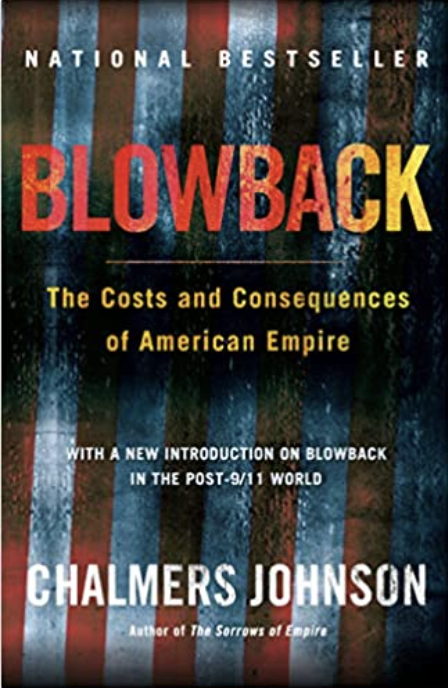
Once upon a time, long, long ago — actually, it was early in the year 2000 — I was involved in publishing Blowback: The Costs and Consequences of American Empire. It had been written by the eminent scholar of Asia, former CIA consultant, and cold warrior Chalmers Johnson. I was his editor at Metropolitan Books. In its introduction, using a word Americans were then (as now) all too uncomfortable with, he bluntly summed up his professional life by labeling himself “a spear-carrier for empire.” And he described the origins of his book’s title this way:
“Officials of the Central Intelligence Agency first invented [the term blowback] for their own internal use… [It] refers to the unintended consequences of policies that were kept secret from the American people. What the daily press reports as the malign acts of ‘terrorists’ or ‘drug lords’ or ‘rogue states’ or ‘illegal arms merchants’ often turn out to be blowback from earlier American operations.”
Ominously enough, he added, “All around the world today, it is possible to see the groundwork being laid for future forms of blowback.” On page 10, he brought up — and remember he was writing this as the previous century ended — the name of “a former protege of the United States,” one Osama bin Laden. In the 1980s, that rich young Saudi had been part of Washington’s secret war against the Soviet Union in Afghanistan, forming a group to battle the Russians that he called al-Qaeda (“the Base”) to battle the Red Army. By the time Chalmers wrote his book, the Russian war there was long over, the Soviet Union had collapsed, and bin Laden had turned against Washington. He was then believed responsible for the bombing of the American embassies in Nairobi, Kenya, and Dar es Salaam, Tanzania. On page 11, Chalmers added that such “retaliation” for American acts was “undoubtedly not yet at an end in the case of bin Laden.”
He summed things up this way: “Because we live in an increasingly interconnected international system, we are all, in a sense, living in a blowback world.”
Sadly, that remains even truer today and, if Chalmers could return from the dead, I have no doubt that he would have much to say about how we now find ourselves on the ultimate blowback planet.
Blowback in a Sole-Superpower World
To use an all-too-appropriate word, given what he was writing about, his book bombed. Boy, did it! The reviewer at the New York Timesdismissed it as “marred by an overriding, sweeping, and cranky one-sidedness.” And it sold next to no copies. It was dead in the water, until, 18 months later… yes, I’m sure you’ve already guessed what I’m about to write next… on September 11, 2001, those towers in New York City came down and the Pentagon was clobbered.
Suddenly, Blowback was on every bookstore bestseller table in America. As Chalmers would mention in his new introduction to the 2003 paperback, Metropolitan Books had to reprint it eight times in less than two months to keep up with demand.
In that volume, he had done something deeply unpopular at the time of publication (except among fringe groups on the left). He had called our country an empire — an imperial power intent on maintaining a staggering military presence globally in the wake of the collapse of the Soviet Union and before the rise of China. A common term used in Washington at the time was the “sole superpower” on planet Earth. And he pointed out, ominously enough, that even without official enemies of any significance, thanks in part to its global imperial presence, Washington had “hollowed out our domestic manufacturing and bred a military establishment that is today close to being beyond civilian control.” He added tellingly that it “always demands more” and was “becoming an autonomous system.” In addition, the post-Vietnam, post-draft, “all volunteer” military was, he pointed out, increasingly “an entirely mercenary force.” Worse yet, he saw the growth of American militarism at home as another form of blowback from this country’s overextension abroad. (Sound familiar in 2022?)
He warned that the collapse of the Soviet Union in the wake of the war in Afghanistan should have been a warning to Washington. Even more ominously, at a moment when this country’s foreign-policy establishment considered us the “indispensable nation” (Secretary of State Madeleine Albright’s phrase), he suggested that we were already experiencing “imperial overextension” and on the long downward slope that all empires experience sooner or later.
And keep in mind that all of this was written before 9/11; before President George W. Bush and crew launched devastatingly ill-fated invasions of Afghanistan and Iraq; before this country’s civilian population became — as the nightmare at Uvaldereminded us recently — armed to the teeth with military-style weaponry. It was long before Donald Trump and before the Republican Party was transformed into something unrecognizable. It was well before Congress became essentially incapable of passing anything of significance for most Americans, even as it was instantly capable of providing $54 billion in aid and arms for the Ukrainians and endless funds for the Pentagon.
President Blowback
Just last month, 22 years later, I reread Blowback. Chalmers is, of course, long gone. (He died in November 2010.) But with the news of these last years and what may be on the horizon in mind, I couldn’t help thinking about how he would have updated the book, were he still here.
As a start, I doubt he would have been particularly surprised by Donald Trump. In June 2005, reintroducing a piece he had done for TomDispatch in 2003 on the scourge of militarism, he was already writing: “The American governmental system is no longer working the way it is supposed to. Many distinguished observers think it is badly damaged in terms of Constitutional checks and balances and the structures put in place by the founders to prevent tyranny.”
And as I added in that same 2005 introduction, reflecting Chalmers:
“In September 2003, only four months after [President George W. Bush’s] ‘Mission Accomplished’ moment on the USS Abraham Lincoln, it was already evident to some of us that neocon dreams of establishing a robust Pax Americana on the planet were likely to be doomed in the sands of Iraq — but that, in the process, the American constitutional system as we’ve known it might well be destroyed.”
Yes, the possibility of our system spinning downward toward some version of tyranny wouldn’t, I suspect, have surprised him. Of course, he didn’t predict Donald Trump. (Who did?) But if anyone could have imagined this country “governed” — and I put that in quotes for obvious reasons — by a billionaire grifter and TV impresario who thought not just unbearably well of, but only of himself, it was Chalmers. Had he been here in 2016, when that bizarre figure ran for president, as he’d been dreaming about doing since at least 2011, and won, I’d put my money on his not being even slightly taken aback. Nor, I suspect, would he have been surprised when the economic inequality that helped Trump to victory only grew ever more rampant in his years in office, while billionaires began to multiply like fleas on a rabid dog.
Honestly, if you think about it for a moment, it’s hard not to imagine The Donald’s success as another version of blowback. In fact, he’s almost inconceivable without the sort of imperial mess Chalmers had in mind and that this country did such a splendiferous job of encouraging with its disastrous invasions of Afghanistan and Iraq and its never-ending war on terror. If it weren’t for the mess that our military machine made of the world in this century (and the money it gobbled up in the process), his rise would be hard to imagine. He now seems like the cause of so much, but honestly, as I wrote during the election campaign of 2016 referring to the disease then in the news: “Perhaps it would be better to see Donald Trump as a symptom, not the problem itself, to think of him not as the Zika Virus but as the first infectious mosquito to hit the shores of this country.”
He certainly marked another key moment in what Chalmers would have thought of as the domestic version of imperial decline. In fact, looking back or, given his insistence that the 2020 election was “fake” or “rigged,” looking toward a country in ever-greater crisis, it seems to me that we could redub him Blowback Donald. (Of course, that “B” could also stand for Blowhard.) And given the present Republican Party, as well as the growing evidence that this country’s political system could be coming apart at the seams, it’s hard not to think that Chalmers was onto something big as the last century ended.
Of one thing I’m sure. He wouldn’t have been slightly shocked to discover that, these days, just about the only thing Congress can agree upon across party lines is the annual raising of the Pentagon budget to levels that now match the military budgets of the next 11 countries combined.
Twenty-First-Century Blowback
In the back of my mind, while rereading his book, I kept wondering how else Chalmers might have updated it in 2022. And what came to mind repeatedly was that potentially ultimate subject, climate change.
Now, Chalmers certainly had a sense of the environmental damage the American empire was already causing, but climate change was not yet on his mind. Recently, to my surprise, I came across a passing reference to it in something I wrote but never published in the 1990s and was surprised I even knew about it then. Still, in this century, as I became ever more aware of it and wrote and published ever more about it at TomDispatch, I came to believe that it would indeed be potentially devastating for humanity. For years, though, I didn’t quite grasp that it would be so in my own lifetime.
Back then, I imagined it as largely a phenomenon of the future, not something for which you could find evidence in the news daily (whether identified as such or not). Yes, at some point I realized, for instance, that South Asia might be more susceptible to climate extremes than many other areas. Still, I hadn’t expected that I would live to see springtime weather with temperatures in the range of 115 to 120 degrees Fahrenheit, or that such horrific and, without air conditioning, increasingly deathly warmth would be followed by devastating flooding. Or that such extremes would grow more common so quickly.
Nor, honestly, had I expected a wave of record July temperatures (and humidity) here in the northeast U.S. and across much of my own country this very May (it hit 95 degrees on a recent day in Philadelphia!). Nor did I imagine that the Southwest and West would be embroiled in a megadrought the likes of which hasn’t been seen on this continent in at least 1,200 years, with devastating, often record-setting fires, blazing in New Mexico and elsewhere ever earlier in the year. Or the unprecedented severe drought and record flooding in parts of Brazil and Argentina. Or the staggering burning and flooding in Australia. Or the unparalleled floods in recent years in China, Germany, and other countries.
I hadn’t imagined that every spring I’d see more or less the same spring article predicting another terrible, if not record, Atlantic hurricane season. Or that I’d hear about a May hurricane of record strength hitting the Pacific coast of Mexico.
And of course, that’s just to start down what seems like an increasingly endless list. I mean, I haven’t even mentioned those three rare tornadoes in Germany or the record May heat wave in Spain, or… but why go on? You get the idea. In fact, you or people you know are undoubtedly living that very reality, too, in some daunting fashion — and at this moment, thanks to the war in Ukraine and endless other distractions, the world is only burning yet more fossil-fuels promising so much worse to come.
To return to Chalmers Johnson, if you think about it for even 30 seconds, climate change has obviously become the greatest blowback event in human history — with almost unimaginably greater climate chaos likely to come. As he would undoubtedly have noted, if you’re living in the most significant blowback nation in human history, since no other country has put more greenhouse gases in the atmosphere than the United States, you’re truly facing — to cite the subtitle of his book — “the costs and consequences of American empire” and, of course, of the imperial oil companies that continue to have such a hand in (mis)shaping our world.
Worse yet, in this century, that newest of imperial powers, China, has already outstripped this country in terms of the fossil-fuelization of this planet’s atmosphere. (Yet another classic case of imperial over-stretch in the offing.)
Talk about decline! These days it almost seems to precede imperial rise. Yikes!
And so many years later, just to out-Chalmers the master himself, let me offer another prediction: if the Republicans sweep into Congress in 2022 and Blowback Donald or one of his act-alikes sweeps (or even creeps) into the White House in 2024, consider that the potential end of the American story, since it would ensure that, for years to come, nothing would be done to stop the ultimate version of blowback.