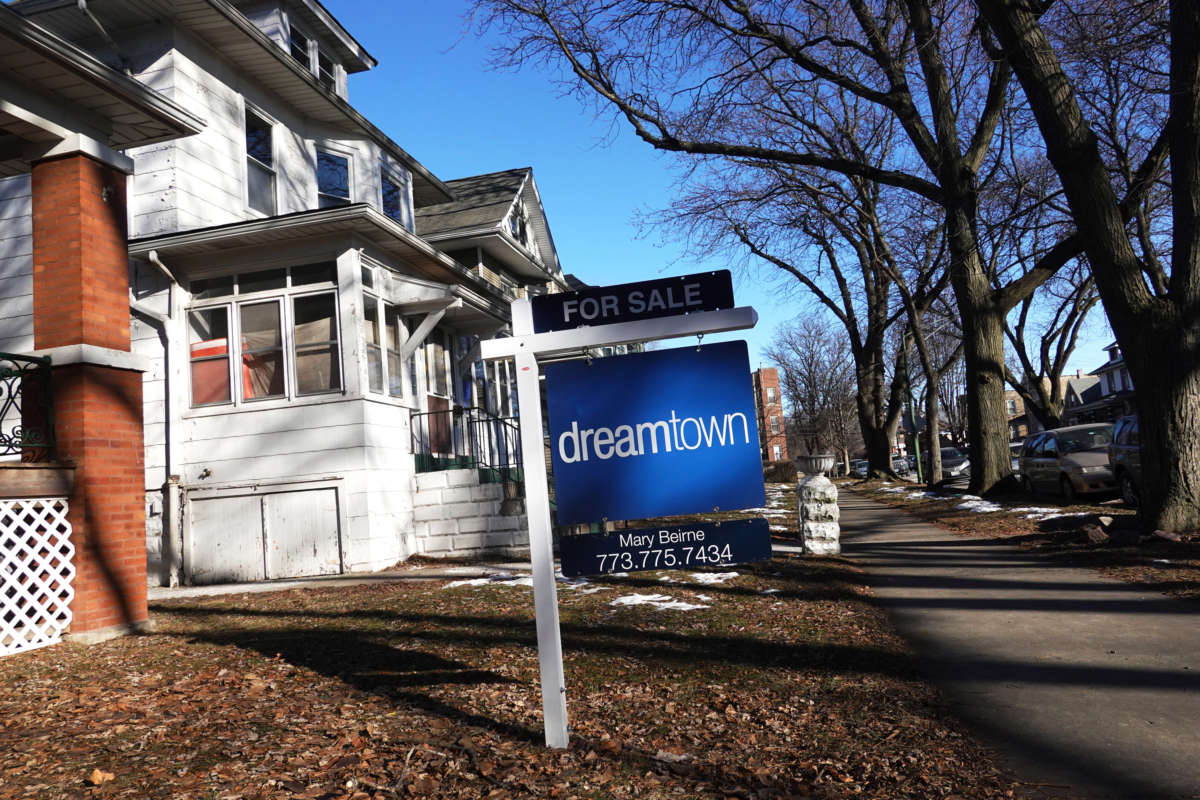
In the late summer of 2021, mortgage rates fell to near-all-time lows, even as the rate of inflation picked up. A borrower with good credit could borrow hundreds of thousands of dollars for 30 years at under 2.9 percent, despite the fact that the rate of inflation had already ticked up to above 5 percent.
And, because where the Federal Reserve goes, the rest of the world follows, interest rates are also soaring globally. Many international observers are worried. Indeed, in a report released earlier this week, the United Nations Conference on Trade and Development (UNCTAD) warned that rapidly tightening monetary conditions could impose a worse cost on the global economy than did either the 2008 crash or the COVID pandemic. Not surprisingly, it suggested that low-income families would bear the brunt of this downturn. UNCTAD called on the Fed to hit the pause button on interest rate hikes.
Inflation creates a climate uncertain for businesses, and when combined with the low unemployment levels currently seen in the U.S., it leads to wage increases that eventually have the potential to recalibrate the economy in organized workers’ favor. Since the Fed is determined to re-establish certainty for businesses and to rein in inflation at all costs, it is unlikely to heed UNCTAD’s warnings, and is likely to plow ahead with its regimen of rate increases.
In the U.S. — and, by extension, much of the rest of the world — two things are happening to the housing market in response to these hikes: the number of homes being bought and sold (and consequently the number of mortgages being taken out) is falling, and housing prices are starting to decline as purchasers feel more pinched by the cost of borrowing. Both will disproportionately hit lower-income families and new homeowners looking to move up the housing ladder.
For seven consecutive months now the number of home sales has declined. This means fewer people are currently able to enter the world of homeownership. It also means that it’s becoming harder for those who already own homes to sell in order to move either to a different city or into better or bigger accommodations in the cities they already live in.
And, while average home prices were still rising modestly into the early summer, in many high-cost cities, a fall-off in prices has now begun. Indeed, some studies have shown that in more than three-quarters of cities, home prices over the past month have retreated from their COVID-era highs. In Seattle, San Diego, Sacramento, San Jose and Las Vegas, Redfin data suggest double-digit drops in what homes are selling for as the Fed’s interest rate hikes ricochet through the broader economy.
Moody’s Analytics now predicts that over the next two years, housing prices will fall in just over half of the 414 major markets that it surveys. In the majority of these markets, especially in cities in the Sunbelt and in the West, it finds that home prices are overvalued by at least 25 percent, meaning that homeowners who bought in the last few years when interest rates were at rock-bottom levels and home prices were soaring are facing huge risks in getting stuck underwater as their real estate investments go south just at the same time as mortgage rates soar.
What makes this more infuriating is that this was an avoidable tragedy. Homeowners don’t make decisions in a vacuum; they buy and sell at least in part because of a financial environment determined by the monetary decisions of the Federal Reserve and the policy decisions of the U.S. government. The housing market was overheated in the last few years by a conscious effort to make money as cheap as possible for as long as possible; now, that housing bubble is being rapidly punctured by a panicked response to inflation by central bankers applying the lessons of the past several inflationary cycles to a pandemic- and war-impacted environment that looks nothing like the recent past. The interest rate hikes embraced by central banks essentially punish home buyers for the failure of expert economists to correctly game out inflationary pressures in the era of COVID and of Russian expansionist military adventures. Whether that punishment will even work, by the Fed’s own terms, and reduce inflation is very much an open question.
The Federal Reserve has gone on an interest-rate-raising spree in recent months as it belatedly attempts to put the inflation genie back in the bottle. There is, in this, an irony. The talking heads and maestros of finance — the experts whose every word markets hang on — spent months trying to calm rattled markets and investors by promising that inflation was transitory, that the fundamentals of the global economy were fine, and that once COVID-related supply chain glitches got sorted out, the world’s major economies would rapidly revert back to inflation in the desired 2 percent range.
They were, of course, hideously wrong. In hindsight, they ought to have gently raised interest rates and tapped the breaks on the housing market before the inflationary spiral took hold, instead of waiting until it was a crisis of such urgency that the massive and rapid interest rate hikes came to be seen as the only tool left in the Fed’s anti-inflation toolkit. But, of course, hindsight is everything. In the moment, their analysis of inflation in 2021 and early 2022 was ultimately as misguided as analyses made 15 years ago by those who waved off the increasingly urgent signs that the housing market was about to crash and pull down key pillars that propped up the global financial system.
In 2006 through 2008, as the housing market grew increasingly volatile, policy makers and those controlling monetary policy ignored the problem until it was too late to make only mild interventions and modest tweaks. When vast numbers of people started to default on their mortgages, and lenders began to suffer a liquidity crisis, it took trillions of dollars of coordinated international interventions to keep the world’s financial system from entirely seizing up and to stop the major industrial economies from sliding into a depression.
Now, in 2022, a similarly inept response by experts who should have known better threatens to crash the housing market in which tens of millions of American families have invested their life savings, following the encouragement of policy makers who kept interest rates artificially low for more than a decade.
The political repercussions from the crash of 2008 are still playing out today; it’s hard to imagine Trump’s ascendancy absent the aftereffects of the crash: the collapse in confidence in government agencies and elected officials, the distrust of self-proclaimed experts, the immiseration of millions of families, and the rage triggered by banks being bailed out while homeowners and ordinary workers were largely left to fend for themselves.
Today, the Fed is stampeding toward a regimen of ever-escalating rates. It is essentially declaring that large increases in unemployment are acceptable — possibly even desirable so as to curb worker power — as a way to rein in an economy it let overheat for years. As a result, the potential exists for a 2008-style sudden and calamitous failure of the housing market, a contraction in employment, and an unleashing of vast political furies in the wake of this.
Sometimes, as UNCTAD seems to have concluded, the medicine is worse than the ailment. In putting both the stability of the U.S. housing market and the employment of large numbers of Americans at risk with a rigid anti-inflation regimen that doesn’t take into account the very particular reasons for rising prices in 2022, the Fed risks fueling growing immiseration, and, in consequence, increased levels of societal upheaval. For months now, the Federal Reserve has talked up its ability to create a “soft landing” for the overheated economy. Now, in dramatically raising the costs of borrowing over the past few months, it has essentially accepted the necessity of a “hard landing” that triggers misery for millions of existing homeowners and puts the ability to purchase a home further out of reach for growing numbers of would-be first-time home buyers. That’s not sound economic policy making; rather, it’s decision-making via panic.
Yes, the Fed’s interest rate-raising frenzy of 2022 may ultimately curb inflation, but the collateral damage this time around, in terms of housing access and unemployment, could rival that of 2008. It could, if things really head south, be as unpleasant as the early 1980s, when monetary policy makers in Reagan’s U.S. and Thatcher’s U.K. sent interest rates and unemployment skyrocketing, in their efforts both to break the power of organized workers and also to tamp down inflation. That’s hardly the mark of a well-thought-out and humane monetary policy.
https://truthout.org/articles/fears-of-a-housing-crash-threaten-life-savings-of-tens-of-millions-in-the-us/