Zoeken in deze blog 🔎🔎

zondag 3 maart 2019

THE BATTLE FOR THE SOUL OF EUROPE


 Comments 14

Iron Ladies and Golden Dreams


Steven Keith

It was Margaret Thatcher who as Prime Minister was the principal driving force behind the expansion of the European Union. It was she who advocated the broadening of the physical, philosophical, financial and spiritual scope of the European Community as it was then known, to include the eastern European and Baltic, former Warsaw Pact states.
Her nemesis at that time was Jaques Delors, a bureaucrat and a Frenchman. He of course (being that he had risen to the appointed post of a Commissioner) came from the Brussels mindset that was then and remains to this day of the same view, that being, that Brussels, Berlin and Paris run the show between them. The physical structures of the EU project in Brussels, Belgium being underpinned by the financial and philosophical capacities of Germany and France.
Thatcher attempted to weaken that triumvirate by expanding the number of nations and taking advantage of the fact that those countries were existing in their post-Soviet incarnation, that being, in a state of virtual financial anarchy, masquerading as liberalism.
Thatcher is dead and gone and the United Kingdom of Great Britain and Northern Ireland is going too – or so it’s people have said.
The reasons that the British gave for leaving the EU were a few in number but one stood out, immigration. The countries on the physical periphery of the European Union, those countries that Mrs Thatcher had spoken up on behalf of all those years ago, are also now raising their voices to express concerns about immigration from out with Europe and they are doing so with much greater fervency, on every level of the stage on which they now speak from.
The voices of those eastern and now the southern states too, are beginning to unite, to privately make bilateral ‘agreements’, something that the EU constitution does not permit, countries like Hungary and Italy, Slovakia and the Czech Republic, even Poland, now have populist parties in powers with popular support and a unity of approach on the issue of external immigration into their countries and to the EU.
That view is fast becoming the majority view on the continent of Europe and it is on a collision course with the Brussels, Berlin and Paris and moreover the leaders of the bureaucratic Triumvirate are now experiencing catastrophic collapses in the confidence that their own electorates have in them to govern in their own peoples best interest.
THE BATTLE FOR THE SOUL OF EUROPE
Of course Margaret Thatcher knew that all of this would unfold as it has. She had her advisors and access to any and every persuasion of advice on offer, as do her successors. Thatcher was not a fan of Europe, not a believer in or a worker for, ‘The Project’.
That project revolves around the Franco- German post WW2 alliance. However, it is an experiment based on the ideas, principles, polices and institutions that had been conceived of by and for the National Socialists during the Weimar Republic and the fascist dictatorship that followed. Mr Delors and the central clique he represented, were never enthusiastic supporters of the movement eastwards. It would mean the dilution of their core values; western European, secular, quasi-atheistic, monolithic, anti-democratic and a belief in their own exceptionalism.
The new members from eastern Europe were not really believers in any of these things. They were and remain as, social conservatives, economic liberals, Christians and believers in ‘real’ democracy, after their experience with Soviet style communist ideology. Indeed their cultural dispositions are much more closely aligned to the nations of southern Europe; Greece, Italy, Spain and Portugal.
And that brings us to today. A time when a fortified fence has been built along, not the border of the EU, but along a line that closely resembles that often used to depict the boundary of the old Holy Roman Empire; the previously iron clad Chancellor Merkel of Germany is now politically dead following her decision to allow one million African and Asian migrants into her country unchecked.
Her fellow ideological traveller President Macron of France is at phenomenally low levels, unprecedentedly low levels in the opinion polls, secessionist movements are on the increase across the continent, even in previously social democratic Scandinavia, and of course the UK has voted to leave.
Britain will leave but will not continue in it’s current incarnation – it will inevitably fracture but that does not necessarily mean that her constituent nations will automatically rejoin the EU. Many voters are not so enthusiastic. There are alternatives. Many voters in European countries agree with their British counterparts. Many are sceptical of the motivations of the European elites.
There are now two clear blocks developing within the European Union, and the one controlled by the Berlin/Paris axis is getting weaker in relation to the other, that led by Mr V Orban in Hungary but supported vocally and vociferously, by the new Italian Prime Minister, and his Prime Ministerial colleagues in Slovakia, Poland and the Czech Republic.
What is more, each of these populist leaders, not all of them of the ‘right’, are friends with President Putin of the Russian Federation. I don’t say this to detract from them, I don’t buy into the Putin monster narrative, I say it because it is the reality.
Over time, the populations of western Europe will come, by their own free will, to the only position that is logical – that being, that neither Putin nor Russia are of any threat to them, their countries nor their cultures, quite on the contrary, they have much in common, as brothers and sisters do! Russia’s influence will only grow as time passes and the story unfolds.
In the future, if the Orban block controls Brussels, then expect a very different arrangement of nation states, including Russia, in Europe. At that point, there is as much chance of a former EU merging with the Russian Federation, to form a Eurasia superpower, as the USA and Canada doing likewise and then welcoming their cultural progenitors into their fold, thus forming another. Geopolitics means one event forces the next. World War One? Triple Entente?
Margaret Thatcher, it could be said, was most responsible for the decision to allow the eastern European nations into the club and Angela Merkel for the unilateral decision to allow in one million refugees, that have created the circumstances that enables the previously stated outcomes to become reality.
If such scenario was to come to pass, then the People’s Republic of China would have no choice but to expand. We really are very close to this outcome being a political reality and the consequences would be catastrophic for all, whether or not they resided within or out with, one of the three superpowers that would be fighting for the scraps on offer.
In the late 1940’s a survey was conducted among the people’s of the US, UK and France. The question they were asked was, “who was responsible for defeating the Nazis?” The American public believed that they did most for victory. The British, when asked, thought that they had given the most. The French people gave the credit to the Red Army of the Soviet Union. Europeans are not necessarily willing to view the Russians as being their natural, default enemy. The English speaking world is and that world is effectively North America and the British Isles.
There is a certain inevitability about the drift into this dystopian nightmare. There was not before. The required circumstances that would cause the EU and the UK to fragment were not in place. They are now. The United States itself is fractured, almost down the middle.
President Donald Trump was recently asked how he thought that this rift, that has become a ravine, can be healed or at least bridged. His answer was revealing. “A global event.” Global events move countries and continents and they can move them very quickly, in a way that changes the world overnight and forever. Look at 9/11.
People in my homeland, Scotland, seem to want to exchange one Union for another. Exchange British exceptionalism for the European flavour. Unfortunately, Scotia might find herself free and independent only fleetingly, before geopolitics gobbles her up. However the Scots don’t seem to see that the big fish that will be swallowing her and England, and Wales and Ireland, will be North America, not Europe.
The wooing will be done in English and English is all that the nations of the British Isles have come to understand.
Steven Douglas Keith is a Scotsman living for twenty years in the mountains of northern India, an essayist, an artist and a poet. As an historian, his work has sought to find the commonalities shared by cultures, specifically between the religious and cultural traditions of the orient and occident. He can be reached through his twitter, and his blog.

Killing Off Our Vital Insects To

2.03.2019 Author: F. William Engdahl

We’re Killing Off Our Vital Insects Too

50IN
Recent independent scientific studies indicate that we are threatening our vital global insect population, including of bees, with widespread extinction through massive deployment of agriculture pesticides. For most of us, insects such as flies or mosquitoes or wasps are nuisances to be avoided. Yet if the latest studies are any indication, we may be in danger of massive elimination of vital insects that maintain nature’s balance. The consequences to life on this planet are only now beginning to be seriously considered.

The first-ever worldwide study of declines of insect species and numbers has just been published by the journal, Biological Conservation. The conclusions are more than alarming. Among other conclusions the study found that over 40% of insect species are threatened with extinction. 
The study found that habitat loss by the conversion to intensive agriculture is the main driver of the declines, as well as agrochemical pollutants such as glyphosate, neonicotinoids and other pesticides. The authors explain, “Here, we present a comprehensive review of 73 historical reports of insect declines from across the globe, and systematically assess the underlying drivers. Our work reveals dramatic rates of decline that may lead to the extinction of 40% of the world’s insect species over the next few decades.”
The study notes recent analyses that indicate that extensive usage of pesticides is the primary factor responsible for the decline of birds in grasslands and aquatic organisms such as fish or frogs in streams. 
Among other things the study cites results of a 27-year study of insect populations in select German protected nature preserves that found a “shocking 76% decline in flying insect biomass at several of Germany’s protected areas…an average 2.8% loss in insect biomass per year in habitats subject to rather low levels of human disturbance. Worryingly, the study shows a steady declining trend over nearly three decades. A study in rain-forests of Puerto Rico has reported biomass losses between 98% and 78% for ground-foraging and canopy-dwelling arthropods over a 36-year period and parallel declines in birds, frogs and lizards at the same areas…”
Especially alarming were the declines in bee populations, especially bumblebees. Since 1980 they found that wild bee species in Britain declined by 52% and 67% in the Netherlands. In the United States, the country which pioneered intensive agribusiness and wide use of chemicals after World War II, they found that wild bees were declining in 23% of the country between 2008 and 2013, mainly in the Midwest, Great Plains and the Mississippi valley. These were the areas where grain production, particularly GMO corn for biofuel production using glyphosate and other chemicals was prevalent. Overall the USA went from a peak in 1947 of six million honey bee colonies, down to less than half or some 2.5 million colonies today. The decline began immediately as widespread agriculture use of the organochloride insecticide DDT was employed. Decline has continued unabated even after DDT was banned in 1972 in the United States as DDT was replaced by glyphosate-based alternatives and other chemical pesticides.
Irreversible decline?

What is poorly understood by the larger public is the essential role that insects play to the entire order of nature and species preservation. As the report notes, “shrews, moles, hedgehogs, anteaters, lizards, amphibians, most bats, many birds and fish feed on insects or depend on them for rearing their offspring. Even if some declining insects might be replaced with others, it is difficult to envision how a net drop in overall insect biomass could be countered.” The study concludes among other sobering points that “the application of herbicides to cropland has had more negative impacts on both terrestrial and aquatic plants and insect biodiversity than any other agronomic practice.” The far most widely used herbicide in the world today is glyphosate and Monsanto Roundup based on glyphosate. 
Another recent study by the California Xerces Society for Invertebrate Conservation reported that California’s monarch butterfly population is at an all-time low. From the 1980s when monitoring began to 2017, some 97% of monarch butterflies had disappeared. Then from 2017 to today another 85% decline was registered. The scientists claim the intensive agriculture use of pesticides, herbicides is the main cause.
Scientists at the University of Texas have identified in experiments that glyphosate, the controversial herbicide in Monsanto Roundup, harms the microbiota needed by honeybees for growing and resisting pathogens. This, combined with earlier studies linking the group of neonicotinoid pesticides to bee deaths, suggest we need an urgent review of the toxins being widely applied to our agriculture crops. Notably, the world’s largest purveyor of both neonicotinoids and of glyphosate-based Roundup today is the merged giant Monsanto/Bayer.
These studies all are putting the focus on an aspect of agrochemical damage that until now has been largely ignored. But insects make up the structural and functional base of many of the world’s ecosystems. A world without birds and bees would be one of catastrophic damage to all life on our planet. Without insects, entire ecosystems collapse. Rather than solving world hunger as the agribusiness industry likes to claim, their promotion of select pesticides such as glyphosate threaten to destroy the food system. Nobody in their right mind would want to do that, would they?

F. William Engdahl is strategic risk consultant and lecturer, he holds a degree in politics from Princeton University and is a best-selling author on oil and geopolitics, exclusively for the online magazine “New Eastern Outlook.”
https://journal-neo.org/2019/03/02/we-re-killing-off-our-vital-insects-too/

https://journal-neo.org/2019/03/02/we-re-killing-off-our-vital-insects-too/

The Clintons, the Canadians, and Western NGOs all Complicit in a Never-Ending Tragedy

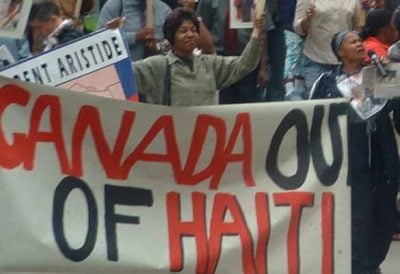
The Coup Against President Aristide 15 Years Later: The Clintons, the Canadians, and Western NGOs all Complicit in a Never-Ending Tragedy

“It’s almost as though the greater the devastation caused by neoliberalism, the greater the outbreak of NGOs. 
Nothing illustrates this more poignantly than the phenomenon of the US preparing to invade a country and simultaneously readying NGOs to go in and clean up the devastation.”
– Arundhati Roy (August 16, 2004) [1]
LISTEN TO THE SHOW
On February 29th 2004, fifteen years ago this week, following an insurgency by a rebel paramilitary army, U.S. Canadian, and French troops executed a coup d’etat against the democratically elected Haitian leader Jean-Bertrand Aristide.
This incident was notable in a long history of imperialist interests determined to thwart any semblance of emancipation from foreign control.
From the arrival of Christopher Columbus through the slave trade, military interventions, occupation and U.S. backed tyrannies, far away powers have profited from the sweat and blood of the people of this island community. [2]
Yet, the spirit of resistance has flourished! Following the world’s first and only successful slave revolt, Haiti had established its independence in 1804. A popular uprising in the 1980s would lead to the collapse of the brutal U.S. backed Duvalier regime. And in spite of U.S. and CIA backed actions to sabotage Haitian democracy, an array of grassroots organizations prevailed in their efforts to elevate Aristide, an advocate for the poor, to the presidency in December 1990. [3]
Aristide’s advocacy for the Haitian people and refusal to implement policies favourable to offshore financial interests coming at the expense of his fellow Haitians led to his 1991 ouster by a CIA-backed coup. U.S. President Bill Clinton would return Aristide to Haiti on the condition he would grant amnesty to the brutal Haitian military and implement structural adjustment programs and other reforms demanded by the World Bank and the other instruments of the so-called ‘Washington Consensus.’ [4]
It was defiance of these conditions by Aristide and his Fanmi Lavalas Party that led to the 2004 coup. [5]
In the 15 years since, a colonial occupation has asserted itself on the island nation in the name of ‘peace-keeping’ and ‘humanitarian relief.’ A closer inspection however, reveals that what may be portrayed as philanthropic benevolence is in fact a disguise for the continued oppression of a peopledaring to defy white supremacist exploitation.
In recent weeks, Haitians are once again rising in opposition to a U.S. puppet government which ironically better fits the criticisms of corrupt and anti-democratic behaviour than does the Maduro government being condemned by the U.S. and Canada. [6]
This week’s Global Research News Hour radio program marks the 15 year anniversary of the 2004 coup and the consequent undermining of Haitian sovereignty with two interviews.
In the first half hour, Jean Saint-Vil elaborates on the historical and geopolitical context of the coup and the ongoing occupation, notes the ignoble efforts in the country by the U.N. and the Clintons among others, and speaks to both the morality and the wisdom of Western powers changing their relationship with Haitians and respecting their sovereignty.
We next speak with Yves Engler specifically about Canada’s role in the coup and the interests it is pursuing in the country. He speaks about how and why even progressive Canadian organizations are echoing the propaganda and talking points enabling the occupation. He discusses the presence of Canadian Special Forces on the ground in Haiti in the midst of recent popular upheaval there. He also brings up the Quebec engineering firm SNC Lavelin, currently making headlines in Ottawa, and takes note of that company’s involvement within Haiti along with its under-reported role within the architecture of Canadian foreign policy decision-making generally.
Jean Saint-Vil is a Haitian-Canadian writer and activist. He co-founder the Canada -Haiti Action Network and has visited Haiti several times before and since the 2004 coup.
Yves Engler is one of Canada’s foremost Canadian foreign policy critics and dissidents. He is the author of nine books on Canadian foreign policy including Canada in Haiti: Waging War on the Poor Majority (2005), which he co-authored with Anthony Fenton, The Black Book of Canadian Foreign Policy (2009), and his most recent, Left, Right: Marching to the Beat of Imperial Canada.
(Global Research News Hour Episode 250)
LISTEN TO THE SHOW
The Global Research News Hour airs every Friday at 1pm CT on CKUW 95.9FM in Winnipeg. The programme is also podcast at globalresearch.ca . Excerpts of the show have begun airing on Rabble Radio and appear as podcasts at rabble.ca.
The Global Research News Hour now airs Fridays at 6pm PST, 8pm CST and 9pm EST on Alternative Current Radio (alternativecurrentradio.com)
Community Radio Stations carrying the Global Research News Hour:
CHLY 101.7fm in Nanaimo, B.C – Thursdays at 1pm PT
Boston College Radio WZBC 90.3FM NEWTONS  during the Truth and Justice Radio Programming slot -Sundays at 7am ET.
Port Perry Radio in Port Perry, Ontario –1  Thursdays at 1pm ET
Burnaby Radio Station CJSF out of Simon Fraser University. 90.1FM to most of Greater Vancouver, from Langley to Point Grey and from the North Shore to the US Border.
It is also available on 93.9 FM cable in the communities of SFU, Burnaby, New Westminister, Coquitlam, Port Coquitlam, Port Moody, Surrey and Delta, in British Columbia, Canada. – Tune in  at its new time – Wednesdays at 4pm PT.
Radio station CFUV 101.9FM based at the University of Victoria airs the Global Research News Hour every Sunday from 7 to 8am PT.
CORTES COMMUNITY RADIO CKTZ  89.5 out of Manson’s Landing, B.C airs the show Tuesday mornings at 10am Pacific time.
Cowichan Valley Community Radio CICV 98.7 FM serving the Cowichan Lake area of Vancouver Island, BC airs the program Thursdays at 6am pacific time.
Campus and community radio CFMH 107.3fm in  Saint John, N.B. airs the Global Research News Hour Fridays at 10am.
Caper Radio CJBU 107.3FM in Sydney, Cape Breton, Nova Scotia airs the Global Research News Hour starting Wednesday Morning from 8:00 to 9:00am. Find more details at www.caperradio.ca
RIOT RADIO, the visual radio station based out of Durham College in Oshawa, Ontario has begun airing the Global Research News Hour on an occasional basis. Tune in at dcstudentsinc.ca/services/riot-radio/
Radio Fanshawe: Fanshawe’s 106.9 The X (CIXX-FM) out of London, Ontario airs the Global Research News Hour Sundays at 6am with an encore at 4pm.
Los Angeles, California based Thepowerofvoices.com airs the Global Research News Hour every Monday from 6-7pm Pacific time. 
Notes: 
  1. http://www.informationclearinghouse.info/article17888.htm
  2. Press for Conversion! (Issue #60), March 2007, pg 3-6; https://www.globalresearch.ca/us-sponsored-coup-detat-the-destabilization-of-haiti/5323726
  3. ibid
  4. ibid
  5. idib
  6. https://www.globalresearch.ca/canadian-policy-on-venezuela-haiti-reveals-hypocrisy-that-media-ignores/5669171

Saudi America & The Truth About Fracking

Bethany McLean: Saudi America & The Truth About Fracking

For years now we've been covering the false promise of the American shale oil "miracle".
Yes, it has extracted a lot more oil out of American soil that most thought possible. But at an economic loss. And at great environmental cost.
If the shale drilling companies can't make any profit, either when oil prices are high or low -- why are we still pursuing shale deposits so aggressively?
To shed further light on this paradox, this week we welcome journalist Bethany McLean to the program. McLean is editor-at-large at Fortune Magazine and a contributing editor for Vanity Fair and Slate magazines. She is also author of the excellent book: Saudi America: The Truth About Fracking And How It's Changing The World.
McLean warns that the hype, the hucksterism, and the geological shortcomings of the deposits themselves, are setting up both investors and American society for tremendous disappointment:
The real catalyst of the shale revolution was the Great Financial Crisis and the era of unprecedentedly-low interest rates that followed.
And that had two effects. One was that it made debt cheap. So these companies that are heavily dependent on being able to raise capital could raise debt at low prices. And without that, I’m not sure there would’ve been a shale revolution because they needed such immense amounts of capital to fund their drilling.
But it had a second impact, which is that when pension funds were no longer able to earn a return in traditional fixed income markets, they’ve increasingly put their money into riskier assets like hedge funds that invest in credit and private equity firms. Those entities, in turn, have increasingly invested in shale.
I got an estimate from one source that said 1/3 of the drilling, a third of the fracking, being done in the country today is being done by private equity-backed companies. So we’ve had this derivative effect of the era of low interest rates.
Now there’s a lot of money that believes believes the story that technological improvements are going to make this industry profitable in the long run. But there are lots of ways that private equity firms and other investors can make money even if the companies themselves don’t. And what I mean by that is that for a long time, a shale company that was publicly traded was valued not on its profits but rather, on a multiple of its production or its reserves.
And so, there's an incentive to take these companies public, where it can trade on its growth and production. It doesn't have to produce profits. You can flip your company to the public markets or sell it to an already-public company. So, it’s kind of a big game of musical chairs in many ways.
And I think there's an unacknowledged problem with the shale revolution that feeds into the lack of profits. And that’s that all wells are not created alike.
And so, that gets to the really core question here. How much really good acreage is there? And it’s a reason to believe that even though the industry did get closer to profitable in this last year, that may not last because a lot of companies were drilling the sweet spots first. They were drilling their best acreage. And the question is, “How much of that is there?” And to be frank, nobody really knows the answer.
Some of that is depending on technological changes. If you can get better technology that enables you to get more oil out of the ground more cheaply; then, something that wasn’t the sweet spot could become a sweet spot. Thus far, though, the evidence seems to be mounting that the picture is the opposite of that. And what I mean by that is Wall Street Journal did a really good piece in late December pointing out that actually, production levels are coming in way short of what companies had estimated.
So, it looks like the sweet spots, overall, aren’t even as sweet as they were forecast to be. It’s not coming in better than expected, it’s coming in shorter projections.
there’s a lot of this idea – the idea has shifted from America being energy-poor to America being resource-abundant. And you hear this idea of American energy independence and even President Trump talks about American energy dominance. And I think I read that the IEA – the International Energy Agency – is forecasting that most of the growth in global production in coming years is going to come from US shale. And as a result of that belief, a lot of the big, long-lived projects that take years of investment before they start to produce have been put on hold. So, that oil isn’t going to be coming online. And so, what happens if shale can’t deliver?
Click the play button below to listen to Chris' interview with Bethany McLean (38m:39s).


Generaal Eichelsheim Wants War

Generaal Onno Eichelsheim @CDS_Defensie We moeten ons #voorbereiden op een grootschalig conflict, terwijl we niet met zekerheid kunnen zegg...