Zoeken in deze blog 🔎🔎

zondag 9 september 2018

Henry Giroux: Neoliberal Fascism and the Twilight of the Social
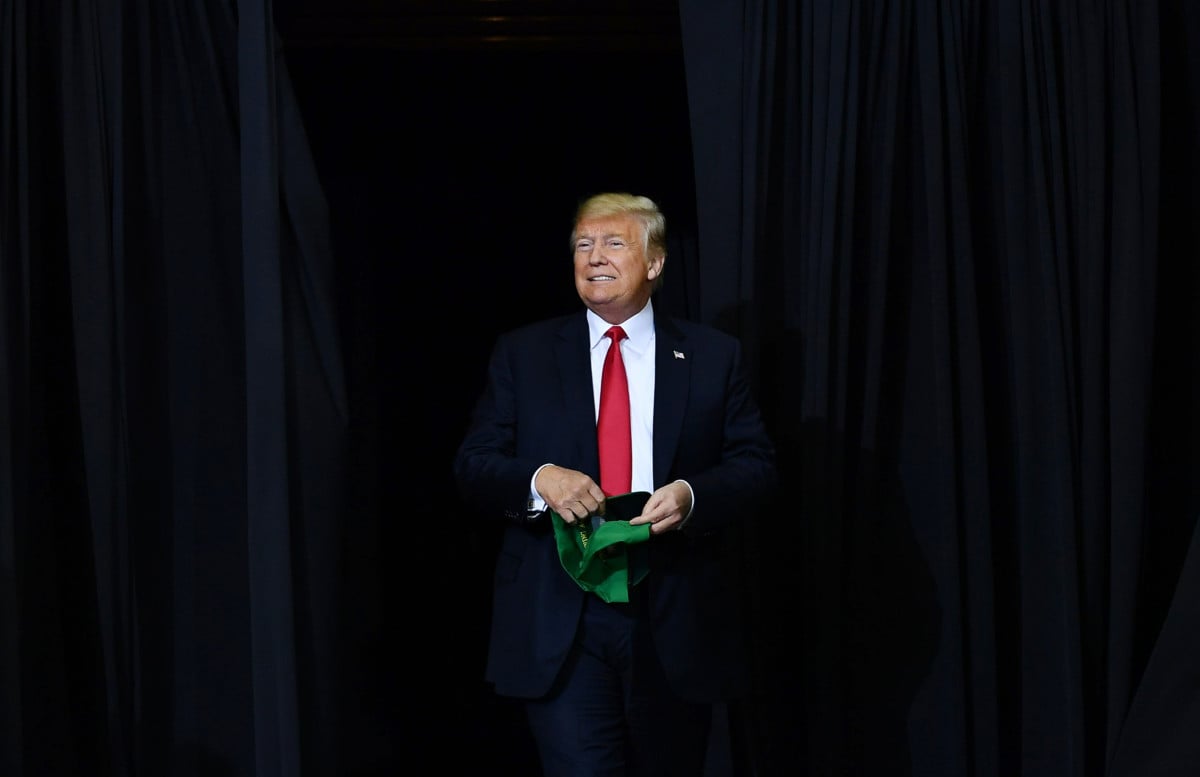
Neoliberal Fascism and the Twilight of the Social

Donald Trump’s increasingly dangerous, incendiary attacks on the media, his willingness to separate children from their parents at the southern border, his efforts to strip citizenship from naturalized citizens and deport US citizens on the groundless claim that they have fraudulent birth certificates, and his relentless attempts to pressure Attorney General Jeff Sessions and others to obstruct the rule of law all amount to a lawless grab for power that is pushing the US further into the abyss of fascism.
The terrors of 20th century fascism have risen once again in the United States but less as a warning about repeating past mistakes than as a measure of the degree to which the lessons of history become irrelevant. Politics now moves between what philosopher Susan Sontag once labeled as “unremitting banality and inconceivable terror.” The “unremitting banality” is evident in Trump’s daily barrage of reckless tweets in which language becomes a weapon to vilify, humiliate and demonize government officials, journalists and critical media outlets. An evil banality is also present in his branding of undocumented immigrants as “murderers and thieves,” “rapists” and criminals who want to “infest our country.”
There is more at work here than the use of coarse language or an unprecedented display of incivility by a sitting president; there is also a flirtation with violence, the rhetoric of white supremacy, and the language of expulsion and elimination. Trump’s embrace of unthinkable terror takes on an even more onerous tone as the language of dehumanization and cruelty materializes into policies that work to expel people from any sense of community, if not humanity itself.
Such policies are evident in Trump’s systemic “zero tolerance” policy, now rescinded, that forcibly separated migrant children from their parents and incarcerated them in prison-like cages where many of them were physically and sexually abused. These attacks have not been limited to children. Aida Chavez reports in The Intercept that both physical and sexual assaults on immigrants in detention centers have become commonplace and are documented in a number of reliable sources. For instance, The Intercept has obtained public records that reveal that more than 1,000 complaints have been made about sexual abuse in immigration detention facilities. The systemic nature and scope of violence and sexual abuse also extends to the reign of terror inflicted on immigrants at the hands of Immigration and Custom Enforcement (ICE) agents. The Office of the Inspector General has received over 33,000 horrifying complaints by immigrants made against ICE, revealing the underpinnings and wanton lawlessness of a fascist police state. Sen. Kirsten Gillibrand has called ICE a “deportation force” and along with a number of prominent politicians, such as New York Mayor Bill de Blasio, has argued that it should be abolished. Cynthia Nixon, the progressive actor who has entered the gubernatorial race in New York, has called ICE “a terrorist organization” and has insisted on its abolition.
Trump’s penchant for cruelty is also on full display in his removal of temporary protected status for hundreds of thousands of refugees from El Salvador, Honduras and Haiti as well as his rescinding of protections “for 800,000 young undocumented immigrants, known as Dreamers.” It gets worse: the Trump administration has advocated depriving undocumented immigrants with due process and threatened to deport them immediately when they cross the border “without a trial or an appearance before a judge.” 
The degree and transparency of Trump’s racism are even more well-defined in his plan to punish legal immigrants for accepting public benefits to which they are entitled, such as food stamps and public housing. Moreover, his rule would authorize federal officials to revoke legal resident status from immigrants who accept such assistance. The guiding force behind this anti-immigrant movement in the Trump administration is hard-liner and white supremacist sympathizer, Stephen Miller, who takes delight in proposing legislation that makes “it harder for legal immigrants to become citizens or get green cards if they have ever used a range of popular public welfare programs, including Obamacare.” 
Legislation that denies immigrants citizenship because they receive public assistance reveals a level of state violence, if not a form of domestic terrorism, that increasingly characterizes the onslaught of Trump’s policies. More recently, he has suggested the death penalty for drug dealers, a plan that takes its cues from Philippine President Rodrigo Duterte’s drug war, which has resulted in deaths of over 20,000 alleged drug users and dealers since 2016, many of whom live in poor communities. 
Meanwhile, as part of his broader attack on human life and the conditions that make it possible, Trump has rolled back many of the Obama-era polices designed to curb climate change; he has reversed environmental protections, such as the banning of pesticides in wildlife refuges, and he has dismantled federal rules regulating American coal plants, which are “designed to curtail coal emissions of carbon dioxide and methane that contribute to climate change.” 
In a case that highlights Trump’s war on youth and his ongoing attempts to destroy the social bonds that sustain a democracy, the United States government attempted to scrap a research-based United Nations-World Health Organization resolution that encouraged breast-feeding. Supporting the interests of infant formula manufacturers, American officials first sought to use language that would water down the resolution. When that failed, they threatened smaller countries such as Ecuador that supported it. Patti Rundall, a policy director supporting the resolution, observed that the actions by the Trump administration were “tantamount to blackmail.” Rundall’s criticism becomes even more alarming given a 2016 study in The Lancet that documented how “universal breast-feeding would prevent 800,000 child deaths a year across the globe and yield $300 billion in savings from reduced health care costs and improved economic outcomes for those reared on breast milk.”

Slow Violence, Fast Violence

Trump’s discourse and policies represent a profound attack on the collective values crucial to a democracy and present a constant assault not just on economic and political institutions but also on the formative culture, public foundations and educational apparatuses necessary to nurture critically active and engaged citizens. Trump’s assault on social obligations, social responsibility, and the social fabric is a fundamental element of his espousal of neoliberal fascism. This new political arrangement operates in its most lethal form as a form of “slow violence,” which in Princeton University scholar Rob Nixon’s terms is a “a violence that occurs gradually and out of sight, a violence of delayed destruction that is dispersed across time and space, an attritional violence that is typically not viewed as violence at all.”
“Slow violence” destroys the formative cultures that make human suffering visible, covers over authoritarian impulses behind the calls for national greatness, and exposes the danger of surrendering freedom for security. At the core of this violence, which has intensified under neoliberal fascism, is an attack on those social forces that defend the welfare state and engage in an ongoing struggle to make concrete the possibilities of democratic socialism. Under neoliberal fascism, chauvinism and militarism work hand in hand with a hardening of the culture, the unleashing of the forces of brutal self-interest, and a growing illiteracy that undermines both public values and a collective struggle against what sociologist C. Wright Mills once called “a politics of organized irresponsibility.” “Slow violence” is difficult to gauge because it is often concealed beneath policies that promote what can be called fast violence.
Fast violence comes with an immediate body blow, exhibits the spectacularized drama of Trump’s imperious and insulting tweets, and produces high-profile assaults on democratic institutions, such as the courts, media and rule of law. Such violence embraces the theatrical, feeds off the spectacle and aims at high shock value. One recent exampleof the fast violence of cultural politics was the almost unthinkable announcement by the Trump administration that Betsy DeVos, the Secretary of Education, was planning — at a time when underprivileged schools lack the most basic resources and support services — to use federal funds, designed to benefit programs aimed at underserved students, to train and arm teachers, in spite of an established federal policy that prohibits using such funds to arm educators. Of course, this hidden agenda legitimated in this proposed policy is that schools attended largely by poor students are sites defined in the image of war, should be modeled after prisons, and necessitate being governed through zero-tolerance policies that often feed the school-to-prison pipeline. The endpoint of such policies moves between pushing poor Black and Brown youth into the criminal justice system and either abolishing these public institutions or turning them into cash cows by privatizing them. The larger goal is to destroy education as a democratic public sphere whose mission is to create an educated citizenry necessary for the workings of a vibrant democracy. The state-sponsored violence at work here imperils the rule of law and works to unravel the alleged democratic institutions, such as the courts and media that some believe provide an impregnable firewall against Trump’s authoritarianism. Taken together “slow” and fast violence under the Trump regime share a cultural politics that erodes memory, substitutes emotion for reason, embraces anti-intellectualism, increases the harshness of rugged individualism and thrives in the glow of what economist Paul Krugman terms a “white nationalism run wild.”
State violence has become the organizing principle shaping all aspects of American society. At the heart of such violence is a full-fledged attack on notions of the social and public space that makes critical thought, dialogue, and the individual and collective pursuit of the common good possible. Under such circumstances, pressing social problems are removed from the inventory of public concerns and ethical considerations. The end point is the replacement of the welfare state and social investments with the punishing state and what Jonathan Simon has called “governing through crime.” This is all too evident in the Trump administration’s mode of governance founded on a harsh, racially charged regime of law and order that is as repressive as it is corrupt. Locked into an “abyss of failed sociality,” the American public finds it increasingly difficult to challenge the assumption that markets and the rule of the strong man are all that is needed to solve all individual and social problems. When public values are invoked, to paraphrase Walter Benjamin, they appear less for their recognizability and relevance for the present than a symbol for what has been irrevocably lost.
Public values and the public good have been reduced to nostalgic reminders of another era — associated, for example, with the New Deal or the Great Society — in which the social contract was seen as crucial to meeting the needs of postwar Americans and fundamental to a substantive democratic order. Rather than viewed as a legacy that needs to be reclaimed, reimagined and renewed, visions of the public good are consigned to the distant past, a passing curiosity like a museum piece perhaps worth viewing, but not worth struggling to revive as either an ideal or a reality. What is “new” about the long decline of public values in US society is not that they are again under attack but that they have become weakened to the point of no longer provoking a massive oppositional social movement in the face of more daring and destructive attacks by the Trump administration. When such values are attacked, the targets are groups who for decades have been largely immune to such attacks because they embody the most cherished ideals associated with democratic public service — immigrants, public school teachers, public servants, poor youth of color and labor unions. This suggests that the precondition for any viable sense of individual and collective resistance must reclaim the social as part of a democratic imaginary that makes education and learning not only central to social change, but also to the struggle to democratize the very character of American politics, institutional power and public discourse.

Neoliberalism’s Attack on Social Bonds

In the aftermath of the horrors of WWII, critical theorist Theodor Adorno remarked that while it becomes difficult to live in the shadow of a history in which there seemed to be no end to terror, it is impossible to evade the past because it “lingers on” after both its own alleged death and because a “willingness to commit the unspeakable survives in people as well as in the conditions that enclose them.” Adorno, in this case, was referring to the survival of fascist elements within democracies consoled by the false belief that history could not repeat itself. With the rise of “illiberal democracy,” and a resurgent embrace of an unapologetic authoritarian across the globe, it is clear that not only has the struggle over democratic laws, rules and rights become more urgent than ever, but the formative culture that creates the social fabric and critical agents, habits and dispositions necessary to sustain and strengthen such a democracy is in peril. The crisis of democracy has taken a lethal turn in the United States.
Over the last 40 years, neoliberalism has produced the more extreme elements of casino capitalism, emphasizing austerity policies designed to accumulate wealth and profits for the financial and corporate elite regardless of social costs and the enormous price paid in human suffering and misery. At the same time, neoliberalism has unleashed and legitimized the mobilizing paroxysms of neo-fascist discourse. Neoliberalism merges a cruel form of contemporary capitalism with elements of white supremacy, ultra-nationalism and elimination policies that echo the horrors of a fascist past. Neoliberalism’s attack on social justice and the common good, coupled with its production of economic conditions that trample on human needs and produce massive inequality in wealth and power, mobilizes the violent energies of a right-wing populism and white supremacist anxieties “about loss of status and social dominance.”
In the neoliberal narrative, people are reduced to merchandise and expected to imitate rather than challenge corporate values. In this view, culture becomes a pedagogical weapon whose aim is to convince people that imagining an alternative future is impossible. In this fascist version of the script, people are largely considered either extensions of capital or disposable, and ultimately subject to racial cleansing, terminal exclusion or worse. Within this convergence of neoliberal rationality and alarming echoes of a fascist history, Trump has emboldened the discourse of borders, walls, racial purging and militarism along with nonstop attacks on people of color, workers, immigrants, women, LBGTQ people, environmentalists and more.
As Trump’s war against democracy intensifies, the speed and onslaught of policies that carry the ghosts of a monstrous past become more difficult to grasp given the endless shocks to the body politic and a plethora of spectacularized earthquakes that follow each succeeding blow to the values, social relations and institutions that make a democracy possible. While the horrors of a fascist past are easy to recall, it is much more difficult at the current moment to learn from history how to resist a culture tied to extreme forms of nationalism, white supremacy, systemic racism, militarism, police violence, the politics of disposability and an expanding culture of cruelty. Equally difficult is understanding how the mechanisms of neoliberal fascism work to undermine modes of social solidarity, the social contract, social obligations and social relations, while sustaining in the public mind “conditions that are hostile to any kind of democratic liberties.”
How does a culture whose mission is to keep democracy alive give way to political, economic and pedagogical arrangements that normalize a hatred of democracy? What role does neoliberal culture play as an educational force to construct policies that undermine human rights and pose a threat to the dignity of politics? How does neoliberalism use corporate-controlled cultural apparatuses to destroy the communal cohesion necessary to nurture support for the common good, public goods and a compassion for others? How do the ideological workstations of neoliberal fascism work to configure all of social life in economic terms? How does neoliberalism’s regressive embrace of individual responsibility work to reduce all social problems to personal failings and in doing so, empty politics of any substance while undermining a grammar of ethics and the moral bearings needed to distinguish good from evil?
These questions point to the terror of the unforeseen that is at the heart of neoliberal formation which has emerged under the Trump administration as a new and frightening political development. As the political sphere is corrupted by ever-greater concentrations of wealth and power, the institutions, cultures, values and ethical principles that make a democracy possible begin to disappear. Political theorist Wendy Brown is insightful on the breakdown of democracy in the troubled present and points to forces that threaten democracy from within by hollowing out its most crucial public institutions. She writes:
Neoliberalism generates a condition of politics absent democratic institutions that would support a democratic public and all that such a public represents at its best: informed passion, respectful deliberation, and aspirational sovereignty, sharp containment of powers that would overrule or undermine it…. Democracy in an era of enormously complex global constellations and powers requires a people who are educated, thoughtful, and democratic in sensibility. This means a people modestly knowing about these constellations and powers; a people with capacities of discernment and judgment in relation to what it reads, watches, or hears about a range of developments in its world; and a people oriented toward common concerns and governing itself.
Neoliberal ideology and its attack on social bonds, critical thinking and democratic values has a long legacy and has accelerated in intensity since the late 1970s. Education in the wider culture is dominated by corporate interests and has become a weapon and disimagination machine. As a form of pedagogical oppression, neoliberalism instrumentalizes learning, reduces education to training, and produces subjects defined by the social relations and values of the market place. Substituting market values for democratic values, it has economized and commercialized all social relations and subordinated human needs to the imperatives of profit making. In an age when self-interest and unchecked individualism are heralded as the essence of agency; democratic relations and ideals, if not human nature, have become difficult to both imagine and recognize. As the longings for wealth, status and power were elevated to the status of national ideals, the mood in America turned dark in a climate marked by despair, a culture of fear aimed at scapegoated populations, skyrocketing inequalities in wealth and power, and a vision that morphed into cynicism, anger and resentment. The American dream gave way to a cruel illusion as the hopes of social mobility, a better future and economic prosperity for all disappeared in the aftermath of the financial crisis of 2008.
As social bonds deteriorate under obscene notions of privatization, business deregulations and an expansion of the precariat, there is a growing moral panic engineered by white nationalists and those who substitute traditional forms of economic nationalism for what might be called cultural sovereignty. In this instance, community is now defined through a “mix of neoliberalism, cultural chauvin­ism, anti-immigrant anger and majoritarian rage as the major model” of governance. An attack on cultural differences has become the driving force of a toxic form of neoliberal fascism that mixes the cruelty of a market-driven system with an embrace of racial purity and social cleansing.
This demagogic pursuit of power driven by a hatred of democracy is reinforced by defunding public goods, tax policies that produce massive inequalities, the expansion of military power, voter suppression polices and the destruction between the balance of freedom and security, and also through a neoliberal formative culture that has redefined the very nature of subjectivity, desire and agency in reductive market terms. This becomes evident in the educational force of a neoliberal culture that defines the citizen as the consumer of commodities, uses economic calculations to measure the worth of the good life, rewards entrepreneurship as the driving force of human agency, and reduces politics to the empty spectacle of voting in election cycles. Under neoliberal fascism, we are citizens with alleged individual and political rights, but without economic and social rights.
As neoliberalism is normalized, self-secure in its proclaimed motto and self-fulfilling prophecy that there is no alternative, it becomes difficult to imagine a society, social relations and a self that is not defined through the rationality, logic and values of the market. In this conception, capitalism and the market are synonymous, and human beings can only be conceived as human capital. Rather than be called to think critically, share power, exercise one’s imagination and hold power accountable, human beings are reduced to pawns to be manipulated by financial markets. Literary critic and political analyst Anis Shivani rightly observes that neoliberalism argues that everything is to be imagined and constructed through the lens of the market and the wishes of the financial elite. He writes:
One way to sum up neoliberalism is to say that everything—everything—is to be made over in the image of the market, including the state, civil society, and of course human beings. Democracy becomes reinterpreted as the market, and politics succumbs to neoliberal economic theory, so we are speaking of the end of democratic politics as we have known it for two and a half centuries. As the market becomes an abstraction, so does democracy, but the real playing field is somewhere else, in the realm of actual economic exchange—which is not, however, the market. We may say that all exchange takes place on the neoliberal surface.
Cynicism now replaces hope as matters of responsibility are reduced exclusively to matters of individual choice, if not character, nurtured by regressive notions of self-enrichment while any notion of the social, dependency or care for the other is viewed as both a weakness and object of contempt. A mix of social amnesia, punitive justice and a theater of cruelty now drive policy decisions increasingly accepted by segments of the public that either refuse or are incapable of connecting private troubles and worries with broader systemic forces. According to late sociologist Zygmunt Bauman, what is broken under such circumstancesis
the link between public agenda and private worries, the very hub of the democratic process … with each of the two spheres rotating by now in mutually isolated spaces, set in motion by mutually unconnected and un-communicating (though certainly not independent!) factors and mechanisms. To put it simply, it is a situation in which people who have been hit don’t know what has hit them – and have little chance of ever finding out.
Under neoliberal fascism, the plague of privatization weakens democratic culture and promotes a flight from any sense of political and social responsibility. As the high priest of a neoliberalism on steroids, Trump embodies the ideology of self-interest and supports corporate interests, for whom the public good is viewed as a site to be colonized and democracy as the enemy of private interests and market liberties.

Neoliberalism Fuels the Trump Administration’s Neo-Fascist Agenda

Policies conducive to the most extreme elements of casino capitalism have become the testing ground for seeing how far, for instance, the Trump administration can advance its neo-fascist agenda. Solutions that echo the extreme cruelty of a sordid past have pushed the United States closer to a full-fledged American fascism that makes clear its hatred of immigrants, the poor, Black people, Indigenous people, Muslims and others who do not fit into the racist logic at work in Trump’s call for “America First.”
Yet, there is more at work here than the proliferation of neoliberal policies that breathe new life into white supremacist ideologies, privatize public goods, limit the power of unions, deregulate the public sphere and hollow out the state by shifting massive amounts of capital through regressive tax policies to big corporations and the ultra-rich.
Under neoliberalism, politics is tied to the discourse of exclusion and powerlessness and is viewed along with democracy as the enemy of a market that views itself above the influence of the rule of law, accountability, ethics, governance and the common good. As legal scholar Eva Nanopoulos observes, in the current historical moment, the specific forms of contemporary fascism have to be understood “in the wider context of their relationship to neoliberalism and the neoliberal crisis.” What is especially important to grasp is how neoliberalism has reconfigured the state to maximize the disintegration of democratic social bonds and obligations, especially through neoliberal policies that test how far a demagogic administration can push a public into accepting practices that are as cruel as they are unimaginable. This logic is now being carried to extremes under Trump as he is constantly redrawing the lines of what is possible in violating human rights and promoting an ever-widening labyrinth of cruelty, destruction and disposability.
Some of the most distinctive features of neoliberal fascism include the disintegration of the social, the collapse of a culture of compassion and the dissolution of public spheres that make democracy possible. Individual existence is now defined through the circulation of commodities and the elevation of self-interest to a national ideal amounts to what Marx once called “the icy water of egotistical calculation.” One consequence is the expansion of an ongoing plague of social atomization, alienation, existential despair and a collective sense of powerlessness. Evidence for the latter can be found in the ongoing opioid crisis, which killed 42,000 people in 2016, the increasing mortality rate for uneducated white men, the growing lack of confidence in American institutions, the desperation experienced by families living on the brink of poverty trying to make ends meet each month, and the heartbreak and despair among the 6.5 million children and their families living in extreme poverty. In addition, the mutually informing forces of despair and powerlessness produce the conditions for the growth of right-wing populism, racism, ultra-nationalism, militarism and fascism.
As the reach of neoliberal ideology spreads throughout society, it works to trivialize democratic values and public concerns, enshrines a militant individualism, celebrates an all-embracing quest for profits, and promotes a form of Social Darwinism in which misfortune is seen as a weakness and the Hobbesian rule of a “war of all against all” replaces any vestige of shared responsibilities or compassion for others. This punishing script constitutes an often unrecognized form of state-sanctioned terrorism that numbs many people just as it wipes out the creative faculties of imagination, memory and critical thought. Under a regime of privatized utopias, hyper-individualism, and ego-centered values, human beings slip into a kind of ethical somnolence, indifferent to the plight and suffering of others. Neoliberalism produces a unique form of modern terrorism. The late Frankfurt School theorist Leo Löwenthal refers to it as a form of mass repression and self-preserving numbness that he argues amounts “to the atomization of the individual.” He writes:
The individual under terrorist conditions is never alone and always alone. He becomes numb and rigid not only in relation to his neighbor but also in relation to himself; fear robs him of the power of spontaneous emotional or mental reaction. Thinking becomes a stupid crime; it endangers his life. The inevitable consequence is that stupidity spreads as a contagious disease among the terrorized population. Human beings live in a state of stupor, in a moral coma.
Implicit in Lowenthal’s commentary is the assumption that as democracy becomes a fiction, the moral mechanisms of language and meaning are undermined. In addition, a culture of atomization, precarity, intolerance and brutishness reinforces an ethos of cruel indifference promoted through a relentless barrage of ruthless policies that test how far the most extreme elements in the convergence of neoliberalism and fascism can be promoted by the Trump administration without arousing mass outrage and resistance.
As I mentioned earlier, the disintegration of social bonds, social ties and emancipatory modes of solidarity and collective struggle are intensified through an endless series of political and ethical shocks produced by the Trump administration. Such shocks are designed to weaken the ability of citizens to resist the ongoing barrage of attacks on the moral indexes and democratic values central to a democracy. They are also designed to normalize neoliberal fascist terrorist tactics, dispelling the notion that such practices are ephemeral to the 20th century.
In its willingness to demonstrate such terror, the state mobilizes fear and unchecked displays of power in order to convince people that the president is above the law and that the only viable response to his increasingly cruel policies is individual and collective resignation. This is an exercise of power without a conscience — a form of violence that revels in the passivity, if not moral infantilism, it wishes to produce in its citizens. Echoes of this view were obvious in Trump’s comment, later claimed to be a joke, that he wants “[his] people” to listen to him the way North Koreans listen to North Korean dictator Kim Jong Un. As the president stated on the Fox News Channel program “Fox & Friends,” “He speaks and his people sit up at attention. I want my people to do the same.” Trump’s war against the social and ethical imagination is part of a larger politics designed to destroy those social ties and public spheres that would encourage a sense of responsibility and compassion toward others, especially those considered the most vulnerable. This is a form of terrorism that celebrates self-interest, bare survival, and a regression to a kind of Social Darwinism and political infantilism. Theorist Leo Löwenthal gets it right in his comment that this form of terrorism is equivalent to a form of self-annihilation. He writes:
Terrorism wipes out the causal relation between social conduct and survival, and confronts the individual with the naked force of nature—that is, of denatured nature—in the form of the all-powerful terrorist machine. What the terror aims to bring about, and enforces through its tortures, is that people shall come to act in harmony with the law of terror, namely, that their whole calculation shall have but one aim: self-perpetuation. The more people become ruthless seekers after their own survival, the more they become psychological pawns and puppets of a system that knows no other purpose than to keep itself in power.
Surely, this is obvious today as all vestiges of social camaraderie give way to hyper-modes of masculinity and a disdain for those considered weak, dependent, alien or economically unproductive.
Central to developing any viable notion of the social is a rethinking of the critical institutions and shared spaces in which matters of morality, justice and equality become central to a new understanding of politics. There is a need to re-imagine where public spaces, connections and public commitments lie beyond the domain of the private and how they can be constructed as part of a broader effort to create engaged and critical citizens willing to fight for an emergent democratic politics. At stake here is a renewed understanding of education as the crucial site in which the intertwined dynamics of individual agency and democratic politics merge. Politics in this sense is connected to a discourse of critique and possibility in which a plurality of memories, narratives and identities come together in defense of a common good and a comprehensive politics that brings together personal and public meanings, discourses and connections.
The political philosopher Hannah Arendt’s fear about the extinguishing of the public realm, along with pragmatist John Dewey’s apprehension about the loss of a public sphere where visions, power, politics and the ethical imagination can be brought to life, are no longer simply an abstract concern. Such trepidations have become a reality in the age of Trump. Amid the current attack on the foundations of social solidarity and the bonds of social obligation, public values are running the risk of becoming irrelevant. In a society in which it has become commonplace to believe that one has no responsibility for anyone other than oneself, the social is downsized to accommodate a culture of hate, bigotry and cruelty.

Keeping the Struggle for a Radical Democracy Alive

There will be no democracy without a formative culture to construct the questioning agents capable of dissent and collective action. Nor will the struggle for a radical democracy get far without a vision that can replace representative politics with a politics and mode of governing based on a participatory politics. Wendy Brown touches on some of the elements of a visionary politics in which power and governance are shared collectively. She writes:
… a left vision of justice would focus on practices and institutions of popular power; a modestly egalitarian distribution of wealth and access to institutions; an incessant reckoning with all forms of power — social, economic, political, and even psychic; a long view of the fragility and finitude of nonhuman nature; and the importance of both meaningful activity and hospitable dwellings to human flourishing…. The drive to promulgate such a counter rationality – a different figuration of human beings, citizenship, economic life, and the political – is critical both to the long labor of fashioning a more just future and to the immediate task of challenging the deadly policies of the imperial American state.
The great philosopher of democracy, Cornelius Castoriadis, adds to this perspective the idea that for democracy to work people have to have a passion for public values and social participation alongside the ability to access public spaces that guarantee the rights of free speech, dissent and critical dialogue. Castoriadis recognized that at the heart of such public spaces is a formative culture that creates citizens who are critical thinkers capable of “putting existing institutions into question so that democracy again becomes [possible] in the full sense of the term.” For Castoriadis, people should not be merely given the right to participate in society; they also should be educated in order to participate in it in a meaningful and consequential manner. According to Castoriadis, the protective space of the social becomes crucial when it functions as an educational space whose aim is to create critical agents who can use their knowledge and skills in order to participate in a wider struggle for justice and freedom. At the center of Castoriadis’s defense of education is a defense of the public realm where, to paraphrase Hannah Arendt, freedom can “find the worldly space to make an appearance.” According to Castoriadis, education was not only an essential dimension of justice and politics, but also democracy itself.
One precondition for bringing Trump’s neoliberal fascism to a halt is the recognition that democracy cannot exist without informed citizens who have a passion for public affairs, and who believe that critical consciousness is one precondition through which politics must pass in order to render individuals fit for the kind of collective struggles that offer the possibility for change. It is difficult to talk about producing the social bonds necessary in any democracy without viewing civic education, literacy and learning as acts of resistance. Education has to become central to politics in which new narratives can be developed that refuse to equate capitalism with democracy, hope with the fear of losing and surviving, and the separation of political equality from economic equality.
In doing so, education has to be turned into an “instrument of political power,” a way of reading against the conditions that produced a fascist past and are with us once again. In the current historical moment, a society of gated communities, walls and prisons has torn asunder any sense of shared community, making it more and more difficult to imagine a sense of collective identity rooted in compassion, empathy, justice and shared obligations to each other. Against this tattering of public space, it is crucial to cultivate a lofty vision that refuses to give up on the radical imagination and the willingness to fight for a world in which an emancipatory kind of struggle and politics is possible.
Such a politics must do more than exhibit outrage toward the regime of neoliberal fascism emerging in the United States and across the globe as a model for the future. It must also take seriously the notion that there is no democracy without a critical formative culture that can enable the critical power and modes of collective support necessary to sustain it. That is, it must develop a relationship between civic education and political agency, one in which the liberating capacities of language and politics are inextricably linked to the civic beliefs, public spaces and values that mark a democratic embrace of the social. This is especially urgent at a time when civic culture is being eradicated and commanding visions of an alternative future are disappearing. Politics must once again become educative and education must become central to politics.
As vehicle for social change, education registers the political, economic and cultural elements that can be used to reclaim a critical and democratic notion of community and the social relations and values that make such communities possible. The challenge to create a new and revitalized language of politics, the social and the common good can move from the abstract to the practical through the power of a mass social movement that recognizes the tactical importance of what Pierre Bourdieu describes in Acts of Resistance as “the symbolic and pedagogical dimensions of struggle” and resistance.
I am not suggesting that education or public pedagogy in the broadest sense is going to offer political guarantees in creating individuals and movements who can fight against the current attacks on democracy, but there will be no resistance without making education central to any political struggle. In his essay “On Politics” in The Sociological Imagination, the late sociologist C. Wright Mills captures the spirit of this sentiment in his comment on the value of the social sciences:
I do not believe that social science will ‘save the world’ although I see nothing at all wrong with ‘trying to save the world’ — a phrase which I take here to mean the avoidance of war and the re-arrangement of human affairs in accordance with the ideals of human freedom and reason. Such knowledge as I have leads me to embrace rather pessimistic estimates of the chances. But even if that is where we now stand, still we must ask: if there are any ways out of the crises of our period by means of intellect, is it not up to the social scientist to state them?… It is on the level of human awareness that virtually all solutions to the great problems must now lie.
If progressives are going to redeem a democratic notion of the social, we need to build on activism that rethinks what it means to take on the challenge of changing how people relate to others and to the conditions that bear down on their lives. Such efforts speak to a notion of educational hope and the possibilities for nurturing modes of civic literacy and critical modes of learning and agency. It also points, as the late historian Tony Judt observed, to the need to forge a “language of justice and popular rights [and] a new rhetoric of public action.” Revitalizing a progressive agenda can be addressed as part of a broader social movement capable of re-imagining a radical democracy in which public values matter, the ethical imagination flourishes, and justice is viewed as an ongoing struggle. In a time of dystopian nightmares, an alternative future is only possible if we can imagine the unimaginable and think otherwise in order to act otherwise. This is no longer an abstract hope but a radical necessity.


Bill Clinton Paved the Way for Trump's War on Immigrants

How Bill Clinton Paved the Way for Trump's War on Immigrants

Then President-Elect Bill Clinton in 1992. (Mark Reinstein / AP) 
This week, the Department of Homeland Security proposed a new regulationthat would allow U.S. Immigration and Customs Enforcement to detain migrant children and their parents indefinitely, upending 20 years of legal precedent. Critics have decried the sadism of such a proposal, but few have acknowledged how multiple Democratic administrations helped pave the way for the Trump administration’s violence and cruelty. In the latest installment of “Scheer Intelligence,” immigration attorney Helen Sklar reminds us that it was President Bill Clinton who first branded immigrants without the necessary documentation an “unlawful presence in the U.S.”
The result, decades later, is that many in Congress “do not want to see the Mexican population in this country documented.” As Sklar tells Truthdig’s Robert Scheer, “Whether it’s based on labor interests and the extent to which people’s undocumented status could be exploited in the workplace … there’s a racial animus that motivates the desire for Mexicans not to be able to regularize their status.”
Ultimately, Clinton’s elimination of laws that made it easier for Mexican immigrants to establish permanent legal status has enabled President Trump to separate families at the border, an act Sklar abhors. While she acknowledges certain historical parallels, Sklar admits this “singling out of children, and making them orphans” is unlike anything she has ever seen. As of Aug. 31, as many as 500 minors remain separated from their parents, victims of the administration’s “zero tolerance” policy.
In the episode, Sklar also examines the horrifying treatment of migrants during the Obama administration. “There was a lot of damage,” she says, “in the realm of abuse of people in detention by customs and border protection, and ICE.”
Listen to the full interview in the player below or read the transcript that follows, and find past editions of “Scheer Intelligence” here.
Robert Scheer: Hi, I’m Robert Scheer, and this is Scheer Intelligence, our weekly podcast where the intelligence comes from my guests. And today it’s immigration lawyer, Helen Sklar, who’s had 33 years dealing with immigration law. And during those 33 years, it’s been up and down as far as immigrant rights and how effectively the law and how punitively the law is enforced. Are we in the worst of times now with Donald Trump? That’s certainly the way the story is being reported.
Helen Sklar: There are aspects to that scenario that are correct, and others that aren’t. To really evaluate what’s going on requires FOIA requests,  journalistic investigations, academic investigations. And those have been going on. But the turnaround time on the data production can be years. The response by the government to a FOIA request can be years. So what we’re–
RS: So for people who don’t understand, you’re referring to the–
HS: Freedom of Information Act.
RS: The Freedom of Information Act, on a federal level, requires them to give information. This is a federal matter, immigration.
HS: Exactly.
RS: And so you’re saying despite all of the lurid stories about people being rounded up, and Obama did this, some people thought he was the Deporter-in-Chief, but then Trump comes in and he calls Obama a wimp, and he’s going to really get rid of 11 million people who have been living here fairly, peacefully and productively. And you’re saying we really don’t quite know what the extent of the damage is?
HS: There was a lot of damage during the Obama administration. In the realm of abuse of people in detention by Customs and Border Protection and ICE, Immigration and Customs Enforcement. There are stories coming out now through data production, document production, under the Freedom of Information Act that are showing thousands of complaints have been filed for sexual abuse, battery, abuse of children—under Obama.
There’s a lag time, because when these documents are sought, either through court actions or through Freedom of Information Act requests, when the data is finally produced, it tends to reflect things that happened, say, between 2010, 2017. So we’re seeing now activity that you would really describe as unconscionable, horrific, to people in the most vulnerable positions, people detained by these agencies that really lack accountability, that lack oversight, that lack systems through which to discipline people. We know that Customs and Border Protection has the highest disciplinary rate of any of the immigration enforcement agencies. And right on the heels of Customs and Border Protection is Immigration and Customs Enforcement, when you compare the level of discipline and termination to all the other federal law enforcement agencies. So it’s a very serious problem, and it’s not one that began with Trump.
Some ways that the situation is worse now is this the separation of parents and children, which is—which has been a level of violation of all standards of decency beyond what I’ve certainly seen in my lifetime. I mean, historically, if you want to go further back, you’re talking about the Chinese Exclusion Act, you’re talking about the detention and rounding up of Japanese Americans—I mean, clearly, there are other events in history that parallel to some extent. But this is the singling out of children, and making them orphans. And as of now, they haven’t all been reunited. And the way it looks, they may never be reunited with their parents. Children were taken without gathering data on who they are, and they were taken at an age when they cannot identify themselves.
RS: Let’s deal with that, the most recent incident. Basically what happened was, Trump came in, defined these people as lawless, as a problem, as another, you know, that we shouldn’t care about, didn’t need to care about, and could just get rid of, and neglected the fact that by any definition, a significant number were innocent, being children. And did they now act just out of stupidity, or meanness, or they didn’t know what they were doing?  Because the publicity for Trump was awful. And up until that point, they’d been able to disguise what they do much more effectively.
HS: He doesn’t strike me as a person who’s that interested in disguising at least some of the terrible things he does. I think it was a matter of pushing the boundaries, not realizing what kind of pushback, outrage he would see as a response. And it’s not just him, it’s [Attorney General Jeff] Sessions, who is very much the architect of this thing as well. You know, in some respects, it has opened the door, it’s pulled back the curtain. And so a wider swath of the public is now seeing the kinds of things that we’ve seen for years. And that’s the substance of the offense, of the abuse, of the disregard of what in fact is causing people to flee from the places that they would like to stay but for the political conditions that are untenable. People don’t come here out of the desire to not live in their home countries; people come here because they can’t stay there. There’s data that show that for every murder in one of the Northern Triangle countries—Guatemala, Honduras, El Salvador—they have determined how many people flee in relation to each murder. And there’s so much data on the fact that it is not an economic motivation, it’s not the desire for better lives for the kids, it’s not some other more insidious intent that causes people to leave their homeland. It’s because they have to. These places are the most homicidal, unsurvivable places in the Western Hemisphere. And it takes very little investigation to see that.
RS: The issue with the Central American countries and so forth had a lot to do with, yes, social instability, crime, gangs. And a lot of that situation was the creation of the, or abetted by, U.S. foreign policy.
HS: Yes.
RS: There’s no doubt, we were a major destabilizing agent, “we” being the United States government, in those countries. But it’s somewhat different than the problem with the Mexican border, which Trump said he wanted a wall.  The Pew Center and others that have studied immigration in a fairly rigorous way concluded that in fact, the border with Mexico was more stable than it had been for some time.
HS: Absolutely.
RS: This is an extreme solution for a problem that at the point was not extreme; it was becoming manageable, the point of immigration. Particularly to the degree that it was fueled by economics, with the great meltdown in the United States, and the recession made coming across the border less attractive. And the fact is, we didn’t have this great flow across the border.
HS: Right. Yeah.
RS: So it’s a problem largely of Trump’s invention.
HS: Exactly. I mean, the number of people being arrested by the Border Patrol in the last year or so has dropped dramatically, by something like 70 percent, in relation to 10 years ago.
One of the things that I’ve tried to communicate with people who don’t know as much about this business is that there was a time when people from Mexico could establish the requirements for lawful permanent residence; they could get a green card and live here in peace without worrying about being apprehended and deported.  During this time, what was required was a showing to an immigration judge that they would suffer extreme hardship if they were deported. And it could be a showing of hardship to one’s self, or to one’s U.S. citizen spouse or children.  Everybody agreed, and that included immigration judges; it even included the person who sat across the other side of the courtroom from where I sat, who represented the government; it included people who employed my clients. Everybody agreed that, assuming a person hadn’t committed any kind of serious crimes, that they had been here seven years or more, they could basically show hardship—which was really just a showing that you had U.S. citizen children here; they were in school, they were either struggling or they were soaring and they were superstar kids—it didn’t matter. If you could make a showing that you’ve got the seven years and you were basically, you know, serious-crime-free, you could get a green card. And that was, that was sort of the golden age of immigration representation and the conferring of benefits under the immigration laws.
HS: When we talk about Mexicans, there were political forces that did not like this program because it was the resolution of the immigration problem for so many people from Mexico. It was really a way for Mexican people to put the stress and the fear of being undocumented behind them, and getting their families on, you know, track with the so-called American dream. So this was in the middle ’80s until the middle nineties. And then there was a bill that came along, it was signed by Bill Clinton, called the Illegal Immigration Reform and Immigrant Responsibility Act. It was passed in 1996, it went into effect in 1997, and it eliminated that program. There has not been a remedy for Mexicans to regularize their status ever since; unlike the know-how that went into the drafting of the Reagan legislation that created what’s known as the legalization program.  So that program I think was passed in 1986; it went into effect in the later ’80s. And that, of course, was the resolution for many people from Mexico. But for the people that came to the United States after 1982 from Mexico, they were the people that relied on suspension of deportation. And this began getting more negative public attention. And people in Congress who reflect the sentiment, an anti-Mexican sentiment—a sentiment that, based on different political analyses, does not want to see the Mexican population in this country documented. Whether it’s based on labor interests and the extent to which people’s undocumented status could be exploited in the workplace, because they’re vulnerable to termination; whether it’s because, you know, there are racial, there’s a racial animus that motivates the desire for Mexicans not to be able to regularize their status. The bottom line is, those people prevailed in getting rid of suspension of deportation. And since that time, I would say among the people from Latin America that are the most vulnerable, separate and apart from the people fleeing persecution, it’s Mexicans. Because the majority of them have come and are here undocumented, and have entered without inspection, and there’s no relief for them.
RS: We started with the devil Trump on the immigration issue, and suddenly you threw in Bill Clinton.
HS: Ah. Yes.
RS: And let me understand his role, because we haven’t heard much about Bill Clinton. We heard that Obama was very rough on immigration. But we should understand, the Democratic Party was generally associated with a much tougher anti-immigration position than the Republicans, traditionally. The Republicans wanted the labor force, they were pro-growth, and so forth. And a part of the labor movement was very anti-immigrant, also was racist for quite a long time. And they were exclusionary.  Ronald Reagan did something enlightened, right? And Bill Clinton messed it up.
HS: Yeah. It was really not widely known among people that have an otherwise sympathetic, you could say, political bias toward people in this country who, have come here to do nothing other than improve the lives of their children and their families, work hard and do right by this country.  As we know, the vast majority of immigrants who come here, including the people who come here without inspection across the U.S.-Mexico border, we know that is what drives most people to come here, is—if it’s not fleeing untenable conditions in Central America, the push factors in relation to Mexicans have been by and large economic.
RS: Let’s be clear about this. So the suspension of deportation started, really in the early ’50s—
HS: Yeah.
RS: I guess Truman was president, and then was continued under Eisenhower and went through different presidents, Republican and Democrat. And you’re saying it got reversed by Bill Clinton.
HS:  Yes, the standard of proof for hardship was raised by virtue of the language of this bill, the Illegal Immigration Reform and Immigrant Responsibility Act.  In order to essentially eliminate it, the standard of proof was elevated by virtue of a new set of words that was adopted to describe what people had to establish to win.
RS: Again, this is under Bill Clinton.
HS: This is under Bill Clinton.
RS: And Democrats supported it, as well as Republicans, or—?
HS: Well, it passed. It wasn’t just the elimination of suspension of deportation; there were multiple features in that legislation that operated together to make all relief basically out of reach.
RS: You’re basically saying that there was a pathway—not the best pathway to citizenship, but there was a pathway to documentation, green cards, that obtained in this country from 1952, you know, at the time of the Korean War; it survived Reagan, it survived Nixon, it survived a lot of people. And then you get to Bill Clinton push through this legislation.  What was the defense of it?
HS: There was a popular political trope at the time that the country was being overrun by criminality; whether you’re talking about people born in the United States or not, there was a very strong sort of attribution of all social problems to a criminal element. And it was very generally defined at the time, and there was a political perspective that took hold in this country. I mean, you know, you recall during the Hillary Clinton campaign that she was forced to confront this repeatedly. People asked her about, how was it that you could support your husband’s position on criminal justice so-called reform? Which included increasing sentences, having all kinds of legislative changes that impacted people in the criminal justice system very negatively. Well, that—there was a parallel for that in the immigration realm.  It’s called IIRIRA for short. This bill, unlike previous legislation in the eighties, was very carefully crafted by people with very good legal minds that figured out how to change the structure of immigration programs and benefits and inadmissibility in different parts of the statute in such a way that people were not eligible for suspension. If they entered without inspection.  So by statute, these people, if they marry a US citizen, for example, or if their child turns 21, a child born in this country—if the person comes with a visa, they’re able to get a green card in the United States. So you come through a port of entry with a visa, as is the case with most people from Europe and other parts of the world that aren’t south of the border. Those people come in with visas, they meet someone, they get married, the person’s a US citizen—they can get a green card in the United States without leaving. If the person is here for many years, and they have a child here, and the child turns 21, that person can be petitioned for by the child and get a green card in the United States if they’ve come with a visa. If they’ve come without inspection, they cannot get a visa in the United States; they have to leave.
RS: And so they’re criminals, by definition. And this was defined by Bill Clinton, and this is exactly the law that Donald Trump is now referring to.
HS: Well, so the piece of it that Bill Clinton brought into being was that being in the United States became illegal. It’s called “unlawful presence.” So if you leave the United States to get that green card through your spouse or through your adult child, you are now inadmissible. Why? Because you’ve been in the United States accumulating what’s called “unlawful presence.” So it’s like a three-legged stool, you could say; the person comes without inspection, they’re not eligible for a green card, they could get the green card if they leave the United States, but if they leave the United States they trigger inadmissibility based on unlawful presence. And this remedy that used to be available, called suspension of deportation, was eliminated.  This is all in one piece of legislation. And it was so extreme, and the consequences of these three statutes working together were so devastating legally.
RS: OK. But basically, Trump is building on a legal precedent that he inherited
HS: You’re hearing now, Trump is building a wall without building the wall. He’s building an invisible wall by tinkering with legislations, changing denial rates, increasing denials, increasing this level of nitpicking around statutory and regulatory interpretation. That’s essentially putting people, putting benefits that people once took for granted out of reach, based on interpretation of the law. So there are all kinds of ways that the numbers of people who are allowed to be here—everyone from people who work in the fields to Ph.D scientists who work for NASA—everyone, all along the spectrum, is being impacted by this ideology of immigrant-bashing. And that’s what’s going on now. And in all of that are some aspects that are unique to this administration.
RS: Then what happened under Bush, the second Bush and then Obama, and then we get to Trump.
HS: So, one of the things that has happened over the last, say, starting in 1988, we could say, is there’s been an expansion of the number of people who are deportable for criminal offenses. So what once were minor offenses, what were once not offenses that would make a person deportable, have been reclassified as aggravated felonies. They’ve been reclassified as crimes involving moral turpitude. This has been done through case law, through administrative decisions, through statutory changes. The drug laws have become much more onerous under the Immigration and Nationality Act, in terms of making people deportable. There are many, many examples of how since 1988, the numbers of people who are deportable for what were once considered relatively minor crimes are now deportable. And many of these grounds of deportation have no pardons or remedial options connected with them. So you can’t apply for a waiver, you can’t apply for relief.  The criminal justice system, most people do not go to trial and have a jury of their peers. They plead guilty, because the bail system is set up in such a way that unless people agree to plead guilty, they have to sit in jail forever. And now, you know, there’s legislation in Sacramento right now that hopefully will reform that, but that’s the case now. So there’s enormous pressure people feel to plead guilty, because they don’t have any other way to get out of jail. So they end up with criminal convictions; there’s more done by, in the public defenders’ offices now than before, in giving people good advice about the immigration consequences of pleading guilty, so there’s quite a bit of improvement there. There’s been a lot of money that’s been allocated under the L.A. Justice Fund to increase the training of public defenders and give them access to immigration people. So there is improvement, but the reality is immigrants have it tough.
RS: OK, but just to we complete the trajectory here to the Donald. And because it is so convenient to think that somehow he invented this problem and this terrible behavior. And I’m not hesitant at all to say he’s certainly exacerbated it, but I just want to get the dimensions straight.
HS: Sure.
RS: So, going from Clinton’s policies up through Trump—you didn’t mention the second President Bush, George W.; I don’t know, did it change much under him?
HS: There was legislation under the second Bush, my recollection of the legislative changes under Bush II have to do mostly with the expansion of criminal, you know, crime-related deportability.
RS: So then you go up through Obama, who was even more aggressive than Bush was—
HS: One of the ways that Trump is very different than, certainly, Clinton and Obama, is that you know, it’s clearer what we have. I mean, he’s, he’s obviously way more upfront about his disdain for immigrants and for people of color.  In a sense, at least it’s clear what we’re up against. I think the revelations about the abuse by the border patrol and Customs and Border Protection, all the immigration enforcement agencies, that’s coming to light now is really coming as a shock to people, because it wasn’t known.
RS: So the glove has come off, but the fist was there all along.
HS: To some extent.
RS: And so, because we don’t have all the data, we don’t know the extent of the cruelty. But there’s one point on which Trump is valid, not morally, but technically and legally, when he says “I am arresting criminals.” And they were left in that exposed position, basically by a policy that Bill Clinton inaugurated.
HS: It’s still not a criminal act to be in the United States illegally. That is not criminal, that’s a civil violation. When I spoke before about accumulating unlawful presence and then leaving and becoming inadmissible, so you can’t come back—that is a civil violation. Crossing illegally is a misdemeanor, but not the act of being here; that’s a civil violation. So we can’t really pin that on Bill Clinton. I mean, this practice of separating the children in order to prosecute the parents for misdemeanor entry without inspection that really is something that we’ve never seen before, nothing like it. I never heard of a prosecution for misdemeanor entry without inspection before Trump. Entry after deportation, yes. But not entry without inspection.
RS:  As you say, because of Trump, suddenly a lot of people are aware of really how basically unstable, horrid, exploitive, people are in this—well, the situation is.  Can you give me just a very brief view of where we’ve been and where we are now? In the 30-odd years that you’ve been an immigration lawyer.
HS: Well I, you know, I remain optimistic that a more sane immigration program will be legislated. I suppose the conditions that would make something like that happen are the same conditions that we’re all hoping for, that would create a saner world for all of us in the realm of the environment, and criminal justice, and welfare rights, and dealing with the homeless problem. I mean, we’re seeing society around us dissemble in Los Angeles. And you know, in order to get to my office to fret about the difficulties my own clients face, I have to step over people on the sidewalk all around my building. And so I ask myself sometimes, you know, how are we going to get through this? But I do remain optimistic that we will.
HS: It seems to me that in some areas, the country is not being governed right now. There just is no governance. It’s becoming—and not just at the federal level. I mean, when you see a level of suffering in the streets of the city you live in, you have to wonder, is there no governmental responsibility for the well-being of the citizenry any longer?
RS: And you live in a city where people you probably voted for are running the city.
HS: Exactly.
RS: You know? This is the Democratic, somewhat liberal city of Los Angeles.
HS: Right, exactly.
RS: And yet you asked the question, is there governance. So the tragedy extends beyond Trump.
All right. That’s a depressing, but perhaps unfortunately realistic view of the impasse in our country, and the immigration issue is another example of our inability to make rational decisions in our own national interest. On that note, let me end with thanks for our guest, Helen Sklar, an immigration attorney of vast experience. And thank you for joining us. The producers for Scheer Intelligence are Josh Scheer and Isabel Carreon. Our engineers at KCRW are Kat Yore and Mario Diaz. And at USC, Sebastian Grubaugh here at the Annenberg School provided excellent engineering work. Thank you, see you next week.

Chris Hedges: The Slaves Rebel


TD ORIGINALS

The Slaves Rebel

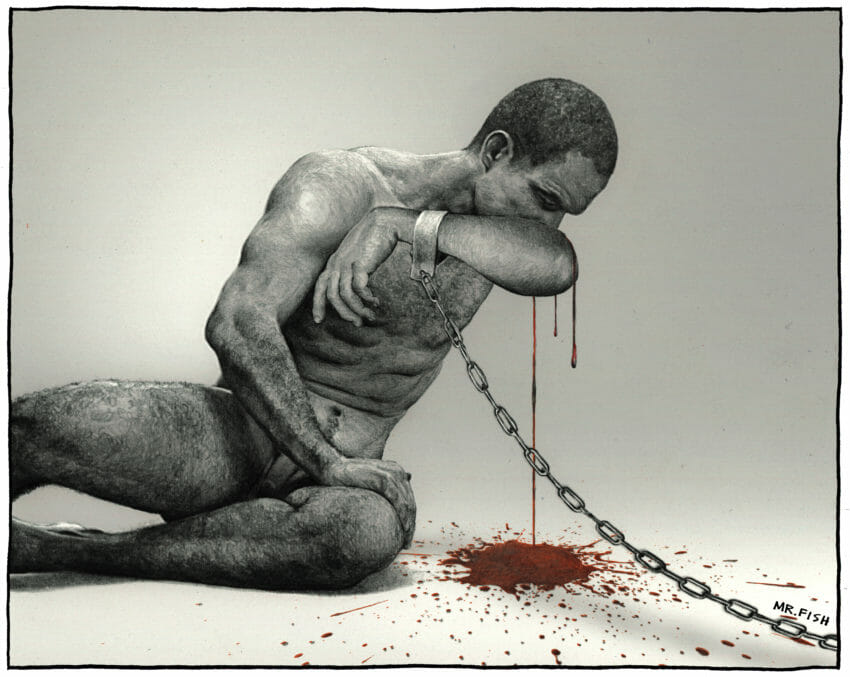
Mr. Fish / Truthdig
The only way to end slavery is to stop being a slave. Hundreds of men and women in prisons in some 17 states are refusing to carry out prison labor, conducting hunger strikes or boycotting for-profit commissaries in an effort to abolish the last redoubt of legalized slavery in America. The strikers are demanding to be paid the minimum wage, the right to vote, decent living conditions, educational and vocational training and an end to the death penalty and life imprisonment.
These men and women know that the courts will not help them. They know the politicians, bought by the corporations that make billions in profits from the prison system, will not help them. And they know that the mainstream press, unwilling to offend major advertisers, will ignore them.
But they also know that no prison can function without the forced labor of many among America’s 2.3 million prisoners. Prisoners do nearly all the jobs in the prisons, including laundry, maintenance, cleaning and food preparation. Some prisoners earn as little as a dollar for a full day of work; in states such as Alabama, Arkansas, Georgia, South Carolina and Texas, the figure drops to zero.
Corporations, at the same time, exploit a million prisoners who work in prison sweatshops where they staff call centers or make office furniture, shoes or clothing or who run slaughterhouses or fish farms.
If prisoners earned the minimum wage set by federal, state or local laws, the costs of the world’s largest prison system would be unsustainable. The prison population would have to be dramatically reduced. Work stoppages are the only prison reform method that has any chance of success. Demonstrations of public support, especially near prisons where strikes are underway, along with supporting the prisoners who have formed Jailhouse Lawyers Speak, which began the nationwide protest, are vital. Prison authorities seek to mute the voices of these incarcerated protesters. They seek to hide the horrific conditions inside prisons from public view. We must amplify these voices and build a popular movement to end mass incarceration.
The strike began Aug. 21, the 47th anniversary of the 1971 killing of the Black Panther prison writer and organizer George Jackson in California’s San Quentin. It will end Sept. 9, the 47th anniversary of the 1971 Attica prison uprising. It is an immensely courageous act of civil disobedience. Prison authorities have innumerable ways to exact retribution, including placing strikers in solitary confinement and severing communication with the outside world. They can take away the few privileges and freedoms, including the limited freedom of movement, yard time, phone privileges and educational programs, that prisoners have. This makes the defiance all the more heroic. These men and women cannot go elsewhere. They cannot remain anonymous. Retribution is certain. Yet they have risen up anyway.
In addition to making demands about wages, the prisoners are calling for an end to the endemic violence that plagues many prisons. During a riot in Aprilat Lee Correctional Institution, a maximum-security prison in South Carolina, seven prisoners were killed and 17 were injured as prison guards waited four hours to intervene.
Prisons in America are a huge and lucrative business. The private prison contractors Corrections Corporation of America and The GEO Group have annual revenues of $1.6 billion and more than $2 billion, respectively. They spent a combined $8.7 million on lobbying from 2010 through 2015, according to OpenSecrets.org. Global Tel Link, which runs the privatized phone services in many prisons, is valued at $1.2 billion. The food service corporation Aramark, a $8.65 billion company, has contracts in 500 prisons across the country although it has been accused of serving contaminated and spoiled food that has led to food poisoning. The money transfer corporation JPay Inc. is a subsidiary of the telecommunications firm Securus Technologies, which is owned by the private equity firm Abry Partners. JPay made $53 million in 2014 on transfers of $525 million, through an average charge of 10 percent to those sending money to prisoners. Corizon Health has a contract to provide health care to more than 300,000 prisoners nationwide. It earns about $1.4 billion a year. And there are many other corporations with equally large revenues and profit margins within the prisons.
Private corporations exploit prison labor in at least 40 states. In some cases these workers are paid next to nothing. They have no benefits, including Social Security participation, and cannot form unions or organize. They are not paid for sick days. And if they complain or are seen as troublesome they are placed in solitary confinement, often for months.
Some of the country’s biggest corporations have moved into prisons to take advantage of this bonded labor force. They include Abbott Laboratories, AT&T, AutoZone, Bank of America, Bayer, Berkshire Hathaway, Cargill, Caterpillar, Chevron, the former Chrysler Group, Costco Wholesale, John Deere, Eddie Bauer, Eli Lilly, ExxonMobil, Fruit of the Loom, GEICO, GlaxoSmithKline, Glaxo Wellcome, Hoffmann-La Roche, International Paper, JanSport, Johnson & Johnson, Kmart, Koch Industries, Mary Kay, McDonald’s, Merck, Microsoft, Motorola, Nintendo, Pfizer, Procter & Gamble, Quaker Oats, Sarah Lee, Sears, Shell, Sprint, Starbucks, State Farm Insurance, United Airlines, UPS, Verizon, Victoria’s Secret, Walmart and Wendy’s.
Fyodor Dostoevsky wrote that “the degree of civilization in a society can be judged by entering its prisons.” Prisons expose how far a state will go to exploit and abuse its most vulnerable. Life in the American prison system is a window into the corporate tyranny that will be inflicted on all of us once we are stripped of the power to resist. The poorest families in the country are forced to pay an array of predatory fees to sustain incarcerated relatives. This is especially cruel to those children whose only contact with an incarcerated parent is through phone service that costs four or five times what it does on the outside. Prison life is one of daily humiliation and abuse. It entails beatings, torture, rape—especially for female prisoners who are preyed upon by prison staff—prolonged isolation, rancid food, inadequate heating and ventilation, substandard or nonexistent health care and being locked in a cage for days at a time, especially in supermax prisons.
Slavery within the prison system is permitted by the 13th Amendment of the U.S. Constitution, passed in 1865 at the end of the Civil War to create a new form of slave labor. It reads: “Neither slavery nor involuntary servitude, except as punishment for crime whereof the party shall have been duly convicted, shall exist within the United States. …” Plantations in the South and industries such as Florida’s vast turpentine farm operations, which survived into the early 20th century, used the 13th Amendment to force black convicts to do the same uncompensated work that many had done as slaves.
“Imprisoned in stockades or cells, chained together at night or held under armed guards on horseback, the turpentine farms were bleak outposts miles from any chance of comfort or contact with the outside world,” Douglas A. Blackmon writes in “Slavery by Another Name,” a description of convict life for tens of thousands of African-Americans that is eerily similar to today’s prison conditions. “Workers were forced to buy their own food and clothes from a camp commissary and charged usurious interest rates on the salary advances used to pay for the goods—typically at least 100 percent.”
Prisons, which contain mostly poor people of color, over half of whom have never physically harmed anyone, are part of the continuum of slavery, Black Codes, Jim and Jane Crow, convict leasing, lynching and the lethal, indiscriminate force used by police on city streets. Prisons are not primarily about crime. They are about social control. They are about profiting off black and brown bodies, bodies that in blighted, deindustrialized neighborhoods do not produce money for corporations but once locked away generate some $60,000 a year per prisoner for prison contractors, police, parole agencies, corrections officers, phone companies, private prisons, money transfer companies, medical companies, food venders, commissaries and the industries that manufacture body armor, pepper spray and the gruesome array of restraints and implements—four- and five-point restraints, restraint hoods, restraint belts, restraint beds, stun grenades, stun guns, stun belts, spit hoods, body orifice security scanners (BOSS chairs), tethers, and waist and leg chains—that look like a collection amassed by the Marquis de Sade. Prisons are also where we warehouse the poor who are mentally ill. It is estimated that 25 percent of the prison population has severe mental illness. Those with crippling mental disorders are given not therapy but cocktails of powerful psychotropic drugs that turn them into zombies sleeping 20 hours a day.
Once corporations moved manufacturing overseas and denied those in poor communities the possibility of a job that could sustain them and their families, they began to extract billions in profit by putting bodies in cages. Since 1970 our prison population has grown by about 700 percent. We have invested $300 billion in prisons since 1980. The prison-industrial complex mirrors the military-industrial complex. The money is public; the profits are private. Those who enrich themselves off the incarcerated are morally no different from those who enriched themselves from the slave trade.
Prisoners, once released, often after decades, commonly suffer from severe mental and physical trauma and other health problems including diabetes (which is an epidemic in prisons because of the poor diet), hepatitis C, tuberculosis, heart disease and HIV. They do not have money or insurance to get treatment for their illnesses when they are released. They have often become alienated from their families and are homeless. Stripped of the right to public assistance, unable to vote, banned from living in public housing, without skills or education and stigmatized by employers, they become members of the vast criminal caste system. Many are burdened with debts because of monetary charges in the criminal justice structure and a predatory system of prison loans. Over 60 percent end up back in prison within five years. This is by design. The lobbyists for the prison-industrial complex make sure the laws and legislation keep the prisons full and recidivism high. This is good for profit. And it is profit, not justice, that is the primary force behind mass incarceration. This system will end only when those profits are wrested from the hands of our modern slaveholders. The only people who can do that are the slaves and the abolitionists who fight alongside them.
The full list of national demands from “the men and women in federal, immigration, and state prisons” reads:
1. Immediate improvements to the conditions of prisons and prison policies that recognize the humanity of imprisoned men and women.
2. An immediate end to prison slavery. All persons imprisoned in any place of detention under United States jurisdiction must be paid the prevailing wage in their state or territory for their labor.
3. The Prison Litigation Reform Act must be rescinded, allowing imprisoned humans a proper channel to address grievances and violations of their rights.
4. The Truth in Sentencing Act and the Sentencing Reform Act must be rescinded so that imprisoned humans have a possibility of rehabilitation and parole. No human shall be sentenced to death by incarceration or serve any sentence without the possibility of parole.
5. An immediate end to the racial overcharging, over-sentencing, and parole denials of black and brown humans. Black humans shall no longer be denied parole because the victim of the crime was white, which is a particular problem in southern states.
6. An immediate end to racist gang enhancement laws targeting black and brown humans.
7. No imprisoned human shall be denied access to rehabilitation programs at their place of detention because of their label as a violent offender.
8. State prisons must be funded specifically to offer more rehabilitation services.
9. Pell grants must be reinstated in all U.S. states and territories.
10. The voting rights of all confined citizens serving prison sentences, pretrial detainees, and so-called “ex-felons” must be counted. Representation is demanded. All voices count!


Leaving Judaism is not a Tragedy


Jewish World Review Oct. 9, 2013 / 5 Mar-Cheshvan, 5774 
Why 71% of Jews believe that leaving 
Judaism is not a tragedy 
but simply a natural progression
By Caroline B. Glick 


Why bother being Jewish? 

JewishWorldReview.com | Why should American Jews bother to be Jewish? According to a new Pew Research Center survey of the American Jewish community, more and more American Jews have reached the conclusion that there is no reason to be Jewish. 
Outside of the Orthodox Jewish community, intermarriage rates have reached 71 percent. Thirty-two percent of Jews born since 1980 and 22% of Jews overall do not describe themselves as Jews by religion. They base their Jewish identity on ancestry, ethnicity or culture. 
Whereas 73% of Jews say that remembering the Holocaust is an essential part of being Jewish, only 19% said that observing Jewish law is a vital aspect of Jewish identity. Fourteen percent say eating Jewish foods is indispensable for their Jewish identity. Forty-two percent say that having a sense of humor is a critical part of being a Jew. 
Gabriel Roth, an intermarried Jewish author, welcomes these numbers. In a column in Slate, Roth claimed that the reason most cultural Jews keep traditions of any kind is a sense of guilt toward their parents and previous generations of Jews. He believes that it's time to get over the guilt. Keeping such traditions has "no intrinsic meaning." 
"How much value can 'Jewish heritage' have if it signifies nothing beyond its own perpetuation?" he asked sneeringly. 
Obviously, the answer is no value. To do something you feel is intrinsically meaningless just because your forefathers did the same meaningless thing is a waste of time. If Judaism has nothing to offer beyond lox and Seinfeld, then there is no reason to remain Jewish. 
The findings of the Pew survey, and indeed, sentiments like those that Roth described are no surprise to those who have been following the downward trajectory of the American Jewish community. 
Numerous initiatives have been adopted over the past decade or so to try to reverse the trend toward assimilation and loss of Jewish identity. These initiatives, including websites like JDate that help Jewish singles find and marry one another, and Birthright, which has brought tens of thousands of young, largely unaffiliated Jews to Israel, have had a positive impact in slowing down the trend. But the move away from Judaism for non-Orthodox American Jews remains seemingly inexorable.
"We have tried a lot of different things and created a lot of wonderful programs," explains political theorist Yoram Hazony, the founder of the Shalem Center and author of The Philosophy of Hebrew Scripture, published last year. 
(Buy it at a discount by clicking here or order in KINDLE edition at a 44% discount by clicking here)
Hazony, who now heads the Herzl Institute, continues, "We've tried everything other than the central thing. Jews need to understand that there is an attractive and compelling idea that makes it valuable to be Jews." 
That idea, as Hazony explained in his recent book, is found first and foremost in the Bible.

“Lots of Very Good Wars!” The Gangsters Have All the Power Now

  OCTOBER 2, 2026 Roaming Charges: “Lots of Very Good Wars!” JEFFREY ST. CLAIR Emai Wounded civilians from the US airstrikes on Enghelab Squ...