Zoeken in deze blog 🔎🔎

zondag 9 september 2012

Obama 213

Kill Lists and Giant Triplets: Obama and the Neoliberal Government
Saturday, 08 September 2012 10:51By Tolu Olorunda, CounterPunch | Op-Ed
Barack Obama.(Photo: The White House / Flickr)Power is self-sufficient, a replete possession, and must be maintained by whatever agency is required.
—Wole Soyinka, Climate of Fear [1]

Wars, especially undeclared ones, invariably boost the powers and status of the president as commander-in-chief. ... A president, however feckless or imposing, is transformed, rendered larger than life. He becomes the supreme commander, the unchallengeable leader and the nation incarnate.
—Sheldon Wolin, Democracy Incorporated[2]

[Author’s note: This essay is an excerpt from The Substance of Truth (Rotterdam: Sense Publishers, 2011). It is offered for reflection on the day the president would, should all go right, accept his party’s nomination for re-election. The begging question, then, is four more years of what? Neoliberalism and imperialism unhinged?]

On January 20, 2009, President Barack Obama received the mantle worn for eight years by George W. Bush, and thereupon swore a new course in domestic andforeign policies, calling in the Middle East for "a new way forward, based on mutual interest and mutual respect," and assuring an economic model on the domesticfront that "helps families find jobs at a decent wage, care they can afford, [and] a retirement that is dignified."[3]
It's been more than two years now, and the tight rope upon which many balanced their hopes—for a truly different and transformative model of governance—has lost a good deal of fidelity, as the Obama Administration proves day after day a determined unwillingness to stray far from many of the policies that earned the ire of millions, the world over, while his predecessor held the fort. From the Justice Department, to the Money Department, to the War Department, promises delivered on the campaign trail that elevated the spirits of citizens, Left and Right, and inspired a political uprising—following eight harrowing years of hubristic, neoliberal rituals—haven't met the early manifestation many expected with a new face and new mind manning the White House. So, now, one question widely abounds: Who is the real Obama? But to ask "is to drift towards the illusion of thinking there is one—as opposed to an infinitely mutable organism, endlessly adapting to political circum­stance, with an eye eternally cocked to the main chance."[4]
Asked often why he, then a one-term U.S. Senator, chose to run for a post many believed he lacked qualifications for, Obama invoked Reverend Martin Luther KingJr.'s exhortation, "the fierce urgency of now," which King applied in a bold April 4, 1967, speech against the Vietnam War efforts of the LBJ Administration, refusingto surrender to "the apathy of conformist thought within one's own bosom and in the surrounding world." Nothing short of "a radical revolution of values," Kingordered, to force a rapid "shift from a thing-oriented society to a person-oriented society." Societies on the brink of defeat against spiritual death need no pointing out,he said. They celebrate "machines and computers, profit motives and property rights" as "more important [than] people." They make like ants and cower before thetrampling wrath of "the giant triplets of racism, extreme materialism, and militarism."
Not one jot or tittle of King's words needs revision 40 years after, even with a Black president warming the highest seat of the land. And if Barack Obama would be remembered years later as a president with rare rigor to "go out into a sometimes hostile world declaring eternal hostility to poverty, racism, and militarism,"[5] hewould have to substitute strikingly different agendas for those currently underway in the first two years of his Administration. So far, the triple giants haven't faced much opposition.
RACISM
On the travails of communities of color, Barack Obama hasn't put forth much. The Black community especially has been blessed with very little from the man 96% ofits voting bloc threw weight behind—and shoveled through snowy, ice-cold weather to see sworn in on Inauguration Day. Of the disparate conditions afflicting Blackand Brown people, the Obama Administration has found very little desire to address.
On the campaign trail, and even before his February 2007 announcement bid for the presidency, Obama's message to Black America differed little from conservative calls for Personal Responsibility, even with glaring institutional and structural barriers obstructing millions of Blacks and Browns from upward mobility. Obama chided poor Black women for feeding their kids leftover Popeyes chicken meals; in sweeping generalization, he scolded Black men for watching SportsCenter ex­cessively (even though later admitting, on several accounts, SportsCenter was his favorite program); he bashed Black boys who fostered dreams of one day playing basketball professionally or making money as rappers.
On economic inequity, nothing better to be said. His analyses find deeper solidarity in neoconservative circles than liberal enclaves. Speaking March 2007 at thehistorical Brown Chapel A.M.E. Church in Selma, Alabama, Obama offered a narrative no White politician could let slip off without facing indignation more fiery than hell harbors. He proclaimed the Civil Rights Movement had brought Black people "90% of the way" to equality, but "[w]e still got that 10% in order to cross over to the other side."[6] That Black net worth only equals 10 cents for every dollar of White net worth failed to factor into this strange interpretation of history and reality. That Blacks barely earn 62 cents for every dollar of White income found no vindication in his sermon;[7] neither did Blacks, despite only 14% of the U.S. population, facing incarceration rates seven times higher than Whites.[8]
A month later, Obama lectured a group of Black South Carolina state legislators on how a "good economic development plan for our community would be if wemake sure folks weren't throwing their garbage out of their cars."[9] Not racist loan practices, not back-bending poverty, not unanswerable greed in government halls, but littering—pushes Black communities farther from self-sufficiency.
Two years earlier, right after Hurricane Katrina had made landfall, Obama stood up to those—in one poll, 84% of the Black community[10]—who held without a shadow of doubt, based on overwhelming evidence, that Race and Class rendered the victims less concerning to their government. "There's been much attention in the press about the fact that those who were left behind in New Orleans were dispro­portionately poor and African American," Obama observed in a statement. "I've said publicly that I do not subscribe to the notion that the painfully slow response of FEMA and the Department of Homeland Security was racially-based. The ineptitude was colorblind."[11]
To great delight of many White centrists and conservatives, Obama repeatedly told the Black poor their conditions could be rectified if only they decided at once toput away childish things and pull themselves out of social and financial misery with the bootstraps of Personal Responsibility. Prominent White conservatives likeGeorge F. Will, Charles Krauthammer, and William Bennett respectively commended Obama early on for refusing to "subscribe to a racial narrative of strife and oppression," for choosing not to "run as a candidate of minority grievance," for never bringing "race into it."[12] But White liberal elites also took great pride in the Black-bashing campaign Obama's team tried to woo skeptical middle-class Whites with. Newsweek editor Jonathan Alter doled out a disturbing contribution in March 2008, suggesting Obama's "most exciting potential for moral leadership could be in the African-American community." After all, he had achieved the impossible—telling them, above all else, "they need to stop being homophobic and anti-Semitic."[13]
In governance, many of Obama's racial philosophies have produced pernicious policies. Asked April 29, 2009, his 100th day in office, "what specific policies can you point to that will target ... communities [of color] and what's the timetable for us to see tangible results"? Obama clung to the farcical fantasy that a rising tide lifts all boats—"my general approach is that if the economy is strong, that will lift all boats as long as it is also supported by, for example, strategies around college afford­ability and job training, tax cuts for working families (as opposed to the wealthiest) that level the playing field and ensure bottom-up economic growth."[14]
Not long after inauguration, Obama unveiled an education budget which cut $85 million for Historically Black Colleges and Universities (HBCUs)—of particular pain at a time when HBCUs, responsible for nearly 20% of undergraduate degrees for Black students, face steeper hurdles from the economic tumbledown. American Indian Tribal Colleges as well fell victim to the budget scalpel.[15]
Under Obama's watch, Black men still swell up the prison-industrial complex at rates disproportionate to Whites, and often for crimes nonviolent. Very little address from the President and his Justice Department has attended this ever-expanding tumor. And while appointees like Timothy Geithner and Thomas Daschle faced nolegal scrutiny for their tax troubles, Black men—as the tragic case of Detroit activist Reverend Edward Pinkney reminds—forever face the wrath of the court system for infractions like invoking biblical scripture to slam a judge.[16]
When his attorney general, Eric Holder, condemned the cowardly conscience of many who won't acknowledge racial disparities, Obama admonished him coldly: "We've made enormous progress and we shouldn't lose sight of that."[17]
In defense, Obama has enjoyed the acquiescence of a Black leadership in crisis (and denial), which for several reasons remains reluctant to challenge the presidentpublicly on any matters. On the one hand, they should hate to grant the Glenn Becks and Rush Limbaughs of the Lunatic Right any additional ammo in blasting away at the president for just about anything; and on the other, they've convinced themselves any popular backlash from the Black community against the First Black President could seal the fate of all Black aspirants for at least another century—that White voters would be let off the hook and feel no more guilt-produced pressure to push another Black person in there, to make up for the past. The Black leadership elite and Black mainstream press don't intend to hold the First Black President's feet to the fire, even if his policies only further subjugate communities they claim to serve and represent.
Ralph Ellison saw this storm blowing five decades ago. "I would like to see a qualified Negro President of the United States," he confessed. "But I suspect that even if this were today possible, the necessities of the office would shape his actions far more than his racial identity."[18] These necessities, unfortunately, have stamped on them the trumpeting of neoliberal economic initiatives at the expense of communities of color.
EXTREME MATERIALISM...'

The Empire 817


Great speech, Bill, but I’ve got a problem

By Alan Bean
Only Bill Clinton can hold an audience through fifty minutes of uninterrupted wonkery.  His speech at the Democratic Convention displayed rhetorical skill, a keen grasp of policy detail and a deep understanding of political reality that only comes with painful experience.  They say convention speeches have little lasting impact.  Clinton’s performance last night may qualify as the rare exception.
But I’ve got a problem.
Mr. Clinton’s triangulating legacy is a big part of the mess we face as a nation.  The Man from Hope mastered the art of the deal.  He met his opponents half way.  He stole their best material.  The new corporate aristocracy could live with a free trading Democrat like this.
Thanks largely to the repeal of Glass-Steagall and the speculative bubbles that followed in its wake, the middle class prospered on Clinton’s watch.  But the poor and the vulnerable (the folks Friends of Justice, and God Almighty, cares about the most) have paid a dreadful price for Clinton’s political success.
In 1996, Clinton signed the Personal Responsibility and Work Opportunities Act that ended welfare as we know it.  The plan worked reasonably well where job markets were strong.  But in many small towns and urban neighborhoods the move from welfare to work, wonderful in theory, didn’t translate to the street.  Now that the job market for the poorest 20% has virtually disappeared, Mr. Clinton’s chickens are roosting everywhere.
And that’s just for starters.  As Michelle Alexander has pointed out to devastating effect, Mr. Clinton perpetuated and extended the war on drugs, a major driver of mass incarceration.  True, this ill-conceived crusade was aided and abetted by the Black Congressional Caucus, the NAACP and the civil rights community in general.  No one wanted to stand up for drug dealing thugs.  An underground economy born of despair was widely condemned but rarely understood.  No one could afford to understand it.
Clinton’s record on immigration was abysmal.  This comment from 1996 typifies his attitude:
We must not tolerate illegal immigration. Since 1992, we have increased our Border Patrol by over 35%; deployed underground sensors, infrared night scopes and encrypted radios; built miles of new fences; and installed massive amounts of new lighting. We have moved forcefully to protect American jobs by calling on Congress to enact increased civil and criminal sanctions against employers who hire illegal workers. Since 1993, we have removed 30,000 illegal workers from jobs across the country.
It sounded sensible at the time, unless you were one of the 12 million undocumented workers who came to America looking for a decent job or to be reunited with family.  Clinton’s support for NAFTA dispossessed thousands of Mexican farmers, many of whom saw a desperate flight America as the only solution to their dire economic problems.  Clinton’s focus on deportation has born poisonous fruit.  According to journalist Seth Wessler:
For the last decade and a half, rates of deportation have steadily risen. In 1992, the U.S. government removed 44,000 people, a historical number at the time. In less than two decades, that number has grown ninefold. In fiscal year 2011, a record-breaking 397,000 people were removed from the U.S. because of their immigration status.
Bill Clinton liked immigrants, just like he liked poor Black people; but he was so far removed, socially, economically and psychologically, from the harsh world of poverty that, repeatedly, he backed the wrong policy horse.  He failed to understand that, for the vast majority of the American undocumented, there isno legal path to citizenship.
There is a big difference between the Republican Marco Rubio and the Democrat Julian Castro.  Because Rubio’s family hails from Cuba, they were welcomed to America just like my white ancestors who arrived in Pennsylvania and South Dakota.
But as Julian Castro shared in his speech earlier this week, his grandmother came to San Antonio from Mexico during a period when you could still cross the Rio Grande with relative impunity.  His mother, Maria del Rosario Castro, was a key organizer with La Raza Unida, a Chicano political party that gave Latinos their first entree into Texas politics in the 1960s and 70s.  For this,she is frequently despised as an America-hating radical.
Mexican nationals who cross the Rio Grande today live in constant dread of the border patrol, ICE officials and the rest of the bloated bureaucracy currently feeding on the carcass of anti-immigrant fervor.  People living in mixed-status families are often afraid to leave their homes for fear of arrest, detention and deportation.  When this occurs, it can be weeks, even months, before loved ones know what happened.
Marco Rubio’s family avoided these indignities by virtue of coming to the United States from a communist nation.  Refugees from Guatemala, Peru and, yes, Mexico, receive a very different reception.  For these brave men and women there is no immigration process, no line to stand in, no legitimate path to citizenship.  They either enter America without documentation, or they surrender to a hopeless plight.
I am not suggesting that Bill Clinton is responsible for mass incarceration, mass deportation, or the rapid deterioration of America’s poorest neighborhoods.  Facing a tidal wave of intolerance, dread and ignorance, Clinton did what it took to survive politically.  Don’t Ask, Don’t Tell wasn’t his idea of a sensible policy; it was simply the best idea available at the time.
I have been moved, encouraged, even inspired by the speakers at this year’s Democratic Convention.  The party’s unapologetic embrace of marriage equality, the DREAM act, and women’s issues is significant.  The party’s rejection of free market fundamentalism and trickle down fantasy is refreshing.
But huge problems remain.  We will never comes to grips with the debt problem until we shrink our military to one-third its present size.  We cannot justify, on moral or economic grounds, spending more on our military than the rest of the world combined.
Bill Clinton survived by meeting corporate America half way.  Neither he nor president Obama can match the Right’s  willingness to hew wood and draw water for the big money boys, which is why the Romney campaign is way ahead in the donation game.  But will the Democrats construct an economic policy that is sure to anger potential donors?
If we left the decision to Elizabeth Warren, perhaps.  If it’s up to Rahm Emmanuel (or virtually everyone else in Obama’s trusted inner circle), you can forget about it.  In America, you can be realistic about balancing the budget or you can be in the tank for the multinational corporations, but you can’t be both.  A financial culture dedicated to short-term profit regardless of the cost will not tolerate sane economic policy.  So long as we’re chasing the next speculative bubble we’re chained to the boom-bust roller coaster.
Could Bill Clinton have succeeded without giving away half the farm to money and militarism while caving in to drug war and anti-immigrant passions?
Can Barack Obama win re-election if he tells us the truth about immigration, the Israel-Palestinian question, the national debt and a thousand other issues?
Can any politician, of whatever ideological stripe, tell the American people that the American dream is gone and it ain’t coming back?
Can we expect to hear our leaders admit that America, for all her military might and financial clout, is no better and worse than any other nation or that, red and yellow, black and white, all are precious in God’s sight?
To ask these question is to answer them.
The sky is not falling any time soon. It is possible that neither global warming nor the next great depression will unfold in my lifetime.  But gradually, year-by-year, the earth’s temperature will rise and the plight of the American middle class will worsen.  The slow-boil may come too gradually for most of the frogs in the American kettle to realize what’s coming, but come it will.
And that’s why our politics of denial is such a tragedy.  Middle-of-the-road politicians keep their heads above water by cutting deals and triangulating.  Potential leaders who speak an approximation of the truth are dismissed, by virtually everyone, as crackpots and extremists.
We can no longer blame the Republicans or the Tea Party for our plight.  When Bill Clinton moved the Democrats to the political center, the Republicans (and their corporate masters) were forced to the extreme Right.  Republican incumbents can no longer cut deals with Democrats without losing the next primary contest to a no-comprises Tea Party zealot.  What worked for Bill Clinton will not work for Barack Obama.  The Republicans don’t oppose the president even when he steals their old ideas because they are mean or crazy; they do it because they are afraid.  If Obama wins re-election we will see four more years of gridlock.
The alternative, of course, is Mitt Romney, a man who has reversed course on every substantive issue from abortion to health care to immigration in order to claim his party’s nomination.  Like Bill Clinton before him, Mr. Romney is the victim of American denial.  It’s not his fault.  There is little he can do but grind his teeth in the night.  This is the America we all live in and nobody, me included, knows how to fix it.
Most likely we will never return to an America in which every decade provided greater prosperity than the last.   We’ve had a good run since the late 1930s, but the rest of the developed world has caught up with us and, in some respects, is passing us by.  We don’t work harder, faster or smarter than other nations, not anymore.
Nor can the world’s economic pie keep expanding forever.  An environmental crisis is just around the corner.  How sad that Mitt Romney used fears of global warming in a failed attempt at humor, while Barack Obama made only one fleeting reference to the issue.  Ten hears hence, the environment will have seized our attention and we will be lamenting our present inattention.
The question is not whether we can return to a world of endlessly expanding prosperity.  The question is how we are going to manage the transition from more to less.  Will we lapse into total denial?  Will we endlessly extol the American Dream circa 1952?  Or will we chart a bold new course rooted in community building and an ethic of enough?
Barack Obama’s speech suggests that he knows more than he can say.  He made little attempt to inspire.  His tone was serious.  He made the expected paean to American greatness, but refused to promise an easy future.  Instead, he called for cooperation and shared sacrifice.  He called on the corporate community to value job security over instant profits.
How did this play in the board rooms of America?  Not well, I suspect.  But it was good to hear the words nonetheless.  The president was rolling the dice, betting that we are ready for that kind of message.
I am.  What about you?

A rabbi’s path to Palestinian solidarity

Editor’s note:   Below is an excerpt from Rabbi Brant Rosen’s new book.  It 

is a record of his journey from liberal Zionist to Palestinian solidarity
activist.  Along the way he has grappled with issues that have elicited
heated debate from his congregants and his readers - something he is glad
about because he says “we simply must find a way to widen the limits of
public discourse on Israel/Palestine, no matter how painful the prospect.”
In it you will find discussions about the growing campaign for BDS –
Boycott, Divestment and Sanctions – and whether it is anti-Semitic; Israel’s
treatment of the Palestinians and whether it constitutes apartheid; and
whether the founding of Israel is based on an injustice.  His own growing
realisation of the terrible injustice that has been done and continues to be
done to the Palestinians is something that he covered up with the usual plea
for “peace and coexistence” until Israel’s ferocious attack on Gaza, known as
Operation Cast Lead, left him in no doubt that “this is not about security at
all – this is about bringing the Palestinian people to their knees.  Once I
admitted
 this to myself, I realized how utterly tired I had become.   Tired
of trying to excuse the inexcusable. Tired of using torturous, exhausting
rationalizations to explain away what I really knew in my heart was sheer
and simple oppression.”

If a rabbi can come to this conclusion beyond any shadow of doubt, then our
political and religious leaders really need to search their own consciences
and stop talking about the conflict as if it is between two equal
protagonists – it is most definitely not and never has been – and move on
from the long compromised “peace process” based on a two state solution that
was doomed from the moment the Oslo accords were signed.  We may not be
able to make good the cumulative injustices suffered by the hundreds of
thousands of Palestinians who have died in exile and under occupation, but
we must begin to make reparations to the generations who bear still festering
wounds and new ones of this monumental human catastrophe.

Sonja Karkar
Editor
http://australiansforpalestine.com


Wrestling in the daylight -
A rabbi’s path to Palestinian solidarity
by Brant Rosen
MONDOWEISS
8 September 2012

        Jacob was left alone. And a man wrestled with him until the break of dawn.
       —Genesis 32:25 

This well-known Biblical episode leaves behind tantalizing questions. Who is
the mysterious “man” with whom Jacob wrestles? What is his identity, and
where did he come from? One popular interpretation suggests that the night
stranger with whom Jacob struggles at this critical moment is none other
than Jacob himself—perhaps his alter ego or his shadow self.

But why must the wrestling match necessarily take place at night? Why does
the night stranger say so desperately to Jacob in the next verse, “Let me
go, for dawn is breaking?” Perhaps this detail is teaching us that our
deepest struggles invariably occur in the most private of places. After all,
whenever we publicly wrestle with our deepest dilemmas, doubts, or fears, we
take a very real risk. That’s why we tend to engage in our most challenging
struggles internally—“in the dead of night.” This book is, among other
things, a record of the moment I personally began to wrestle in the
daylight. It documents a two-year period during which I publicly struggled,
as a congregational rabbi, with one of the most difficult and painfully
divisive issues facing the American Jewish community.

* * *
I’ve identified deeply with Israel for most of my life. I first visited at a
very young age and have been back to visit more times than I can even count.
In my early twenties, I spent two years there studying, working, and living
on kibbutzim. I have family members and many dear friends who live in
Israel. My Jewish identity has been profoundly informed by the classic
Zionist narrative: the story of a small underdog nation forging a national
and cultural rebirth out of the ashes of its near-destruction. The
redemptive nature of this narrative has at times assumed a quasi-sacred
status for me, as it has for many American Jews of my generation and older.

Politically speaking, I’ve identified with what tends to be referred to
today as “liberal Zionism.” I’ve long been inspired by Israel’s Labor
Zionist origins, and I’ve generally aligned myself with positions advocated
by the Israeli left and the Israeli peace movement. When it came to the
ongoing conflict with the Palestinians, I’d invariably intone a familiar
refrain of liberal Zionists: “It’s complicated.”

If I found myself occasionally troubled by ill-advised or even unjust
Israeli policies, I tended to view them as “blemishes” on an otherwise
stable democracy and a noble national project. At the end of the day, I
understood the essence of this conflict to be a clash between two national
movements, each with compelling and valid claims to the same small piece of
land. In the end, the only viable, equitable solution would be its division
into two states for two peoples.

Over the years, however, I confess, I struggled with nagging, gnawing doubts
over the tenets of this liberal Zionist narrative. Although I was able to
keep these doubts at bay—for the most part—I was never able to successfully
silence them. I experienced the earliest of these doubting voices when
Israel invaded Lebanon in 1982, unleashing a shocking degree of military
firepower that shook my naive “David vs. Goliath” assumptions to their core.
Several years later, the voices grew even louder as I witnessed the
brutality with which Israel put down the nonviolent Palestinian
demonstrations of the First Intifada. And they grew more insistent still
when I began to witness firsthand the darker truths of Israel’s oppressive
occupation of the West Bank and Gaza.

Truth be told, however, if I was troubled by these things, it was less out
of concern for the well-being or safety of Palestinians per se than it was
the tribal notion that the occupation was “corrupting Israel’s soul” and
endangering Israel’s future existence as a “Jewish and democratic state.”
Like many liberal Zionists, I dealt with such concerns by retreating to the
safety of political pedagogy: These troubling realities simply proved to us
all the more that we needed to redouble our efforts toward the peace process
and an eventual two-state solution.

When I was ordained as a rabbi in 1992, the stakes were raised on my
political views—particularly when it came to Israel/Palestine. Given the
ideological centrality of Zionism in the American Jewish community, my inner
conflicts over Israel’s oppressive treatment of Palestinians now carried
very real professional consequences. Rabbis and Jewish leaders are under
tremendous pressure by the American Jewish organizational establishment to
maintain unflagging support for the state of Israel. Congregational rabbis
in particular take a very real professional risk when they criticize Israel
publicly. To actually stand in solidarity with Palestinians would be
tantamount to communal heresy.

Shortly after I was ordained, I began reading the newly published English
translations of Israel’s “New Historians”—important scholars, such as Benny
Morris, Tom Segev, Avi Shalim, and Ilan Pappe—who exposed the darker truths
about the establishment of the Jewish state and the birth of the Palestinian
refugee problem. These books had a powerful, even radicalizing, impact upon
me. I became increasingly struck by the sheer injustice that accompanied
Israel’s birth, an injustice that was not only historical but, as I was
coming to believe, still very much present and ongoing.

From here, I began to entertain difficult questions about the ethnic
nationalism at the heart of Zionism—and became more and more troubled that
Israel’s identity as a Jewish state was entirely dependent upon the
maintenance of a Jewish majority within its borders. In the United States,
the very suggestion of a “demographic time bomb” (an oft-used term used by
liberal Zionists to advocate the critical importance of a two-state
solution) would be considered incorrigibly racist. In my more unguarded
moments, I’d ask myself: Why, then, do we bandy this concept about so freely
when it pertains to the Jewish state?

Despite the questions, I nevertheless found a safe and comfortable home in
liberal Zionism for the first decade of my rabbinate, affiliating with such
organizations as Americans for Peace Now, Brit Tzedek v’Shalom, and J
Street. All the while, the gnawing voices continued. Although I shared the
elation of many at the signing of the Oslo Accords in 1993, my optimism was
short-lived. In due time, Israel expanded its settlement regime over the
Palestinian territories, Israeli Prime Minister Yitzhak Rabin was
assassinated, and the Clinton-brokered peace talks at Camp David crashed and
burned.

When the horrors of the Second Intifada began in the fall of 2000, I dealt
with my anguish through a carefully cultivated avoidance of the
Israel/Palestine issue. Whenever I addressed the subject in writings or
sermons, it was usually with a vague but essentially substance-free plea for
“peace and coexistence” on both sides. I would mourn the loss of life for
both peoples and advocate redoubling our efforts at a peace process I
increasingly feared was empty at the core.

Israel’s second military campaign in Lebanon during the summer of 2006
jolted me temporarily out of my avoidance. As I read and watched another
military bombardment of Beirut—and my e-mail inbox filled up with Jewish
Federation blasts exhorting me to support the Israel Emergency Campaign—I
was deeply saddened that my community showed precious little concern about
the sheer magnitude of the violence Israel was unleashing yet again against
the people of Lebanon. Although I certainly felt compassion for—along with a
certain tribal solidarity with—the citizens of Northern Israel suffering
under Hezbollah rocket fire, I was unable to accept the utter destruction
the IDF was inflicting upon Lebanon in the name of national security. Still,
I kept my silence. The pressure to present a united Jewish communal front
during a time of war still trumped my own inner struggle.

In October 2006, I started a keeping a blog I called Shalom Rav. (The title
is a pun: Shalom rav, or “abundant peace,” is the name of a well-known
Jewish prayer—but the Hebrew can also be taken to mean “hello, Rabbi.”) At
the time, my intention was simply to hold forth on anything or everything I
thought to be worthy of sharing over the blogosphere. As a congregational
rabbi serving in Evanston, Illinois, I also thought it would be an effective
way for my congregants to hear more regularly from their rabbi.

Because social action had always played an important role in my rabbinate, I
intended to devote a significant percentage of my blog posts to current
issues of social justice and human rights. As a result, a reader perusing
Shalom Rav in those early years could read my thoughts on subjects as
wide-ranging and diverse as the wars in Iraq and Afghanistan, fair-trade
coffee, torture at Guantánamo, poverty and hunger in sub-Saharan Africa, and
human rights in Darfur. Soon, however, the focus of my blog changed
dramatically.

* * * 

                On December 28, 2008, I read the first news report of Israel’s 
military assault on Gaza—a campaign that would soon be well-known as
Operation Cast Lead. On the first day of operations, the Israeli Air Force
destroyed Hamas security facilities in Gaza, killing more than 225 people,
most of whom were new police cadets participating in a graduation ceremony.
Numerous civilians, including children, were also among the dead. By the end
of the day, it was clear we were only witnessing the beginning of a much
longer and even more violent military campaign that would drive much farther
into Gaza.

I remember reading this news with utter anguish. At the same, oddly enough,
I realized that I was finally observing this issue with something
approaching true clarity: This is not about security at all—this is about
bringing the Palestinian people to their knees.

Once I admitted this to myself, I realized how utterly tired I had become.
Tired of trying to excuse the inexcusable. Tired of using torturous,
exhausting rationalizations to explain away what I really knew in my heart
was sheer and simple oppression.

After staring at my screen for what seemed like an eternity, I logged on to
my blog and typed out a post entitled “Outrage in Gaza: No More Apologies.”
I ended with a declaration—and a question:

What Israel has been doing to the people of Gaza is an outrage. It has
brought neither safety nor security to the people of Israel and it has
wrought nothing but misery and tragedy upon the people of Gaza.

There, I’ve said it. Now what do I do?
Although it was a simple and not particularly eloquent post, I knew full
well what it would mean when I clicked “publish.” It represented a very
conscious and public break from the liberal Zionist fold that had been my
spiritual and political home for almost my entire life. But although I was
finally very clear about what I was leaving behind, I was not at all sure
about where I now belonged. Hence the final line of my post: Now what do I
do?

Although I expected my words to make waves, I was still astonished by what
happened next: The post immediately went viral, eliciting 125 comments in
less than a month—far more than I have ever received before or since.
Although some of the initial commenters were congregants, I ultimately
received responses from all over the world. Predictably, some lashed out
against my post, but as the comments continued to roll in, I was surprised
to read the words of many more—congregants, Jews, and non-Jews
alike—expressing their immense thanks for what I had written. The comment
thread was peppered with a palpable sense of gratitude and relief that a
Jewish leader—a rabbi, no less—had finally crossed a significant line so
publicly.

My post was not, as many assumed at the time, a temporary burst of emotion
on my part. As Israel intensified its military assault on Gaza throughout
January 2009, my anguish only deepened. I read news reports of Apache
helicopters dropping hundreds of tons of bombs on 1.5 million people crowded
into a besieged 140-square-mile patch of land. I learned about the bombing
of schools and homes in which entire families were destroyed, about men,
women, and children literally burned to the bone with white phosphorus.
Throughout it all, I continued to blog openly about the outrages I believed
Israel was committing in Gaza—and about my increasing sense of solidarity
with Gazan civilians.

Over the months following Cast Lead, I broadened my scope, writing numerous
posts addressing my changing relationship to Israel. As the months went by,
I brought all my nagging, gnawing doubts out into the bright light of day.
It soon became clear to me that Cast Lead was simply the final tipping point
of a domino line I’d been setting up steadily over the years. I became
increasingly involved in Palestinian solidarity work, founding, with my
colleague Rabbi Brian Walt, an initiative called Jewish Fast for Gaza and
taking on a leadership role in the rapidly growing national organization
Jewish Voice for Peace. Along the way, I recorded and commented upon my
newfound activism in Shalom Rav.

Although I knew I was taking a risk on many levels by publishing my initial
post, the conversation that has resulted fills me with hope. I am immensely
proud of the relatively high and eloquent level of the debate on my blog,
and I am regularly awed by the willingness of so many of my commenters to be
fundamentally challenged over such a difficult issue. Over the years, I’ve
been humbled and excited to convene this lively, almost Talmudic discussion
between members of my congregation along with countless others: Jews,
Israelis, Palestinians, Muslims, Christians, and citizens of various
ethnicities and nations, many of whom I have never actually met—and most
likely never will.

* * *

                Today, I continue to serve my congregation in Evanston. I continue to 
“wrestle in the daylight,” and I continue to advocate for a just peace in
Israel/Palestine. I’m often asked where I stand now—that is, now that I’ve
officially broken ranks with liberal Zionism. Although it’s not a simple
answer, I do know this: My primary religious motivation comes from my
inherited Jewish tradition, in which God commands me to stand with the
oppressed and to call out the oppressor. I know that the American Jewish
community is my spiritual home and that I stand with the Palestinian people
in their struggle against oppression. And I know that I fervently desire a
just and peaceful future for Israelis and Palestinians.

I also know that my constituency is not as narrow as some might think.
Through my work, I have come to discover increasing numbers of
Jews—particularly young Jews—who genuinely seek a home in the Jewish
community but cannot countenance the Jewish establishment’s orthodoxy on
Israel. I have also met many non-Jews—including Palestinians, interfaith
colleagues, and fellow political activists—who constitute a new, exciting,
ever-growing community of conscience.

Along the way, I’ve come to believe that too many of us have been wrestling
in the dark on this issue for far too long. I believe we simply must find a
way to widen the limits of public discourse on Israel/Palestine, no matter
how painful the prospect. It is my fervent hope that the conversations
presented here might represent, in their small way, a step toward the light
of day.

AFP link: http://www.australiansforpalestine.net/69335#more-69335
Original Link: http://mondoweiss.net/2012/09/wrestling-in-the-daylight-a-rabbis-path-to-palestinian-solidarity.html

The Neoliberal Religion 47


Myths & Surprises in the so-called Recession. Towards a Mixed Economy

jumpf-ers
Silvia Swinden | Pressenza
The Credit Rating Agencies, the OECD and the World Bank continue to forecast ­– and perhaps also induce – worse to come in the World Economy, prompting further austerity measures, cuts, privatisations and rounds of QE (not Queen Elizabeth but Quantitative Easing: Printing Money without printing it but electronically making it available to banks). The EU demands that high unemployment stricken Greeks work a longer week (!?) and rescue packages to banks disappear into the black holes of Tax Havens. Climate Change forecasts disasters but the Chinese are blamed for “dumping” cheap solar panels on Europe – and for increasing their carbon footprint as we outsource them industrial production, whilst expecting they should save the global economy. The – many and varied – sane economic alternatives are dismissed outright. Not everything is what it seems.
The culture of today’s global financial ethos is one of consumerism (“I shop therefore I am”), mass production and economic growth followed by periods of “recession” during which the most successful companies buy out or force the weaker ones to close in a process of progressive concentration never seen before in the history of humanity. Rapid speculative profit rather than long term investment creates a sense of uncertainty and instability where only having lots of money (never enough, in fact) can protect a member of this system’s image of the future. In this way only money, a meaningless convention, rather than the creative process of production, acquires any weight in the scale of society’s values. Human relationships are marked by relentlessly stressing the advantages of individualism, competition and success. Existential emptiness is filled by the progressive development of the entertainment industry. The senses are caressed by visual images, music, and the opportunity to live vicariously the life of heroes and heroines, celebrities and victims of atrocities, princesses and murderers, all from the comfort of our own living room, whilst the values of the pervading system are absorbed uncritically.
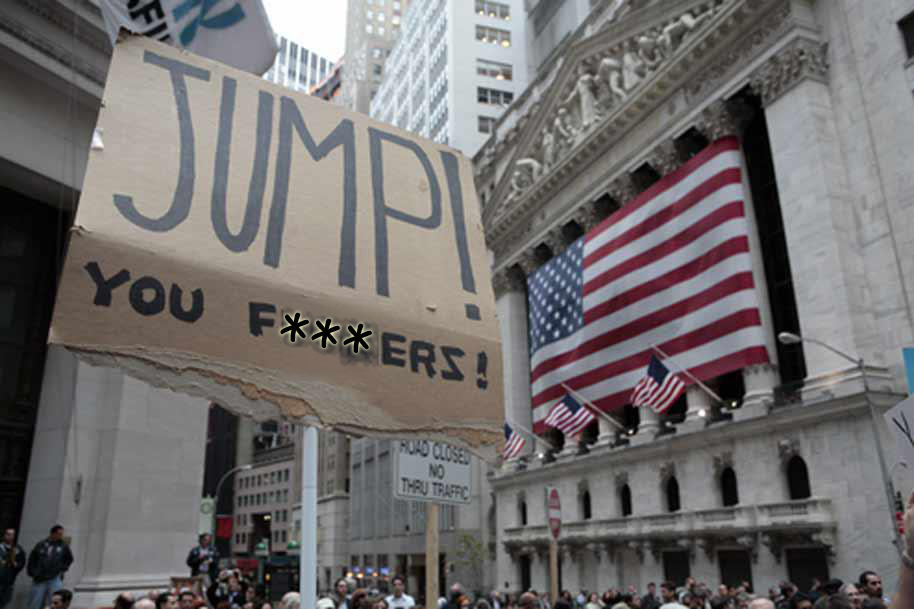
But sometimes something does not make sense, and it makes us wonder: “Woman plunges to her death from top restaurant that has become suicide spot for City (London’s Financial District) workers.” How many? Three, between 2007 and 2012; all successful members of the Financial Sector workforce, with different stories but immediately bringing up memories of stockbrokers’ mass suicides in the 1930’s crash. According to Macleansthere were 6 stock market related deaths in Wall Street during 2008. Different sources put the 1930 death tall at around 23,000. It’s one of the most deeply ingrained images of Wall Street during the crash: the distraught stockbroker out on the window ledge. During the bank bailouts in September, protesters outside the New York Stock Exchange carried “Jump you f***ers” placards.
Interestingly enough the American Economist John Kenneth Galbraith (1) reports in his book The Great Crash, that statistically the suicide rate didn’t increase at all in New York during the months of the 1930 crash. Nor were there many actual cases of Wall Street types jumping. Instead, the “suicide myth” grew out of the popular belief that broken speculators are predisposed to self-destruction. “News coverage of bankers jumping to their deaths was so intense that sidewalks began to be seen as unsafe”, according to historian Charles Geisst’s Wall Street: A History. “But for all the attention the deaths received, the phenomenon was limited”. In fact, considering that at the time 12,000 workers were being laid off every day the suicide rate may well have been increased by unemployment. (BBC)
Enter QE, inject money into the economy, save the banks, try to control de inevitable inflation that will ensue and fail again to kick-start the economy. The reason? The collective wealth of the Britain’s’ 1,000 richest people rose by 30% in 2010 in the wake of the economic crisis. In New Zealand the richest 150 increased their wealth by 20%. Very simply, a system designed to concentrate wealth will continue doing so unless the rules are changed. More importantly, “growth” is not synonymous with “well being” and unless human markers rather than monetary ones take centre stage we will not be able to address the real suffering created by this system. Suicide is always difficult to understand, more so if people are not listened to. Aggression? Riots? Domestic violence? Racism? Substance abuse? Blame the individual, nothing to do with society.
Crisis? What Crisis?
Big Money, Big Oil, Big Pharma and Big Arms Trade, are all enjoying record profits. But they are not the only ones navigating through the crisis without too much trouble. In fact, it is not necessary to sell your soul to the devil to remain economically viable. There are many examples of companies and towns that sticking to high human centred moral principles organise themselves for stability and growth.
Many people are surprised when told that John Lewis, the swish high street department store and its subsidiaries, is owned by its workers; a cooperative, or partnership, where the employees are the shareholders as profits are distributed amongst all, as bonuses. It was of course affected by the downturn but the reduction in bonuses (on average 18% of the salary) was just of 3.5%, (for the first time in 3 years) with no layoffs and the creation of 4.400 new jobs.
The Mondragon Corporation is a federation of worker cooperatives based in the Basque region of Spain. Founded in the town of Mondragón in 1956, currently it is the seventh largest Spanish company in terms of asset turnover and the leading business group in the Basque Country. At the end of 2011 it was providing employment for 83,869 people working in 256 companies in four areas of activity: Finance, Industry, Retail and Knowledge. Scholars such as Richard D. Wolff, American professor of economics, have hailed the Mondragon set of enterprises, including the good wages it provides for employees, the empowerment of ordinary workers in decision making, and the measure of equality for female workers, as a major success and have cited it as a working model of an alternative to the capitalist mode of production. Whilst Spain’s unemployment level is around 22 per cent, the Mondragon co-operatives have shown impressive resilience that has enabled them to take their share of economic hits and emerge largely unscathed.
Juan Manuel Sánchez Gordillo, mayor of Marinaleda in Andalusia, Spain, has become famous for staging robberies at supermarkets and giving stolen groceries to the poor. During his 30 years as mayor he has introduced a cooperative farming system in Marinaleda and has repeatedly tried to take over land for farming, the latest target being 1,200 hectares of land owned by the Ministry of Defence. Cooperativism and Commoning in action, in Marinelada nobody goes hungry.
We have already published in Pressenza UN General Secretary Ban Ki-Moon’s report/celebration of Cooperative Banks for their resilience in the crisis.
Towards a Cooperatives-Only Monolithic System?
The Argentinean Economist Guillermo Sulling, in his essay “Mixed Economy: Beyond Capitalism” points out the importance of establishing a verity of formats in the context of participatory democracy, the State being a Coordinator rather than an Administrator dissociated from social needs. Here are some extracts from his work:
“A Mixed Economy System would resolve the root of inequality in the distribution of wealth, through employee participation in profits, ownership and management of companies… Implementing agricultural reforms where rational and necessary and inheritance rights would limit the excesses of economic power that have caused so much damage to humanity. A Mixed Economy System would end the monopolistic control of strategic resources and basic services… with commitment to human rights, among them health care and free public education within set standards of excellence…ending the irrational exploitation of environmental resources…A Mixed Economy System, will not depend solely on markets initiatives for productive investment and employment generation, but active policies for development, guiding the private sector or intervening to generate investment… A Mixed Economy System, would do away with usury/speculation of private banking by creating a state zero interest bank …as it is necessary to merge social interests and economic interests in a new system where the state remains in control of providing for the needs of the people and the direction of the economy, while the people take over the operation and direction of the state.”
1. Amongst his famous phrases: “Under capitalism, man exploits man. Under communism, it’s just the opposite.” “The modern conservative is engaged in one of man’s oldest exercises in moral philosophy; that is, the search for a superior moral justification for selfishness.” He was a Keynesian and his BBC series The Age of Uncertaintyso incensed the then leader of the British Conservative Party, Margaret Thatcher the ultra-neoliberal Milton Friedman was brought over from Chicago to lecture against Galbraith’s economic viewpoints.

Obama 212


EDITORIAL

A Court Denounces ‘Executive Fiat’


  • FACEBOOK
  • TWITTER
  • GOOGLE+
  • E-MAIL
  • SHARE
  • PRINT
  • REPRINTS

In a scalding opinion issued on Thursday, Judge Royce Lamberth of Federal District Court rejected new rules imposed by the Obama administration last spring that limit access to counsel for prisoners at Guantánamo Bay, Cuba, who are not actively challenging their detention.

Related

Opinion Twitter Logo.

Connect With Us on Twitter

For Op-Ed, follow@nytopinion and to hear from the editorial page editor, Andrew Rosenthal, follow@andyrNYT.
Calling the government’s position an untenable challenge to the separation of powers, he said the administration had improperly given itself “final, unreviewable power to delay, hinder or prevent access to the courts, ” which amounted to “executive fiat.”
Under the new rules, those not challenging their detention would not be guaranteed access to their lawyers. Instead, the military commander of Guantánamo would have “authority and discretion” to decide whether they could meet, and about other matters, like whether lawyers would have access to their own files containing classified information.
The judge wrote, “It is clear that the government had no legal authority to unilaterally impose” the new rules. He declared them null and void, saying the court would not abdicate “its great responsibility to guarantee that its doors remain open to these detainees.”
The decision keeps in place a court order that has ensured that all prisoners have access to lawyers and that their lawyers can use classified information, including documents they have produced while representing clients, and can discuss classified information with lawyers for other detainees. Those older rules have worked acceptably for eight years; there is no reason to alter them.
Access to the courts “means nothing without access to counsel,” the judge said. Most of the prisoners do not speak English, some are illiterate, and all hail from foreign lands with wildly different legal systems. Their access to counsel is crucial to their right to prove that their detention is lawless.
A decade after the first prisoners were taken to Guantánamo, “only a handful have been tried or convicted,” Judge Lamberth wrote. He is completely right in his insistence that the administration respect the rule of law.

Stem niet. Acteer Zelf! 3


I Abstain: 5 Reasons I'm not Voting


http://www.youtube.com/watch?v=5kS8cLd8KYg&feature=related  


George Carlin tells it like it is American Politics.flv


http://www.youtube.com/watch?v=RBrARSKQQs8&feature=related 

zaterdag 8 september 2012

Western Propaganda 4


Meet Amber Lyon: Former Reporter Exposes Massive Censorship at CNN


I saw first-hand that these regime claims were lies, and I couldn’t believe CNN was making me put what I knew to be government lies into my reporting.
- Amber Lyon
The Amber Lyon story is just the latest in a series of articles that expose the total Joseph Goebbels like censorship rampant in mainstream media today.  The first one I posted several weeks ago exposed how the NY Times basically just regurgitates whatever government officials tell them, while the other showcased how an NPR reporter covering D.C. had to leave and do her own thing out of frustration.  This is precisely why alternative media sites are taking off.  They provide the only outlets left for genuine journalism.
So back to Amber.  Back in March 2011, CNN sent a four person team to Bahrain to cover the Arab Spring.  Once there, the crew was the subject of extreme intimidation amongst other things, but they were able to record some fantastic footage.  As Glenn Greenwald of the UK’s Guardian writes in his blockbuster article from today:
In the segment, Lyon interviewed activists as they explicitly described their torture at the hands of government forces, while family members recounted their relatives’ abrupt disappearances. She spoke with government officials justifying the imprisonment of activists. And the segment featured harrowing video footage of regime forces shooting unarmed demonstrators, along with the mass arrests of peaceful protesters. In sum, the early 2011 CNN segment on Bahrain presented one of the starkest reports to date of the brutal repression embraced by the US-backed regime.
Despite these accolades, and despite the dangers their own journalists and their sources endured to produce it, CNN International (CNNi) never broadcast the documentary. Even in the face of numerous inquiries and complaints from their own employees inside CNN, it continued to refuse to broadcast the program or even provide any explanation for the decision. To date, this documentary has never aired on CNNi.
Having just returned from Bahrain, Lyon says she “saw first-hand that these regime claims were lies, and I couldn’t believe CNN was making me put what I knew to be government lies into my reporting.”
After Lyon’s crew returned from Bahrain, CNN had no correspondents regularly reporting on the escalating violence. In emails to her producers and executives, Lyon repeatedly asked to return to Bahrain. Her requests were denied, and she was never sent back. She thus resorted to improvising coverage by interviewing activists via Skype in an attempt, she said, “to keep Bahrain in the news”.
In March 2012, Lyon was laid off from CNN as part of an unrelated move by the network to outsource its investigative documentaries.
“At this point,” Lyon said, “I look at those payments as dirty money to stay silent. I got into journalism to expose, not help conceal, wrongdoing, and I’m not willing to keep quiet about this any longer, even if it means I’ll lose those payments.”
Amber Lyons, I salute you.
Please forward this post to everyone you know.  I for one want to live in a country with some real and free press.  Not some CIA propaganda arm that pretends to be a reliable source of news.
Read Greenwald’s excellent article here.
In Liberty,
Mike

The Queue Behind BRICS’ Door

  Forwarded this email?  Subscribe here  for more The Queue Behind BRICS’ Door Ghana seeks BRICS partner status while Zimbabwe prepares a fu...