Zoeken in deze blog 🔎🔎

zondag 16 december 2007

Irak 233


'Baghdad, Dec 15, 2007 (VOI) –
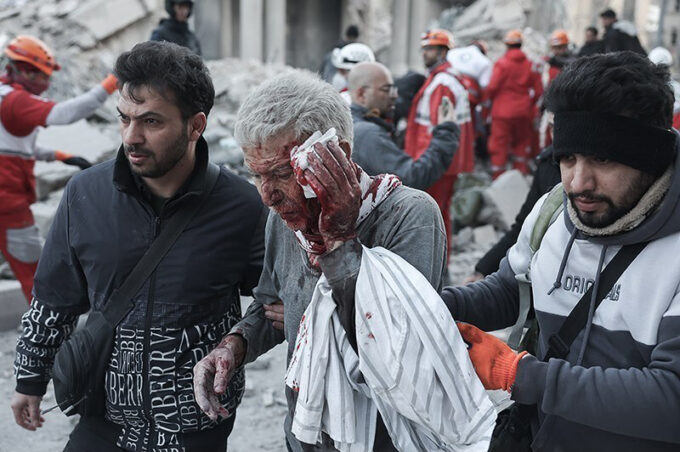
Iraq's anti-corruption board revealed on Saturday that there were five million Iraqi orphans as reported by official government statistics, urging the government, parliament, and NGOs to be in constant contact with Iraq's parentless children."The government should set up an institutional or legislative program to help the Iraqi orphans. Iraqi is an oil-rich country and it is not acceptable that its orphans remain groaning in this tragedy," the anti-corruption board chief, Moussa Faraj, said during a conference in Baghdad dedicated to orphans in Iraq."The board on its own cannot meet the Iraqi orphans' needs, but there should be an organization or even a ministry to provide care for orphans," he said.The Iraqi parliament's women & family committee had proposed a draft law to set up a fund for the orphans.During the conference, Wijdan Salem Mikhail, the Iraqi minister of human rights, said in a speech that the phenomenon "is one of the most passive things that grew immensely during the past few years due to destructive wars and unbridled violence in the country to unprecedented heights.""These factors have logically caused the number of widows and orphans to greatly increase," she said.'

Het Neoliberale Geloof 74

'WASHINGTON — With the housing market in decline, unscrupulous sales agents are popping up in the booming reverse mortgage industry, where reports of deceptive and high-pressure sales tactics are worrying lawmakers and consumer advocates alike.
Both say thousands of older Americans could be steered into inappropriate loans, just as millions were lured into now-shaky sub-prime loans. Their solution? Better loan counseling and stronger government supervision and regulation.
"We have gone through a savings and loan collapse, a stock market bubble and are currently in the middle of a lending mess. Our goal is to make sure that the reverse mortgages don't become the scandal of the next decade," said Sen. Claire McCaskill, D-Mo., said at a hearing this week before the Senate Special Committee on Aging.
Reverse mortgages typically allow homeowners who are 62 and older to borrow against their home equity without having to repay the money until the home is sold or the borrower dies or permanently moves out. The older the borrower and the greater the value of the home, the more money that can be borrowed.
Ninety percent of reverse mortgages are issued through the federally insured Home Equity Conversion Mortgage program. The number of HECM loans issued annually has grown from 157 in 1990 to more than 76,000 last year. Lenders expect to issue more than 214,000 loans this year.
Most agree that reverse mortgages, used properly, can provide cash to help seniors live more comfortably. In fact, the Senate on Friday passed bipartisan legislation that removes the cap on the number of reverse mortgage loans that the Federal Housing Administration can insure.
But as the popularity of reverse mortgages grows, the industry is proving fertile ground for predatory lenders, loan agents and brokers who see older, cash-strapped borrowers as easy pickings.
Peter Bell, president of the National Reverse Mortgage Loan Association, said he doesn't believe the problem is widespread. But he conceded that sales agents left jobless by the housing crisis are migrating to the reverse mortgage industry and may "have a different type of mentality about moving transactions through quickly."
More than 12.5 million seniors ages 65 and over own their homes with no mortgage debt, representing more than $4 trillion in home equity. Those numbers will only increase as the first of nearly 80 million baby boomers born before1964 begin retiring in the next few years.'

Lees verder: http://www.mcclatchydc.com/homepage/story/23196.html

Het Neoliberale Geloof 73

Tevreden snurkt men zachtjes verder in de polderlandse pers:

'Bulls, bankers blind to inevitable bust.
By Doug Wakefield (with Ben Hill)

While observing current events through the lens of history over the past few years, there have been times in which the only conclusion I could draw was that we were beginning a bear market that would prove much more severe than the one from 2000 to 2002.

As fiat currency and money supplies have exploded the world over, we have seen a proliferation of products, with varying acronyms, as the financial world tries to distance itself from the risky loans it originated. My experiences, as a researcher and investment advisor, suggest that the root of the problem is in investors' thinking. Between the autumn of 2002 and the spring of 2003, multiple markets began bull runs. As 2007 comes to a close, the only lesson most investors learned from the US$7 trillion loss of those years is to "hang on" when the market declines.

But while the past five years have produced substantial bull markets in a range of equity classes, they have also produced investors who have failed to read the historic accounts of how rapid credit creation ultimately ends in collapse. The need to slow down and prepare for contracting credit is lost in the fast-paced, unforgiving world of momentum trading. But those who have been reading the headlines since the first of August can plainly see that the world is rapidly shifting from one that embraces risk to one that shuns it. And as historical precedent suggests, since the credit bubble started breaking down just four months ago, our government, as well as those of the Europeans and Asians, have sought to intervene.

With several equity markets set to finish 2007 at or near historic highs, you may be thinking that things are not nearly that gloomy. Two years ago, we released a research paper on short selling, aptly titled "Riders on the
Storm: Short Selling in Contrary Winds". Some thought it foolish to attempt to thwart the gods of modern capitalism, and I must admit it's been a rough ride. Most who hold to my line of thinking have been unheard by family, friends, and associates.

But, once again I write to encourage some and to implore others to suspend judgement for a few minutes until they have critically appraised the evidence. If you come to the conclusion that I am wrong, what has it cost you but a few minutes of your time? But if I am right, it will not matter who wrote what when, but only that, as crowd behavior shifted from greed to fear, you heard an idea that later proved to be extremely valuable.

Heard it all before?
If we see something one time, and extrapolate that the conclusion will always be the same, we stand a high chance of failure. But if we watch multiple occurrences of similar patterns unfolding over months, quarters, and years - sometimes fast, sometimes slow - with different degrees of force and destruction, across different nationalities, cultures, and time periods, then those who ignore such data, do so at their own peril. So as you read and try to gain your bearings in this unfolding market, let me share with you two hindrances, in the form of words we think or say, that are barriers to accurate assessments.

Statement 1: "Hey, if you're so smart, how much did you make in the last 12 months?" With the Dow substantially higher than it was when I released our short selling paper in January of 2006, you know I've heard this statement before. But this statement reveals a fallacious understanding of how the market, and life itself, works.'

Lees verder: http://www.atimes.com/atimes/Global_Economy/IL14Dj01.html

Martelen 88

En terwijl in de polder het grote slapen doorgaat, bericht men in de grote mensenwereld:

'NAOMI WOLF
What Is Probably in the Missing Tapes
Posted December 13, 2007 03:55 PM (EST)

To judge from firsthand documents obtained by the ACLU through a FOIA
lawsuit, we can guess what is probably on the missing CIA
interrogation tapes -- as well as understand why those implicated are
spinning so hard to pretend the tapes do not document a series of
evident crimes. According to the little-noticed but extraordinarily
important book Administration of Torture: A Documentary Record from
Washington to Abu Ghraib and Beyond (Jameel Jaffer and Amrit Singh,
Columbia University Press, New York 2007), which presents dozens of
original formerly secret documents - FBI emails and memos, letters
and interrogator "wish lists," raw proof of the systemic illegal
torture of detainees in various US-held prisons -- the typical "harsh
interrogation" of a suspect in US custody reads like an account of
abuses in archives at Yad Vashem.
More is still being hidden as of this writing -- as those in Congress
now considering whether a special prosecutor is needed in this case
should be urgently aware: "Through the FOIA lawsuit," write the
authors, "we learned of the existence of multiple records relating to
prisoner abuse that still have not been released by the
administration; credible media reports identify others. As this book
goes to print, the Bush administration is still withholding, among
many other records, a September 2001 presidential directive
authorizing the CIA to set up secret detention centers overseas; an
August 2002 Justice Department memorandum advising the CIA about the
lawfulness of waterboarding [Italics mine; nota bene, Mr. Mukasey]
and other aggressive interrogation methods; documents describing
interrogation methods used by special operations forces in Iraq and
Afghanistan; investigative files concerning the deaths of prisoners
in U.S. custody; and numerous photographs depicting the abuse of
prisoners at detention facilities other than Abu Ghraib.'

What we are likely to see if the tapes documenting the interrogation
of Abu Zubaydah and Abd Al-Rahim Al-Nashiri are ever recovered is
that the "confessions" of the prisoners upon which the White House
has built its entire case for subverting the Constitution and
suspending civil liberties in this country was obtained through
methods such as electrocution, beating to the point of organ failure,
hanging prisoners from the wrists from a ceiling, suffocation, and
threats against family members ("I am going to find your mother and I
am going to fuck her" is one direct quote from a US interrogator). On
the missing tapes, we would likely see responses from the prisoners
that would be obvious to us as confessions to anything at all in
order to end the violence. In other words, if we could witness the
drama of manufacturing by torture the many violently coerced
"confessions" upon which the whole house of cards of this White House
and its hyped "war on terror" rests, it would likely cause us to
reopen every investigation, including the most serious ones
(remember, even the 9/11 committee did not receive copies of the
tapes); shut down the corrupt, Stalinesque Military Commissions
System; turn over prisoners, the guilty and the innocent, into a
working, accountable justice system operating in accordance with
American values; and direct our legal scrutiny to the torturers
themselves -- right up to the office of the Vice President and the
President if that is where the investigations would lead.'


Het Neoliberale Geloof 72

Dames en Heren nu echt opletten:

'Financial Times
December 11, 2007

Why the credit squeeze is a turning point for the world

By Martin Wolf

These are historic moments for the world economy. I
felt the same during the emerging market financial
crises of 1997 and 1998 and the bubble in technology
stocks that burst in 2000. This "credit crunch" may, I
believe, be an equally important turning point for
financial markets and the world economy. Why do I
believe this? Let me count the ways.

First and most important, what is happening in credit
markets today is a huge blow to the credibility of the Anglo-Saxon model of transactions-orientated financial capitalism. A mixture of crony capitalism and gross incompetence has been on display in the core financial markets of New York and London. From the "ninja" (no- income, no-job, no-asset) subprime lending to the placing (and favourable rating) of assets that turn out to be almost impossible to understand, value or sell, these activities have been riddled with conflicts of interest and incompetence. In the subsequent era of "revulsion", core financial markets have seized up (see charts at link, above).

Second, these events have called into question the
workability of securitised lending, at least in its
current form. The argument for this change - one, I
admit, I accepted - was that it would shift the risk
of term-transformation (borrowing short to lend long)
out of the fragile banking system on to the shoulders
of those best able to bear it. What happened, instead,
was the shifting of the risk on to the shoulders of
those least able to understand it. What also occurred
was a multiplication of leverage and term-
transformation, not least through the banks' "special investment vehicles", which proved to be only notionally off balance sheet. What we see today, as a result, is a rapid shrinkage of markets in asset-backed paper (see chart).

Third, the crisis has opened up big questions about the
roles of both central banks and regulators. How far,
for example, do the responsibilities of central banks
as "lender-of-last-resort" during crises stretch?
Should they, as some argue, be market-makers-of-last
resort in credit markets? What, more precisely, should
a central bank do when liquidity dries up in important
markets? Equally, the crisis suggests that liquidity
has been significantly underpriced. Does this mean that
the regulatory framework for banks is fundamentally
flawed? What is left of the idea that we can rely on
financial institutions to manage risk through their own
models? What, moreover, can reasonably be expected of
the rating agencies? A market in US mortgages is hardly
terra incognita. If banks and rating agencies got this
wrong, what else must be brought into question?
Fourth, do you remember the lecturing by US officials,
not least to the Japanese, about the importance of
letting asset prices reach equilibrium and transparency
enter markets as soon as possible? That, however, was
in a far-off country. Now we see Hank Paulson, US
Treasury secretary, trying to organise a cartel of
holders of toxic securitised assets in the "superSIV".
More importantly, we see the US Treasury intervene
directly in the rate-setting process on mortgages, in
an attempt to shore up the housing market. Either, or
both, of these ideas might be good ones (though I
strongly doubt it). But they are at odds with what the
US has historically recommended to other countries in a
similar plight. Not for a long time will people listen
to US officials lecture on the virtues of free
financial markets with a straight face.

Fifth (and here we start to move from the questions
about the workings of the financial system to global macro-economic implications), the crisis signals a necessary re-rating of risk. It turns out that it also represents a move towards holding more transparent and liquid assets, as one would expect. This correction is altogether desirable. It has, moreover, been selective. It is a striking feature of what has happened that emerging markets have emerged as a safe haven as investors run away from US households. For those in emerging economies, this must be sweet revenge. They should not cheer too soon. Today's favourites may be brutally discarded tomorrow.

Sixth, this event may well mark the limits to the US
role as consumer of last resort in the world economy.
As the Organisation for Economic Co-operation and
Development notes in its latest Economic Outlook, the correction is well under way. In 2007, it forecasts, US final domestic demand will grow by just 1.9 per cent, down from 2.9 per cent in 2006. It forecasts a further decline, to growth of 1.4 per cent, next year. In both years, net exports will make a positive contribution to
growth: 0.5 percentage points in 2007 and 0.4
percentage points in 2008, as the trade deficit shrinks
in real terms. In this way, the US is re-importing the
stimulus it exported to the rest of the world in
previous years. The credit crunch is quite likely to
accelerate this process. So the US needs strong growth
of net exports. For this reason, policymakers are
relaxed about the dollarâۉ„¢s fall, provided it does not awaken fears of rapidly rising inflation.

Seventh, a US recession is possible. Whether it happens
depends overwhelmingly on consumers. The principal
counterpart of the external deficits has been the
excess of spending over income by households. That has
meant negligible savings and a big jump in household
debt: mortgage debt jumped from 63 per cent of
disposable incomes in 1995 to 98 per cent in 2005. This
rising trend is unlikely to continue in a falling
housing market. Unwillingness (or inability) to borrow
on such a scale will, in turn, hamper the effectiveness
of US monetary policy. That, in turn, makes a weak
dollar and strong export growth yet more important.

Last but not least, this event also has big
significance for the game of "pass-the-external-
deficits" that has characterised the world economy for
several decades. It has proved virtually impossible for emerging market economies to run large deficits, without running into crises. Over the past decade, the US filled the (growing) gap as ever-larger borrower of last resort. This epoch has probably now ended. But the surpluses being run by China and Japan, by oil exporters and, within the European Union, by Germany continue to grow. If we are to enjoy global macro- economic stability, a creditworthy set of countervailing borrowers must emerge. If the US ceases to increase its absorption of the growing savings surpluses being generated elsewhere, which countries will be able and willing to do so?

Experience teaches that big financial shocks affect
patterns of lending and spending across the world.
Originating, as it does, at the core of the world
economy, this one will do so, too. The question is how
stable and dynamic the world economy that emerges will
be.'


Zie: http://www.ft.com/cms/s/90126fca-a810-11dc-9485-0000779fd2ac,Authorised=false.html?_i_location=http%3A%2F%2Fwww.ft.com%2Fcms%2Fs%2F0%2F90126fca-a810-11dc-9485-0000779fd2ac.html%3Fnclick_check%3D1&_i_referer=&nclick_check=1

Het Neoliberale Geloof 71


'This crisis spells the end of the free market consensus
The credit squeeze is set to trigger the end of the boom that has shaped our times. Politics is going to change with it.

Seumas Milne The Guardian

New Labour has led a charmed economic life for the past decade. Britain's ejection from the European exchange rate mechanism in the early 1990s and a unique set of international conditions helped deliver a record that earlier generations of British politicians could only have fantasised about. Whatever other disasters and scandals they could be held responsible for, the economy was always Tony Blair and Gordon Brown's secret weapon: the "longest period of sustained economic growth since records began", low inflation, rapid job creation and a strong boost to public spending, all at the same time. The fact that it has also been a story of rising inequality, stubborn unemployment and ballooning levels of debt - and has depended on the international financial system's toleration of a huge trade deficit to sustain it - has until now barely shifted the perception of economic success. That has been the crucial backdrop to the me-too politics of recent years and the free market consensus that underpins it. It is also, of course, the record that finally propelled Brown into 10 Downing Street.
But there can now be no doubt that such halcyon days are coming to an end. What kicked off in the US earlier this year, in the shape of the sub-prime mortgage lending crisis, has now spread like gangrene across a deregulated global financial system, imposing a vice-like squeeze on the very credit cushion that has hitherto kept the US and British economies afloat. In Britain, it has already led to the collapse of Northern Rock and the first run on a British bank since the Victorian era. But the impact will certainly go much further, particularly in an economy so lop-sidedly dominated by the financial sector. Already, the house price collapse and prospect of mass repossessions is tipping the US economy towards full-blown recession. In Britain, which now has the highest level of personal debt of any industrial country - at £1.4 trillion, larger than national income - the expectation must be that the economy is heading in the same direction. As the full impact of the credit crunch makes itself felt, the house price bubble is bound to deflate further. That in turn will cut demand, bringing with it a painful economic slowdown at the very least.'

Lees verder: http://www.guardian.co.uk/commentisfree/story/0,,2226539,00.html

De Dollar Hegemonie 39


'Offshoring Interests and Economic Dogma
Shrinking the US Dollar from the Inside-Out
By PAUL CRAIG ROBERTS

On December 8, Chinese and French news services reported that Iran had stopped billing its oil exports in dollars.
Americans might never hear this news as the independence of the US media was destroyed in the 1990s when Rupert Murdoch persuaded the Clinton administration and the quislings in Congress to allow the US media to be monopolized by a few mega-corporations.
Iran's oil minister, Gholam Hossein Nozari, declared: "The dollar is an unreliable currency in regards to its devaluation and the loss oil exporters have endured from this trend." Iran has proposed to OPEC that the US dollar no longer be used by any oil exporting countries. As the oil emirates and the Saudis have already decided to reduce their holdings of US dollars, the US might actually find itself having to pay for its energy imports in euros or yen.
Venezuela's Chavez, survivor of a US-led coup against him and a likely target of a US assassination attempt, might follow the Iranian lead. Also, Russia's Putin, who is fed up with the US government's efforts to encircle Russia militarily, will be tempted to add Russia's oil exports to the symbolic assault on the dollar.
The assault is symbolic, because the dollar is not the reserve currency due to oil exports being billed in dollars. It's the other way around. Oil exports are billed in dollars, because the dollar is the reserve currency.
What is important to the dollar's value and its role as reserve currency is whether foreigners continue to consider dollar-denominated assets sufficiently attractive to absorb the constant flow of red ink from US trade and budget deficits. If Iran and other countries do not want dollars, they can exchange them for other currencies regardless of the currency in which oil is billed.
Indeed, the evidence is that foreigners are not finding dollar-denominated assets sufficiently attractive. The dollar has declined dramatically during the Bush regime regardless of the fact that oil is billed in dollars. Iran is dropping dollars in response to the dollar's loss of value. This is a market response to a depreciating currency, not a punitive action by Iran to sink the dollar.'

Lees verder: http://www.counterpunch.org/roberts12132007.html

“Lots of Very Good Wars!” The Gangsters Have All the Power Now

  OCTOBER 2, 2026 Roaming Charges: “Lots of Very Good Wars!” JEFFREY ST. CLAIR Emai Wounded civilians from the US airstrikes on Enghelab Squ...