Zoeken in deze blog 🔎🔎

woensdag 29 maart 2006

Onafhankelijke Journalistiek


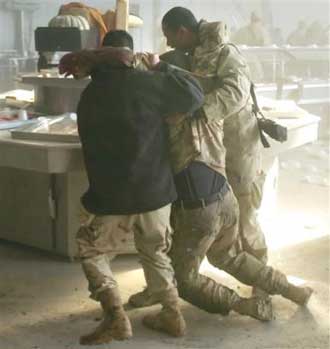
De Amerikaanse journalist Greg Mitchell schrijft: 'The War Reporter Who Turned Prophet on Iraq. Looking back at E&P's extensive commentary on media coverage of the Iraq war three years ago, I was struck again by how Chris Hedges stands out as a kind of seer. The longtime war reporter, who decided to sit this one out, was among the few who recognized that taking Baghdad would be the easy part. By Greg Mitchell (March 28, 2006) -- Looking back at E&P’s extensive, and often critical, commentary on media coverage of the Iraq war three years ago, I was struck again by how Chris Hedges stands out as a kind of prophet. The longtime war reporter, who decided to sit this one out, was among the few who recognized that taking Baghdad would be the easy part. Let's contrast it with the criminal incompetence of the U.S. war planners. That British memo recording President Bush's meeting with Prime Minister Blair two months before the war, in contrast, reveals that the two leaders expected an easy ride during the occupation with little sectarian violence. One thing Hedges said back then, in early April 2003, has stuck with me. I think it could go down, unfortunately, as the most prescient quote of the entire war. Speaking of what the U.S. was facing in an Iraq occupation, he said: “It reminds me of what happened to the Israelis after taking over Gaza, moving among hostile populations. It's 1967, and we've just become Israel.”E&P contributor Barbara Bedway interviewed Hedges during the run-up to the war in early 2003, and then during and just after the invasion. He was a logical source. Hedges had covered 12 wars, most recently for The New York Times, and was held for a week by the Iraqi Republican Guard during the Shiite uprising following the Gulf War. He also wrote the influential book, "War Is a Force That Gives Us Meaning."Even before the attack on Iraq, he warned of the limits of the embedding program, which discouraged independent reporting on the “other side,” the civilian toll, and the long-term obstacles to the success of any occupation. "Most reporters in war are part of the problem," he cautioned. "You always go out and look for that narrative, like the hometown hero, to give the war a kind of coherency that it doesn't have. “He also warned: “When the military has a war to win, everything gets sacrificed before that objective, including the truth." About a month into the occupation, in May 2003, he said: "We didn't ever discover how many civilian casualties occurred in the first Gulf War, and I doubt we'll ever know about this one." And: "We don't have a sense of what we have waded into here. The deep divisions among the varying factions could be extremely hard to bridge, and the historical and cultural roots are probably beyond the American understanding…. For occupation troops, everyone becomes the enemy."In his book, Hedges was prone to impassioned meditations on how the seductive attractions of war obscure its harsher truths, and that, even when necessary, it is a sickening, not a glorious, enterprise. He has said that he wrote the book because he feared that "we are losing touch with ourselves, with our role in the world, and with the danger such enthusiasm for war ultimately brings to our nation. … I wanted to lay bare war's contagion. And I wanted to do it now as we enter a new and volatile moment in our history, one where introspection is so necessary and so lacking."Bedway’s article from April 2, 2003, deserves another look. I’m not sure whether I should say “read it and weep” or “read it and learn.” It may be too late for the latter. Here are some excerpts from the article.*For Chris Hedges, the veteran journalist who has covered over a dozen conflicts around the globe, it's clear that the U.S. military's use of embedded reporters in Iraq has made the war easier to see and harder to understand. Yes, "print is doing a better job than TV," he observes. "The broadcast media display all these retired generals and charts and graphs, it looks like a giant game of Risk [the board game]. I find it nauseating." But even the print embeds have little choice but to "look at Iraq totally through the eyes of the U.S. military," he points out. "That's a very distorted and self-serving view." To Hedges, who is fluent in Arabic, this instantaneous "slice of war" reporting is bereft of context. Reporters have a difficult time interviewing Iraqi civilians, and many don't even try, he says: "We don't know what the Iraqis think." The reporters are "talking about a country and culture they know nothing about."Hedges believes the growing hostility between the Iraqis and Americans makes covering the war a far more dangerous job than reporters could have initially imagined: "My suspicion is that the Iraqis view it as an invasion and occupation, not a liberation. This resistance we are seeing may in fact just be the beginning of organized resistance, not the death throes of Saddam's fedayeen. I've witnessed how insurgencies build in other conflicts -- guerilla leaders [could appear] who are unknown to us now. They know the landscape. “It reminds me of what happened to the Israelis after taking over Gaza, moving among hostile populations. It's 1967, and we've just become Israel. I fear what happened there will happen here."The real "shock and awe" may be that we've been lulled into a belief that we can wage war cost-free, according to Hedges: "We feel we can fight wars and others will die and we won't. We lose track of what war is and what it can do to a society. The military had a great disquiet about the war plans, as far back as last fall. The press did not chase down that story."The best preparation for covering war does not lie in one-week boot camp training for journalists, Hedges says ruefully, but having a deep understanding of the humanities: "In seminary, we put so much time into studying human nature, how moral choices are made. I have a deep respect for Islam that I learned in seminary -- I don't look at Arabs as two-dimensional figures. I'm a great believer in the humanities. If you know Shakespeare, you know human nature."

11 september 2001 (4)


Van Boudine Berkenbosch kreeg ik twee emails: 'Langzaam maar zeker komt de waarheid omtrent 9/11 aan het licht. Een bekende Amerikaanse acteur, Charlie Sheen, heeft verklaard dat hij niet gelooft in de officiële versie van 9/11. Zijn verklaring wordt niet alleen serieus genomen door Alex Jones, de LinksLiberale reporter van Prisonplanet. Zie: http://www.prisonplanet.com/index.html
Ook de CNN bemoeit zich er nu mee.

Vandaag stond op Prisonplanet:

At time of press Showbiz Tonight's CNN poll shows 84% support Charlie Sheen's comments on 9/11. This figure is rising and we expect it to go higher before the poll closes. Click here to vote yes and support Charlie Sheen.

Op National Geografic is steeds een magische reportage te zien over 9/11, waarop WTC 7 niet bestaat, dus ook niet instort, waarop brandweermannen geen bommen hebben horen afgaan in de Twin Towers en waarop het vliegtuigwrak van de Boeing 757 die zou zijn gecrashed in het Pentagon weliswaar onzichtbaar blijft, maar daar gaat het niet over. Volgens Prisonplanet is er een connectie tussen National Geografic en Skull&Bones.

Verder circuleren er op Internet reeds talloze video's waarop de aanslagen aan de hand van authentiek beeldmateriaal worden geanalyseerd. Op Scholars for 9/11 Truth kan men doorlinken naar een aantal van deze films. Vooral Loose Change 2nd Edition is een aanrader. Zie: http://www.st911.org/
Voor mensen die geen Amerikaans / Engels verstaan, is er deze link:
Op http://streaming.reopen911.org/video/PainfulDeceptions_dutch.html staat een anderhalf uur durende film over 9/11, met Nederlandse ondertiteling.
Met vriendelijke groet,
Boudine'

En deze:
'De acteur Charlie Sheen wordt nu nagevolgd door andere Amerikaanse acteurs. Zij zeggen openlijk dat ze niet geloven in de officiële versie van 9/11. Een andere weblog waarmee ik correspondeer is http://johnito.blogspot.com/ Van daar kan men nu doorlinken naar de CNN-uitzending van Sheen en zo voort.
In de hoop dat de waarheid rond 9/11 spoedig aan het licht komt,
Met vriendelijke groet,
Boudine'

Zie ook: http://www.prisonplanet.com/articles/march2006/250306showbiztonightalex.htm

Israelisch Expansionisme 12

Hoewel Europese politici - en zeker de Nederlandse politici - altijd de mond vol hebben over het respecteren van mensenrechten heeft de Europese Unie Israel toch een speciale status verleent, waardoor 'de joodse natie' probleemloos al zijn producten hier kwijt kan. Maar al jarenlang verzoekt de Palestijnse samenleving met klem om Israel te boycotten zolang het land het internationaal recht schendt. 'Palestinian Civil Society Calls for Boycott, Divestment and Sanctions against Israel Until it Complies with International Law and Universal Principles of Human Rights. One year after the historic Advisory Opinion of the International Court of Justice (ICJ) which found Israel’s Wall built on occupied Palestinian territory to be illegal, Israel continues its construction of the colonial Wall with total disregard to the Court’s decision. Thirty eight years into Israel’s occupation of the Palestinian West Bank (including East Jerusalem), Gaza Strip and the Syrian Golan Heights, Israel continues to expand Jewish colonies. It has unilaterally annexed occupied East Jerusalem and the Golan Heights and is now de facto annexing large parts of the West Bank by means of the Wall. Israel is also preparing - in the shadow of its planned redeployment from the Gaza Strip - to build and expand colonies in the West Bank. Fifty seven years after the state of Israel was built mainly on land ethnically cleansed of its Palestinian owners, a majority of Palestinians are refugees, most of whom are stateless. Moreover, Israel's entrenched system of racial discrimination against its own Arab-Palestinian citizens remains intact. In light of Israel’s persistent violations of international law, and
Given that, since 1948, hundreds of UN resolutions have condemned Israel’s colonial and discriminatory policies as illegal and called for immediate, adequate and effective remedies, and
Given that all forms of international intervention and peace-making have until now failed to convince or force Israel to comply with humanitarian law, to respect fundamental human rights and to end its occupation and oppression of the people of Palestine, and
In view of the fact that people of conscience in the international community have historically shouldered the moral responsibility to fight injustice, as exemplified in the struggle to abolish apartheid in South Africa through diverse forms of boycott, divestment and sanctions;
Inspired by the struggle of South Africans against apartheid and in the spirit of international solidarity, moral consistency and resistance to injustice and oppression,
We, representatives of Palestinian civil society, call upon international civil society organizations and people of conscience all over the world to impose broad boycotts and implement divestment initiatives against Israel similar to those applied to South Africa in the apartheid era. We appeal to you to pressure your respective states to impose embargoes and sanctions against Israel. We also invite conscientious Israelis to support this Call, for the sake of justice and genuine peace.
These non-violent punitive measures should be maintained until Israel meets its obligation to recognize the Palestinian people’s inalienable right to self-determination and fully complies with the precepts of international law by:
1. Ending its occupation and colonization of all Arab lands and dismantling the Wall;
2. Recognizing the fundamental rights of the Arab-Palestinian citizens of Israel to full equality; and
3. Respecting, protecting and promoting the rights of Palestinian refugees to return to their homes and properties as stipulated in UN resolution 194.' Lees verder:
http://www.badil.org/Boycott-Statement.htm

Israelisch Expansionisme 11

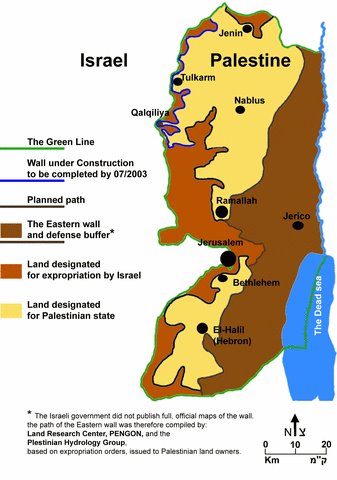
Een studie van de Verenigde Naties benadrukt nog eens de illegaliteit van de Israelische Apartheids Muur: 'United Nations Study: Palestinian land has been divided into separate 'ghettos' enclosed by Wall. A report compiled by the United Nation Office for the Coordination of the Humanitarian Affairs (OCHA) revealed a new social and economic reality that has emerged in the last year for Palestinians in the West Bank: that they have been imprisoned in separate enclaves, or 'ghettos', surrounded by the Wall and unable to move. Says the report summary, "It is important to note that had the Barrier in the West Bank been constructed on the Green Line, this report would be unnecessary. Concerned that Palestinian livelihoods and access to essential services would be harmed by the construction of the West Bank Barrier, the international donor community – through the Humanitarian Emergency Policy Group (HEPG) - requested regular updates on the humanitarian impact of the Barrier. The HEPG comprises the European Commission and the EU President, the World Bank, USAID, Norway and UNSCO."
The study concluded that in fact the Wall does have an extremely harmful impact on Palestinians living in the West Bank. Hundreds of exits from Palestinian communities to main and regional roads are blocked. Traffic among the enclaves is directed to secondary roads and a small number of main roads passing through Israel Army-controlled checkpoints. Entry to the Jordan Valley (in the east), Palestinian East Jerusalem and to various enclaves caught between the separation fence and the Green Line is barred to all Palestinians except those registered as residents of those areas. To enter such areas, special authorization to "non-residents" must be obtained, and it is rarely given. Palestinians are not allowed to drive their cars between the northern and southern West Bank (through the Abu Dis checkpoint east of Jerusalem). Private vehicular traffic to and from Nablus is prohibited. Passage by car through the Qalandiya checkpoint north of Jerusalem is limited to bearers of Jerusalem residency cards, in cars with Israeli license plates. At the Zaatara checkpoint south of Nablus entry is frequently denied to all south-bound residents of the northern West Bank as part of the Israeli "differentiation" policy.
Palestinian farmers are losing large swaths of farmland, as Israel seizes the land by constructing the Annexation Wall as deep as 20 kilometers inside the border of the West Bank. Farmers have suffered tremendously from the Israeli annexation of land and destruction of water sources and orchards over the last several years. Over 1 million olive trees, the main source of livelihood for many Palestinian farmers, have been uprooted by Israeli soldiers and settlers, often with no reason given except ''security reasons''.' Lees verder: http://www.palestinecampaign.org/features.asp?d=y&ID=559

Racisme in Israel

In Israel's kwaliteitskrant Haaretz schrijft de kritische journalist Gideon Levy over het racisme van zijn joodse landgenoten. 'One racist nation. Contrary to appearances, the elections this week are important, because they will expose the true face of Israeli society and its hidden ambitions. More than 100 elected candidates will be sent to the Knesset on the basis of one ticket - the racism ticket. If we used to think that every two Israelis have three opinions, now it will be evident that nearly every Israeli has one opinion - racism. Elections 2006 will make this much clearer than ever before. An absolute majority of the MKs in the 17th Knesset will hold a position based on a lie: that Israel does not have a partner for peace. An absolute majority of MKs in the next Knesset do not believe in peace, nor do they even want it - just like their voters - and worse than that, don't regard Palestinians as equal human beings. Racism has never had so many open supporters. It's the real hit of this election campaign. One does not have to be Avigdor Lieberman to be a racist. The "peace" proposed by Ehud Olmert is no less racist. Lieberman wants to distance them from our borders, Olmert and his ilk want to distance them from out consciousness. Nobody is speaking about peace with them, nobody really wants it. Only one ambition unites everyone - to get rid of them, one way or another. Transfer or wall, "disengagement" or "convergence" - the point is that they should get out of our sight. The only game in town, the 'unilateral arrangement," is not only based on the lie that there is no partner, is not only based exclusively on our "needs" because of a sense of superiority, but also leads to a dangerous pattern of behavior that totally ignores the existence of the other nation.' Lees verder: http://www.haaretz.com/hasen/spages/698426.html

Klimaatverandering 30

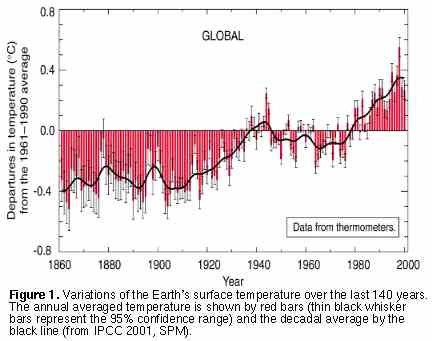
In de angelsaksische wereld is het milieu een steeds belangrijker onderwerp in de media, maar niet in Nederland. Volgens een aantal van mijn collega's is de reden het feit dat de politici er weinig aandacht aan besteden. Milieu is voor hen geen prioriteit meer. De Independent bericht: 'Your world. Your say: The great global warming debate. Yesterday we asked The Independent's readers to make their contribution to the all-party inquiry on climate change. Your response has been nothing short of extraordinary. Here we publish our first selection of your letters and emails. The scientist James Lovelock has a view of our climatically challenging future in which each country becomes a fortress and acts and adapts in their own interests locally as best they can, and somehow or other saves " civilisation" for a few survivors. Mr Challen's line of thinking is a more worthy legacy of civilisation to carry into the future. We must be bold! If Britain is the fifth largest economy in the world then it must partner (genuinely, in every conceivable way - a marriage) with the fifth poorest and set up an attempt to put in place contraction and convergence. Britain's spend of CO2 comes down whilst, let us say, Rwanda's comes up until we meet at a point (closer to their starting spend than ours) that gives us a chance of avoiding catastrophic climate change. This means a Rwandan's life becomes more materially and energy positive whilst a Britain's goes the other way. It does not mean a pay-off to them to keep their levels low whilst ours continue to rise. We become one. We share sacrifice to end poverty and excess at the same time. Putting our money, unilaterally if necessary at first, where our mouths are has many advantages: * It is the most powerful argument we can deploy for encouraging contraction and convergence globally. It also gives us a chance to get our hands dirty and understand how to make it work' Lees verder:
http://news.independent.co.uk/environment/article354271.ece

dinsdag 28 maart 2006

De Oorlogsstaat 32


Uiteindelijk gaat het alleen om geld. Hier kunt u zien hoe miljarden aan belastinggeld werd gestolen door Amerikaanse bedrijven in Iraq. De Oorlogswinsten. 'Iraq's Missing Billions.
Exposed: How American Contractors With The Help Of U.S. Government Raped Iraq.
Dispatches/GuardianFilms.
Dr Ali Fadhil, a 29 year old Iraqi doctor, investigates what has happened to billions of dollars worth of Iraqi money which was put into the care of the US led coalition to be spent for the benefit of Iraqi people on the reconstruction of their country. He uncovers a shocking story of fraud, incompetence and corruption, unscrupulous foreign contractors who made millions from dodgy contracts, and literally billions of dollars which cannot be properly accounted for.' Zie: http://www.informationclearinghouse.info/article12499.htm

"Supporting Ukraine is a very cheap way to make sure that Russia is not a threat to the NATO alliance."

  In 2023 schreef ik het volgende " Nu wij ruim driekwart eeuw na de Tweede Wereldoorlog in een nieuw fascisme zijn beland -- waarin de...