Despite Ceasefire, Israel Continues to Expand Occupation of Southern Lebanon
Those displaced from south Lebanon wonder if they will ever return.
Did you know that Truthout is a nonprofit and independently funded by readers like you? If you value what we do, please support our work with a donation.
On April 17, Zahra al-Qusaybi woke up to news of a ceasefire in Lebanon. For six weeks, she and her two adult daughters had languished in a crowded school shelter in Saida, a city 27 miles south of the capital Beirut.
They were among 1.1 million people uprooted from their homes when Israel escalated its war on Lebanon on March 2, ostensibly to disarm the Lebanese militant group Hezbollah.
Like many of them, al-Qusaybi and her daughters packed their belongings and returned to their town when the ceasefire was announced. On the ride down, they passed mounds of rubble and their phones vibrated with news of ongoing airstrikes.
Despite the apparent truce, Israel was still bombing south Lebanon. “Israel killed three young men in our town on the day we returned,” al-Qusaybi, 57, told Truthout. “They were killed within the first hour we arrived.”
Israel is still breaching the agreement three weeks into the ceasefire. On May 6, it bombed the southern suburbs of Beirut to assassinate a Hezbollah commander, marking the first attack on the capital since the ceasefire. Days earlier, Israel killed at least 110 people across the south between May 1 and May 4, according to Lebanon’s health ministry.
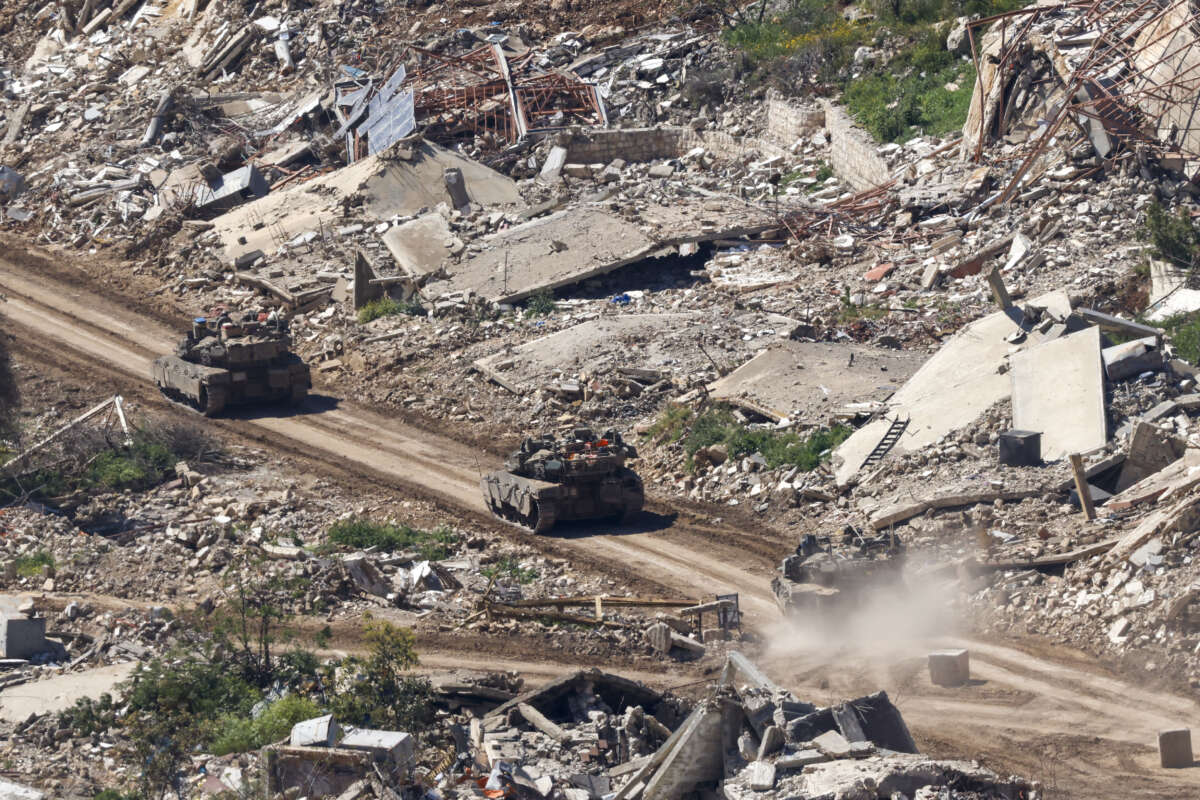
Israel has also exploited the ceasefire to blow up entire villages and vital infrastructure as part of a strategy to empty Lebanese lands and turn them into what it has called a “buffer zone.”
U.S. President Donald Trump has justified the daily breaches by arguing that the ceasefire doesn’t strip Israel of its right to “self-defense.” Yet analysts and rights groups say that “self-defense” has become a euphemism for waging a forever war against Lebanon’s Shia community, from which Hezbollah draws most of its support.
“The fact Israel has continued to empty and destroy entire villages during ceasefires suggests that this is part of a long-term strategy to displace — perhaps permanently — the Shia population,” said Nadim Houry, an expert on Lebanon and the executive director of the Arab Reform Initiative, an independent think tank.
Ethnic Cleansing in Southern Lebanon
Volunteers from the Saida school shelter said most people returned to their towns after the ceasefire was announced. However, they turned back when they realised the war hadn’t stopped.
Al-Qusaybi and her family stayed just one night in their dusty home in Nabatiyeh, a governorate that Israel has heavily bombed. As they walked through the front door, they carefully stepped around the broken glass and debris littered on the floor, evidence that Israeli bombs had shattered the windows and crumbled the walls.
While asleep that night, nearby airstrikes shook their home and jolted al-Qusaybi’s daughters awake. They were terrified and exhausted, so they returned to the shelter with their mother on April 19.
“When we came back, I was overwhelmed with despair and humiliation because we were forced to leave our home, again,” al-Qusaybi told Truthout.
Like so many people, she doesn’t know when the south will be safe enough to head back. Earlier in the conflict, on March 16, Israeli Defense Minister Israel Katz said nobody from the Shia community would be able to return until northern Israel is secure.
He didn’t explain what that means in practice.
Houry worries that hundreds of thousands of people could be displaced indefinitely. “Based on what Israel is trying to do, their strategy could lead towards the ethnic cleansing of the south,” he warned.
Israel has been trying to make large swathes of the south unlivable to create a permanent zone of occupation. The strategy started after the previous ceasefire in November 2024, following a major escalation against Hezbollah.
Over the next 15 months, Israel violated the truce more than 10,000 times. It blew up entire Lebanese villages along its border and destroyed reconstruction facilities and equipment, according to a report by Human Rights Watch.
Israel has expanded the so-called buffer zone during the current ceasefire by systematically destroying new villages, electricity grids, bridges, and mosques, according to ACLED, a monitor tracking conflict developments worldwide.
The zone is gradually expanding and threatens to reach as far as Nabatiyeh, where al-Qusaybi is from.
A Familiar Blueprint
Israel has imposed an arbitrary “Yellow Line” to guard the territory it currently occupies in southern Lebanon and deny hundreds of thousands of people from returning to their lands. Anyone approaching the delineation, which splits 10 kilometers of Lebanese land from the rest of the country, is shot.
While Israel adopted a similar strategy in Gaza after a ceasefire was announced in October 2025, such demarcations hark back to the 1948 Nakba (or Catastrophe), in which Zionist militias expelled 750,000 Palestinians from their homes to make way for the creation of Israel.
A year later, Israel established “free-fire” zones around its contested borders, permitting troops to kill Palestinian refugees trying to return, mainly from the West Bank and Gaza. About 1,000 civilians were shot dead in 1949 alone.
The number of people killed while approaching the Yellow Line in Lebanon is unclear. However, nearby residents often hear the thunderous sounds of Israel bombing and bulldozing towns in the buffer zone to the ground.
Under international humanitarian law, civilians have the right to return to their lands after the military action that displaced them ends. But in practice, Israel could permanently displace entire communities from southern Lebanon so long as it continues to face little meaningful restraint, said Ramzi Kaiss, the Lebanon researcher for Human Rights Watch.
“There has been no significant pushback [against Israel] by states that have leverage, such as those who finance its military or those that have the ability to impose sanctions,” he told Truthout over the phone.
Longing for Home
When Trump announced an extension of the ceasefire on April 23, most displaced people shrugged. The south was still unsafe and many were struggling to cope with the loss of their homes and livelihoods. Some are fortunate to be staying with relatives further north, while others are sleeping in makeshift tents. Only 124,000 have found a place in one of the 625 state-administered shelters, all of which are overcrowded and under-resourced.
Mohamed Baz, 83, said that he sleeps in his car outside the shelter in Saida, which has no space to accommodate him. Speaking softly, he said he was relatively wealthy before the current war upended his life. He had three homes, yet Israel destroyed two of them in his town of Bint Jbeil. Several of his children and grandchildren are living in the one still standing in Beirut.
When asked why he isn’t staying there too, Baz said his car is “quieter” and that there isn’t space to accommodate more people at his home. He simply yearns to return to Bint Jbeil, but the town is located within the Yellow Line. “There isn’t a ceasefire,” he mumbled. “Israel is destroying our homes and towns and … attacking and killing those trying to return.”
Baz and al-Qusaybi lived through Israel’s 18-year occupation from 1982 to 2000 and both hope this one will end too. But Baz has accepted that he may never return to his town due to his old age, while al-Qusaybi is determined to go back, even if it is risky.
“If I die, then I’ll die with my head held high,” she said, with a faint smile. “I’ll die with dignity.”
Media that fights fascism
Truthout is funded almost entirely by readers — that’s why we can speak truth to power and cut against the mainstream narrative. But independent journalists at Truthout face mounting political repression under Trump.
We rely on your support to survive McCarthyist censorship. Please make a tax-deductible one-time or monthly donation.


Geen opmerkingen:
Een reactie posten