No Deal After 21 Hours: Iran Blames ‘Illogical’ US Demands, Says It is in ‘No Hurry’
 Share
Share Tweet
Tweet Pin
Pin Email
Email Share
Share
Iran-US talks collapse after 21 hours as Tehran blames excessive US demands and Washington says Iran rejected terms.
Key Developments
- 21-hour Iran-US negotiations in Islamabad end without agreement, no next round scheduled.
- Iran says US made “excessive and illogical demands” on nuclear program and Hormuz.
- US claims Iran rejected its “final and best offer” despite “significant flexibility”.
21-Hour Talks End without Agreement
Direct negotiations between Iran and the United States in Islamabad ended without any agreement after more than 21 hours of continuous discussions.
Iranian state television reported that “despite the numerous initiatives presented by the Iranian side, the excessive and illogical demands of the American side prevented progress in the negotiations,” adding that the Iranian delegation engaged in “continuous and intensive negotiations that lasted 21 hours with the aim of safeguarding the national interests of the Iranian people.”
Tasnim News Agency confirmed that the talks concluded without results, stating that the US side’s “excessive demands and ambitions” prevented a common framework from being reached.
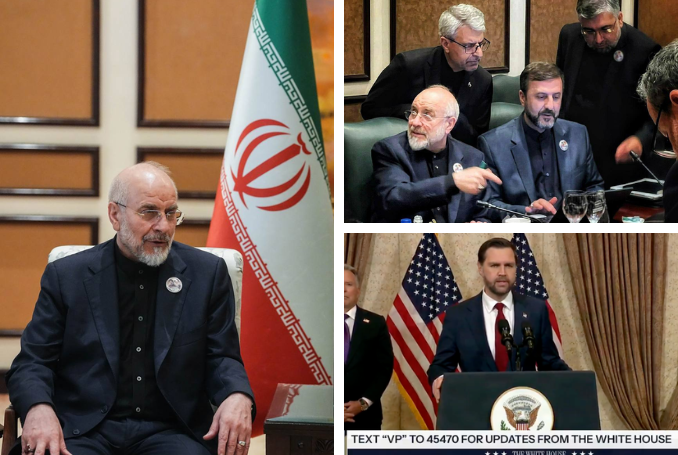
US Vice President JD Vance also confirmed the failure of the talks, saying: “We have been at it now for 21 hours, and we’ve had a number of substantive discussions with the Iranians. That’s the good news. The bad news is that we have not reached an agreement.”
Iran: US Sought through Talks What It Failed to Achieve by War
According to Tasnim, the US delegation attempted to secure concessions it had failed to obtain through military escalation.
“In the negotiation room, the Americans intended to achieve goals that they failed to achieve by the war against Iran, including the issue of the Strait of Hormuz and the removal of nuclear materials from the country,” the agency reported.
The Iranian delegation, led by Mohammad Baqer Qalibaf and including Foreign Minister Abbas Araqchi and Ali Baqeri, “prevented the realization of US excessive demands by preserving the fundamental rights of the people.”
Tasnim added that Iran proposed multiple initiatives to reach a joint framework, but “the American greed for excessive demands had pushed them far from rationality and realism.”
An informed source told the agency: “Iran has put forward reasonable initiatives and proposals in the negotiations. The ball is in America’s court to look at the issues realistically.”
‘Power Diplomacy’
Iranian media described the negotiations as part of a strategy of “power diplomacy,” conducted from a position shaped by recent military developments.
Officials emphasized that the Iranian delegation entered the talks with a clear mandate to protect national rights and would not concede on core issues, including nuclear capabilities and strategic control over the Strait of Hormuz.
Deputy Foreign Minister Kazem Gharibabadi said the current round differs from previous negotiations, citing a history of “dishonesty, deceit, and breach of promise” by the United States.
He added that Iran’s strengthened position—military, strategic, and political—has reshaped the dynamics of the talks.
US: Iran Rejected ‘Final and Best Offer’
US Vice President JD Vance said the negotiations failed because Iran refused to accept US terms.
“We just could not get to a situation where the Iranians were willing to accept our terms. I think we were quite flexible; we were quite accommodating,” he said.
He described the US proposal as “a method of understanding that is our final and best offer,” adding: “We’ll see if the Iranians accept it.”
Vance emphasized that preventing Iran from acquiring nuclear weapons remains Washington’s “core goal,” stating that the US seeks “an affirmative commitment that they will not seek a nuclear weapon.”
He also noted that US President Donald Trump was closely involved in the talks, saying he spoke with him “a half-dozen times, a dozen times” during the negotiations.
The negotiations began at the level of main delegations before moving to technical and expert committees, including economic, military, legal, and nuclear specialists.
Tasnim reported that expert-level discussions lasted for more than two hours within the broader negotiation marathon, reflecting the complexity of the issues under discussion.
Iranian Foreign Ministry spokesman Esmaeil Baqaei said the talks lasted between 24 and 25 hours in total and included both areas of agreement and unresolved disputes.
“We have reached an understanding on a number of issues,” he said, adding that there were “differences of opinion on 2–3 important matters.”
Iran: ‘No Hurry’, Responsibility on Washington
No timeline has been announced for a new round of negotiations.
A source close to the Iranian negotiating team told Fars News that the US delegation appeared to be “looking for a pretext to exit the talks,” adding that Iran currently has no plans to engage in another round.
Al Mayadeen’s bureau chief in Pakistan reported that the US delegation departed Islamabad immediately after the talks concluded.
Iranian sources emphasized that Tehran is not under pressure to rush into an agreement.
“Iran is in no hurry,” an informed source said, warning that nothing will change regarding the Strait of Hormuz “until the United States agrees to a reasonable agreement.”
Tasnim reported that the Iranian delegation believes Washington needs the talks more, particularly to repair its international standing following the war.
Iranian officials reiterated that diplomacy remains an open path, but its success depends on what Baqaei described as the “seriousness and good faith of the opposing side” and its willingness to accept Iran’s “legitimate rights and interests.”
(PC, Tasnim, Al Mayadeen, Al-Jazeera)



Geen opmerkingen:
Een reactie posten