If We Can’t Run the World, We’ll Break It: Inside the New Global Power Play ⏰
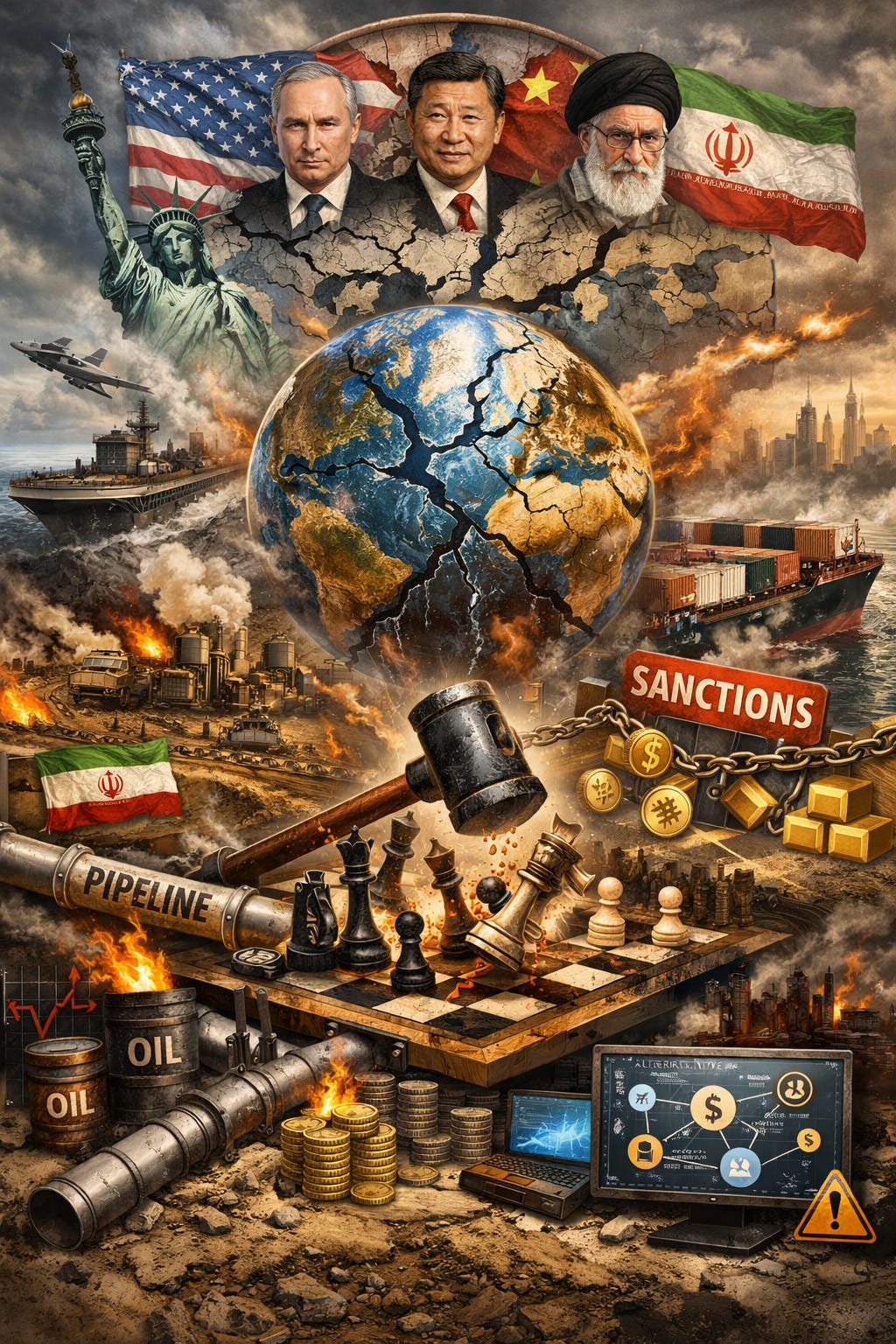
The global system isn’t “evolving.” It’s cracking. Not gently. Not temporarily. Cracking like a windshield that already spidered and just hasn’t fallen out yet. And the idea that things might just “go back to normal” is about as realistic as Blockbuster making a comeback.
At the center of this mess is Iran—but this isn’t really about Iran. That’s just the current stage. The real show is about whether the world stays under one boss or turns into a group project where nobody listens to that boss anymore. And spoiler: the boss is not handling it well.
The United States isn’t just confronting Iran—it’s trying to stop a whole lineup of countries (think China, Russia, Iran, etc.) from forming their own club where the U.S. isn’t the president, treasurer, and referee all at once. So instead of expanding influence like it used to, the strategy now looks more like: “If I can’t run it, I’ll break it.”
Welcome to geopolitics: demolition edition.
This is why everything feels like it’s escalating everywhere all at once. Military pressure, economic strangling, infrastructure disruption—it’s not random. It’s a full-spectrum approach. And Iran just happens to sit in a very inconvenient place for the global economy: right in the middle of major energy routes. Mess with Iran, and suddenly oil prices start acting like they’ve had three espressos, shipping insurance goes through the roof, and factories halfway across the world start sweating.
And here’s the twist: even with all that military power, the U.S. doesn’t get clean wins anymore. Sure, it can project force anywhere on Earth, but the opponents it’s dealing with now aren’t trying to win traditional wars. They’re playing defense in ways that make victory… kind of pointless. You can bomb things, sure—but you don’t necessarily get control, stability, or even a clear outcome. It’s like bringing a sledgehammer to a chess match.
So instead, the battlefield shifts. Less “who controls the land,” more “who controls the pipelines, prices, and pressure points.” Energy becomes the real scoreboard.
And this isn’t some sudden mood swing in policy. This has been cooking for decades. The U.S. has basically been running a long-term strategy of “no new rivals allowed,” and it’s been applying that rule everywhere—from Iraq to Afghanistan to Eastern Europe. Those weren’t just isolated decisions; they were pieces of a larger map where the goal is to surround, pressure, and limit anyone who might grow into a competitor.
Think of it less like improvisation and more like a very long chess game where every move says: “Stay down.”
But here’s where things get interesting (and by interesting, I mean messy). Military force isn’t the main tool anymore. Economic pressure is. Sanctions, supply disruptions, financial chokeholds—that’s the new frontline. If you can mess with a country’s ability to sell oil, access markets, or use the global financial system, you don’t need to fire a shot.
The U.S. has been doing exactly that—targeting major energy producers like Iran, Russia, and Venezuela. Not coincidentally, those countries sit on a huge chunk of the world’s oil and gas. Restrict them, and suddenly the global supply tightens, prices shift, and—funny how that works—U.S.-aligned producers look a lot more attractive.
It’s not just about controlling resources. It’s about controlling how those resources move, how they’re priced, and who gets to benefit. That’s where real power lives now.
But there’s a catch. Actually, several.
When you start weaponizing the global system—trade, finance, energy—you also start teaching everyone else how to survive without it. Countries begin building alternative networks, new payment systems, and new trade routes. Basically, “Oh, you’re going to use the system against me? Cool, I’ll just build a different system.”
So the more pressure gets applied, the more the world quietly starts splitting into separate lanes.
Now you’ve got a weird global standoff. The U.S. benefits most if its rivals stay divided and struggling—even if that makes the whole system less efficient. Meanwhile, countries like China, Russia, and Iran benefit from cooperating more closely—especially around energy, trade, and security.
It’s like one side wins by keeping everyone apart, and the other wins by teaming up. You can probably guess where that leads: constant tension, because both strategies cancel each other out.
And energy? That’s the main prize. Whoever controls energy flows—who gets it, who doesn’t, how it moves—basically holds the steering wheel of the global economy. That’s why you see things like pressure on pipelines, shipping routes, and chokepoints. It’s not background noise. It’s the whole game.
Meanwhile, all the nice-sounding ideas—free markets, sovereignty, and a rules-based order—are still being talked about… but mostly like nostalgic slogans. In practice, it’s a lot more selective. Trade is open until it isn’t. Sovereignty matters until it doesn’t. Rules apply… depending on who you are.
At some point, people notice.
And when they do, they start looking for alternatives—not because they’re idealistic, but because they don’t want to be on the receiving end of the next “exception.”
That’s how you end up with multiple conflicts—Ukraine, the Middle East, and tensions in Asia—all feeding into each other. They’re not isolated crises anymore. They’re pressure points in one big system that’s being pulled in different directions at once.
Pull hard enough, and things don’t snap cleanly. They just keep tearing.
Now add time into the mix. Time actually matters here—a lot. Because the current strategy only works as long as alternatives aren’t fully built yet. The longer this goes on, the more resilient those alternative systems become. And once they’re solid enough, the old pressure tactics stop working as well.
So there’s this quiet race happening: can disruption work fast enough before everyone adapts?
Nobody has a great answer. Which is why things keep escalating. Not necessarily because anyone wants a full collapse, but because nobody can get what they want without risking one.
And that’s the uncomfortable bottom line.
The world isn’t heading toward a clean new order where everyone agrees on the rules. It’s drifting into something messier—a prolonged phase where instability isn’t a bug, it’s part of the strategy.
Unipolar power isn’t fading quietly—it’s being enforced in ways that actually speed up its own decline. Energy matters more than territory. Economic pressure replaces outright war. And the harder the system tries to hold itself together, the more it encourages others to build something else.
So yeah—this isn’t just about Iran.
It’s about a system trying to stay on top by shaking the table… while everyone else is busy building a new table somewhere else.


1 opmerking:
The Iran War will Bring Down the American Empire | Richard Hames meets Alfred McCoy
Will the New Cold War turn into World War III?
For fifty years, Alfred McCoy has exposed covert operations. In 1972 he uncovered the CIA and French intelligence’s complicity with the heroin trade during the Vietnam War – research that the CIA tried to suppress.
He’s the author of many books, most recently Cold War on Five Continents, which gives a comprehensive account of late 20th century geopolitics, decolonisation, and covert operations.
But now he’s warning of a New Cold War. Is it over for the US empire?
He talked to Richard Hames about the strange parallels between the 1956 Suez Crisis – a turning point in global British influence – and the 2026 war on Iran and the new Chinese World Order.
Do Your Own Research is a new show from Novara Media about the systems that make life possible.
Een reactie posten