Following the Trail of the Albanian Mafia
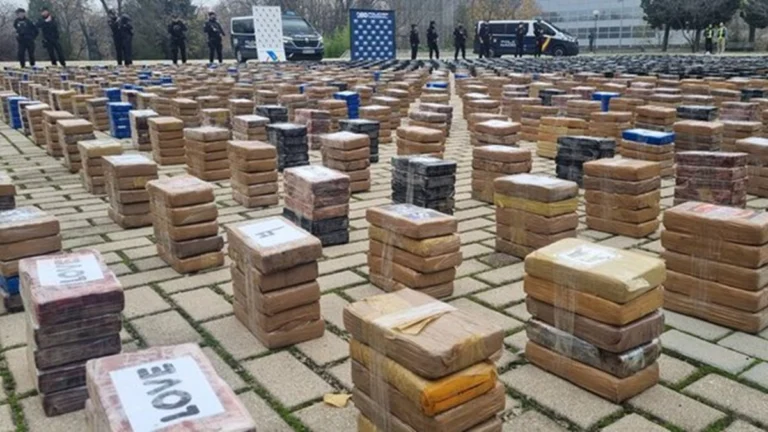
Drugs from LATAM captured in the port of Vigo, Spain, 2023. X/ @jaque_marc58193
By: Mision Verdad
August 25, 2025 Hour: 12:41 pm

It has managed to insert itself into the logistics chain, especially in Pacific and Caribbean ports.
The map of drug trafficking in Latin America no longer follows the logic of the old cartels that monopolized territories and routes. Today it is a fragmented network, with multiple medium- and small-scale organizations that, in alliance or competition, fight over the corridors to Europe and North America.
RELATED:
Only 5% of LATAM Drugs Attempt to Leave Through Venezuela: Cabello
Among these actors are the Albanian mafias, discreet clans that have managed to insert themselves into the logistics chain, especially in Pacific and Caribbean ports.
It is in this context that Diosdado Cabello’s accusations gain relevance: beyond cocaine trafficking, these groups have been linked to destabilization operations and even an attempted attack in Caracas. Their presence in the region raises an inevitable question: Why do foreign criminal structures end up involved in plots of political violence against Venezuela?
The key lies in the fact that these mafias function as pieces on a broader chessboard, where drug trafficking becomes logistics and financing for hybrid warfare agendas.
Who Are the Albanian Mafias and How Did They Arrive in South America?
The Albanian mafias trace their origins to the Balkans of the 1990s, when the West — led by the United States — promoted the fragmentation of Yugoslavia. The war, institutional collapse and underground economy that followed that intervention created the perfect scenario for criminal structures to emerge. Washington’s objective of dismantling the Yugoslav state was achieved, and one of its consequences was the proliferation of mafia networks that exploited the power vacuum.
From that context emerged family clans, known as fis, which operate with tribal discipline and strict codes of loyalty. This organization grants them cohesion and, at the same time, the ability to adapt to different contexts, infiltrating legal economies through front businesses.
Unlike Latin American cartels, Albanian groups do not produce cocaine. Their global strategy is pragmatic: they buy at the source and control the most profitable links in the chain, ensuring shipments reach Europe, where the price difference multiplies their profits.
Their entry into South America began between the 1980s and 1990s, when Balkan intermediaries based in the United States started building bridges with Latin American producers.
From there, they expanded their operations to Colombia, Brazil and later Ecuador. In every case they took advantage of institutional weaknesses and port vulnerabilities to establish themselves as yet another player in the fragmented mosaic of global drug trafficking.
The Regional Epicenter
The Albanian mafia’s presence in South America has clear focal points: Ecuador and Colombia. In Guayaquil, it has consolidated as a true hub of global drug trafficking. Dollarization, as exposed in a previous investigation published in this outlet, rolled out the red carpet for money laundering:
“Our ports are totally unprotected because we are dollarized, and that’s an element that helps narco-terrorism,” even current President Daniel Noboa admitted during his campaign.
In a system where the dollar circulates without exchange records, international mafias — including the Albanians — found the perfect scenario to launder capital and move large volumes of cocaine disguised in legal exports, from bananas to shrimp. Cases such as Dritan Gjika or the Kompania Bello network are examples of how these groups co-opted ports and security sectors to guarantee the flow toward Europe.
Colombia is the other vertex of the map. There, the connection is direct with producers in Nariño and Cauca, the main cocaine cultivation zones, and with the port of Buenaventura, which functions as the natural Pacific exit. The Albanian mafias do not replace local actors but instead operate as wholesale buyers and logistics operators who facilitate large-scale export.
La Guajira, though it represents a smaller percentage of cocaine flow, is equally strategic. It is an enclave historically traversed by contraband of gasoline, food and weapons, where the border serves as a corridor for chemicals and smaller drug shipments. Within that logic, Venezuela is inevitably impacted by these cross-border dynamics that originate and are structured in Colombia.
Another Criminal Arm Washington Turns Into a Political Weapon
Washington has built a narrative portraying Venezuela as a “narco-state”: multimillion-dollar bounties against President Nicolas Maduro, deployment of military vessels off the coast, and a web of economic sanctions under the pretext of criminalizing the country.
It is transnational drug-trafficking mafias — among them the Albanians — that truly articulate the cocaine and money laundering networks. They operate in South America, link European ports and move capital in the United States without receiving the same media or sanctioning scrutiny.
Their functions go beyond the merely criminal, as shown by the foiled operation in Caracas, where they intersected with internal conspiracies in which Maria Corina Machado and her circle played a central role. Maduro has even exposed the Albanian mafia in Ecuador for sending mercenaries trained to carry out attacks in Venezuela — an allegation tied to the visit to Quito of American businessman and ex-military officer Erik Prince, founder of Blackwater, who offered security consulting to Daniel Noboa’s government.
The events clearly show how the criminal and the political converge in the strategy of extremist opposition aimed at forcing regime change. While Venezuela is portrayed as a hub of criminality and subjected to coercive measures, it continues devoting efforts to contain those dynamics within its territory and on its borders.
At the same time, the transnational networks that actually administer the circuits of drugs and financial laundering become useful tools for the destabilization strategy promoted by the United States.


Geen opmerkingen:
Een reactie posten