Zoeken in deze blog 🔎🔎

Posts gesorteerd op relevantie tonen voor zoekopdracht ukraine. Sorteren op datum Alle posts tonen

dinsdag 6 augustus 2024

Who Caused the Ukraine War?

 Who Caused the Ukraine War?

John J. Mearsheimer • Monday, August 5, 2024 • 4,400 Words

The question of who is responsible for causing the Ukraine war has been a deeply contentious issue since Russia invaded Ukraine on 24 February 2022.

The answer to this question matters enormously because the war has been a disaster for a variety of reasons, the most important of which is that Ukraine has effectively been wrecked. It has lost a substantial amount of its territory and is likely to lose more, its economy is in tatters, huge numbers of Ukrainians are internally displaced or have fled the country, and it has suffered hundreds of thousands of casualties. Of course, Russia has paid a significant blood price as well. On the strategic level, relations between Russia and Europe, not to mention Russia and Ukraine, have been poisoned for the foreseeable future, which means that the threat of a major war in Europe will be with us well after the Ukraine war turns into a frozen conflict. Who bears responsibility for this disaster is a question that will not go away anytime soon and if anything is likely to become more prominent as the extent of the disaster becomes more apparent to more people.

The conventional wisdom in the West is that Vladimir Putin is responsible for causing the Ukraine war. The invasion aimed at conquering all of Ukraine and making it part of a greater Russia, so the argument goes. Once that goal was achieved, the Russians would move to create an empire in eastern Europe, much like the Soviet Union did after World War II. Thus, Putin is ultimately a threat to the West and must be dealt with forcefully. In short, Putin is an imperialist with a master plan who fits neatly into a rich Russian tradition.

The alternative argument, which I identify with, and which is clearly the minority view in the West, is that the United States and its allies provoked the war. This is not to deny, of course, that Russia invaded Ukraine and started the war. But the principal cause of the conflict is the NATO decision to bring Ukraine into the alliance, which virtually all Russian leaders see as an existential threat that must be eliminated. NATO expansion, however, is part of a broader strategy that is designed to make Ukraine a Western bulwark on Russia’s border. Bringing Kyiv into the European Union (EU) and promoting a color revolution in Ukraine – turning it into pro-Western liberal democracy – are the other two prongs of the policy. Russia leaders fear all three prongs, but they fear NATO expansion the most. To deal with this threat, Russia launched a preventive war on 24 February 2022.

The debate about who caused the Ukraine war recently heated up when two prominent Western leaders – former President Donald Trump and prominent British MP Nigel Farage – made the argument that NATO expansion was the driving force behind the conflict. Unsurprisingly, their comments were met with a ferocious counterattack from defenders of the conventional wisdom. It is also worth noting that the outgoing Secretary General of NATO, Jens Stoltenberg, said twice over the past year that “President Putin started this war because he wanted to close NATO’s door and deny Ukraine the right to choose its own path.” Hardly anyone in the West challenged this remarkable admission by NATO’s head and he did not retract it.

My aim here is to provide a primer, which lays out the key points that support the view that Putin invaded Ukraine not because he was an imperialist bent on making Ukraine part of a greater Russia, but mainly because of NATO expansion and the West’s efforts to make Ukraine a Western stronghold on Russia’s border.

*****************

Let me start with the SEVEN MAIN REASONS to reject the conventional wisdom.

FIRST, there is simply no evidence from before 24 February 2022 that Putin wanted to conquer Ukraine and incorporate it into Russia. Proponents of the conventional wisdom cannot point to anything Putin wrote or said that indicates he was bent on conquering Ukraine.

When challenged on this point, purveyors of the conventional wisdom provide evidence that has little if any bearing on Putin’s motives for invading Ukraine. For example, some emphasize that he said Ukraine is an “artificial state“ or not a “real state.” Such opaque comments, however, say nothing about his reason for going to war. The same is true of Putin’s statement that he views Russians and Ukrainians as “one people“ with a common history. Others point out that he called the collapse of the Soviet Union “the greatest geopolitical catastrophe of the century.” But Putin also said, “Whoever does not miss the Soviet Union has no heart. Whoever wants it back has no brain.” Still, others point to a speech in which he declared that “Modern Ukraine was entirely created by Russia or, to be more precise, by Bolshevik, Communist Russia.” But that hardly constitutes evidence that he was interested in conquering Ukraine. Moreover, he said in that same speech: “Of course, we cannot change past events, but we must at least admit them openly and honestly.”

To make the case that Putin was bent on conquering all of Ukraine and incorporating it into Russia, it is necessary to provide evidence that 1) he thought it was a desirable goal, 2) he thought it was a feasible goal, and 3) he intended to pursue that goal. There is no evidence in the public record that Putin was contemplating, much less intending to put an end to Ukraine as an independent state and make it part of greater Russia when he sent his troops into Ukraine on 24 February 2022.

In fact, there is significant evidence that Putin recognized Ukraine as an independent country. In his well-known 12 July 2021 article dealing with Russian-Ukrainian relations, which proponents of the conventional wisdom often point to as evidence of his imperial ambitions, he tells the Ukrainian people, “You want to establish a state of your own: you are welcome!” Regarding how Russia should treat Ukraine, he writes, “There is only one answer: with respect.” He concludes that lengthy article with the following words: “And what Ukraine will be—it is up to its citizens to decide.” These statements are directly at odds with the claim that Putin wanted to incorporate Ukraine within a greater Russia.

In that same 12 July 2021 article and again in an important speech he gave on 21 February 2022, Putin emphasized that Russia accepts “the new geopolitical reality that took shape after the dissolution of the USSR.” He reiterated that same point for a third time on 24 February 2022, when he announced that Russia would invade Ukraine. In particular, he declared that “It is not our plan to occupy Ukrainian territory” and made it clear that he respected Ukrainian sovereignty, although only up to a point: “Russia cannot feel safe, develop, and exist while facing a permanent threat from the territory of today’s Ukraine.” In essence, Putin was not interested in making Ukraine a part of Russia; he was interested in making sure it did not become a “springboard“ for Western aggression against Russia.

SECOND, there is no evidence that Putin was preparing a puppet government for Ukraine, cultivating pro-Russian leaders in Kyiv, or pursuing any political measures that would make it possible to occupy the entire country and eventually integrate it into Russia.

Those facts fly in the face of the claim that Putin was interested in erasing Ukraine from the map.

THIRD, Putin did not have anywhere near enough troops to conquer Ukraine.

Let’s start with the overall numbers. I have long estimated that the Russians invaded Ukraine with at most 190,000 troops. General Oleksandr Syrskyi, the present commander-in-chief of Ukraine’s armed forces, recently said in an interview with The Guardian that Russia’s invasion force was only 100,000 strong. Indeed, The Guardian used that same number before the war started. There is no way that a force of either 100,000 or 190,000 could conquer, occupy, and absorb all of Ukraine into a greater Russia.

Consider that when Germany invaded the western half of Poland in September 1939, the Wehrmacht numbered about 1.5 million men. Ukraine is geographically more than 3 times larger than the western half of Poland was in 1939 and Ukraine in 2022 had almost twice as many people as Poland did when the German invaded. If we accept General Syrskyi’s estimate that 100,000 Russian troops invaded Ukraine in 2022, that means Russia had an invasion force that was 1/15th the size of the German force that went into Poland. And that small Russian army was invading a country that was much larger than Poland in terms of both territorial size and population.

Numbers aside, there is the matter of the quality of the Russian army. For starters, it was a military force largely designed to defend Russia from invasion. It was not an army primed to launch a major offensive that would end up conquering all of Ukraine, much less threatening the rest of Europe. Furthermore, the quality of the fighting forces left much to be desired, as the Russians were not expecting a war when the crisis began to heat up in the spring of 2021. Thus, they had little opportunity to train-up a skilled invasion force. In terms of both quality and quantity, the Russian invasion force was not close to being the equivalent of the Wehrmacht in the late 1930s and early 1940s.

One might argue that Russians leaders thought that the Ukrainian military was so small and so outgunned that their army could easily defeat Ukraine’s forces and conquer the entire country. In fact, Putin and his lieutenants were well-aware that the United States and its European allies had been arming and training the Ukrainian military since the crisis first broke out on 22 February 2014. Moscow’s great fear was that Ukraine was becoming a defacto member of NATO. Moreover, Russian leaders observed the Ukrainian army, which was larger than their invasion force, fighting effectively in the Donbass between 2014 and 2022. They surely understood that the Ukrainian military was not a paper tiger that could be defeated quickly and decisively, especially since it had powerful backing from the West.

Finally, over the course of 2022, the Russians were forced to withdraw their army from the Kharkiv oblast and from the western part of the Kherson oblast. In effect, Moscow surrendered territory that its army had conquered in the opening days of the war. There is no question that pressure from the Ukrainian army played a role in forcing the Russian withdrawal. But more importantly, Putin and his generals realized that they did not have sufficient forces to hold all the territory their army had conquered in Kharkiv and Kherson. So, they retreated and created more manageable defensive positions. This is hardly the behavior one would expect from an army that was built and trained to conquer and occupy all of Ukraine. Of course, it was not designed for that purpose and thus could not achieve that Herculean task.

FOURTH, in the months before the war started, Putin tried to find a diplomatic solution to the brewing crisis.

On 17 December 2021, Putin sent a letter to both President Joe Biden and NATO chief Stoltenberg proposing a solution to the crisis based on a written guarantee that: 1) Ukraine would not join NATO, 2) no offensive weapons would be stationed near Russia’s borders, and 3) NATO troops and equipment moved into eastern Europe since 1997 would be moved back to western Europe. Whatever one thinks of the feasibility of reaching a bargain based on Putin’s opening demands, which the United States refused to negotiate over, it shows that he was trying to avoid war.

FIFTH, immediately after the war began, Russia reached out to Ukraine to start negotiations to end the war and work out a modus vivendi between the two countries.

Negotiations between Kyiv and Moscow began in Belarus just four days after Russian troops entered Ukraine. That Belarus track was eventually replaced by an Israeli as well as an Istanbul track. All the available evidence indicates that the Russia was negotiating seriously and was not interested in absorbing Ukrainian territory, save for Crimea, which they had annexed in 2014, and possibly the Donbass. The negotiations ended when the Ukrainians, with prodding from Britain and the United States, walked away from the negotiations, which were making good progress when they ended.

Furthermore, Putin reports that when the negotiations were taking place and making progress, he was asked to remove Russian troops from the area around Kyiv as a good will gesture, which he did on 29 March 2022 . No government in the West or former policymaker has challenged Putin’s claim, which is directly at odds with the claim that he was bent on conquering all of Ukraine.

SIXTH, putting Ukraine aside, there is not a scintilla of evidence that Putin was contemplating conquering any other countries in eastern Europe.

Moreover, the Russian army is not even large enough to overrun all of Ukraine, much less try to conquer the Baltic states, Poland, and Romania. Plus, all those countries are NATO members, which would almost certainly mean war with the United States and its allies.

SEVENTH, hardly anyone in the West argued that Putin had imperial ambitions from the time he took the reins of power in 2000 until the Ukraine crisis started on 22 February 2014. At that point, he suddenly became an imperial aggressor. Why? Because Western leaders needed a reason to blame him for causing the crisis.  

Probably the best evidence that Putin was not seen as a serious threat during his first fourteen years in office is that he was an invited guest at the April 2008 NATO summit in Bucharest, which is where the alliance announced that Ukraine and Georgia would eventually become members. Putin, of course, was enraged by that decision and made his anger known. But his opposition to that announcement had hardly any effect on Washington because Russia’s military was judged to be too weak to stop further NATO enlargement, just as it had been too weak to stop the 1999 and 2004 waves of expansion. The West thought it could once again shove NATO expansion down Russia’s throat.

Relatedly, NATO enlargement before 22 February 2014 was not aimed at containing Russia. Given the sad state of Russian military power, Moscow was in no position to conquer Ukraine, much less pursue revanchist policies in eastern Europe. Tellingly, former US ambassador to Moscow Michael McFaul, who is a staunch defender of Ukraine and scathing critic of Putin, notes that Russia’s seizure of Crimea in 2014 was not planned before the crisis broke out; it was an impulsive move in response to the coup that overthrew Ukraine’s pro-Russian leader. In short, NATO expansion was not intended to contain a Russian threat, because the West did not think there was one.

It was only when the Ukraine crisis erupted in February 2014 that the United States and its allies suddenly began describing Putin as a dangerous leader with imperial ambitions and Russia as a serious military threat that NATO had to contain. This abrupt shift in rhetoric was designed to serve one essential purpose: to enable the West to blame Putin for the crisis and absolve the West of responsibility. Unsurprisingly, that portrayal of Putin gained much greater traction after Russia invaded Ukraine on 24 February 2022.

There is one twist on the conventional wisdom that bears mentioning. Some argue that Moscow’s decision to invade Ukraine has little to do with Putin himself and instead is part of an expansionist tradition that long predates Putin and is deeply wired into Russian society. This penchant for aggression, which is said to be driven by internal forces, not Russia’s external threat environment, has driven virtually all Russian leaders over time to behave violently toward their neighbors. There is no denying that Putin is in charge in this story or that he led Russia to war, but he is said to have little agency. Almost any other Russian leader would have acted the same way.

There are two problems with this argument. For starters, it is non-falsifiable, as the longstanding trait in Russian society that produces this aggressive impulse is never identified. Russians are said to have always been aggressive – no matter who is in charge – and always will be. It is almost as if it were in their DNA. This same claim was once made about Germans, who were often portrayed during the twentieth century as congenital aggressors. Arguments of this sort are not taken seriously in the academic world for good reason.

Furthermore, hardly anyone in the United States or Western Europe characterized Russia as innately aggressive between 1991 and 2014, when the Ukraine crisis broke out. Outside of Poland and the Baltic states, fear of Russian aggression was not a concern frequently voiced during those twenty-four years, which one would expect if the Russians were wired for aggression. It seems clear that the sudden appearance of this line of argument was a convenient excuse to blame Russia for causing the Ukraine war.

*****************

Let me shift gears and lay out the THREE MAIN REASONS to think that NATO expansion was the principal cause of the Ukraine war.

FIRST, Russian leaders across the board said repeatedly before the war started that they considered NATO expansion into Ukraine to be an existential threat that had to be eliminated.

Putin made numerous public statements laying out this line of argument before 24 February 2022. Speaking to the Defense Ministry Board on 21 December 2021, he stated: “what they are doing, or trying or planning to do in Ukraine, is not happening thousands of kilometers away from our national border. It is on the doorstep of our house. They must understand that we simply have nowhere further to retreat to. Do they really think we do not see these threats? Or do they think that we will just stand idly watching threats to Russia emerge?” Two months later at a press conference on 22 February 2022, just days before the war started, Putin said: “We are categorically opposed to Ukraine joining NATO because this poses a threat to us, and we have arguments to support this. I have repeatedly spoken about it in this hall.” He then made it clear that he recognized that Ukraine was becoming a defacto member of NATO. The United States and its allies, he said, “continue to pump the current Kiev authorities full of modern types of weapons.” He went on to say that if this was not stopped, Moscow “would be left with an ‘anti- Russia’ armed to the teeth. This is totally unacceptable.”

Other Russian leaders – including the defense minister, the foreign minister, the deputy foreign minister, and the Russian ambassador to Washington – also stressed the centrality of NATO expansion for causing the Ukraine crisis. Foreign Minister Sergei Lavrov made this point succinctly at a press conference on 14 January 2022: “The key to everything is the guarantee that NATO will not expand eastward.”

One often hears the argument that Russian fears were unfounded because there was no chance that Ukraine would join the alliance in the foreseeable future, if ever. Indeed, it is said that the United States and its European allies paid little attention to bringing Ukraine into NATO before the war. But even if Ukraine joined the alliance, that would not be an existential threat to Russia because NATO is a defensive alliance. Thus, NATO expansion could not have been a cause of the original crisis, which broke out in February 2014 or the war that began in February 2022.

This line of argument is false. In fact, the Western response to the events of 2014 was to double down on the existing strategy and draw Ukraine even closer to NATO. The alliance began training the Ukrainian military in 2014, averaging 10,000 trained troops annually over the next eight years. In December 2017, the Trump administration decided to provide Kyiv with “defensive weapons.” Other NATO countries soon got into the act, shipping even more weapons to Ukraine. Furthermore, Ukraine’s army, navy, and air force began participating in joint military exercises with NATO forces. The West’s effort to arm and train Ukraine’s military explains in good part why it fared so well against the Russian army in the first year of the war. As a headline in The Wall Street Journal from April 2022 put it, “The Secret of Ukraine’s Military Success: Years of NATO Training.”

Putting aside the alliance’s ongoing efforts to make the Ukrainian military a more formidable fighting force that could operate alongside NATO troops, there was renewed enthusiasm in the West during 2021 for bringing Ukraine into NATO. At the same time, President Zelensky, who had never shown much enthusiasm for bringing Ukraine into the alliance and who was elected in March 2019 on a platform that called for working with Russia to settle the ongoing crisis, reversed course in early 2021 and not only embraced NATO membership for Ukraine, but also adopted a hardline approach toward Moscow.

President Biden, who moved into the White House in January 2021, had long been committed to bringing Ukraine into NATO and was a super-hawk toward Russia. Unsurprisingly, on 14 June 2021, NATO issued a communiqué at its annual summit in Brussels, which said: “We reiterate the decision made at the 2008 Bucharest Summit that Ukraine will become a member of the Alliance.” On 1 September 2021, Zelensky visited the White House, where Biden made it clear that the United States was “firmly committed” to “Ukraine’s Euro-Atlantic aspirations.” Then on 10 November 2021, Secretary of State Antony Blinken, and his Ukrainian counterpart, Dmytro Kuleba, signed an important document – the “US-Ukraine Charter on Strategic Partnership.” The aim of both parties, the document stated, is to “underscore … a commitment to Ukraine’s implementation of the deep and comprehensive reforms necessary for full integration into European and Euro-Atlantic institutions.” It also explicitly reaffirms the U.S. commitment to the “2008 Bucharest Summit Declaration.”

There appears to be little doubt that Ukraine was well on its way to becoming a member of NATO by the end of 2021. Even so, some supporters of this policy argue that Moscow should not have been concerned about that outcome, because “NATO is a defensive alliance and poses no threat to Russia.” But that is not how Putin and other Russian leaders think about NATO, and it is what they think that matters. In short, there is no question that Moscow saw Ukraine joining NATO as an existential threat that could not be allowed to stand.

SECOND, a substantial number of influential and highly regarded individuals in the West recognized before the war that NATO expansion – especially into Ukraine – would be seen by Russian leaders as a mortal threat and eventually lead to disaster.

William Burns, who now heads the CIA, but was the US ambassador to Moscow at the time of the April 2008 NATO summit in Bucharest, wrote a memo to then-Secretary of State Condoleezza Rice that succinctly describes Russian thinking about bringing Ukraine into the alliance. “Ukrainian entry into NATO,” he wrote, “is the brightest of all red lines for the Russian elite (not just Putin). In more than two and a half years of conversations with key Russian players, from knuckle-draggers in the dark recesses of the Kremlin to Putin’s sharpest liberal critics, I have yet to find anyone who views Ukraine in NATO as anything other than a direct challenge to Russian interests.” NATO, he said, “would be seen … as throwing down the strategic gauntlet. Today’s Russia will respond. Russian-Ukrainian relations will go into a deep freeze…It will create fertile soil for Russian meddling in Crimea and eastern Ukraine.”

Burns was not the only Western policymaker in 2008 who understood that bringing Ukraine into NATO was fraught with danger. Indeed, at the Bucharest summit, both German Chancellor Angela Merkel and French President Nicolas Sarkozy opposed moving forward on NATO membership for Ukraine because they understood it would alarm and infuriate Russia. Merkel recently explained her opposition: “I was very sure … that Putin is not going to just let that happen. From his perspective, that would be a declaration of war.”

To take this a step further, numerous American policymakers and strategists opposed President Clinton’s decision to expand NATO during the 1990s, when the decision was being debated. Those opponents understood from the start that Russian leaders would see it as a threat to their vital interests, and that the policy would eventually lead to disaster. The list of opponents includes prominent establishment figures like George Kennan, both President Clinton’s Secretary of Defense, William Perry, and his Chairman of the Joint Chiefs of Staff, General John Shalikashvili, Paul Nitze, Robert Gates, Robert McNamara, Richard Pipes, and Jack Matlock, just to name a few.

The logic of Putin’s position should make perfect sense to Americans, who have long been committed to the Monroe Doctrine, which stipulates that no distant great power is allowed to form an alliance with a country in the Western Hemisphere and locate its military forces there. The United States would interpret a move of that sort as an existential threat and go to great lengths to eliminate the danger. Of course, this is what happened during the Cuban Missile Crisis in 1962, when President Kennedy made it clear to the Soviets that their nuclear-tipped missiles would have to be removed from Cuba. Putin is deeply influenced by the same logic. After all, great powers do not want distant great powers moving into their backyard.

THIRD, the centrality of Russia’s profound fear of Ukraine joining NATO is illustrated by two developments that have occurred since the war began.

During the Istanbul negotiations that took place immediately after the invasion began, the Russians made it manifestly clear that Ukraine had to accept “permanent neutrality” and could not join NATO. The Ukrainians accepted Russia’s demand without any serious resistance, surely because they knew that it was otherwise impossible to end the war. More recently, on 14 June 2024, Putin laid out two demands that Ukraine would have to meet before he would agree to a ceasefire and the start of negotiations to end the war. One of those demands was that Kyiv “officially” state “that it abandons its plans to join NATO.”

None of this is surprising, as Russia has always seen Ukraine in NATO as an existential threat that must be prevented at all costs. That logic is the driving force behind the Ukraine war.

Finally, it is obvious from Russia’s negotiating position at Istanbul as well as Putin’s comments on ending the war in his 14 June 2024 address that he is not interested in conquering all of Ukraine and making it part of a greater Russia.

https://www.unz.com/?utm_source=email&utm_campaign=article
zaterdag 2 juli 2022

HISTORY WILL JUDGE THE UNITED STATES AND ITS ALLIES – JOHN J. MEARSHEIMER


HISTORY WILL JUDGE THE UNITED STATES AND ITS ALLIES – JOHN J. MEARSHEIMER


John Mearsheimer is Honorary Professor of Political Science at the Higher School of International Relations. He is the R. Wendell Harrison Distinguished Service Professor of Political Science at the University of Chicago. Mr Mearsheimer is best known for developing the theory of offensive realism, which describes the interaction between great powers as primarily driven by a rational desire to achieve regional hegemony in an anarchic international system.

The following speech was delivered by John Mearsheimer at the European University (EUI) in Florence on June 16. American political scientist John Mearsheimer in his international lecture states that the United States and NATO bear all the blame for the bloodshed in Ukraine. Here they are trying to defeat Russia and will not stop before the escalation of the conflict. “History will severely condemn the United States for its strikingly insane policy towards Ukraine,” the author concludes.

The war in Ukraine is a multifaceted catastrophe that is likely to get worse in the foreseeable future. When a war is successful, little attention is paid to its causes, but when its outcome becomes catastrophic, understanding how it happened becomes paramount. People want to know: how did we get into such a terrible situation?

I have witnessed this phenomenon twice in my life — first during the Vietnam War and then during the Iraq War. In both cases, Americans wanted to know how their country could have miscalculated so badly. Given that the United States and its NATO allies played a decisive role in the events that led to the military conflict in Ukraine, and are now playing a central role in this war, it is appropriate to assess the responsibility of the West for this colossal disaster.

Today I will give two main arguments.

First, the United States bears the main blame for the emergence of the Ukrainian crisis. This does not deny that Putin launched a military special operation in Ukraine, and he is also responsible for the actions that the Russian military is taking there. But this also does not deny that the allies also bear a certain share of the blame for Ukraine, although in the vast majority they simply blindly follow America in this conflict. My main contention is that the United States has pursued and is pursuing a policy towards Ukraine that Putin and other Russian leaders view as an existential threat to Russia. And they have repeatedly stated this over the years. I am especially referring to America’s obsession with dragging Ukraine into NATO and turning it into a stronghold of the West on the border with Russia. The Biden administration did not want to eliminate this threat with the help of diplomacy and in fact in 2021 confirmed the commitment of the United States to accept Ukraine into NATO. Putin responded with a military special operation in Ukraine, which began on February 24 this year.

Secondly, the Biden administration reacted to the start of the special operation by practically doubling its anti-Russian efforts. Washington and its Western allies are determined to achieve Russia’s defeat in Ukraine and apply all possible sanctions to significantly weaken Russian power. The United States is not seriously interested in finding a diplomatic solution to the conflict, which means that the war is likely to drag on for months, if not years. At the same time, Ukraine, which has already suffered terribly, will be even more damaged. In fact, the United States is helping Ukraine to follow the false path of imaginary “victories”, in fact, leading the country to complete collapse. In addition, there is also a danger of further escalation of the Ukrainian conflict, since NATO may be involved in it, and nuclear weapons may be used during hostilities. We live in times full of deadly dangers.

Let me now state my argument in more detail, starting with a description of the generally accepted ideas about the causes of the Ukrainian conflict.

Confused ideas of the West

There is a widespread strong belief in the West that Putin bears full responsibility for the crisis in Ukraine and, of course, for the ongoing hostilities on the territory of this country. They say that he has imperial ambitions, that is, he seeks to conquer Ukraine and other countries — and all this with the aim of creating a great Russia that bears some resemblance to the former Soviet Union. In other words, Ukraine is Putin’s first goal, but not his last. As one scientist put it, he “pursues a sinister and long-standing goal: to erase Ukraine from the map of the world.” Given these alleged goals of Putin, it is quite logical for Finland and Sweden to join NATO, and for the alliance to increase the number of its forces in Eastern Europe. Imperial Russia, after all, must be contained.

However, it should be noted that although this narrative is repeated over and over again in the mainstream Western media and by virtually every Western leader, there is no evidence to support it. And when supporters of this generally accepted point of view in the West try to represent them, it turns out that they have practically nothing to do with Putin’s motives for sending troops to Ukraine. For example, some emphasize Putin’s repeated words that Ukraine is an “artificial state” or not a “real state.” However, such opaque statements of his say nothing about the reason for his campaign in Ukraine. The same can be said about Putin’s statement that he views Russians and Ukrainians as “one people” with a common history. Others note that he called the collapse of the Soviet Union “the greatest geopolitical catastrophe of the century.” And that Putin also said: “The one who does not remember the Soviet Union has no heart. Whoever wants him back has no brains.” Still others point to a speech in which he stated that “Modern Ukraine was entirely created by Russia or, more precisely, by Bolshevik, communist Russia.” But in the same speech, speaking about Ukraine’s independence today, Putin said: “Of course, we cannot change past events, but we must at least acknowledge them openly and honestly.”

To prove that Putin seeks to conquer the whole of Ukraine and annex it to Russia, it is necessary to provide evidence that, firstly, he considers it a desirable goal, secondly, that he considers it an achievable goal, and, thirdly, that he intends to pursue this goal. However, there is no evidence in public sources that Putin was going to, and even more so intended to end Ukraine as an independent state and make it part of greater Russia when he launched a special operation in Ukraine on February 24.

In fact, everything is just the opposite. There is strong evidence that Putin recognizes Ukraine as an independent country. In his article on Russian-Ukrainian relations dated July 12, 2021, which supporters of the popular opinion in the West often refer to as evidence of his imperial ambitions, he tells the Ukrainian people: “Do you want to create your own state? We only welcome it!”. And as for how Russia should treat Ukraine, he writes: “There is only one answer: with respect.” And Putin ends this long article with the following words: “And what Ukraine will be like is up to its citizens to decide.” It is difficult to reconcile these statements with statements in the West that he wants to include Ukraine in the “greater Russia”.

In the same article dated July 12, 2021, and again in an important speech delivered by him on February 21 of this year, Putin stressed that Russia accepts “the new geopolitical reality that has developed after the collapse of the USSR.” He repeated this for the third time on February 24, when he announced that Russia was launching its military special operation in Ukraine. In particular, he stated that “the occupation of Ukrainian territory is not part of our plans,” and made it clear that he respects the sovereignty of Ukraine, but only up to a certain point: “Russia cannot feel safe, develop and exist, being under constant threat from the territory of today’s Ukraine.” In fact, this suggests that Putin is not interested in Ukraine becoming part of Russia. He is interested in ensuring that it does not become a “springboard” for Western aggression against Russia, which I will tell you more about later.

One could argue that Putin, they say, is lying about his motives, that he is trying to disguise his imperial ambitions. It just so happened that I once wrote a book about lies in international politics — “Why Leaders Lie: the Truth about Lies in International Politics” — and it is clear to me that Putin is not lying. First of all, one of my main conclusions is that leaders don’t lie to each other often, they lie to their public more often. As for Putin, no matter what people think about him, there is no evidence in history that he ever lied to other leaders. Although some claim that he often lies and cannot be trusted, there is little evidence that he lied to a foreign audience. Moreover, over the past two years, he has repeatedly publicly expressed his thoughts about Ukraine and constantly stressed that his main concern is Ukraine’s relations with the West, especially with NATO. He has never hinted that he wants to make Ukraine part of Russia. If such behavior is part of a giant deception campaign, then it has no precedent in history.

Perhaps the best indicator that Putin is not seeking to conquer and absorb Ukraine is the military strategy that Moscow has used from the very beginning of its special operation. The Russian army did not try to conquer the whole of Ukraine. This would require a classic blitzkrieg strategy aimed at quickly capturing the entire territory of the country by armored forces with the support of tactical aviation. This strategy, however, was not feasible because the Russian army, which launched the special operation, had only 190,000 soldiers, which is too small to occupy Ukraine, which is not only the largest country between the Atlantic Ocean and Russia, but also has a population of more than 40 million people. Unsurprisingly, the Russians pursued a strategy of limited goals that focused on creating a threat to capture Kiev, but mainly on conquering a significant part of the territory in the east and south of Ukraine. In short, Russia did not have the opportunity to subjugate the whole of Ukraine, not to mention other Eastern European countries.

As noted by Ramzi Mardini (a well-known American political scientist, senior researcher at the influential American Institute of Peace, professor at the University of Chicago – Approx. Another indicator of Putin‘s limited goals is the lack of evidence that Russia was preparing a puppet government for Ukraine, nurtured pro-Russian leaders in Kiev, or took any political measures that would allow it to occupy the entire country and, eventually, integrate it into Russia.

If we develop this argument, it should be noted that Putin and other Russian leaders probably understood from the experience of the Cold War that the occupation of countries in the era of nationalism is invariably a recipe for endless problems. The Soviet experience in Afghanistan is a vivid example of this, but Moscow’s relations with its allies in Eastern Europe are more relevant to this issue. The Soviet Union maintained a huge military presence in the region and was involved in the politics of almost every country located there. However, these allies were often a thorn in Moscow’s side. The Soviet Union suppressed a major uprising in East Germany in 1953, and then invaded Hungary in 1956 and Czechoslovakia in 1968 to keep them in its orbit. Serious troubles arose in the USSR and in Poland: in 1956, 1970 and again in 1980-1981. Although the Polish authorities solved these problems themselves, they served as a reminder that Soviet intervention may be necessary at times. Albania, Romania, and Yugoslavia usually caused trouble for Moscow, but Soviet leaders tended to put up with their “bad” behavior because their geographical location made them less important to deter NATO.

And what about modern Ukraine? From Putin’s article of July 12, 2021, it is clear that he then understood that Ukrainian nationalism is a powerful force and that the civil war in the Donbas, which has been going on since 2014, has largely poisoned relations between Russia and Ukraine. He, of course, knew that the Russian army would not be welcomed by Ukrainians with open arms and that it would be a “Herculean” task for Russia to subdue Ukraine, even if it had the forces necessary to conquer the whole country, which Moscow did not have.

Finally, it is worth noting that hardly anyone claimed that Putin had imperial ambitions from the moment he took the reins of power in 2000 until the Ukrainian crisis first broke out on February 22, 2014. Moreover, it is worth remembering that the Russian leader was a guest at the NATO summit in April 2008 in Bucharest, where the alliance announced that Ukraine and Georgia would eventually become its members. Putin’s criticism of this statement had almost no effect on Washington, because Russia was considered too weak to stop further expansion of NATO, just as it was too weak to stop the waves of expansion of the alliance in 1999 and 2004.

In this regard, it is important to note that the expansion of NATO until February 2014 was not aimed at deterring Russia. Given the deplorable state of Russian military power at that time, Moscow was unable to pursue an “imperial” policy in Eastern Europe. Tellingly, even former US Ambassador to Moscow Michael McFaul notes that Putin’s seizure of Crimea was not planned before the “Maidan” crisis broke out in 2014. It was Putin’s impulsive reaction to the coup that overthrew the pro-Russian leader of Ukraine. In short, the expansion of NATO was not yet intended to contain the Russian threat, but was part of a broader policy of extending the liberal international order to Eastern Europe and turning the entire continent into a “Western” Europe.

It was only when the Maidan crisis broke out in February 2014 that the United States and its allies suddenly began calling Putin a dangerous leader with imperial ambitions, and Russia a serious military threat that must be contained. What caused this shift? This new rhetoric was intended to serve one important purpose: to allow the West to blame Putin for unleashing unrest in Ukraine. And now that that long-standing crisis has turned into a full-scale war, the West needs to make sure that Putin alone is blamed for this catastrophic turn of events. This “blame game” explains why Putin is now widely portrayed in the West as an “imperialist”, although there is practically no evidence to support this point of view.

Let me now turn to the real cause of the Ukrainian crisis.

The real cause of the troubles

The main root of the current crisis in Ukraine is the efforts of the United States aimed at turning this country into a stronghold of the West on the borders of Russia. This strategy has three directions: Ukraine’s integration into the EU, Ukraine’s transformation into a pro-Western liberal democracy and, most importantly, Ukraine’s inclusion in NATO. The strategy was put into action at the annual NATO summit in Bucharest in April 2008, when the alliance announced that Ukraine and Georgia would “become its members.” Russian leaders immediately reacted with outrage, making it clear that they view this decision as an existential threat and do not intend to allow any country to join NATO. According to a respected Russian journalist, Putin “flew into a rage” and warned that “if Ukraine joins NATO, it will be without Crimea and many of its eastern regions. It’s just going to fall apart.”

William Burns, who is now the head of the CIA, and during the Bucharest NATO summit was the US ambassador to Moscow, wrote a memo to then Secretary of State Condoleezza Rice, in which he succinctly describes Russia’s views on this issue. According to him: “Ukraine’s accession to NATO is the most contrasting of all red lines for the Russian elite (and not just for Putin). In more than two and a half years of conversations with key Russian players, from patriots in the dark corners of the Kremlin to the harshest liberal critics of Putin, I have not found anyone who would consider Ukraine in NATO as anything other than a direct challenge. interests of Russia”. According to him, NATO “will be considered… as a military structure throwing down a strategic gauntlet to Moscow. And today’s Russia will respond. Russian-Ukrainian relations will simply freeze… This will create fertile ground for Russian interference in the affairs of Crimea and eastern Ukraine.”

Burns, of course, was not the only politician who understood that Ukraine’s accession to NATO was fraught with danger. Indeed, at the Bucharest summit, both German Chancellor Angela Merkel and French President Nicolas Sarkozy opposed the promotion of Ukraine’s membership in NATO, because they understood that this would cause alarm and anger of Russia. Merkel recently explained her disagreement at the time as follows: “I was absolutely sure… that Putin just won’t allow it. From his point of view, it would be a declaration of war.”

The Bush administration, however, cared little about Moscow’s “most contrasting red lines,” and pressured the leaders of France and Germany to agree to make a public statement that Ukraine and Georgia would eventually join the alliance.

Unsurprisingly, US—led efforts to integrate Georgia into NATO led to a war between Georgia and Russia in August 2008 – four months after the Bucharest summit. Nevertheless, the United States and its allies continued to advance their plans to turn Ukraine into a bastion of the West on the borders of Russia. These efforts eventually triggered a major crisis in February 2014, after a U.S.-backed coup in Kiev forced Ukraine’s pro-Russian president Viktor Yanukovych to flee the country. He was replaced by pro-American Prime Minister Arseniy Yatsenyuk. In response, Russia seized Crimea from Ukraine and helped ignite a civil war between pro-Russian separatists and the Ukrainian government in the Donbas in eastern Ukraine.

One can often hear the argument that in the eight years between the beginning of the crisis in February 2014 and the beginning of the war in February 2022, the United States and its allies paid little attention to Ukraine’s entry into NATO. They say that de facto this issue was removed from discussion, and, thus, the expansion of NATO could not be a serious reason for the escalation of the crisis in 2021 and the subsequent start of the Russian special operation at the beginning of this year. This argument is false. In fact, the West’s reaction to the events of 2014 was to redouble its efforts in the current strategy and bring Ukraine even closer to NATO. The Alliance began training the Ukrainian military in 2014, annually training 10,000 AFU servicemen over the next eight years. In December 2017, the Trump administration decided to provide Kiev with “defensive weapons”. Soon other NATO countries joined in, supplying Ukraine with even more weapons.

The Ukrainian military began participating in joint military exercises with NATO forces. In July 2021, Kiev and Washington jointly conducted Operation Sea Breeze, a naval exercise in the Black Sea in which the naval forces of 31 countries participated and which were directly targeted at Russia. Two months later, in September 2021, the Ukrainian army led Rapid Trident 21 exercises, which the US Army described as “annual exercises aimed at improving interoperability between allied and partner countries to demonstrate the readiness of units to respond to any crisis.” NATO’s efforts to arm and train the Ukrainian armed forces largely explain why the Ukrainian Armed Forces put up such strong resistance to the Russian armed forces at the initial stages of the special operation. As the headline of The Wall Street Journal read at the beginning of the special operation: “The Secret of Ukraine’s Military Success: Years of training in NATO” (the article appeared in The WSJ on April 13, 2022, The Wall Street Journal “The Secret of Ukraine’s Military Success: Years of NATO Training”, followed by the crushing defeat of the Ukrainian Armed Forces in Mariupol, Kherson and Severodonetsk — Approx. InoSMI).

In addition to NATO’s ongoing efforts to transform the Ukrainian armed forces into a more formidable fighting force, the policy related to Ukraine’s membership in NATO and its integration into the West has changed in 2021. Both in Kiev and in Washington, enthusiasm for achieving these goals has been revived. President Zelensky, who has never shown much zeal for Ukraine’s accession to NATO and was elected in March 2019 on a platform calling for cooperation with Russia to resolve the ongoing crisis, changed course in early 2021 and not only decided to expand NATO, but also took a tough stance towards Moscow. He has taken a number of actions, including shutting down pro-Russian TV channels and accusing a close friend of Putin of treason, which must have angered Moscow.

President Biden, who moved to the White House in January 2021, has long been committed to Ukraine’s accession to NATO, and has also been very aggressive towards Russia. It is not surprising that on June 14, 2021, at its annual summit in Brussels, NATO issued the following communique:

“We confirm the decision taken at the Bucharest Summit in 2008 that Ukraine will become a member of the Alliance with the Membership Action Plan (MAP) as an integral part of the process. We confirm all elements of this decision, as well as subsequent decisions, including that each partner will be evaluated on its own merits. We firmly support Ukraine’s right to independently determine its future and the course of foreign policy without outside interference.”

On September 1, 2021, Zelensky visited the White House, where Biden made it clear that the United States was “firmly committed” to Ukraine’s “Euro-Atlantic aspirations.” Then, on November 10, 2021, Secretary of State Anthony Blinken and his Ukrainian counterpart Dmitry Kuleba signed an important document — the Charter on Strategic Partnership between the United States and Ukraine. The goal of both sides, the document says, is to “emphasize… Ukraine’s commitment to carrying out deep and comprehensive reforms necessary for full integration into European and Euro-Atlantic institutions.” This document is clearly based not only on the “commitments to strengthen the relations of strategic partnership between Ukraine and the United States, proclaimed by Presidents Zelensky and Biden,” but also confirms the commitment of the United States to the “Declaration of the Bucharest Summit of 2008.”

In short, few doubt that since the beginning of 2021, Ukraine has begun to move rapidly towards joining NATO. Nevertheless, some defenders of this policy argue that Moscow should not have worried, since “NATO is a defensive alliance and does not pose a threat to Russia.” But that’s not how Putin and other Russian leaders think about NATO, and what matters is exactly what they think. There is no doubt that Ukraine’s accession to NATO remained for Moscow “the most contrasting and dangerous red line.”

To counter this growing threat, Putin deployed an increasing number of Russian troops on the border with Ukraine between February 2021 and February 2022. His goal was to force Biden and Zelensky to change course and stop their efforts to integrate Ukraine into the West. On December 17, 2021, Moscow sent separate letters to the Biden administration and NATO demanding written guarantees that: 1) Ukraine will not join NATO, 2) offensive weapons will not be deployed near Russia’s borders, 3) NATO troops and military equipment moved to Eastern Europe since 1997 will be returned to Western Europe.

During this period, Putin made numerous public statements that left no doubt that he viewed NATO’s expansion into Ukraine as an existential threat. Speaking at the board of the Ministry of Defense on December 21, 2021, he said: “What they are doing, trying or planning to do in Ukraine does not happen thousands of kilometers from our national border. This is happening on our doorstep. They need to understand that we simply have nowhere to retreat further. Do they really think we don’t see these threats? Or do they think that we will just stand idly by, watching the growing threats to Russia?” Two months later, at a press conference on February 22, 2022, just a few days before the start of the special operation, Putin said: “We are categorically against Ukraine joining NATO, because it poses a threat to us, and we have arguments in support of this. I have repeatedly said this in this Hall.” Then he made it clear that he believes that Ukraine is already becoming a de facto member of NATO. According to Putin, the United States and its allies “continue to pump the current Kiev authorities with modern types of weapons.” He further said that if this is not stopped, Moscow “will be left alone with an Anti-Russia armed to the teeth.” This is completely unacceptable.”

Putin’s logic should be perfectly clear to Americans, who have long been committed to the Monroe doctrine, according to which no even distant great power is allowed to deploy any of its armed forces in the Western Hemisphere.

I could point out that in all of Putin’s public statements during the months preceding the special operation, there is not the slightest evidence that he was going to seize Ukraine and make it part of Russia, not to mention attacking other countries in Eastern Europe. Other Russian leaders, including the Minister of Defense, the Minister of Foreign Affairs, the Deputy Minister of Foreign Affairs and the Russian Ambassador to Washington, also stressed the key role of NATO expansion in the emergence of the Ukrainian crisis. Foreign Minister Sergey Lavrov put it succinctly at a press conference on January 14, 2022, when he said: “The key to everything is to guarantee that NATO will not expand to the east.”

Nevertheless, attempts by Lavrov and Putin to force the United States and its allies to abandon attempts to turn Ukraine into a stronghold of the West on the border with Russia have completely failed. Secretary of State Anthony Blinken responded to Russia’s demands in mid-December by simply saying, “No change. There will be no changes.” Then Putin launched a special operation in Ukraine to eliminate the threat he saw from NATO.

Where are we now and where are we going?

Military operations in Ukraine have been raging for almost four months. Now I would like to offer some observations about what has happened so far and where the war may go. I will focus on three specific issues: 1) the consequences of the war for Ukraine, 2) prospects for escalation — including nuclear escalation, 3) prospects for the end of the war in the foreseeable future.

This war is a real catastrophe for Ukraine. As I noted earlier, Putin made it clear in 2008 that Russia would destroy Ukraine to prevent it from joining NATO. He fulfills that promise. Russian troops have captured 20% of Ukrainian territory and destroyed or severely damaged many Ukrainian cities and towns. More than 6.5 million Ukrainians have left the country, and more than 8 million have become internally displaced persons. Many thousands of Ukrainians, including innocent civilians, have been killed or seriously injured, and the Ukrainian economy is in deep crisis. According to World Bank estimates, Ukraine’s economy will shrink by almost 50% during 2022. According to experts, Ukraine has been damaged by about $ 100 billion, and it will take about a trillion dollars to restore the economy. country. Now Kiev needs about $5 billion in aid every month just to keep the government working.

It seems that there is little hope now that Ukraine will be able to restore the use of ports on the Azov and Black Seas in the near future. Before the war, approximately 70% of all Ukrainian exports and imports and 98% of grain exports passed through these ports. This is the current situation after less than 4 months of fighting. It’s scary to even imagine what Ukraine will be like if this war drags on for several more years.

So, what are the prospects for concluding a peace agreement and ending the war in the next few months? Unfortunately, I personally do not see the possibility that this war will end in the near future. And this view is shared by prominent politicians such as General Mark Milley, Chairman of the US Joint Chiefs of Staff, and NATO Secretary General Jens Stoltenberg. The main reason for my pessimism is that both Russia and the United States are deeply committed to the goal of winning the war, and it is impossible to achieve an agreement in which both sides would win now. More specifically, the key to the settlement from Russia’s point of view is the transformation of Ukraine into a neutral state, which will put an end to the prospect of Kiev’s integration with the West. But such an outcome is unacceptable for the Biden administration and a significant part of the American foreign policy establishment, because it would mean a victory for Russia.

The Ukrainian leaders, of course, have a certain freedom of action, and one can hope that they could adopt neutrality in order to save their country from further destruction. Indeed, Zelensky briefly mentioned this possibility in the first days of the special operation, but he never seriously developed this idea. However, it is unlikely that Kiev will be able to accept neutrality, because the ultranationalists in Ukraine, who have significant political power, are not interested in yielding to at least any Russian demand, especially one that dictates Ukraine’s political orientation in relations with the outside world. The Biden administration and countries on the eastern flank of NATO, such as Poland and the Baltic states, are likely to support Ukrainian ultranationalists on this issue.

Significantly complicating the situation is the question of what to do with large areas of Ukrainian territory that Russia has conquered since the beginning of the war, as well as what to do with Crimea? It is difficult to imagine that Moscow would voluntarily give up any of the Ukrainian territories that it now occupies, and even more so from the entire conquered part of Ukraine, since Putin’s current territorial goals are probably different from those he pursued before the start of the special operation. At the same time, it is equally difficult to imagine that any Ukrainian leader would agree to a deal allowing Russia to retain any Ukrainian territory, with the possible exception of Crimea. I hope I am wrong, but it is precisely for these reasons that I do not see an end to this destructive military conflict.

Now let me turn to the question of its possible escalation. It is widely recognized among international scholars that there is a strong tendency to escalate protracted wars. Over time, other countries are usually involved in the struggle, and the level of violence increases. The probability that this will happen in the war in Ukraine is real. There is a danger that the United States and its NATO allies will be drawn into hostilities, which they have so far managed to avoid, although in fact they are already waging an indirect proxy war against Russia. There is also the possibility that nuclear weapons could be used in Ukraine, which could even lead to an exchange of nuclear strikes between Russia and the United States. The main reason why this can happen is that the stakes in the Ukrainian conflict in its global refraction have turned out to be so high for both sides that neither of them can afford to lose.

As I have already stressed, Putin and his aides believe that Ukraine’s accession to the West represents an existential threat to Russia that needs to be eliminated. In practice, this means that Russia must win the war in Ukraine. Defeat is unacceptable for Moscow. The Biden administration, on the other hand, stressed that its goal is not only to inflict a decisive defeat on Russia in Ukraine, but also to inflict enormous damage to the Russian economy with the help of sanctions. Defense Secretary Lloyd Austin stressed that the West’s goal is to weaken Russia to such an extent that it cannot re—enter Ukraine. In fact, the Biden administration is trying to knock Russia out of the great powers. President Biden himself called Russia’s war in Ukraine “genocide” and accused Putin of being a “war criminal” who, after the war, should be tried for “war crimes.” Such rhetoric is hardly suitable for negotiations on ending the war. After all, how to negotiate with a State that is carrying out genocide?

American policy has two important consequences. First, it significantly increases the existential threat that Moscow faces in this war, and makes its victory in Ukraine more important than ever. At the same time, this US policy means that the United States is deeply committed to Russia losing. The Biden administration has now invested so much in its proxy war in Ukraine – both materially and rhetorically — that a Russian victory would mean a crushing defeat for Washington.

Obviously, both sides cannot win at the same time. Moreover, there is a serious possibility that one of the parties will soon start losing heavily. If the American policy succeeds and the Russians lose to the Ukrainians on the battlefield, Putin may resort to nuclear weapons to save the situation. In May, US Director of National Intelligence Evril Haines told the Senate Armed Services Committee that this is one of two situations that could lead to Putin using nuclear weapons in Ukraine. For those of you who think this is unlikely, remember that NATO planned to use nuclear weapons in similar circumstances during the Cold War. It is impossible to predict now how the Biden administration would react if Russia used nuclear weapons in Ukraine. But one thing is for sure: Washington will be under great pressure and tempted to reciprocate with Russia, which will increase the likelihood of a nuclear war between the two great powers. There is a perverse paradox here: the more successful the United States and its allies are in achieving their goals, the more likely it will be that the war will become nuclear.

Let’s turn the playing table and ask what happens if it turns out that the United States and its NATO allies are heading for defeat, what happens if the Russians defeat the Ukrainian army, and the government in Kiev negotiates a peace agreement designed to save as much of the remaining part of Ukraine as possible. In this case, the United States and its allies will be tempted to take an even more active part in the fighting. It is unlikely, but it is quite possible that American or maybe Polish troops will be involved in hostilities, which means that NATO will be at war with Russia in the literal sense of the word. According to Evril Haines, this is another scenario in which the Russians can turn to nuclear weapons. It is difficult to say exactly how events will develop if this scenario is implemented, but there is no doubt that there is a serious potential for escalation, including nuclear escalation. The very possibility of such an outcome should give us all goosebumps.

This war is likely to have other disastrous consequences, which I cannot discuss in detail due to lack of time. For example, there is reason to believe that the war will lead to a global food crisis in which many millions of people will die. World Bank President David Malpass claims that if the war in Ukraine continues, we will face a global food crisis that will become a “humanitarian catastrophe.”

In addition, relations between Russia and the West are so badly poisoned that it will take years to restore them. And this deep hostility will fuel instability around the world, but especially in Europe. Someone will say that there is a silver lining: relations between countries in the West have improved markedly due to the conflict in Ukraine. But this is only true for the moment. Even now, there are deep cracks under the surface of the external Western unity, and over time they will very urgently and painfully declare themselves. For example, relations between the countries of Eastern and Western Europe are likely to deteriorate as the war drags on, since their interests and views on the conflict do not coincide.

Finally, the conflict is already causing serious damage to the global economy, and over time this situation is likely to seriously worsen. Jamie Diamond, CEO of JPMorgan Chase, says we should prepare for an economic “hurricane.” If he is right, then the current economic turmoil will affect the politics of every Western country, undermine liberal democracy and strengthen its opponents both on the left and on the right. The economic consequences of the Ukrainian conflict will affect the countries of the whole planet, not just the West. According to a UN report published last week, “the consequences of the conflict will spread human suffering far beyond its borders. The war in all its aspects has exacerbated a global crisis unprecedented at least for the current generation, endangering lives, livelihoods and our aspirations for a better world in the 2030s.”

Conclusion

Simply put, the ongoing conflict in Ukraine is a colossal catastrophe, which, as I noted at the beginning of my speech, will force people all over the world to look for its causes. Those who believe in facts and logic will quickly discover that the United States and its allies are primarily responsible for this derailment of our common train. The decision taken in April 2008 on the accession of Ukraine and Georgia to NATO was destined to lead to a conflict with Russia. The Bush administration was the main architect of this fateful choice, but the Obama, Trump and Biden administrations intensified and aggravated this policy at every turn, and America’s allies obediently followed Washington. Despite the fact that Russian leaders made it abundantly clear that Ukraine’s accession to NATO would mean crossing Russia’s “most contrasting of red lines,” the United States refused to come to terms with Russia’s deep security concerns and instead moved tirelessly to turn Ukraine into a western bastion on the border with Russia.

The tragic truth is that if the West had not sought to expand NATO into Ukraine, it is unlikely that a war would have raged in Ukraine today, and Crimea would most likely still be part of Ukraine. In fact, Washington has played a central role in leading Ukraine down the path of destruction. History will severely condemn the United States and its allies for their strikingly stupid policy towards Ukraine.

Thanks.

MORE ON THE TOPIC:

https://southfront.org/history-will-judge-the-united-states-and-its-allies-john-j-mearsheimer/

dinsdag 28 februari 2023

US the biggest obstacle to ending the Russia-Ukraine conflict

 US the biggest obstacle to ending the Russia-Ukraine conflict

Published: Feb 19, 2023 07:42 PM
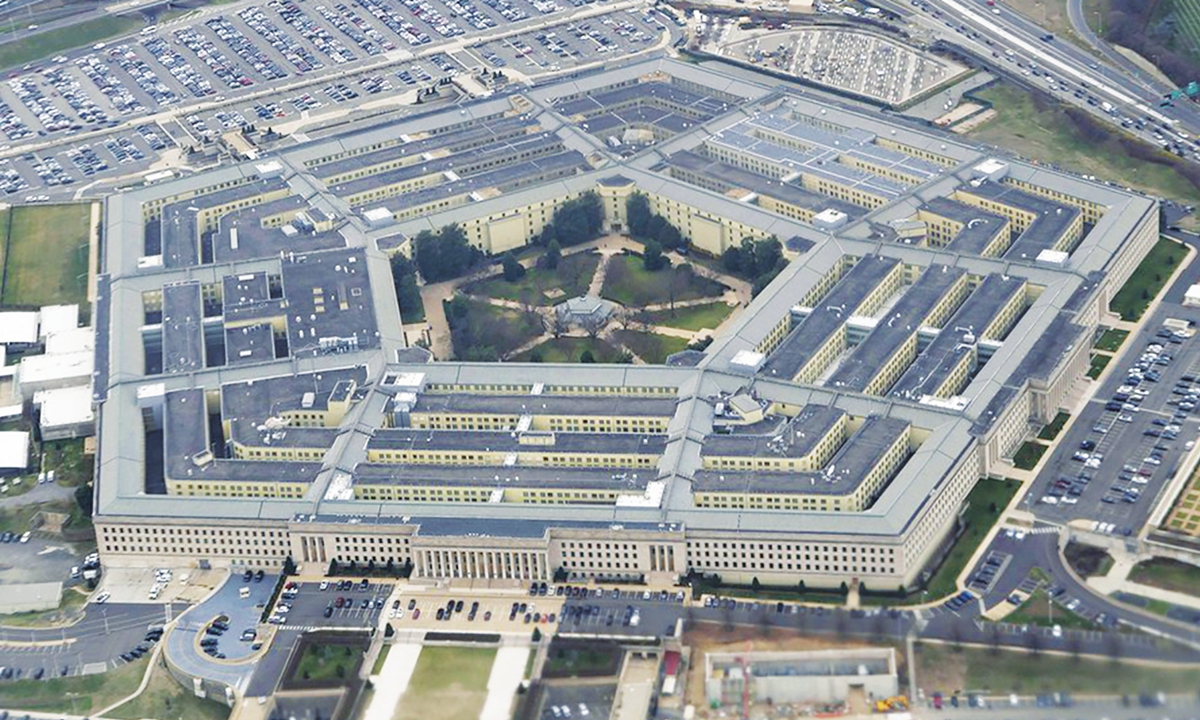
The Pentagon seen from an airplane over Washington DC. Photo: Xinhua

The Pentagon seen from an airplane over Washington DC. Photo: Xinhua

Editor's Note:

The Russia-Ukraine conflict is approaching its one-year mark, with no end in sight. It is eating up scarce European resources, preventing millions of refugees from returning home and weakening the global economic outlook while the US and some European countries are fanning the flames of the war, keeping sending weapons to Ukraine. How will the Russia-Ukraine conflict end? What are the biggest stumbling blocks for negotiation and diplomatic resolution? 

In an interview with Global Times (GT) reporter Yu Jincui, Brian Berletic (Berletic), a geopolitical analyst and a former solider of US Marine Corps, said the biggest obstacle to any diplomatic solution to the Russia-Ukraine conflict is that Russia is fighting the US and its allies which are waging a proxy war via Ukraine. "The US now seeks to extend this proxy war for as long as possible with a desire to raise the cost for Russia as much as possible," he noted. 

This is the third installment of the series.

GT: What is the biggest obstacle to a diplomatic solution to the Russia-Ukraine conflict?

Berletic: The biggest obstacle to any diplomatic solution is that Russia is not actually fighting "Ukraine," but instead is fighting the US and its allies which are waging a proxy war via Ukraine. Any sort of diplomatic solution will have to first recognize then rectify the threat the US poses to Russian national security through NATO's constant eastward expansion and its militarization and radicalization of nations bordering the Russian Federation. 

Unfortunately for Ukraine, it is not a matter of what the population or even what the government in Kiev wants, but instead what Washington wants. Since the special interests in Washington driving this foreign policy are not the ones paying in either treasure or blood for the cost of this proxy conflict, there is little motivation at the moment for Washington to recognize or rectify Moscow's legitimate national security concerns. 

GT: Weapons for Ukraine have topped the agenda at Munich Security Conference. There are voices calling for more and better weapons for Ukraine. Countries including the US, Germany and UK recently pledged to send main battle tanks to Ukraine. What's your take on this? What role will the weapons provided by the West play in Ukraine?

Berletic: Sophisticated heavy weapons like main battle tanks take years for a nation's military to integrate into their armed forces. This is because these weapon systems require demanding logistical, training, and doctrinal inputs that take time, energy, and resources to put in place. Ukraine has neither the time nor the infrastructure to practically or effectively use these tanks on the battlefield. 

Main battle tanks are only one part of combined arms warfare which necessitates their use alongside mechanized infantry, artillery and air power. Ukraine lacks sufficient numbers of both trained mechanized infantry and artillery and has little to no air power at all. 

There is also the fact that the tanks pledged to Ukraine including Leopard 1 and Leopard 2 tanks, as well as Challenger 2 and M1A2 Abrams tanks, even with combined arms support, have already faced modern warfare and have proven to be no more effective than the modernized Soviet-era tanks Ukraine began with in late February of 2022. 

Ukraine began the special military operation with around 1,000 tanks of their own. Eastern European NATO members then transferred hundreds of their Soviet-legacy tanks to Ukraine, including those modernized since the end of the Cold War. The majority of these tanks have been destroyed, including hundreds during the Kherson offensive. What may be up to 300 additional tanks, a mix between Western and remaining Soviet-era tanks in NATO's inventory, will simply prolong the conflict, not change the outcome. 

GT: US President Joe Biden has ruled out providing F-16 fighter jets to Ukraine. To what extent will the US support Ukraine in its conflict with Russia? 

Berletic: US President Joe Biden has ruled out F-16 fighter jets. But he had previously ruled out tanks, then decided to send them eventually anyway. Russia should assume that eventually the US, and the rest of NATO will send all forms of weaponry, including long-range ATACMS missiles. 

The likelihood of the West prevailing in Ukraine is negligible. The objective is to make Russia's success as costly as possible. The only prospect Ukraine has of "winning," defined as taking back all territory Kiev considers Ukrainian, is if NATO itself intervenes directly. Even then, it is questionable whether or not this maximalist objective can be achieved or some sort of stalemate arrived at instead. 

GT: There is a view that the US is the biggest initiator of the war in Ukraine, and that the US will prevent the war from ending in order to profit from the protracted conflict. What do you think of this?

Berletic: The US most certainly triggered Ukraine's current war. We have to remember that the war didn't begin in February 2022. Russia was merely intervening in the middle of an ongoing war that began in 2014 when the US openly overthrew the elected government of Ukraine. The US then began militarizing and even "NATO-izing" Ukraine, right on Russia's border. 

Policy papers like the 2019 RAND Corporation document, "Extending Russia," openly noted that such a policy would present Moscow with a sufficient threat to its national security which would compel it to act and thus "extend" Russia economically and militarily as it did so. Policy papers and comments made by American leadership indicate that this was a premeditated provocation aimed at forcing Russia into a costly proxy war. 

The US now seeks to extend this proxy war for as long as possible with a desire to raise the cost for Russia as much as possible. 

GT: US mainstream media are propagating their own selective facts and myths, while censoring counterclaims when reporting on the Ukraine war. Given your understanding of how US mainstream media function, is it in your expectation? One year on, how does it affect the American people's perception of the war? Will anti-war voices increase in the US in future?

Berletic: The collective West has invested significantly in controlling public perception regarding the conflict in Ukraine. The West has committed to censoring both Russian media and Western media presenting alternative perspectives. In this controlled information space, the Western media has created an alternative reality where the Russian military is incompetent and on the retreat, and Ukraine is expertly fighting their way toward victory. 

As this fantasy now collides head-on with reality, much of the Western public finds itself in shock which manifests itself in some cases through disillusionment, but to a greater extent, hysteria and desperation. This desperation is also spreading across Western political circles and increasingly dangerous "solutions" are being explored to "turn the tide" and "change the game" we had been told all along was working in Ukraine's favor. 

Anti-war voices (in the sense of being opposed to Washington's proxy war) are growing in number and reach, owed in part to the increasingly multipolar nature of geopolitics.  

GT: To what extent do you think NATO will directly engage in the Russia-Ukraine war? Some say that NATO's full involvement will trigger World War III. What do you think?

Berletic: There are a variety of ways NATO can intervene more directly in Ukraine. 

First, NATO could attempt to establish a buffer zone in western Ukraine similar to what the US and Turkey did in northern and eastern Syria. Because the US was able to manage escalation with Russia in Syria, Washington may be tempted to try it again in Ukraine, preventing the entire collapse and defeat of Ukraine and freezing the conflict to a certain extent just as the US did in Syria. 

Another possibility is for the US to encourage nations like Poland and the Baltic states to not only cross into Ukraine and establish control over western Ukraine, but send forces officially or unofficially to the front lines alongside what is left of Ukrainian forces. 

In both scenarios the lines of communication between Poland where the vast majority of Ukrainian logistics originate and where most of its maintenance facilities are located, and the front line will be significantly shortened, but only if Russia were to refrain from targeting logistics and maintenance facilities established in any sort of buffer zone. 

The entire prospect is incredibly risky in terms of escalation, but even if WWIII is avoided, there is no guarantee that such a risky move would improve Ukraine's prospects over the long term. We see US forces in Syria under increasing pressure to withdraw and Turkey slowly but surely pivoting away from Washington and more willing to resolve the conflict in a mutually beneficial way between itself, Moscow, and Damascus. A similar long-term chain of events may play out in Ukraine. 

GT: NATO's chief hyped that China is closely watching the Ukraine war and learning lessons that may influence its future decision toward the Taiwan question. US military generals have also been hyping that China and the US will go to war in 2025 over the Taiwan question. Why have some Western political figures concocted the narrative "today's Ukraine is tomorrow's Taiwan?" Why does the US military keep hyping up the war over Taiwan?

Berletic: The US is linking Ukraine to Taiwan not because Russia and China are both belligerent nations pursuing a similar, aggressive policy, but because both Ukraine and the Taiwan island play key roles in Washington's ambitions to encircle and contain both Russia and China in an attempt to eliminate them as peer or near-peer rivals. 

Just as the US created a national security threat in Ukraine to provoke Moscow, the US is doing likewise in the Taiwan island to provoke Beijing. 

Washington is well aware that within the current status quo peaceful reunification between Taiwan and the rest of China is inevitable. While there is no prospect for Washington to create an "independent" Taiwan, the US seeks to make reunification as costly and as bitter as possible for China. It is not that China is in any rush for conflict by 2025, but instead it is between 2025-2030 when the window of opportunity closes entirely on any prospect of the US waging war on China and achieving a favorable outcome. 

The US must create the conditions for war over Taiwan now, while the economic and military disparity between China and the US is still narrowing, or accept a peaceful reunification of Taiwan with the rest of China as disparity begins to grow economically and militarily between China and the US in Beijing's favor. 
https://www.globaltimes.cn/page/202302/1285750.shtml

Joanna's Narcissism (6)

A few months after Joanna M. left Amsterdam to return to her family in Sofia, capital of Bulgaria, she suddenly appeared again in our city o...