Zoeken in deze blog 🔎🔎

Posts gesorteerd op relevantie tonen voor zoekopdracht perception management. Sorteren op datum Alle posts tonen

zondag 4 juni 2023

De Onthullende Yoeri Albrecht Affaire 7

Maandag 11 april 2022 publiceerde ik het volgende op mijn weblog: 

De Oekraïense Virtuele Werkelijkheid


Als de Oekraïne-crisis ook maar iets bewijst, dan is het dat het virtuele bewustzijn van de westerse massa gemanipuleerd blijft door wat militaire strategen ‘perception-management’ betitelen, een media-techniek die door het onafhankelijke Wikipedia als volgt wordt toegelicht: 


Perception management is a term originated by the US military. The US Department of Defense (DOD) gives this definition:


‘Actions to convey and/or deny selected information and indicators to foreign audiences to influence their emotions, motives, and objective reasoning as well as to intelligence systems and leaders at all levels to influence official estimates, ultimately resulting in foreign behaviors and official actions favorable to the originator's objectives. In various ways, perception management combines truth projection, operations security, cover and deception, and psychological operations.’


‘Perception’ is defined as the ‘process by which individuals select, organize, and interpret the input from their senses to give meaning and order to the world around them.’


Veelzeggend is dat de ‘phrase “perception management” has often functioned as a euphemism for “an aspect of information warfare.”’ Bovendien geldt dat de ‘phrase "perception management" is filtering into common use as a synonym for "persuasion." Public relations firms now offer "perception management" as one of their services. Similarly, public officials who are being accused of shading the truth are now frequently charged with engaging in "perception management" when disseminating information to media or to the general public.’ 


Typerend is ook het volgende:


Beginning in the 1950s, news media and public information organizations and individuals carried out assignments to manage the public's perception of the CIA, according to the New York Times. Carl Bernstein wrote in 1977 that ‘The CIA in the 1950s, '60s, and even early 70s had concentrated its relationships with journalists in the most prominent sectors of the American press corps, including four or five of the largest newspaper in the country, the broadcast networks, and the two major weekly news magazines.’ David Atlee Phillips, a former CIA station chief in Mexico City, described the method of recruitment years later to Bernstein: ‘Somebody from the Agency says, “I want you to sign a piece of paper before I tell you what it's about.” I didn't hesitate to sign, and a lot of newsmen didn't hesitate over the next twenty years.’


Dat het begrip ‘perception management’ van doorslaggevend belang is voor de westerse beleidsbepalende elite, blijkt onder andere uit het feit dat ‘For years the FBI has listed foreign perception management as one of eight "key issue threats" to national security,’ en dat: ‘The FBI clearly recognizes perception management as a threat when it is directed at the US by foreign governments.’

https://en.wikipedia.org/wiki/Perception_management  


De bekende Amerikaanse ‘television-host’ Bill O’Reilly merkte dan ook eens op: ‘U weet dat in showbusiness, politiek en al het andere, perceptie de werkelijkheid is.’ In de huidige collectieve westerse ‘perceptie’ moeten Oekraïners en hun corrupte regime in Kiev worden gezien als het slachtoffer van één man, ‘Poetin’ of ‘Poedler,’ zoals de Volkskrant de Russische president demoniseerde, als onderdeel van de bellicose propaganda-campagne waaruit elke nuance en elke context is verdwenen. Deze ‘perceptie’ is momenteel zo succesvol dat de werkelijkheid geen enkele rol meer speelt. Waren er in het verleden hier en daar nog mainstream-journalisten die niet ‘embedded’ waren, en de politieke en militaire propaganda met feiten onderuit haalden, vandaag de dag is hier geen enkele sprake meer van. Dit is de eerste oorlog waarbij het Westen is betrokken, die geen tegenstem aan het woord laat, geen dissidente visie toelaat, geen zinvolle wederhoor pleegt, geen bredere context belicht. Er is op alle kanalen slechts één officiële 'waarheid' te vernemen, en dat is dat ‘Poetin’ een ‘duivel’ is, en de Russen ‘een kwaad’ in de wereld vormen ‘dat geen grenzen kent,’ aldus de voorpagina van de Volkskrant van zaterdag 9 april 2022. 

https://stanvanhoucke.blogspot.com/2022/04/de-oekraiense-virtuele-werkelijkheid.html 


Intussen is de media-propaganda almaar absurder geworden. Het gevolg van de dagelijkse propaganda is dat zelfs de directeur van het hoofdstedelijke ‘debatcentrum’ De Balie, Yoeri Albrecht, weigert een debat te organiseren tussen voor- en tegenstanders van een staakt het vuren, en zelfs een journalist aanviel omdat die had gevraagd wat precies de nauwe banden tussen de NAVO en de Balie inhielden. De ‘perceptie’ moet, desnoods ten koste van een Derde Wereldoorlog, gehandhaafd blijven. Elke journalist die door de CIA wordt ingehuurd weet wat de ‘inlichtingendienst’ van hem of haar verwacht. En de andere westerse mainstream-journalisten volgen braaf de officiële consensus, al was het maar om te voorkomen dat hun carrière gevaar loopt. Hetzelfde geldt voor de huidige generatie politici. Laat ik als bejaarde journalist op grond van mijn ervaringen en het werk van de buitenlandse intelligentsia een aantal feiten belichten. De invloedrijkste media ideoloog van de twintigste eeuw was de Amerikaan Walter Lippmann, die als informele adviseur optrad van verschillende  Amerikaanse presidenten, en die in 1964 — tien jaar voor zijn dood — de ‘Presidential Medal of Freedom’ ontving, ‘the highest civilian award of the United States, along with the Congressional Gold Medal. It is an award bestowed by the president of the United States to recognize people who have made "an especially meritorious contribution to the security or national interests of the United States, world peace, cultural or other significant public or private endeavors.”’

https://en.wikipedia.org/wiki/Presidential_Medal_of_Freedom 


Welnu, als de meest invloedrijke journalistieke ideoloog van de VS benadrukte Lippmann na het ontstaan van de massamaatschapij en de consumptiecultuur in de jaren twintig van de vorige eeuw dat ‘public opinions must be organized for the press if they are to be sound, not by the press,’ aangezien ‘Without some form of censorship, propaganda in the strict sense of the word is impossible. In order to conduct propaganda there must be some barrier between the public and the event. Access to the real environment must be limited, before anyone can create a pseudo-environment that he thinks is wise or desirable.' Immers: 'How small our proportion of direct observations is when compared to those observation that are conveyed to us through the media.' 


Om nu te voorkomen dat de massa, in de woorden van Lippmann, 'a bewildered herd' op hol slaat, moeten de beelden die deze ‘verwarde kudde’ krijgt toegediend streng geselecteerd worden, zodat de juiste opvattingen ontstaan. Dit kon volgens hem en de Amerikaanse elite niet anders ‘for the real environment is altogether too big, too complex, and too fleeting for direct acquaintance.' De massamens 'is not equipped to deal with so much subtlety, so much variety, so many permutations and combinations. And although we have to act in that environment, we have to reconstruct it on a simpler model before we can manage it.'


En zo is het mogelijk geworden dat we leven in een systeem dat door de Amerikaanse socioloog C. Wright Mills kort maar krachtig is omschreven als 'rationalisme zonder rede,' waarbij:


de machthebbers de opinies [verschaffen] en de middelen waarmee die gerealiseerd kunnen worden. Mensen bestaan in de mediamarkten alleen als massa; hun acties verlopen parallel omdat hun opinies parallel verlopen, en opinies zijn parallel omdat ze alle uit één bron afkomstig zijn: die van de media.


Mills wees erop dat ‘De mensen zijn, zelfs als ze handelen, meer toeschouwers dan medespelers. Het publiek van de massamaatschappij handelt bij acclamatie, bij plebisciet. Passief staat het toe, actief klapt het in de handen. Het is geen handelen dat uit eigen, autonome beslissingen of initiatieven voortkomt; het is geconditioneerde reactie op gecontroleerde stimuli die van het centrale beheersapparaat uitgaan. Omdat het publiek van de massamaatschappij markt voor de media en geactiveerde massa is geworden, is de discussiefase van het proces van opinievorming vrijwel uitgeschakeld.


Met als gevolg dat een kleine groep neoconservatieven in de NAVO nu moeiteloos kunnen beslissen dat het hoogste tijd is voor een ‘regime change’ in Moskou, en de westerse politiek verantwoordelijken van links en rechts kritiekloos achter de oorlogszuchtigen aan marcheren, zelfs bereid zijn het risico van een Derde Wereldoorlogen te lopen. Op haar beurt holt de mainstream-pers buiten adem achter de macht van de ‘deep state’ aan, waarmee zij bewijst hoe invloedrijk Lippmann is geweest toen hij een eeuw geleden stelde dat 'publieke opinies moeten worden georganiseerd voor de pers als ze solide willen zijn, niet door de pers.’ Niets nieuw onder de zon. De Amerikaan Edward Bernays, neef van Freud, en grondlegger van de public-relations industrie schreef voorafgaand aan de Tweede Wereldoorlog: 


The conscious and intelligent manipulation of the organized habits and opinions of the masses is an important element in democratic society. Those who manipulate this unseen mechanism of society constitute an invisible government which is the true ruling power of our country… In almost every act of our daily lives, whether in the sphere of politics or business, in our social conduct or our ethical thinking, we are dominated by the relatively small number of persons… who understand the mental processes and social patterns of the masses. It is they who pull the wires which control the public mind. 


Het is niet verbazingwekkend dat Bernays' ideologie bijzonder aansloeg bij de elite, zowel die in de VS als in Nazi-Duitsland: 


During Bernays' lifetime and since, propaganda has usually had dirty connotations, loaded and identified with the evils of Nazi PR genius Joseph Goebbels, or the oafish (onnozele. svh) efforts of the Soviet Communists. In his memoirs, Bernays wrote that he was 'shocked' to discover that Goebbels kept copies of Bernays' writings in his own personal library, and that his theories were therefore helping to 'engineer' the rise of the Third Reich.


Bernays proudly referred to this all-important social process as the 'engineering of consent.' All of this had little, if anything, to do with real democracy. The objective for Bernays was to provide government and media outlets with powerful tools for social persuasion and control. As a matter of fact, so impressed was he with Bernays’ early works Crystallizing Public Opinion (1923) and Propaganda (1928) that Nazi propaganda minister Joseph Goebbels relied heavily upon them for his own dubious inspiration in the 1930s.


In his autobiography, titled 'Biography of an Idea,' Bernays recalls a dinner at his home in 1933 where Karl von Weigand, foreign correspondent of the Hearst newspapers, an old hand at interpreting Europe and just returned from Germany, was telling us about Goebbels and his propaganda plans to consolidate Nazi power. Goebbels had shown Weigand his propaganda library, the best Weigand had ever seen. Goebbels, said Weigand, was using my book 'Crystallizing Public Opinion' as a basis for his destructive campaign against the Jews of Germany. This shocked me... Obviously the attack on the Jews of Germany was no emotional outburst of the Nazis, but a deliberate, planned campaign.


Pas in 1965 liet Bernays weten dat het hem shokkeerde een leermeester te zijn geweest voor de Nazi’s; desalniettemin heeft hij zijn ideologie nooit veranderd. De technieken van Bernays worden ook in het Westen op grote schaal gebruikt in de westerse reclame en de zogeheten democratische politiek en natuurlijk in de commerciële mainstream media. Niet voor niets koos in 1999 het Amerikaanse tijdschrift Life Bernays als één van de honderd belangrijkste figuren van de hele twintigste eeuw. Zo kon het laissez-faire kapitalisme van de jaren twintig weer terugkeren in de jaren negentig, en opnieuw met desastreus gevolg, want de perioden van crisis zijn onlosmakelijk verbonden met het neoliberalisme. 


Een oplettende waarnemer ziet vandaag de dag talloze voorbeelden van wat de Nazi-minister van Propaganda, Joseph Goebbels, destijds aldus verwoordde: ‘Wij spreken niet om iets te zeggen, maar om een bepaald effect te bereiken.’ Het was de Groen-Linkse burgemeester Femke Halsema die tijdens een toespraak  op 25 mei 2023 een schoolvoorbeeld gaf van Goebbel’s propaganda-praktijken door in verband met de introductie van een verwoeste Russische tank ondermeer het volgende te beweren:


Maar laat deze tank ook een waarschuwing zijn.

Dat de vreedzaamheid, de menselijkheid, de democratische waarden en vrijheid niet vanzelfsprekend zijn.

Het plaatsen van deze tank is niet een gebaar van triomf.

Integendeel, het is een gebaar van pijn, verdriet en geknakte democratie.

De tank herinnert ons eraan dat we democratie elke dag moeten verdedigen.

Tegen misinformatie en samenzweringstheorieën, extremisme en zondenbokkenpolitiek, haat en onverdraagzaamheid.

Door ons uit te spreken tegen leugens, want zonder waarheid is er geen democratie.

https://stanvanhoucke.blogspot.com/2023/05/femke-halsemas-extremisme.html 

De schaamteloosheid van haar beweringen ontging de verzamelde vredesactivisten niet. Zij protesteerden tegen de bellicose houding van Halsema en het establishment. Halsema’s hypocrisie demonstreerde datgene wat C. Wright Mills zes decennia geleden gedocumenteerd aantoonde, namelijk dat:


het doel van de opinie-organisatoren [is] om de bevolking in een voortdurende staat van emotionele onderworpenheid te houden... Immers, als het maar eenmaal gelukt is om een mentaliteit van volgzaamheid en gehoorzaamheid te kweken, is het niet moeilijk meer om de mensen te doen geloven en te doen voelen wat men maar wil... hun opinies zijn parallel omdat ze alle uit één bron afkomstig zijn: die van de media.


Misschien nog erger is dat Halsema de mond vol had over democratie, terwijl toch de NAVO, in nauwe samenwerking met Washington sinds 2001 de soevereiniteit van talloze landen ernstig heeft geschonden, waarbij miljoenen slachtoffers vielen, vrouwen, kinderen, bejaarden voorop. Bovendien verzweeg zij tevens dat in Oekraïne de democratie niet wordt verdedigd aangezien de oppositiepartijen en de oppositie-media verboden zin door Zelensky. Bovendien sleepte Halsema de ‘Joden’ er met de haren bij, zonder te vermelden dat de Oekraïeners tijdens de Tweede Wereldoorlog mede verantwoordelijk waren voor het vermoorden van anderhalve miljoen joden, eenkwart van alle joden die tijdens de holocaust werd uitgeroeid. Tevens verzweeg de Groen-Linkse burgemeester dat op dit moment Oekraïense Neo-Nazi’s uiterst actief zijn, zowel aan het front als bij het oprichten van monumenten voor de belangrijkste Nazi, de wegens terrorisme veroordeelde Stepan Bandera, tevens betrokken bij de massamoord op etnische Polen. Halsema’s weerzinwekkende houding wordt geaccepteerd door haar partij, hetgeen aantoont hoe gecorrumpeerd ook politiek links is. Zij demonstreerde ironisch genoeg dat ‘zonder waarheid er geen democratie’ is.

Ooit wees Noam Chomsky op een opmerkelijke feit toen hij over de verlichtingsfilosoof David Hume schreef:


in considering his First Principles of Government, he expressed his puzzlement over ‘the easiness with which the many are governed by the few’ and ‘the implicit submission with which the men resign their own sentiments and passions to those of their rulers.’ ‘When we enquire by what means this wonder is brought about,’ Hume concluded, ‘we shall find, that as Force is always on the side of the governed, the governors have nothing to support them but opinion. It is therefore, on opinion only that government is founded; and this maxim extends to the most despotic and most military governments, as well as to the most free and most popular.’


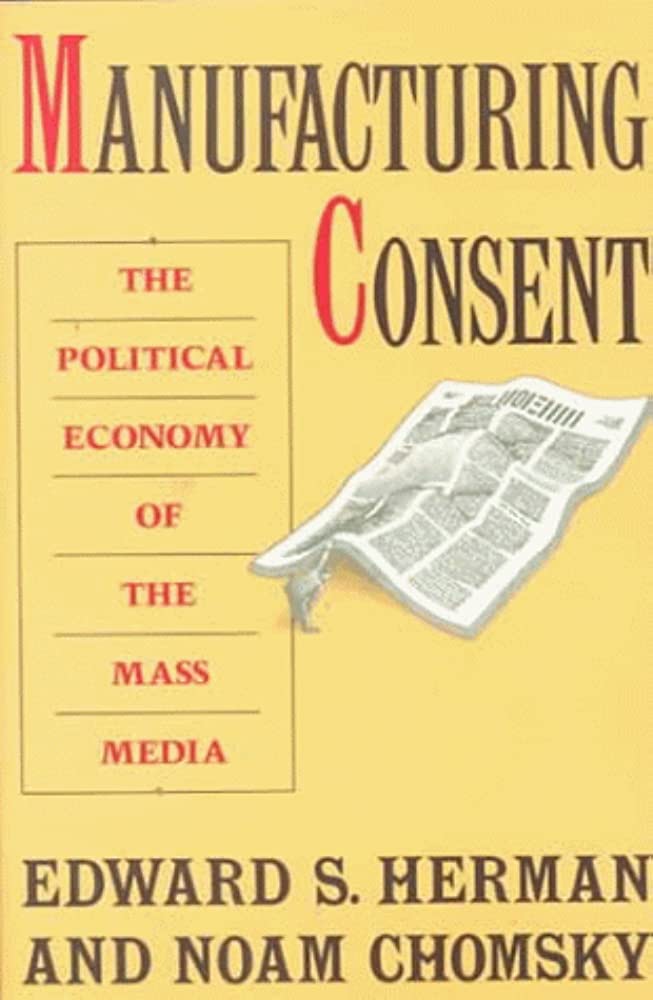
In hun uitgebreid gedocumenteerde, opzienbarende studie Manufacturing Consent. The political economy of the Mass Media (1988) beschrijven de Amerikaanse geleerden Edward S. Herman en Noam Chomsky de berichtgeving van de westerse commerciële media aldus:


In contrast to the standard conception of the media as cantankerous, obstinate, and ubiquitous in their search for truth and their independence of authority, we have spelled out and applied a propaganda model that indeed sees the media as serving a ‘societal purpose,’ but not that of enabling the public to assert meaningful control over the political process by providing them with the information needed for the intelligent discharge of political responsibilities. On the contrary, a propaganda model suggests that the ‘societal purpose’ of the media is to inculcate and defend the economic, social, and political agenda of privileged groups that dominate the domestic society and the state. The media serve this purpose in many ways: through selection of topics, distribution of concerns, framing of issues, filtering of information, emphasis and tone, and by keeping debate within the bounds of acceptable premises.


Beide prominente wetenschappers concluderen na ruim 400 pagina's documentatie tenslotte:


As we have stressed throughout this book, the U.S. media do not function in the manner of the propaganda system of a totalitarian state. Rather, they permit  —  indeed, encourage — spirited debate, criticism, and dissent, as long as these remain faithfully within the system of presuppositions and principles that constitute an elite consensus, a system so powerful as to be internalized largely without awareness. No one instructed the media to focus on Cambodia and ignore East Timor. They gravitated naturally to the Khmer Rouge and discussed them freely — just as they naturally suppressed information on Indonesian atrocities in East Timor and U.S. responsibility for the aggression and massacres. In the process, the media provided neither facts nor analyses that would have enabled the public to understand the issues or the bases of government policies toward Cambodia and Timor, and they thereby assured that the public could not exert any meaningful influence on the decisions that were made. This is quite typical of the actual ‘societal purpose’ of the media on matters that are of significance for established power; not ‘enabling the public to assert meaningful control over the political process,’ but rather averting any such danger. In these cases, as in numerous others, the public was managed and mobilized from above, by means of the media's highly selective messages and evasions. As noted by media analyst W. Lance Bennett: ‘the public is exposed to powerful persuasive messages from above and is unable to communicate meaningfully through the media in response to the messages... Leaders have usurped enormous amounts of political power and reduced popular control over the political system by using the media to generate support, compliance, and just plain confusion among the public.’


En:

Given the imperatives of corporate organization and the workings of the various filters, conformity to the needs and interests of privileged sectors is essential to succes. In the media, as in other major institutions, those who do not display the requisite values and perspectives will be regarded as ‘irresponsible,’ ‘ideological,’ or otherwise aberrant, and will tend to fall by the wayside. While there may be a small number of exceptions, the pattern is pervasive, and expected. Those who adapt, perhaps quite honestly, will then be free to express themselves with little managerial control, and they will be able to assert, accurately, that they perceive no pressures to conform. The media are indeed free — for those who adopt the principles required for ‘societal purpose.'


Dat wat betreft de ideologische achtergrond, maar ook qua opzet en functioneren van de commerciële massamedia valt het nodige op te merken. Maar daarover de volgende keer.


After WWII, the nazis were recycled and brought into the CIA. The CIA has been developing fascist assets in Ukraine for 70 years. The CIA has had a station in Ukraine since 1948 with operations directed against first the Soviet Union & then Russia.


maandag 11 april 2022

De Oekraïense Virtuele Werkelijkheid

Als de Oekraïne-crisis ook maar iets bewijst, dan is het dat het virtuele bewustzijn van de westerse massa gemanipuleerd blijft door wat militaire strategen ‘perception-management’ betitelen, een media-techniek die door het onafhankelijke Wikipedia als volgt wordt toegelicht: 

Perception management is a term originated by the US military. The US Department of Defense (DOD) gives this definition:


‘Actions to convey and/or deny selected information and indicators to foreign audiences to influence their emotions, motives, and objective reasoning as well as to intelligence systems and leaders at all levels to influence official estimates, ultimately resulting in foreign behaviors and official actions favorable to the originator's objectives. In various ways, perception management combines truth projection, operations security, cover and deception, and psychological operations.’


‘Perception’ is defined as the ‘process by which individuals select, organize, and interpret the input from their senses to give meaning and order to the world around them.’


Veelzeggend is dat de ‘phrase “perception management” has often functioned as a euphemism for “an aspect of information warfare.”’ Bovendien geldt dat de ‘phrase "perception management" is filtering into common use as a synonym for "persuasion." Public relations firms now offer "perception management" as one of their services. Similarly, public officials who are being accused of shading the truth are now frequently charged with engaging in "perception management" when disseminating information to media or to the general public.’ 


Typerend is ook het volgende:


Beginning in the 1950s, news media and public information organizations and individuals carried out assignments to manage the public's perception of the CIA, according to the New York Times. Carl Bernstein wrote in 1977 that ‘The CIA in the 1950s, '60s, and even early 70s had concentrated its relationships with journalists in the most prominent sectors of the American press corps, including four or five of the largest newspaper in the country, the broadcast networks, and the two major weekly news magazines.’ David Atlee Phillips, a former CIA station chief in Mexico City, described the method of recruitment years later to Bernstein: ‘Somebody from the Agency says, “I want you to sign a piece of paper before I tell you what it's about.” I didn't hesitate to sign, and a lot of newsmen didn't hesitate over the next twenty years.’


Dat het begrip ‘perception management’ van doorslaggevend belang is voor de westerse beleidsbepalende elite, blijkt onder andere uit het feit dat ‘For years the FBI has listed foreign perception management as one of eight "key issue threats" to national security,’ en dat: ‘The FBI clearly recognizes perception management as a threat when it is directed at the US by foreign governments.’

https://en.wikipedia.org/wiki/Perception_management 


De bekende Amerikaanse ‘television-host’ Bill O’Reilly merkte dan ook eens op: ‘U weet dat in showbusiness, politiek en al het andere, perceptie de werkelijkheid is.’ In de huidige collectieve westerse ‘perceptie’ moeten Oekraïners en hun corrupte regime in Kiev worden gezien als het slachtoffer van één man, ‘Poetin’ of ‘Poedler,’ zoals de Volkskrant de Russische president demoniseerde, als onderdeel van de bellicose propaganda-campagne waaruit elke nuance en elke context is verdwenen. Deze ‘perceptie’ is momenteel zo succesvol dat de werkelijkheid geen enkele rol meer speelt. Waren er in het verleden hier en daar nog mainstream-journalisten die niet ‘embedded’ waren, en de politieke en militaire propaganda met feiten onderuit haalden, vandaag de dag is hier geen enkele sprake meer van. Dit is de eerste oorlog waarbij het Westen is betrokken, die geen tegenstem aan het woord laat, geen dissidente visie toelaat, geen zinvolle wederhoor pleegt, geen bredere context belicht. Er is op alle kanalen slechts één officiële 'waarheid' te vernemen, en dat is dat ‘Poetin’ een ‘duivel’ is, en de Russen ‘een kwaad’ in de wereld vormen ‘dat geen grenzen kent,’ aldus de voorpagina van de Volkskrant van zaterdaqg 9 april 2022, onder een foto van dode en gewonde burgers ‘op het station van Kramatorsk.’ 

https://www.moonofalabama.org/2022/04/more-evidence-that-ukraine-fired-the-missile-which-killed-dozens-in-kramatorsk.html?fbclid=IwAR3m3h27FeWKsLvkcNiEmecWI6aIRPzO8lSs_dFfPgb1lsy3o_lz5JOEly8 


Ondanks het feit dat Russische autoriteiten ogenblikkelijk foto’s van de restanten van één van de twee raketten hebben gepubliceerd, die aannemelijk maken dat het hier een Oekraïense raket is,  beweert de Volkskrant een dag na de aanslag zonder zelf enig onderzoek te hebben verricht dat de ‘aanslag op een vol treinstation in Kramatorsk in Oost-Oekraïne duidelijk maakt dat het geweld van het Russische leger geen grenzen lijkt te kennen,’ daaraan onmiddellijk de volgende retorische vraag toevoegend: ‘Wat kan het Westen doen om dit te stoppen?’ De ‘duivel’ en zijn ‘kwaad,’ dat is de kern van het westerse ‘perception management,’ collectief overgenomen door de zogeheten ‘vrije pers,’ zonder dat zijzelf ook maar enigszins beseft hoe 'embedded' zij functioneert. Niet dat ik hier beweer dat de Russen het niet hebben gedaan, maar net als mijn mainstream collega’s weet ik het domweg niet en hanteer ik de aloude journalistieke vuistregel van hoor en wederhoor, vooral ook omdat ik zelf regelmatig getuige ben geweest hoe de westerse media logen. De massa-vernietigingswapens van Saddam zijn daarvan slechts één voorbeeld, een oorlogsmisdaad die de hele regio van honderden miljoenen mensen in lichterlaaie zette. 


In plaats van zelf te onderzoeken wat de waarheid zou kunnen zijn of daadwerkelijk is, beweren de westerse media onmiddellijk dat de Russische strijdkrachten de schuldigen zijn, terwijl de westerse pers uit ervaring weet hoe NAVO-autoriteiten kunnen liegen. Ook een politieke brokkenmaker als D’66 minister van Defensie Kajsa Ollongren suggereert zonder enig bewijs dat Rusland de dader is, want ‘The horrific images from Bucha and other reports of crimes against innocent civilians must have an international response. War crimes must be investigated and documented so that those responsible can be brought to justice and punished.’ Vanzelfsprekend kan in haar optiek de Oekraïense neo-nazi’s deze ‘oorlogsmisdaden’ nooit hebben gepleegd, want in dat geval is ook Nederland, door haar wapenzendingen, juridisch aansprakelijk voor het militair steunen van oorlogsmisdadigers.       


De huidige politieke maskerade in het Westen trekt zich nauwelijks nog iets aan van democratische spelregels. Dankzij het ‘perception management,’ in handen van de politieke-, bureaucratische- en media-elite, kan het bewustzijn van het grote publiek voortdurend in de juiste richting manipuleren. Dit wordt nog eens vergemakkelijkt door de westerse censuur én vooral door de zelfcensuur het journaille. Terecht waarschuwde de dissidente Australische journaliste Caitlin Johnstone op 8 april 2022: 


Twitter consults with the US government when deciding what to censor, consults with US government-funded think tanks to determine what people see on the platform, conducts censorship in favor of US government narratives, and has the gall to label others ‘state-affiliated media.’


Bijna niets kan aan het boze oog van Big Brother ontsnappen. Nagenoeg alles wordt vooraf gecontroleerd, overtreders worden met een banvloek gestraft, en monddood gemaakt. Zodoende worden de mainstream-journalisten er nog eens aan herinnert wat de elite wel of niet wenst te vernemen. De vooraanstaande correspondent Patrick Lawrence, die voor de ‘International Herald Tribune,' werkte, en 'columnist, essayist, author and lecturer’ is, stelde al op 8 maart 2022 onder de kop ‘The Casualties of Empire’ allereerst het volgende:


Diabolic methods of propaganda and perception management are at work now that have no precedent. This is war waged in a new way — against domestic populations as well as those declared as enemies.


The news reports come in daily from Moscow, Kiev and the Western capitals: how many dead since Russia began its intervention in Ukraine on Feb. 24,  how many injured, how many hungry or cold, how many displaced. We do not know the true count of casualties and the extent of the suffering and ought not pretend we do: This is the reality of war, each side having its version of unfolding events.


My inclination is to add the deaths in Ukraine these past two weeks to the 14,000 dead and the 1.5 million displaced since 2014, when the regime in Kiev began shelling its own citizens in the eastern provinces — this because the people of Donetsk and Lugansk rejected the U.S.­–cultivated coup that deposed their elected president. This simple math gives us a better idea of how many Ukrainians are worthy of our mourning.


As we mourn, it is time to consider the wider consequences of this conflict, for Ukrainians are not alone among its victims. Who else has suffered? What else has been damaged? This war is of a kind humanity has never before known. What are its costs?


Among paying-attention people it is increasingly plain that Washington’s intent in provoking Moscow’s intervention is, and probably has been from the first, to instigate a long-running conflict that bogs down Russian forces and leaves Ukrainians to wage an insurgency that cannot possibly succeed.


Is there another way to explain the many billions of dollars’ worth of weapons and matériel the U.S. and its European allies now pour into Ukraine? If the Ukrainians cannot win — a universally acknowledged reality — what is the purpose here?


Whether this strategy goes as Washington wants, or if Russian forces get their work done and withdraw to avoid a classic quagmire, remains to be seen. But as Dave DeCamp noted in antiwar.com last Friday, there is no sign whatsoever that the Biden administration plans any further diplomatic contacts with the Kremlin.


The implication here should be evident. The U.S. strategy effectively requires the destruction of Ukraine in the service of America’s imperial ambitions. If this thought seems extreme, a brief reference to the fates of Afghanistan, Iraq, Libya and Syria will provide all the compelling context one may need.


Brzezinski’s Plan in 1979 


To an extent, I find surprising given its calamitous consequences, Zbigniew Brzezinski’s plan in 1979 to arm the Afghan mujahideen against the Soviets remains the more or less unaltered template.


President Jimmy Carter’s national security adviser saw nothing wrong with getting into bed with what became Al–Qaeda. Now it is the Nazi militias that infest Ukraine’s National Guard that the U.S. arms and trains.


If the record is anything to go by, this conflict could well destroy what remains of Ukraine as a nation. In the worst outcome, little will remain of its social fabric, its public spaces, its roads, bridges, schools, and municipal institutions. This destruction has already begun.


Here is what I do not want Americans to miss: We are destroying ourselves and what hope we may have to restore ourselves to decency as we watch the regime governing us destroy another nation in our name. This destruction, too, has already begun.


Many people of many different ages have remarked in recent days that they cannot recall in their lifetimes a more pervasive, suffocating barrage of propaganda than what has engulfed us since the months that preceded Russia’s intervention. In my case it has come to supersede the worst of what I remember from the Cold War decades.


In January 2021, NATO published the final draft of a lengthy study it called Cognitive Warfare. Its intent is to explore the potential for manipulating minds — those of others, our own — beyond anything heretofore even attempted. ‘The brain will be the battlefield of the 21st century,’ the document asserts. ‘Humans are the contested domain. Cognitive warfare’s objective is to make everyone a weapon.’


In a subsection headed ‘The vulnerabilities of the human brain,’ the report has this to say:


‘In particular, the brain:


is unable to distinct [sic] whether the information is right or wrong:


is led to believe statements or messages it has already heard as true, even though these may be false;


accepts statements as true, if backed by evidence, with no regards to [sic] the authenticity of that evidence.’


And this, which I find especially fiendish:


‘At the political and strategic level, it would be wrong to underestimate the impact of emotions… Emotions — hope, fear, humiliation — shape the world and international relations with the echo-chamber effect of social media.’


Cognitive Warfare is a window onto diabolic methods of propaganda and perception management that have no precedent. This is a war waged in a new way — against domestic populations as well as those declared as enemies.

And we have just had a taste of what it will be like as these techniques, well-grounded in cutting-edge science, are elaborated. Yet more disturbing to me than the cold prose of the report is the astonishing extent to which it proves out. Cognitive warfare, whether or not the NATO report is now the propagandists’ handbook, works, and it is working now on most Americans.

https://consortiumnews.com/2022/03/08/patrick-lawrence-the-casualties-of-empire/ 

Het is griezelig te zien hoe weerloos de opportunistische politici en pers zijn geworden, hoe gemakkelijk zij gemanipuleerd zijn, en hoe braaf de bevolking alle propaganda slikt. Het is allemaal al uitgebreid gedocumenteerd beschreven door grote westerse denkers, maar helaas: vergeefs, wanneer ik naar de reacties om mij heen kijk. Dit totalitair functionerende bestel is erin geslaagd de alledaagse realiteit  te laten vernietigen door de virtuele werkelijkheid van de elite. Opvallend genoeg hebben zowel George Orwell als Aldous Huxley gelijk gekregen: het klassieke beeld van de mens als een autonoom reagerend individu heeft al lang plaats moeten maken voor de consumerende massamens, wiens handelingen geconditioneerde reflexen zijn. Op deze wijze is de politieke macht in enkele handen gevallen. Dat laat ook de Duitse vrouwelijke kunstenaar Hito Steyerl zien in haar opzienbarende tentoonstelling in het Amsterdamse Stedelijk Museum. In haar essaybundel Duty Free Art (2017) toont zij aan hoe de democratische werkelijkheid een visuele werkelijkheid is geworden. Zij stelt:   


Political power is increasingly being eroded. Who achieves or doesn’t achieve political representation matters less and less. Even people with full political privileges, members of parties — even parliaments — are increasingly ignored. Because whatever the people want, whoever they are, and regardless of who represents them, the contemporary sovereigns are mainly the ‘markets.’ The markets, not the people, are to be appeased, satisfied, and pleased by the political class. In the area of economics, representation exists too. Participation in economic processes is measured by the abilities to get credit, to own, and to consume. This also explains the contemporary rage against what is essentially economic or consumer exclusion. Many contemporary riots do not have political goals—why should they, since political action proves powerless in many cases?—but strive for economic participation: the most concentrated expression of this is the looting of shopping malls.


This erosion of political power is a result of decades of redistribution of wealth, opportunity, and actual power from the poor to the rich. While it was possible, the poor were appeased with credit and indentured shopping. Now that this no longer seems to work, economic participation has become a battleground. 


But what does all this have to do with fascism? On the surface, nothing. But these phenomena are all symptoms of what could tentatively be called post-democracy. In post-democracy, politics is successively abandoned as a means of organizing the common. 


Post-democracy is also felt within political institutions. Citizens of the European Union, for example, are faced with a host of institutions that are not democratically legitimized (among these, again, financial institutions, which are not subject to any political control). The votes of citizens do not have the same weight, depending on their citizenship, thus creating different classes of political representation. Within Europe and beyond, oligarchies of all kinds are on the rise. Retreating bureaucracies are replaced with authoritarian rule, tribal rackets and organized vigilantism. The so-called monopoly of violence is increasingly privatized, handed over to private armies, security companies and outsourced gangs. Forces that could be controlled democratically are weakening, while states and other actors impose their agendas through emergency powers or “necessity.” There have been so many examples of this over the last few decades that I don’t even want to start listing them. 


All of these symptoms intensify anxieties around the idea of political representation as such. Weren’t we promised equality? Yes, we were. Wasn’t the idea of democracy that we’d all be represented? No, we aren’t. Political representation involves a certain arbitrariness and randomness — to a certain extent they are inherent in it, but they seem to be accelerating at a tremendous rate right now. It involves instability, unpredictability, and a large dose of futility.


De virtuele 'democratie' is alles dat overgebleven is van de werkelijkheid. En de media verspreiden vrijwillig deze virtuele 'democratie.' Meer daarover later.


Netanyahu was gewaarschuwd voor ‘7 oktober’, maar deed niets

4 uur geleden   (Dinsdag 8 september, 17:29) Netanyahu was gewaarschuwd voor ‘7 oktober’, maar deed niets De Israëlische premier Benjamin Ne...