Zoeken in deze blog 🔎🔎

zaterdag 22 november 2025

ICC: US Blackmail of Judges ICC

Nicolas Guillou, French ICC judge sanctioned by the US: 'You are effectively blacklisted by much of the world's banking system'
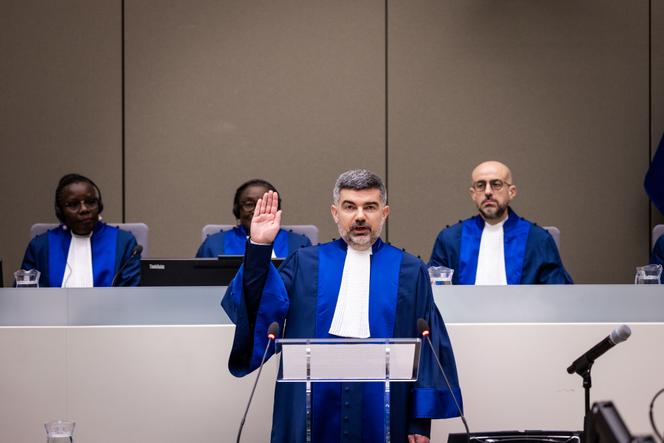
Six judges and three prosecutors at the International Criminal Court have been sanctioned by the Trump administration. In an interview with Le Monde, Guillou discusses the impact of these measures on his work and daily life. 

Interview by  (The Hague (Netherlands) correspondent)

Published on November 19, 2025, at 8:00 pm (Paris)

4 min read

Lire en français
French judge Nicolas Guillou is sworn in at the headquarters of the International Criminal Court in The Hague, Netherlands, on March 8, 2024. 

Nicolas Guillou, a French judge at the International Criminal Court (ICC), was sanctioned by the United States under a decision made by Donald Trump on August 20. The US Treasury Department justified the action, stating that "Guillou is being designated for ruling to authorize the ICC's issuance of arrest warrants for Israeli Prime Minister Benjamin Netanyahu and former Minister of Defense Yoav Gallant." Both men are indicted for war crimes and crimes against humanity for their roles in the destruction of the Gaza Strip.

In total, six judges and three prosecutors from the ICC, including Chief Prosecutor Karim Khan, have been sanctioned by the US. In an interview with Le Monde, the judge explained the impact of these measures on his work and daily life. Without commenting on ongoing cases, he called on European authorities to activate a mechanism that could limit the impact of US restrictions.

What is the purpose of the American sanctions mechanism?

Initially, it was created to address human rights violations, counter terrorism and combat drug trafficking. Today, nearly 15,000 individuals are on the US sanctions list, mostly members of Al-Qaeda, the Islamic State group (IS), mafia organizations and the leaders of authoritarian regimes. Among this long list are nine ICC judges.

What do these sanctions mean, concretely, in your daily life?

It goes far beyond simply being banned from US territory. The sanctions affect all aspects of my daily life. They prohibit any American individual or legal entity, any person or company, including their overseas subsidiaries, from providing me with services.

All my accounts with American companies, such as Amazon, Airbnb, PayPal and others, have been closed. For example, I booked a hotel in France through Expedia, and a few hours later, the company sent me an email canceling the reservation, citing the sanctions. In practice, you can no longer shop online because you do not know if the packaging your product comes in is American. Being under sanctions is like being sent back to the 1990s.

Is access to the banking system still possible?

Sanctions are even more intrusive in this area. There are banks, even non-American ones, that close the accounts of sanctioned individuals. Any banking transaction involving an American individual or company, or conducted in US dollars, or in a currency that uses the dollar for conversion, is prohibited. In practice, you are effectively blacklisted by much of the world's banking system. On top of that, all payment systems are American: American Express, Visa, Mastercard. Overnight, you find yourself without a bank card, and these companies have an almost complete monopoly, at least in Europe. American companies are actively involved in intimidating sanctioned individuals – in this case, the judges and prosecutors who serve justice in contemporary armed conflicts. These sanctions can last over a decade or even longer. Putting someone under sanctions creates a state of permanent anxiety and powerlessness, with the intent of discouragement.

Does it work?

I took an oath as a judge when I started my professional life over 20 years ago. I took another oath upon joining the Court [in March 2024]. I apply the law adopted by 125 states [that are parties to the treaty establishing the ICC]. That is my compass. As judges, we know that delivering justice is not always easy. But faced with these attacks, ICC judges and prosecutors stand firm, and they will continue to do so.

What can you do?

Continue administering justice with complete independence, even in difficult circumstances. Today, the ICC investigates globally, despite the logistical and security challenges. In recent years, arrest warrants have been issued in connection with conflicts in Ukraine, Palestine and Afghanistan. Arrests have been made in the Philippines and Libya. Reparations programs are in place for victims in Mali, the Central African Republic and the Democratic Republic of the Congo.

The 125 member states of the Court will hold their annual Assembly in The Hague, Netherlands, in early December. What support do you expect, given that the Trump administration threatens further sanctions against the institution as a whole?

The impact of sanctions will depend largely on governments' responses. Will they support us? Will they ensure the ICC's suppliers continue to work with it? For the ICC, this is a moment of truth: Who are its real defenders? Who has the courage to defend human values in the face of barbarity? That is what is at stake. International criminal justice is not an abstraction. Our cases concern hundreds, even thousands, of victims of murder, rape and torture. They speak of their suffering, of thousands of corpses, the maimed and orphans. When the Court is attacked, it is the victims who are silenced.

What can governments do?

In the face of US sanctions, European authorities can implement the "blocking statute" [a mechanism used in the past that protects EU citizens and companies from the effects of sanctions imposed by third countries]. Europe needs greater sovereignty, especially in digital and banking matters. That is the only way to reduce the impact of sanctions and, indirectly, protect the victims of international crimes. Today, there is no room for naivety. Without sovereignty – military, health, financial and digital – we can no longer guarantee the rule of law. Some European lawmakers have become aware of these issues. Still, this awareness must grow among national governments and the European Commission, because behind the sanctions against the ICC lies the entire question of the rule of law.

Does an international rule of law exist?

The international rule of law is a project spanning generations that began after the Second World War. In concrete terms, the rule of law is equality for all individuals, globally, before justice. The Court was built to be the last resort in a system designed to protect victims of war or the most serious crimes. It is the foundation of humanity's shared values that is at stake.

How do you explain the importance the ICC has taken on?

The ICC is seen as important today because it exposes the fractures of the contemporary world. If you look at a map and see which countries are not members of the ICC, you find that many have imperial ambitions; often, they are former empires. And after three decades of progress in multilateralism, empires are striking back. Some believe that power should serve the law – that is the very principle of international law. Others, on the contrary, believe that the law should serve power. For them, international criminal justice is an obstacle. It is an obstacle to empires. That is why we are under attack. But despite these challenges, I remain deeply optimistic because there is a tremendous demand for justice worldwide.

Translation of an original article published in French on lemonde.fr; the publisher may only be liable for the French version.

Reuse this content

https://www.lemonde.fr/en/international/article/2025/11/19/nicolas-guillou-french-icc-judge-sanctioned-by-the-us-you-are-effectively-blacklisted-by-much-of-the-world-s-banking-system_6747628_4.html


Security Council Shamefully Grants Colonial Domination Over Palestine to the US


Security Council Shamefully Grants Colonial Domination Over Palestine to the US

A UN Special Rapporteur has decried the resolution as a violation of Palestinian people’s right to self-determination.

UN Security Council members vote on a draft resolution to authorize an “International Stabilization Force” in Gaza, authored by the U.S. at UN Headquarters, on November 17, 2025.

Truthout is a vital news source and a living history of political struggle. If you think our work is valuable, support us with a donation of any size.

In 1947, the United Nations General Assembly committed the UN’s original sin when it partitioned Palestine to create Israel. This launched the Nakba, the ethnic cleansing of the Indigenous people, and the establishment of a settler colonial state.

Now, 78 years later, the UN Security Council has committed the UN’s second cardinal sin. It enshrined Israel’s illegal occupation of Palestinian lands, put its imprimatur on Israel’s genocide, and granted colonial control over the lives of the Palestinians to the United States, which has aided and abetted the genocide.

On November 17, 2025, the Council adopted Resolution 2803, by a vote of 13-0. Russia and China, both permanent members of the Security Council, could have vetoed it. But shamefully they abstained, ostensibly influenced by support for the resolution from several Arab and Muslim states, including Egypt, Qatar, Jordan, Saudi Arabia, and the United Arab Emirates, as well as Turkey, Indonesia, and Pakistan.

The resolution incorporates Donald Trump’s “peace plan.” It grants control over Gaza to the U.S.-led “Board of Peace” and it orders the deployment of a U.S.-led occupation force called “International Stabilization Force (ISF).” Trump will oversee both colonial bodies, in collaboration with Israel. Palestinians will not be allowed to participate in their own governance.

The Board of Peace is designed to function as a transitional administrator of Gaza. It will control all services and humanitarian aid, all ingress and egress into and out of Gaza, and will supervise the financing and reconstruction of Gaza. The resolution “underscores the importance” of humanitarian assistance but does not require the unimpeded provision of aid.

Given a two-year renewable mandate, the ISF will be more than simply a peacekeeping force. Since the Council established it under Chapter 7 of the UN Charter, the ISF will have the power to disarm Palestinian groups, as Israel insists. There is no provision in the resolution for disarming the Israel Occupation Forces, the body that has been conducting the genocide.

“A military force answering to a so-called ‘Board of Peace’ chaired by the President of the United States, an active party to this conflict that has continually provided military, economic and diplomatic support to the illegal occupying Power, is not legal,” said Francesca Albanese, Special Rapporteur on the situation of human rights in the Palestinian territories occupied since 1967. “It is a brazen attempt to impose, by threat of continued force against a virtually defenseless population, U.S. and Israeli interests, plain and simple.”

“Essentially, it will leave Palestine in the hands of a puppet administration, assigning the United States, which shares complicity in the genocide, as the new manager of the open-air prison that Israel has already established,” Albanese added.

Since October 2023, Israel has killed nearly 70,000 Palestinians and wounded more than 170,000. Nearly everyone in Gaza has been displaced by Israel multiple times and Gaza has largely been reduced to rubble. Israel has violated the latest ceasefire at least 393 times and killed at least 312 Palestinians since it went into effect on October 10, 2025.

In three recent cases, the International Court of Justice (ICJ) found a plausible case of genocide by Israel, that Israel’s occupation of Palestinian territory is unlawful, and that Israel has illegally used starvation of civilians as a weapon of war. The International Criminal Court issued arrest warrants for Israeli Prime Minister Benjamin Netanyahu and former Defense Minister Yoav Gallant for war crimes and crimes against humanity.

The Resolution Violates the Palestinian People’s Right to Self-Determination

The Security Council resolution violates fundamental tenets of international law including the right of the Palestinian people to self-determination. “The ICJ was clear: self-determination is an inalienable right of the Palestinian people and the UN and all States have an obligation to assist in its realization,” Albanese said. “This can only begin with the immediate and unconditional withdrawal of Israel’s unlawful presence in the occupied Palestinian territory. Replacing an abusive trustee with another is not self-determination, it is unlawful.”

Albanese was referring to the 2004 advisory opinion of the ICJ, which ruled that “the principle of self-determination of peoples has been enshrined in the United Nations Charter and reaffirmed by the General Assembly … pursuant to which ‘Every State has the duty to refrain from any forcible action which deprives peoples … of their right to self-determination.’”

The right to self-determination includes but isn’t limited to the right of peoples to control their own land and natural resources; the right to be free from demographic manipulations by any third party; and the right to determine their own political status, economic development, and future.

But the resolution says that only after undefined “reform” and “redevelopment” are determined sufficient by the colonial administration, “the conditions may finally be in place for a credible pathway to Palestinian self-determination and statehood.”

Resolution 2803 “rewards the U.S., a co-perpetrator of genocide, with control over Gaza and its potentially lucrative reconstruction process, while simultaneously relieving the Israeli regime of all of its responsibilities as an illegally occupying force,” Yara Hawari wrote in Al-Shabaka, a Palestinian-led think tank. “Palestinian participation is expected to be tightly limited and heavily conditioned. Trump’s plan confines it to ‘technocratic’ and ‘apolitical’ roles, subject to continuous external supervision and effectively excluding any representatives with democratic legitimacy or political agency.” 

Hamas and other Palestinian factions rejected the resolution. They wrote in a joint statement that ISF “will turn into a type of imposed guardianship or administration — reproducing a reality that restricts the Palestinian people’s right to self-determination and to managing their own affairs.”

“Assigning the international force with tasks and roles inside the Gaza Strip, including disarming the resistance, strips it of its neutrality, and turns it into a party to the conflict in favor of the occupation,” Hamas said. “Any international force, if established, should only be present at the border to separate the forces and monitor the ceasefire, and it should be under full UN supervision and act solely in coordination with the Palestinian institutions, without the occupation having any role in this.”

Samir Al-Bakri, a resident of Gaza City, told Mondoweiss, “It is as if the mission of the international force coming to Gaza is to protect Israel’s borders from Palestinians without offering anything in return to us. And it won’t even offer us any real protection either; it won’t prevent Israel from carrying out its military operations or aerial bombardments of Gaza. It may even help Israel achieve its goals.”

Uniting for Peace

The UN Charter grants primary authority for the maintenance of international peace and security to the Security Council. Uniting for Peace(UFP) is a mechanism created in a resolution adopted by the General Assembly in 1950 to bypass the Soviet Union’s veto in the Council during the Korean War. It says that the “failure of the Security Council to discharge its responsibilities on behalf of all the Member States … does not relieve Member States of their obligations or the United Nations of its responsibility under the Charter to maintain international peace and security.”

In adopting Resolution 2803, the Security Council did not discharge its responsibilities under the Charter to act on behalf of Palestine, a permanent observer state, which is undergoing the first live-streamed genocide in history. Nor is the Council discharging its responsibility to maintain international peace and security by memorializing an illegal occupation and an ongoing genocide.

Colombian President Gustavo Petro has declared that he will introduce a Uniting for Peace resolution in the UN General Assembly to establish a multinational protection force for Palestinians and levy sanctions and an arms blockade to end the genocide and liberate Palestine from the unlawful Israeli occupation.

In retaliation, the U.S. government has revoked Petro’s visa, imposed sanctions against him, raised punitive tariffs on Colombia, and threatened the use of military force against Colombia.

People opposed to the U.S.’s colonial takeover of Palestine can join the Boycott, Divestment, and Sanctions Movement, lobby for arms embargoes, and support accountability for Israeli and U.S. leaders responsible for perpetrating the genocide.

We must do everything within our power to stop this atrocity and support the struggle of the Palestinian people for self-determination.

SUPPORT MEDIA THAT FIGHTS FASCISM

Truthout is funded almost entirely by readers — that’s why we can speak truth to power, cut against the mainstream narrative and uplift the movements resisting fascism.

But independent journalists at Truthout face mounting political suppression under Trump.

We launched a fundraiser this month to combat these challenges. Sadly, we fell short of our goal before the deadline, but you can still make a difference. Please make a one-time or monthly donation to Truthout.


Het Joodse Raadslid Naomi Italiaander en de Zionistische Terreur

Ik las in  het  Joodse propaganda-orgaan NIW dat " Het kersverse Amsterdamse gemeenteraadslid Naomi Italiaander," zowaar " J...