Mijn vriend, de beeldend kunstenaar Rob Schrama, in actie:
Kunstwerk voorspelt vrede in Midden-Oosten
In de Uilenburgersjoel in Amsterdam is komend weekend een kunstwerk te zien, waarin de datum is vastgelegd wanneer er vrede zal zijn in het Midden-Oosten. Woensdagochtend 6 oktober brengt de Amsterdamse kunstenaar Rob Schrama zijn kunstobject naar deze synagoge, als bijdrage aan de centrale expositie van de Open Ateliers Nieuwmarkt. Op vrijdag 8 oktober wordt deze door Touria Meliani, wethouder Kunst en Cultuur, geopend.
Rob Schrama legde geheel onbewust de datum van de vrede vast, toen hij in 2004 het kunstwerk maakte. In een begeleidend gedicht, dat naast het object te lezen is, beschrijft de kunstenaar het ontstaansproces. Tijdens de eerste expositie in 2005 attendeert een Israëlische geleerde hem dat het kunstwerk totaal iets anders voorstelt dan wat de meeste mensen er in zien.
De jaren die volgen, voelt Rob Schrama de drang om in Jeruzalem Palestijnen en Israëliërs nader tot elkaar te brengen. Negen jaar lang organiseert hij daar het vredesevenement "Jerusalem Hug" die door vele duizenden bezoekers uit de gehele wereld wordt bezocht en Palestijnen en Israëliërs samen brengt in hun wens naar vrede.
In het najaar van 2019 vliegt Rob Schrama boven Israël. Tijdens zijn vlucht checkt hij zijn post en leest in een e-mail: “ik zag een nieuwe hemel en een nieuwe aarde; want de eerste hemel en de eerste aarde was voorbijgegaan, en de zee was niet meer. Toen zag ik de heilige stad, het nieuwe Jeruzalem, uit de hemel neerdalen". (Openbaringen 21). Hij kijkt uit het vliegtuigraampje naar het landschap beneden hem en ziet dat de tijd weldra komen gaat. De zee onder hem droogt in een ras tempo uit. Als het zo door gaat, zal de zee over een paar jaar er niet meer zijn.......
Rob Schrama gelooft niet dat wonderen uit de Bijbel zomaar zullen gaan plaatsvinden. Enkel door actief handelen kan een vrede ontstaan. Als actiekunstenaar ligt er voor hem dus nog veel werk te wachten om dit proces in Jeruzalem tot stand te helpen brengen.
In de tussentijd bent u van harte welkom, de vredesvoorspelling in Rob Schrama's bijdrage aan de Open Ateliers Nieuwmarkt, in de Uilenburgsjoel te aanschouwen.
Plaats en tijd: Uilenburgersjoel Nieuwe Uilenburgerstraat 91 Amsterdam
‘Psychedelic Renaissance’ Entirely About Corporate Greed
There’s a lot of money to be made selling cures for the psychological wounds inflicted by the very system which enables that sale, writes Caitlin Johnstone.
“Money has begun flowing into companies intending to monetize psychedelic therapy as new research has increasingly shown that blowing one’s mind can alter it for the better,” reads an article in The Los Angeles Times titled “Money is pouring into psychedelics. Meet the mystical hedge fund investor bankrolling the boom.”
“This scientific and commercial excitement rests on research showing that psychedelics can supercharge mental health treatment for PTSD, depression, anxiety, addiction, and other chronic ailments of the mind, enabling patients to dive deep, confront their traumas and — a rarity for mental illnesses — return healed,” the article reads. “That goes for synthetic chemicals such as MDMA and ketamine as well as plant-derived drugs such as psilocybin (the active ingredient in magic mushrooms), the South American plant brew ayahuasca, and the West African root-derived substance iboga.”
LA Times’ Sam Dean shares the personal journey of hedge fund investor Sa’ad Shah and his involvement in what has become a multibillion-dollar psychedelics industry long before even the legal infrastructure necessary for such companies to turn a profit is in place. We learn of Shah’s experience with ayahuasca, his interest in mystical traditions and personal growth, and his conviction in the shift that has for the last few years been known as the psychedelic renaissance.
And then, about halfway down the article, we get to the actual meat of the matter:
“Shah welcomes big pharma and big institutions to enter the fray in the interest of spreading the chemical gospel far and wide. He sees the financial and therapeutic potential for psychedelics not in the cannabis model, which would make psychedelics broadly available for retail purchase, but in the pharmaceutical mode — psychedelics as prescribed drugs, with patent rights, administered in medical settings.”
That “with patent rights” bit right there is behind the so-called psychedelic renaissance we’ve been hearing so much about: “favoring the FDA regulatory route over the Oregon route,” as a psychiatrist cited in the article put it. It’s being driven not by the need to free human consciousness from the prohibition-induced coma it’s been under since the sixties so that we can collectively navigate through the many existential hurdles our species is fast approaching with wisdom and insight, but by the agenda to make rich people even richer by forcefully controlling psychedelic substances via the pharmaceutical industry.
And I’ll take it a step further and say that the recent mainstreaming of psychedelics is also due to the fact that the abusive nature of capitalism is causing a widespread mental health crisis that our rulers have a vested interest in preventing so the slaves will keep turning the gears of the machine.
Terence McKenna once said,
“Psychedelics are illegal not because a loving government is concerned that you may jump out of a third story window. Psychedelics are illegal because they dissolve opinion structures and culturally laid down models of behaviour and information processing. They open you up to the possibility that everything you know is wrong.”
But this is changing. We’re now seeing support for psychedelic use from the same plutocratic class and its corporate media who always work to maintain the status quo upon which their kingdoms are built.
Netflix has released multipledocumentariesextolling the benefits of hallucinogenic substances for personal growth and healing. Every few days there’s a new mainstream article or news segment about the latest study showing the undeniable mental health benefits of this or that psychedelic substance for this or that psychological ailment.
So, what changed? The situation changed. Global capitalist institutions are acutely aware that Western civilization is in the midst of a mental health crisis that only looks likely to get worse, with depression, anxiety disorders and substance abuse skyrocketing on myriadfronts for years. The increasingly widespread use of antidepressants has not led to an overall decline in symptoms and prevalence of mood disorders in the U.S., Australia, Canada, England and other wealthy countries. In America young people have been growing progressively more depressed and anxious for over 80 years, and no one knows why.
Well, I could hazard a guess why.
I would guess that continually pummeling people’s minds with messaging that they are inadequate if they don’t look a certain way, own the right products and make enough money is bad for their psychological health.
I would guess that hammering people with bootstrapping fallacies and telling them that they’re the problem if they can’t keep their head above water in a system that’s rigged against them drives people a bit crazy.
I would guess that a nonstop barrage of mass media propaganda shamelessly lying to people and telling them that everything’s fine when it clearly isn’t and that endless human butchery by the military is perfectly normal takes a toll on their psychological wellbeing.
I would guess that a population growing poorer and poorer and having more and more of its power taken away from as serfs under a corporate oligarchy would be alienating and depressing.
I would guess that working long hours at meaningless gear-turning for an amoral corporate machine while being inundated with artificial mainstream culture manufactured in Hollywood, New York and Langley is soul-destroying.
So, our mental health is deteriorating, the solutions that our systems have been offering are not working, and in fact it’s likely that the deterioration of mental health is due primarily to the abusive nature of those very systems. But the capitalism machine still needs workers, and those workers won’t turn the gears if they can’t get out of bed in the morning.
So desperate measures have been called in. Give the gear-turners tightly controlled doses of psychedelics, enough to get them functional but not enough to awaken them to the reality of their enslavement, and hopefully you’ve built some systemic scaffolding which enables their minds to put up with the relentless mass-scale psychological abuse that the status quo requires.
And made a massive fortune in the process. There’s a lot of money to be made selling cures for the psychological wounds inflicted by the very system which enables that sale.
This is why nearly all of the chatter we are seeing about psychedelics is about fixing people’s psychological problems instead of helping them to attain self-actualization, transformation, transcendence and enlightenment. It’s not about waking people up, it’s about turning them from broken cogs into useful cogs. It’s not to free them from the machine but to help them better serve it, while also serving the interests of clever pharmaceutical investors.
Psychedelics are useful not for the hallucinations they provide but for the hallucinations they remove. At the shallower end of the pool, they can help dispel the psychological illusions which feed into our depression, anxiety and PTSD. At the deep end they have the potential to remove our fundamental hallucinations about ego, mind, separation and consciousness. The gamble appears to be premised on building a high fence to keep everyone playing in the shallow end of the pool, where they are useful.
But, as people often point out to me whenever I highlight this, that plan can easily backfire. You’re not dealing with something mundane and predictable here, you’re dealing with the most uncharted terrain in human consciousness. There’s a lot of wiggle room for miracles in that space.
If psychedelics were anything other than a threat to the status quo they wouldn’t have been banned for half a century and the CIA would still be dosing the public with LSD. It will be interesting to see how this thing unfolds. Maybe this time they finally bit off more than they can chew.
Help ons onafhankelijk te blijven! Doe een gift op NL11 TRIO 0390 407 380
Stop Wapenhandel leidt een internationale werkgroep over Wapens, Militarisme en Klimaatverandering waarin activisten en onderzoekers uit verschillende landen samenwerken tegen toenemende militarisering van de klimaatcrisis. Bijvoorbeeld de strategische plannen van de NAVO in de wateren van de smeltende Noordpool.
Er is contact gezocht met de Britse klimaatgezant Toppings in de aanloop van de COP26 klimaatconferentie in Glasgow. Tientallen organisaties stellen dat ook krijgsmachten moeten bijdragen aan het doel om de opwarming van de aarde onder de 1,5 C graden te houden. De meeste deelnemers aan de werkgroep menen trouwens dat alleen minder bewapening tot een serieuze vermindering van broeikasgas door de krijgsmacht kan leiden.erwordt weinig geloof gehecht aan de emissievrije gevechtsvliegtuigen en raketten, die de wapenindustrie in zijn duurzaamheidsverslagen voorspiegeld
De grootste bedreigingen van onze veiligheid liggen momenteel op het terrein van gezondheid en van klimaatverandering. Dreigingen waar je met wapens niets tegen kan beginnen.
Steun ons werk tegen militarisering van klimaatverandering. Volg onze berichten op sociale media. Doe mee, deel informatie en help met een gift.
Court for Intergenerational Climate Crimes
Een project van de Indiase activist Radha D’Souza en kunstenaar Jonas Staal, geproduceerd door Framer Framed platform voor moderne kunst. In een grootschalige installatie in de vorm van een tribunaal vinden hoorzittingen plaats waar grote bedrijven en de Nederlandse staat worden aangeklaagd voor Intergenerationele klimaatmisdaden. Op 31 oktober treedt Stop Wapenhandel op als getuige-deskundige in het proces tegen wapenbedrijf Airbus. Regristeren voor deelname op REGISTER: 31 OCT 2021, 13:00-18:00 Framer Framed, Oranje-Vrijstaatkade 71 Amsterdam. Ook te volgen via livestream.
Vredescongres: (Re)imagine our world
Van 15 tot 17 oktober vindt in Barcelona het World Peace Congress plaats met deelnemrs uit alle continenten. Met bijdragen van onder meer Noam Chomsky, Vandana Shiva en Jody Williams. Stop Wapenhandel organiseert voor het European Network Against Arms Trade een workshop “Why EU arms export keeps fuelling war and repression”. Het onderzoeksrapport met dezelfde titel zal rond die tijd op onze website gepubliceerd worden. Het gehele congres is ook online en interactief te volgen, registreer op https://www.ipb2021.barcelona/register/
The ultra-rich have a myriad of mind-boggling ways of getting away with not paying taxes that the rest of us have to.
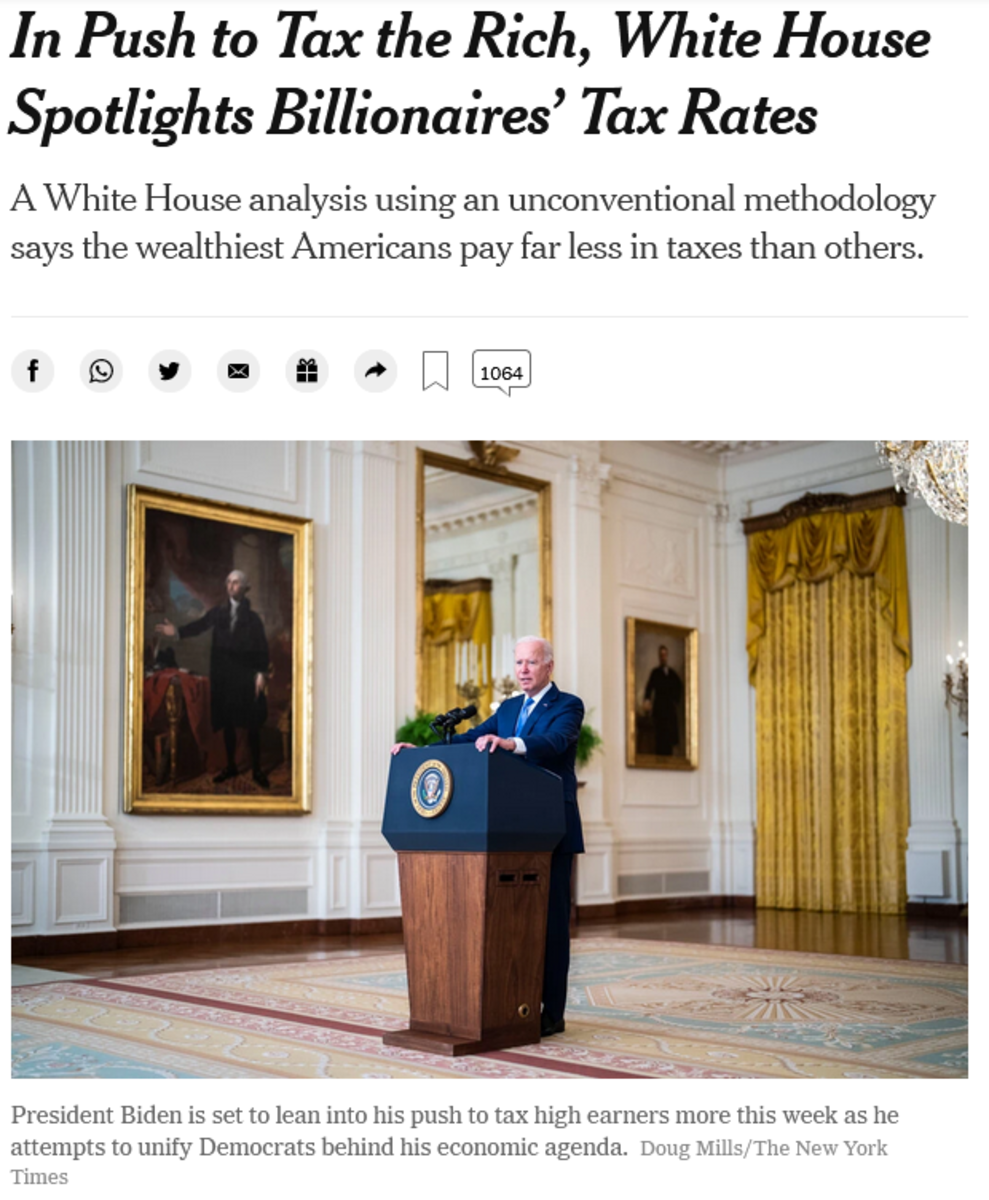
According to a White House analysis (9/23/21), the country’s 400 wealthiest families have an effective tax rate of just over 8%. At the New York Times (9/23/21), reporter Jim Tankersley was quick to cast doubt on the figure.
According to Tankersley’s framing, the analysis “seeks to show a gap between the tax rate that everyday Americans face and what the richest owe on their vast holdings,” and is “an attempt to bolster Mr. Biden’s claims that billionaires are not paying what they actually should owe in federal taxes, and that the tax code rewards wealth, not work” (emphasis added). In other words, it’s an analysis with a political agenda.
The New York Times (9/23/21) criticizes the White House for taking into account the main way billionaires make money.
Dubious data point
This is in contrast to “most measures of tax rates,” which “do not use the White House method of counting asset gains as annual income.” The piece emphasizes how “unconventional” the White House analysis is, and that it’s “well below what other analyses have found.” (Note that these analyses don’t “seek to show,” but simply “find,” thus enhancing their social science credibility.)
Tankersley points to one data point here:
The independent Tax Policy Center in Washington estimated this year that in 2015, the highest-earning 1,400 households in the country paid an average effective tax rate of about 24%, compared with an average rate of about 14% for all taxpayers.
First, that “most” measures don’t count asset gains says more about how thoroughly the rich have rigged the tax code to exclude most of their income than it does about how one ought to measure income—or tax rates. The Tax Policy Center figure, for instance, only considers federal income tax, which ignores state and local income tax, as well as payroll, consumption and excise taxes.
Second, the “independent” Tax Policy Center should hardly be assumed to be agenda-free; according to its most recent annual report (2017) available online, the group’s “Leadership Committee” includes representatives of major financial firms like Goldman Sachs, Morgan Stanley and the Carlyle Group, entities that have a direct stake in keeping gains in financial assets from being counted as income.
And third, it’s crucial that the data from the Tax Policy Center comes from 2015, since that was before the 2017 Trump tax cuts slashed taxes even further for the ultra-rich. As New YorkTimes columnist David Leonhardt (10/6/19) pointed out in 2019, the tax cuts “helped push the tax rate on the 400 wealthiest households below the rates for almost everyone else” in 2018, to 23% for the wealthiest versus 28% for the average taxpayer.
It’s a remarkable victory for the rich over the rest of us: The richest Americans had an effective tax rate of 70% in 1950 and 47% in 1980. Meanwhile, the average taxpayer has seen relatively little change in their effective tax rate over the same period.
That’s all according to University of California/Berkeley economists Emmanuel Saez and Gabriel Zucman (Triumph of Justice, 2019), who were not using the “unconventional” White House method of dividing taxes paid by total asset gains. They were, however, using the White House method of looking at the top 400 as measured by wealth, rather than the top 1,400 as measured by adjusted gross income. They were also considering all taxes, including payroll tax (Social Security and Medicare), state income tax, and consumption and excise taxes.
ProPublica (6/8/21) “compared how much in taxes the 25 richest Americans paid each year to how much Forbes estimated their wealth grew in that same time period”—an obvious precedent for the White House analysis that was overlooked by the New York Times.
If you want to look at what the very richest Americans pay in taxes, then the way Saez/Zucman and the White House do it is more accurate than the way the Tax Policy Center does it, because those 400 billionaires—worth a combined $3.2 trillion last year, up $240 billion from the year prior, as calculated annually by Forbes—are very often not those with the highest taxable income.
For instance, Warren Buffett, a perennial Forbes 400 member who currently ranks No. 4, voluntarily released his tax returns in 2015. His reported income ($11.6 million) didn’t even put him in the top 14,000 earners. That year, Buffett paid about 16% of his reported income in taxes.
Buffett released his returns in response to Trump’s attempt to deflect attention from his own refusal to release his returns; Buffett had nothing to hide, since his methods of avoiding taxes were perfectly legal.
As ProPublica (6/8/21) found in its recent bombshell report on leaked tax returns of the ultra-rich—yet another analysis using similar methods to the White House that went unacknowledged by Tankersley—Buffett is particularly good at tax avoidance: From 2014–18, while his wealth grew by over $24 billion, he managed to pay less than $24 million in taxes. It’s an effective tax rate of 19% on reported income measured the “conventional” way, but a tax rate of just 0.1% on his actual gains. That’s the lowest of any of the country’s billionaires.
As Open Secrets (4/23/20) points out, many lawmakers have a direct interest in avoiding taxes on wealth.
Mind-boggling methods
The ultra-rich have a myriad of mind-bogglingways of getting away with not paying taxes that the rest of us have to. Two that the Biden administration is pushing to eliminate relate to asset gains.
If someone sells a stock, any gains from the purchase price are taxed at a significantly lower rate than other income; the White House is seeking to end that preferential treatment for those earning above $1 million.
Further, if someone instead holds that stock until they die, and leaves it to an heir, those gains are not taxed. So billionaires like Buffett and Jeff Bezos can vastly increase their wealth, never pay taxes on most of it as long as they don’t sell it, pass those assets to their children upon their death and—poof!—those billions are never subject to income tax. This dodge is called the stepped-up basis, and it’s a major driver of the racial wealth gap.
Lawmakers impacted
Most people don’t think the wealthy—or corporations—pay their fair share of taxes (Pew, 4/30/21). But their representatives aren’t eager to fix the system. Tankersley mentioned at the end of his piece that congressional Democrats have “pushed back” on Biden’s efforts to change both capital gains taxes and the stepped-up basis. He didn’t mention how many Democrats would be directly negatively impacted by those fixes.
Given that the majority of members of the last Congress were millionaires (Open Secrets, 4/23/20), any children they have will greatly benefit from the stepped-up basis. And any member of Congress who holds stock and ever plans to sell any of it is impacted by increases in the capital gains tax. Not to mention all the wealthy donors funneling money into super PACs for most Congress members.
Fortunately for them, they’ve got the New York Times running interference.
Dozens of masked Israeli settlers lead an organized assault on the Palestinian village of Mufagara, beating and stoning residents while wreaking havoc home by home.
A car seen overturned during a settler attack on the Palestinian village of Mufagara in the South Hebron Hills. Sixty masked settlers attacked people, homes, and cars, September 28, 2021. (Alliance for Human Rights)
“All of a sudden I heard glass shatter and then all the children screaming from the other room. I ran over there. Muhammad’s head was wounded, he was bleeding on the floor. He is three years old. And the settlers were still outside, all the children were around [Muhammad], crying like I’ve never seen them cry.”
This is how Mariam Hamamdah, 30, described Tuesday’s coordinated assault by dozens of Israeli settlers on the village of Mufagara in the South Hebron Hills, on the final day of the Jewish holiday of Simhat Torah. Muhammad, her nephew, was hit in the head by a stone thrown by the settlers. He was hospitalized in Be’er Sheva’s Soroka Medical Center with a fracture in his skull and internal bleeding in his brain.
The attack on the village began at 1 p.m. after a group of masked settlers assaulted a Palestinian shepherd. They slit the throats of three of his sheep, after which the shepherd fled with two children who were accompanying him, one of whom was his son. Soon after, several dozen more masked settlers arrived armed with handguns, stones, clubs, and sticks. At least 60 Israelis participated in the attack on Mufagara, which has been a target of settler violence before — but never like this.
Subscribe to The Landline
+972's weekly newsletter
Mufagara is one of dozens of unrecognized Palestinian villages in the area of Masafer Yatta in the occupied West Bank. Although the village has existed for generations, its residents are not granted building permits by the Israeli authorities. Representatives from the Civil Administration — the arm of Israel’s military government that rules the occupied territories — arrive here regularly to demolish homes and other structures.
Blood stains on the floor of a home in the Palestinian village of Mufghara in the South Hebron Hills after 60 masked settlers attacked people, homes, and cars, September 28, 2021. (Basil al-Adraa)
According to Mufagara’s residents, the settlers began by throwing stones at their village, then went home to home while cutting water pipes with knives and machetes. Many of the residents fled to the nearby valley for safety. A few of the masked attackers even entered the homes and wreaked havoc inside. Others turned over vehicles belonging to the residents and tried to roll them down into the nearby valley. One settler opened fire on a Palestinian man who was throwing stones at him from inside of his home, but was unharmed.
Israeli soldiers were present during the attack, but instead of stopping the violence, they simply stood behind the masked settlers. The soldiers also fired large amounts of tear gas and rubber bullets at Palestinians who were defending themselves from the attack with stones. Settler-soldier cooperation is nothing new in the West Bank, but over the last few months it has had lethal repercussions for Palestinians.
“I heard a noise, I went outside in my sandals and saw people looking toward the nearby [settlement] outpost of Avigayil,” said Fadel Hamamdah, 45. “I went over to the mosque and saw the settlers attacking a shepherd, a man named Amar. He was with a small child. They beat him mercilessly with stones. He was on his own land in the valley, near the olive trees.”
Fadel describes that at a certain point, settlers drove a green tractor into Mufagara from Havat Ma’on, the outpost built on the other side of the village. “He parked in the center of the village,” Fadel said, “and [the tractor] was full of clubs and machetes, and the settlers had guns. We protected ourselves against the tractor, and the settlers began to attack the village. More and more settlers arrived, all of them masked. The army then began to shoot tear gas and stun grenades at us.”
He continued: “They went home by home. They destroyed the windows in eight houses. They wounded at least five children with stones. It was organized, planned. They split up — five here, 15 there, an unbelievable number of settlers. They destroyed the cars completely. Families were in their homes during the attack.” The windows of Fadel’s own home were completely shattered by stones.
WATCH: Settlers attack the village of Mufagara
Hadra Hamamdah, Fadel’s wife, described how she saw the settlers standing by the mosque, close to their homes. “They began throwing stones at us. I screamed, ‘you’re attacking children, you’re destroying our homes!’ This is the first time I’ve seen this kind of attack. In the past, [settlers] came here, but not in these numbers, not with such ease.
“My son Ahmad’s eyes were full of tears from the tear gas, which the soldiers threw on the residents who tried to defend themselves. My neighbor, a pregnant woman, left one of the homes and fell. We need volunteers who will sleep here with us. My children are afraid to fall asleep.”
Mariam, meanwhile, was in her garden when she heard the masked settlers arriving from Avigayil. “I put all the children in a small room — about 20 kids, one after another. I told them not to worry, and locked the door,” she said.
“I remembered that there were children sleeping in the next room. And I heard the settlers outside, smashing cars, and my house being hit by stones. I opened the door and ran like mad to the other room. Two children were screaming there. I held them in my arms.”
One of the rocks hit her three-year-old nephew Muhammad, who was in the next room. “I picked him up and ran to the soldiers, who were standing a few hundred meters from there,” Mariam recounted. “They told me to go to the ambulance, but I said that I was afraid, since there were settlers next to it.”
Three-year-old Muhammad Hamamdah seen in Soroka Medical Center in Be’er Sheva after being hit in the head by a stone thrown by a settler during an attack on the Palestinian village of Mufagara, in the South Hebron Hills, September 28, 2021. (Basil al-Adraa)
“Muhammad’s eyes were closed the entire time. He had fainted. A military jeep arrived and took us to the ambulance, along with Muhammad’s uncle who was with us. When we were in the ambulance, the settlers tried to attack the uncle. The boy bled in the ambulance for half an hour until the settlers left, and then they took him to Soroka [Hospital].”
Muhammad remains in Soroka, and is slated to be transferred to a hospital in the West Bank for further treatment. He is currently in stable condition.
As Mariam described what had happened, her son Qusay, also three years old, was screaming in her arms. He too had been hit by a stone that day. The wailing of children could be heard in every home in Mufagara, even though the attack happened hours earlier.
“I am 45, I was born here, and I’ve never seen anything like this,” said Mahmoud Hamamdah, another resident. “Settlers entering our homes while we’re in the valley and another group of settlers attacking us with stones. There has never been such an attack with such an enormous number [of settlers].”
For Mahmoud, the assault serves a clear purpose. “The settlers want to create territorial contiguity between Avigayil and Havat Ma’on, with us in the middle. That is their goal now: to use violence to force us to leave. They are always taking over more land and attacking us. It’s like the army, which destroys our homes. [They do] everything so that we leave.”
Masked Israeli settlers seen during an attack on the Palestinian village of Mufghara in the South Hebron Hills. Sixty masked settlers attacked people, homes, and cars, September 28, 2021. (Basil al-Adraa)
Israeli settlers have established seven new outposts in the South Hebron Hills over the past several, calling them “shepherds’ farms.” Settlers have built a total of around 54 new outposts across the West Bank in the last five years, all of them illegal according to Israeli law itself as well as international law. The settlement farms receive thousands of dunam of land, which have been expropriated from Palestinians by the Israeli state.
Several hundred Israeli settlers operate these farms, and many of them hop from farm to farm voluntarily. They communicate and coordinate via WhatsApp groups, and in preparation for the Sukkot holiday, they asked people to come to the farms to volunteer. It is not clear whether there is a connection between the recent call for volunteers and the attack that took place on Tuesday.
Settlers regularly come out of these outposts in order to attack Palestinians in an attempt to coerce the latter off their land. We have witnessed and documented dozens of such cases, which appear to have escalated and grown more dangerous with every passing year.
Correction: A previous version of this article noted that the attack happened on the final day of the Jewish holiday of Sukkot. It has been amended to reflect that the attack took place on the Jewish holiday of Simchat Torah, which is celebrated immediately after the seven-day Sukkot holiday.
A version of this article was first published in Hebrew on Local Call. Read it here.


 By
By “M
“M