Zoeken in deze blog 🔎🔎

zaterdag 31 juli 2021

Israel’s attack on Gaza diminished its support


Israel’s attack on Gaza diminished its support among Democratic voters

Almost 70% of Democratic voters now say that their congressional reps support Israel more than they do.

A new University of Maryland Critical Issues Poll shows that Israel’s recent attack on Gaza hurt its reputation among Democratic voters, particularly young Democratic voters. Almost 70% of Democratic voters, who know where their local lawmakers stand on the issue, now say that their congressional representatives support Israel more than they do.

3,379 American adults were surveyed on the conflict between  June 22 to July 21. The post-attack shift becomes immediately evident when the new numbers are compared against a similar poll that the group carried out in August of 2020.

The 2020 poll found that 13.1% of Democrats wanted the United States government to favor the Palestinians and 10.4% wanted Israel to be favored. In the new poll 17.9% want the U.S. to back the Palestinians and just 9.5% want the government to learn toward Israel. 

Among Democrats between the ages of 18-34, 34.5% want Palestinians to be favored and just 9.1% want U.S. support to tip toward Israel.

These numbers become even more striking among Democrats between the ages of 18-34. The 2020 poll found that 18.3% of them wanted the U.S. to back Palestine and 11.4% wanted them to favor Israel. Now 34.5% want Palestinians to be favored and just 9.1% want support to tip toward Israel.

Shibley Telhami, a nonresident senior fellow with the Center for Middle East Policy, in the Foreign Policy program at Brookings, summarized the findings. “One striking finding in this poll is the large shift in Democratic attitudes toward Israel that’s too big to be explained simply by long-term trends, putting the spotlight on May’s Gaza conflict,” he wrote. “The poll certainly shows a continued, now-familiar trend of robust support for Israel among Republicans, coupled with a reduction of backing for Israel among Democrats. It also highlights a contrast between the highly supportive public posture that the Biden administration has taken on Israel and Democratic public opinion, which overwhelmingly wants the U.S. to be even-handed, with those who want to take a side increasingly backing the Palestinians.”

“There is evidence that the recent Gaza fighting further diminished support for Israel among Democrats, especially young Democrats.”

Shibley Telhami

He continues, “There is evidence that the recent Gaza fighting further diminished support for Israel among Democrats, especially young Democrats. In particular, the change from just 11 months earlier is too substantial to be a function of long-term demographic trends, or a further outcome of political polarization in Washington…”

The new poll also shows that majority of Americans opposed President Joe Biden’s handling of the recent crisis in Gaza. 52.6% disapproved of Biden’s moves and 47.4% approved. 27.7% of Democrats opposed Biden’s moves but, as Telhami points, these numbers are even more notable when one considers how low Biden’s disapproval rating is among Democratic voters. Again, these numbers go way up when younger Democrats are isolated. Almost half the Democrats between 18-34 said they disapproved of the President’s efforts.

Although Republican support for Israel remains somewhat solid, the new poll also indicates that Republican lawmakers are to the right of their voters on this issue. Of those polled who knew where their elected officials stand on the issue, 67.7% of Democrats and 44.4% of Republicans said their congress members support Israel more than they do.


These new findings couldn’t come at a worse time for Israel. The country’s leaders and its supporters began waging a vociferous PR battle shortly after Ben & Jerry’s announced it would stop selling its ice cream in illegal settlements.

In a recent piece in The Conversation St. Lawrence University Government Professor Ronnie Olesker said she expects more companies to follow Ben & Jerry’s lead. She cites a Gallup poll from May that found Israel has a net favorability of just 3% among Democrats and voters who lean Democratic. That’s down from 31% in the early 2000s.

“While I don’t doubt the company’s values were behind the decision, I also believe something else was at work: Israel is losing the battle for public opinion,” writesOlesker.

https://mondoweiss.net/2021/07/israels-attack-on-gaza-diminished-its-support-among-democratic-voters/?utm_source=mailpoet&utm_medium=email&utm_campaign=daily-email-mailpoet&fbclid=IwAR2gjRZ-8X1rMtI4IagVwGbDvI1-mAG8kiWlVj7QMRXEhu28_YjBZljGJkQ


Why the Paris Climate Agreement Might Fail


Why the Paris Climate Agreement Might be Doomed to Fail

An economist argues that the international accord, which depends on collective action, does not include the kinds of incentives and penalties that would ensure that countries do their part.

The slogan "For the planet" is projected on the Eiffel Tower as part of the World Climate Change Conference 2015 (COP21) on Dec. 11, 2015 in Paris, France. Credit: Chesnot/Getty Images

The slogan "For the planet" is projected on the Eiffel Tower as part of the World Climate Change Conference 2015 (COP21) on Dec. 11, 2015 in Paris, France. Credit: Chesnot/Getty Images

Share this article

Not long before the Paris Agreement was signed in 2015, Scott Barrett wanted to test how likely it was that the pact would work. As an economist who studies international cooperation, Barrett decided to design a game to model how the signatories might behave.

Poker chips stood in for emissions cuts. The goal was to avoid “catastrophe,” which players could achieve by contributing some of their chips to a collective pot. Just as no one knows the exact level of emissions cuts necessary to avoid a given amount of warming, the players did not know exactly how many chips the pot needed to avoid catastrophe, only that the threshold lay within a certain range.

Players were told to agree on a common goal for the pot, and to make pledges for their own contributions. If they avoided catastrophe, everyone received a substantial pay-out. If they failed, each player was given only a small number of chips, creating a clear incentive to reach the goal.

Barrett is the vice dean of Columbia University’s School of International and Public Affairs, and designed the experiment with Astrid Dannenberg, a behavioral and environmental economist at the University of Kassel, in Germany. The key question was whether the “name-and-shame” structure of the Paris Agreement, in which governments periodically review each others’ pledges, would lead countries to make steeper emissions cuts. 

Barrett and his colleague ran many rounds of the game with different players, and the result was clear: The pact’s design led players to agree on a higher collective goal, and to make more ambitious individual pledges. But for the most part, players ended up contributing fewer chips than they had promised, barely giving more than they would have without the “name-and-shame” design, which did little to avoid catastrophe.

The outcome of the game illustrates a problem inherent to climate change: Success or failure is determined only by whether the collective goal is achieved, regardless of how much any single country contributes. So while countries are all but assured of a bad outcome if they don’t take action, they could be even worse off if they limit their own emissions sharply but others do not.

“What they want is some kind of assurance that others will contribute,” Barrett said.

The game showed that the Paris accord, like the global climate pacts that preceded it, fails to provide this assurance, Barrett said. 

But there is another treaty, created 34 years ago in response to a threat to the atmosphere’s ozone layer, that is widely viewed as a success and credited with preventing hundreds of millions of cases of skin cancer. And Barrett thinks that earlier accord has lessons to offer international leaders, as they struggle to reach climate goals.

Limiting Free Rides

The Montreal Protocol was adopted in 1987 to phase-out a group of chemicals, including chlorofluorocarbons, or CFCs, which were creating dangerous holes in the ozone layer. The agreement set hard limits on the production and consumption of CFCs—used in air conditioners, refrigerators and industry—that ratcheted down over time. It also prohibited trade in the chemicals or in products that used them between countries that had signed the agreement and those that hadn’t. As more countries joined the pact, the global refrigerant market shrank for those that hadn’t signed, creating a tipping point that all but forced countries to join up once a critical mass was reached.

The Montreal Protocol created positive incentives, too. It gave chemical companies certainty that there would be a growing market for CFC replacements, and helped facilitate innovation in the industry. And, critically, in order to entice developing countries to join, it created a mechanism for wealthy countries to help pay the costs for poorer ones to comply, and to share technologies they had developed. This pairing of carrots and sticks pressed countries not only to join but to comply: In the jargon of international diplomacy, the protocol was self-enforcing.

India initially resisted joining the agreement. At the time, the country was planning to expand the production and use of CFCs. But in 1992, as it saw its potential trading market shrink because it could not make deals with countries that had signed, and with the promise of payments to help phase out CFCs if it joined, India signed the protocol.

In contrast, in 2015, not long before signing the Paris Agreement, India announced plans to double its coal production. “And the rest of the world just pretty much shrugged its shoulders,” Barrett said.

India wanted to develop its economy and reduce poverty. Burning more coal was the simplest way to do that, and the accord gave no compelling incentives to look at alternatives.

“If you have an effective system for negotiation,” Barrett said, “then what the rest of the world should have said is, ‘Of course we understand why you want to do that. But if you do that, you’re going to undermine your future development as well as that of everyone else. And’—this is really critical—‘Here’s another technology that gives you the same energy you would have gotten from coal, and the only reason you’re not going to it in the first place is because it’s more expensive. But we’re going to pay you the difference.’”

To work, Barrett said, diplomats would also have needed a stick to punish India if it didn’t agree, as they did with the trade barrier in the Montreal Protocol.

One of the key shortcomings of the Paris Agreement, Barrett argues, is that it fails to address the “free-rider problem,” which stems from the fact that countries would enjoy the benefits of global efforts to limit emissions regardless of their contributions. This creates a temptation to ride on the emissions cuts of other nations, and can doom the overall effort: If everyone shirks, the global cuts never materialize.

“And that’s been the whole problem from the beginning,” he said. “We’ve had 30 years of negotiations, more diplomatic effort on this than any other in all of world history, and all this time global emissions have been rising.”

Fossil Fuels and the First Order Problem

There was another reason the Montreal Protocol worked, many policy experts say: DuPont, the leading U.S. manufacturer of CFCs, wanted it to. The chemicals had come off patent by the late 1980s, and were no longer earning the company large profits. DuPont had researched replacements, and if it could turn them into commercial products it stood to make money.

To many academics and advocates, this points to a different and more familiar explanation for why the United Nations climate negotiations have fallen short: domestic politics and, ultimately, corporate power.

“Climate change is going to produce winners and losers, and if you’re a loser, you’re going to fight like hell to make sure that climate regulation doesn’t move forward,” said Jessica Green, an associate professor of political science at the University of Toronto. “And in fact, that’s what we’ve seen.”

Green and others identify the decades-long fight waged by the fossil fuel industry as the most important force holding back change. They point to studies that have demonstrated the well-known effects of lobbying by oil and gas companies, and to research findings that run counter to the ideathat global climate efforts have been stymied by the collective action problems Barrett studies. 

“I think that the capture of political processes by fossil capital is a huge, huge problem, and it is the first order problem,” Green said. “Unless you deal with that, you can’t make meaningful progress. You make incremental progress, and that’s what we’ve done.”

From this perspective, Montreal’s success hinged on the support it received from the chemical industry. But this glosses over an important detail: It was the agreement itself that helped bring the industry on board.

“When the Montreal Protocol was signed, there was opposition all the way up to the signature,” said Stephen Andersen, who was working at the EPA on ozone-depleting substances at the time, and has devoted his career to supporting the protocol.

“In fact, when the deal was made in Montreal, industry was flabbergasted. They thought they’d blocked it,” Andersen said. Only about two-dozen countries joined the agreement initially, “but as soon as it was signed, industry started looking at it and saying, ’Well, if this is what’s happening, what should we do?’”

Andersen, who is now director of research at the Institute for Governance and Sustainable Development, described an almost overnight change in the industry’s attitude. He hosted a side event in Montreal before the signing that focused on alternatives to CFCs, but the corporate representatives who attended presented few options.

“It was almost a joke, there was so little that people would disclose,” he said. “But once the treaty was signed, people realized there’d be change and they said, ‘Well, what do we actually have that we can do?’ And it turned out to be much more than they expected themselves.”

Barrett acknowledges that Montreal is an imperfect analogue for the Paris Agreement. While CFCs were used in a relatively narrow set of products, fossil fuels power the global economy. DuPont and other chemical companies were in the best position to produce alternatives, but it is not clear whether oil companies have any competitive advantage in the renewable energy sector or other fields.

But he is not alone in thinking that the Paris Agreement’s avoidance of trade restrictions misses an important opportunity to press countries to act.

“Trade is the thing that drives climate change,” said Diann Black-Layne, ambassador for climate change for Antigua and Barbuda and lead climate change negotiator for the Alliance of Small Island States. “If you block the importation of goods and services—and please include services—you would have a transition like you would not believe.”

Piecing Things Together

Some policy experts and academics argue that it’s too soon to say the Paris Agreement will fail.

“We do have good signs that the Paris Agreement is starting to work the way it was intended to work,” said Nathaniel Keohane, president of the Center for Climate and Energy Solutions, a climate change think tank. “If it works, it would be because it creates a framework where countries have to set targets and then are expected to live up to them, and where their progress is monitored and reported on and there’s a real degree of transparency. Now we are just on the cusp of that.”

Barrett said he is not optimistic. But he also doesn’t favor replacing or renegotiating the Paris Agreement. “The message isn’t that Paris is bad, it’s not,” he said. “The message is that Paris is not enough.”

Instead, Barrett points to a more obscure agreement as a model, one that piggy-backed on the Montreal Protocol and could help countries meet their targets under the Paris accord. In 2016, nations agreed on the Kigali Amendment, which targets hydrofluorocarbons, potent greenhouse gases that were developed as ozone-friendly replacements for CFCs. Notably, the chemical industry and Republican Senators pressed the Trump administration to join the agreement, but the White House delayed ratification of the amendment. President Joe Biden initiated the process in January.

Barrett said diplomats should work to create smaller, more technical agreements that could supplement the Paris Agreement, focusing, for example, on emissions cuts in particular industries. These agreements would lack the dramatic appeal of the Paris accord, especially because any gains they achieved would necessarily be incremental and limited. Barrett is not even convinced that these types of pacts could limit warming to within the Paris agreement targets, but he thinks it’s the best shot we’ve got.

“This approach we’re taking of trying to do everything together hasn’t worked,” he said. “Let’s try to build some other agreements. And yeah, each one is not going to solve the problem, but each one will do something. And maybe we can start, over a period of time, start to piece things together.”

When Society Collapses


When Society Collapses, Will The US Be One Of The Best Places To Be Located?

Tyler Durden's Photo
BY TYLER DURDEN
FRIDAY, JUL 30, 2021 - 08:20 PM

Authored by Michael Snyder via TheMostImportantNews.com,

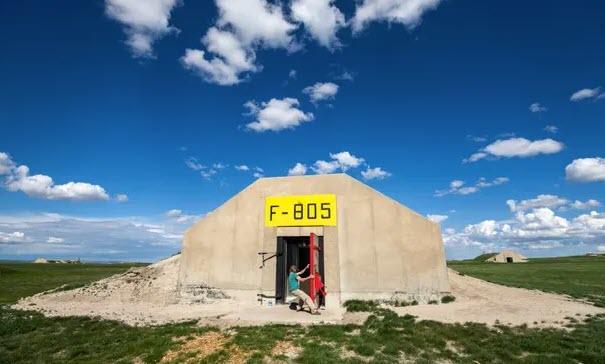
On some level, we all know that it is just a matter of time before our society implodes.  When that day finally arrives, where will you want to be living?  I know that most of you have thought about this at some point.  Even if we don’t admit it to others, most of us have spent at least a little bit of time thinking about worst case scenarios.  Our world is getting a little bit crazier with each passing day, and that was definitely true today.  We are cruising down a highway that doesn’t lead anywhere good, and it won’t be too long before the wheels start coming off.  When the music finally stops and everyone is scrambling to find a chair, where will you be located?

Earlier today, I was surprised to learn that a scientific study was recently conducted to determine the best place to live during a global societal collapse.

According to that study, the best place to live when our world goes completely haywire will be New Zealand…

New Zealand, Iceland, the UK, Tasmania and Ireland are the places best suited to survive a global collapse of society, according to a study.

In recent years, New Zealand has become extremely popular with the elite.  Many wealthy individuals have gobbled up properties in prime locations in anticipation of what is coming.

I used to recommend New Zealand too, but after what I have witnessed during this pandemic I can no longer do that.  The top politicians in New Zealand have shown that they are authoritarian control freaks, and at this point I am urging everyone to avoid the country.

One thing that you will notice about the top five names on the list is that they are all islands.  Having the natural protection of the ocean is definitely a desirable thing, but being close to shore also makes you vulnerable to tsunamis and rising sea levels.

Of course no place is perfect.  Wherever you live, there are going to be certain risks.

The researchers that conducted this study said that a number of different factors were used to come up with the final results…

To assess which nations would be most resilient to such a collapse, countries were ranked according to their ability to grow food for their population, protect their borders from unwanted mass migration, and maintain an electrical grid and some manufacturing ability. Islands in temperate regions and mostly with low population densities came out on top.

When they were asked about the United States, the researchers said that the inability of the U.S. to prevent mass migration pushes it just out of the top 5…

That’s because its giant land borders make it vulnerable to migration from people who would be trying to escape climate disasters in their own countries: Think streams of people pouring over the southern border from Mexico or the northern border from Canada, for instance.

Still, the U.S. would have fallen somewhere just out of the Top 5, the researchers at Anglia Ruskin University in the U.K. told DailyMail.com.

Unfortunately, I believe that there are other factors which need to be considered which should push the U.S. way down the list.

For example, during the riots of 2020 we clearly witnessed the potential for widespread civil unrest in this country.  Major cities were burning from coast to coast last summer, and since that time we have been experiencing an unprecedented spike in violent crime.

So when things really start falling apart, I would strong recommend avoiding any of our core urban areas.

Another factor to consider is how authorities would react during a major pandemic.  This week, the authoritarian side of Joe Biden has come out, and it has been quite frightening to watch.

I think that one lesson that we have all learned over the past year is that during a global health crisis you really want to be some place where you can simply be left alone.

The potential for natural disasters is another very important factor that was not mentioned by the researchers that conducted the study.  Our world is not a stable place, and we saw another very clear example of this on Thursday.  Alaska was hit by a magnitude 8.2 earthquake, and that represented the largest quake to hit the United States in more than 50 years…

The largest Alaska earthquake since 1965 caused a tsunami warning and local evacuations along the southwest Gulf of Alaska coast late Wednesday. After tsunami waves of less than 1 foot arrived onshore, the warning was canceled and coastal residents returned home.

Jeremy Zidek, a spokesman for the Alaska Division of Homeland Security and Emergency Management, said he expects any damage from the earthquake may be revealed in the morning.

We are being told that it was the sixth largest earthquake in the recorded history of North America, and it really shook a lot of people up…

In Sand Point, Patrick Mayer, the superintendent of schools for the Aleutians East Borough, was sitting in his kitchen when the shaking started.

“It started to go and just didn’t stop,” he said. “It went on for a long time and there were several aftershocks, too. The pantry is empty all over the floor, the fridge is empty all over the floor.”

Sadly, the truth is that this is just the beginning.

As I have detailed in “Lost Prophecies” and “7 Year Apocalypse”, I am deeply concerned about the potential for great natural disasters on both coasts and along the New Madrid fault zone in the middle of the country.

War is another factor that the researchers should have considered.

It is hard to imagine an entirely peaceful global societal collapse.  And when a major war does erupt, it is probably inevitable that the United States will be right in the middle of it.

Right now, military experts are telling us that Taiwan is one of the key hotspots that could potentially spark a major war, and we just learned that China recently simulated an invasion of the island…

FEARS of World War Three have been sparked after China staged massive military drills “invading Taiwan”.

Beijing also boasted about defeating the US and the UK in any conflict – and says it is confident the advantages are on its side.

And I also think that it is very noteworthy that Russia and China are planning to conduct “joint military exercises” next month…

Russia and China will conduct joint military exercises involving 10,000 troops in mid-August, the Interfax news agency cited the Russian defence ministry as saying on Thursday.

So many of the trends that I have been watching for years are now starting to accelerate.

The hour is late, and time is running out.

But of course any sort of a “global collapse” is simply unimaginable to most Americans, and for now ignorance is bliss.

*  *  *

It is finally here! Michael’s new book entitled “7 Year Apocalypse” is now available in paperback and for the Kindle on Amazon.


https://www.zerohedge.com/geopolitical/when-society-collapses-will-us-be-one-best-places-be-located?utm_campaign=&utm_content=Zerohedge%3A+The+Durden+Dispatch&utm_medium=email&utm_source=zh_newsletter


About Cheese in Painting

 This Article Is Only About Cheese in Painting

I feel ashamed. As an official cheese-lover who could eat it every day for every meal, I still haven’t dedicated a single line to cheese in painting! I must repent and compensate all cheese lovers for the lost time. This post is best enjoyed with blue cheese fondue, a cheesecake, toast with butter and cheese, some nice onion soup with cheddar, a cheese muffin, a cheeseburger, or just a piece of sheep cheese on its own…

Cheese and Almonds

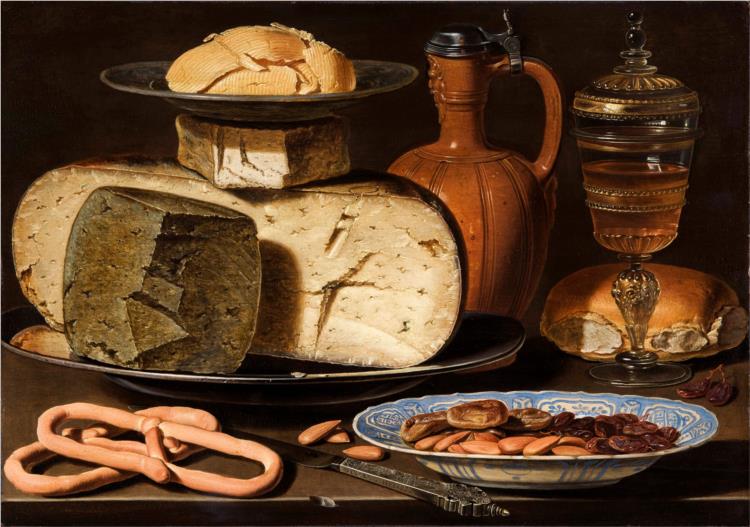
Clara Peeters, Still Life with Cheeses, Almonds and Pretzels, 1615, Mauritshuis, Hague, Netherlands, cheese in painting
Cheese in Painting: Clara Peeters, Still Life with Cheeses, Almonds and Pretzels, 1615, Mauritshuis, The Hague, Netherlands.

There is no confirmed information on Clara Peeters. We’re led to believe she worked in Antwerp as one of very few female painters. Nearly all of her paintings are still lifes, a limitation imposed by contemporary culture on women who wanted to create art. If you study the side of the knife’s handle you will see Peeter’s signature. Actually, six of her known paintings include the same inscribed silver knife. Moreover, on the blade of at least three of these knives, there is a silver mark of the city of Antwerp. At Peeter’s time knives were carried by guests when they were invited to a party or were used as wedding gifts. 

Cheese and Artichokes

Clara Peeters, Still Life with Cheeses, Artichoke, and Cherries, 1625, Los Angeles County Museum of Art (LACMA), Los Angeles, CA, USA.
Cheese in Painting: Clara Peeters, Still Life with Cheeses, Artichoke, and Cherries, 1625, Los Angeles County Museum of Art (LACMA), Los Angeles, CA, USA.

Here we see another variation of local and imported foods juxtaposed by Peeters. There is the same knife, some artichokes, cherries, salt, local bread – and of course the cheese!

Cheese and Fruit

Floris van Dyck, Still Life with Cheeses, c.1615, Rijksmuseum, The Netherlands, cheese in painting
Cheese in Painting: Floris van Dyck, Still Life with Cheeses, c. 1615, Rijksmuseum, Amsterdam, Netherlands.

Floris Claesz. van Dijck was a painter from Haarlem who today ranks as one of the pioneers of Dutch still-life painting. We can definitely see why: his astounding illusion of reality makes us believe that the pewter plate on the edge of the table seems close enough to touch. We can almost sense the delicacy of the damask material for the beautifully ornamented tablecloths.

Floris van Dyck, Still Life with Fruit, Nuts and Cheese, 1613, Frans Hals Museum, Haarlem, The Netherlands, cheese in painting
Cheese in Painting: Floris van Dyck, Still Life with Fruit, Nuts and Cheese, 1613, Frans Hals Museum, Haarlem, Netherlands.

We have a very similar scene here: damask tablecloths, Chinese porcelain, pewter dishes, and various foods which make this still life a “breakfast piece,” in Dutch “ontbijtje“. This type of still life originated around 1610 in Antwerp and Haarlem. We see the table from slightly above, which was the characteristic point of view of early still lifes, so that all the objects and their details be clearly seen.

Cheese and Butter

Floris van Schooten (circa 1580/1588–1656) Blue pencil.svg wikidata:Q420055 Floris van Schooten, Still-Life with Glass, Cheese, Butter and Cake, unknown date, private collection, cheese in painting
Cheese in Painting: Floris van Schooten, Still-Life with Glass, Cheese, Butter and Cake, first half of the 17th century, private collection. Wikimedia Commons (public domain).

Van Schooten began his career with enormous breakfast-pieces, filled with food and items on a table top, tilted towards the spectator and covered with rugs or white damask cloths. Later, he limited his compositions to small-scale pieces, focusing on fruit and often featuring a pewter beaker with punched decoration. He had a practice of signing his work with a small monogram, often tucked away on a knife blade or dish edge (if anyone can spot it here, let me know!). Unfortunately this has contributed to many of his pictures being attributed to others.

Cheese and Flowers

Joris van Son, Still-Life with Cheese, 1650s, Palais des Archevêques, Tours, cheese in painting
Cheese in Painting: Joris van Son, Still-Life with Cheese, 1650s, Palais des Archevêques, Tours, France.

Joris van Son worked in Antwerp under another painter, Jan Davidsz. de Heem, one of the rare artists who captured the extent of the exuberance of Flemish Baroque painting. (de Heem was Dutch so there was a difference in his painting, especially in use of color.) Joris van Son successfully adopted the style of his master and created similar compositions.


Getting hungry? There’s some more food in art:

Magda, art historian and Italianist, she writes about art because she cannot make it herself. She loves committed and political artists like Ai Weiwei or the Futurists; like Joseph Beuys she believes that art can change us and we can change the world.


https://www.dailyartmagazine.com/cheese-in-painting/


An Argentine Hooker, a Jabhat al-Nusra Terrorist, and A Homosexual Prime Minister.

  Herman Meeuwissen @HermanMeeuwiss1 Petra Wetering is in de Heer, daarom zal ze zoiets als onderstaand nooit zeggen over Bibi Netanyahu - B...