Zoeken in deze blog 🔎🔎

vrijdag 14 mei 2021

Israel as a Terrorist State


Israel as a Terrorist State

As stated previously in The CIA as a Terrorist Organization "terrorism" is here taken to mean the practice of the deliberate inflicting (either directly or indirectly) of harm, injury, death and/or destruction upon a civilian target sufficient to cause horror, revulsion or despair among civilian populations and/or their political leaders, with the goal of causing those populations or political leaders to act in a way desired by the terrorists.

A terrorist state is a state which practices terrorism, even if it pretends (or rather, lies) to the world that it does not. It hardly needs to be pointed out that Israel is a terrorist state. Brutal repression of, and bloody attacks on, Palestinian civilians with the official Israeli aim of causing a change in the policies or actions of the Palestinian leadership is a clear case of terrorism.

One of the vilest acts of terrorism committed by Israel was the assassination on 2004-03-22 of the 67-year old spiritual head of Hamas, an organization which, as well as resisting Israel's illegal occupation of the West Bank, attempts to provide educational, medical, etc., services to the Palestinian people, whose social infrastructure has been practically destroyed by Israel.
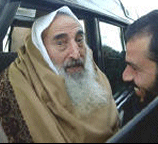
Israel assassinates Hamas founder and leader

Hamas spiritual leader Shiekh Ahmed Yassin was killed at daybreak Monday when Israeli helicopters fired missiles at his car as he left a mosque near his house in Gaza City.

Kawther Salam: The assassination of Sheikh Yassin was written between the Lines of the U.S. Road Map

And then a month later Israel used the same method (a missile fired from a U.S.-supplied helicopter gunship) to murder Sheikh Yassin's successor, Abdel Aziz Rantissi (his son was also killed in the attack).

There is no limit to Israel's depravity. Every abomination is followed by a worse abomination. It is almost as if Israel is taunting the world by heaping evil on top of evil.


Israel has been a terrorist state from its beginning, and has its foundations in terrorism. Three Israeli prime ministers were or are terrorists:

  • Menachim Begin took part in terrorist acts in the 1940s, including the attack on the King David Hotel which killed 91 people.
    Begin ordered ... the destruction of the central British administrative offices in the King David Hotel. — Jewish Virtual Library

    In 1946, Jewish terrorists agitating for their own state in British-occupied Palestine blew up Jerusalem's King David Hotel, killing 91. Two years later, an independent Israel was established. "There were a lot of innocent British women and children killed there," says Hanson. "But in the end, it worked; the British left." — Some Dirty Little Secrets About Terrorism

  • Yitzhak Shamir was the operations commander, and later leader, of the Stern Gang, a terrorist group which was responsible for a string of political assassinations.

    Shamir was a member of two militant Jewish underground organizations which ... were active in counter-terrorist acts against Arabs as well as sabotage against the British. — The Department for Jewish Zionist Education  (Note the use of the term counter-terrorist to disguise terrorism.)

    In post-war British-mandated Palestine the words Stern Gang equalled "terrorism" — assassinations, bombings, the full works.  ... Yitzhak Shamir had been the gang's operations commander.  ... By appointing Shamir Foreign Minister, Prime Minister Menachem Begin had selected the organiser of two famous assassinations: the killing of Lord Moyne, the British Minister representative in the Middle East, in 1944, and that of Count Folke Bernadotte, the UN's special Mediator on Palestine, in 1948. — Stern Gang: what does 'mekhabbel' mean?

    During the fight for Jewish statehood, extremist military groups sometimes resorted to the use of terrorist tactics. One such instance occurred in 1948 when members of the Jewish underground organization LEHI (Fighters for the Freedom of Israel) killed UN Peace Mediator Count Folke Bernadotte to protest his diplomatic efforts to modify the Palestine partition plan.  ... Yitzhak Shamir reputedly played a role in planning the assassination; however, he was never tried and went on to become Prime Minister of Israel. — The Assassination of Count Bernadotte

  • Ariel Sharon initiated the Sabra-Shatila massacre in which between 1000 and 3000 people (mostly Palestinians) were murdered, and now leads a terrorist campaign against all Palestinians living in the occupied territories of the West Bank.

    As commander of the notorious Unit 101, Sharon led attacks on Palestinian villages in which women and children were killed.  The massacre in the West Bank village of Qibya, on October 14, 1953, was perhaps the most notorious. His troops blew up 45 houses and 69 Palestinian civilians — about half of them women and children — were killed. — The Electronic Intifada

    No one has ever been tried for the massacre, but an official Israeli commission of inquiry found that Israel's defense minister at the time, Ariel Sharon, "bears personal responsibility" as well as "indirect responsibility." It was Sharon, after all, who had ordered the Israel Defense Forces to invade Beirut and surround the camps. ... Like Pinochet and other war criminals, Sharon and his Phalangist underlings should be brought to book; if they can successfully evade justice, then it will give heart to killers everywhere. — Marking a Massacre, The Nation

    Sharon's preemptive logic undercuts all form of dialogue and negotiations. Its rule of thumb is violence, and then more violence, whether it manifests itself as a military attack or as an aggressive act of dispossession. So while it may seem that the bloody routine is in some way preordained, it is actually Sharon's preemptive zeal alongside Hamas' and Islamic Jihad's fundamentalism that has clouded the horizon and concealed, as Arendt might have said, the possibility for a better future. — Neve Gordon, Sharon's Preemptive Zeal, Counterpunch, 2003-09-24

    See also:


The Likud Party was founded by terrorists.

The terrorists of the 1940's were given full amnesty after establishing their nation, so instead of being brought to justice, they were able eventually to take power and keep all dissenters in line through terror and fear. The terrorists have become statesmen of the Jewish State. They have little moral ground to condemn modern Arab terrorists for doing what they themselves did in the 1940's and 1950's and have continued to do to the present day. — Zionism in Bible Prophecy: Part 6

And, of course, the terrorist state of the U.S.A. continues to support the terrorist state of Israel by giving it tanks, planes, rocket launchers and financial support to the tune of three billion dollars a year (why?), with which Israel has built up the fourth-largest military machine in the world.  Israel's hegemony over the Middle East will continue, however, only as long as American money makes it possible. One day this money will no longer be forthcoming, for one reason or another. That will be Israel's Day of Reckoning. And none too soon either.


See also:


The Assassination of Rafiq Hariri

contributor to Al Jazeera's website wrote:

If some recent events are put together the finger pointing at Israel and the U.S. for Hariri's assassination will be more justified. The U.S. wants to attack Iran but fears that any attempt to do so will put Israel at risk from Hezbollah and Syrian troops. Being desperate, the U.S. connived with France to pass the most unacceptable and ridiculous resolution ever in UN history while they are in Iraq and Afghanistan, they want Syria out of Lebanon so that Israel has a free hand on Hezbollah in case of any attack on Iran. After the resolution failed to garner support, now the U.S. is using another strategy to cause a civil war in Lebanon. Al Hariri's assassination is clearly the combined efforts of the CIA and the Mossad.

See more on the assassination of Rafiq Hariri at Syria is Doomed.

And for a mention of a few acts of Israeli state terrorism from 1950 to the present see this article by Muhammad Idrees Ahmad: Motive and Precedent in the Gemayel Assassination


September 11, 2001

The attacks of 9/11, were clearly acts of terrorism, since they were the deliberate infliction of death and destruction upon civilian and military targets sufficient to cause horror and revulsion among the civilian population of the U.S. and their political leaders, with the goal of causing those populations and political leaders to act in a way desired by the terrorists.

And how did those political leaders respond? By declaring a "War on Terrorism", later shortened by George W. Bush (because he could not pronunce the word terrorism properly) to the "War on Terror". Since the alleged perpetrators were identified by the FBI (within hours) as Arabs, the U.S. thus gave itself permission to wage war on any Arab country it wished to, since all Arab countries could be suspected of harboring terrorists — at least, in the popular mind, reinforced by propaganda from the U.S. mainstream media. (But curiously, although all 19 alleged terrorists were from Saudi Arabia, the U.S. never claimed that that country was a haven for terrorists.)

One country, in particular benefited from this "War on Terror", namely, Israel. On the evening of 9/11 the New York Times reported:

Asked tonight what the attack meant for relations between the United States and Israel, Benjamin Netanyahu, the former prime minister, replied: “It's very good." Then he edited himself: “Well, not very good, but it will generate immediate sympathy.”

Israel's Ma'ariv newspaper reported (as stated in Haaretz) that in a speech the following day Netanyahu said:

We are benefiting from one thing, and that is the attack on the Twin Towers and Pentagon, and the American struggle in Iraq."

Any time a crime is committed one has to ask: Who benefits? Obviously the 9/11 attacks were crimes of the first magnitude. Did Afghanistan benefit? No. Did Iraq benefit? No? Did the shadowy CIA-invented Al Qaida benefit? If so, how? Did Israel benefit? Yes, according to Netanyahu. Did the U.S. itself benefit? Yes, because the "War on Terror" gave the U.S. government a pretext to trash the U.S. Constitution by implementing what has come to be a totalitarian police state. So we have two immediate suspects, Israel and the U.S.

Any time a crime is committed one also has to ask: Who had the means? It now seems clear that the means for the demolition of the Twin Towers was the use of atomic bombs. Only a handful of countries possess atomic bombs, and they include both the U.S. and Israel (which obtained its nuclear technology from France and the U.S. — including information obtained by Israeli spies such as Jonathan Pollard).

Several people have considered the evidence suggesting an Israeli involvement in 9/11. For one, see Israel and 9/11. Foreknowledge by Israeli agents or companies in Manhattan of the attack on the Twin Towers would be a strong indication that Israel was indeed involved in this act of terrorism. Evidence of foreknowledge is provided in Keith Maart's well-researched articles:

The Five Celebrating Israelis:
September 11th Foreknowledge and Possible Complicity
Corroborated by Evidence from FBI Investigation and Other New Information

Zim Shipping: New Evidence suggests
Six Months Foreknowledge of the September 11th Attack Date
and Potential Involvement in the Israeli Deep Cover Operation

Who planted the atomic bombs in the basements of the Twin Towers? CIA operatives? U.S. Marines? But it is hard to imagine that any Americans would install atomic bombs in the Twin Towers knowing that their detonation would likely kill thousands of their fellow citizens. (This concern was not shared by those Americans in the Bush Administration, the Pentagon and the CIA who were involved in the planning of the 9/11 attacks.) But Israeli operatives would not likely be especially worried about the imminent deaths of thousands of Americans if no Jews were killed and if the operation significantly reduced the danger to Israel from hostile states in the Middle East. And, with the help of Zim Shipping, it would not be difficult to transport 30-40 atomic bombs from Israel to Manhattan (one for each of the central supporting columns).

https://www.serendipity.li/zionism/israel_terr.htm?fbclid=IwAR1CP5615m7wVEgjAikiZfIwqQO_1vtVbXe9Dt4VyUuEkXmAV2xGt1ucD7U


This is apartheid


A regime of Jewish supremacy from the Jordan River to the Mediterranean Sea: This is apartheid

More than 14 million people, roughly half of them Jews and the other half Palestinians, live between the Jordan River and the Mediterranean Sea under a single rule. The common perception in public, political, legal and media discourse is that two separate regimes operate side by side in this area, separated by the Green Line. One regime, inside the borders of the sovereign State of Israel, is a permanent democracy with a population of about nine million, all Israeli citizens. The other regime, in the territories Israel took over in 1967, whose final status is supposed to be determined in future negotiations, is a temporary military occupation imposed on some five million Palestinian subjects.

Over time, the distinction between the two regimes has grown divorced from reality. This state of affairs has existed for more than 50 years – twice as long as the State of Israel existed without it. Hundreds of thousands of Jewish settlers now reside in permanent settlements east of the Green Line, living as though they were west of it. East Jerusalem has been officially annexed to Israel’s sovereign territory, and the West Bank has been annexed in practice. Most importantly, the distinction obfuscates the fact that the entire area between the Mediterranean Sea and the Jordan River is organized under a single principle: advancing and cementing the supremacy of one group – Jews – over another – Palestinians. All this leads to the conclusion that these are not two parallel regimes that simply happen to uphold the same principle. There is one regime governing the entire area and the people living in it, based on a single organizing principle.

When B’Tselem was founded in 1989, we limited our mandate to the West Bank (including East Jerusalem) and the Gaza Strip, and refrained from addressing human rights inside the State of Israel established in 1948 or from taking a comprehensive approach to the entire area between the Jordan River and the Mediterranean Sea. Yet the situation has changed. The regime’s organizing principle has gained visibility in recent years, as evidenced by the Basic Law: Israel – the Nation State of the Jewish People passed in 2018, or open talk of formally annexing parts of the West Bank in 2020. Taken together with the facts described above, this means that what happens in the Occupied Territories can no longer be treated as separate from the reality in the entire area under Israel’s control. The terms we have used in recent years to describe the situation – such as “prolonged occupation” or a “one-state reality” – are no longer adequate. To continue effectively fighting human rights violations, it is essential to examine and define the regime that governs the entire area.

This paper analyzes how the Israeli regime works to advance its goals in the entire area under its control. We do not provide a historical review or an evaluation of the Palestinian and Jewish national movements, or of the former South Africa regime. While these are important questions, they are beyond the purview of a human rights organization. Rather, this document presents the principles that guide the regime, demonstrates how it implements them and points to the conclusion that emerges from all of this as to how the regime should be defined and what that means for human rights.

Divide, separate, rule

MapIn the entire area between the Mediterranean Sea and the Jordan River, the Israeli regime implements laws, practices and state violence designed to cement the supremacy of one group – Jews – over another – Palestinians. A key method in pursuing this goal is engineering space differently for each group.

Jewish citizens live as though the entire area were a single space (excluding the Gaza Strip). The Green Line means next to nothing for them: whether they live west of it, within Israel’s sovereign territory, or east of it, in settlements not formally annexed to Israel, is irrelevant to their rights or status.

Where Palestinians live, on the other hand, is crucial. The Israeli regime has divided the area into several units that it defines and governs differently, according Palestinians different rights in each. This division is relevant to Palestinians only. The geographic space, which is contiguous for Jews, is a fragmented mosaic for Palestinians:

  • Palestinians who live on land defined in 1948 as Israeli sovereign territory (sometimes called Arab-Israelis) are Israeli citizens and make up 17% of the state’s citizenry. While this status affords them many rights, they do not enjoy the same rights as Jewish citizens by either law or practice – as detailed further in this paper.
     
  • Roughly 350,000 Palestinians live in East Jerusalem, which consists of some 70,000 dunams [1 dunam = 1,000 square meters] that Israel annexed to its sovereign territory in 1967. They are defined as permanent residents of Israel a status that allows them to live and work in Israel without needing special permits, to receive social benefits and health insurance, and to vote in municipal elections. Yet permanent residency, unlike citizenship, may be revoked at any time, at the complete discretion of the Minister of the Interior. In certain circumstances, it can also expire.
     
  • Although Israel never formally annexed the West Bank, it treats the territory as its own. More than 2.6 million Palestinian subjects live in the West Bank, in dozens of disconnected enclaves, under rigid military rule and without political rights. In about 40% of the territory, Israel has transferred some civilian powers to the Palestinian Authority (PA). However, the PA is still subordinate to Israel and can only exercise its limited powers with Israel’s consent.
     
  • The Gaza Strip is home to about two million Palestinians, also denied political rights. In 2005, Israel withdrew its forces from the Gaza Strip, dismantled the settlements it built there and abdicated any responsibility for the fate of the Palestinian population. After the Hamas takeover in 2007, Israel imposed a blockade on the Gaza Strip that is still in place. Throughout all of these years, Israel has continued to control nearly every aspect of life in Gaza from outside.

Israel accords Palestinians a different package of rights in every one of these units – all of which are inferior compared to the rights afforded to Jewish citizens. The goal of Jewish supremacy is advanced differently in every unit, and the resulting forms of injustice differ: the lived experience of Palestinians in blockaded Gaza is unlike that of Palestinian subjects in the West Bank, permanent residents in East Jerusalem or Palestinian citizens within sovereign Israeli territory. Yet these are variations on the fact that all Palestinians living under Israeli rule are treated as inferior in rights and status to Jews who live in the very same area.

Detailed below are four major methods the Israeli regime uses to advance Jewish supremacy. Two are implemented similarly throughout the entire area: restricting migration by non-Jews and taking over Palestinian land to build Jewish-only communities, while relegating Palestinians to small enclaves. The other two are implemented primarily in the Occupied Territories: draconian restrictions on the movement of non-citizen Palestinians and denial of their political rights. Control over these aspects of life lies entirely in Israel’s hands: in the entire area, Israel has sole power over the population registry, land allocation, voter rolls and the right (or denial thereof) to travel within, enter or exit any part of the area.

A. Immigration – for Jews only: 

ImmigrationAny Jew in the world and his or her children, grandchildren and spouses are entitled to immigrate to Israel at any time and receive Israeli citizenship, with all of its associated rights. They receive this status even if they choose to live in a West Bank settlement not formally annexed to Israel’s sovereign territory.

In contrast, non-Jews have no right to legal status in Israeli-controlled areas. Granting status is at the almost complete discretion of officials – the Minister of the Interior (within sovereign Israel) or the military commander (in the Occupied Territories). Despite this official distinction, the organizing principle remains the same: Palestinians living in other countries cannot immigrate to the area between the Mediterranean Sea and the Jordan River, even if they, their parents or their grandparents were born and lived there. The only way Palestinians can immigrate to areas controlled by Israel is by marrying a Palestinian who already lives there – as citizen, resident or subject – as well as meeting a series of conditions and receiving Israeli approval..

Israel not only hampers Palestinian immigration but also impedes Palestinian relocation between the units, if the move – in the perception of the regime – would upgrade their status. For instance, Palestinian citizens of Israel or residents of East Jerusalem can easily relocate to the West Bank (although they risk their rights and status in doing so). Palestinians in the Occupied Territories cannot obtain Israeli citizenship and relocate to Israeli sovereign territory, except for in very rare instances, which depend on the approval of Israeli officials.

Israel’s policy on family unification illustrates this principle. For years, the regime has placed numerous obstacles before families in which each spouse lives in a different geographical unit. Over time, this has impeded and often prevented Palestinians marrying a Palestinian in another unit from acquiring status in that unit. As a result of this policy, tens of thousands of families have been unable to live together. When one spouse is a resident of the Gaza Strip , Israel allows the family to live there together, but if the other spouse is a resident of the West Bank, Israel demands they relocate permanently to Gaza. In 2003, the Knesset passed a Temporary Order (still in force) banning the issuance of Israeli citizenship or permanent residency to Palestinians from the Occupied Territories who marry Israelis – unlike citizens of other countries. In exceptional cases approved by the Minister of the Interior, Palestinians from the West Bank who marry Israelis may be granted status in Israel – yet it is only temporary and does not entitle them to social benefits.

RoadblockIsrael also undermines the right of Palestinians in the Occupied Territories – including East Jerusalem – to continue living where they were born. Since 1967, Israel has revokedthe status of some 250,000 Palestinians in the West Bank (East Jerusalem included) and the Gaza Strip, in some cases on the grounds they had lived abroad for more than three years. This includes thousands of East Jerusalem residents who moved mere miles east of their homes to parts of the West Bank that are not officially annexed. All these individuals were robbed of the right to return to their homes and families, where they were born and raised.

B. Taking over land for Jews while crowding Palestinians in enclaves: 

MapIsrael practices a policy of “Judaizing” the area, based on the mindset that land is a resource meant almost exclusively to benefit the Jewish public. Land is used to develop and expand existing Jewish communities and build new ones, while Palestinians are dispossessed and corralled into small, crowded enclaves. This policy has been practiced with respect to land within sovereign Israeli territory since 1948 and applied to Palestinians in the Occupied Territories since 1967. In 2018, the underlying principle was entrenched in Basic Law: Israel – the Nation State of the Jewish People, which stipulates that “the State considers the development of Jewish settlements a national value and will take action to encourage and promote the establishment and reinforcment of such settlements.”

Inside its sovereign territory, Israel has enacted discriminatory laws, most notably the Absentee Property Law , allowing it to expropriate vast tracts of Palestinian-owned land, including millions of dunams in communities whose residents were expelled or fled in 1948 and were barred from returning. Israel has also significantly reduced the areas designated for Palestinian local councils and communities, which now have access to less than 3% of the country’s total area. Most of the designated land is already saturated with construction. As a result, more than 90% of land in Israel’s sovereign territory is now under state control.

Israel has used this land to build hundreds of communities for Jewish citizens – yet not a single one for Palestinian citizens. The exception is a handful of towns and villages built to concentrate the Bedouin population , which has been stripped of most of its proprietary rights. Most of the land on which Bedouins used to live has been expropriated and registered as state land. Many Bedouin communities have been defined as ‘unrecognized’ and their residents as ‘invaders.’ On land historically occupied by Bedouins, Israel has built Jewish-only communities.

The Israeli regime severely restricts construction and development in the little remaining land in Palestinian communities within its sovereign territory. It also refrains from preparing master plans that reflect the population’s needs, and keeps these communities’ areas of jurisdiction virtually unchanged despite population growth. The result is small, crowded enclaves where residents have no choice but to build without permits .

Israel has also passed a law allowing communities with admission committees, numbering hundreds throughout the country, to reject Palestinian applicants on grounds of “cultural incompatibility.” This effectively prevents Palestinian citizens from living in communities designated for Jews. Officially, any Israeli citizen can live in any of the country’s cities ; in practice, only 10% of Palestinian citizens do. Even then, they are usually relegated to separate neighborhoods due to lack of educational, religious and other services, the prohibitive cost of purchasing a home in other parts of the city, or discriminatory practices in land and home sales.

The regime has used the same organizing principle in the West Bank since 1967 (including East Jerusalem). Hundreds of thousands of dunams, including farmland and pastureland, have been taken from Palestinian subjects on various pretexts and used, among other things, to establish and expand settlements, including residential neighborhoods, farmland and industrial zones. All settlements are closed military zones that Palestinians are forbidden from entering without a permit. So far, Israel has established more than 280 settlements in the West Bank (East Jerusalem included), which are now home to more than 600,000 Jews. More land has been taken to build hundreds of kilometers of bypass roads for settlers.

Planning and buildingIsrael has instituted a separate planning system for Palestinians in the West Bank, chiefly designed to prevent construction and development. Large swathes of land are unavailable for construction, having been declared state land, a firing zone, a nature reserve or a national park. The authorities also refrain from drafting adequate master plans reflecting the present and future needs of Palestinian communities in what little land has been spared. The separate planning system centers on demolishing structures built without permits – here, too, for lack of choice. All this has trapped Palestinians in dozens of densely-populated enclaves, with development outside them – whether for residential or public use, including infrastructure – almost completely banned.

C. Restriction of Palestinians’ freedom of movement

Freedom of movementIsrael allows its Jewish and Palestinian citizens and residents to travel freely throughout the area. Exceptions are the prohibition on entering the Gaza Strip, which it defines “hostile territory,” and the (mostly formal) prohibition on entering areas ostensibly under PA responsibility (Area A). In rare cases, Palestinian citizens or residents are permitted to enter Gaza.

Israeli citizens can also leave and reenter the country at any time. In contrast, residents of East Jerusalem do not hold Israeli passports and lengthy absence can result in revocation of status.

Israel routinely restricts the movement of Palestinians in the Occupied Territories and generally forbids them from moving between the units. Palestinians from the West Bank who wish to enter Israel, East Jerusalem or the Gaza Strip must apply to the Israeli authorities. In the Gaza Strip, which has been blockaded since 2007, the entire population is imprisoned as Israel forbids almost any movement in or out – except in rare cases it defines humanitarian. Palestinians who wish to leave Gaza or Palestinians from other units who wish to enter it must also submit a special application for a permit to the Israeli authorities. The permits are issued sparingly and can only be obtained through a strict, arbitrary mechanism, or permit regime , which lacks transparency and clear rules. Israel treats every permit issued to a Palestinian as an act of grace rather than the fulfillment of a vested right.

In the West Bank, Israel controls all the routes between the Palestinian enclaves. This allows the military to set up flying checkpoints, close off access points to villages, block roads and stop passage through checkpoints at will. Furthermore, Israel built the Separation Barrier within the West Bank and designated Palestinian land, including farmland, trapped between the barrier and the Green Line as “the seam zone .” Palestinians in the West Bank are barred from entering this zone, subject to the same permit regime.

No flightsPalestinians in the Occupied Territories also need Israeli permission to go abroad. As a rule, Israel does not allow them to use Ben Gurion International Airport, which lies inside its sovereign territory. Palestinians from the West Bank must fly through Jordan’s international airport – but can only do so if Israel allows them to cross the border into Jordan. Every year, Israel denies thousands of requests to cross this border, with no explanation. Palestinians from Gaza must go through Egyptian-controlled Rafah Crossing – provided it is open, the Egyptian authorities let them through, and they can undertake the long journey through Egyptian territory. In rare exceptions, Israel allows Gazans to travel through its sovereign territory in an escorted shuttle, in order to reach the West Bank and from there continue to Jordan and on to their destination.

D. Denial of Palestinians’ right to political participation 

VotingLike their Jewish counterparts, Palestinian citizens of Israel can take political action to further their interests, including voting and running for office. They can elect representatives, establish parties or join existing ones. That said, Palestinian elected officials are continually vilified – a sentiment propagated by key political figures – and the right of Palestinian citizens to political participation is under constant attack .

The roughly five million Palestinians who live in the Occupied Territories cannot participate in the political system that governs their lives and determines their futures. Theoretically, most Palestinians are eligible to vote in the PA elections. Yet as the PA’s powers are limited, even if elections were held regularly (the last were in 2006), the Israeli regime would still rule Palestinians’ lives, as it retains major aspects of governance in the Occupied Territories. This includes control over immigration, the population registry, planning and land policies, water, communication infrastructure, import and export, and military control over land, sea and air space.

In East Jerusalem, Palestinians are caught between a rock and a hard place. As permanent residents of Israel, they can vote in municipal elections but not for parliament. On the other hand, Israel makes it difficult for them to participate in PA elections.

Political participation encompasses more than voting or running for office. Israel also denies Palestinians political rights such as freedom of speech and freedom of association. These rights enable individuals to critique regimes, protest policies, form associations to advance their ideas and generally work to promote social and political change.

DemonstrationsA slew of legislation, such as the boycott law and the Nakba law, has limited Israelis’ freedom to criticize policies relating to Palestinians throughout the area. Palestinians in the Occupied Territories face even harsher restrictions : they are not allowed to demonstrate; many associations have been banned; and almost any political statement is considered incitement. These restrictions are assiduously enforced by the military courts, which have imprisoned hundreds of thousands of Palestinians and are a key mechanism upholding the occupation. In East Jerusalem, Israel works to prevent any social, cultural or political activity associated in any way with the PA.

The division of space also hampers a unified Palestinian struggle against Israeli policy. The variation in laws, procedures and rights among the geographical units and the draconian movement restrictions have separated the Palestinians into distinct groups. This fragmentation not only helps Israel promote Jewish supremacy, but also thwarts criticism and resistance.

No to apartheid: That is our struggle

No to ApartheidThe Israeli regime, which controls all the territory between the Jordan River and the Mediterranean Sea, seeks to advance and cement Jewish supremacy throughout the entire area. To that end, it has divided the area into several units, each with a different set of rights for Palestinians – always inferior to the rights of Jews. As part of this policy, Palestinians are denied many rights, including the right to self-determination.

This policy is advanced in several ways. Israel demographically engineers the space through laws and orders that allow any Jew in the world or their relatives to obtain Israeli citizenship, but almost completely deny Palestinians this possibility. It has physically engineered the entire area by taking over of millions of dunams of land and establishing Jewish-only communities, while driving Palestinians into small enclaves. Movement is engineered through restrictions on Palestinian subjects, and political engineering excludes millions of Palestinians from participating in the processes that determine their lives and futures while holding them under military occupation.

A regime that uses laws, practices and organized violence to cement the supremacy of one group over another is an apartheid regime. Israeli apartheid, which promotes the supremacy of Jews over Palestinians, was not born in one day or of a single speech. It is a process that has gradually grown more institutionalized and explicit, with mechanisms introduced over time in law and practice to promote Jewish supremacy. These accumulated measures, their pervasiveness in legislation and political practice, and the public and judicial support they receive – all form the basis for our conclusion that the bar for labeling the Israeli regime as apartheid has been met.

If this regime has developed over many years, why release this paper in 2021? What has changed? Recent years have seen a rise in the motivation and willingness of Israeli officials and institutions to enshrine Jewish supremacy in law and openly state their intentions. The enactment of Basic Law: Israel – the Nation State of the Jewish People and the declared plan to formally annex parts of the West Bank have shattered the façade Israel worked for years to maintain.

The Nation State basic law, enacted in 2018, enshrines the Jewish people’s right to self-determination to the exclusion of all others. It establishes that distinguishing Jews in Israel (and throughout the world) from non-Jews is fundamental and legitimate. Based on this distinction, the law permits institutionalized discrimination in favor of Jews in settlement, housing, land development, citizenship, language and culture. It is true that the Israeli regime largely followed these principles before. Yet Jewish supremacy has now been enshrined in basic law, making it a binding constitutional principle – unlike ordinary law or practices by authorities, which can be challenged. This signals to all state institutions that they not only can, but must, promote Jewish supremacy in the entire area under Israeli control.

Israel’s plan to formally annex parts of the West Bank also bridges the gap between the official status of the Occupied Territories, which is accompanied by empty rhetoric about negotiation of its future, and the fact that Israel actually annexed most of the West Bank long ago. Israel did not follow through on its declarations of formal annexation after July 2020, and various officials have released contradicting statements regarding the plan since. Regardless of how and when Israel advances formal annexation of one kind or another, its intention to achieve permanent control over the entire area has already been openly declared by the state’s highest officials.

The Israeli regime’s rationale, and the measures used to implement it, are reminiscent of the South African regime that sought to preserve the supremacy of white citizens, in part through partitioning the population into classes and sub-classes and ascribing different rights to each. There are, of course, differences between the regimes. For instance, the division in South Africa was based on race and skin color, while in Israel it is based on nationality and ethnicity. Segregation in South Africa was also manifested in public space, in the form of a policed, formal, public separation between people based on skin color – a degree of visibility that Israel usually avoids. Yet in public discourse and in international law, apartheid does not mean an exact copy of the former South African regime. No regime will ever be identical. ‘Apartheid’ has long been an independent term, entrenched in international conventions, referring to a regime’s organizing principle: systematically promoting the dominance of one group over another and working to cement it.

The Israeli regime does not have to declare itself an apartheid regime to be defined as such, nor is it relevant that representatives of the state broadly proclaim it a democracy. What defines apartheid is not statements but practice. While South Africa declared itself an apartheid regime in 1948, it is unreasonable to expect other states to follow suit given the historical repercussions. The response of most countries to South Africa’s apartheid is likelier to deter countries from admitting to implementing a similar regime. It is also clear that what was possible in 1948 is no longer possible today, both legally and in terms of public opinion.

As painful as it may be to look reality in the eye, it is more painful to live under a boot. The harsh reality described here may deteriorate further if new practices are introduced – with or without accompanying legislation. Nevertheless, people created this regime and people can make it worse – or work to replace it. That hope is the driving force behind this position paper. How can people fight injustice if it is unnamed? Apartheid is the organizing principle, yet recognizing this does not mean giving up. On the contrary: it is a call for change.

Fighting for a future based on human rights, liberty and justice is especially crucial now. There are various political paths to a just future here, between the Jordan River and the Mediterranean Sea, but all of us must first choose to say no to apartheid.


Demonstraties in Amsterdam, Utrecht, Den Haag, Groningen en Eindhoven Tegen Zionistisch Geweld


demonstraties

Demonstraties in Amsterdam, Utrecht, Den Haag, Groningen en Eindhoven

De dreigende huisuitzettingen van Palestijnen in Sheikh Jarrah, het buitensporige geweld in en rond de Haram el Sherif en de bombardementen op Gaza motiveren veel mensen om hun stem te laten horen. 

Wij organiseren in samenwerking met anderen de volgende demonstratie:

Amsterdam, de Dam, zondag 16 mei, van 14u00 – 17u00

Organisatie: docP-BDS Nederland, Internationale Socialisten, Ontmoet Palestina, Pro-Palestina Damgroep, DIDF (Federatie van Democratische Arbeidersverenigingen), Het Palestijnse Huis

De oproep voor deze demonstratie kan hier door organisaties ondersteund worden.

Facebook evenement.

De afgelopen weken zien we een escalatie van het geweld tegen de Palestijnen. Om onze solidariteit te betuigen gaan wij zondag 16 mei om 14 uur (Amsterdam, de Dam, op 1,5 meter afstand met mondkap) de straat op en roepen de Nederlandse staat op om het Israëlische geweld van de afgelopen weken te veroordelen en sancties in te stellen tegen Apartheid. Wij eisen stopzetting van militaire samenwerking met Israel en opschorting van het associatieverdrag.

Maar ook in andere steden worden er demonstraties georganiseerd zoals in Utrecht, Den Haag, Maastricht en Eindhoven u vindt hier een overzicht.

Ja! Ik doneer!

Sheikh Jarrah

Sheikh Jarrah: Wat er gebeurt en hoe je actie kunt ondernemen

De afgelopen weken en dagen zijn de Palestijnse protesten voor #SaveSheikhJarrah, in bezet Oost-Jeruzalem, in omvang toegenomen. Ze zijn geconfronteerd met brute onderdrukking door Israëlische apartheidsveiligheidstroepen, waaronder politieagenten die zijn opgeleid in de Israëlische politieopleidingsacademie die gedeeltelijk eigendom is van G4S en Allied Universal.

Palestijnse inwoners van Sheikh Jarrah hebben langdurige juridische strijd geleverd in Israëlische rechtbanken tegen uitzettingsbevelen, waardoor ze etnisch zouden worden gezuiverd, met geweld uit hun huizen zouden worden gezet en vervangen door illegale Israëlische kolonisten.

Vorige week, 7 mei 2021, hebben Israëlische kolonisten hun reactie op de rechtmatige claims van de inwoners van Sheikh Jarrah ingediend bij de Israëlische rechtbank, een apparaat van het Israëlische apartheidsregime.

De Palestijnse families kregen vervolgens tot maandag 10 mei 2021, de tijd om met de kolonisten een “akkoord” te bereiken over het recht op hun huis. Sheikh Jarrah behoort toe aan de Palestijnse families. Het maakt deel uit van het bezette Palestijnse grondgebied, en daarom komt elke aanwezigheid van Israëlische kolonisten daarin neer op een oorlogsmisdaad volgens het internationaal recht. De Israëlische nederzettingenonderneming is een integraal onderdeel van haar apartheidssysteem tegen alle Palestijnen.

Het bloedige neerslaan van Palestijnse protesten in Sheikh Jarrah door Apartheid Israel roept ons op tot actie. We hebben eerder onze collectieve kracht bewezen in de vorm van #BDSHier zijn 9 acties die je kunt ondernemen om de Israëlische straffeloosheid te bestrijden en Sheikh Jarrah te redden. #SaveSheikhJarrah.

De Groene NAVO-Propagandist Maarten Muns

  Op zoek naar een modus vivendi met Rusland Containment of detente? Welke ideologie er ook regeert, Rusland blijft een expansieve macht. ‘H...