Zoeken in deze blog 🔎🔎

zaterdag 21 november 2020

Shocking Figures Show How Much US is Fueling the Violence in Yemen


Shocking New Figures Show How Just Much the US is Fueling the Violence in Yemen

New figures from the UN and the Stockholm International Peace Research Institute show that since the war in Yemen began, the US has sold over $13 billion in high-tech weapons to Saudi Arabia, making the Kingdom a cash cow for US weapons makers.

November 20th, 2020

Despite presenting itself as a force for good and peace in the Middle East, the United States sells at least five times as much weaponry to Saudi Arabia than aid it donates to Yemen. The State Department constantly portrays itself as a humanitarian superpower with the welfare of the Yemeni people as its highest priority, yet figures released from the United Nations and the Stockholm International Peace Research Institute (SIPRI) show that since the war in Yemen began, the U.S. government has given $2.56 billion in aid to the country, but sold over $13 billion in high-tech weapons to Saudi Arabia, the leader of the coalition prosecuting a relentless onslaught against the country.

Figures like these are always debatable. What constitutes legitimate “aid” is a question everyone would answer differently. Furthermore, the $13 billion figure does not include the enormous weapons deal Saudi Arabia signed with Donald Trump in 2017, which will reportedly see the Kingdom purchase $350 billion over ten years.

SIPRI is skeptical of the size of these numbers, but if they prove to be correct, once the orders begin arriving, they will make the paltry aid donations seem like small change by comparison. Sales include all manner of military equipment, from radar and transport systems to F-15 fighter jets, TOW missiles, Abrams tanks, and Paladin howitzers.

While the Saudis pay in petrodollars, Yemenis pay in blood. Four years ago, the Saudi Air Force bombed a well-attended funeral in Yemen’s capital, Sanaa. It was a bright, clear day. The Saudis used a “double tap” airstrike to ensure maximum carnage. 240 people were killed, and like with the 2018 Saudi attack on a school bus that killed 40 children, the bombs that did the damage were 500-pound (227 kilogram) MK 82’s, built and supplied by Lockheed Martin, America’s largest weapons contractor.

“Making billions from arms exports which fuel the conflict while providing a small fraction of that in aid to Yemen is both immoral and incoherent. The world’s wealthiest nations cannot continue to put profits above the Yemeni people,” said Muhsin Siddiquey, Oxfam’s Yemen Country Director.

Four years ago this week, US MK82 bombs killed hundreds at a funeral in Yemen. The same bombs are still being used today. 

Already the region’s poorest nation, Yemen has been utterly devastated by the six-year conflict. The United Nations estimates that 14 million people — over half the country’s population — are at risk of famine, and 20.5 million need help accessing drinkable water. 80% of the population, it calculates, needs some form of humanitarian assistance. The Saudi-led coalition, which includes the UAE, Qatar, and Bahrain, has deliberately attacked soft targets like hospitals and water facilities, carrying out the equivalent of one strike against such buildings every ten days since the fighting began.

“The fact that the United Nations, faced with such enormous human, environmental and migration devastation around the world, has said for several years now that Yemen is the worst humanitarian crisis in the world, that says it all. This war has devastated what was already the poorest country in the Arab world. Not only the direct bombing — of funerals, of weddings — but the blockading and bombing of the ports. Yemen is a country very dependent on imported food, basic medicines, everything. So when the ports are closed down, people move close to starvation very quickly,” Phyllis Bennis, Director of the New Internationalism Project at the Institute for Policy Studies and an expert on the Middle East, told MintPress.

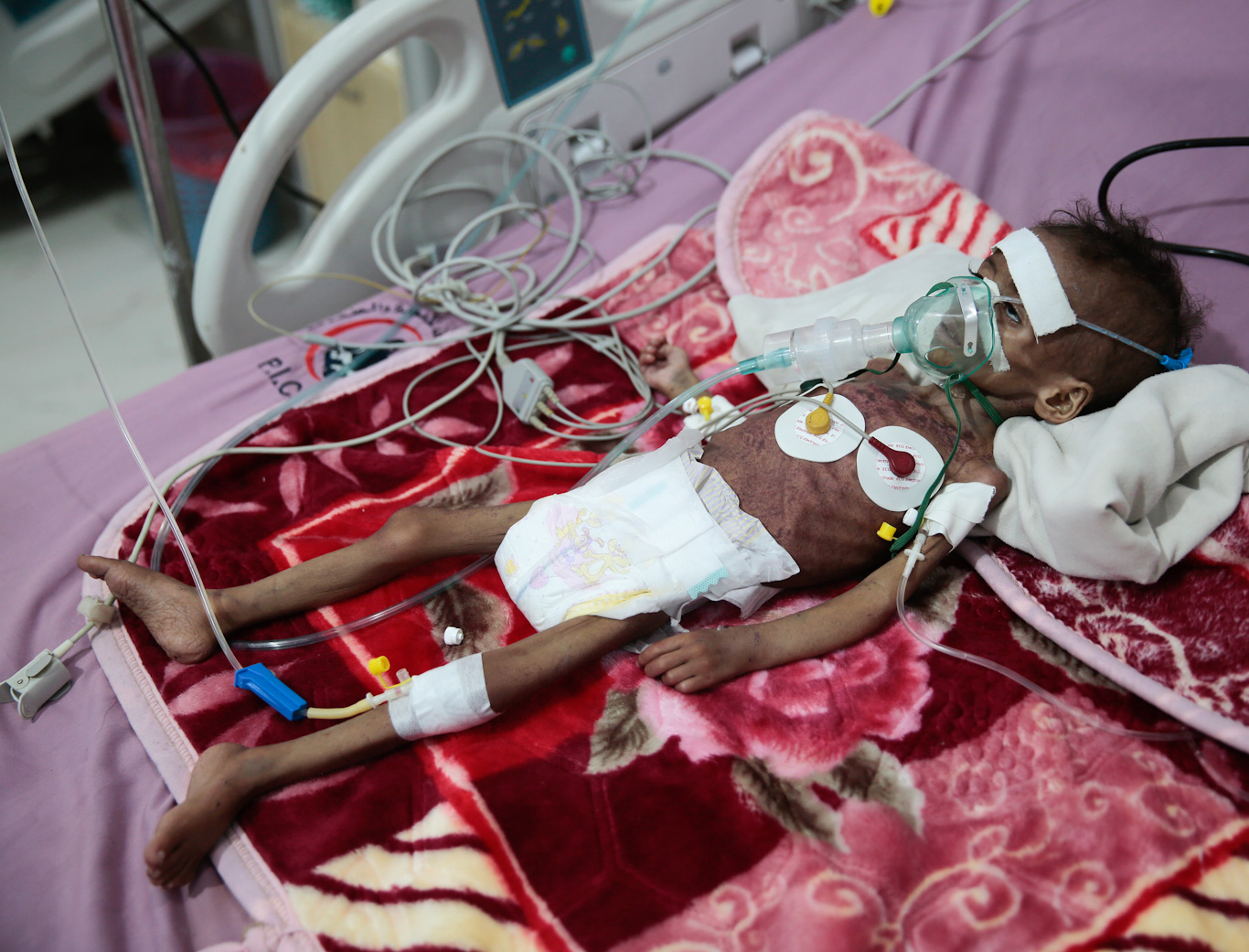
Yemen malnourished

A malnourished girl receives treatment at a feeding center at Al-Sabeen hospital in Sanaa, Yemen. Nov. 3, 2020. Hani Mohammed | AP

In addition to supplying the weapons, the U.S. (and many of its European allies) train Saudi forces, have provided critical military infrastructure and logistical support, and even refueled Saudi bombers in the air and provided targeting guidance to help Saudi forces find their marks more efficiently. On top of that, the U.S. has shielded Riyadh from international censure by defending it at bodies like the United Nations. In essence, the U.S. is involved in every area of the Yemen conflict, doing everything up to pulling the trigger itself.

“The U.S. must end its support for Saudi Arabia and the United Arab Emirates and instead prioritize the people across Yemen fighting to survive,” Scott Paul, Oxfam America’s Humanitarian Policy Lead told MintPress in a statement.

The U.S. has paused much of its aid to the most vulnerable Yemenis, while it continues to provide weapons that fuel the deadly conflict. Congress and the American people have made it clear that they do not want any part in this. We continue to call for the U.S., the international community and all parties to the conflict to push for peace, and we will hold the incoming Biden administration to its pledge to do its part.”

According to Oxfam, Saudi Arabia carries out the equivalent of “one air raid every 10 days affecting hospitals and water facilities in Yemen. 

The United States has a long history of mistreating Yemen. In 1990, the administration of George H.W. Bush wanted a unanimous United Nations agreement to rubber-stamp its attack on Iraq. Yemen, newly appointed to the Security Council, refused to go along with the resolution (as did Cuba). Just minutes after it voted against the U.S. plan, a senior American diplomat told the Yemeni representative, on a hot mic, “That was the most expensive ‘no’ vote you ever cast.” Within hours, all U.S. aid (a $70 million program) to the country was stopped. 800,000 Yemeni workers were expelled from Saudi Arabia, and the country had difficulties securing loans with international financial institutions. Thus, as Bennis said, “The U.S. refusal to take Yemen and Yemenis seriously goes back a very long way.”

Saudi Arabia has proven to be one of the United States’ most loyal allies in the region over the past 50 years — and its enforcer. In return for keeping the oil money flowing into the United States, Washington has been willing to defend the country’s abysmal human rights record, and even to overlook the assassination of journalists like the Washington Post’s Jamal Khashoggi. Andrew Feinstein, an arms industry expert and author of “The Shadow World: Inside the Global Arms Trade,” explained to MintPress that,

The U.S. has allied itself with Saudi Arabia, despite it being one of the world’s most corrupt countries and worst human rights abusers, at home and abroad, for two primary reasons: oil and the U.S. right’s desire for regime change in Iran. This is despite the reality that Saudi is the primary ideological supporter of, financier and, weaponizer of the most extreme Islamist groups.”

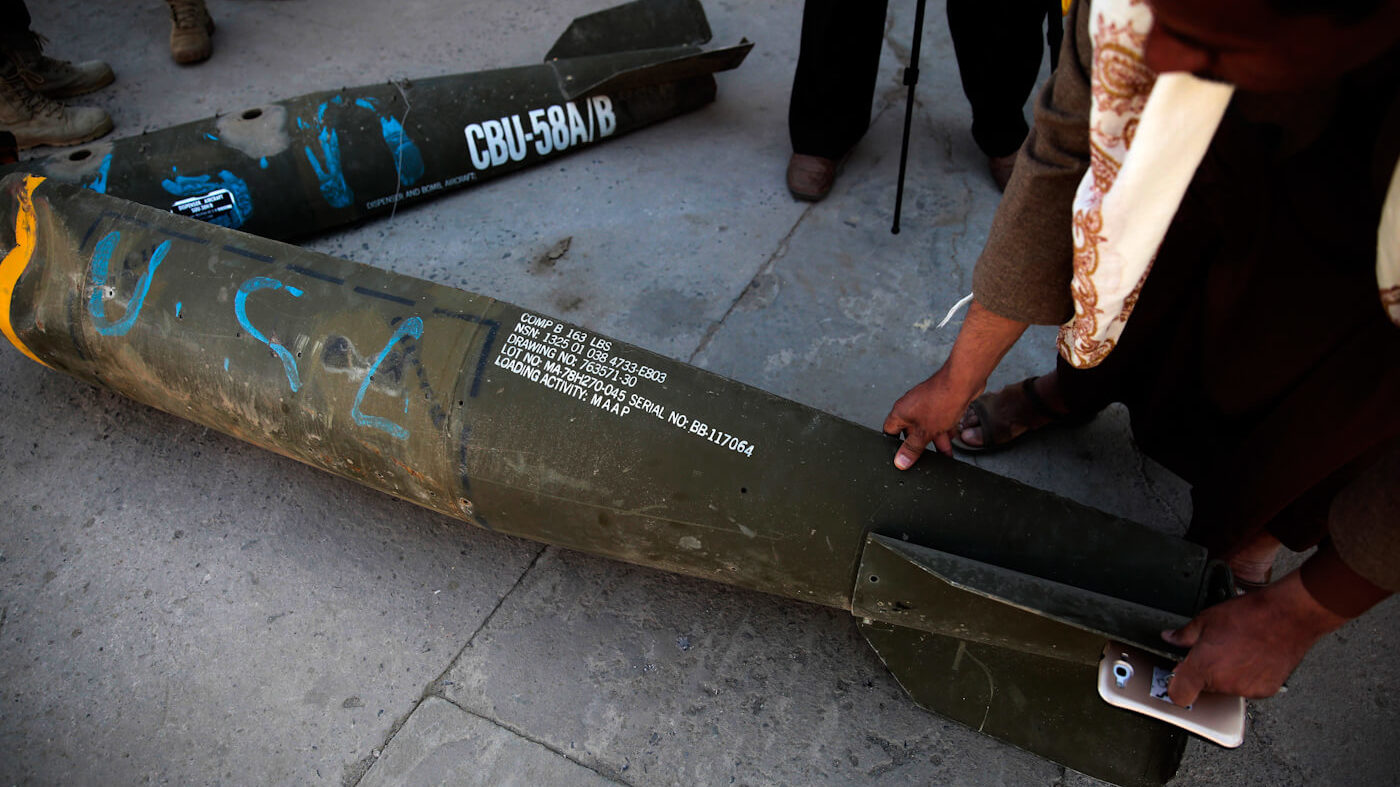
Saudi Arabia Yemen Cluster Bomb

A Houthi man inspects an unexploded US-made cluster bomb in Sanaa, Yemen, 2016. Hani Mohammed | AP

Under Trump, the United States has sharply increased its military support to Saudi Arabia, signing a number of weapons deals that put the lie to any idea that he was an anti-war president. Overall, SIPRI calculates that the U.S. accounted for 36% of global weapons sales between 2015 and 2019, a large increase over the previous five years. Saudi Arabia is by far America’s best customer, and America is the Kingdom’s most important supplier, accounting for three-quarters of all purchases. In 2019, this included 59,000 guided bombs, most of which were destined to be dropped on soft targets in Yemen. As Bennis noted, “The Saudis buy more arms from the U.S. than any other country in the world, so it is embedded in the very fabric of the military industrial complex here.” Furthermore, many of Washington’s other best customers are also Middle Eastern dictatorships also bombing Yemen.

Saudi Arabia will be hosting the G20 summit this weekend, a meeting of the 20 most powerful nations in the world. Remarkably, for a country where women cannot travel or get married without permission from a man, the Saudi government has chosen “female empowerment” as the theme of this year’s meeting. And while the G20 is being urged to hold Saudi Arabia accountable for its role in Yemen, that possibility seems doubtful, seeing as G20 arms exports to Riyadh are three times what they give to Yemen in aid.

Joe Biden has a real chance to add ending one of the twenty-first century’s most violent conflicts: the war in Yemen. 

With an impending change of administration in the White House, there is some talk that a Biden administration will reverse direction on Yemen. Bennis, however, was skeptical of how profound a change Biden will implement:

There may be a rather abrupt change. The question, for me, is how deep it will be. Biden has made a commitment on his statement of intention on foreign affairs to end U.S. involvement in the Saudi War on Yemen. How that gets defined is the question. There will be some symbolic moves very quickly after he is inaugurated, hopefully in the first days or weeks of the new administration. The big question is will he actually stop the massive arms sales of basics- the F-15s and F-16s, the bombers and bombs, the drones, the ammunition and equipment that is responsible for so much death and destruction in Yemen. Is he prepared to do that? I’m hopeful but not terribly optimistic.”

This is the view echoed by Yemenis on the ground who spoke to MintPress. Ibrahim Abdulkareem, who lost his infant child when a Saudi warplane dropped a U.S.-made bomb on his home in Sanaa in 2015, said that Biden’s statement of intention on foreign affairs was not good enough: ”I am not optimistic that Biden will stop supplying [Saudi leader Mohammed] Bin Salman with bombs like the ones that killed my daughter,” he stated. In international affairs, money talks. And the U.S. is making a lot of it from this war.

Feature photo | Graphic by Antonio Cabrera for MintPress News

Alan MacLeod is a Staff Writer for MintPress News. After completing his PhD in 2017 he published two books: Bad News From Venezuela: Twenty Years of Fake News and Misreporting and Propaganda in the Information Age: Still Manufacturing Consent. He has also contributed to Fairness and Accuracy in ReportingThe GuardianSalonThe GrayzoneJacobin MagazineCommon Dreams the American Herald Tribune and The Canary.

https://www.mintpressnews.com/how-much-us-arms-sales-saudi-arabia-fueling-violence-yemen/273181/


Israeli Publishers Have Been Writing About a COVID-Like Pandemic for Years


Predictive Programming? Israeli Publishers Have Been Writing About a COVID-Like Pandemic for Years

The general public’s willing acceptance of the draconian restrictions placed on mobility and freedom of assembly due to the coronavirus was “predicted” in fictional novels and other artistic creations over the last few decades. Is it a matter of life imitating art or something more sinister?

Life imitates art is a phrase we often hear when certain events are seemingly foretold in a painting, a song, or any number of the creative disciplines people engage in. Books, in particular, are a generous source of such lore. Sometimes, the separation between the work of art’s making and the foreshadowed event is eerily short, leading to speculation that more than simple creative genius was behind its production.

Drawing too close a link between an artist’s inspiration and a future event mirrored in their work is a risky proposition, but sometimes the events depicted on the page or the screen parallel real life so closely, that questions of predictive programming arise ­– a concept many in academia dismiss as the ravings of “conspiracy theorists” in a familiar pattern of discrediting narratives that challenge authority.

Alan Watt, the man credited with postulating the notion of predictive programming, describes it as “a subtle form of psychological conditioning provided by the media to acquaint the public with planned societal changes to be implemented by our leaders. If and when these changes are put through, the public will already be familiarized with them and will accept them as natural progressions, thus lessening possible public resistance and commotion.”

While scorned by sycophants of power and gatekeepers, predictive programming is not an especially farfetched idea. Anyone who has ever put together an advertising campaign knows that conditioning public opinion is the name of the game and after nearly one century of television and a world awash in screens that relentlessly try to influence consumer behavior, predictive programming is just a small step beyond that.


Netflix and Pill

Most people become uncomfortable with the thought of “planned societal changes” imposed from up on high by an earthly hierarchy of powerful overlords but have little resistance to ascribing such broad shifts in society to providential deities or invisible forces from another realm.

Our failure to recognize that we are the creators of our own societies has been fomented by consumer-driven capitalist enterprises controlled by a relative handful of plutocrats, who invest heavily in molding human imagination by supplanting authentic expressions of community and culture with their logos, taglines, and catchy jingles.

Of course, the mechanisms of social control have grown by leaps and bounds since the advent of the Internet and big data, which allows for unprecedented levels of societal targeting, down to its individual members. Never has this been more apparent than in the situation we all find ourselves at present during this curious pandemic crisis, where the synchronized actions on the part of organs of the establishment, such as government, the press, and academia, have imposed a standardized vision of reality and decreed rules for social interaction on a largely docile society, which accepted the draconian shift without much resistance at all.

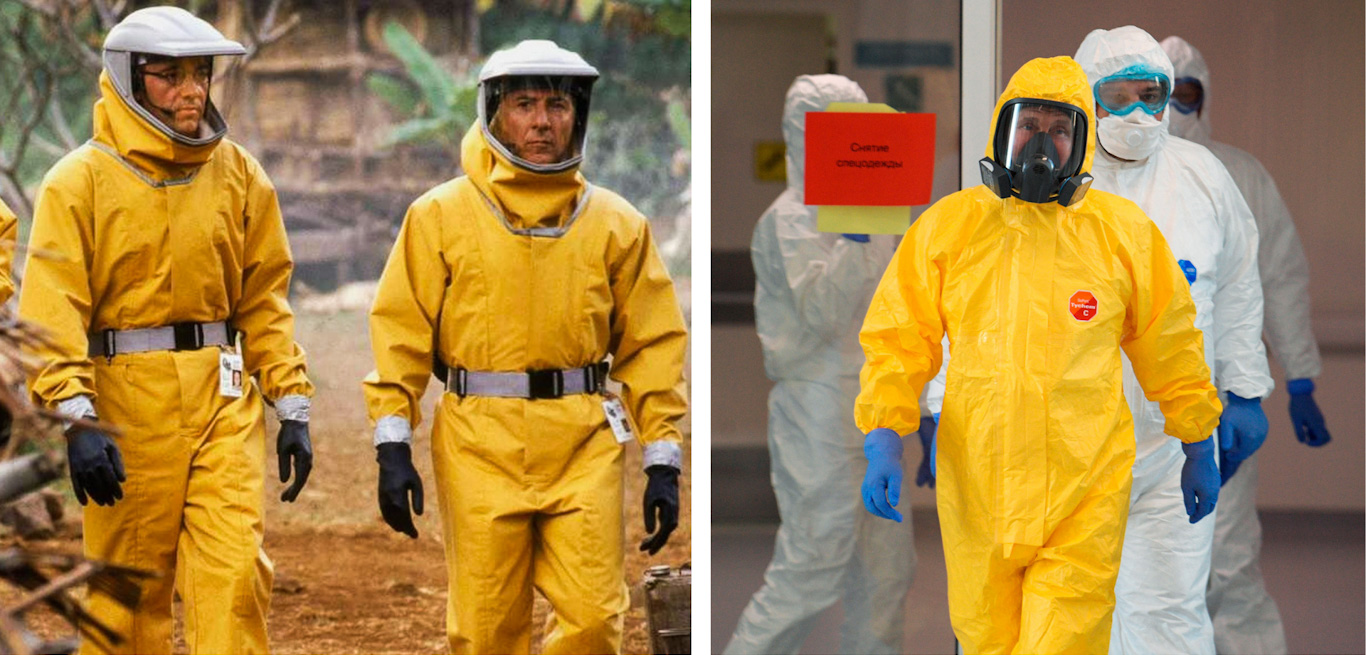
Many will recall the 1995 movie “Outbreak”, which marked the start of a slew of Hollywood and international productions of films with plotlines revolving around a killer virus. Most of these movies had large marketing budgets that ran intense advertising campaigns. The essence of movies like “Pandemic,” “Contagion,” “28 Days Later,” and dozens more in this genre, reached millions if not billions of people around the world through trailers and other means of dissemination.

Outbreak Putin Yellow Covid suit

Life imitating art? A still from the 1995 film “Outbreak,” left, and Vladimir Putin donning Hoffman-esque fashion

In 2019, a Netflix series called “Explained” aired “The Next Pandemic;” an episode in the documentary-style show that warns us about a looming pandemic featuring none other than Bill Gates as one of the “experts” walking viewers through the deliberately frightening setup, which begins with apocalyptic scenarios of humanity’s end and Gate’s opinion on which scenario is more likely.

Unsurprisingly, the former Microsoft CEO identifies zoonotic diseases as the main threat to the world. An astonishing prediction by a man with no real background in biology or science, whose words have nonetheless been anointed by corporate media as gospel. Almost every point highlighted in the episode mirrors our present reality and the narrative about its source.

Wet markets, shutdowns, and the role of technology are all predictively examined as real possibilities just as news of the novel coronavirus was about to explode on the world scene. An incredible coincidence, to say the least. Or, is there more to this story?

Are we witnessing life imitating art or is art being used to steer life in a particular direction, that certain interests want society to go in? A book published almost twenty-five years ago might hold the answer.


Fact or Fiction

The title of the book is “2020” and it was published in 1994 by an Israeli editorial house called Keter Press, which literally translates to “Crown” or “Corona” Press. An inauspicious start for those who dismiss any speculation into predictive programming as tin-foil hat material, but all this could simply be a coincidence at this point.

The novel was originally written as a film script in 1987 by an Israeli psychiatrist and daughter of one of the Jewish state’s most well-known playwrights. Hamutal Shabtai was only in her early twenties when she ostensibly wrote the story, which predicts the state of the world today as a result of the counter virus measures with uncanny accuracy and foretells of a society ravaged by a virus, which ushers in a “global health dictatorship”

The book was only published in Hebrew and never translated into English, but the 600-page tome details the burgeoning surveillance state that is currently being rolled out under the guise of Covid-19. The author describes a world where society is divided between an at-risk and healthy population, where the former are kept in quarantine.

Touching another person is fatal and everyone’s movements are closely monitored and all public spaces are equipped with “biometric doors,” that use a color-coded system very similar to that implemented in Amazon warehouses, that indicate who should be placed in isolation. The novel also mentions a worldwide “health treaty,” which will determine social mobility and human interaction laws for all countries.

Amazon has started testing on augmented reality social distancing technologies following demands for public safety amid COVID-19. 

Another Israeli author-produced another incredible feat of apparent clairvoyance in a book published only five years ago titled “Moratorium,” which describes a virus from bats that comes out of Asia and decimates humanity. Regardless of your thoughts on predictive programming, such pinpoint accuracy begs a deeper look.


A Strange History

Perhaps more interesting than the stunning details related in the novel “2020,” the history of the publishing house itself reveals some odd connections that are worth examining. Keter Press began as an Israeli-government program called The Israel Program for Scientific Translations in 1959 and was dedicated to translating and publishing scientific and technical manuscripts from Russian into English for the National Science Foundation in the United States, which is the technical counterpart of the National Institutes of Health.

In the 1960s, the Israeli-government-owned publisher branched out into English-speaking markets with two subsidiary companies until it was sold off in the latter half of the decade to an investment firm, which in turn sold it again to another investment firm that gave the publishing house its current name. Considered the “most prominent” publisher of contemporary Hebrew literature in Israel today, as well as encyclopedia Judaica, Keter Publishing Ltd. merged with the other largest publisher in Israel after it was acquired by Modan Publishing House in 2016.

In 1987, the same year 2020 was written as a movie script, Keter became a public company. Two years later British tycoon and spymaster Robert Maxwell – father of Ghislaine Maxwell ­– acquired control of the publishing house after Maxwell Communication Corporation bought Macmillian, which then owned Keter. The publishing house was passed on to an Israeli investment concern called Arledan after Maxwell’s death in 1991, which owned it until 2016.

Ari Ben-Menashe, a former Israeli military intelligence official, claims Jeffrey Epstein and Ghislaine Maxwell worked for Israeli intelligence 

Robert Maxwell’s links to Israeli intelligence has been well documented by Whitney Webb for MintPress News in her series on Jeffrey Epstein, who ran a sex-trafficking blackmail operation with his daughter, Ghislaine. Maxwell’s ties to a publishing company with such extensive ties to the Israeli government, which was providing what were most likely very sensitive materials from Russian scientists to the American NSF at the height of the Cold War, is enough to cast doubt on the true origins of the 2020 novel.


A Call To Art

The movie “They Live” is popularly seen as a film that ‘exposes’ our present reality through a fictional premise that is really nothing new. The struggle for power is as old as mankind and those who strive for it are constantly scheming to maintain their position over the rest of us. Insomuch as it projects a dystopian world under the oppressive thumb of a monstrous elite, “They Live” also falls under the definition of predictive programming despite the protagonist’s hero journey, so ubiquitous in American cinema.

As we stand on the precipice of a fate even worse than the skeletal cyborgs depicted in the movie, the rollout of massive surveillance technologies and a deputized scientific establishment who wish to confine us to a hospital bed in our own homes is a wake-up call to real artists and creators who have the courage and the vision to produce art that doesn’t so blatantly serve the agendas of power.

Feature photo | A technician mans a booth at a new coronavirus lab at Ben-Gurion International Airport, near Tel Aviv, Israel, Nov. 9, 2020. Ohad Zwigenberg Pool via AP

Raul Diego is a MintPress News Staff Writer, independent photojournalist, researcher, writer and documentary filmmaker.

https://www.mintpressnews.com/israel-keter-publishing-predictive-programming-covid-19/273208/


Chris Kijne en de Gesubsidieerde Onwetendheid 30

Nu het geloof in de eeuwige vooruitgang onvermijdelijk tegen zijn eigen grenzen is gestoten, rest de mensheid alleen het besef van het tragische, net als in de Griekse oudheid. Hierover zei de  joods Britse auteur John Berger op middelbare leeftijd:

I see art as a tragic phenomenon, a comment of an alternative reality, because the reality in which people live is so profoundly unsatisfactory, and at certain times intolerabel. The human situation is tragic, the result of self-consciousness. It is not tragedy itself which is intolerable, what is intolerable is that this tragedy is not given its due dignity.      


In zijn anno 1992 verschenen essaybundel Stemverheffing verklaarde de inmiddels bejaarde Berger dat de ‘veronderstellingen waarvan het mediabedrijf uitgaat namens het publiek zijn behalve blind ook verblindend.’ Vogens Berger was het misschien juist ‘op dit punt dat onze vorm van democratie een langzame dood sterft. Als dat zo is, dan als gevolg van een weigering. De weigering van het mediabedrijf om het feit te erkennen en te laten doorwerken dat het publiek in zijn hart weet hoe de wereld in elkaar zit,’ om hier onmiddellijk aan toe te voegen dat de ‘reden van deze weigering die een bedreiging is voor onze vorm van democratie, de reden waarom het mediabedrijf stelselmatig onderschat wat we gemeen hebben, die reden is steeds dezelfde: de normloze drang tot verkopen.’  Waar de in 2017 overleden Berger naar streefde was:


dat mensen zich ervan bewust worden hoe armoedig het mediabedrijf ze bedient als publiek. Armoedig, omdat met de waardigheid van kijker en bekekene de vloer wordt aangeveegd. Herstel iets van die waardigheid — gun mensen de tijd, verschuif het gebruikelijke zwaartepunt — en slecht nieuws wordt van een onderbreking de waarheid. Er zijn tal van waarheden waarvoor geen directe oplossing bestaat. Het woord ‘oplossing’ raakt niet aan het tragische. Wíj moeten in aanraking komen met het tragische en ons erdoor laten raken. We zouden er misschien door veranderen als we het benoemden. Ook benoemd blijft het tragische tragisch, maar slecht nieuws zou het niet worden. Alleen van daaruit is een realistische politiek mogelijk. 


Bijna tien jaar later schreef hij op 75-jarige leeftijd in The Guardian van 28 mei 2001, in een introductie van het werk van de Braziliaanse fotograaf Sebastião Salgado: 


In the 1940s the French philosopher Simone Weil wrote this —  a kind of summing up, I think, of what Salgado was saying: ‘There are only two services that images can offer the afflicted. One is to find the story that expresses the truth of their affliction. The second is to find the words that can give resonance, through the crust of external circumstances, to the cry that is always inaudible: “Why am I being hurt?”’


If we accept what is happening in pictures like these, we are face to face with the tragic. And what happens in face of the tragic is that people have to accept it and cry out against it, although it won't change anything. And they cry out, very frequently, to the sky. In many of his pictures the sky is very important. Spectators who have lost any sense of tragedy look at his skies and say, ‘Ha! What a beautiful set, what a well-chosen moment.’ But it isn't a question of aesthetics. The tragic sky is the only thing that can be appealed to in certain circumstances. Who listens to them in the sky? Perhaps God. Perhaps the dead. Perhaps even history.


Because the children in his pictures are looking at the camera, they know that they are looking at the world. And so they address a question to the world: What are you, you out there? Or: Is there anything else out there?


Following their questions, we could ask ourselves three things:


1. The priorities according to which we perceive and react to the world — can they be changed?

2. Those kids, the true specters of hope, looking at us from the five continents — whose hope do they embody?

3. Who needs who the most - they us or we them?

https://www.theguardian.com/culture/2001/may/28/artsfeatures.globalisation  


Het probleem waarmee Vooruitgangsgelovigen als Geert Mak worstelen, werd in 2005 helder verwoord door de van origine Tsjechische auteur Milan Kundera in zijn essay - And If the Tragic Has Deserted Us?


De grote menselijke conflicten bevrijden van de naïeve interpretatie als een strijd tussen goed en kwaad, ze begrijpen in het licht van het tragische, was een enorme prestatie van de geest; het bracht de onvermijdelijke relativiteit naar voren van menselijke waarheden; het maakte de noodaak duidelijk om rechtvaardig te zijn tegen de vijand. Maar het morele manicheïsme heeft een onvernietigbare vitaliteit.


In verband hiermee wees Kundera op het volgende:


Hitler dompelde Europa niet alleen onder in een onbeschrijflijke verschrikking maar beroofde het ook van het tragische levensgevoel. Net als de strijd tegen het nazisme, zou de hele hedendaagse politieke geschiedenis van toen af aan gezien en ervaren worden als een strijd tussen goed en kwaad.


Die ontwikkeling riep bij Kundera de onvermijdelijk de vraag op:


Is dit een regressie? Een terugval in de pré-tragische fase van de mensheid? Maar als dat zo is, wie heeft dan een terugval ondergaan? De Geschiedenis zelf, die onrechtmatig in bezit is genomen van criminelen? Of is het onze manier van begrijpen van de Geschiedenis? Vaak denk ik: het tragische heeft ons verlaten; en dat zou weleens de ware straf kunnen zijn.


Het tragische wereldbeeld van de klassieken betekent een frontale aanval op de hoogmoed van de totalitaire technocratie, waarin de wereld als gevolg van de Westerse globalisering is veranderd. Wijlen Theodore Roszak, een Amerikaanse historicus en hoogleraar, die ondermeer aan Stanford University doceerde, werkte dit feit uit in zijn wereldwijde bestseller Opkomst van een tegencultuur (1971). Hij wees erop dat in:


de technocratie niets meer klein of eenvoudig [is] of overzichtelijk voor de niet-technicus. In plaats daarvan gaat de omvang en de complexiteit van alle menselijke activiteiten — politiek, economische, cultureel — de competentie van de amateur-burger te boven en vergt onmiddellijk de aandacht van speciaal opgeleide deskundigen. Rond deze centrale kern van experts die zich bezighoudt met de grote publieke zaken van algemeen belang groeit een kring van subsidiaire experts die, gedijend op het algemene sociale aanzien van technische bekwaamheid in de technocratie, zich een invloedrijk gezag aanmatigen over de schijnbaar meest persoonlijke levensfacetten: seksueel gedrag, de opvoeding van kinderen, geestelijke gezondheid, recreatie, enzovoorts. In de technocratie streeft alles ernaar puur technisch te worden, het voorwerp van beroepsmatige aandacht. Daarom is de technocratie het bewind van deskundigen — of van degenen die de deskundigen in dienst kunnen nemen.

Het resultaat van de voortdurende technologische omwenteling is de neoliberale revolutie geweest, waardoor, zo schreef de Amerikaanse emeritus hoogleraar Politieke Economie en Filosofie, Alan Nasser, tussen:


1980 and 2016 the global 1 percent captured twice as much of the growth in income as the bottom 50 percent. What’s more, Credit Suisse reports that as of 2015 the richest global 1 percent had accumulated more wealth than the rest of the world put together. In the same year, a mere 62 individuals had accumulated as much wealth as is held by the bottom 50 percent of humanity…


There is decisive evidence that neoliberalism’s widening inequality tends to generate uncommon rates of physical and mental health disorders. A Princeton study found that middle-aged non-Hispanic white Americans suffered a great increase in mortality between 1998 and 2013. This was the first such case in American history. The increase is entirely concentrated among persons with a high school degree or less, a reliable criterion of poverty. Among whites with any college experience, mortality rates have declined during this period. And disease is not the issue. The predominant causes of death are suicide, chronic alcohol abuse and drug overdoses. Paul Krugman has noted that these statistics mirror ‘the collapse in Russian life expectancy after the fall of communism.’ The Princeton study labels these mortalities ‘deaths of despair.’ It is noteworthy that among the population in question, wages have fallen by over 30 percent since 1969. In a detailed study of the health effects of austerity, based on data from the Great Depression, Asian countries during the 1990s Asian Financial Crisis, and European countries suffering austerity policies after the 2008 crisis, researchers found that the more austerity was practiced in a country, the more people became ill and the more people died.

https://www.counterpunch.org/2017/12/22/how-inequality-kills/    


Het is onvermijdelijk dat de technocratie het individu zijn menselijke waardigheid ontneemt,  omdat de technische ‘apparatuur zelf de gebruikers ervan conditioneren elkaar op dezelfde manier te gebruiken als machines gebruikt worden,’ aldus de Amerikaanse sciencefiction-auteur Frank Herbert in  zijn roman Dune (1963), het best verkochte sciencefiction-boek ooit. Bovendien duldt techniek geen tegenspraak. Op zijn beurt stelde de Duitse filosoof Martin Heidegger in de jaren vijftig van de twintigste eeuw dat:


de mens steeds meer, op alle gebieden van het bestaan, door de krachten van technische apparatuur en automaten wordt  ingesloten. De machten die de mens overal en op ieder ogenblik, onder één of andere vorm van technische installatie opeisen, vasthouden, meesleuren en in het nauw brengen — die machten zijn reeds lang menselijke wil en beslissingskracht over het hoofd gegroeid, want zij zijn niet door de mens gemaakt.


Heidegger realiseerde zich dat alleen door gebruik te maken van de techniek nieuwe techniek kan worden ontwikkeld. Zelfs de elite van managers en technologen hebben geen greep meer op datgene wat wordt ontworpen. Een voor de hand liggend voorbeeld is elke nieuwe generatie computers, die alleen door een voorafgaande generatie computers kan worden ontworpen. De van origine Nederlandse econoom, professor Mark Blaug, stelde in 1998 dat ‘We have created a monster that is very difficult to stop,’ door onze obsessie voor techniek ‘over substance.’ Onze machteloosheid blijkt eveneens uit het feit dat ‘it is easier to imagine a total catastrophe which ends all life on Earth than it is to imagine a real change in capitalist relations,’ aldus de auteurs van Meme Wars. The Creative Destruction of Neoclassical Economics (2012). Al zes decennia geleden constateerde eveneens Heidegger dat:


[g]een enkel individu, geen enkele groep mensen, geen enkele commissie van nog zo vooraanstaande staatslieden, onderzoekers en technici, geen enkele conferentie van leidinggevende personen uit het bedrijfsleven en de industrie vermag het historisch verloop van het atoomtijdperk te remmen of in een bepaalde richting te leiden. Geen enkele louter menselijke organisatie is in staat, de heerschappij over dit tijdperk te verwerven.


In 1969 schreef de voor de nazi’s gevluchte joods-Duitse politieke theoretica Hannah Arendt:


The technical development of the implements of violence has now reached the point where no political goal could conceivably correspond to their destructive potential or justify their actual use in armed conflict. Hence, warfare — from time immemorial the final merciless arbiter in international disputes — has lost much of its effectiveness and nearly all its glamour. The ‘apocalyptic’ chess game between the superpowers, that is, between those that move on the highest plane of our civilization, is being played according to the rule ‘if either “wins” it is the end of both’; it is a game that bears no resemblance to whatever war games preceded it. Its ‘rational’ goal is deterrence, not victory, and the arms race, no longer a preparation for war, can now be justified only on the grounds that more and more deterrence is the best guarantee of peace. To the question how shall we ever extricate (bevrijden uit. svh) ourselves from the obvious insanity of this position, there is no answer. 


In zijn boek Non Violence. The History of A Dangerous Idea (2008) maakt de Amerikaanse auteur en journalist, Mark Kurlansky, zijn lezers erop attent dat:


Since the close of the twentieth century it has become common place to refer to it as the most catastrophically bloody century in history. Lenin, who saw war as ‘an inevitable stage of capitalism,’ had predicted this at the century’s beginning. By the end of the century, an estimated 187 million people had died in war, the equivalent of 10 percent of the planet’s population at the outbreak of World War I. That made it a record century, but also a far higher percentage of war fatalities were civilian than in any previous century. In World War I, one-fifth of casualties were civilian, but in world War II it went up to two-thirds. In twenty-first-century warfare, such as in Iraq, the casualties may be as high as 90 percent civilian. 


Toch is het een feit dat, aldus Kurlansky:


[n]uclear weapons did not end warfare, because that would have required political leaders to completely rethink their concept of power. As the Hungarian writer György Konrád pointed out, the political elite had no alternative concept. ‘They have none because they are professionals of power. Why should they choose values that are in direct opposition to physical force?’ 


Precies zoals Hannah Arendt meer dan een halve eeuw geleden schreef op ‘de vraag hoe wij ons ooit zullen bevrijden uit de evidente krankzinnigheid’ van de wederzijdse verzekerde vernietiging er domweg ‘geen antwoord bestaat.’ En dus leeft de mens in een werkelijkheid waarbij geldt dat ‘als één van beide “wint” dit het einde van beide betekent.’ Desondanks is een wedergeboren christen als Geert Mak bereid om dit ‘spel’ te spelen door deel te nemen aan de huidige collectieve pershetze tegen Rusland. Wij hebben hier inderdaad te maken met een ‘evidente krankzinnigheid’van propagandisten, in dienst van het neoliberale bestel, die zich niets aantrekken van de mogelijke consequenties van hun niet aflatende haatcampagne. De Makkianen zijn al in het interbellum schitterend voorspeld als slotakkoord van de Westerse beschaving door auteurs als de Oostenrijkse auteur Robert Musil in zijn trilogie Der Mann ohne Eigenschaften, en Hermann Broch in zijn trilogie Die Schlafwandler, waarin deze Oostenrijkse auteur en essayist de mogelijkheden schetst van de moderne mens in een massamaatschappij. Naar aanleiding van de protagonist in het eerste deel van De Slaapwandelaars, de jonge aristocraat en legerofficier Joachim Pasenow, schreef de van origina Tsjechische auteur Milan Kundera dat:


Naarmate de magische invloed van de Kerk afstompte, verving het uniform het priesterlijke gewaad en verhief het zich tot het niveau van de totale autoriteit. 


Het uniform kiezen we niet zelf, het wordt ons verleend; de zekerheid van het universele tegenover de onbestendigheid van het individuele,


alsof dat uniform: 


hem zou kunnen beschermen tegen de kou van de toekomst waarin hij niets meer te respecteren zou hebben.


Over de tweede mogelijkheid, August Esch, de hoofdrolspeler van het tweede deel, schrijft Kundera dat deze rusteloze boekhouder ‘het fanatisme van het goddeloze tijdperk’ belichaamt:


Aangezien alle waarden versluierd zijn, kan alles als waarde beschouwd worden. De gerechtigheid, de orde, zoekt hij dan weer eens in de vakbondsstrijd, dan weer in de religie, vandaag in de politiemacht, morgen in het droombeeld van Amerika, wanneer hij droomt te emigreren. Hij zou een terrorist kunnen zijn, maar ook een berouwvol terrorist, die zijn maskeraden verraadt, een strijder voor een partij, lid van een sekte, maar ook een kamikaze die zijn leven wil opofferen. Alle hartstochten die de bloedige Geschiedenis van onze eeuw teisteren, worden in zijn bescheiden avontuur begrepen, ontmaskerd, geanalyseerd en in een vreselijk daglicht gesteld. 


Voor Esch ‘is de wereld verdeeld in het rijk van het Goede en het rijk van het Kwade, maar het Goede en het Kwade zijn beide helaas even onidentificeerbaar.’


De protagonist van het derde deel, de ‘con man’ en deserteur Wilhelm Huguenau, typeert de ‘onschuldige streber,’ die zich in ‘de wereld zonder gemeenschappelijke waarden,’ volgens Kundera, ‘buitengewoon op zijn gemak voelt.’ Immers:


De afwezigheid van morele geboden betekent zijn vrijheid, zijn bevrijding. 


Er schuilt een diepe betekenis in het feit dat hij, zonder overigens enig schuldgevoel, Esch vermoordt. Want ‘de mens die behoort tot een geringer stelsel van waarden vernietigt altijd de mens die behoort tot een uitgebreid maar in verval verkerend waardestelsel, de grootste ellendeling neemt altijd de rol van beul op zich in het proces van waarden-devaluering en, op de dag dat de klaroenen van het Laatste Oordeel weerklinken, zal het de van alle waarden vrijgemaakte mens zijn die de beul wordt voor een wereld die zichzelf veroordeeld heeft.’ De modere Tijd is in de geest van Broch de brug tussen de heerschappij van het irrationele geloof en de heerschappij van het irrationele in een wereld zonder geloof. De mens wiens gedaante zich aan het einde van die brug aftekent, is Huguenau. Gelukkige, niet te beschuldigen moordenaar. Het einde van de Moderne Tijd in zijn euforische versie.


Kundera wijst erop dat Pasenow, Esch, Huguenau drie ‘fundamentele mogelijkheden,’ drie ‘oriëntatiepunten zijn zonder welke het mij onmogelijk lijkt de existentiële landkaart van onze tijd te tekenen.’ Dit wil niet zeggen dat ieder mens slechts één van deze drie‘fundamentele mogelijkheden’ c.q. ‘oriëntatiepunten’ vertegenwoordigt, want de mens kan in zijn leven al deze manifestaties doorlopen of zelfs tegelijk vertonen. Zo weet ik uit decennialange ervaringen met Geert Mak dat hij allerlei aspecten van August Esch in zich draagt, zoals zijn manicheïsme, waarbij ’de wereld is verdeeld in het rijk van het Goede en het rijk van het Kwade,’ terwijl zowel ‘het Goede’ als ‘het Kwade’ bij hem inderdaad altijd ‘onidentificeerbaar’ blijven. Wanneer hij beweert dat de VS ‘decennialang als ordebewaker en politieagent’ fungeerde dan is duidelijk dat hij — net als Hubert Smeets, Chris Kijne, Ian Buruma, Bas Heijne, en Hubert Smeets — Washington en Wall Street tot ‘het rijk van het Goede’ rekent, waarbij ‘het Goede’ niet ‘identificeerbaar is.’ Een imperialistische mogendheid die voortkwam uit de genocide van talloze Indiaanse volkeren en ontelbare miljoenen burgers elders heeft vermoord, onderdrukt, uitgebuit, en dit nog steeds doet, waardoor het 93 procent van zijn bestaan sinds 1776 in oorlog is, kan onmogelijk worden geïdentificeerd als ‘het Goede.’ En aangezien in Mak’s teksten alle waarden ‘versluierd zijn, kan’ ook bij hem van ‘alles als waarde beschouwd worden.’ De ene keer is het de ‘gerechtigheid,’ de volgende keer de sociaal-democratische‘orde,’ vervolgens zoekte hij zijn waardevrije waarden ‘in de religie,’ terwijl hij ‘morgen’ zijn waarden vindt ‘in het droombeeld van Amerika,’ waarvoor hij een ‘geheime liefde’ zegt te koesteren. 


Mak kan binnen enkele dagen een geheel nieuw masker opzetten. Hij vertoont zelfs aspecten van de ‘con man’ Wilhelm Huguenau, die in ‘de wereld zonder gemeenschappelijke waarden,’ de rol van de ‘onschuldige streber’ speelt, en zich daarin dermate ‘op zijn gemak voelt,’ dat mijn oude vriend van de ene op de andere dag van mening kan veranderen, zoals ik herhaaldelijk gedocumenteerd heb beschreven. Mak’s ‘vriendelijke, vaderlijke God,’ waarin hij zegt te geloven, is kitsch, het product van een niet doorleefde werkelijkheid, de projectie van een genotzuchtige babyboomer die nog steeds meent overal recht op te hebben. Hoe kan een populaire opiniemaker die niet alleen claimt te geloven in een 'genadige' en ‘milde, liefdevolle God,’ maar ook meent dat hijzelf ‘die genade overbrengt op’ zijn ‘medemensen,’ omdat hij er diep van doordrongen zou zijn ‘deel’ uit te maken ‘van een gemeenschap die de hele wereld omvat,’ toch tegelijkertijd oproepen om ‘meer aan defensie uit te geven’? Hier speelt Geert Mak de rol van de jonge aristocraat en legerofficier Joachim Pasenow, die het gewaad van een geestelijke verving door het ‘uniform’ en dat ‘verhief tot het niveau van de totale autoriteit.’ Van mij mag mijn oude vriend beweren dat ‘er lijnen lopen tussen’hem en ‘andere mensen’ en ook nog eens ‘tussen’ hem en zijn ‘God’ maar waarom voert hij, gezien al die ‘lijnen,’ een doortrapte hetze tegen ‘de Russen’? Waar is ineens de ‘liefdevolle genade’ gebleven? Die genade kunnen we immers niet verwachten ‘op de dag dat de klaroenen van het Laatste Oordeel weerklinken,’ en ‘de van alle waarden vrijgemaakte mens' de 'beul wordt voor een wereld die zichzelf veroordeeld heeft.’ Of vergeeft Mak’s God, die ‘milde man,’ alleen de bejaarde Geert Mak's ‘zwakheid’? Ik vermoed dat hier sprake is van hetzelfde verraad als die van zijn vader, dominee Catrinus Mak, toen deze godsvruchtige zielenherder drie jaar na het aan de macht komen van Hitler het 'Joodse volk' verraadde door publiekelijk akkoord te gaan met het verbannen van joodse Duitsers uit het openbare leven. 


Net als de hoofdpersoon in Der Mann Ohne Eigenschaften is Geert Mak, gelijk veel andere vrome christenen, 'een willekeurig personage in een willekeurige werkelijkheid,’ een man zonder eigenschappen, die net als een kameleon op momenten van stress, of bedreigingen vanuit de omgeving, van kleur verandert. Want al Mak’s maskers zijn camouflage van een intens onzeker mens, die zich overschreeuwt, en als narcist niet kan stoppen met aandacht trekken. 


Zoals hij tijdens zijn adolescentie van het christendom afdreef, zo verloor hij geleidelijk aan zijn geloof in de sociaal-democratische heilsleer van de jaren zeventig, en deinde hij in de jaren negentig met de neoliberale stroom mee die ‘moderne en open verhoudingen tussen mannen en vrouwen, chefs en ondergeschikten’ creëert, aldus liet hij zijn protagonisten in de bestseller In Europa (2004)verklaren. Maar in werkelijkheid gebeurde er iets heel anders in de landen achter de Muur. Alleen een groot schrijver als de joods-Hongaarse auteur Imre Kertész was in staat die gecompliceerde realiteit te beschrijven. Na drie totalitaire systemen aan den lijve te hebben meegemaakt: het nationaal socialisme, het communisme en tenslotte het neoliberale kapitalisme, schreef deze Nobelprijswinnaar Literatuur (2002) in De Verbannen Taal uit 2004 over de ontheemde intellectueel en de mainstream-opiniemaker met een ideologische kijk op alles:


Als hij zich maar ergens aan vast kan klampen, zodat hij zijn eenzaamheid en sterfelijkheid kan vergeten. Voor dit doel biedt de ideologie hem een complete wereld, 


en wie zijn ideologische ‘hoop’ laat varen, stapt: 


uit deze wereld, verliest zijn thuis. Hij verliest zijn schuilplaats, zijn bedreigde geborgenheid, zijn met prikkeldraad omgeven zekerheid.


Aldus functioneert voor de opiniemakers van de massamedia ‘collaboratie als nationale bestaansvorm,’ als overlevingsstrategie ten koste van de waarheid en daarmee de samenleving. Opnieuw Kertész: 


Wat moeten we nu geloven? Wat is de werkelijkheid, en waar moeten we ons aan houden? 'Ach, wat hebben wij gemaakt van het woord! In sommige monden voldoet het niet eens meer voor leugens, het is dieper gezonken dan dat, het is weggezakt in betekenisloosheid,' schrijft Denis de Rougemont in zijn boek La part du diable (dit boek van de Zwitserse denker verscheen in 1946. svh). Maar het ressentiment, die troebele drab van driften die onder de woorden borrelt, is echt. Het wordt enerzijds gevoed door angst en bestaansonzekerheid: veel intellectuelen, die hier jaren- en decennialang op hun eigen manier om de vrijheid hebben gevochten (of om datgene wat ze voor vrijheid aanzagen), merkten plotseling dat de grond onder hun voeten werd weggetrokken. In werkelijkheid stortte slechts het waardensysteem in waarin zij een vaste plek hadden. De snelheid waarmee dat gebeurde leek op een vrij val en dat schokte hen. Tegen de tijd dat ze bijkwamen van de dreun van die val en uit de stofwolken van de puinhopen te voorschijn kwamen, sprak de wereld om hen heen inmiddels de taal van beurzen, banken en mafia’s.


Zes jaar vóór het einde van de meest bloedige eeuw in de geschiedenis van de mensheid — in de tijd dat voor Geert Mak  ‘het optimisme hoogtij vierde’ — zei Imre Kertész het volgende tijdens een toespraak, getiteld ‘De ongelukkige twintigste eeuw’:


Het is een feit dat in deze eeuw alles ontmaskerd is: alles heeft minstens éénmaal zijn ware gezicht laten zien, alles is echter geworden. De militair werd tot beroepsmoordenaar, de politiek tot misdaad, het kapitaal tot mensenvernietigingsindustrie compleet met lijkverbrandingsovens, de wet tot spelregels van het vuile spel, de wereldvrijheid tot gevangenis van de volkeren, het antisemitisme tot Auschwitz, het nationale gevoel tot genocide. Overal schijnt de ware intentie doorheen, alle idealen van onze eeuw zijn doordrenkt van geweld en destructiviteit. Misschien is de situatie zoals de grootste kenner van de ziel van de tijd, Franz Kafka, het verwoordde: ‘Het negatieve te doen is nog onze taak; het positieve is ons al gegeven.’


Na de heerschappij van achtereenvolgens fascisten, communisten en tenslotte de neoliberale kapitalisten te hebben ervaren, constateerde hij op zijn oude dag in De verbannen taal:


Het is in ieder geval een twintigste-eeuws verschijnsel dat politiek en cultuur niet alleen elkaars tegenpolen zijn geworden, maar ook elkaars vijanden. Dit is geen natuurlijke ontwikkeling, en de politiek die losgekomen is van de cultuur en die door haar macht een onbegrensde en gewetenloze alleenheerschappij verwerft, zorgt voor enorme verwoestingen  — zo niet in mensenlevens en materieel goed, dan toch in de psyche van de mensen. Het instrument van de verwoesting heet ideologie. In de twintigste eeuw, dit verschrikkelijke tijdperk van verlies van waarden, werden alle waarden tot ideologie. En het ergste is dat de moderne massa, die nooit deel heeft gehad aan cultuur, deze ideologieën als cultuur in zich heeft opgenomen.


Maar pas de Corona-lockdown doet Geert Mak beseffen dat hij en zijn publiek ‘met open mond [staan] te kijken naar die abrupte stilstand in de wereld, beklemd en vooral verbijsterd,’ aangezien zijn ‘favoriete columnist,’ Maxim Februari van NRC Handelsblad, hem had geopenbaard dat de ’toekomst niet te voorspellen’ is, en ‘van het weinige wat wel valt te voorspellen wil je de helft niet weten.’ Mak kent zichzelf zo slecht dat hij niet eens beseft dat dit altijd het geval is geweest, en juist hij een schoolvoorbeeld is van het niet willen weten. Sterker nog: het is kenmerkend voor alle Makkianen om ‘de helft’ van de werkelijkheid absoluut ‘niet' te willen 'weten.’ En daar staan ze nu, de propagandisten van de ‘urban elites,’ met lege handen. Met een mond vol tanden en een minimum aan kennis zien deze goed betaalde praatjesmakers nu ‘een gitzwarte horizon,’ die ‘iedere dag dichterbij [komt].’ Jarenlang hebben zij zichzelf en hun publiek in slaap gesust met simplistische politieke opinies. Maar de crisis waarin het Westen al sinds de opkomst van de massamaatschappij steeds verder werd ondergedompeld, is niet in de eerste plaats politiek, maar cultureel. De burger kan politici en opiniemakers niets verwijten, want die heeft deze dwazen zelf ‘gekozen,’ of op zijn minst geaccepteerd. De elite en haar pleitbezorgers in de politiek en de pers weerspiegelen de diepe culturele crisis waarin het Westen is beland. Het is daarom de hoogste tijd dat het publiek zich afwendt van al deze parasieten. Zij hebben de mensheid niets te bieden. 


John Berger: 'The human situation is tragic, the result of self-consciousness. It is not tragedy itself which is intolerable, what is intolerable is that this tragedy is not given its due dignity.'  


Professor Marandi RIPS into Epstein lawyer, Dershowitz with precision

https://x.com/DD_Geopolitics/status/2083669958685254033 Professor Marandi RIPS into Epstein lawyer, Dershowitz with precision. 11:43 p.m. · ...