Zoeken in deze blog 🔎🔎

zaterdag 22 april 2017

Marx, Orwell and State-Cartel Socialism

Marx, Orwell and State-Cartel Socialism

OK, so our collective eyes start glazing over when we see Marx and Orwell in the subject line, but refill your beverage and stay with me on this. We’re going to explore the premise that what’s called “socialism”–yes, Scandinavian-style socialism and its variants–is really nothing more than finance-capital state-cartel elitism that has done a better job of co-opting its debt-serfs than its state-cartel “capitalist” cronies.
We have to start with the question “what is socialism”? The standard definition is: a political and economic theory of social organization that advocates that the means of production, distribution, and exchange should be owned or regulated by the community as a whole.
In practice, the community as a whole is the state. Either the state owns a controlling interest in the enterprise, or it controls the surplus (profits), labor rules, etc. via taxation and regulation.
The problem with equating the community with the state is the community is a completely different order from the centralized state, which is operated and controlled by a self-serving clerisy class that institutionalizes benefiting the few at the expense of the many.
The more accurate definition of socialism is: the means of production are owned and controlled by those who produce the goods and services.
Marx wrote a great many things in his career, and those who view his writings as scripture will argue endlessly over various interpretations and passages, much like people argue over the Bible.
In my view, Marx was a political-economy philosopher, not a demi-god, and so he retained the right to be completely wrong about some things, to contradict himself, to have missed important second-order effects, to have gotten some things half-right, etc., and most importantly, not to have been clairvoyant about the trajectory of history and capitalism, which he correctly identified as disruptively dynamic, i.e. everything solid melts into air.
One of the things Marx got right was the alienation of the producer/ worker from the output of his/her labor. The alienation is not just a loss of ownership; it’s also a loss of agency and a psychological alienation from the entire mode of production.
The workers’ alienation from the output of their labor doesn’t vanish just because the state owns the means of production; rather, the “capitalist” elite is replaced by a political elite and a state-clerisy managerial class.
“Socialism” is simply another flavor of state-cartel capitalism; Orwell would be proud of all the simulacrum self-serving “socialists” who have managed to enrich themselves at the expense of those actually producing goods and services.
Calling state-cartel finance-capitalism “socialism” doesn’t make it socialist.Orwellian double-speak doesn’t change the neofeudal nature of debt-based state-cartel finance-capitalism.
Let’s boil it down to its essence: if the producers don’t directly own/control the output of their labor, it’s capitalism, not socialism. State ownership/ control is nothing but the state-cartel coin turned over.
The only truly socialist system would be comprised of worker-owned collectives and co-ops, and privately owned and operated small enterprises.
In a truly socialist system, global corporations would pay such high entry fees and taxes that they could not compete on price against local worker-owned collectives/ co-ops.
In a truly socialist system, state functionaries would be banned from accepting bribes, campaign contributions, seats on philantro-capitalist foundations, corporations, etc., and barred from taking jobs in corporations after leaving state employment.
In state-cartel economies, “socialist” or otherwise, the system optimizes corporate profits, influence and agency. In a truly socialist system, worker-owned collectives/ co-ops and small business are optimized and corporations are de-optimized.
The only way state-cartel “socialist” economies can prop up their vast spending is by inflating even vaster debt and housing bubbles via financialization— the exact same mechanism used in so-called “capitalist” economies to benefit the few at the expense of the many.
So-called “socialist” nations from China to Scandinavia are inflating monumental bubbles of debt to keep their delusions of sustainability aloft. I have covered China’s unprecedented expansion of debt many times; Acting Man does an admirable job of covering Scandinavian Bubbles in Overdrive.
Worker-owned and controlled enterprises don’t need to inflate-monopoly-capital financialization bubbles to stay afloat. Only state-cartel elite-run systems need to exploit financialization to keep from imploding.
Danish household debt to GDP is among the highest in the world: what’s “socialist” about debt bubbles?
“Socialist” countries like Denmark are practicing extreme financial repression: what is “socialist” about negative interest rates?
Why does “socialist” Sweden need to inflate one of the world’s most precarious housing bubbles? If “socialism” requires extremes of financialization to stay afloat– sorry folks, it isn’t socialism.
Here’s Norway’s M2 money supply. What’s remotely “socialist” about this staggering increase in elite-controlled money supply?
Last but not least, here’s SOE (state-owned enterprises) “socialist” China’s debt to GDP ratio.
As Marx anticipated, finance-capital would come to dominate industrial capital and the state. What we see in these charts is finance-capital running to extremes to keep the state-cartel version of capitalism from imploding.
When “socialist” states have to impose finance-capital extremes that even exceed the financialization of nominally capitalist economies, it gives the lie to their claims of “socialism.” The simulacrum “socialist” economies will implode with even greater force than the nominally capitalist economies, as a result of the same dynamic: state-cartel financialization is intrinsically unstable and unsustainable.

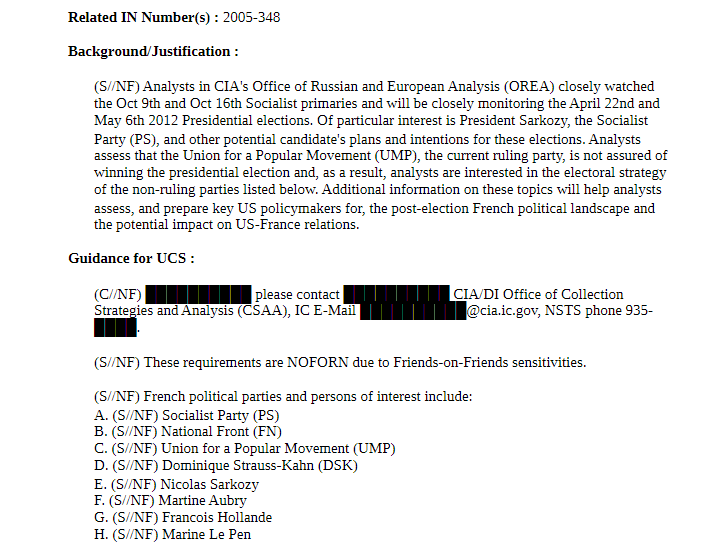
La lettre de mission de la CIA pour l’Ă©lection prĂ©sidentielle française de 2012

Source : WikiLeaks, le 16 fĂ©vrier 2017.
Des services d’espionnage humain (HUMINT) et numĂ©rique (SIGINT) de la CIA ont tentĂ© d’infiltrer tous les grands partis politiques français dans les sept mois prĂ©cĂ©dant l’Ă©lection prĂ©sidentielle de 2012. Ces rĂ©vĂ©lations sont contenues dans trois ordres de mission publiĂ©s aujourd’hui par Wikileaks comme contexte aux prochaines sĂ©ries « Vault 7 » de la CIA. Sont nommĂ©ment ciblĂ©s le PS, le FN, l’UMP, François Hollande, Nicolas Sarkozy, Marine Le Pen, Martine Aubry et Dominique Strauss-Kahn.
La CIA pensait que l’UMP n’Ă©tait pas assurĂ©e de la réélection de Nicolas Sarkozy. Des demandes spĂ©cifiques ont Ă©tĂ© faites au sujet de son parti, dont : l’obtention des “Plans stratĂ©giques de l’Ă©lection” de l’UMP, les alliances et les ruptures en cours dans l’Ă©quipe dirigeante de l’UMP, les rĂ©actions de membres de l’UMP aux stratĂ©gies de campagne de Nicolas Sarkozy, les discussions au sein de l’UMP au sujet de toutes les “ce qui Ă©tait perçu comme une possibilitĂ© de perdre le pouvoir” après l’Ă©lection, les tentatives de changement de la mission idĂ©ologique du parti et enfin les discussions Ă  propos du soutien de Sarkozy Ă  l’UMP et Ă  “l’importance qu’il accorde au maintien de la domination du parti”. Des instructions spĂ©cifiques chargeaient les officiers de la CIA de dĂ©couvrir dans des discussions privĂ©es de Sarkozy ce qu’il pensait “des autres candidats” ainsi que la manière dont il interagissait avec ses conseillers. Le fait que Sarkozy se soit lui-mĂŞme nommĂ© “Sarkozy l’amĂ©ricain ne l’a pas protĂ©gĂ© de l’espionnage amĂ©ricain durant les Ă©lections de 2012 ou sa prĂ©sidence.
L’ordre de mission “Plan stratĂ©gique Ă©lectoral des candidats et des partis politiques de l’opposition” qui a ciblĂ© François Hollande, Marine Le Pen et d’autres membres de l’opposition nĂ©cessitait d’obtenir les stratĂ©gies Ă©lectorales des partis d’opposition, d’obtenir des informations sur les dynamiques internes du parti et sur ses leaders en devenir, des efforts pour influencer et mettre en Ĺ“uvre des dĂ©cisions politiques, l’aide de hauts fonctionnaires, de figures du gouvernement ou d’hommes d’affaires, des vues sur les États-Unis, des efforts pour atteindre d’autres pays dont l’Allemagne, le Royaume-Uni, la Libye, IsraĂ«l, la Palestine, la Syrie et la CĂ´te d’Ivoire, ainsi que des renseignements sur le financement du parti et du candidat.
Deux parties de l’ordre de mission : “Quels politiques promeuvent-ils afin d’accĂ©lĂ©rer la croissance Ă©conomique de la France” et “Quelles sont leurs opinions sur le modèle allemand d’amĂ©lioration de la balance extĂ©rieure” rĂ©sonnent avec la consigne d’espionnage amĂ©ricain de la mĂŞme annĂ©e. Cette demande nĂ©cessitait d’obtenir des dĂ©tails sur chaque contrat d’exportation de 200 millions de dollars ou plus. La lettre de mission demandait de dĂ©terminer l’attitude des candidats face Ă  la crise Ă©conomique europĂ©enne, Ă  partir de leur position sur la crise de la dette grecque, et de la vulnĂ©rabilitĂ© de l’État français et des banques face Ă  un dĂ©faut grec, et des “propositions et recommandations spĂ©cifiques” sur l’attitude Ă  adopter face Ă  la “crise de l’euro-zone”.
Les lettres de mission de la CIA publiĂ©es aujourd’hui sont classifiĂ©es et rĂ©servĂ©es Ă  des yeux amĂ©ricains seulement (“NOFORN”) du fait de “sensibilitĂ©s amicales”. Les ordres exigent que les informations collectĂ©es soient destinĂ©es Ă  soutenir les activitĂ©s de la CIA, de la section europĂ©enne de l’agence de renseignement de dĂ©fense (DIA), ainsi que la section de recherche et de renseignement du ministère amĂ©ricain des affaires Ă©trangères. L’OpĂ©ration s’est dĂ©roulĂ©e durant 10 mois, du 21 novembre 2011 au 29 septembre 2012, notamment durant l’Ă©lection prĂ©sidentielle française d’avril et mai 2012, et plusieurs mois après la formation du nouveau gouvernement.
Vous pouvez tĂ©lĂ©charger le document complet ICI


Antarctic Surface Melt More Widespread Than Thought

Antarctic Surface Melt More Widespread Than Thought

Since the days of the great early 20th century polar explorers, scientists have noticed the unbelievably bright blue ponds and streams of meltwater that can form on the glaciers and ice shelves of Antarctica and were even crucial to the recent collapse of one ice shelf.
While most research into Antarctic ice melt has concentrated on the impacts of warming ocean waters that are eating away at the ice from below, a new continent-wide survey shows that these surface meltwater drainage systems are much more prevalent around the continent than was previously thought.
The systems, described in two new studies published Wednesday in the journal Nature, vary from a collection of ponds to a roaring seasonal river that dumps meltwater into the ocean via a 400-foot-wide waterfall. The ubiquity and variety of these meltwater systems may means they are more important to the future stability of Antarctica’s ice shelves than scientists had realized, the researchers behind the survey say.
“It shows that we’re just starting to understand” the complexities of such systems and that we need “more sophisticated views of the plumbing on our planet,” study co-author Robin Bell, a polar researcher at Columbia University’s Lamont-Doherty Earth Observatory, said.

Continent-Wide View

Antarctica’s coasts are fringed with hundreds of floating platforms of ice called ice shelves, which buttress the massive glaciers behind them. When those ice shelves are destabilized or crumble, the glaciers behind them flow faster, ferrying more land-bound ice to the ocean and raising global sea levels.
The continent’s vast ice sheets contain enough ice to raise global sea levels by nearly 200 feet were it all to melt, though even partial melt could cause vulnerable coastal areas that are home to millions to be gradually claimed by the sea.
Most of the work to understand the melt of Antarctica’s ice shelves and glaciers has concentrated on the effects of warm ocean waters lapping away at them from below, not the surface meltwater produced by warming air temperatures.
Ponds and streams of meltwater had been documented on Antarctica as far back as the famed expeditions led by Ernest Shackleton and Robert Falcon Scott in 1909 and 1912, respectively. Though meltwater is thought to have been a major contributing factor in the collapse of the Larsen B ice shelf in 2002, most research into such surface melt features were concentrated in Greenland, where they seemed to be more important to understanding warming-driven melt.
No comprehensive view of Antarctica’s surface melt features existed. Bell and Jonathan Kingslake, also at Lamont-Doherty, along with several colleagues, pored over satellite images dating back to 1973 and aerial photos going back to 1947 to do just that.
“Quickly we started to realize that they’re much more widespread than people thought,” Kingslake said.
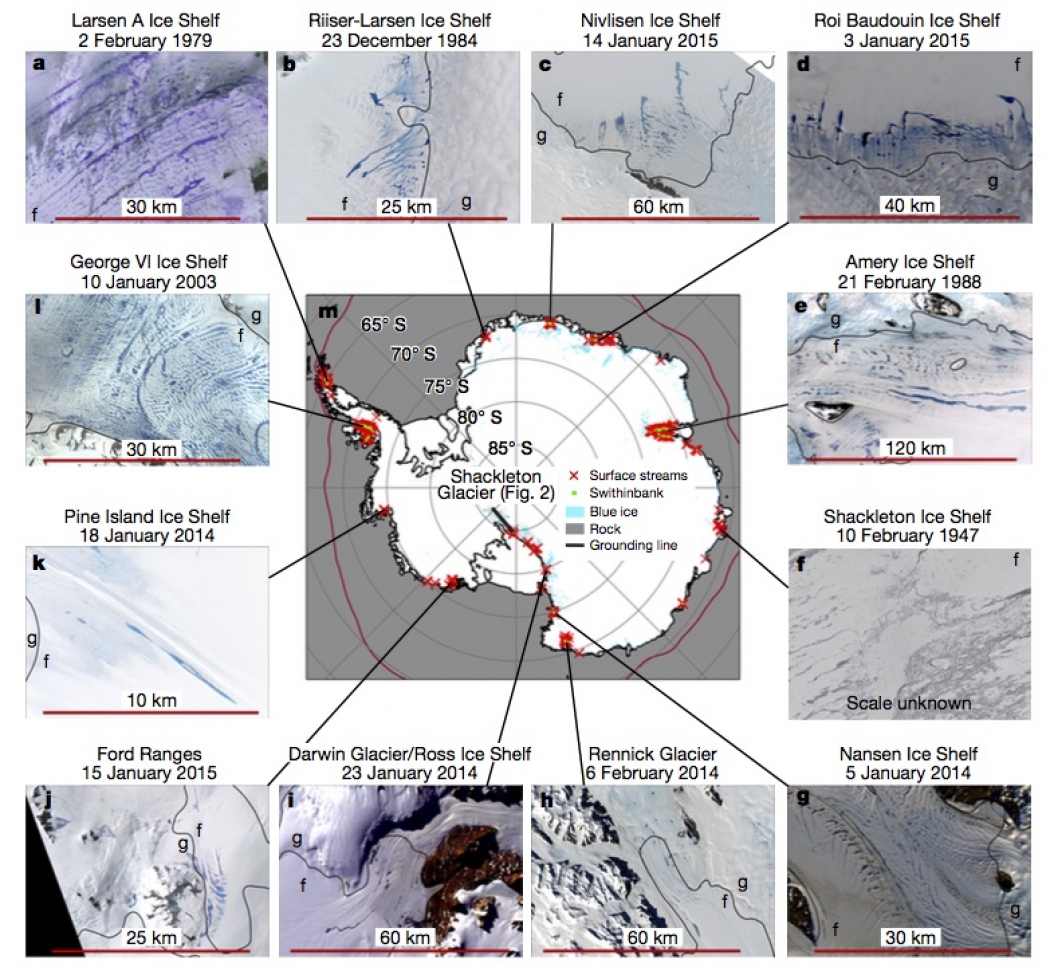
Surface meltwater drainage systems found around Antarctica in satellite images and aerial photos.
Click image to enlarge. Credit: Kingslake, et al./Nature
They found nearly 700 drainage systems that formed during the summer melt season, some of which were found farther inland and at higher altitudes than the researchers expected. These systems had been around for decades and while some were stationary ponds, others were made up of streams that transported water as far as 75 miles and fed melt ponds, the largest of which, on the Amery Ice Shelf, reached 50 miles long.
“It’s huge,” Kingslake said. “And it’s been [forming] since 1973 and we didn’t really know about it.”

Ice Shelf Stability

Most of the melt ponds and streams form near rock outcrops or bluish ice exposed by the sharp winds that scour snow from the surface; these features are darker than the surrounding ice and so absorb more solar energy.
In one paper, the team took a closer look at the system they found on the Nansen Ice Shelf, which was first observed during the Shackleton and Scott expeditions. The Scott team noted that the “noise of running water from a lot of streams sounded odd after the usual Antarctic silence,” and fell into several of the ponds and streams.
The new research shows that during warm years with considerable melt, a river system forms that eventually ends in a 400-foot-wide waterfall that can siphon off an entire year’s worth of surface melt in just a week.
The different types of meltwater drainage systems could raise different possibilities for ice sheet stability. A constellation of melt ponds helped to destabilize the Larsen B ice shelf by absorbing more solar energy and seeping into crevasses in the ice and causing it to further fracture. But an efficient river system like that found on Nansen could actually protect the ice shelf, Bell and her colleagues posit. By quickly exporting meltwater from the ice sheet, the river could prevent that energy absorption and infiltration of cracks.
But the meltwater streams could also help transport meltwater to more vulnerable parts of the ice.
“We have these two different scenarios and we don’t know which one is more likely,” Kingslake said, though that will likely vary from ice shelf to ice shelf. “So we really can’t tell what the future holds for any one particular ice shelf.”
A relatively flat ice shelf (a) is likely to have numerous melt ponds and streams, which could destabilize the shelf by infiltrating crevasses and causing more fracture, while an ice shelf with a steeper slope (b) may have more of a large river network that could export meltwater off the ice shelf.
Click image to enlarge. Credit: Nature
Kingslake and Bell plan to dive deeper into the data to start understanding why ice shelves exhibit different drainage systems and to find out where the meltwater is going, as some could seep into surface snow instead of staying at the surface. A better understanding of how, when and where the meltwater forms could help scientists better model how different ice shelves will respond to rising temperatures, which are expected to increase surface melt.
“It is important to find out how many other ice shelves have a large scale river network, which transports meltwater efficiently into the ocean, as currently, we are only aware of the river and waterfall system on the Nansen ice shelf,” Alison Banwell, a glaciologist at the Scott Polar Research Institute at the University of Cambridge, said in an email. Banwell, who wrote a Nature commentary on the two papers, was not involved with the research.
“Looking at the presence of melt water and its fate is critical,” Eric Rignot, a NASA and University of California, Irvine, glaciologist who also wasn’t involved in the work, said in an email, as “models assuming that all surface meltwater will pond and crack the ice are overly simplistic.” He said it was “a stretch,” though to say that surface rivers like that on the Nansen shelf would protect the ice.
Regardless of what they find, Bell and Kingslake are excited to delve further into the meltwater systems, which Bell says show that “there’s still so much beauty to be discovered on our planet.”


Gore Vidal on the Cold War

Media of the Day


Gore Vidal on the Cold War

North Korean Holocaust

History Lesson awaits Trump if he Attacks North Korea: Analysts

Korea specialist Professor Bruce Cumings notes North Korea became a national security fortress-state as a result of “the holocaust the North experienced during the Korean War”.  After the ‘Communist’ label and racial epithets were applied to dehumanize the populace, the US essentially wiped North Korea off the map, with hundreds of thousands or (more likely) millions of North Koreans killed by US mass-shootings, fly-by bombings, strafings, possible biological warfare, crops being wiped out, and the dumping of hundreds of tons of napalm (a fiery gel that sticks to targets), which drove the country’s peasant population under ground.
While this is generally referred to in the US as the “Forgotten War”, the victims tend to remember it more clearly and have built a security regime centered on deterring the next attack by history’s biggest military empire.  However, scholars have also pointed out that when the US becomes less belligerent towards NK, the NK regime in turn decreases its belligerence.  This was particularly evident in the contrast between the policies of the Clinton and Bush regimes.  As Clinton decreased US belligerence towards NK, NK became significantly more conciliatory.  But when Bush Jr. entered office and renewed threatening rhetoric, NK responded in kind, conducting missile tests and honing its nuclear deterrent.
With the Trump regime now making fresh threats (which are illegal under international law) and sending more heavy weaponry towards NK, Cumings writes:
On November 8, 2016, nearly 66 million voters for Hillary Clinton received a lesson in Hegel’s “cunning of history.” A bigger lesson awaits Donald Trump, should he attack North Korea. It has the fourth-largest army in the world, as many as 200,000 highly trained special forces, 10,000 artillery pieces in the mountains north of Seoul, mobile missiles that can hit all American military bases in the region (there are hundreds), and nuclear weapons more than twice as powerful as the Hiroshima bomb (according to a new estimate in a highly detailed Times study by David Sanger and William Broad).
…Last October, I was at a forum in Seoul with Strobe Talbott, a former deputy secretary of state for Bill Clinton. Like everyone else, Talbott averred that North Korea might well be the top security problem for the next president. In my remarks, I mentioned Robert McNamara’s explanation, in Errol Morris’s excellent documentary The Fog of War, for our defeat in Vietnam: We never put ourselves in the shoes of the enemy and attempted to see the world as they did. Talbott then blurted, “It’s a grotesque regime!” There you have it: It’s our number-one problem, but so grotesque that there’s no point trying to understand Pyongyang’s point of view (or even that it might have some valid concerns). North Korea is the only country in the world to have been systematically blackmailed by US nuclear weapons going back to the 1950s, when hundreds of nukes were installed in South Korea. I have written much about this in these pages and in the Bulletin of the Atomic Scientists. Why on earth would Pyongyang not seek a nuclear deterrent? But this crucial background doesn’t enter mainstream American discourse. History doesn’t matter, until it does—when it rears up and smacks you in the face.
Award-winning journalist Eric Margolis writes:
Few Americans have any idea how ferocious a conventional second Korean War could be. They are used to seeing Uncle Sam beat up small, nearly defenseless nations like Iraq, Libya or Syria that dare defy the Pax Americana.
The US could literally blow North Korea off the map using tactical nuclear weapons based in Japan, South Korea and at sea with the 7th Fleet [but] a fight-to-the-end North Korea may fire off a number of nuclear-armed medium-range missiles at Tokyo, Osaka, Okinawa and South Korea. These missiles are hidden in caves in the mountains on wheeled transporters and hard to identify and knock out.
Such a nuclear exchange would expose about a third of the world’s economy to nuclear contamination, not to mention spreading nuclear winter around the globe.
A conventional US attack on North Korea would be far more difficult. The North is a small nation of only 24.8 million. Its air and sea forces are obsolete and ineffective. They would be vaporized on the first day of a war. But North Korea’s million-man army has been training and digging in for decades to resist a US invasion. Pyongyang’s 88,000-man Special Forces are poised for suicide attacks on South Korea’s political and military command and control and to cripple key US and South Korean air bases, notably Osan and Kunsan.
North Korea may use chemical weapons such as VX and Sarin to knock out the US/South Korean and Japanese airbases, military depots, ports and communications hubs. Missile attacks would be launched against US bases in Guam and Okinawa.
US analysts have in the past estimated a US invasion of North Korea would cost some 250,000 American casualties and at least $10 billion, though I believe such a war would cost four times that much today [emphases added].
Military conscription might have to be re-introduced.
[NK] has prepared for a long guerilla war in the mountains that could last for decades. They have been practicing for 30 years.
Is Commander-in-Chief Trump, who somehow managed to avoid military service during the Vietnam War, really ready to launch a big war in Asia?
North Korea is a horrid, brutal regime. But so is Egypt, whose tin pot dictator was wined and dined by Trump last week.
Award-winning journalist Patrick Cockburn writes that instead of starting another war with North Korea, the US might be better off “exploring how to end all the wars it has [already] started”.
[The] militarised options favoured by “the Washington playbook” that Obama came to so despise have produced little but disaster in the post-9/11 era and are likely to do so again. Almost everything advocated by the Washington foreign policy establishment since the start of the war in Afghanistan in 2001, Iraq in 2003, Libya and Syria in 2011 and Yemen in 2015 has created or exacerbated the conflicts. Note that none of these wars have ended or show much sign of doing so.
Obama could see what was going wrong, though he generally responded with stoic resignation rather than attempting to change the course of events.
TV channels and op-ed writers who treat the expertise of Washington think tanks with such fawning reverence should reflect on the Obama White House’s view of these institutions.
Relief in foreign capitals that much authority [in the US] is in the hands of experienced generals may be displaced. None of these soldiers were quite as successful or farsighted in Iraq and Afghanistan as their admirers now proclaim and they have a natural tendency towards resolving problems by force.
While Cockburn notes Trump’s recent attacks against Syria, his use of the US’s largest non-nuclear explosive device against ISIS in Afghanistan, and his belligerence towards North Korea have made Trump newly popular with the Washington establishment, Margolis suggests launching a war against North Korea may, after the US public realizes how costly and deadly such a war would be, make Trump even less popular in the US, as well as internationally.
Robert J. Barsocchini is an independent researcher and reporter whose interest in propaganda and global force dynamics arose from working as a cross-cultural intermediary for large corporations in the US film and Television industry.  His work has been cited, published, or followed by numerous professors, economists, lawyers, military and intelligence veterans, and journalists.  He begins work on a Master’s Degree in American Studies in the fall.


MOAB. 70% of Americans Approve

Published on 
by

What's Worse? Trump Dropping 'Mother of All Bombs' or That 70% of Americans Approve

Widespread support comes despite the lack of information from the Pentagon about damage from the "Mother of All Bombs" in Afghanistan
Afghan youths near the site of a U.S. bombing in the Achin district of Nangarhar Province this month. (Photo: Noorullah Shirzada/Agence France-Presse—Getty)
Despite the lack of information from the Pentagon about President Donald Trump's deployment on April 13 of the "Mother of All Bombs" in Afghanistan—or its aftermath—close to 70 percent of American voters say they "strongly" or "somewhat" support the bombing, according to a new poll.
Defense Secretary James Mattis said Thursday that "he does not intend to discuss damage estimates from last week's use of the military's most powerful non-nuclear bomb on an Islamic State stronghold in Afghanistan," the Associated Press reported.
An Afghan official said this week that the bombing killed 96 Islamic State [ISIS] militants, though "the official provided no proof of the deaths or information on how officials reached the number of 96," as the New York Times notes. There have been no confirmed reports of civilian casualties. 
The Times further reported on Tuesday:
It was unclear whether any Afghan or coalition forces have made it to the bombing site five days after the attack. The senior Afghan security official said the day after the bombing that Afghan commandos had done so and, after clearing the site, had handed it over to American military forensic teams.
[Zabihullah] Zmarai, the provincial council member, said local officials in Achin told him that neither Afghan nor American forces had arrived at the site.
A spokesman for the Afghan commandos, Jawid Salim, agreed. "It is not true that the members of U.S. forensic are at the scene of bombing—no one is there," he said. "We are in the area and we see everything." 
According to Agence France-Presse on Wednesday, security forces are blocking both journalists and local residents from accessing the site. The outlet reported:
The blast triggered shockwaves which residents said they felt miles away. It was said by the Afghan defence ministry to have killed at least 95 militants, including some IS commanders and foreign fighters, but no civilians. 
The statement could not be independently verified, with reporters including AFPcorrespondents turned away from the site again Wednesday even though there was no sign of fighting in the immediate area.
Ahmad Jan, a resident of Achin who fled IS fighting and moved with his family to the provincial capital Jalalabad long before the bomb was dropped, told AFP he had no idea whether his house or relatives survived the attack. 
"No one can go there, they have completely blocked the area. I don't know if my house is destroyed. They have not even shown any dead bodies to anyone," he said.


Make a difference. Join us.

Donate to Common Dreams

Ali M. Latifi, a writer based in Kabul, Afghanistan, offered this first-hand account in Thursday's New York Times:
Two hills obstructed view of the bombed area. American helicopters flew overhead. Three hours passed but we weren't allowed to proceed further. Officials spoke cheerfully of resounding success and precision of the operation.
Yet every time we sought permission to visit the bombed area, they found excuses to keep us away: "The operation is ongoing!" "There are still Daesh"— Islamic State—"fighters on the loose!" "There are land mines!" and finally, "The area is being cleared!" “No civilians were hurt!"
"In the end, 'Madar-e Bamb-Ha' [the Dari translation for 'Mother of All Bombs'] became the star of a grotesque reality television show," she wrote. "We know how much it weighs, what it costs, its impact, its model number, and its code name. We know nothing about the people it killed except they are supposed to be nameless, faceless, cave-dwelling Islamic State fighters. It was a loud blast, followed by a loud silence. It is yet another bomb to fall on Afghan soil, and the future of my homeland remains as uncertain as ever."
But that uncertainty is not reflected in the United States, where respondents to a Politico/Morning Consult survey seem to have been swayed by Trump and the military's latest display of "shock and awe."
"As you may know, the United States recently dropped the military's largest non-nuclear bomb on a cave complex suspected to be controlled by ISIS, in Afghanistan, according to the U.S. Department of Defense," the 1,992 registered voters were asked. "Knowing this, do you support or oppose the military dropping the largest non-nuclear bomb on an ISIS cave complex in Afghanistan?"
Forty-three percent said they strongly supported the action, while 26 percent said they were "somewhat" behind the bombing. Just eight percent said they strongly opposed it.
The results lend credence to author and analyst Phyllis Bennis' call, published this week, "to integrate opposition to these wars into the very core of the movements already rising so powerfully against racism, for women's and LGBTQ rights, for climate and economic justice, for Native rights, for immigrant rights and refugee protections, for Palestinian rights, and much more."
"We'll need new strategies, new tactics," she wrote, "but we continue to stand on the shoulders of those who have gone before us. Our country is waging war against peoples across the globe, indeed waging war against the earth itself. But we are still here, challenging those wars alongside those who guard the earth, who protect the water, who defend the rights of those most at risk."
Indeed, wrote Seelai Popal, Ali A. Olomi, and Laila Rashidie on Thursday, it is time "for people of conscience in the U.S. to step forward and demand an end to the murder of the Afghan people and the poisoning of our land. The terrorism waged by the U.S. and its allies in the name of the 'war on terror' far outstrips the violence of those they claim to fight. It is time for the global community to demand that all militaries stop using our people and our lands as the testing grounds for war and weaponry. It is time to end the occupation of Afghanistan."

Declassified military archives show sexualized violence against Palestinians has been openly celebrated in Israel.

  Forwarded this email?  Subscribe here  for more   Watch now TEE ASHBY JUL 26   READ IN APP   “Palestinian Feminist Collective organizer Ta...