Zoeken in deze blog 🔎🔎

woensdag 29 november 2006

Musee du Quai Branly 2


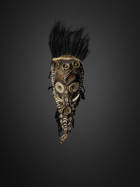
Adolf Bastian, de voormalige directeur en oprichter van het Museum voor Volkerenkunde in Berlijn, zei ooit eens: ‘Avant tout, achetons en masse, pour les sauver de la destruction, les produits de la civilization des sauvages et accumulons dans nos musees.’ Ik las dit op een bordje in een donker zaaltje vol knotsen, schilden, hakmessen van ‘natuurvolkeren’ in het schitterende Musée du Quai Branly.

‘Voor alles, koop massaal op, om de producten van de beschaving der wilden van de ondergang te redden en in onze musea te verzamelen.’ Dat is het wonderlijke aspect van de blanke westerse cultuur. Men vernietigde de andere civilisaties, maar vond die tegelijkertijd wel belangrijk genoeg om de uiterlijke vormen ervan voor de eeuwigheid te bewaren. En nu liggen ze in een Parijs museum dat duidelijk maakt dat de westerse weg van de technologie slechts één van de vele beschavingsvormen is en dat er in feite geen wezenlijk niveauverschil bestaat tussen de verschillende civilisaties. De westerse mens mag zich dan wel op de borst slaan dat hij zoveel beschaafder is dan alle anderen, maar ondertussen gedraagt hij zich even gewelddadig en oorlogszuchtig als de grootste barbaren uit de geschiedenis.
Wanneer u tijd heeft, bezoek dan dit buitengewoon interessante museum. U zult verstelt staan van de vormenrijkdom in de wereld.

Zie: http://www.quaibranly.fr/index.php?id=1&L=1

Irak 120


Trouw bericht vanochtend:

'Vs-irak / Media zien ’burgeroorlog’ Irak.


Amerikaanse media zijn om: het conflict in Irak heet bij hen voortaan een ’burgeroorlog’.
De Los Angeles Times had de primeur: die schrijft al sinds oktober over ’de burgeroorlog in Irak’. Deze week besloot de omroep NBC, naar eigen zeggen na zorgvuldig beraad, dat voorbeeld te volgen. „De situatie in Irak, met gewapende, gemilitariseerde fracties die vechten voor hun eigen politieke agenda kan gekarakteriseerd worden als een burgeroorlog.” De New York Times is het daarmee eens, maar wijst erop dat het conflict veel gecompliceerder is dan uit het woord ’burgeroorlog’ blijkt.
De discussie over de benaming liep al, maar na het bloedbad van vorige week in Sadr City en de wraakacties die volgden, kon een conclusie niet uitblijven. Ook VN-topman Kofi Annan gaf deze week toe dat de situatie in Irak wel erg op een burgeroorlog begint te lijken.
Maar president Bush wilde daar gisteren nog steeds niets van weten. Volgens Bush maakt het geweld deel uit van de ’sektarische onrust’ die negen maanden geleden begon met de aanslag op de sjiitische Gouden Moskee in Samarra. Ook de Amerikaanse legerwoordvoerder generaal-majoor William Caldwell zei gisteren dat het geweld nog niet past binnen de militaire definitie van een burgeroorlog. Hij stelt dat Al- Kaida achter de aanslagen van vorige week zat, om sjiieten en soennieten tegen elkaar op te zetten.
Voor de Iraanse geestelijk leider Ali Khamenei is een burgeroorlog niet aan de orde, bleek uit zijn woorden gisteren tegen de bezoekende Iraakse president Talabani. Het geweld houdt op als de Amerikanen vertrekken, zei hij, want die huren terroristen en oud-leden van Saddam Hoesseins regime in om Irak te destabiliseren. Hij zegde Iraanse hulp toe om de veiligheidssituatie in Irak te verbeteren.'

Zie: http://www.trouw.nl/hetnieuws/wereld/article558240.ece/vs-irak_Media_zien_burgeroorlog__Irak

Trouw zet 'burgeroorlog' nog tussen aanhalingstekens in de kop, maar zal binnenkort ook volmondig van een burgeroorlog spreken, net als alle andere Nederlandse commerciele massamedia. De grote broers in de VS zijn 'om' en dan volgen normaal gesproken de Nederlandse massamedia. Opmerkelijk is deze zin: 'De Los Angeles Times had de primeur: die schrijft al sinds oktober over ’de burgeroorlog in Irak’.' Primeur? Wat nu, is hier sprake van een onthulling? Nee, absoluut niet, de LA Times doet alleen wat elk massamedium zou moeten doen: goed kijken, ter plaatse aanwezig zijn, onafhankelijk berichten. Allemaal zaken die zeker de Nederlandse media niet doen. Ze hebben geen correspondent in Irak, kunnen dus ook niet goed kijken en zijn niet onafhankelijk. Dus schrijven ze over en herhalen wat anderen hen voorzeggen. Als Trouw onafhankelijk zou zijn, dan zou het nu de eigen christelijke voormannen als Balkenende ter verantwoording roepen over de voormalige Nederlandse militaire betrokkenheid in Irak, die uiteindelijk in een burgeroorlog is geeindigd. Maar dat verband legt de krant niet. De 'primeur' zal van anderen moeten komen. Net als in het geval van de Irakese burgeroorlog zal dat via internet moeten komen. Al lang voor de LA Times werd er door onafhankelijke internet-bronnen over een burgeroorlog gesproken. In de wereld van de commerciele massamedia is er geen sprake van oorzaak en gevolg. Alles gebeurt als het ware bij toeval. Zo ziet de wereld van een kind er ook uit. Ineens brak er een 'burgeroorlog' uit. Gek nietwaar? Ineens, zonder aanleiding.

Het gebrek aan onafhankelijkheid bij de Nederlandse massamedia komt niet alleen door de commerciele belangen die op de achtergrond meespelen, maar ook door politieke. Dat verzin ik niet, getuige het volgende citaat van Frits van Exter, hoofdredacteur van Trouw. In een interview met ‘Extra,’ een kritisch maandblad over de massamedia, verklaarde hij: ‘De aandacht van de media [ wordt] natuurlijk voor een belangrijk deel gestuurd… door de politieke machten… Dat geldt voor de nationale politiek, maar natuurlijk ook voor de internationale politiek… Het heeft voor een deel te maken met de vluchtigheid van het medium. Deels ook volgen de media elkaar, sommige zijn dominanter, en andere lijden aan kuddegedrag… Als je volgend bent, dan betekent dat als een autoriteit, of iemand die gekozen is om een bepaald gezag uit te oefenen, zegt “ik vind dit een belangrijk onderwerp, daar gaan we nou es wat aan doen,” dat je dat ook bekijkt. De dingen waar hij (sic) het niet over heeft, die volg je dus minder… het werkt voor een deel reflexmatig. Reflexen zijn het, je bent daar geconditioneerd in.’ De spijker op de kop. Inderdaad, kuddegedrag, reflexen, gezagsgetrouw en ondertussen net doen alsof de journalist 'objectief' is.

De commerciele massemedia hebben een eigen concon geschapen en die noemen ze de werkelijkheid.

dinsdag 28 november 2006

Irak 119

En de chaos wordt stapje voor stapje totaal. Blind marcheert het Westen onder leiding van de VS van bloedbad naar bloedbad. Tot de rekening wordt opgemaakt. Zag u De Hoop Scheffer glunderen toen hij voor het oog van de wereld president Bush een handje mocht geven?

'Iraq's Shiite prime minister, struggling to prevent sectarian violence from sending Iraq into full-fledged civil war, is facing strong criticism from top Shiite and Sunni Arab leaders alike as he prepares for a summit with President Bush next week.
On Saturday, a prominent Sunni religious leader warned that Iraq's escalating sectarian violence will spread throughout the Middle East unless the international community withdraws support for Prime Minister Nouri al-Maliki's government.
"I call on the Arab states, the Arab League and the United Nations to stop this government and withdraw its support from it. Otherwise, the disaster will occur and the turmoil will happen in Iraq and other countries," said Sheik Harith al-Dhari, who heads the Association of Muslim Scholars.
Last week, Iraq's Interior Ministry issued an arrest warrant against al-Dhari, saying he was wanted for inciting violence and terrorism.
On the other side of Iraq's sectarian divide, Shiite politicians loyal to the radical anti-American Shiite cleric Muqtada al-Sadr have threatened to boycott parliament and the Cabinet if al-Maliki goes ahead with the planned summit in Jordan on Wednesday and Thursday. The political bloc, known as Sadrists, is a mainstay of support for al-Maliki.
The White House has said the meeting is still on.
Iran, the top U.S. rival in the region, had planned its own summit Saturday, inviting the presidents of Iraq and Syria in what was seen as a bid to assert its role as a powerbroker in Iraq. Syria did not respond, perhaps to avoid annoying the U.S., and Iraq's president said he could not get to Iran before Sunday at the earliest because Baghdad's airport was closed to commercial flights following a deadly attack Thursday in Sadr City.
Suspected Sunni insurgents killed 215 people in the Shiite slum with mortars and five car bombs in the deadliest single attack of the war. On Saturday, Sadrist lawmaker Qusai Abdul-Wahab blamed U.S. forces for the attack, saying they failed to provide security.
As Vice President Dick Cheney traveled to the neighboring Sunni country of Saudi Arabia on Saturday to seek help in calming Iraq, Iraq's sectarian violence shifted to Diyala province north of Baghdad, where gunmen broke into two Shiite homes and killed 21 men in front of their relatives, police said. U.S. and Iraqi forces also killed 58 insurgents during fighting in the same region.'

Lees verder: http://www.truthout.org/docs_2006/112606A.shtml Of:
http://apnews.myway.com/article/20061126/D8LKE5K80.html

The Empire 68

'THE GREAT TURNING:
FROM EMPIRE TO EARTH COMMUNITY.

http://www.davidkorten.org/Books/greatturning.htm

David Korten’s classic bestseller, When Corporations Rule the World, was one of the first books to articulate the destructive and oppressive nature of the global corporate economy. Now, ten years later, Korten shows that the problem runs deeper than corporate domination—with far greater consequences.

In The Great Turning, Korten argues that corporate consolidation of power is merely a contemporary manifestation of what he calls “Empire”: the organization of society by hierarchies of domination grounded in violent chauvinisms of race, gender, religion, nationality, language, and class. The result has been the same for 5,000 years, fortune for the few and misery for the many. Increasingly destructive of children, family, community, and nature, the way of Empire is leading to environmental and social collapse.

The Great Turning makes the case that we humans are a choicemaking species that at this defining moment faces both the opportunity and the imperative to choose our future as a conscious collective act. We can no longer deny the need nor delay our response. A mounting perfect economic storm is fast approaching. A convergence of climate change, peak oil, and the financial instability inherent in an unbalanced global trading system will bring an unraveling of the corporate-led global economy and a dramatic restructuring of every aspect of modern life.

We cannot avoid the unraveling. We can, however, turn a potentially terminal crisis into an epic opportunity to bring forth a new era of Earth Community grounded in the life-affirming cultural values shared by most all the world’s people and eloquently articulated in the Earth Charter.

The Great Turning is an essential resource for those who understand this need and are prepared to engage what Thomas Berry calls the Great Work. It cuts through the complexity of our time to illuminate a simple, but elegant truth. We humans live by stories. We are held captive to the ways of Empire by a cultural trance of our own creation maintained by stories that deny the higher possibilities of our human nature—including our capacities for compassion, cooperation, responsible self-direction, and self-organizing partnership.

Changing our future begins with changing our stories. A work already underway, it ultimately calls out for the participation of every person on the planet. The Great Turning points the way to the inspiring outcome within our reach.

Table of Contents (some chapters are excerpted here)'

Martin Luther King


'The continuing ''danger' of King.''

By Derrick Z. Jackson

Second of two parts

[Part One: http://www.boston.com/news/globe/

editorial_opinion/oped/articles/

2006/11/22/a_king_we_hardly_knew/]

PALO ALTO, Calif.

Clayborne Carson said that one of the most profound
things in the early notes of the Rev. Martin Luther
King Jr. is how they foreshadow the last years of King.

"Most people think King grew into his opposition to the
Vietnam War, grew into global issues, grew, so to
speak, beyond race into speaking about other things,"
said Carson, founding director of the King Papers
Project at Stanford University. The notes for King's
early sermons, discovered in the last decade, will soon
be published in the sixth volume of the papers.

"He was a person struggling to be understood, yet was
so boxed in by his public image and public expectations
. . . What the writings make abundantly clear was that
now we can see that the King of 1968 was finally saying
what he believed in 1948."

Carson said that the early writings make ironic the
criticism King took for his anti-Vietnam speeches from
civil rights leaders fearful of losing the support of
the Johnson administration on domestic issues. "When
you add it up," Carson said, "it's as if King is
saying, 'You guys haven't been listening to me.' "

Reading a 1953 sermon called "The False God of
Nationalism," one can guess what King might think about
our unilateral invasion of Iraq, walls along the
Mexican border, and the politics of fear after 9/11.
"The watchword of this new religion is 'My country,
right or wrong,' " King wrote. ". . . In Germany, it
was preached by Hitler. In Italy, it was preached by
Mussolini. And in America it is being preached by the
McCarthy s and the Jenners, the advocators of white
supremacy, and the America first movements."

In a 1949 sermon called "Civilization's Greatest Need,"
King wrote, "Our material and intellectual advances
have outrun our moral progress." When one thinks of
last week's stampede, shooting, and stealing over
release of the latest PlayStation, King has a point. "I
tell you, it is not enough to have the power of
concentration," he wrote, "but worthy objectives upon
which to concentrate."
http://www.boston.com/news/globe/

editorial_opinion/oped/articles/2006/11/25/

the_continuing_danger_of_king/

Zie ook: MARTIN LUTHER KING -

THE FATAL SHOT CAME FROM A DIFFERENT DIRECTION
http://www.whatreallyhappened.com/ARTICLE1/overlooked.html

The Empire 67

De BBC bericht:

'CIA role claim in Kennedy killing.

New video and photographic evidence that puts three senior CIA operatives at the scene of Robert Kennedy's assassination has been brought to light.


The evidence was shown in a report by Shane O'Sullivan, broadcast on BBC Newsnight.
It reveals that the operatives and four unidentified associates were at the Ambassador Hotel, Los Angeles in the moments before and after the shooting on 5 June, 1968.
The CIA had no domestic jurisdiction and some of the officers were based in South-East Asia at the time, with no reason to be in Los Angeles.
'Decoy'
Kennedy had just won the California Democratic primary on an anti-War ticket and was set to challenge Nixon for the White House when he was shot in a kitchen pantry.
A 24-year-old Palestinian, Sirhan Sirhan, was arrested as the lone assassin and notebooks at his house seemed to incriminate him.
However, even under hypnosis, he has never been able to remember the shooting and defence psychiatrists concluded he was in a trance at the time.
Witnesses placed Sirhan's gun several feet in front of Kennedy but the autopsy showed the fatal shot came from one inch behind.
Dr Herbert Spiegel, a world authority on hypnosis at Columbia University, believes Sirhan may have been hypnotically programmed to act as a decoy for the real assassin.
Evidence
The report is the result of a three-year investigation by filmmaker Shane O'Sullivan. He reveals new video and photographs showing three senior CIA operatives at the hotel.'

Lees verder: http://news.bbc.co.uk/2/hi/programmes/newsnight/6169006.stm

The Empire 66

'No One to Lose To.
By Maureen Dowd
The New York Times

After the Thanksgiving Day Massacre of Shiites by Sunnis, President Bush should go on Rupert Murdoch's Fox News and give an interview headlined: "If I did it, here's how the civil war in Iraq happened."
He could describe, hypothetically, a series of naïve, arrogant and self-defeating blunders, including his team's failure to comprehend that in the Arab world, revenge and religious zealotry can be stronger compulsions than democracy and prosperity.
But W. is not yet able to view his actions in subjunctive terms, much less objective ones. Bush family retainers are working to deprogram him, but the president is loath to strip off his delusions of adequacy.
W. declined to tear himself away from his free-range turkey and pumpkin mousse trifle at Camp David and reassure Americans about the deadliest sectarian attack in Baghdad since the U.S. invaded. More than 200 Shiites were killed and hundreds more wounded by car bombs and a mortar attack in Sadr City. October was the bloodiest month yet for civilians, and in the last four months, some 13,000 men, women and children have died.
American helicopters and Iraqi troops did not arrive for two hours after Sunni gunmen began a siege on the Health Ministry controlled by the Shiite cleric Moktada al-Sadr, who has a militia that kills Sunnis and is married to the Maliki government.
Continuing the cycle of revenge yesterday, Shiite militiamen threw kerosene on six Sunnis and set them on fire, as Iraqi soldiers watched, and killed 19 more.
The New York Times and other news outlets have been figuring out if it's time to break with the administration's use of euphemisms like "sectarian conflict." How long can you have an ever-descending descent without actually reaching the civil war?
Some analysts are calling it genocide or clash of civilizations, arguing that civil war is too genteel a term for the butchery that is destroying a nation before our very eyes. Anthony Shadid, The Washington Post reporter who won a Pulitzer Prize for his Iraq coverage, went back recently and described "the final, frenzied maturity of once-inchoate forces unleashed more than three years ago by the invasion. There was civil-war-style sectarian killing, its echoes in Lebanon a generation ago. Alongside it were gangland turf battles over money, power and survival; a raft of political parties and their militias fighting a zero-sum game; a raging insurgency; the collapse of authority; social services a chimera; and no way forward for an Iraqi government ordered to act by Americans who themselves are still seen as the final arbiter and, as a result, still depriving that government of legitimacy. Civil war was perhaps too easy a term, a little too tidy."
It will be harder to sell Congress on the idea that America's troops should be in the middle of somebody else's civil war than to convince them that we need to hang tough in the so-called front line of the so-called war on terror against Al Qaeda.'

Zie: http://www.truthout.org/docs_2006/112606F.shtml

De Groene NAVO-Propagandist Maarten Muns

  Op zoek naar een modus vivendi met Rusland Containment of detente? Welke ideologie er ook regeert, Rusland blijft een expansieve macht. ‘H...