Ukraine and Yemen Wars Highlight US’s Role as Biggest Arms Dealer in the World
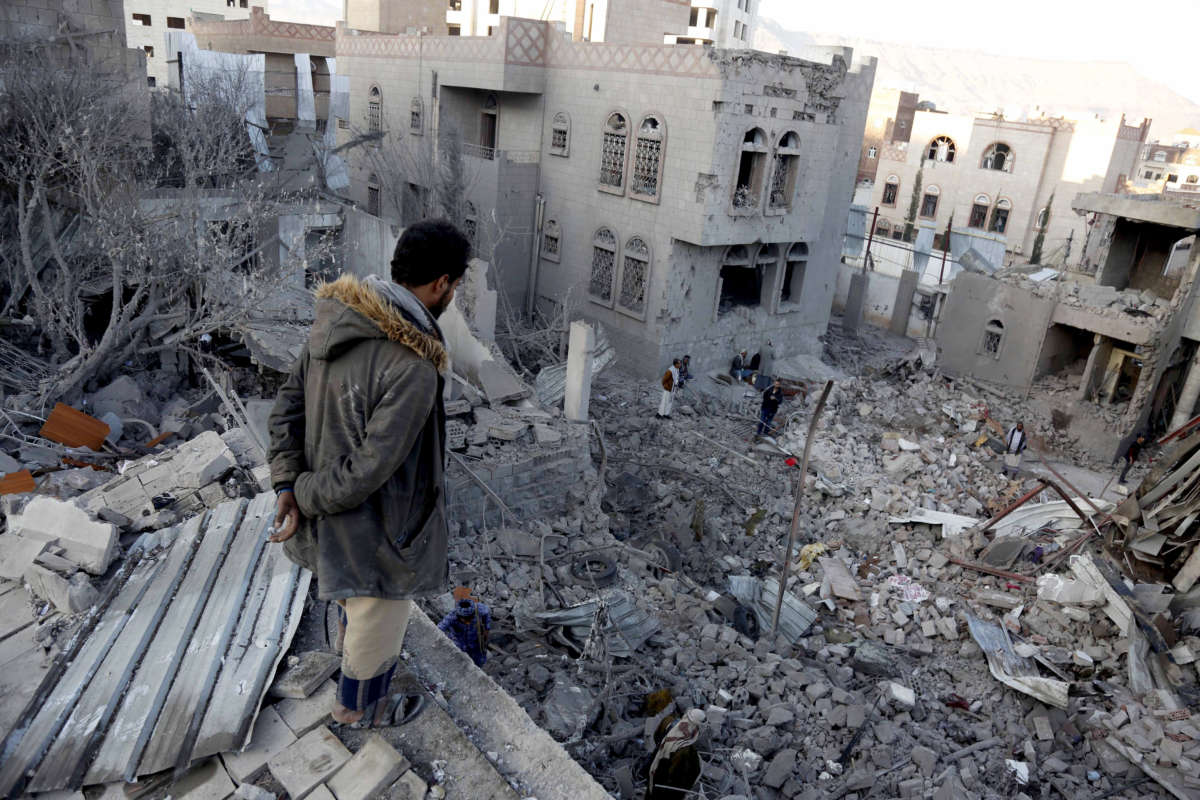
Analysts say the defense industry has spent billions of dollars lobbying Congress while quietly making much more in profit by manufacturing weapons that fuel deadly conflicts in Ukraine, Yemen and across the world under federal arms sales agreements that have little effective congressional oversight.
There is a dangerous “feedback loop” between major weapons manufacturers in the United States that make billions in profits from arms sales, the countries that arm themselves with these weapons, and the U.S. government, which uses arms sales as “tools” to gain economic and diplomatic leverage, according to Dan Auble, a researcher at money-in-politics tracker OpenSecrets.
“Unfortunately, it’s ultimately the human beings on the ground who suffer as a result of the prolonged wars that are fed from these arms sales abroad,” Auble told reporters on Thursday.
The U.S. is the top arms dealer in the world, followed by Russia, France and the United Kingdom, with the U.S. responsible for 39 percent of arms exports globally, according to the Stockholm International Peace Institute.
Meanwhile, OpenSecrets reports that major U.S. weapons manufacturers such as Raytheon, Lockheed Martin and General Dynamics, which capitalize on conflict, collectively spent $2.5 billion lobbying Congress over the past 20 years, with $177 million spent on lobbying last year alone. Raytheon Technologies was the defense industry’s top spender in 2021 with a $15.3 million investment in lobbying Congress, where ever-expanding military budgets provide endless opportunity for profit.
About 43 percent of U.S. arms exports got to the Middle East, where Saudi Arabia and the United Arab Emirates are top customers. Both countries are leading a coalition fighting in a civil war in Yemen that is entering its eighth year. An estimated 377,000 people have died in Yemen due to fighting, displacement, hunger and disease in what is considered by the United Nations to be the world’s worst humanitarian disaster.
Weapons manufactured in the U.S. — ranging from helicopters to bombs and missile systems — are used in Yemen and result in deaths of civilians, despite recent assurances from the Saudi government and the Biden administration that U.S. weapons are only used for defensive purposes, Auble said. Congress has made several attempts at ending U.S. involvement in Yemen’s brutal civil war, but none have been successful.
“There is currently a ceasefire in place that is letting some [humanitarian] aid arrive, but it remains to be seen how well that will hold,” Auble said. “Of course, past truces have not.”
President Joe Biden pledged on the campaign trail to end U.S. support for the Saudi-led war in Yemen, but after an initial pause in arms sales, the Biden administration approved a $500 million contract for helicopter purchases and $650 million contract for air-to-air missiles in 2021. Rep. Ilhan Omar (D-Minnesota) introduced a joint resolution in the House to block the sale of missiles, but the resolution did not pass.
Like weapons manufacturers, the governments of some arms recipients also spend big on lobbying and influence. An analysis of federal “foreign agent” registrations reveals that Saudi Arabia and the United Arab Emirates have spent $130 million since 2016 on media outreach campaigns in the U.S. and on lobbying dozens of members of Congress on arm sales and other issues, according to Auble.
There is also a humanitarian crisis in Ukraine, where millions of people have been displaced and thousands of civilians have been killed since Russia’s brutal invasion began in February. Since April 1, the U.S. has authorized $12 million in security assistance to Ukraine, including heavy weaponry, bringing total U.S. military assistance to the embattled nation to more than $3 billion, according to the Forum on the Arms Trade. More than two dozen other nations and the European Union have sent weapons or security support to Ukraine.
Russia’s bloody aggression and targeting of civilians has shocked the world, and U.S. military assistance to Ukraine enjoys ample support within Congress and the Biden administration. However, antiwar activists argue that simply dumping weapons into a complex proxy war pitting Russia’s imperialist ambitions against the expansionist NATO alliance is deeply misguided and is not the way to bring about peace. In fact, an influx of weapons from the U.S. can prolong and intensify wars as well as civilian misery.
The war has put Ukrainian leftists in an extremely difficult position, and many have taken up arms against Russia while remaining critical of nationalism and the Ukrainian state.
Jennifer Erickson, an associate professor of political science at Boston College and researcher with the World Peace Foundation, said ongoing armed conflicts generally do not deter U.S. arms sales to foreign governments, especially when those governments are repeat customers.
“The U.S. is pretty consistently exporting to most armed conflicts worldwide,” Erickson said on Thursday while promoting a new report on U.S. arms sales. “This is in part because U.S. export law provides presidents with significant flexibility for presidential policy and preferences.”
U.S. presidents use arms sales to build regional alliances and pursue global economic goals, but selling weapons has “intractable risks,” according to Erickson. Precautions taken by the U.S. to ensure that weapons do not end up in the “wrong hands” often fall short.
Of course, the U.S. government’s perception of the “right hands” doesn’t always ensure the weapons won’t be used to wage bloody wars and kill civilians. Weapons are durable and can be reused in ways the government cannot predict or control and risk falling into the hands of a wide range of armed groups, including those that oppose U.S. interests.
Despite these risks, Erickson said, “Congress is structurally incapable of serving as an effective check on arms sales” for several reasons. Lobbying by foreign governments and the defense industry aside, the president is only legally required to notify lawmakers of sales over $14 million, and these notifications often leave Congress with only one month to act. If Congress opposes an arms sale, lawmakers must pass legislation with a two-thirds majority to avoid a presidential veto, and no such effort has ever been successful in modern history.
“We just haven’t seen it happen,” Erickson said, adding that presidential power “reigns supreme” in U.S. decisions over weapons transfers.
For example, in recent years Sen. Bernie Sanders and other progressives have teamed up with isolationist Republicans to pass historic war powers resolutions to end U.S. support for the Saudi-led coalition fighting in Yemen, but those efforts were either rejected by other lawmakers or met with a presidential veto Congress was unable to override.
Bipartisan proposals to end U.S. complicity with the civil war in Yemen enjoyed substantial public support, and Erickson said the efforts were a “best-case scenario” for congressional action on arms sales. Still, they failed.
With China and Russia flexing their imperialist muscles, a “New Cold War” mentality is gripping U.S. policy makers as well as global leaders as the world’s great powers enter an age of renewed competition. This could increase U.S. reluctance to cut off arms transfers to active conflict zones such as Yemen and Ukraine, according to Erickson’s report.
Congress could step in and reform the rules for arms sales by lowering the $14 million threshold for notifying lawmakers, for example, or by requiring a “substantive risk analysis” of whether the U.S.-made weapons could be used for genocide or war crimes, along with a mechanism that would allow a sale to be easily denied.
However, Erickson and Auble said members of Congress are often focused on domestic issues and their own political careers, and there is little political incentive for lawmakers to wade into the arena of the weapons trade.
“I think that still leaves the question of whether Congress wants to do something” in the first place, Erickson said.


