Zoeken in deze blog 🔎🔎

maandag 26 april 2021

Reuters, BBC, and Bellingcat Versus Russia


Reuters, BBC, and Bellingcat participated in covert UK Foreign Office-funded programs to “weaken Russia,” leaked docs reveal


New leaked documents show Reuters’ and the BBC’s involvement in covert UK FCO programs to effect “attitudinal change” and “weaken the Russian state’s influence,” alongside intel contractors and Bellingcat.


The UK Foreign and Commonwealth Office (FCO) have sponsored Reuters and the BBC to conduct a series of covert programs aimed at promoting regime change inside Russia and undermining its government across Eastern Europe and Central Asia, according to a series of leaked documents.

The leaked materials show the Thomson Reuters Foundation and BBC Media Action participating in a covert information warfare campaign aimed at countering Russia. Working through a shadowy department within the UK FCO known as the Counter Disinformation & Media Development (CDMD), the media organizations operated alongside a collection of intelligence contractors in a secret entity known simply as “the Consortium.”

Through training programs of Russian journalists overseen by Reuters, the British Foreign Office sought to produce an “attitudinal change in the participants,” promoting a “positive impact” on their “perception of the UK.”

“These revelations show that when MPs were railing about Russia, British agents were using the BBC and Reuters to deploy precisely the same tactics that politicians and media commentators were accusing Russia of using,” Chris Williamson, a former UK Labour MP who attempted to apply public scrutiny to the CDMD’s covert activities and was stonewalled on national security grounds, told The Grayzone.

“The BBC and Reuters portray themselves as an unimpeachable, impartial, and authoritative source of world news,” Williamson continued, “but both are now hugely compromised by these disclosures. Double standards like this just bring establishment politicians and corporate media hacks into further disrepute.”

Thomson Reuters Foundation spokesperson Jenny Vereker implicitly confirmed the authenticity of the leaked documents in an emailed response to questions from The Grayzone. However, she contended, “The inference that the Thomson Reuters Foundation was engaged in ‘secret activities’ is inaccurate and misrepresents our work in the public interest. We have for decades openly supported a free press and have worked to help journalists globally to develop the skills needed to report with independence.”

The batch of leaked files closely resembles UK FCO-related documents released between 2018 and 2020 by a hacking collective calling itself Anonymous. The same source has claimed credit for obtaining the latest round of documents.

The Grayzone reported in October 2020 on leaked materials released by Anonymous which exposed a massive propaganda campaign funded by the UK FCO to cultivate support for regime change in Syria. Soon after, the Foreign Office claimed its computer systems had been penetrated by hackers, thus confirming their authenticity.

The new leaks illustrate in alarming detail how Reuters and the BBC – two of the largest and most distinguished news organizations in the world – attempted to answer the British foreign ministry’s call for help in improving its “ability to respond and to promote our message across Russia,” and to “counter the Russian government’s narrative.” Among the UK FCO’s stated goals, according to the director of the CDMD, was to “weaken the Russian State’s influence on its near neighbours.”

Reuters and the BBC solicited multimillion-dollar contracts to advance the British state’s interventionist aims, promising to cultivate Russian journalists through FCO-funded tours and training sessions, establish influence networks in and around Russia, and promote pro-NATO narratives in Russian-speaking regions.

In several proposals to the British Foreign Office, Reuters boasted of a global influence network of 15,000 journalists and staff, including 400 inside Russia.

The UK FCO projects were carried out covertly, and in partnership with purportedly independent, high-profile online media outfits including Bellingcat, Meduza, and the Pussy Riot-founded Mediazona. Bellingcat’s participation apparently included a UK FCO intervention in North Macedonia’s 2019 elections on behalf of the pro-NATO candidate.

The intelligence contractors that oversaw that operation, the Zinc Network, boasted of establishing “a network of YouTubers in Russia and Central Asia” while “supporting participants [to] make and receive international payments without being registered as external sources of funding.” The firm also touted its ability to “activate a range of content” to support anti-government protests inside Russia.

The new documents provide critical background on the role of NATO member states like the UK in influencing the color revolution-style protests waged in Belarus in 2020, and raise unsettling questions about the intrigue and unrest surrounding jailed Russian opposition figure Alexei Navalny.

Further, the materials cast serious doubt on the independence of two of the world’s largest and most prestigious media organizations, revealing Reuters and the BBC as apparent intelligence cut-outs feasting at the trough of a British national security state that their news operations are increasingly averse to scrutinizing.

Reuters solicits secret British Foreign Office contract to infiltrate Russian media

A series of official documents declassified in January 2020 revealed that Reuters was secretly funded by the British government throughout the 1960s and 1970s to assist an anti-Soviet propaganda organization run by the MI6 intelligence agency. The UK government used the BBC as a pass-through to conceal payments to the news group.

The revelation prompted a Reuters spokesman to declare that “the arrangement in 1969 [with the MI6] was not in keeping with our Trust Principles and we would not do this today.”

The Trust Principles outline a mission of “preserving [Reuters’] independence, integrity, and freedom from bias in the gathering and dissemination of information and news.”

In its own statement of values, the BBC proclaims, “Trust is the foundation of the BBC. We’re independent, impartial and honest.”

However, the newly leaked documents analyzed by The Grayzone appear to reveal that both Reuters and the BBC are engaged yet again in a non-transparent relationship with the UK’s foreign ministry to counter and undermine Russia.

In 2017, the non-profit arm of the Reuters media empire, the Thomson Reuters Foundation (TRF), delivered a formal tender offering to “enter into a Contract with the Secretary of State for Foreign Affairs, as represented by the British Embassy Moscow, for the provision of a project ‘Capacity Building in Russian Media.'” The letter was signed by Reuters CEO Monique Ville on July 31, 2017.

Reuters’ tender was a response to a call for bids by the FCO, which sought help in implementing “a programme of themed tours to the UK by Russian journalists and online influencers.” 

Working through the British Embassy in Moscow, the FCO sought to produce an “attitudinal change in the participants,” promoting a “positive impact” on their “perception of the UK.”

In 2019, the FCO put forward a similar initiative, this time articulating a more aggressive plan to “counter the Russian government’s narrative and domination of the media and information space.” In effect, the British government was seeking to infiltrate Russian media and propagate its own narrative through an influence network of Russian journalists trained in the UK.

Reuters responded to both calls by the FCO with detailed tenders. In its first bid, the media giant boasted of establishing a global network of 15,000 journalists and bloggers through “capacity building interventions.” In Russia, it claimed at least 400 journalists had been cultivated through its training programs.

Reuters claimed to have performed 10 previous training tours for 80 Russian journalists on behalf of the British embassy in Moscow. It proposed eight more, promising to promote “UK cultural and political values” and “create a network of journalists across Russia” bonded together by a shared “interest in British affairs.”

Reuters’ tender highlighted the institutional prejudices and interventionist agenda that underlined its training programs. Detailing a series of UK FCO-funded programs dedicated to “countering Russian state-funded propaganda,” Reuters conflated Russian government narratives with extremism. Ironically, it referred to its own efforts at weakening them as “unbiased journalism.”

At the same time, Reuters appeared to recognize that its covert collaboration with the British Embassy in Moscow was highly provocative and potentially destructive to diplomatic relations. Recounting a UK FCO-funded tour it ran for Russian journalists in the midst of the Sergei Skripal affair, after the British government accused Moscow of poisoning a turncoat Russian intelligence officer who spied for Britain, the tender stated, “[Thomson Reuters Foundation] was in constant communication with the British Embassy in Moscow, to assess levels of risk, including reputational risk to the embassy.”

The mention by Reuters of the Belarusian TV Station Belsat, and its particular relevance “to the UK Government Strategy’s capacity to detect and counter the spread of Russian information” was notable. While describing itself as “the first independent television channel in Belarus,” Belsat is, as the Reuters tender makes clear, a vehicle of NATO influence.

Based in Poland and funded by the Polish Foreign Ministry and other EU governments, Belsat played an influential role in promoting the color revolution-style protests that erupted in May 2020 to demand the ouster of Belarusian President Alexander Lukashenko.

Ultimately, Reuters’ bid appears to have been successful, as it received a July 2019 contract with the FCO’s Conflict, Stability & Security Fund (CSSF). But neither entity seemed to want the public to know about their collaboration on a project designed to counter Russia. The contract was marked “Strictly Confidential.”

“Weaken the Russian state’s influence”

The programs exposed through the latest leak of documents operate under the auspices of a shadowy division of the Foreign and Commonwealth Development Office called Counter Disinformation & Media Development (CDMD). Led by an intelligence operative named Andy Pryce, the program has shrouded in secrecy.

Indeed, the British government has denied freedom of information requests about the division’s budget and stonewalled members of parliament like Chris Williamson who sought data about its budget and agenda, citing national security to block their demands for information.

“When I tried to probe further,” former MP Williamson told The Grayzone, “ministers refused to let me have access to any documents or correspondence relating to this organization’s activities.  I was told that releasing this information could ‘disrupt and undermine the program’s effectiveness.’”

During a meeting convened in London on June 26, 2018, Pryce outlined a new FCO program “to weaken the Russian State’s influence on its near neighbors.” He solicited a consortium of firms to assist the British state in establishing new and seemingly independent media outlets to counter Russian government-backed media in Moscow’s immediate sphere of influence, and to amplify the messaging of NATO-aligned governments.

Justified on the basis of Russia’s supposed intention to “sow disunity and course[sic] disruption to democratic processes,” the campaign Pryce laid out was more aggressive and far-reaching than anything Russia has been caught doing in the West.

Pryce emphasized that secrecy was of the essence, warning that “some grantees will not wish to be linked to the FCO.”

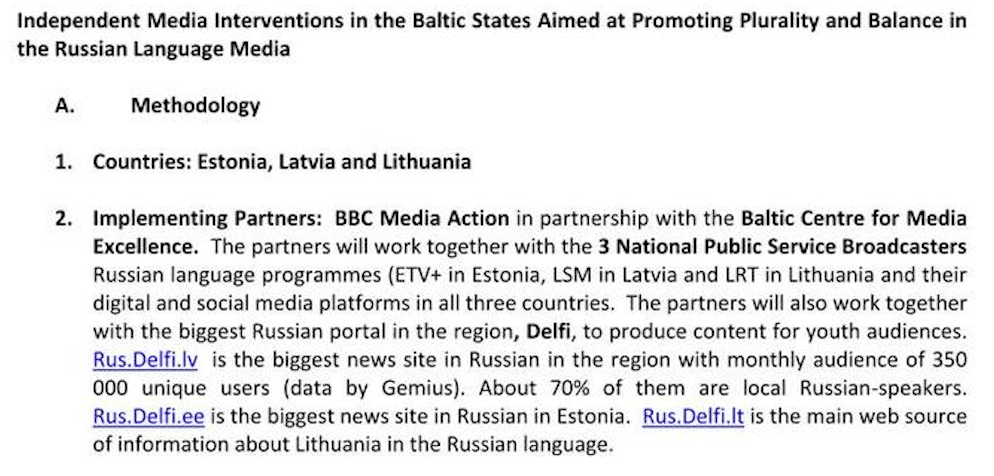
A year later, the FCO’s CDMD division outlined a program to run through 2022 at a cost of $8.3 million to the British taxpayer. It aimed to establish new outlets and support preexisting media operations “to counter Russia’s efforts to sow disunity” and “increase resilience to hostile Kremlin messaging in the Baltic states.”

Thus the British government set out with an array of intelligence contractors to dominate Baltic media with pro-NATO messaging – and perhaps sow some disunity of its own.

As seen below, the BBC placed an apparently successful bid to participate in the covert Baltic program through its non-profit arm, known as BBC Media Action.
The BBC also proposed to participate in a separate UK FCO media propaganda program in Ukraine, Moldova, and Georgia. It named Reuters and a now-defunct intelligence contractor called Aktis Strategy, which participated in previous FCO CDMD programs, as key allies in its consortium.

The BBC identified local partners like Hromadske, a Kiev-based broadcast network born in the midst of the so-called Maidan “Revolution of Dignity” in 2014 that relied on ultra-nationalist muscle to remove an elected president and install a pro-NATO regime. Hromadske materialized almost overnight with seed money and logistical support from the US Agency for International Development (USAID) and billionaire media mogul Pierre Omidyar’s Network Fund.

BBC Media Action proposed working through Aktis to cultivate and grow pro-NATO media in conflict areas like the Donbas region of eastern Ukraine, where a proxy war has raged since 2014 between the Western-backed Ukrainian military and pro-Russian separatists. It was textbook information warfare, weaponizing broadcast media to turn the tide of battle in a protracted, grinding conflict.

The UK FCO propaganda campaign warned that “Kremlin-affiliated structures” could undermine the project if it was exposed. For a media organization that claims to place trust at the heart of its charter of values, the BBC was certainly operating under a high degree of secrecy.

The UK FCO’s meddling in Eastern Europe and the Baltics created a feeding frenzy among contractors seeking to provide “capacity building” and media development assistance on Russia’s periphery. Among the bidders were Reuters and veteran FCO contractors that had participated in an array of information warfare campaigns from Syria to the British home front.

The Consortium

Among the intelligence contractors bidding to participate in the UK FCO-funded Consortium were the Zinc Network and Albany Communications. As journalist Kit Klarenberg noted in a February 18 report on the recent FCO leaks, these firms “boast staff possessed of [security] clearances, individuals who previously served at the highest levels of government, the military and security services. They furthermore have extensive experience in conducting information warfare operations on London’s behalf the world over.”

Previously known as Breakthrough, Zinc has contracted for the UK Home Office to covertly implement media projects propagandizing British Muslims under the auspices of the Prevent de-radicalization initiative. In Australia, Zinc was caught running a clandestine program to promote support for government policies among Muslims.

Ben Norton reported for The Grayzone on Albany’s record of “secur[ing] the participation of an extensive local network of over 55 stringers, reporters and videographers” to influence media narratives and advance Western regime-change goals in Syria, while conducting public relations services on behalf of extremist Syrian militias funded by NATO member states and Gulf monarchies to destabilize the country.

In its bid for the UK FCO media program in the Baltic region, Albany proposed a series of satirical “interactive games” like “Putin Bingo” to encourage opposition to the Russian government and exploit “frustrations experienced by Russians in the EU.”

Albany pitched a Latvia-based outlet called Meduza as “a leading proponent of these games.” A top website among Russian opposition supporters, Meduza has received financial support from the Swedish governmentand several billionaire-backed pro-NATO foundations.

As a UK FCO contractor, the Zinc Network said it was “delivering audience segmentation and targeting support” not only to Meduza, but also to Mediazona, a supposedly independent media venture founded by two members of the anti-Kremlin performance art group Pussy Riot.

One of Mediazona’s founders, Nadya Tolokonnikova, shared a stage with former US President Bill Clinton at the Clinton Foundation’s 2015 conference. The following year, Tolokonnikova trashed now-imprisoned Wikileaks founder Julian Assange, claiming, “He’s connected with the Russian government, and I feel that he’s proud of it.”

Besides delivering “targeting support” for “independent” outlets pushing the right line against the Kremlin, Zinc proposed leveraging UK FCO funding into a program of direct payments and gaming Google search results in their favor. The intelligence cut-out was explicit about its desire to reduce the search visibility of the Russian government-backed broadcaster RT.com.

The UK covertly funded and managed a network of Russian YouTubers and “activated” anti-government protest content

In a document marked “private and confidential,” Zinc revealed the Consortium’s role in setting up a “YouTuber network” in Russia and Central Asia designed to propagate the message of the UK and its NATO allies.

According to Zinc, the Consortium was “supporting participants mak[ing] and receiv[ing] international payments without being registered as external sources of funding,” presumably to circumvent Russian registration requirements for foreign-funded media outfits.

Zinc also helped the YouTube influencers “develop editorial strategies to deliver key messages” while working “to keep their involvement confidential.” And it carried out its entire program of covert propaganda in the name of “promoting media integrity and democratic values.”

Perhaps the most prominent Russian YouTube influencer is Alexei Navalny, a previously marginal nationalist opposition figure who was nominated for a Nobel Prize after becoming the target of a high-profile poisoning incident that brought relations between Russia and the West to its post-Cold War nadir.

The Russian government’s sentencing of Navalny to a 2.5-year prison term for evading parole has inspired a new wave of anti-government protests. Back in 2018, Navalny personally co-sponsored national demonstrations against the banning of the encrypted messaging app Telegram.

In its bid for a UK FCO contract, Zinc revealed that it played a behind-the-scenes role “to activate a range of content within 12 hours of the recent telegram protests.” Whether those activities involved Navalny or his immediate network was unclear, but the private disclosure by Zinc appeared confirm that British intelligence played a role in amplifying the 2018 protests.

Russian intelligence services have released sting video footage showing Vladimir Ashurkov, the executive director of Navalny’s FBK anti-corruption organization, meeting in 2013 with a suspected British MI6 agent named James William Thomas Ford, who was operating out of the British embassy in Moscow. During the rendezvous, Ashurkov can be heard asking for 10 to 20 million dollars to generate “quite a different picture” of the political landscape.

In 2018, Ashurkov’s name appeared in leaked documents exposing a covert, UK FCO influence network called the Integrity Initiative. As The Grayzone reported, the Integrity Initiative operated behind the cover of a think tank called the Institute for Statecraft, which concealed its own location through a fake office in Scotland.

Run by a group of military intelligence officers, the secret propaganda group worked through clusters of media and political influencers to escalate tensions between the West and Russia. Listed among the London cluster of anti-Russian influencers was Ashurkov.

The Integrity Initiative’s military directors outlined their agenda in stark, unequivocal terms. As the leaked memo below illustrates, they aimed to exploit the media, think tanks and their influence network to stir up as much hysteria about Russia’s supposedly malign influence as possible. Since they embarked on their covert campaign, nearly all their wishes have come true.

Bellingcat joins the Zinc Network, allegedly meddles in North Macedonia’s elections

After Alexei Navalny’s poisoning, he collaborated with the UK-based “open source” journalism outfit Bellingcat to pin the crime on Russia’s FSB intelligence services. Though it is well established that Bellingcat is funded by the National Endowment for Democracy, a US government entity that supports regime-change operations around the globe, the fact has never appeared in the reams of fawning profiles that corporate media outlets, including Reuters, have published about the organization.

Bellingcat’s role as a partner in the Zinc Network’s UK FCO-funded EXPOSE Consortium may add an additional layer of suspicion about the outlet’s claim to independence.

Indeed, Bellingcat was listed in leaked 2018 documents as a key member of Zinc’s “Network of NGOs.” Among the members in the network was the Institute for Statecraft, the front for the Integrity Initiative.

Bellingcat founder Eliot Higgins has vehemently denied accepting funding from the UK FCO or collaborating with it. But after Zinc documents leaked in early 2019, Higgins disclosed that some version of the Zinc proposal had received the green light from the Foreign Office.

Christian Triebbert, a Bellingcat staff member who was named as a potential trainer by the Zinc documents, and who now heads the New York Times’ video investigations unit, claimed the program consisted of benign workshops on “digital research and verification skills.”

What he and Higgins did not mention, however, was that Bellingcat had apparently been dispatched by the Zinc Network to “respond” to the 2019 parliamentary elections in North Macedonia. Stakes were high as the elections were likely to determine whether the tiny country would enter NATO and join the EU. The pro-NATO candidate triumphed, and not without a little help from the British Foreign Office and its allies.

According to the Zinc proposal, Bellingcat provided training to the Most Network, a Macedonian media outlet. It was joined by DFR Lab, a project of the NATO- and US government-funded Atlantic Council in Washington, DC.

After apparently participating in the covert UK FCO-funded intervention in North Macedonia, Bellingcat published an article ahead of the country’s 2020 parliamentary elections entitled, “Russia’s interference in North Macedonia.”

Several Zinc Network documents list Reuters as a member of the UK FCO-funded Consortium media intervention in the Baltic states.

Asked by The Grayzone how Reuters’ participation in UK FCO-funded programs aimed at countering Russia conformed to the news organization’s Trust Principles, spokesperson Jenny Vereker stated, “This funding supports our independent work to assist journalists and journalism all over the world, as part of our mission to strengthen a free and vibrant global media ecosystem to support a plurality of voices and preserve the flow of accurate and independent information. This is because accurate and balanced news coverage is a crucial pillar of any free, fair and informed society.”

In recent years, the BBC and Reuters have played an increasingly aggressive part in demonizing the governments of countries where London and Washington are seeking regime change. Meanwhile, high-profile online investigative outlets like Bellingcat have sprouted up seemingly overnight to assist these efforts.

With the release of the UK FCO documents, questions must be raised about whether these esteemed news organizations are truly the independent and ethical journalistic entities they claim to be. While they hammer away at “authoritarian” states and malign Russian activities, they have little to say about the machinations of the powerful Western governments in their immediate midst. Perhaps they are reluctant to bite the hand that feeds them.


zondag 25 april 2021

De 'Verderfelijke Effecten' van Ian Buruma's Invloed

Onder de kop ‘America’s Undimmed Global Culture’ verklaarde Ian Buruma op 7 april 2021 op ’The World's Opinion Page met grote stelligheid dat ‘For better or worse, the influence of American culture remains as strong as ever.’ Hij eindigt zijn betoog met de bewering dat:


One can, and perhaps should, take the optimistic view that moral panics in the US blow over; reason will once again prevail. It could be that the Biden era will take the sting out of Trumpism, and the tolerance for which American intellectual life has often been admired will be reinvigorated. This might even happen while the noxious effects of American influence still rage in other countries. For the sake of America and the world, one can only hope it happens soon.


Hoe nu? ‘Verderfelijke effecten van de Amerikaanse invloed’ die alleen toe te schrijven zouden zijn aan ‘Trumpisme’? Is president Trump binnen slechts vier jaar tijd zo machtig en invloedrijk geweest dat hij een blijvend stempel op de Amerikaanse geschiedenis heeft gedrukt? Alleen een dwaas gelooft een dergelijk simplisme. Kortom, opiniemaker Buruma zelf is een exemplarisch voorbeeld geworden van ‘verderfelijke effecten’ op zijn half-geïnformeerde middenklasse-publiek. Immers, volgens hem is plotseling vanuit het oneindige niets, zonder enige aanleiding, zonder de wet van oorzaak en gevolg, het verschijnsel Trump opgedoken, waardoor ‘de tolerantie voor’ het ‘Amerikaanse intellectuele leven’ van de ene op de andere dag als sneeuw voor de zon zou zijn verdwenen. Al deze quatsch wordt allang weersproken door honderden gezaghebbende Amerikaanse intellectuelen. Zo schreef George Kennan, de grondlegger van de Amerikaanse buitenland politiek van na de Tweede Wereldoorlog — en een scherpzinnige waarnemer van de desastreuze machiavellistische machtspolitiek van zijn land — een gedesillusioneerde terugblik op zijn tijdperk. Aan het slot van zijn boek Sketches From A Life (1989) stelde hij somber vast:


Ik beschouw de Verenigde Staten van deze laatste jaren van de twintigste eeuw als een in wezen tragisch land, begiftigd met uitstekende natuurlijke hulpbronnen die het snel aan het verkwisten en uitputten is, en met een intellectuele en artistieke intelligentsia van groot talent en originaliteit. Voor deze intelligentsia hebben de dominante politieke machten in het land weinig begrip of respect. Haar stem wordt doorgaans tot zwijgen gebracht of overschreeuwd door de commerciële media. Het is waarschijnlijk veroordeeld om, net als de Russische intelligentsia in de negentiende eeuw, voorgoed een hulpeloze toeschouwer te blijven van de verontrustende koers in het leven van de natie. 


Op zijn beurt merkte de Amerikaanse historicus, professor Mark Atwood, op dat voor deze architect van de ‘containment-politiek,’  zijn doctrine bij hem meermaals tot grote ontgoocheling leidde:


that haunted him until his death in 2005. Kennan believed that the Soviet Union, however repugnant, posed little military threat to the West and urged that the United States rely mostly on economic and political means to resist Communist expansion. Other officials, above all Nitze, who succeeded Kennan as chief of policy planning, saw things differently, especially after the outbreak of the Korean War in 1950. Kennan watched with regret as the United States subsequently poured enormous resources into weaponry and military bases,


waardoor de VS tegenwoordig al geruime tijd een oppermachtig militair-industrieel complex bezit dat mede verantwoordelijk is voor een buitenlandse schuld van meer dan 28 biljoen dollar, 28 keer een miljoen keer een miljoen, volgens de officiële cijfers van eind april 2021. De inmiddels overleden Amerikaanse geleerde professor Chalmers Johnson, een gezaghebbende oud CIA-adviseur en internationaal bekend door zijn Blowback-Trilogy, verklaarde — toen ik hem in 2006 interviewde over het ‘militair Keynesianisme’ — dat hiermee:


wordt aangegeven dat het militair-industrieel complex, de wapenindustrie, een integraal onderdeel is geworden van de Amerikaanse economie. In toenemende mate fabriceren wij in de Verenigde Staten niet zoveel. We hebben gezien hoe in de afgelopen decennia onze economie ernstig is uitgehold. Daarentegen produceren we wel massaal wapens, een buitengewoon lucratieve zaak, we verkopen ze wereldwijd. Het heeft nagenoeg niets te maken met de defensie van ons land maar alles met de commerciële belangen van de wapenindustrie (die in in private handen is. svh). Die industrie is buitengewoon wonderlijk, het heeft maar één klant, er bestaat nauwelijks enige concurrentie en het is geen kapitalisme, maar staatssocialisme. Ik ben van mening dat het belangrijkste punt is dat de beleidsbepalers in de Verenigde Staten zich in 1991, ten tijde van de ineenstorting van de Sovjet Unie, zich simpelweg niet konden voorstellen dat hun economie zou groeien zonder door te gaan met het militair-industrieel complex en dus met de wapenindustrie. 


Meer algemeen gesproken was de Verenigde Staten eraan gewend geraakt een imperium te bezitten en om op elk continent de dienst uit te maken, te geloven dat het praktisch overal bij elk besluit betrokken moest zijn. Tegelijkertijd was het al in 1991 niet langer meer in een economische positie om zijn wereldwijd imperium te handhaven. Desondanks zocht het onmiddellijk na de val van de Sovjet Unie naar een vervangende vijand, terwijl het zich dat niet kon permitteren. Eén van kwalijkste aspecten van het besluit om als het ware de Koude Oorlog voort te zetten was het feit dat de Verenigde Staten geen rekening hield met de mogelijkheid dat het dezelfde weg zou opgaan als de Sovjet Unie. Ook wij zijn in steeds grotere problemen geraakt door 'imperial overstretch' (dat wil zeggen: het rijk kost meer dan het opbrengt), door een toenemend economisch verval en door de overmatige afhankelijkheid van de wapenindustrie. Daarnaast krijgen we steeds meer te maken met wat de CIA noemt 'blowback,' een term daterend uit 1953 toen de Amerikaanse overheid in het geheim betrokken was bij de omverwerping van een democratisch gekozen buitenlandse regering, te weten de Iraanse premier Mohammed Mossadeq die de oliebronnen had genationaliseerd. 


Blowback betekent de onbedoelde consequenties van geheime buitenlandse operaties. Het is daarbij belangrijk te benadrukken dat het wraakneming betreft voor buitenlandse operaties die volstrekt geheim gehouden werden voor het Amerikaanse publiek, natuurlijk niet voor de slachtoffers ervan. Het resultaat is dat zodra er represailles volgen de Amerikaanse burger volstrekt onvoorbereid is en de gebeurtenissen niet kan zien in termen van oorzaak en gevolg. De aanslagen van 11 september 2001 zijn het duidelijkste voorbeeld daarvan. In plaats van te vragen waarom ze ons haten, had president Bush zich beter kunnen afvragen wie op aarde ons niet haat, en ons haat met goede redenen.

http://home.planet.nl/~houck006/johnson.html  


Zelfs de oud
National Security Advisor en voormalige Amerikaanse minister van Buitenlandse Zaken, Henry Kissinger, waarschuwde in 2015, toen Barack Obama nog president was, dat ‘Breaking Russia has become an objective,’ terwijl toch ‘the long-range purpose should be to integrate it.’ Hetzelfde jaar werd bovendien bekend dat ‘Obama Backs Biggest Nuclear Arms Buildup Since Cold War,’ aangezien de toenmalige Amerikaanse president:

has backed investment in new nuclear delivery systems, upgraded warheads, resilient command networks, and industrial sites for fabricating nuclear hardware that, when added to the expense of maintaining the existing arsenal, will cost $348 billion between 2015 and 2024.


De totale vernieuwing van het totale nucleaire arsenaal van de VS wordt geschat op ruim één biljoen dollar. Het gerenommeerde Amerikaanse zakentijdschrift Forbes schreef dan ook dat:


This isn't what most observers expected from Obama. A longtime supporter of nuclear disarmament, he gave a speech shortly after being inaugurated in 2009 highlighting ‘America's commitment to seek the peace and security of a world without nuclear weapons.’

https://www.forbes.com/sites/lorenthompson/2015/12/15/obama-backs-biggest-nuclear-arms-buildup-since-cold-war/#52c812af2a0f    


De grootscheepse gewelddadige Amerikaanse interventies van vooral de afgelopen twee decennia hebben een buitengewoon gevaarlijke situatie gecreëerd, waarbij een Derde Wereldoorlog tot één van de mogelijkheden behoort. De huidige status quo, een voortzetting van de  ‘peaceful coexistence,’ en de consensus daarover, kan in een oogwenk zijn verdwenen. Wat normaal lijkt, blijkt ineens volkomen abnormaal. De oud New York Times correspondent Chris Hedges waarschuwt in dit verband dat:


Most people have no concept of how fragile the environment is. There is a kind of emotional incapacity to understand a collapse, even when it is facing you. The nature of illusion is that it is designed, at least for the moment, to make you feel good about yourself, about your country, about where you are going. In that sense it functions like a drug. And those who question the illusions are challenged not so much for the veracity (waarachtigheid. svh) of what they say, but for puncturing (het ontzenuwen. svh) these feelings. 


An attempt to get up and question where we are going and who we are, and immediately the critique will be that you are such a pessimist, such a cynic, that you are not an optimist. Optimism becomes a kind of disease, what created the financial meltdown (in 2008. svh), where you have this kind of cheerful optimism in the face of utter catastrophe, and you plow forward, based on an optimism which is no longer rooted in reality. 


If hope becomes something you express through illusion, it is not hope, it is phantasy. The cult of the self is, in biblical terms, a form of adultery (begeerte. svh), everything is about you, whether it is the worship of power, money, it all goes back to the self, it is all creating little monuments to yourself, it all is investment into a particular goal of self-aggrandizement. 


De regelmatige lezer van mijn weblog weet dat ik vele tientallen voorbeelden heb gegeven van Amerikaanse deskundigen die de propaganda van columnisten als Ian Buruma hebben weerlegd. Ondanks het gedocumenteerde werk van deze intellectuelen, blijft hij toch zijn nonsens verkopen. De ware ‘verderfelijke effecten van de Amerikaanse invloed’ zijn evenwel niet ontstaan door het ‘Trumpisme,’ maar door het Amerikaanse expansionisme dat al sinds de negentiende eeuw erop toeziet dat de elite in Washington en op Wall Street ervan verzekerd kunnen blijven dat haar buitenlandse markten en grondstoffen beschermd blijven door het massale geweld van de zwaarst bewapende strijdkrachten in de geschiedenis van de mensheid. Juist dit verzwijgt broodschrijver Ian Buruma. Hij wordt niet betaald door de ‘urban elites’ om de werkelijkheid te beschrijven, maar om de Amerikaanse illusies wereldwijd rond te bazuinen. Feit is dat voor onze ogen de wereld ingrijpend verandert, en tegelijkertijd de hele mensheid bedreigd wordt door de ‘noxious effects of American influence,’ oftewel het geglobaliseerde neoliberale kapitalisme van het Britse- en Amerikaanse rijk, dat tot voor kort door Buruma werd geprezen ‘als lichtende voorbeelden van internationale openheid en liberalisme.’  


Terwijl mainstream-opiniemakers nog wanhopig bezig zijn de witte westerse beschaving te redden, kennelijk in de verwachting dat dit achterhoedegevecht het westerse verval kan stuiten, is onder intellectuelen wereldwijd een volstrekt andere discussie ontstaan, namelijk hoe de wereld in te richten zodra het imperialistische Westen na vijf eeuwen kolonialisme zijn alleenheerschappij kwijt is. In zijn boek Europe And Its Shadows. Coloniality After Empire (2019) zet daarover de Iraans-Amerikaanse hoogleraar Hamid Dabashi ondermeer het volgende uiteen:


The distinguished novelist and Nobel Prize laureate Toni Morrison has observed: ‘All immigrants to the United States know (and knew) that if they want to become real, authentic Americans they must reduce their fealty (trouw. svh) to their native country and regard it as secondary, subordinate, in order to emphasize their whiteness.’ But the question is not fealty to any ‘native country.’ The question is rather the systematic subordination of all immigrants, regardless of how they have been color-coded, to the myth of the ‘white people’ and the violent fantasies of their civilizing missions. No brown, black, or any other thus colored person can ever be completely ‘white.’ But their trying to pass as white is a mechanism of humiliation and denigration they willingly play to presume they are part of the power structure and a more ‘normal’ human being. This psychopathology came to the United States with European settler colonialists and informed their slaughter of Native Americans, and it was exacerbated in the course of transatlantic African slavery. With every new wave of immigrants, this racist European pedigree keeps repeating and consolidating itself. 


In How Jews Became White Folks and What That Says About Race in America (1998), Karen Brodkin has put forward one line of argument as to how American Jews began to pose and perform themselves as ‘white’ since World War II. The practice is not peculiar to American Jews, of course. Upon their arrivals and one generation into a successful economic status, other recent immigrants, Muslims and Hindus alike, Iranians and Indians in particular, have also sought to posit and pass themselves as (almost) white. Becoming white has always been the most potent way for racialized ‘minorities' to overcome their violently alienated personhood in order to become something they could (and should) never be. Whiteness is the most solid European legacy left behind as the very idea of ‘America’ began to racialize its domination of the continent. Struggle for racial justice must therefore commence and continue with the full knowledge of how racial divides were socially manufactured and politically sustained before we can learn how to overcome them. The full acknowledgment of the murderous history of racism in the United States and Europe is the first step toward dismantling it. No postmodern or post-structuralist deconstruction of race can disregard the sustained history of racism as coterminous (samenvallend. svh) with capitalist modernity. It must acknowledge and sublate (assimileren. svh) to overcome it. 


Here, we need a ‘double consciousness’ of a different sort than the one W. E. B. DuBois famously theorized. This ‘double consciousness’ is not between a universalized white and a reified (concrete. svh) black consciousness. It is between the false ‘colored’ consciousness on one hand and the liberated consciousness for a democratic uprising on the other. The vast, beautiful, and ennobling consciousness of all racialized people — black, brown, yellow, red, or else the Jew, Muslim, and so on — must here come together to empower a new liberation Farbenlehre that no longer partakes in but dismantles and overcomes the false consciousness of the racialized minorities. The invention of ‘white people’ was a blatant mechanism of European and Europeanized power and domination. Dismantling that murderous myth will break down the backbone of a racist ideology that has kept a settler colonial consciousness in power for too long — from the earliest European settler colonies in the ‘New World’ to Israel.


Onder de titel ‘Europe: A fragmented Allegory’ wijst Dabashi erop dat:


To dismantle Europe as an idea, we must understand the manner of its undue prolongation. The postcolonial theorists are as much responsible for this prolongation as the fact and phenomenon they were rightly criticizing. Frantz Fanon’s groundbreaking Wretched of the Earth enabled a body of critical thinking beyond his immediate horizons. More than half a century after its original publication, much has changed and much has remained the same. As we think Fanon, we think the world around us — from Europe and beyond Europe into worlds that Europe has read and misread, enabled and disabled all at one and the same time. If we are to transcend Eurocentricism and Europhobia and bring the very idea of Europe and the very assumption of ‘Europeans’ into the world at large, we must begin by overcoming the colonial conditioning of this metaphor. With every turn of my arguments in this book, I am pushing Fanon forward to a renewed recognition of our lived experiences—from within and now beyond our notions of coloniality. Europe is a depleted metaphor, clinging to its remaining energy like a drowning survivor of a shipwreck. The rise of far right from one end of Europe to another, Brexit, the eastern European zeal to be more Catholic than the pope in their insistence they are ‘Europeans’ are all signs of this desperation. Fanon said Europe is the creation of ‘the Third World.’ Said suggested ‘the Orient’ is the invention of ‘the West.’ We now know they were both right but also limited by their own time lines: both Europe and the Third World are each other’s inventions. This is how knowledge reproduces and procures itself. We need to discover the new worlds (real and possible) around us: the pending environmental calamities, the massive population movements, degenerative sectarianism, rampant xenophobia — these are the indices of the emerging worlds — all rooted in the conditions of our coloniality but now fragmented into the particles of multiple and possible worlds. 


The world we live in today is the logical consequence of the colonial savagery of Europe around the globe — not just in material, environmental, and human terms, but also in terms of the critical apparatus of thinking about Europe we have inherited. The idea of Europe in and of itself has never been as fragmented and volatile as it is today — and yet we need critically to catch up with the current condition of the world in which Europe finds itself dissolving. The current post-Brexit world in Europe, coinciding with the Trump presidency in the United States, comes at the tail end of the Thatcher/Reagan romance with a deregulation bonanza, with neoliberal free fall, with neoconservative ‘Project for the New American Century.’ The year 2016 pronouncedly changed the landscape of the very idea of ‘the liberal democratic West,’ for ‘the West’ itself, to be sure, was never an ideal for the world at large, and in fact brought it nothing but gut-wrenching colonial catastrophe and unending misery, whether championed by UK under Thatcher or crusaded by Reagan and his progenies. Labor under Blair consolidated Thatcherism and added to it even more global warmongering, as the United States under Obama wreaked havoc on the world precisely on the model of Reagan who was one of Obama’s heroes and role models. The Conservative/Labour or Republican/Democratic bifurcation means very little to the world at large. The liberals on both sides of the Atlantic are now lamenting the ‘illiterate white working class’ who they believe have robbed them of their lofty illusions about ‘Western liberal democracy.’ People around the world are only laughing bitterly at this self-pitying charade.


The overriding assumption of Europe is being pulled and pushed from its edges and its inner core. Brexit was and remains a clear indication that the illusion of Europe as a unified idea or coherent polity, economy, and culture is coming to pieces. It is not just the majority of the British who have voted to exit Europe and resorted back to their own xenophobic anxieties. The very same sentiments are evident throughout the rest of Europe, whatever that means anymore — from Greece to Spain, and from France to Scandinavia. From France, Austria, and the Netherlands at the heart of the continent to Greece and Denmark on its farthest ends, the rise of the xenophobic right is a clear sign of dismantling of the very idea of Europe as the epicenter of its own imaginative geography. It is quite telling that the only adamant voices to keep talking about Europe on BBC World News are in fact eastern European post-Soviet republics who were never considered ‘the real Europeans’ to begin with. Germany is holding them all together for they offer the necessary cheap labor and potential market to sustain its economy. The hostility toward Angela Merkel, the German chancellor, for her welcoming ‘Syrian refugees’ points the rivalry now evident between native cheap labor and their transnational rivalries. It is an internal colonization of cheap labor by transnational capital to which the Syrian and other refuges are now an external factor. These unfolding realities have both confirmed Fanon and Said’s insights and yet have superseded them. ‘Europe’ has lost its metaphoric power of othering anything anymore. It has become even more internally convoluted than before. The task at hand is to build on Fanon and Said’s insights and move forward beyond their respective Eurocentricism, which has been conducive to the Europhobic manner in which they have been read. Governmentality in Europe is coloniality elsewhere, and vice versa. Conditions of coloniality have transcended any binary of national, regional, or continental divide. Cheap and dispensable labor facing transnational amorphous capital — that basic and fundamental fact knows no Europe or non-Europe, no self or other. The conditions of governmentality and coloniality have become one and the same. 


Professor Dabashi komt in dit deel van zijn boek tot de slotsom dat:


What Fanon and Said did was both materially and metaphorically positing the colonial (Oriental) and the capital (Orientalist) on two opposite camps. They no longer are. They are categorically separate but politically contingent (op elkaar aangewezen. svh)), occupying the same space, woven onto each other, just like Israel and Palestine, the colonizer and the colonized. Within each falsely manufactured camp, you have both the colonizer and the colonized as Albert Memmi and Ashis Nandy realized a very long time ago. If so, then we need to unfurl that involute (ineen gevochten. svh) shape into a flat and democratically leveled plane. The collapse of the metaphor of Europe is the inaugural (inwijdings. svh) moment of remapping the world in freer, more democratic, fairer, more just, and more responsible terms. From the ruins of Europe as a fragmented allegory we must retrieve its most betrayed promises against its most terrorizing deeds.

Ik vrees dat mijn oude vrienden Geert Mak, zoon van een koloniale evangelist, en Ian Buruma, zoon van een rijk geworden advocaat, niet bij machte zijn te doorgronden waarover Dabashi het precies heeft wanneer hij spreekt van het ‘herwinnen’ van de ‘meest verraden beloften’ door het Westen, te weten, de christelijke moraal en de Verlichtingsidealen die ernstig geschonden zijn door de eeuwenlange westerse genocidale politiek. Mak bijvoorbeeld meent nog steeds dat de Verlichting is bedacht in Europa, maar Amerika heeft het uitgevoerd, als real life experiment,’ terwijl Ian Buruma nog steeds volhoudt dat Napoleon Bonaparte een Verlichtingsprofeet was, die ‘the idea of the universality of rights’ had verspreid. In werkelijkheid gaf de Franse keizer opdracht tot een massaal bloedbad op Haiti, nadat de slaven daar zich onafhankelijk van Frankrijk hadden verklaard. Maar ook de slavernij, gerechtvaardigd door racisme, speelt hier bij deze twee witte mannen geen enkele rol. Hoe kunnen deze twee opiniemakers die aperte leugens verspreiden, hun zienswijze verruimen? Daar hebben beiden geen enkel belang bij, hoe optimistisch u en ik ons ook zullen opstellen.  


De Verlichte Geert Mak preekt vanaf de kansel. The WhiteMan's Burden.  


The elimination of the war crimes court is near-complete

  With Karim Khan's dismissal, the elimination of the war crimes court is near-complete Millions of people around the world will now fin...