Zoeken in deze blog 🔎🔎

zondag 10 november 2019

Chris Hedges: 'The Enemy Within'

The Enemy Within


The Enemy Within
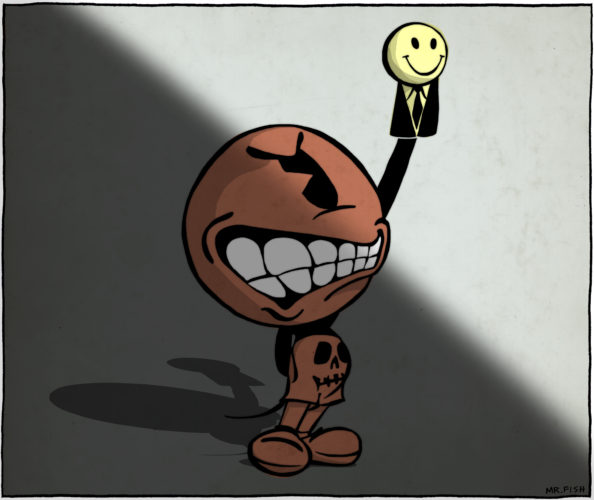
Mr. Fish / Truthdig
Our democracy is not in peril—we do not live in a democracy. The image of our democracy is in peril. The deep state—the generals, bankers, corporatists, lobbyists, intelligence chiefs, government bureaucrats and technocrats—is intent on salvaging the brand. It is hard to trumpet yourself as the world’s guardian of freedom and liberty with Donald Trump blathering on incoherently about himself, inciting racist violence, insulting our traditional allies along with the courts, the press and Congress, tweeting misspelled inanities and impulsively denouncing or sabotaging bipartisan domestic and foreign policy. But Trump’s most unforgivable sin in the eyes of the deep state is his criticism of the empire’s endless wars, even though he lacks the intellectual and organizational skills to oversee a disengagement.
The deep state committed the greatest strategic blunder in American history when it invaded and occupied Afghanistan and Iraq. Such fatal military fiascoes, a feature of all late empires, are called acts of “micro-militarism.” Dying empires historically squander the last capital they have, economic, political and military, on futile, intractable and unwinnable conflicts until they collapse. They seek in these acts of micro-militarism to recapture a former dominance and lost stature. Disaster piles on disaster. The architects of our imperial death spiral, however, are untouchable. The clueless generals and politicians who propel the empire into expanding chaos and fiscal collapse are successful at one thing—perpetuating themselves. No one is held accountable. A servile press treats these mandarins with near-religious veneration. Generals and politicians, many of whom should have been cashiered or put on trial, are upon retirement given lucrative seats on the boards of the weapons manufacturers, for whom these wars are immensely profitable. They are called upon by a fawning press to provide analysis to the public of the mess they created. They are held up as exemplars of integrity, selfless service and patriotism.
After nearly two decades, every purported objective used to justify our wars in the Middle East has been upended. The invasion of Afghanistan was supposed to wipe out al-Qaida. Instead, al-Qaida migrated to fill the power vacuums the deep state created in the wars in Iraq, Syria, Libya and Yemen. The war in Afghanistan morphed into a war with the Taliban, which now controls most of the country and is threatening the corrupt regime we prop up in Kabul. The deep state orchestrated the invasion of Iraq, which had nothing to do with the attacks of 9/11. It confidently predicted it could build a Western-style democracy and weaken Iran’s power in the region. Instead, it destroyed Iraq as a unified country, setting warring ethnic and religious factions against each other. Iran, which is closely tied to the dominant Shiite government in Baghdad, emerged even stronger. The deep state armed “moderate” rebels in Syria in an effort to topple President Bashar Assad, but when it realized it could not control the jihadists—to whom it had provide some $500 million in weapons and assistance—the deep state began to bomb them and arm Kurdish rebels to fight them. These Kurds would later be betrayed by Trump. The “war on terror” spread like a plague from Afghanistan, Iraq, Syria and Libya to Yemen, which after five years of war is suffering one of the world’s worst humanitarian disasters. The financial cost for this misery and death is between $5 trillion and $8 trillion. The human cost runs into hundreds of thousands of dead and wounded, shattered cities, towns and infrastructure and millions of refugees.
Trump committed political heresy when he dared to point out the folly of unchecked militarism. He will pay for it. The deep state intends to replace him with someone—perhaps Mike Pence, as morally and intellectually vacuous as Trump—who will do what he or she is told. This is the role of America’s executive: Personify and humanize the empire. Do so with pomp and dignity. Barack Obama—who speciously reinterpreted the 2001 Authorization for Use of Military Force to give the executive the right to assassinate anyone abroad, even a U.S. citizen, deemed to be a terrorist—excelled at the game.


The removal of Trump from office would not threaten corporate power. It would not restore civil liberties, including our right to privacy and due process. It would not demilitarize the police or champion the rights of the working class. It would not impede the profits of the fossil fuel and banking industries. It would not address the climate emergency. It would not disrupt the warrantless surveillance of the public. It would not end extraordinary renditions, the kidnapping of those around the globe considered to be enemies of the state. It would not halt the assassinations by militarized drones. It would not halt the separation of children from their parents and the warehousing of these children in filthy, overcrowded conditions. It would not remedy the consolidation of wealth and power by the oligarchs and the further impoverishment of the citizenry. The expansion of our prison system and of black sites throughout the world, sites where we torture, would continue, as would the gunning down of poor, unarmed citizens in urban wastelands. Most importantly, the catastrophic foreign wars that have resulted in a series of failed states and wasted trillions of taxpayer dollars, would remain sacrosanct, enthusiastically embraced by the leaders of the two ruling parties, puppets of the deep state.
The impeachment of Trump, despite the enthusiasm of the liberal elite, is mostly cosmetic. The entire political and governmental system is corrupt. Hunter Biden was reportedly paid $50,000 a month to sit on the board of the Ukrainian gas company Burisma Holdings, although he has no training or experience in the gas industry. He had previously worked for the credit card corporation MBNA, which was one of Joe Biden’s largest campaign contributors when he was a senator from Delaware. Hunter Biden was hired by Burisma Holdings for the same reason he was hired by MBNA. His father, long a tool of corporate power and the military-industrial complex, in short the deep state, was a senator and later the vice president. Joe Biden, the Clintons and the Democratic Party leaders personify the legalized bribery that defines their rivals in the Republican Party. Corporate candidates in the two ruling parties are preselected, funded and anointed. If they do not abide by the demands of the deep state, which protects corporate interests and the management of empire, they are removed. There is even a word for it—primarying. Corporate lobbyists write the laws. The courts enforce them. There is no way in the American political system to vote against the interests of Goldman Sachs, Citigroup, AT&T, Amazon, Microsoft, Walmart, Alphabet, Facebook, Apple, Exxon Mobil, Lockheed Martin, UnitedHealth Group or Northrop Grumman.
We, the American public, are spectators. An audience. Who will be seated when the game of musical chairs stops? Will Trump be able to hold on to power? Will Pence be the new president? Or will the deep state elevate a political hack like Biden or a neoliberal apologist such as Pete Butiggieg, Amy Klobuchar or Kamala Harris to the White House? Will it draft Michael Bloomberg, John Kerry, Sherrod Brown or, God forbid, Hillary Clinton? And what if the deep state fails? What if the rot in the Republican Party, or what Glen Ford calls Trump’s “white man’s party,” is so profound it won’t sign on for the political extinction of the most incompetent president in American history? The power struggle, which includes blocking Bernie Sanders and Elizabeth Warren from obtaining the Democratic Party nomination, will make for months of great television and generate billions in advertising revenue.
The war between the deep state and Trump began the moment he was elected. Former CIA Director John Brennan and former Director of National Intelligence James Clapper—both now paid news cable commentators—along with former FBI head James Comey soon would accuse Trump of being a tool of Moscow. Intelligence agencies leaked salacious stories about “pee tapes” and blackmail, plus reports of “repeated contacts” with Russian intelligence. Brennan, Clapper and Comey were quickly joined by other former intelligence officials, including Michael Hayden, Michael Morell and Andrew McCabe. Their attacks were then amplified by former senior military leaders including William McRaven, James Mattis, H.R. McMaster, John Kelly, James Stavridisand Barry McCaffrey.
The Russia conspiracy, after the release of the Mueller report, proved to be a dud. The deep state actors, however, were re-energized by Trump’s decision to pressure the government of Ukraine to investigate Biden. Trump, this time, seems to have given his deep state enemies enough rope to hang him.
The impeachment of Trump marks a new and frightening chapter in American politics. The deep state has shown its face. It has made a public declaration that it will not tolerate dissent, although Trump’s dissent is rhetorical, mercurial and ineffectual. The effort to impeach Trump sends an ominous message to the American left. The deep state not only intends to prevent, as it did in 2016, Bernie Sanders or any other progressive Democrat from achieving power, but has signaled that it will destroy any politician who attempts to question the maintenance and expansion of empire. Its animus toward the left is far more pronounced than its animus toward Trump. And its resources to destroy those on the left are nearly inexhaustible.
The political philosopher Sheldon Wolin saw it all in his 2008 book “Democracy Incorporated: Managed Democracy and the Specter of Inverted Totalitarianism.” He wrote:
The political role of corporate power, the corruption of the political and representative processes by the lobbying industry, the expansion of executive power at the expense of constitutional limitations, and the degradation of political dialogue promoted by the media are the basics of the system, not excrescences upon it. The system would remain in place even if the Democratic Party attained a majority; and should that circumstance arise, the system will set tight limits to unwelcome changes, as is foreshadowed in the timidity of current Democratic proposals for reform. In the last analysis the much-lauded stability and conservatism of the American system owe nothing to lofty ideals, and everything to the irrefutable fact that it is shot through with corruption and awash in contributions primarily from wealthy and corporate donors. When a minimum of a million dollars is required of House candidates and elected judges, and when patriotism is for the draft-free to extol and for the ordinary citizen to serve, in such times it is a simple act of bad faith to claim that politics-as-we-now-know-it can miraculously cure the evils which are essential to its existence.
There are no internal or external checks on the deep state. The democratic institutions, including the press, that once gave citizens a voice and a say in the exercise of power have been neutered. The deep state will further the corporate consolidation of wealth and power, expand the social inequality that has thrust half of Americans into poverty or near poverty, strip us of our remaining civil liberties and feed the rapacious appetites of the military and the war industry. The resources of the state will be squandered as the federal deficit balloons. The frustration and feelings of stagnation among a disempowered and neglected citizenry, which contributed to the election of Trump, will mount.
There will come a moment of reckoning, as there has during the last few days in Lebanon and Chile. Social unrest is inevitable. Any population can be pushed only so far. The deep state, incapable of reform and determined to retain its grip on power, will morph under the threat of popular unrest into a corporatized fascism. It has at its disposal the legal and physical tools to instantly turn the United States into a police state. This is the real danger behind the deep state’s drive to impeach Trump. It is a stark message to obey or be silenced. Trump, in the end, is not the problem. We are. And if the deep state fails to rid itself of Trump it will, however reluctantly, use him to carry out its dirty work. Trump, if he manages to survive in power, will get his military parades. We will get, with or without Trump, tyranny.


Chris Hedges
Columnist
Chris Hedges is a Truthdig columnist, a Pulitzer Prize-winning journalist, a New York Times best-selling author, a professor in the college degree program offered to New Jersey state prisoners by Rutgers…
Chris Hedges


Mr. Fish
Cartoonist
Mr. Fish, also known as Dwayne Booth, is a cartoonist who primarily creates for Truthdig.com and Harpers.com. Mr. Fish's work has also appeared nationally in The Los Angeles Times, The Village Voice, Vanity…
Mr. Fish

Suddenly There Is a Debate among Democrats over U.S. Aid to Israel

November 10, 2019
Dear stan,
The cracks are starting to show in the wall of steadfast support for Israel that we are used to seeing in congress. There is suddenly a debate among Democrats over conditioning U.S. aid to Israel, with defenders of the status quo trying to play catchup. Josh Ruebner analyzed the shift saying we must support these steps in the right direction while acknowledging that none of them go nearly far enough. And Michael Arria reported on one effort to do just that as progressive organizations are pushing Bernie Sanders to turn his rhetoric of holding Israel accountable into legislative action.

Still, there will clearly be challenges. Phil wrote about how limited the debate is within the mainstream Jewish community, as evidenced by the recent J Street national conference. "The J Street conference at times seemed like a battle inside the oligarchy over which Zionism will dominate, liberal or conservative support for Israel," he wrote. It is clear the challenge to U.S. policy will have to come from elsewhere.

And meanwhile, the news remains grim from Palestine. Our week began with coverage of a leaked video showing an Israeli officer shooting a Palestinian man in the back as he walked away from the officers, his hands raised in the air. And as if to purposely prove that this disregard for Palestinian human rights begins at the very top, later in the week the Israeli Supreme Court upheld a government decision to deport Human Rights Watch’s Israel and Palestine Director Omar Shakir, over accusations that he advocates for BDS. Not only does Israel act with impunity, but it is actively moving to bar anyone who would seek to hold it accountable.

Finally, I want to be sure to point your attention to Hannah Gurman's fascinating review of Bari Weiss's book How to Fight Anti-Semitism, which contextualizes Weiss's book in the long standing debate between neoconservatives and progressives. "Ultimately, Weiss and other neoconservative analysts of contemporary anti-semitism force Jews into a cynical politics that pits Jewish survival against other movements for social justice," Gurman writes. "Progressives have a more compelling vision to offer in which a politics of solidarity addresses threats against Jewish communities not at the expense of other 'others,' but alongside them."

Thanks for reading,


Adam Horowitz
Executive Editor, Mondoweiss


The Economy?

Anyone who says, "It's the economy, stupid" is being stupid


In a new Gilded Age of massive economic inequality, "the economy" is an abstraction meant to conceal ugly reality


DAVID MASCIOTRA
NOVEMBER 9, 2019 5:00PM (UTC)
Unusual times demand unusual measures. If you value Salon's original reporting and commentary, we urge you to support it — by supporting our writers directly. Right here, right now, you can make a financial contribution to help make David Masciotra's work possible. All donations go directly to writers. 
“It’s the economy, stupid” has become a bromide of American political discourse. Ignoring that the majority of voters rarely vote according to their actual class interest, pundits and journalists continually recite the phrase that James Carville, Bill Clinton’s 1992 campaign director, coined to explain his strategy to convince the public to change presidential leadership in the middle of a recession. 
The obtuse and odious Trump priesthood is betting that Carville’s wisdom resounds in 2020, which is why whenever its members appear on television they mindlessly parrot the declaration that “the economy” is booming, or as the president himself likes to boast, “The economy is the greatest we’ve had in history.”
The Carville phrase is in desperate need of a rewrite, and here is a more accurate political law: Anyone who says “the economy” is stupid.
In a country as large as the United States, the use of one word to summarize the material, financial and fiscal life of every city, region, demographic and industry as if it operated as a collective has always been shortsighted and simpleminded. Generalizations are often sloppy, but it is particularly reckless to think and speak — not to mention govern — as if the economic situation of the impoverished South Side of Chicago were identical, or even approximately equivalent, to the economic life of the wealthy North Side. Even if one could intelligently speak of a cohesive city economy, it would require significant delusion to then imply that the “economy” of Chicago resembles that of Gary, Indiana, only a few miles away. 
A closer look through the magnifying glass reveals the elementary truth of Karl Marx’s observation that divergent class struggles sketch different economies even in the same industry, or company for that matter. Jeff Bezos and an Amazon warehouse worker who has to beg for a break to urinate do not live in the same economic universe. Yet the world’s highest paid pundits speak as if the ephemeral “economy” — as opposed to the daily reality of working people — were a thing that actually existed. 
To present their case that their favorite abstraction applies to the experience of wage earners and average voters, owners of private planes will rattle off a series of facts, figures and data points, all of which coalesce to create a statistical Potemkin village. 
Yes, the unemployment rate is at a historic low, but it does not take into account the millions of laborers who are “underemployed” — working part-time hours when they are in desperate need of full-time, salaried work — nor does it even acknowledge the existence of the large number of Americans so distraught and despondent over their own privation, and the economic devastation of their surroundings, that they have not applied for a job in a year or longer.
When President Bill Clinton worked with Newt Gingrich’s Congress to pass “Welfare to Work” reform, requiring welfare recipients, including single mothers without access to affordable child care, to enter the labor force, they demonstrated a typical condescension and paternalism toward the poor. No such lectures about “personal responsibility” were delivered to the wealthy, who were just beginning to destroy the housing market, and prepare the table for the Great Recession of 2008. The justification for “ending welfare as we know it,” to use another popular perversion of language from the 1990s, was that any job is better than no job.
That work-at-all-costs philosophy is now an unspoken guide of economic analysis in the United States. Since the crash of 2008, 75 percent of new jobs pay less than $50,000 a year, and a large percentage barely pay above minimum wage. This period of low-wage job growth, in a country where millions of people already fall under the degrading classification of “working poor,” has transformed into a second Gilded Age: Eighty-five percent of post-recession income growth has occurred among the top 1 percent of earners. 
As an indication of how Americans are surviving the Serengeti Plain of cutthroat corporate capitalism, the unemployment number means nothing. The stock market, no matter how many self-congratulatory CEOs and oblivious financial reporters declare otherwise, means the same. The richest 10 percent of Americans own 84 percent of stocks. Barring a crash, which would reverberate throughout the entire country, the daily rise and fall of Wall Street has no effect on most Americans. A good day for the Dow might lead to a better tip for the pool boy at a hedge fund manager’s third home, but it won’t have any influence on the waitress at the diner on the other side of town, the family farmer across the state, or the home health care worker helping an elderly diabetic inject his insulin — a drug he could not afford if he were not on Medicare. 
The truth is that “the economy,” as most of the commentariat discusses it, does not exist. It is an illusion, a phantom that is never quite visible. What do all of the economic forecasts mean for the 58 percent of Americans who have less than $1,000 in savings, or the 28 percent who have no savings at all? They are one misfortune away from financial obliteration. 
The Wall Street Journal recently reported that many young families have no choice but to “go deep in debt to stay in the middle class.” Whether “the economy” grows by 3 percent or 3.5 percent next quarter will have no relevance in the lives of Americans who are manically juggling thousands in credit-card debt and student-loan payments, along with the ordinary expenses of living, all while praying with every breath that their children don’t get sick, their car does not break down and their landlord does not raise the rent.
There is no “economy” for most poor and working-class Americans. There is only everyday life. 
The same is true for the whining plutocrats at the top of the American hierarchy who will feel no pain or anxiety if the stock market dips slightly or the GDP rate drops. Jamie Dimon, the CEO of JPMorgan Chase, which paid a heavy fine to avoid further punishment for its role in the collapse of the housing market; Leon Cooperman, a billionaire hedge fund manager; and Microsoft founder Bill Gates all recently broke out the world’s smallest violin to complain about their potential persecution from Elizabeth Warren’s wealth tax. If anyone could repair the reputation of Vladimir Lenin — forget Bernie Sanders — it is a group of multimillionaires and billionaires literally crying (at least in Cooperman’s case), at the mere prospect of paying more taxes while millions of Americans suffer without health care, adequate nutrition and shelter. 
Donald Trump exposed the charade of “the economy” when, after signing a massive tax cut for the wealthy, he told his friends at Mar-a-Lago, “You all just got a lot richer.”
Trump’s rare moment of honesty is a useful reminder that anyone who says “it’s the economy, stupid” is being stupid. 
Focusing on real life makes for a more intelligent conversation, and could also make for a better country. 

DAVID MASCIOTRA

David Masciotra is the author of "Mellencamp: American Troubadour" (University Press of Kentucky, 2015) and the forthcoming "I Am Somebody: Why Jesse Jackson Matters" (Bloomsbury Publishing). Contribute through LaterPay to support David's Salon articles — all money donated goes directly to the writer.
MORE FROM DAVID MASCIOTRA
https://www.salon.com/2019/11/09/anyone-who-says-its-the-economy-stupid-is-being-stupid/?utm_source=Master+Newsletter+List&utm_campaign=3771eb82e9-DAILY_W_IMAGES_AND_ADS&utm_medium=email&utm_term=0_5deda2aaa7-3771eb82e9-303728757

Trees, Plants, And Insects Speak To Us

Trees, Plants, And Insects Speak To Us – OpEd 

I was born and raised in Baguio City,  Philippines, at a time when it was more rural than anything else like a city. My great grandmother lived with us so we were taught to raise chicken, a few pigs and grew some fruit trees from avocados, guavas, cherries, to coffee. I came to know the mountains, the trees, the land, the springs where guppies thrived and green turtles perched on rocks for sunbath. I came to know of edible plants and poisonous ones. Of herbs and wildcrafting, not to mention, supposedly haunts of spirits that guarded the land and hills.
I hiked every ascent of the city and came to know where swallows lay their eggs on rock crevices, where owls peered at daytime and where the sweetest water flowed from a treasured and secret brook. I walked on the land every summer day and never got bored. Today, even as I live several miles where I was born, I still walk the land. There is always something new to see and learn. Even if I sit on my terrace overlooking trees, plants and a pond, I get to see something new and revealing. 
Just the other night, I woke up hearing a rustling at the the eave of the veranda and upon going out, was surprised to see a big bird roosting at a ledge where I keep my honey. I did not know what kind of bird it was, but it must have been very tired as it just sat and slept even with my flashlight on its feathery face.
Now and then as I write on the small table outside the bedroom window at night, all sorts of insects come, flutter, invited by the lights. Some hover over my lamp, one or two come close to the laptop and find time to sit..wondering what I was doing on the keys that don’t pay them no mind.

My bees are my regular guests. When I wake up at 2 or 3 am to write liking the chilly wisp of cold air, I disturb them, they come out from their hives and go round and around the light. And all around me too. All I do is sit still. They come and feel who I am and they let me be, never stinging or bothering me. They may think me nuts for being out past graveyard shift instead of being fast asleep but they let me be. So I ignore them as well.
Sometimes I feel they hanker for talk but that people just don’t listen or attempt to listen to them. Which makes me feel a bit guilty becuase I always proclaim the earth is alive but am short most often than not in feeling that life.
The bees, birds and insects are alive. So are plants, flowers, grass and the trees. How many of us really look down to see if these are alive?
Researches have proven that trees, flowers, weeds and grasses know more that what we know. The smell of a newly-cut grass, for instance is actually the smell of pheromones sent out by the grass. It is threatened, calling to pollinating insects. But we don’t hear it as that because we don’t know.
Do trees have consciousness, emotions, intelligence? Some researches say yes, others are quite about it, those who don’t care say no. We may never know because research is busier making bombs, beauty creams, poison and thinking of how people can become rich, instead of understanding the creations of the world. 
To me, they’re alive and they matter. The realization of the aliveness of the non-human is the crack in the paradigm, a shift from understanding nature as passive, unfeeling, and mechanical, to seeing the non-human all around us as aware, a huge something in which we, as humans, participate but can never control, that we can study, become aware of, learn about and find many patterns of translation. The assumption that plants and animals have no feelings was made by science hundreds of years ago, for convenience.
Whether I am in my garden tending to the soil or vegetables, raising seedlings or planting trees, I know that I am with life and a certain degree of communication exists, binds and exist in an unsaid dynamism. This act of translation between human and non-human happen everyday, to each and everyone of us. Unfortunately, our conscious lives are unaware of it. Everywhere, in small ways, such translation continues.
To say that plants and trees have no feelings is cultural assumption. It has no scientific basis. This assumption makes it easier to experiment on animals, easier to exploit them, hunt them, or use them as a “resource.”
This kind of thinking has resulted in the snarled mix of contradictions, beliefs, sentimentality, superiority, and fear with which humans continue to regard and portray the non-human world.

There are researches that examined plants and animals for ‘intelligence’ and revealed positive results in many new and surprising ways. Such research is finding that certain animals and plants are far more ‘intelligent’ than anyone had ever even guessed. However, intelligence is the wrong word. Consciousness is the wrong word. But science doesn’t have the right words. We have no language because plants and animals are not like humans. Such comparisons are habitual but not useful.
Nevertheless, evidence continues to grow showing that animals are smarter than humans have ever understood them to be.
Among plants and trees, they have great great sensitivity computing complex aspects of their environment and change behaviour to optimize fitness within their local environment. They can anticipate changes in weather, climate, temperature and even danger. They are also very generous, more generous than humans.. Nitrogen fixing trees sleep and fold their leaves at night and release water which they don’t need so other plants and trees and make use of the water.
Plants and trees communicate with each other through networks, warn other plants of danger, call for help, feed other plants, or put out pheromones to attract particular insects.
And even as I walk now, I am far from understanding everything what plants and trees tell us. They have been here for millions of years, they know history far more than us, if we get to know everything they have seen and experienced, it may help some of our problems now. On every walk now, a particular insect or bird flies by. I am not sure I interpret them fairly. What kind of knowledge do they have of us? Over generations, birds remember that people harm them. Trees know that people will cut them and the grass knows that man will burn them to nothingness.
The biggest, most profound and most revolutionary shift we could move to now is to live in a world where saying hello to the tree, grass, weed or any plant is a sign of deepest respect and an acknowledgment of our own lack of understanding and knowledge. Greeting a butterfly or bee buzzing by and thanking the soil and water for the life they give us.
But more than saying hello, it is acknowledging that life they have which gives us life. —- to acknowledge the limits of translation, to acknowledge our own unknowing and to acknowledge our own naivity. We are part of the world, and the world is within us as we are within an alive and enormous network of being that looks back at us. To perceive this is at once so profound and also simple. It begins with the most obvious everyday things around you. The most radical thing you can do is to look down, look around, say hello and then begin to learn what that means.
You can start doing that now.

Dr. Michael A. Bengwayan

Dr. Michael A. Bengwayan

Dr. Michael A. Bengwayan wrote for the British Panos News and Features and GEMINI News Service, the Brunei Times, and US Environment News Service. In the Philippines, he wrote for DEPTHNews of the Press Foundation of Asia, Today, the Philippine Post, and Vera Files. A practicing environmentalist, he holds postgraduate degrees in environment resource management and development studies as a European Union (EU) Fellow at University College, Dublin, Ireland. He is currently a Fellow of Echoing Green Foundation of New York City. He now writes for Business Mirror and Eurasia Review.

Geert Mak is van zijn geloof gevallen

COLUMN
MARTIN SOMMER

Geert Mak is van zijn geloof gevallen en dat is landelijk nieuws

Neo-Nazi Militia Trained by US Military


The elimination of the war crimes court is near-complete

  With Karim Khan's dismissal, the elimination of the war crimes court is near-complete Millions of people around the world will now fin...