Ze trekken gele hesjes aan om op te vallen, gehoord te worden en niet langer buitengesloten van het economische spel waarvan de gewone man het slachtoffer is. Dat doen ze al 24 weken door heel Frankrijk, in de grote steden maar ook in de kleine plaatsen. Maar wat drijft hen, welke kracht zorgt dat zij politiegeweld van rubber kogels, granaten, traangas, politiehonden, wapenstok en waterkanon trotseren? Week in week uit staan ze daar weer tot verrassing van vriend en vijand. Is het moed die hen drijft, boosheid, patriottisme? Het antwoord op deze vraag is verborgen, maar eigenlijk weten we het allemaal. Alleen wil eigenlijk niemand eraan herinnerd worden.
Opnieuw protesteren op 27 april, beter bekend als #Acte24, tienduizenden Gilets Jaunes tegen de verpauperingspolitiek van Macron. In tientallen plaatsen kleuren de straten weer geel.
In Parijs lijken de vakbonden serieus toenadering te zoeken met de Gele Gesjes, hier trekken ze samen op.
Eind december 2018 zoekt een cameraploeg van Euronews Gilets Jaunes op, ze lopen een week met hen mee, ze praten met de betrokkenen, leggen hun verhalen vast en hun voorspelling. Een zin die zij uitspreken blijft nagalmen:
‘Dit kan maanden doorgaan, we hebben niets te verliezen.’
Ieder jaar publiceert de EU via Eurostat armoedecijfers van de lidstaten. In Frankrijk leven bijna 11 miljoen mensen op of onder de armoedegrens (17% van de bevolking). Ze vertellen dit ook in de video van Euronews, zij moeten knokken om aan het eind van de maand nog voldoende eten te hebben. Gepensioneerden moeten baantjes zoeken om het hoofd boven water te houden. De lasten van het levensonderhoud gieren de pan uit. Een vrouw zegt dat ze met haar kind niet van haar inkomen kan rondkomen. ‘Ze nemen ons alles af,’ zegt een man boos.
Deze misère zorgt voor steeds meer boosheid die eens in de zoveel jaar de kop opsteekt. Deze keer is het een langdurige vreedzame volksopstand, die weleens zou kunnen ontaarden in een revolutie. Het is met andere woorden de armoede die de Gilets Jaunes drijft. Die hen voortstuwt om rotondes te bezetten, tolpoorten van de snelwegen open te zetten, massaal te protesteren. Ze doen dit in een uiterste poging zodat de zon ook voor hen zal gaan schijnen. Ze willen af van de duivel die armoede heet, hen nooit met rust laat, steeds weer in een andere gedaante opduikt en hen diep in de zorgen steekt. Het is een serieuze opgave om voor hun rechten op te komen omdat protesteren niet zonder gevaar is in Frankrijk.
Tegenover zich treffen de Gele Hesjes een nietsontziende politiemacht die straffeloos mensen letsel toebrengt. Het regime Macron geeft de verschillende politiediensten die de opstand neerslaan blijkbaar onbeperkte bevoegdheden. En daar gedragen de dienders zich ook naar. Dit is voor een zich democratie noemend land een vreemde omstandigheid. De vrijheid van meningsuiting wordt door het regime steeds meer ingeperkt met als excuus geweld van de Gilets Jaunes. Als de Franse media over de Gele Hesjes schrijven dan is dit op een badinerende toon en steeds benadrukken ze geel geweld, terwijl de werkelijke agressie afkomstig is van de politiediensten. Het is zelfs veroordeeld door de VN.
De roep om Revolutie wordt steeds sterker en steeds meer voelbaar in de straten van de Franse steden. De Gilets Jaunes hebben geen alternatief meer als er niet naar hen geluisterd wordt.
Ondertussen komt 1 mei steeds dichterbij. De dag van de Arbeid is traditiegetrouw in Frankrijk een roerige dag. Er zijn al verschillende oproepen uitgegaan om hiervan een gedenkwaardige dag te maken, want zeggen de Franse Gele Hesjes:
‘Wij schrijven geschiedenis en de rest geeft commentaar.’
First, lets establish the fact that Palestine (even according to the Jewish Torah and Literature) was never the native land of the jews. Whether the old jews invaded Palestine as migrants from Iraq along with their forefather Abraham, or from Egypt along with their Moses, or even from deep Africa where their alleged exodus originally started, the old jews were never natives of Palestine.
Now, if you want to believe in ancient Talmudic fairytales of the fevered Moses that Jehovah (the jew) suddenly popped his eyes in the Desert of Sinai to give (the already inhabited) Palestine for the “poor slaves” of Egypt, it is your problem but that has nothing to do with reality or history: the old jews (as well as the modern European invaders) are nothing more than colonizers to a land that was never ever their homeland.
It is needless to say that historically the Canaanites, Jebosites (of Jerusalem), the Hittits (of Hebron); the Amorites of Schem, and the rest of the seven nation-tribes are the original inhabitants of Palestine who dwelled this land for thousands upon thousands of years before the old jewish invasion. It is needless to say that the natives of Palestine are those who built the ancient cities (towns) of Palestine like Jerusalem, Hebron, Jericho, Schem/Nablus and the rest of the Palestinian-Canaanites twons and villages.
It is needless to state the fact that the jebosite natives of Canaan/Palestine had built Jerusalem with its paganist temple some 1500 years before any jew stepped this land.
It is clear in the Torah (Jehovah addressing Moses) talks about “their” (the other nations) land, but not “yours” or the land of the jews. And that the jews had to fight the natives of that land, and even to annihilate those natives (according to the orders of the jewish Jehovah), which they couldn’t, as it was clear from the New Testament that the natives of Palestine (the Canaanites) believed in Jesus and stayed in their land, while the jews didn’t, but plotted against him and accused him of blasphemy. and were subsequently kicked out of the land.
The Zionist-jewish justification:
But how the ancient (as well as the modern) invaders of Palestine justify their land robbery and bloody crimes against the natives including genocide? There are two keywords that can clarify the Zionist delusional way of thinking, these two words are the “promised land” and “Amalek”
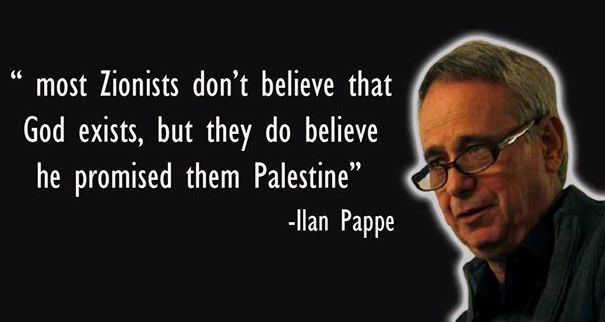
“Promised land” or “God gave us the land” are the first words the modern Zionist colonizers use to justify their ethnic cleansing of the natives and their ongoing crimes. Whether you believe their Toratic heresies or not, whether the Zionist colonizer in Palestine was ultra religious or from the far-left fringe, whether he was an ardent Zionist or a “peace dove”, none of them can justify his/her mere existence in Palestine other than through this magic word of “god gave us the land”, as if god is nothing but a real-estate agent working for others.
One evening, we sat under the stars looking at the flickering lights of Palestinian villages. Bobby Brown [A zionist settler], with a wave of his arm, said: “All the Palestinians have to leave this land. God gave this land to us, the Jews.”
This is how they justify robbing the native Chrtistian land property
Jehovahm Yehwah, YHWH, Elohim, Hashem or “god” are all various names for the same jewish “god”/ or a bush, that popped his head in the desert of Sinai to chat to the fevered or deluded Moses to give him a land that was never ever jewish land before that bush suddenly talked.
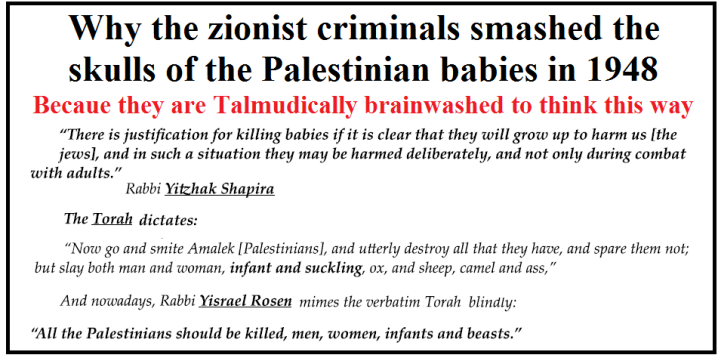
The annihilation of the Amaleks , (the original natives of Palestine) is the second keyword the Zionist-jewish mentality uses to justify the criminal acts. The Amalek and the necessity to fight and annihilate them is widely discussed among the jewish religious circles, which refers to all the non-jews especially the natives of Palestine in particular. To gain a sacred motivator for the Zionist colonial project, the jewish references have to demonize the Palestinian native (or any possible opponent of the Zionist colonial project), the jewish religious circles attribute the (amalekite) nature to Toratically justify the annihilation.
Now, whether you believe it or not, Palestine has become the “jewish homeland” and all those who oppose this heresy or when the natives fight back for their stolen homes then they are demonized as “anti-semitic” Amalekites that should be annihilated by direct orders from the jewish Jehovah.
President Putin left nothing to doubt when he proudly proclaimed that Russia and the Eurasian Economic Union regional integration organization that it leads are strategically merging with China and its Belt & Road Initiative, with this process having unprecedentedly far-reaching strategic consequences for the supercontinent and 21st-century geopolitics as a whole.
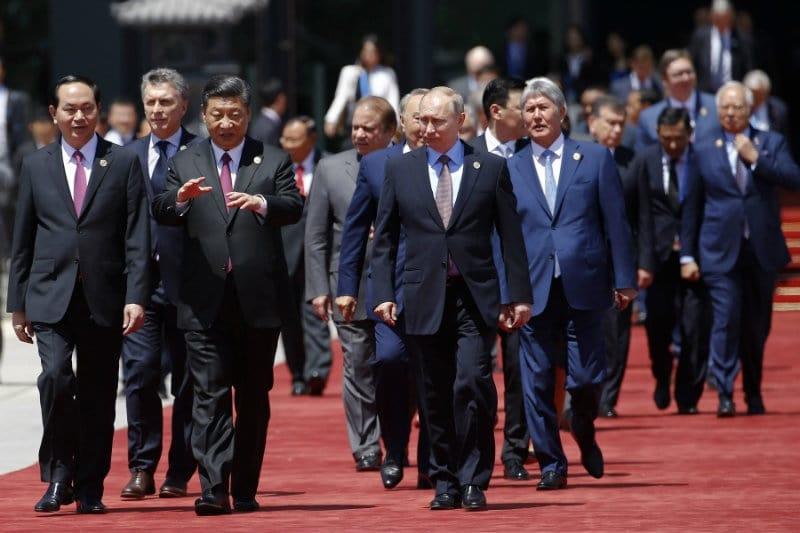
This year’s Belt & Road Initiative (BRI) Forum is a monumental event bringing together several dozen heads of state and providing a platform for the international community to better understand this world-changing vision. President Putin gave an important speech during this event that can be summarized as his proud proclamation that Russia and the Eurasian Economic Union (EAU) regional integration organization that it leads are strategically merging with China and its BRI. There’s no doubt that this process will have unprecedentedly far-reaching strategic consequences for the supercontinent and 21st-century geopolitics as a whole, which is why his entire address deserves to be analyzed in full. What therefore follows is the transcript of his speech interspersed with brief interpretations of the text in order to help the reader appreciate just how significant of an event this was and what his words might mean for the future of Russian grand strategy:
Passage:
“President Xi Jinping, Ladies and gentlemen,
First of all, I would like to thank my good friend President of China Xi Jinping for inviting me to attend the second Belt and Road Forum for International Cooperation. I would like to express my appreciation for the opportunity to be here in such a large representative group and to meet with each other, to discuss current issues of global development and principles of cooperation.
I have listened with great interest – as I am sure many other people in this hall have – about the principles and goals of China’s development, that is, how the People’s Republic of China, the world’s largest economy today in terms of purchasing power parity, is planning to develop and build relationships with its partners. This is of fundamental importance both for Russia and, I am sure, for many of our colleagues who have gathered here in Beijing today.”
Interpretation:
When China talks, the world listens.
Passage:
“It is obvious that the implementation of this ambitious project, Belt and Road, promoted by our Chinese colleagues, is aimed at strengthening the constructive cooperation of the Eurasian states. Its truly unifying goal is to ensure harmonious and sustainable economic development and economic growth throughout the Eurasian space.
Russia has emphasised on numerous occasions that PRC President’s Belt and Road initiative rimes with Russia’s idea to establish a Greater Eurasian Partnership, a project designed to ‘integrate integration frameworks’, and therefore to promote a closer alignment of various bilateral and multilateral integration processes that are currently underway in Eurasia.”
Interpretation:
China’s Silk Road vision of Eurasian integration is complementary to Russia’s Greater Eurasian Partnership, with the key concept being that both Great Powers are now ready to “integrate (their) integration frameworks”, which confirms what the Russian Ambassador to China said earlier this month and strongly implies Moscow’s unstated but de-facto participation in BRI’s flagship project of CPEC, too.
Passage:
“Russia is ready to undertake efforts for creating a transparent and enabling environment in order to promote cooperation across Eurasia.
It is important that we come up with effective ways of responding to the risks of a fragmented global political, economic and technological landscape and growing protectionism, with illegitimate unilateral restrictions imposed bypassing the UN Security Council or, even worse, trade wars as its most dangerous expressions.
It is our firm belief that only by working together can we counter urgent challenges such as decelerating economic growth, the deepening prosperity gap among nations as well as technological backwardness.”
Interpretation:
Only multilateral economic cooperation such as the sort proposed by China’s BRI and Russia’s EAU (to say nothing of these integration projects’ impending merger) can counteract the systemically destabilizing consequences of the US’ “trade war” and the “Trumpist” worldview that inspired it.
Passage:
“Let me repeat what I have said on numerous occasions: these negative trends feed terrorism, extremism and illegal migration flows, causing old regional conflicts to resurface and new ones to emerge.”
Interpretation:
Russian President Putin, Chinese President Xi, and Prime Minister Khan of the global pivot state of Pakistan are all on the same page regarding the fact that the source of many security threats can be traced back to economic problems, hence the interest that the new Multipolar Trilateral has in pursuing the integration of the EAU, BRI, and CPEC.
Passage:
“I strongly believe that Eurasia can become a role model in devising a meaningful and positive agenda for overcoming these and other urgent international problems. Peoples of various cultures, religions and traditions have inhabited the vast Eurasian space for millennia.
Of course, there were wars and conflicts throughout the continent’s history, but sooner or later they subsided, while common sense and the natural aspiration of the people to peace and communication always triumphed at the end of the day.”
Interpretation:
Despite its diversity, Eurasia won’t be the scene of a destabilizing so-called “Clash of Civilizations” that shadowy forces are actively trying to spark, but rather the platform for a Convergence of Civilizations that will stabilize the supercontinent following the integration of the aforementioned integration frameworks (EAU, BRI, CPEC).
Passage:
“Russia is interested in the closest cooperation with all Eurasian partners on the basis of unshakable principles of respect for the sovereignty, rights and legitimate interests of each state. It is on these principles that we are building the Eurasian Economic Union, with our partners – Armenia, Belarus, Kazakhstan, and Kyrgyzstan. Soon, on May 29, the EAEU will have been in existence for five years. Over this period, a common market has been created, and conditions are being created to ensure the free movement of goods, services, capital and labour.
Common markets have been formed, as well as a common digital space.
In his remarks just now, President Xi Jinping spoke about linking his initiatives with similar ones and with other associations that are forming in our vast space. This absolutely fits into our plans. The EAEU states are actively working to strengthen industrial and technological cooperation, to build efficient transport and logistics chains. And we, too, together with our Chinese friends, with all our partners, will talk more during our meetings today and tomorrow, we will continue coordinating this work, work of a global nature.”
Interpretation:
The Russian-led EAU is the core of Moscow’s supercontinental integration strategy, and it perfectly dovetails with China’s BRI.
Passage:
“We also continue pursuing the policy of harmonising our monetary and fiscal policies. At the same time, the Eurasian Economic Union strives for the widest possible cooperation with all interested countries and associations. I am primarily referring to the People’s Republic of China, the country we consider to be our key supporter, our natural partner in the integrated development of the continent.
The five EAEU member states have unanimously supported the idea of pairing the EAEU development and the Chinese Silk Road Economic Belt project. The agreements reached in this regard are being successfully implemented. In the coming months, the Agreement on Trade and Economic Cooperation between the EAEU and China will enter into force.”
Interpretation:
The EAU will continue harmonizing its economic strategy with China, Russia’s key supporter and natural partner in jointly integrating Eurasia, with more cooperation agreements to be forthcoming.
Passage:
“The Eurasian Union is committed to liberalising economic ties with its other partners as well, and has already signed a free trade agreement with Vietnam and a provisional agreement with Iran paving the way to the creation of a free trade area. The preparation of similar instruments with Singapore and Serbia is nearing completion, and talks are underway with Israel, Egypt and India.
We cooperate actively with the Shanghai Cooperation Organisation and the Association of Southeast Asian Nations.
We undoubtedly stand for expanding business ties with the European Union, our long-standing and traditional partner, in a constructive and equitable manner. Even if there are currently some differences between us, they cannot and should not cast a shadow on our shared responsibility for the future of Europe and all of Eurasia.”
Interpretation:
Russia’s Greater Eurasian Partnership vision is truly all-encompassing and seeks to spread multipolarity into every corner of the supercontinent, even doing what most observers had hitherto thought to be politically impossible by connecting Iran and its hated “Israeli” foe togetherthrough the same multilateral trade framework of the EAU.
Passage:
“Let me emphasise that the Great Eurasian Partnership and Belt and Road concepts are both rooted in the principles and values that everyone understands: the natural aspiration of nations to live in peace and harmony, benefit from free access to the latest scientific achievements and innovative development, while preserving their culture and unique spiritual identity. In other words, we are united by our strategic, long-term interests.
I strongly believe that the comprehensive approach that underpins both concepts will help us further enhance economic cooperation within the continent, develop shared transport and energy infrastructure and promote digital technology. This way, integration will serve the interests of our peoples and all Eurasian nations to the fullest extent.”
Interpretation:
“Win-win” isn’t high-sounding rhetoric exclusive to the Chinese, but is a credible Eurasian-wide vision that can ultimately improve the living standards of the supercontinent’s many people if it’s successfully pursued by all nations in full coordination with one another.
Passage:
“Once again, I would like to thank our partners, our Chinese friends for this initiative. Thank you for your attention.”
Interpretation:
No one should ever forget that while the vision of “win-win” is completely inclusive, it wouldn’t be possible to seriously implement in practice had it not been for China’s BRI, therefore making the People’s Republic the core of this paradigm-changing 21st-century process that’s poised to irreversibly revolutionize global geopolitics.
With only days to go before the final EU debate and vote on the new Copyright Directive (we’re told the debate will be at 0900h CET on Tuesday, 27 March, and the vote will happen at 1200h CET), things could not be more urgent and fraught. That’s why today’s announcement by Poland’s Platformy Obywatelska—the second-largest party in the European People’s Party (EPP) bloc—is so important.
Platformy Obywatelska has said that it will vote to block the entire Copyright Directive unless Article 13—a ground-breakingly terrible Internet law that will lead to widespread filtering of all Europeans’ Internet speech, images, and videos—is stricken from the final draft.
EPP, a coalition of European national political parties, is the key backer of Article 13 and the largest party in the European Parliament. Without its support, Article 13 is very unlikely to make it through the final vote.
The EPP is deeply split on the issue. EPP parties from Luxembourg, Sweden and the Czech Republic all oppose the measure, so Poland is in good company.
The other blocs that strongly back Article 13 are the S&D (socialist) and ALDE (liberal) MEPs.
This could be the final battle over the Directive. If it dies in Tuesday’s vote, there will be no chance to bring it back before EU elections in May. This is no time to sit on the sidelines. Step up and be heard. They have the money, but we have the people!
Cory Doctorow is a science fiction author, activist, journalist and blogger — the co-editor of Boing Boing and the author of young adult novels like HOMELAND, PIRATE CINEMA and LITTLE BROTHER and novels for adults like RAPTURE OF THE NERDS and MAKERS. He is the former European director of the Electronic Frontier Foundation and co-founded the UK Open Rights Group. Born in Toronto, Canada, he now lives in London.