Zoeken in deze blog 🔎🔎

zondag 1 juli 2018

Elsevier: 'Shell is staat in de staat'

Oliegigant Shell is staat in de staat

Met zijn enorme omvang, buitenlandse ‘ambassades’ en ‘regeringsvliegtuigen’ lijkt oliereus Shell eerder op een staat dan op een bedrijf. De grootste bondgenoot is het land waar het hoofdkantoor staat: Nederland. Politici en diplomaten zijn er kind aan huis.
Wie is machtiger: Mark Rutte of Ben van Beurden? Als het salaris een indicatie is, dan legt de minister-president van Nederland het zonder enige twijfel af tegen de hoogste baas van oliereus Shell. Van Beurden – goed voor 8,9 miljoen euro per jaar – verdient 56 keer zoveel als Rutte, die voor zijn werk dit jaar iets meer dan 159.000 euro op zijn bankrekening krijgt bijgeschreven.
Over de grote macht van Van Beurdens bedrijf in Nederland bestaat weinig twijfel. Shell kan qua omvang de vergelijking met de rijksoverheid moeiteloos doorstaan (zie de animatie hieronder). Qua vliegtuigen wint de top van Shell (vier) het van het kabinet (één).
720p geselecteerd als afspeelkwaliteit
00:00
   
01:16
720p geselecteerd als afspeelkwaliteit
00:00
   
01:16

Zevende bedrijf op aarde

Het olie- en gasconcern voert elk jaar opnieuw, met gemak, de top-500 van grootste bedrijven van Elsevier Weekblad aan. In Nederland is het in 1907 opgerichte bedrijf buiten­categorie. In de lijst van grootste bedrijven ter wereld van zakenblad Forbes staat het op de zevende plaats.

Het bedrijf is internationaal een factor van belang – iets wat je van Nederland anno 2018 moeilijk kunt zeggen. De aanzwellende kritiek op het fossiele DNA van Shell doet daar (vooralsnog) weinig aan af. Dat het hoofdkantoor van de Nederlands-Britse multi­national in Den Haag staat, verschaft Nederland aanzien en zorgt, direct en indirect, voor tienduizenden banen. Daar doet Den Haag graag wat voor terug.

Diplomaten gedetacheerd

Olievoorraden bevinden zich vaak onder de grond van instabiele landen zoals Irak en Nigeria. Het ministerie van Buitenlandse Zaken biedt Shell graag de helpende hand, net bij andere grote bedrijven. Maar de samenwerking met het concern gaat verder. Diplomaten worden geregeld gedetacheerd bij het bedrijf.
Doel ervan, in de woorden van de toenmalige ministers Uri Rosenthal (Buitenlandse Zaken, VVD) en Maxime Verhagen (Economische Zaken, CDA) in 2011: ‘het opbouwen van kennis en een beter begrip van de sector’. De huidige ambassadeur in het Verenigd Koninkrijk, Simon Smits, was van 2006 tot 2008 gedetacheerd senior adviseur overheidsrelaties bij Shell.

Sancties niet ten koste van Shell

Toen er in 2006 sprake was van sancties tegen olieproducent Iran, wilde Nederland die alleen steunen als Shell daarvan niet de dupe werd. ‘De Nederlandse regering steunt gerichte acties tegen Iran, maar geen acties die Shells activiteiten daar beperken,’ schreef een Amerikaanse diplomaat uit Den Haag in een in 2010 via Wikileaks uitgelekt ambtsbericht.
Moeite om zijn belangen onder de aandacht van Tweede Kamer en Trêveszaal te brengen, heeft Shell dus niet. Dat Shell zijn belangen veilig probeert te stellen, is niet vreemd. Dat doet het wereldwijd opererende concern ook niet alleen in Nederland. Het bedrijf heeft een afdeling ‘government relations’ – een soort diplomatieke dienst die contacten met regeringen onderhoudt in de landen waar het zakendoet. In dat opzicht vertoont Shell trekken van een staat.

Rutte bellen

Ook in Brussel en Washington heeft Shell een stevige delegatie. Volgens het Transparantieregister van de Europese Unie werken er in Brussel onder leiding van hoofd EU-zaken Ivan Martin zeventien mensen. Shell trekt ruim 4,5 miljoen euro per jaar uit voor de aanwezigheid in de Europese hoofdstad.
Ook in Nederland heeft Shell zijn lobby goed op orde. Werkgeversclub VNO-NCW waakt vanuit de Haagse Malietoren over de belangen van Shell en andere grootbedrijven.
Shell is daarnaast ook lid van de Dutch Trade and Investment Board, volgens de eigen website een ‘belangrijk adviesorgaan van het kabinet’, waar grote ondernemingen en ministeries praten over onderwerpen als de versterking van de concurrentiepositie van het land. En als het nodig is, kan Ben van Beurden de premier natuurlijk ook persoonlijk bellen.

Ministers werkten voor Shell

Wat opvalt, is de persoonlijke verwevenheid van Shell en het landsbestuur: oud-medewerkers van Shell belanden op het pluche, oud-bewindslieden stappen na gedane zaken over naar Shell.
Het huidige kabinet telt drie ministers die eerder in hun loopbaan op de loonlijst van het beursgenoteerde concern stonden. Zij kennen het bedrijf van binnenuit. Het gaat om minister van Financiën Wopke Hoekstra (CDA), minister voor Buitenlandse Handel Sigrid Kaag (D66) en minister van Economische Zaken Eric Wiebes (VVD), tevens verantwoordelijk voor het netelige Groningse aardgasdossier, waar Shell als aandeelhouder van de Nederlandse Aardolie Maatschappij (NAM) bij betrokken is.

To Remember!

'Rebuilding America's Defenses' and the Project for the New American Century
by Bette Stockbauer
June 18, 2003


"Rebuilding America's Defenses (RAD)" is a policy document published by a neoconservative Washington think tank called the Project for the New American Century (PNAC). Its pages have been compared to Hitler's Mein Kampf in that they outline an aggressive military plan for U.S. world domination during the coming century. And just as Hitler's book was not taken seriously until after his catastrophic rise to power, so it seems that relatively few Americans are expressing alarm at this published document that is a blueprint for many of the present actions of the Bush administration, actions which have begun to destabilize the balance of power between the nations of the world.

There is, indeed, much reason for alarm because PNAC is not an ordinary think tank and "RAD" is not an ordinary policy paper. Many PNAC members now hold key positions in the White House, Defense and State Departments, among them Dick Cheney, Donald Rumsfeld, Paul Wolfowitz, Richard Perle, Elliot Abrams, Lewis Libby, and John Bolton, along with others in lesser positions. William Kristol, writer for the conservative magazine, the Weekly Standard, is chairman of the group.

Some of these men have been advocating for a strong military posture since the ending of cold war hostilities with the Soviet Union. Wishing to capitalize on the fact that the US had emerged as the world's preeminent superpower, they have lobbied for increases in military spending in order to establish what they call a Pax Americana that will reap the rewards of complete military and commercial control of land, sea, air, space, and cyberspace. This, they said, would be accomplished by the waging of "multiple simultaneous large-scale wars" and one of their first orders of business was always the removal of Saddam Hussein, thereby giving the US a toehold in the oil-rich Middle East.

During the Clinton presidency, when the Republicans were out of power, this militaristic wing in American politics became highly organized and efficient. They formed the PNAC in 1997 And published "RAD" in September 2000. Determined to have their world empire, they offered an eerie prophecy on page 52 of that document about how it might be accomplished, "Further, the process of transformation, even if it brings revolutionary change, is likely to be a long one, absent some catastrophic and catalyzing event – like a new Pearl Harbor." Their dream of a catalyzing event could not have been better actualized than in the events of 9/11.

Although there could have been many responses to the tragedy of 9/11, the Bush administration seized upon that event to mold public opinion into accepting many ideas embodied in "RAD". The overthrow of Saddam Hussein, was being proposed by Rumsfeld and Wolfowitz one day after 9/11, even before anyone knew who was responsible for the attacks. As soon as the war against Afghanistan was completed, the focus of US policy became regime change in Iraq, with all of the tragic consequences we are now seeing in that country.

Policies advocated in "RAD" are being enacted with terrifying speed, such as denigration of the UN, importance of Homeland Security, abrogation of international agreements, revamping of the US nuclear program and the spread of American military power into all corners of the globe by preemptive engagement. In Iraq we have seen the embodiment of "RAD" directives that call for the subjugation of regimes considered hostile to US interests and the prevention of military build-up in countries that may challenge US power. Bush's "Axis of Evil" nations Iraq, Iran and North Korea are mentioned numerous times as potential trouble spots and there is repeated insistence that the US establish military outposts in the Middle East and East Asia.

Most frightening is its complete isolation from any ideas of world unity and cooperative action. The authors appear to be intent on waging war as an answer to the problems of our planet, tragically imagining that peace can be won by enforcing American values on every other nation. A more chilling statement of the PNAC devotion to militaristic domination cannot be found than in Richard Perle's concept of "total war". "No stages," he said, "This is total war. We are fighting a variety of enemies. There are lots of them out there. All this talk about first we are going to do Afghanistan, then we will do Iraq... this is entirely the wrong way to go about it. If we just let our vision of the world go forth, and we embrace it entirely and we don't try to piece together clever diplomacy, but just wage a total war... our children will sing great songs about us years from now."

This article is a summarization of "RAD." I believe it is of importance to become familiar with this document because it is determining US policy decisions which will have far reaching repercussions for decades to come. Subject areas are arranged under three topics: A. Pax Americana, outlining the rationale for global empire, B. Securing Global Hegemony, pinpointing regions that are considered trouble spots for US policy, C. Using the Military to Gain Empire, outlining military plans for complete world domination. My personal comments are in italics; page numbers are from the original document. See URLs at the end for further reading. 

A. Pax AmericanaThe building of Pax Americana has become possible, claims "RAD," because the fall of the Soviet Union gave the United States status as the world's preeminent superpower. Consequently the US must now work hard, not only to maintain that position, but to spread its military might into geographic areas that are ideologically opposed to its influence, waging "multiple simultaneous large-scale wars" to subdue countries that may stand in the way of US global preeminence. Rationales offered for going to war with other nations are the preservation of the "American peace" and the spread of "democracy."
On Preserving American Preeminence
"It is not a choice between preeminence today and preeminence tomorrow. Global leadership is not something exercised at our leisure, when the mood strikes us or when our core national security interests are directly threatened; then it is already too late. Rather, it is a choice whether or not to maintain American military preeminence, to secure American geopolitical leadership, and to preserve the American peace" (p. 76).

"The Cold War world was a bipolar world; the 21st century world is – for the moment, at least – decidedly unipolar, with America as the world's 'sole superpower.' America's strategic goal used to be containment of the Soviet Union; today the task is to preserve an international security environment conducive to American interests and ideals. The military's job during the Cold War was to deter Soviet expansionism. Today its task is to secure and expand the 'zones of democratic peace;' to deter the rise of a new great-power competitor; defend key regions of Europe, East Asia and the Middle East; and to preserve American preeminence through the coming transformation of war made possible by new technologies" (p. 2).

Four Vital Missions
"RAD" lists four vital missions "demanded by US global leadership":

"Homeland Defense. . . . the United States . . . must counteract the effects of the proliferation of ballistic missiles and weapons of mass destruction that may soon allow lesser states to deter US military action by threatening US allies and the American homeland itself. Of all the new and current missions for US armed forces, this must have priority.

"Large Wars. Second, the United States must retain sufficient forces able to rapidly deploy and win multiple simultaneous large-scale wars and also to be able to respond to unanticipated contingencies in regions where it does not maintain forward-based forces.

"Constabulary Duties. Third, the Pentagon must retain forces to preserve the current peace in ways that fall short of conducting major theater campaigns. . . . These duties are today's most frequent missions, requiring forces configured for combat but capable of long-term, independent constabulary operations.

"Transform US Armed Forces. Finally, the Pentagon must begin now to exploit the so-called 'revolution in military affairs,' sparked by the introduction of advanced technologies into military systems; this must be regarded as a separate and critical mission worthy of a share of force structure and defense budgets" (p. 6).

". . . the failure to provide sufficient forces to execute these four missions must result in problems for American strategy. And the failure to prepare for tomorrow's challenges will ensure that the current Pax Americana comes to an early end" (p. 13).

On Usurping the Power of the UN
"Further, these constabulary missions are far more complex and likely to generate violence than traditional 'peacekeeping' missions. For one, they demand American political leadership rather than that of the United Nations, as the failure of the UN mission in the Balkans and the relative success of NATO operations there attests. Nor can the United States assume a UN-like stance of neutrality. . . . American troops, in particular, must be regarded as part of an overwhelmingly powerful force" (p. 11).

B. Securing Global Hegemony
"RAD" takes the posture that only the US should manipulate international relations and points out "trouble spots" that may cause future problems, like all of East Asia, and Iraq, Iran, and North Korea (now labeled by George Bush as the "Axis of Evil"). There is concern that several nations might come together to challenge US interests. Consequently any nation that produces nuclear weapons or engages in significant arms buildup will be viewed as a potential threat.

"America's global leadership, and its role as the guarantor of the current great-power peace, relies upon the safety of the American homeland; the preservation of a favorable balance of power in Europe, the Middle East and surrounding energy-producing region, and East Asia; and the general stability of the international system of nation-states relative to terrorists, organized crime, and other 'non-state actors.'

"A retreat from any one of these requirements would call America's status as the world's leading power into question. As we have seen, even a small failure like that in Somalia or a halting and incomplete triumph as in the Balkans can cast doubt on American credibility. The failure to define a coherent global security and military strategy during the post–Cold War period has invited challenges; states seeking to establish regional hegemony continue to probe for the limits of the American security perimeter" (p. 5).

Axis of Evil
"The current American peace will be short-lived if the United States becomes vulnerable to rogue powers with small, inexpensive arsenals of ballistic missiles and nuclear warheads or other weapons of mass destruction. We cannot allow North Korea, Iran, Iraq or similar states to undermine American leadership, intimidate American allies or threaten the American homeland itself. The blessings of the American peace, purchased at fearful cost and a century of effort, should not be so trivially squandered" (p. 75).

Iraq and the Persian Gulf
"Although the no-fly-zone air operations over northern and southern Iraq have continued without pause for almost a decade, they remain an essential element in US strategy and force posture in the Persian Gulf region. Ending these operations would hand Saddam Hussein an important victory, something any American leader would be loath to do" (p. 11).

"The Air Force presence in the Gulf region is a vital one for US military strategy, and the United States should consider it a de facto permanent presence, even as it seeks ways to lessen Saudi, Kuwaiti and regional concerns about US presence" (p. 35).

East Asia
"Raising US military strength in East Asia is the key to coping with the rise of China to great power status.

"The prospect is that East Asia will become an increasingly important region, marked by the rise of Chinese power….A similar rationale argues in favor of retaining substantial forces in Japan. In recent years, the stationing of large forces in Okinawa has become increasingly controversial in Japanese domestic politics, and while efforts to accommodate local sensibilities are warranted, it is essential to retain the capabilities US forces in Okinawa represent. If the United States is to remain the guarantor of security in Northeast Asia, and to hold together a de facto alliance whose other main pillars are Korea and Japan maintaining forward-based US forces is essential" (p. 18).

"Reflecting the gradual shift in the focus of American strategic concerns toward East Asia, a majority of the US fleet, including two thirds of all carrier battle groups, should be concentrated in the Pacific. A new, permanent forward base should be established in Southeast Asia" (p. 39).

Europe
"Despite the shifting focus of conflict in Europe, a requirement to station US forces in northern and central Europe remains. The region is stable, but a continued American presence helps to assure the major European powers, especially Germany, that the United States retains its longstanding security interest in the continent. This is especially important in light of the nascent European moves toward an independent defense 'identity' and policy; it is important that NATO not be replaced by the European Union, leaving the United States without a voice in European security affairs" (p. 16).

Regime Change
"American military preeminence will continue to rest in significant part on the ability to maintain sufficient land forces to achieve political goals such as removing a dangerous and hostile regime when necessary" (p. 61).

"America's adversaries will continue to resist the building of the American peace; when they see an opportunity as Saddam Hussein did in 1990, they will employ their most powerful armed forces to win on the battlefield what they could not win in peaceful competition; and American armed forces will remain the core of efforts to deter, defeat, or remove from power regional aggressors" (p. 10).

C. Using the Military to Gain Empire
One stated objective of "RAD" is "to outline the large, 'full-spectrum' forces that are necessary to conduct the varied tasks demanded by a strategy of American preeminence for today and tomorrow" (p. 5). Much of the document is an elucidation of those missions and includes specific recommendations about weaponry, deployment patterns, increased personnel and defense spending. It envisions a future in which the United States is in complete control of land, sea, air, space and cyberspace of planet Earth and urges a new rendition of Reagan's "Star Wars" defense shield program.

"Until the process of transformation is treated as an enduring military mission – worthy of a constant allocation of dollars and forces – it will remain stillborn" (p. 60).

"If an American peace is to be maintained, and expanded, it must have a secure foundation on unquestioned US military preeminence" (p. 4).

"In sum, the 1990s have been a 'decade of defense neglect'. This leaves the next president of the United States with an enormous challenge: he must increase military spending to preserve American geopolitical leadership, or he must pull back from the security commitments that are the measure of America's position as the world's sole superpower and the final guarantee of security, democratic freedoms and individual political rights" (p. 4).

Army
"American landpower remains the essential link in the chain that translates US military supremacy into American geopolitical preeminence. . . . Regimes are difficult to change based upon punishment alone. If land forces are to survive and retain their unique strategic purpose in a world where it is increasingly easy to deliver firepower precisely at long ranges, they must change as well, becoming more stealthy, mobile, deployable and able to operate in a dispersed fashion. The US Army, and American land forces more generally, must increasingly complement the strike capabilities of the other services. Conversely, an American military force that lacks the ability to employ ground forces that can survive and maneuver rapidly on future battlefields will deprive US political leaders of a decisive tool of diplomacy" (p. 30).

Air Force
"Because of its inherent mobility and flexibility, the Air Force will be the first US military force to arrive in a theater during times of crisis; as such, the Air Force must retain its ability to deploy and sustain sufficient numbers of aircraft to deter wars and shape any conflict in its earliest stages. Indeed, it is the Air Force, along with the Army, that remains the core of America's ability to apply decisive military power when it pleases. To dissipate this ability to deliver a rapid hammer blow is to lose the key component of American military preeminence" (p. 37).

Navy/Marine Corps 
"The end of the Cold War leaves the US Navy in a position of unchallenged supremacy on the high seas, a dominance surpassing that even of the British Navy in the 19th and early parts of the 20thcentury. With the remains of the Soviet fleet now largely rusting in port, the open oceans are America's, and the lines of communication open from the coasts of the United States to Europe, the Persian Gulf and East Asia. Yet this very success calls the need for the current force structure into question. Further, the advance of precision-strike technology may mean that naval surface combatants, and especially the large-deck aircraft carriers that are the Navy's capital ships, may not survive in the high-technology wars of the coming decades. Finally, the nature and pattern of Navy presence missions may be out of synch with emerging strategic realities. In sum, though it stands without peer today, the Navy faces major challenges to its traditional and, in the past, highly successful methods of operation" (p. 39).

Overseas Bases to Advance American Geopolitical Interests
"There should be a strong strategic synergy between US forces overseas and in a reinforcing posture: units operating abroad are an indication of American geopolitical interests and leadership, provide significant military power to shape events and, in wartime, create the conditions for victory when reinforced. Conversely, maintaining the ability to deliver an unquestioned 'knockout punch' through the rapid introduction of stateside units will increase the shaping power of forces operating overseas and the vitality of our alliances. In sum, we see an enduring need for large-scale American forces" (p. 74).

"As a supplement to forces stationed abroad under long-term basing arrangements, the United States should seek to establish a network of 'deployment bases' or 'forward operating bases' to increase the reach of current and future forces. Not only will such an approach improve the ability to project force to outlying regions, it will help circumvent the political, practical and financial constraints on expanding the network of American bases overseas" (p. 19).

Nuclear Expansion
"…of all the elements of US military force posture, perhaps none is more in need of reevaluation than America's nuclear weapons. Nuclear weapons remain a critical component of American military power but it is unclear whether the current US nuclear arsenal is well-suited to the emerging post–Cold War world. . . . there may be a need to develop a new family of nuclear weapons designed to address new sets of military requirements, such as would be required in targeting the very deep underground, hardened bunkers that are being built by many of our potential adversaries" (p. 8). If the United States is to have a nuclear deterrent that is both effective and safe, it will need to test." (pp. 7–8).

"But what should finally drive the size and character of our nuclear forces is not numerical parity with Russian capabilities but maintaining American strategic superiority – and, with that superiority, a capability to deter possible hostile coalitions of nuclear powers. US nuclear superiority is nothing to be ashamed of; rather, it will be an essential element in preserving American leadership in a more complex and chaotic world" (p. 8).

Space Command – Control of the "International Commons"
". . . control of space – defined by Space Command as 'the ability to assure access to space, freedom of operations within the space medium, and an ability to deny others the use of space' – must be an essential element of our military strategy" (p. 55).

"The ability to have access to, operate in, and dominate the aerospace environment has become the key to military success in modern, high-technology warfare. . . . How well the Air Force rises to the many challenges it faces – even should it receive increased budgets – will go far toward determining whether US military forces retain the combat edge they now enjoy" (pp. 38–39).

"Much as control of the high seas – and the protection of international commerce – defined global powers in the past, so will control of the new 'international commons' be a key to world power in the future. An America incapable of protecting its interests or that of its allies in space or the 'infosphere' will find it difficult to exert global political leadership" (p. 51).

"As Space Command also recognizes, the United States must also have the capability to deny America's adversaries the use of commercial space platforms for military purposes in times of crises and conflicts. Indeed, space is likely to become the new 'international commons', where commercial and security interests are intertwined and related. (Pp. 54–55).

Star Wars
"Building an effective, robust, layered, global system of missile defenses is a prerequisite for maintaining American preeminence" (p. 54).

". . . effective ballistic missile defenses will be the central element in the exercise of American power and the projection of US military forces abroad. Without it, weak states operating small arsenals of crude ballistic missiles, armed with basic nuclear warheads or other weapons of mass destruction, will be in a strong position to deter the United States from using conventional force, no matter the technological or other advantages we may enjoy. Even if such enemies are merely able to threaten American allies rather than the United States homeland itself, America's ability to project power will be deeply compromised" (p. 12).

Cyberspace or 'Net War'
"If outer space represents an emerging medium of warfare, then 'cyberspace', and in particular the Internet hold similar promise and threat. And as with space, access to and use of cyberspace and the Internet are emerging elements in global commerce, politics and power. Any nation wishing to assert itself globally must take account of this other new 'global commons'.

"Although many concepts of 'cyber-war' have elements of science fiction about them, and the role of the Defense Department in establishing 'control', or even what 'security' on the Internet means, requires a consideration of a host of legal, moral and political issues, there nonetheless will remain an imperative to be able to deny America and its allies' enemies the ability to disrupt or paralyze either the military's or the commercial sector's computer networks. Conversely, an offensive capability could offer America's military and political leaders an invaluable tool in disabling an adversary in a decisive manner.

"Taken together, the prospects for space war or 'cyberspace war' represent the truly revolutionary potential inherent in the notion of military transformation. These future forms of warfare are technologically immature, to be sure. But, it is also clear that for the US armed forces to remain preeminent and avoid an Achilles Heel in the exercise of its power they must be sure that these potential future forms of warfare favor America just as today's air, land and sea warfare reflect United States military dominance" (p. 57).

Future Forms of Warfare, Including Biological
"Future soldiers may operate in encapsulated, climate-controlled, powered fighting suits, laced with sensors, and boasting chameleon-like 'active' camouflage. 'Skin-patch' pharmaceuticals help regulate fears, focus concentration and enhance endurance and strength. A display mounted on a soldier's helmet permits a comprehensive view of the battlefield – in effect to look around corners and over hills – and allows the soldier to access the entire combat information and intelligence system while filtering incoming data to prevent overload. Individual weapons are more lethal, and a soldier's ability to call for highly precise and reliable indirect fires – not only from Army systems but those of other services – allows each individual to have great influence over huge spaces. Under the 'Land Warrior' program, some Army experts envision a 'squad' of seven soldiers able to dominate an area the size of the Gettysburg battlefield – where, in 1863, some 165,000 men fought" (p. 62).

"Although it may take several decades for the process of transformation to unfold, in time, the art of warfare on air, land, and sea will be vastly different than it is today, and 'combat' likely will take place in new dimensions: in space, 'cyber-space,' and perhaps the world of microbes. Air warfare may no longer be fought by pilots manning tactical fighter aircraft sweeping the skies of opposing fighters, but a regime dominated by long-range, stealthy unmanned craft. On land, the clash of massive, combined-arms armored forces may be replaced by the dashes of much lighter, stealthier and information-intensive forces, augmented by fleets of robots, some small enough to fit in soldiers' pockets. Control of the sea could be largely determined not by fleets of surface combatants and aircraft carriers, but from land and space based systems, forcing navies to maneuver and fight underwater. Space itself will become a theater of war, as nations gain access to space capabilities and come to rely on them; further, the distinction between military and commercial space systems – combatants and noncombatants – will become blurred. Information systems will become an important focus of attack, particularly for US enemies seeking to short-circuit sophisticated American forces. And advanced forms of biological warfare that can target specific genotypes may transform biological warfare from the realm of terror to a politically useful tool" (p. 60).


For further reading, see "Rebuilding America's Defenses" on the PNAC website at:

http://newamericancentury.org/RebuildingAmericasDefenses.pdf.

There is a website devoted exclusively to articles and information about PNAC at: 

http://pnac.info/

Truthout and Information Clearing House have many enlightening articles about the PNAC. See especially "Blood Money" by William Rivers Pitt at: 

http://truthout.org/docs_03/022803A.shtml.

See "Global Eye-Dark Passage" by Chris Floyd at:

http://www.informationclearinghouse.info/article2326.htm.
This article is followed by a long list of links to published articles about the PNAC.

Also see article by John Pilger at:

http://pilger.carlton.com/print/124759.

A longer summary of "RAD" (including more extensive quotes than here) can be found at http://gvtc.com/~mpingo/pnac.html. 

comments on this article? 

Bette Stockbauer is a writer, activist and conservationist who lives in central Texas. She has been working for issues related to peace and justice since the Vietnam era.

http://www.antiwar.com/orig/stockbauer1.html


Western Fantasies about Russia-Saudi Arabia Plot

30.06.2018 Author: Petr Lvov

Western Fantasies about Russia-Saudi Arabia Plot

5850f17

Recently, the OPEC countries and Russia (note: OPEC+) have agreed to increase oil output to a million barrels per day.
In reality, the increase will amount to approximately 600,000 barrels, as “some countries” are experiencing problems with extraction, in general. This the was a diplomatic way of referring to the situation in Venezuela, where social, political and technological problems are intensifying. The OPEC nations, in principle, are prepared to make up for the Venezuelan quota, but they require its formal agreement. This essentially means that a crisis is at hand there, and OPEC is fully aware of the fact that Venezuela will not be able to revive its oil industry in the near future.
Iran is seemingly following in Venezuela’s footsteps. As soon as sanctions on Iran are imposed, as a result of mounting pressure from the US, and chances are that these pending restrictions will resemble those in place before the conclusion of the Iran nuclear deal by Tehran and the six international intermediaries on its nuclear programme, the OPEC countries may need to make up for more than 2 million barrels by working together.
Russia is not part of this organization, but considering the fact that the Russian Federation and the USA are both leading oil producers that do not belong to the cartel, they should be taken into account. Traditionally, Americans follow an independent oil export policy, and earlier, Russia followed suit by developing a policy that was independent of OPEC’s. But as a result of the sudden fall in oil prices in 2014, which caused serious financial and economic problems in Russia, Saudi Arabia and many other countries whose earnings depend on the “oil drug”, at present, Moscow prefers to reach a consensus on quotas with the cartel, first and foremost with Saudi Arabia. Otherwise oil prices may become too unpredictable for the Russian state budget. Clearly, this issue, and not only the love of football, brought the Saudi Crown Prince Mohammad Bin Salman Al Saud to the opening of the World Cup in Moscow.
Iranians reacted to this visit quite nervously, and hinted that any “plots” to do with oil exports behind its back are simply unacceptable. Iran has clearly fallen victim to rumors, being actively spread by the West, about the “secret deal” struck by the Russian Federation and Saudi Arabia with the aim to replace OPEC with a new cartel, in which these two countries will have the final say. Tehran’s perception of any communication on this issue is also clouded by the worsening situation in the Iranian society, while Washington’s aggressiveness towards Tehran continues to intensify, and Trump is fairly close to initiating further hostilities against it, first and foremost in Syria. Americans need to isolate Tehran, as completely as possible, from any external ties, and it cannot be ruled out that during the meeting between Trump and Putin, scheduled for the middle of July, the US leader will attempt to incite tensions in the relations between Moscow and Tehran.
As for the Kingdom of Saudi Arabia, Riyadh is always ready to trip Iran over, as it views Tehran as its main rival, and perhaps even an enemy, in the region.
At present it is clear that the situational alliance between Russia and Iran in Syria is under pressure. Hence, on 21 June, the US State Department released a fairly stern warning about an immediate cessation of all military activities in the southern de-escalation zone in Syria, which was then quickly followed by an air strike against the Syrian divisions and Shiite military units near al-Tanf.
On Saudi Prince’s arrival in Moscow, many Western analysts began talking about Russia’s and Saudi Arabia’s intention to create an alternative to OPEC, which is to be run by them, since both countries are leading oil exporters but cannot get the current oil cartel to reach essential decisions on setting quotas on “black gold” extraction. Another supporting argument used by the analysts is that serious maneuvers by OPEC+ members had been anticipated even before the OPEC+ meeting in Vienna. First and foremost because apparently, Russia had been planning to force the cartel to come to a decision on substantially increasing the oil output, by 1.5 million barrels per day. In addition, references to a statement by the Head of the Ministry of Energy of the Russian Federation, Alexander Novak, were made, according to which Saudi Arabia had seemingly agreed to increase overall OPEC+ oil output by the previously mentioned amount. However, it is widely known that Riyadh agreed to increase the overall oil output, but by only 500,000 barrels per day. In response, Iran stated that it was prepared to walk out on any deals if Moscow and Riyadh agreed to increase oil outputs. Since from the viewpoint of Tehran’s officials, a rise in oil outputs and a likely decrease in oil prices at a time when Iran, under pressure from the US sanctions, cannot increase its output or sales, would lend unwitting support to Washington’s attempts, aided by Saudi Arabia, to worsen the economic situation in Iran (note: the latest public protests in Iran are proof that Iran’s problems are serious indeed). This was the message voiced by Iran’s Petroleum Minister, Bijan Namdar Zangeneh, during his speech. He did not mention that Moscow was the catalyst behind the push to increase oil outputs, but it was clear to everyone that “rocks were hurled” not only in the direction of Saudi Arabia but also Russia.
At the meeting, held on 22-23 June, the OPEC/Non-OPEC Joint Ministerial Monitoring Committee (JMMC) reached a compromise and recommended that the members could loosen restrictive measures and increase oil output starting on 1 July by 1 million barrels per day and not by 1.5 million. However, it is not as yet clear whether this decision will be supported at the meeting with more ministers in attendance. Most likely the decision will not be upheld since Bijan Namdar Zangeneh had left the committee session even before it ended, stating that the meeting was not productive. Perhaps, an agreement could have been reached even without Iran, but the number of those unhappy about the output increase has risen and includes Venezuela, Iraq and many other small exporters who, in practice, cannot raise oil outputs and will fall victim to a potential oil price decrease.
Afterwards, more rumors started circulating in the West that Russia and Saudi Arabia were apparently planning on inviting oil exporters, who took part in the agreement to limit OPEC+ outputs, to join a new oil cartel. The only feature that would distinguish the new organization from its existing equivalent would be that the leading oil producers, which include Russia and Saudi Arabia, would have more voting power, contrary to OPEC’s principle of “one country, one vote”. The Bloomberg Agency even maintained that Russia sorely needs such an organization in order to manipulate oil outputs and prices to meet the needs of its budget. Saudi Arabia’s purpose in this “plot” would be to ensure Iran’s weakened influence and isolation, which leads to the conclusion that Moscow would be willing to cooperate with pro-US Riyadh and not with its traditional ally Tehran in this endeavor.
The fact that this is not true, but yet another red herring from Western oil analysts, is supported by the fact that the consequences of such a “plot” would be far too transparent to the other OPEC participants. Hence, hoping for a mass defection of exporters to this new organization is far-fetched, especially since not only Iran, Iraq and Venezuela, but also Qatar, Ecuador and other oil exporting countries, would oppose such a “cartel within a cartel” structure. Clearly, these nations extract much less petroleum than Saudi Arabia or Russia, but once they embark on a course to increase oil outputs in the long-term, it could lead to a price catastrophe on the market.
Thus this fictitious “super OPEC” will most likely remain just a figment of Western imagination, only because a failing organization for regulating oil prices along the lines of the Forum of countries, established by natural gas exporters in Doha in 2008 and meant to become an “OPEC gas equivalent” but yet to have any real effect on the gas market, is simply a burden to the leading oil producers. Not to mention the fact that Russia is firmly against any “plots” behind its partners’ backs, especially those that are as politically important to Moscow as Iran and Venezuela are. The Russian Federation has little interest in an economic crash there with the resulting internal political instability. Tehran should, certainly, not take Western rumors to heart, especially since they are being deliberately spread by the West in order to drive a wedge between Russia and Iran.

Pyotr Lvov, Ph.D in political science, exclusively for the online magazine “New Eastern Outlook.”

https://journal-neo.org/2018/06/30/western-fantasies-about-russia-saudi-arabia-plot/


https://journal-neo.org/2018/06/30/western-fantasies-about-russia-saudi-arabia-plot/

De Oude Waanvoorstellingen van Nieuw Rechts


Foto: Youtube

‘Cultuurmarxisme’: de oude waanvoorstellingen van Nieuw Rechts

Geplaatst door redactie socialisme.nu, donderdag 21 juni 2018, 16:34 

Het afgelopen jaar zijn de netwerken rond Forum voor Democratie (FvD) en The Post Online (TPO) bezig geweest om de ‘cultuurmarxisme’-theorie te lanceren in het publieke debat. Tegenwoordig is de term vooral bekend als centraal leerstuk van de Amerikaanse neofascistische ‘alt-right’-beweging. Voor naziterrorist Anders Breivik vormde het het ideologische raamwerk om tientallen sociaal-democratische jongeren te vermoorden op Utøya. 

Door Jeroen van der Starre 

Gelukkig kan het Nederlandse publiek nu ook kennis nemen van deze onfrisse ideeën en wel in boekvorm. Paul Cliteur, de voorzitter van het ‘wetenschappelijk instituut’ van FvD gaf een bundel over het onderwerp uit, waarin verschillende auteurs in dertien hoofdstukken onthullen dat de ‘cultuurmarxisten’ de westerse wereld hebben overgenomen.1 

Cliteur

In het eerste hoofdstuk voert Cliteur het ‘cultuurmarxisme’ terug op de ideeën van de Italiaanse marxist Antonio Gramsci. Hij beroept zich hierin op de autoriteit van de ‘alt-right’-trol Milo Yiannopoulos, die in zijn boek Dangerous enkele alinea’s aan Gramsci wijdt. Cliteur en Yiannopoulos stellen dat Gramsci afscheid nam van het idee van revolutie door werkende mensen en zich in plaats daarvan zou hebben gericht op de ‘vernietiging’ van de westerse cultuur.2 

De Frankfurter Schule – een groep neomarxistische filosofen en sociologen – zouden in navolging van Gramsci de babyboom-generatie hebben gehersenspoeld met absurde ideeën. Zo hebben zij mensen laten geloven in het bestaan van racisme en klimaatverandering. Babyboomers ‘hebben op school, op televisie, via popmuziek en tal van andere kanalen, onbewust de beginselen van de kritische theorie ingelepeld gekregen: ‘diversiteit’, ‘klimaat’ en ‘racisme’ (p24). 

Er wordt geen poging gedaan om enig bewijs te leveren voor de stelling dat deze kleine groep denkers de scholen, media en zelfs muziekindustrie onder controle hadden. Hoe ze daarin slaagden blijft ook onduidelijk. En dat de Frankfurters geen goed woord over hadden voor popmuziek of televisie doet kennelijk niet ter zake. Of het was slechts een afleidingsmanoeuvre, want ‘ontmaskering’ is volgens Cliteur de grootste bedreiging voor het ‘cultuurmarxisme’: 

Links voelt zich nu uitgedaagd door de term ‘cultuurmarxisme’, omdat men het onaangename gevoel krijgt dat men ontmaskerd wordt. Het ging nou net zo lekker, we kregen de media in handen, de universiteiten en de kranten – en nu wordt er op ons gelet. Misschien als afleidingsmanoeuvre toch maar eens de P.C. Hooft-prijs naar Leon de Winter. (40) 

De ‘cultuurmarxistische’ indoctrinatiecampagne leidde tot het ontstaan van postmodernisme, cultuurrelativisme, identiteitspolitiek, ‘criminalisering’ van islamofobie en het overnemen van de ‘islamistische strategie’ om islamkritiek als racisme te bestempelen (26-7). De kern is volgens Cliteur dat het ‘cultuurmarxisme’ deze middelen inzet als ‘strategieën om de democratie te ondermijnen’ en dat is ook waarom ‘cultuurmarxisten’ bijvoorbeeld zo’n groot voorstander zijn van jihadistisch terrorisme (29). 

Welkom in de waanzin 

Na dit al behoorlijk bizarre en feitenvrije relaas van Cliteur betreden we pas werkelijk het rijk van de waanzin: bij Sid Lukkassen hebben we de logica in zijn geheel achter ons gelaten en bij Wim van Rooy – bekend van zijn pleidooi om moslims op grote schaal te deporteren – hebben we de bodem bereikt en blijven quasifilosofische dronkenmanspraat en racistische paranoia over. 

De meeste auteurs herhalen dezelfde riedel over Gramsci en de Frankfurters en ondertussen wordt de lijst van veronderstelde ‘cultuurmarxistische’ actoren, misdaden en strategieën langer en langer. 

De cultuurmarxisten zijn niet alleen socialisten of zelfs sociaal-democraten, maar een hele lijst van figuren en instellingen die over het algemeen weinig met elkaar te maken hebben of ideeën vertegenwoordigen die elkaar uitsluiten. 

In de academische wereld wordt hiermee de menswetenschappen als zodanig bedoeld, en existentialistische filosofen, psychoanalytici, poststructuralisten en zelfs de katholieke filosoof Taylor. Verder gaat het bijvoorbeeld om Angela Merkel, Emmanuel Macron, de surrealisten, de KGB, koningin Máxima, het feminisme, Ernest Hemingway, de Wereldraad van Kerken, de counterculture van eind jaren 60, de Europese Unie en natuurlijk die eeuwige ‘postmoderne bankiers’ en ‘kosmopolieten’ (208) – welke complottheorie kan zonder? 

Zelfs de meest basale beweringen die de auteurs doen zijn uit de lucht gegrepen. De verschillende spelers hebben meestal niets elkaar of met Marx of Gramsci te maken. Een deel van hen – zoals de eerste golf feministen en de surrealisten – konden Gramsci trouwens ook helemaal niet hebben gelezen. Deze schreef zijn gevangenisgeschriften tussen 1929 en ’35 en ze werden pas in de loop van de jaren 50 in het Italiaans gepubliceerd, Engelse vertalingen volgden in de jaren 70. De Frankfurter Schule werd in 1924 opgericht, het eerste surrealistische manifest is uit hetzelfde jaar. Waarschijnlijk is dat waarom de auteurs regelmatig beweren dat Gramsci zijn ideeën over hegemonie al in 1920 zou hebben geformuleerd. 

Maar laten we ons vooral niet laten hinderen door feiten en het betoog van de auteurs vervolgen. De ‘cultuurmarxisten’ – om begrijpelijke redenen meestal ‘men’ genaamd – hebben de universiteiten, de gerechtshoven, de media, internationale verdragen, politieke partijen (het ‘partijkartel’) en natuurlijk Silicon Valley in de zak. Overal verspreidt men dezelfde giftige ideologie om de westerse cultuur te ondermijnen. Linkse opiniemakers krijgen EU-subsidie om de ideeën van het kartel te verspreiden, scholen zijn ‘één grote indoctrinatiemachine’ geworden ‘waar ideologisch gemotiveerde moslims alle facetten van het onderwijs naar hun hand zetten’ (219). ‘Cultuurmarxisten’ vonden ‘racisme’ uit om zwarte mensen te vertellen dat zij onderdrukt worden en mensen tegen elkaar uit te spelen. In werkelijkheid bestaat er volgens de auteurs geen racisme en seksisme in het westen – de onderdrukkers zijn feministen en antiracisten. En moslims natuurlijk. 

De cultuurmarxisten plegen terreuraanslagen (59). Ze zetten ‘massaconsumptie’ en ‘commercialisering’ in (72, 110) om de ‘monoculturaliteit’ en ‘samenbindende tradities en vaderlandsliefde’ te ondermijnen (64). Neoliberalisme en ‘consumptiekapitalisme’ zouden het gevolg zijn van de ‘cultuurmarxistische’ ontworteling van de cultuur (56, 216). Verder is het voor de vernietiging van de ‘Avondlandse’ cultuur van belang dat het gezin wordt ondermijnd en daarom hebben de cultuurmarxisten – ongetwijfeld in hun ‘geheime burelen’ (126) – feminisme, #metoo en pedofilie (57) als wapen tegen het volk ontdekt.3 En wist u dat de Amerikaanse President Roosevelt onder invloed stond van de communisten? 

Als ‘cultuurmarxisme’ eenmaal gedefinieerd is als ondermijning van het ‘Avondland’ kan alles wat de auteurs als zodanig zien tot het ‘cultuurmarxisme’ worden gerekend. Zo wordt een neoliberaal-kapitalistisch project als de EU ineens ‘marxistisch’ en liggen volstrekt onverenigbare intellectuele tradities als marxisme en poststructuralisme ineens in elkaars verlengde. 

Islam 

De slachtoffers van het ‘cultuurmarxisme’ en het perspectief dat de auteurs aannemen is dat van de ‘islamcritici’, u weet wel: gewoon bezorgde mensen die het ‘demografisch verval’ en de ‘ethnocide op de Europese cultuur’ met lede ogen aanzien (198). 

Wim van Rooy stelt dat de islam een ‘vreemd lichaam’ is dat in zijn wezen radicaal is. De ware islam is die van Daesh (196) en stelt geweld verplicht (195). Moslims voeren een demografische jihad (203) en zijn al sinds de jaren 70 bezig met de invasie van Europa (190). 

Van Rooy sluit zich aan bij de Franse neofascist Alain de Benoist – de meest vooraanstaande vertegenwoordiger van de Nouvelle Droite – die zegt dat mensen van verschillende rassen niet kunnen samenleven. ‘Wanneer men de islam in het Westen aan het werk ziet, is die vaststelling van de Benoist blijkbaar een understatement,’ vindt Van Rooy. De ‘Umvolkung’ is in volle gang (215) en in Frankrijk vormen de ‘hordes en clans’ een ‘nieuw soort SA’ die ‘de islamofascistische banlieues regeren.’ (213) 

‘Cultuurmarxisten’ werken nauw samen met de islam, want de ondermijning van het Avondland is hun hoogste doel. Volgens Jesper Jansen willen feministen eigenlijk dat de sharia wordt ingevoerd. 

[H]et kapitalistische, oorlogszuchtige, racistische, seksistische, heteronormatieve, verkrachting-vergoeilijkende Westen moet kapot. Om dat te laten gebeuren is een nog repressiever, racistischer, seksistischer, verkrachtings-normaliserender, heteronormatiever en oorlogszuchtiger patriarchaat nodig. (268) 

Volgens Wim van Rooy is de burgeroorlog die de neofascistische complotdenkers Camus en Faye voorspellen eigenlijk al gaande (226). Er zijn maar twee kampen: het ‘volk’ – de etnisch-culturele Europeaan, voor zover deze extreem-rechts is – enerzijds, ‘links’, de islam en hun onbewuste ‘nuttige idioten’ anderzijds. Islamofobie bestaat niet en is volgens Van Rooy slechts bedoeld om hem en zijn medestrijders te ‘psychiatriseren’ – ‘de psychiatrische inrichting … is niet meer ver weg,’ voorspelt ook Derk Jan Eppink (142). 

Wie niet tegen de islam is, is voor Van Rooy een ‘islamofiel’ en dat is een veelzeggende term. In de Duitse antisemitische beweging van de late 19de eeuw werd volgens dezelfde logica het woord ‘filosemiet’ bedacht om tegenstanders van het antisemitisme mee te beschrijven: voor hen, net als voor Van Rooy, was er geen middenweg – je was voor of tegen de Joden.4 

Demagogie 

Zoals gezegd blijven de auteurs elke onderbouwing van hun beweringen schuldig. Hoewel Van Rooy oproept om de ‘complexiteit’ van de ‘feiten’ te laten spreken (223) en Jansen uitroept dat dat feminisme ‘niet-falsifieerbaar’ is, blinken de teksten in de bundel uit in bizarre drogredeneringen en verdraaiingen. Aangevoerde bronnen bewijzen nogal eens het tegenovergestelde van wat wordt beweerd. 

Het rekenwonder Jesper Jansen beweert dat de ‘technische’ daling van de misdaadcijfers in Zweden ‘de facto’ een toename laten zien, omdat die elders sneller dalen. Ook spreekt hij lovende woorden over een demonstratie van ‘(voor Zweedse begrippen) rechtse groepen’ en schande van de feministen die tegen deze groepen de straat op gingen. Dat het ging om een alliantie van voetbalhooligans en de neonazistische Nordische Verzetsbeweging die migrantenjongeren op straat in elkaar sloegen, vertelt hij er niet bij. 

Sid Lukkassen beweert dat cultuurhistoricus Thomas von der Dunk zich een ‘cultuurmarxist’ noemt, maar het filmpje dat dit moet bewijzen laat juist zien dat deze zegt dat hij ‘volgens de definitie van de vorige spreker (Sid Lukkassen, zoals het geval wil) ongetwijfeld een cultuurmarxist’ is. Als illustratie van hoe verschrikkelijk gevaarlijk de Frankfurter Schule was, vertelt Sid Lukkassen dat het instituut in maart 1933 wegens ‘staatsgevaarlijke tendensen’ werd gesloten. Dat dit samenviel met de benoeming van Hitler tot dictator en de de opening van Dachau om de politieke tegenstanders van het nazisme in op te sluiten paste kennelijk niet in zijn verhaal. 

Het gebrek aan enig bewijs voor de absurde complottheorie wordt door Sid Lukkassen op klassieke wijze wegverklaard: de ‘cultuurmarxisten’ hebben alles netjes weten toe te dekken. Het gebrek aan bewijs wordt zo zélf als bewijs voor het bestaan van de samenzwering gepresenteerd. Als voorbeeld geeft hij dat een handboek voor sociale en culturele antropologie een lemma over ‘cultuurmarxisme’ bij herdruk een wat andere titel gaf. Dat het ‘cultuurmarxisme’ in dezen gewoon duidt op de toepassing van een marxistische methodologie in cultureel onderzoek en niet op de betekenis die Lukkassen en co eraan geven, ontgaat hem kennelijk volkomen. 

Zo zijn er nog een hele reeks aan voorbeelden te noemen. De hele bundel ademt een schreeuwend gebrek aan intellectuele integriteit. Het is demagogie van begin tot eind. 

Alt-right 

Volgens de auteurs is de opkomst van de ‘cultuurmarxisme-theorie een teken van het ontwaken van het volk. Maar dat deze ‘theorie’ juist opkomt tegen de achtergrond van de gestage verzwakking van links is veelzeggend. Een veel betere verklaring is de opkomst en het toegenomen zelfvertrouwen van extreem-rechts – in het bijzonder FvD en extreem-rechtse media als TPO, waarvoor de meeste auteurs van deze bundel regelmatig schrijven. 

De inspiratie komt vooral uit de VS. Dat Cliteur zich beroept op een clown als Yiannopoulos, die nauwelijks iets over Gramsci te zeggen heeft en in zijn hele boek niet één voetnoot gebruikt, spreekt boekdelen. Yiannopoulos populariseert een gematigde versie van het ‘alt-right’-gedachtegoed.5 Mede daarom is het veiliger voor voor Cliteur veiliger om hem te citeren dan de echte theoretici van het ‘cultuurmarxisme’: Kevin MacDonald en Jared Taylor. En dat scheelt: want die beide auteurs zijn biologische racisten en MacDonald windt er geen doekjes om dat ‘cultuurmarxisme’ een Joodse samenzwering is. Het antisemitische karakter van de theorie wordt in deze bundel verzwegen, maar dog whistles als ‘kosmopolieten’ en ‘postmoderne bankiers’ zijn duidelijk genoeg. 

De theorie heeft zijn oorsprong in het klassieke fascisme. Dat zijn de redacteurs van het boek zich bewust en proberen het op ironische wijze onschadelijk te maken. Zo nemen ze een citaat uit Trouw waarin de vergelijking met de nazistische cultuurbolsjewisme-theorie in wordt gemaakt op als blurb op de achterflap. 

De eersten die de term ‘cultural marxism’ in deze zin gebruikten waren de Britse fascisten in de jaren 20 en 30 en toen al was het een vrije vertaling van het Duitse Kulturbolschewismus. 

Volgens een schrijver van de BUF [British Union of Fascists] was het de taak van het ‘cultuurmarxisme’ om de kiemen van culturele desintegratie te zaaien, omdat een klimaat van nationaal en cultureel verval het doel van revolutionair communisme zou helpen … [E]en andere cultuurcommentator van de BUF beweerde dat communisme de cultuur van seksuele promiscuïteit aanmoedigde, omdat het uit was op de vernietiging van het … gezin.6 

Ook voor Hitler was het marxisme de grote vijand. Haar internationalisme en opvatting van klassenstrijd was een bedreiging voor de ‘vaderlandsliefde’ en de ‘nationale eenheid’. 

De bolsjewisering van Duitsland betekent … de vernietiging van de hele christelijk-Avondlandse cultuur. … In erkenning van de naderende catastrofe en de ontoereikendheid van de verdedigingsmiddelen werd de NSDAP opgericht. Haar doel is in het kort: vernietiging en uitroeiing van de marxistische Weltanschauung.7 

Onze nieuwe rechtsen kijken nog uit met termen als ‘uitroeiing’, maar hun paranoia is wezenlijk dezelfde. De ‘cultuurmarxisme’-theorie is een poging om alles wat maar in de verste verte links is tot ‘volksverraders’ te kunnen verklaren en zelf in de slachtofferrol te kruipen. 

Het ‘cultuurmarxistische’ project zal volgens de auteurs leiden tot ‘strooptochten’ door bloeddorstige moslims. De ‘etnische en culturele substitutie’ van ‘blanke’ Europeanen door het ‘vreemde lichaam’ der islam, zal leiden tot een burgeroorlog (226). Feminisme leidt tot ‘verwarde metromannen’ en fragmentatie van de maatschappij. De ‘alomtegenwoordige terreur’ van de ‘politieke correctheid’ kan alleen maar leiden tot een ‘totalitaire staat’ en een ‘Europese dictatuur’ (148). Er nadert een catastrofe en de verdedigingsmiddelen zijn ontoereikend. 

Oplossingen 

Deze bundel is een duizelingwekkende presentatie van de intellectuele onkunde van de nieuw-rechtse ideologen. Maar deze randfiguren vertegenwoordigen een politieke beweging. Dat zij in deze bundel openlijk over rassen en een burgeroorlog met de islam durven schrijven is vooral een teken van zelfvertrouwen en de normalisering van hun gedachtegoed. De ‘cultuurmarxisme’-theorie dient om het autoritaire project van die beweging te rechtvaardigen. 

Paul Cliteur komt als antwoord op het ‘cultuurmarxisme’ met de term ‘weerbare democratie’: we moeten de democratie weerbaar maken tegen ondermijnende invloeden als ‘cultuurmarxisme’ en de islam. Met andere woorden: de invloed van andersdenkenden en moslims (misschien wel iedereen niet niet ‘etnisch-cultureel’ Nederlands is) moet worden geneutraliseerd. 

Het wordt niet duidelijk of we hierbij aan de maatregelen tegen het ‘staatsgevaarlijke’ marxisme uit maart 1933 moeten denken. Maar we moeten in ieder geval terug naar het anti-communisme uit de tijd van de Koude Oorlog. De praktijk in de BRD om Berufsverbote op te leggen aan communisten noemt Cliteur de ‘meest uitgewerkte vorm van “weerbare democratie”-wetgeving’ (21). Kennelijk is het idee om socialisten, feministen en andere ‘cultuurmarxisten’ te weren uit het onderwijs en publieke functies. 

Eind juni vindt het congres van de FvD-Jügend plaats, met Cliteur als spreker. De poster roept jongeren op om ‘in verzet’ te komen tegen hun linkse leerkrachten. De onmiskenbare oproep om het onderwijs te zuiveren van andersdenkenden, als eerste stap in de vernietiging van het ‘marxisme’, maakt glashelder dat we hier te doen hebben met een fascistische beweging in wording. 

We doen er goed aan om dit gevaar onder ogen te zien. De expliciete fascistische taal in deze bundel en de poging tot georganiseerde intimidatie van leerkrachten laten zien hoeveel zelfvertrouwen ‘nieuw rechts’ met slechts twee zetels in de Kamer al heeft. Hoe hun definitieve oplossingen voor de moslim- en ‘cultuurmarxisme’-vraagstukken eruit zien wachten we liever niet af. 

Paul Cliteur, e.a. (red.),
Cultuurmarxisme. Er waart een spook door het Westen.
ASPEKT 2018 / 305 pagina’s


Noten

  • 1. Bijna alle auteurs beschrijven dezelfde extreem-rechtse complottheorie, maar Boudry en Hendriks nemen afstand van die interpretatie en plaatsen zich op dat punt buiten het centrale betoog van de bundel.
  • 2. Geen van de auteurs heeft enig benul van Gramsci, wie iets over hem wil weten kan bijvoorbeeld beginnen bij Harman (1977), Gramsci versus Eurocummunism, idem (2007), Gramsci, the Prison Notebooks and Philosophy of Peter Thomas (2009), The Gramscian Moment. Leiden: Brill.
  • 3.‘Avondland’ verwijst is het ideale Europa van de Duitse Völkische beweging van na de Eerste Wereldoorlog, waarvan de nazi’s de bekendste exponenten zijn. Het ‘ideaal’ bestond uit een raciaal en cultureel gezuiverd Europa met een autoritair rijk als staatsvorm. Zie voor de geschiedenis van de Avondland-mythe: Volker Weiß (2017), Die Autoritäre Revolte. Die Neue Rechte und der Untergang des Abendlandes, Stuttgart: Klett Cotta. pp. 155-86.
  • 4. Zie bijvoorbeeld Lars Fischer (2007), The Socialist Response to Antisemitism in Imperial Germany (p18): ‘The organised political antisemites initially introduced the term to denounce their opponents and it promptly became a generally accepted shorthand to denote all those who opposed organised political antisemitism. This usage obviously signifies an equally general acceptance of the assumption that there could, on this matter, be no neutral ground. One could only be either for the Jews or against them.’
  • 5. David Neiwert (2017), Alt-America. The Rise of the Radical Right in Trumps America, pp. 214, 247.
  • 6. Thomas Linehan (2000), British Fascism, 1918-39: Parties, Ideology and Culture, p.235
  • 7. Geciteerd in Ian Kershaw (1998), Hitler 1889–1936: Hubris. p.245 Het hele Duitse citaat is te vinden op Wikipedia.


Israelis are doing to Palestinians what Nazis did to Jews

Israelis are doing to Palestinians what Nazis did to Jews during WWII – Erdogan

Israelis are doing to Palestinians what Nazis did to Jews during WWII – Erdogan
Israeli actions in Gaza are similar to those perpetrated against Jewish people during Nazi persecution, Turkish leader Recep Tayyip Erdogan said. Days earlier, he called Israel a “terrorist” and “apartheid” state.
“There is no difference between the atrocity faced by the Jewish people in Europe 75 years ago and the brutality that our Gaza brothers are subjected to,” Turkish President Erdogan said on Friday, as cited by AFP.
“The children of those being subject to all sorts of torture in concentration camps during World War II are now attacking Palestinians with methods that would put Nazis to shame,” Erdogan reiterated.
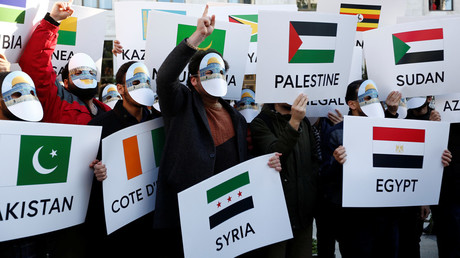
The Turkish strongman was speaking in Istanbul, where presidents, prime ministers and other dignitaries from over 40 Muslim states gathered for an emergency meeting of the Organization of Islamic Cooperation (OIC). The gathering showed support for Palestinians and condemned the inauguration of the US embassy in Jerusalem. The OIC has also pledged to create an “international peacekeeping force” to protect the Palestinians.
A long-time critic of Israel, Erdogan recently engaged in a war of words with Benjamin Netanyahu, accusing him of being “a terrorist”and leading “an apartheid state.” The Israeli premier did not mince his words either, calling Erdogan “a butcher” with reference to Turkey’s ‘Olive Branch’ operation in Syria’s Kurdish enclave of Afrin.
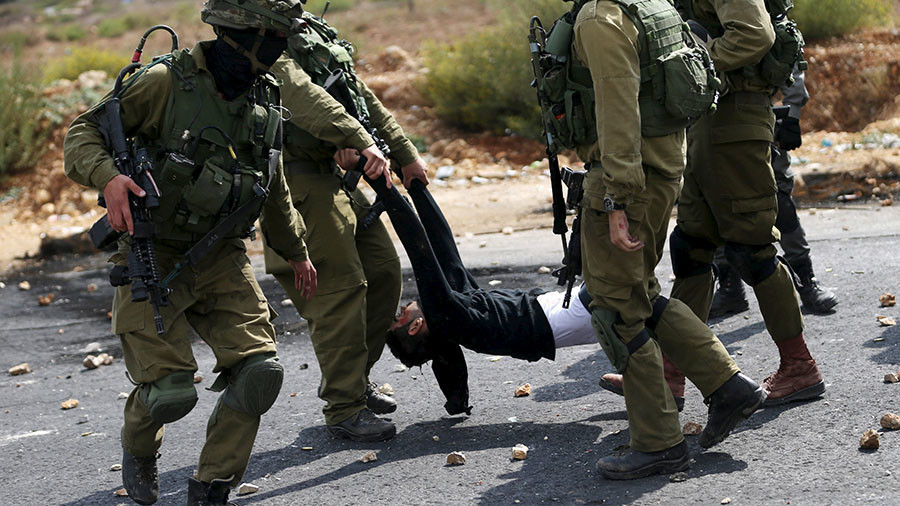
The lingering feud between Turkey and Israel escalated on the heels of renewed violence in Gaza, where massive protests erupted during the last week. At least 60 protesters were killed and over 2,700 were injured by Israeli bullets, according to the Palestinian Health Ministry.
Reacting to the spike in violence, Ankara called for Israel to be held accountable, particularly by filing a lawsuit at the International Criminal Court (ICC) in The Hague. “Israel should be taken to the International Criminal Court [over the killing of Palestinians]. Since third parties cannot do it, Palestine needs to initiate this,” Foreign Minister Mevlut Cavusoglu told state broadcaster TRT Haber on Thursday.
He also vowed to ensure “that the Israeli authorities and Israeli soldiers who point guns at defenseless people are held accountable.” His call was joined by the OIC Secretary General Yousef al-Othaimeen, who branded the Israeli actions “a war crime and a crime against humanity.” 
Responding to the Turkish proposal, Yuval Steinitz, Israel’s minister for national infrastructure, energy and water, said Turkey is “ripe” to appear in the ICC long before Israel. Recalling Turkey’s crackdown on Kurds, he said “those who live in glass houses should not throw stones.”

Genocide "is the loudest Jewish voice today"

wendz 🏴󠁧󠁢󠁳󠁣󠁴󠁿🇵🇸🇱🇧🇾🇪 @wendzedin I’m with Laith on this….it seems Rabbi Teitelbaum would certainly agree with him 🤷‍♀️ Geciteerd...