Zoeken in deze blog 🔎🔎

maandag 29 november 2010

De Nuance van de NRC 190

Dit vond de commerciele krant de NRC de meest relevante informatie informatie:


Moslimbroeders verliezen in Egypte


En dit beschouwt de mensenrechtenorganisatie Human Rights Watch de meest relevante informatie. Aan wiens kant staat u?

For Immediate Release
Egypt: Elections Marred as Opposition Barred from Polls
Violence, Arrests and Fraud Allegations Widespread
(Cairo, November 29, 2010) – Elections to Egypt’s People’s Assembly on November 28, 2010, were marred by reports that opposition supporters were barred from polling stations and subjected to violence, Human Rights Watch said today. There were reports of numerous irregularities including arrests and harassment of journalists, denial of access for opposition candidate representatives to 30 polling stations visited by Human Rights Watch across the country and widespread allegations of voter fraud.
“The authorities promised that Egyptian civil society could monitor the elections without the need for international observers,” said Joe Stork, deputy director of Human Rights Watch’s Middle East division. “Unfortunately the repeated exclusion of opposition representatives and independent monitors from polling stations, along with reports of violence and fraud suggest that citizens were not able to partake in free elections.”
Human Rights Watch did not monitor the voting or counting process and did not seek access to polling stations. Human Rights Watch representatives went to 30 polling stations in six governorates and interviewed voters, candidate representatives, as well as civil society observers and journalists outside polling stations in order to assess the human rights environment surrounding the elections.
Denial of Access for Candidate Representatives, Voters and Independent Observers
Human Rights Watch met with representatives of independent and opposition candidates outside most of these polling stations. They consistently reported that in the vast majority of cases, polling and security officials denied representatives access to polling stations when they did not have a police stamp on the notarized form identifying them as a candidate’s proxy, and in many cases even where they did have such a stamp from a police station.
By law, each candidate has the right to one representative in every polling station in his or her district and candidates had provided representatives with notarized proxies. But on the morning of voting day, polling station officials told candidate representatives that this document was insufficient and that they would need to get it stamped by the local police station. An administrative court ruling in November determined that it was sufficient to have a general proxy, that has been notarized, and that the additional authentication by the police station was not necessary.
In Hadayik el Kobba, in the east of Cairo, the Hadayik police station refused to stamp the proxies of representatives of independent candidate Amr Zaki. As a result none of the candidate’s representatives were able to enter the polling stations.
In Alexandria, Human Rights Watch observed independent candidate Osama Kamal try to enter the Mustafa Kamel polling station. Officials at the door turned him away and told him he needed another stamp from a police station.
A number of polling stations were closed for at least several hours during the day, in violation of regulations issued by the Higher Elections Committee, which ordered polls open between 8 a.m. and 7 p.m. In the Cairo neighborhood of Dokki, Human Rights Watch observed the Hoda Shaarawy polling station for women, which opened at 8 a.m. At 9 a.m. security officers forcibly removed representatives of opposition candidates. At 9:30 a.m. they closed the polling station, though a large crowd outside called on them to “open the doors.” Security officers there told Human Rights Watch representatives and a local journalist to stop filming and ordered them to move away. They did not give a reason for the closure. Around midday officers finally opened the gate again and slowly started allowing people in.
Arwa Abd al-Rahman, the representative for the Wafd party candidate at that polling station, told Human Rights Watch:
I had the right proxy, signed and stamped by the police station, and they still wouldn’t let me in. The head of the polling station sent me to the State Security officer, who threw my permit away and told me “you’re not going in,” giving me a painful shove on my back to make me leave.
In Karmouz, in Alexandria, women voters who had planned to vote for the Muslim Brotherhood candidate running as an independent said that officers denied them access to the polling station. In the Delta city of Samanoud, Mustafa Nashar, 44, a lawyer and spokesperson for another independent candidate, Saad Ismat al-Husseini, told Human Rights Watch that poll officials arrived at Sayyida Zainab polling station at around 8:30 a.m., a half hour after the scheduled opening, and that police officers with them preventing voters from entering. “When I explained who I was,” Nashar said, “one of the officers verbally abused me and hit me on my shoulder, saying, ‘There are no elections today’.”
Voters waiting to enter Sayyida Zainab, a women-only polling station, pushed their way in at that point and, Nashar claimed, found some see-through ballot boxes that already contained several hundred ballots, an indication, Nashar claimed, that ballot-stuffing had started early.
One female voter who did not wish to be named, told Human Rights Watch that at 3.30 p.m. at Sayyida Aisha, another women-only polling station in Samanoud, a police officer and colleagues, all without uniforms but wearing sidearms, entered the school from a rear door and expelled all the candidate representatives unrelated to the ruling National Democratic Party – as far as she knew these representatives were all associated with independent candidates.
Human Rights Watch encountered other instances where groups of young men, and sometimes women, entered polling stations in substantial numbers for the apparent purpose of disrupting polling and intimidating voters supporting opposition candidates. Ahmad Noh, a candidate for the legally-recognized leftist opposition party Tagammu` in the Gharbiyya village of Shubra Babil, in Mahalla, told Human Rights Watch that his representatives were also barred from polling stations.
At the Um al-Abtal polling station in Tala, in the governorate of Munufiya north of Cairo, Bashwat Hamed, a lawyer and proxy for independent candidate Muhammad Anwar Sadat said that at 11 a.m., having had to argue her way inside, officials kicked out the representative of an independent candidate affiliated with the Muslim Brotherhood. She said she then went into a room where she saw the head of the polling station stuffing ballots into a voting box.
When Human Rights Watch visited the Um al-Abtal polling station shortly before the 7 p.m. close of voting, several dozen opposition supporters tried to prevent poll workers from loading boxes of what they believed were fraudulently stuffed ballot boxes onto trucks. At that point the crowd was charged by a handful of uniformed Central Security officers along with several dozen young men in plain clothes swinging large sticks. Several Central Security armored vehicles escorted the ballot trucks to the main counting headquarters.
Human Rights Watch observed at that point another organized column of men with sticks approaching the polling station. When they arrived outside the polling station, Human Rights Watch overheard a uniformed officer tell them they were “no longer needed” and sent them to another location – a clear indication that the plain clothed men were being directed by police.
At the ballot counting center for Tala, several hundred Central Security troops and riot police formed a security cordon. Human Rights Watch observed inside the counting center dozens of uniformed security personnel as well as a similar number of men in plainclothes still carrying sticks. At that point counting had not yet begun.
Violence, arrests and the role of security services
According to Muslim Brotherhood lawyer Abdelmoneim Abdelmaqsud, security forces arrested a total of 186 members from in front of polling stations in Port Said, Ismailiya, Damietta, Beheira and Dakahliya.
In Abu Sulaiman neighborhood in El Raml of Alexandria, independent candidate Subhi Saleh told Human Rights Watch that he was roughed up during a visit to the polling station in the Alexandria suburb of Abis to hear voters’ complaints. No representatives of candidates from parties other than the ruling NDP were inside, Saleh said. At about 1:30 p.m. in the street outside the station, several dozen young men attacked Saleh and a dozen of his supporters with fists and sticks. Saleh, who was running against Abd al-Salam al-Mahgoub, a former governor of Alexandria, said that someone grabbed him by the throat and choked him. Six witnesses confirmed his account to Human Rights Watch. Human Rights Watch met with Saleh about an hour later, at about 2:30 p.m., in a car on a highway at the edge of the village. “This all happened under the eyes of police,” he told Human Rights Watch. His collar was torn and stained with blood.
Human Rights Watch spoke with several supporters of opposition candidates who were victims of election-day violence in the Delta city of Samanoud. Muhammad Awad, 37, a representative of independent candidate Abd al-Halim Hilal, was at the Sadat Secondary School polling station at around 9:30 a.m. when a large group of young men with knives and machetes came inside the school and pulled him and a colleague, 47-year-old Sayid Ibrahim Muhammad al-Wakil, out into the schoolyard. Awad had a large wound on his head above his left temple, dressed in bandages, from what he said was a knife attack. Al-Wakil had a vivid gash at least six inches long on his forearm, which he said he got when he raised his arm to shield his head from a blow with a wooden stick studded with nails. The two men told Human Rights Watch that they recognized some of their attackers, whom they characterized as low-level neighborhood criminals and drug-dealers. They claimed they also recognized in the schoolyard some men whom they said were with the Ministry of Interior’s State Security Investigations division.
Mahmud Abd al-Wahhab Khalil, the 21-year-old nephew and also the driver of the same independent candidate, Abd al-Halim Hilal, was lying on a hospital bed in the Samanoud hospital when Human Rights Watch met with him. He said that a large group whom he characterized as “thugs” entered the yard of the Mubarak Educational Complex polling station, shouting that they were closing the school on behalf of Muhammad al-Berberi, an NDP candidate and also a former high-ranking police official. Khalil said when some of the men discovered his association with the opposition candidate they surrounded him and began beating him on the legs with large sticks. Khalil said then when he solicited assistance from uniformed security forces “they shooed me away.”
Human Rights Watch met briefly with a local police official in Samanoud When asked about reports of violence against opposition candidate supporters, the official claimed to be unaware of any such incidents.
Attacks on Journalists
Security officers arrested and briefly detained at least 10 journalists and harassed and restricted dozens of others on voting day. Adam Makary, from Al Jazeera English, told Human Rights Watch that polling station officials denied him accesses to the six polling stations he had visited despite the fact that he had the required permits.
Photojournalist Bassem Mortada from Al- Masry al-Youm English told Human Rights Watch:
I was in Helwan, standing on the street outside a polling station taking pictures as five large buses arrived and large group of civil servants descended and went into the polling station. After a while an officer saw me and came over ordering me to stop. He made me go into the polling station with him, took my camera away and wiped off all the pictures. He questioned me for around 20 minutes and finally let me go after telling me that I was not allowed to take any pictures for the rest of the day.
In Shubra, officers arrested Ahram English Portal journalist Yasmine Fathy for half an hour. Jano Charbel, a journalist with Al-Masry al-Youm English, told Human Rights Watch:
In Mahalla, I had been filming outside and went inside the gate to the polling station. When I went inside a police officer stopped me and questioned me for about 20 minutes about who I was and what I was covering. They told me that I had to leave Mahalla immediately and go straight back to Cairo without visiting any other polling stations.
“The evidence suggests that Egyptian officials made a concerted effort to prevent opposition candidates from exercising their rights during voting,” Stork said.
For more Human Rights Watch reporting on Egypt, please visit:
http://www.hrw.org/en/middle-eastn-africa/egypt

For more information, please contact
In Cairo, Heba Morayef (English, Arabic, French): +20-123-810-319; or morayeh@hrw.org
In Cairo, Joe Stork (English): +20-170-190-996 (mobile); or storkj@hrw.org
In Cairo, Tom Malinowski (English): +20-174-183-630 (mobile)
In Cairo, Daniel Williams (English, Spanish): +20-103-302-417; or williad@hrw.org

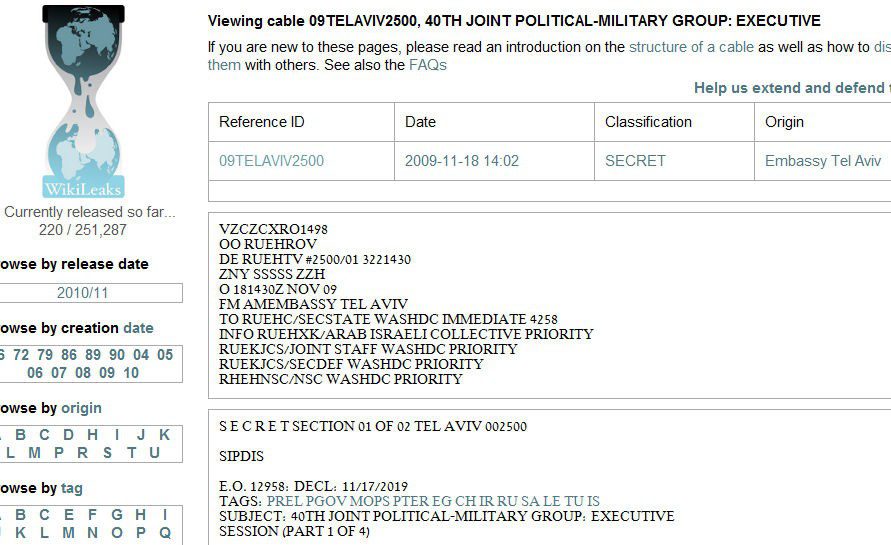
Israel as a Rogue State 153

EMBARRASSING WIKILEAKS REVELATIONS CONCERNING U.S.-ISRAEL RELATIONS

wikileaks screenshot

U.S. embassy cable regarding meeting of U.S. diplomats and high level Israel security officials (Wikileaks)

When the U.S. government began serially apologizing to various nations around the world, including Israel, about what was to come from the Wikileaks dump, I knew something juicy was in the offing. And the materials don’t disappoint. I’d say though, rather than providing lightning flash revelations, they merely deepen our understanding of how the relationship works and what these guys say behind closed doors.

Here are some fascinating memos. This one dated October 31, 2008, in particularis a bit of a jaw-dropper. Usually, diplomats maintain a strict separation between their professional work and spying. The CIA does the latter and diplomats concentrate on foreign policy matters. Apparently, no longer. A memo from the Rice-era State Department, which euphemistically notes that its contents call for assisting in compiling “biographical information” on Palestinians, calls for U.S. personnel to report credit card, frequent flier account numbers, and work schedule to their superiors in Washington:

2. (S/NF) State biographic reporting - including on Palestinians:   A.  (S/NF) The intelligence community relies on State reporting officers for much of the biographical information collected worldwide.  Informal biographic reporting via email and other means is vital to the community's collection efforts and can be sent to the INR/B (Biographic) office for dissemination to the IC.  State reporting officers are encouraged to report on noteworthy Palestinians as information becomes available.   B.  (S/NF) When it is available, reporting officers should include as much of the following information as possible: office and organizational titles; names, position titles and other information on business cards; numbers of telephones, cell phones, pagers and faxes; compendia of contact information, such as telephone directories (in compact disc or electronic format if available) and e-mail listings; internet and intranet "handles", internet e-mail addresses, web site identification-URLs; credit card account numbers; frequent flyer account numbers; work schedules, and other relevant biographical information.

It also calls for reporting:

--Details of travel plans such as routes and vehicles used by Palestinian Authority leaders and HAMAS members.

It’s also rather shocking to find the U.S. concerned with, and seeking intelligence about this:

--Information on illegal weapons transactions with Israelis.

And it’s no wonder that during the paranoid reign of Dick Cheney, the U.S. administration told its Middle East diplomats to watch out for this:

--Indications of interest by Palestinian terrorist groups in the acquisition or use of chemical, biological, or nuclear weapons...

The U.S. government appears greatly concerned about Israel’s capabilities to beg, borrow or steal top-secret U.S. technology. It asks diplomats to report on:

--Plans and efforts to acquire US export-controlled telecommunications equipment and technology. --Plans and efforts to export or transfer state-of-the art telecommunications equipment and technology. --Details about information repositories associated with radio frequency identification (RFID)-enabled systems used

This February 26, 2009 account of a meeting between Congress member Benjamin Cardin and Bibi Netanyahu after national elections but before he became prime minister, reveals the latter’s grandiosity concerning the “Iranian threat:”

Netanyahu described a nuclear Iran as the greatest threat facing Israel, and urged...a viable military option to confront a problem that he said threatened the region and could prove a "tipping point" in world history... 
According to Netanyahu, if Iran develops a nuclear weapon capability it will "topple the peace process" and "change the history of the world."
Netanyahu complained that Iran's "tentacles" were choking Israel, and that a new one grew back whenever one was cut off.  Netanyahu charged that Iran was developing nuclear weapons with the express purpose of wiping out Israel...

Interesting too is this passage, in which Bibi confuses Christian evangelical millenialism with Persian Muslim theology about which he clearly knows nothing:

Netanyahu described the Iranian regime as crazy, retrograde, and fanatical, with a Messianic desire to speed up a violent "end of days."

In the following passage, Bibi reveals his disdain for the concept, widely accepted in the international community, of a return to 1967 borders in exchange for peace. Those who claim the Israeli PM accepts a two state solution should reconcile that belief with this:

...According to Netanyahu - withdrawing to the 1967 borders...would "get terror, not peace"

Here is more about the sham peace that Bibi envisions offering the Palestinians:

Once the Palestinian Authority develops into a real partner it will be possible to negotiate an agreement over territory, settlements and "refined" Palestinian sovereignty without an army or control over air space and borders.

What he’s describing isn’t a country, but a Bantustan.

Netanyahu, in this portion of the memo, reveals that there is indirect trade between Israel and Iraq facilitated through Jordan. Considering that Iraq supposedly has an ironclad ban on trade with Israel in place, if true, this claim is fascinating:

Pointing to what he described as strong but unpublicized trade between Haifa port and Iraq via Jordan, he suggested assembly points could be set up in the West Bank for some goods, which would create thousands of jobs.

It should also be noted that Israel had imported Iranian oil until recently despite Israel’s supposedly ironclad ban on such commerce. All of this indicates the level of hypocrisy that accompanies solemn ideological pronouncements by leaders, whether in Tel Aviv or Baghdad.

A November 16, 2009 memo concerning a high level meeting between U.S. diplomats and senior Israeli military-intelligence confirms that the IDF repeats the same nonsense in such private sessions as it does publicly:

Israeli officials explained that they were going through an unprecedented period of calm due to the deterrent effect of Operation CAST LEAD...

And more nonsense from the defense ministry chief of military intelligence analysis (keep in mind we are now precisely one year from the date of this meeting):

General Baidatz argued that it would take Iran one year to obtain a nuclear weapon and two and a half years to build an arsenal of three weapons.

Amos Gilad, in this passage, shows the proper level of disingenuousness by actually claiming that Middle Eastern countries will clamor for their own nuclear weapons if Iran gets one, rather than from fear of Israel having one:

Amos Gilad explained his view of the repercussions of an Iranian nuclear capability stating that it would give Iran a free hand in supporting "HAMAStan" in Gaza and "Hezbollahstan" in Lebanon.  Gilad also argued that Saudi Arabia would definitely react to a nuclear Iran by obtaining a weapon (with Pakistani assistance) and Egypt would almost certainly follow.

Someone will have to explain to me how Iran having a nuclear weapon will embolden its policies regarding Hezbollah and Hamas. Would it threaten to use its bomb to support its proxies in these countries? It just doesn’t make sense.

In this passage, the Israeli military brass argue that despite the undermining of the PA security apparatus that occurs when the IDF conducts anti-terror incursions in the West Bank, it must continue to do so…for the sake of Jordan!! I kid you not:

...They [the Israelis] stated that if Israel allowed a weak and untrained security force to take over in the West Bank in the short term, the result will be deterioration of the Israel-Jordan relationship over the long term.  The prospect of poor Israeli-Jordanian relations, according to Amos Gilad, is unacceptable, and would result in the loss of "strategic depth" for Israel.

How ending Israeli disruption of Palestinian sovereignty in the West Bank would disrupt Israel’s relations with Jordan is a mystery beyond me. The fact that a senior Israeli general would pose this nonsense in a meeting with high level American officials shows both Israel’s delusions and its disrespect for the intelligence of their U.S. interlocutors.

The following exchange shows that the Americans and Israeli are talking past each other, the former with naiveté and the latter with utter cynicism:

He [assistant U.S. defense secretary] asked if Israel had made any headway in tems of an information operations campaign to better communicate with the people of Gaza.  Israeli officials offered very little in the way of a communications strategy or long-term vision for the territories, but reinforced Israel's core belief that HAMAS has only sinister motives, and that any attempt Fatah might make to improve its standing in Gaza would only be met with HAMAS opposition...Ambassador Vershbow sought further clarification on this point, querying Israeli officials over the level of public support for HAMAS.  Specifically, the ASD asked if there was any way to undermine support for HAMAS vis-a-vis the peace process. Amos Gilad responded simply by saying that one of Israel's biggest concerns is the atmosphere created by disjointed peace talks.  Specifically, Gilad stated that political promises of peace, unification, and reconciliation -- concepts that are never realized -- are only resulting in a climate of uncertainty that is unhealthy.  On this matter, Gilad mentioned that Egypt's role in pushing reconciliation is not helpful and often counterproductive

The U.S. projects a pragmatic interest in combatting Hamas through a public diplomacy campaign, to which the Israelis say: why waste your time? Israel clearly argues for continued Palestinian fragmentation and divisiveness as a policy goal, a losing long-term proposition if ever there was one.

In this exchange on the Goldstone Report, the Israeli MOD’s director general sells the Yanks a bill of goods. Not sure how making 300,000 calls to Palestinians warning them to get out of Dodge constitutes an “extraordinary step to mitigate civilian casualties,” when inhabitants had either already abandoned their homes or could not do so due to the fact that the IDF shot virtually anything that moved on the streets:

In bringing up the Goldstone Report, DG Buchris emphasized that the Government of Israel took extraordinary steps to mitigate civilian casualties, despite HAMAS's deliberate use of civilians as human shields.  He stated that the IDF made over 300,000 phone calls to alert civilians before bombing legitimate military targets.  He also compared Israeli operations in Gaza to U.S. operations in Iraq and Afghanistan and stated that Israel would do whatever was necessary to protect its population.  In response, ASD Vershbow recalled U.S. support for Israel in handling of the Goldstone report, and offered to share U.S. experience in investigating incidents in Iraq and Afghanistan as the GOI considered whether to conduct an additional investigation.

I’m not clear whether Vershbow’s “offer” in the last sentence is one to help Israel avoid serious investigation of Cast Lead abuses (since U.S. investigations of our own abuses in Iraq and Afghanistan have failed miserably); or whether this constitutes what he believes is a serious offer to help Israel do the right thing. If the latter, it’s a woefully naïve offer.

In this passage, Amos Gilad seems to be conjuring a total fiction:

Gilad also noted that Turkey wanted to improve its relationships with Iran and asserted that it had made some very aggressive plans recently to support HAMAS.

To give you a sense of how almost eager Israel appears to be to engage in a pre-emptive srike that would surely spark a war among Iran, Syria, Lebanon and Israel, read this warning levelled by the Israeli MOD’s chief intelligence analyst:

Israeli officials have major concerns over developments within Hezbollah -- specifically, its relationship with Syria and Iran.  General Baidatz spoke of this relationship and drew attention to the existing supply of Fateh-110 long-range missile that Iran sent to Syria. Israeli officials believe these missiles are destined for Hezbollah.  According to Baidatz and others, if the delivery were to occur, this would significantly alter Israel's calculus.  Under such a scenario, the looming question for Israeli policymakers then becomes: "to strike or not to strike."

In other words, a top Israeli intelligence analyst is warning the Americans that if Syria supplies a particular rocket to Hezbollah the IDF would pre-emptively attack Hezbollah and in doing so likely spark major hostilities.

In a different meeting of the same individuals as above, Amos Gilad again makes a claim I’ve never heard before:

He noted that rockets from Lebanon can now cover the entire territory of Israel

I’d like to know on what basis he makes this claim. And even if true, you’d think it might make Israel MORE eager to negotiate a settlement with Syria, Hezbollah’s sponsor. This appears not to be the case as Israel prefers to complain to the Americans about the military threats it faces from its enemies while doing nothing to resolve the disputes themselves.

This colloquy reveals that high-level Israeli officials are not above lying outright to their American interlocutors:

[U.S. diplomat Tom] Goldberger…questioned whether more commercial and humanitarian goods could be allowed through the Gaza border crossings. Gilad strongly stated that there were no limits on commercial goods through the border crossings.

This is such a bald-faced lie that one wonders whether the notetaker at the meeting misunderstood something. Can Gilad really believe anyone would fall for such bulls(&t?

In this memo dated November 18, 2009, IDF officers (including Amos Gilad) and ministry of defense senior officials (including the director general of the ministry) ask for a waiver that would allow Israelis with dual-citizenship to have the same access to sensitive U.S. military technology that a U.S. citizen would have. As you read this, think of Jonathan Pollard, Ben Ami Kadish and any number of other Israeli spies who had/ve dual citizenship:

Dual Citizenship Issues -----------------------   9. (S) The GOI raised the issue of dual citizenship within the context of access to sensitive technology.  U.S. participants acknowledged Israeli concerns, noting that the issue is being worked at the highest levels of the USG to reach consensus on how to proceed.  The GOI recommended obtaining a waiver similar to the relationship from which Canada or Australia benefit.

No telling what sorts of mischief this waiver would allow. What’s most chutzpadik is the notion that Israel should be treated to the same waiver that Canadian and Australian dual-citizens receive, as if Israel has as close and friendly relations with the U.S. as those countries. Don’t forget that the U.S. Justice Department ranks Israel third among foreign nations in terms of the intensity of its espionage operations in the U.S.

Regarding worsening relations between Israel and Turkey, six months before the Mavi Marmara fiasco Israel was noticing Turkey wasn’t returning the love:

Turkey ------   10. (S) The GOI raised the current direction the Government of Turkey has taken toward Syria and Iran -- and away from Israel.  Israeli participants argued that Turkey has been supportive of Hamas in Gaza while pursuing a more "Islamic" direction with the goal of becoming a regional superpower. The GOI argued that the Turkish military is losing its ability to influence government decisions and strategic direction.  After this past year, GOI participants said they have a "bad feeling" about Turkey.  The GOI noted that the Israel Air Force (IAF) Commander in the past wanted to speak to the Turkish Air Force Commander, but his Turkish counterpart declined.

One wonders, given Israel’s awareness of the deterioration of relations (“they have a ‘bad feeling’”) why it didn’t act more cautiously in its attack on the Mavi Marmara. Did it, by then, not give a crap about relations with Turkey believing they were a lost cause anyway? Or did someone in the Israeli navy f&*k up big-time and not realize what a disaster was in store given the means they chose to subdue the relief ship?

As noted above, the Israeli are not above dissimulation in their attempts to blow smoke up the U.S.’ read end. A mere two months (the memo is dated July 26, 2007) before Israel attacked Syria’s alleged nuclear reactor (an act of aggression which the Syrian’s did not respond to), Dagan lies directly to the face of a Bush’s Homeland Security advisor in this meeting:

Dagan echoed other reports that Syria expects an Israeli attack this summer, and has raised its level of readiness.  Despite the fact that Israel has no intention of attacking, said Dagan, the Syrians are likely to retaliate over even the smallest incident, which could lead to quick escalation.

ShareThis

Related posts:

  1. Turkey Threatens to Suspend Relations With Israel, Issues Ultimatum
  2. Wikileaks Reveals Possible U.S. Espionage and Counter-Espionage Activity in Israel
  3. Lieberman Shames Turkish Ambassador, Torpedoes Israel-Turkish Relations
  4. Wikileaks’ Afghanistan Trove to Rival Ellsberg’s Pentagon Papers?
  5. Poll: Iranians Willing to Forego Nuclear Weapons in Return for Normalizing Relations

Related posts brought to you by Yet Another Related Posts Plugin.

Tags: , , , , , , ,

Israel als schurkenstaat 291

mario Bergen


Geachte

Ter informatie/publicatie

Graag uw aandacht voor volgende informatie die vandaag bekend werd door WikiLeaks:

· De Amerikaanse ambassadeur Richard H. Jones schrijft in een geheime nota op 8 januari 2007 over de executie van vier Palestijnen in Ramallah op klaarlichte dag. De Ramallah-operatie werd bevolen door de Israëlische legercommandant van de Westelijke Jordaanoever zonder de Israëlische minister van Defensie daarover in te lichten. Het maakt een gebrek aan coördinatie duidelijk tussen het civiele en militaire leiderschap in Israël.

· Een ontmoeting tussen de Amerikaanse binnenlandse veiligheidschef Frances Fragos Townsend en Mossad-directeur Meir Dagan vond plaats in juli 2007.

Israël maakt duidelijk dat het internationale inspanningen wenst om VN-resoluties in Libanon te laten gelden met als doel Syrië te verwijderen van Iraanse invloed. Volgens de Mossad vrezen Jordanië, Saudi-Arabië en de Golfstaten allen Iran, maar moet iemand anders “de karwei afmaken”.Dagan ziet Qatar als “een echt probleem” en beschuldigd Sheikh Hamid (Hamad) ervan om met alle betrokkene – Syrië, Iran en Hamas – mee te spelen. Dagan vraagt dat Amerika zijn militaire basis terugtrekt uit Qatar.

Dagan verklaard dat zonder de Israëlische campagne tegen Hamas op de Westelijke Jordaanoever het regime van de Palestijnse president Abbas en Fatah binnen de maand zou vallen. Hij zou dan zijn “mysterieus welvarende” zoon kunnen vergezellen in Qatar. Volgens Dagan werd sinds 1994 zo’n 6 miljard Amerikaanse dollar gepompt in de Palestijnse Autoriteit. Dit bracht nul komma nul resultaat op, buiten enkele Palestijnen in de top 500 van rijkste ter wereld aldus Dagan. Israël gelooft in Eerste minister Salam Fayyad, vooral omdat die geen machtsbasis heeft. Fatah zou zich moeten reorganiseren om macht te hebben, maar de “oude garde” blijft het voor het zeggen hebben.

· Bij een ontmoeting met ambassadeur Richard H. Jones op 17 augustus 2007 vraagt de Mossad meer aandacht voor een regimewissel in Iran. Dit kan volgens de Mossad gebeuren door het versterken van minderheden in Iran. Mossad-directeur Dagan is ervan overtuigd dat de V.S. en Israël een regimewissel in Teheran kunnen bewerkstelligen en het Iraanse nucleaire project kunnen vertragen.

(Cfr. De Iraanse presidentsverkiezingen van 12 juni 2009 die het westen onterecht “frauduleus” bestempelde en het Amerikaans plan van 400 miljoen dollar om Iran te destabiliseren: http://www.mo.be/node/21674 )

· Op 2 januari 2008 zegt Generaal Omar Soliman, hoofd van de Egyptische inlichtingendiensten tegen de Amerikaanse ambassadeur dat Caïro druk op de Palestijnse Islamistische Beweging zal behouden. Volgens Soliman moet Hamas kiezen tussen een verzetsbeweging en meestappen in het politieke proces. Hij ziet Iran als een “betekenisvolle bedreiging” voor Egypte en adviseert andere Arabische landen om afzijdig te blijven van Teheran.

· Op 31 oktober 2008 stuurt Washington een geheime nota naar alle ambassades in het Midden-Oosten. Men vraagt gedetailleerde informatie over alle Palestijnse leiders en Hamas. Ook reisplannen van Hamas en de Palestijnse Autoriteit moeten onmiddellijk aan Washington worden overgemaakt zodra bekend. Biografische, financiële en biometrische informatie mag niet ontbreken. De lijst met gewenste informatie door de ambassade die werkt voor president Obama is zo lang dat geen enkel detail van het leven in Palestina-Israël nog onbekend is in het Witte Huis.

· Op 30 juli 2009 uit Tel Aviv zijn bezorgdheid over de levering van F-15SA gevechtsvliegtuigen aan Saudi-Arabië. De zogenaamde gematigde Arabische landen zoals Saudi-Arabië, Egypte en Libanon zouden nadien vijanden van de Israëlische staat kunnen worden en zijn bestaansrecht in vraag kunnen stellen. De kleinere militaire kloof tussen deze landen met Tel Aviv en een nucleair-bewapend Iran maken Israël bezorgd.

· Hamad bin Khalifa al-Thani, de emir van Qatar, vraagt op 14 februari 2010 aan Senator John Kerry dat de V.S. alles in het werk stellen om tot vrede tussen Israël en de Palestijnen te komen. De V.S. moet Damascus duidelijk maken dat het recht heeft op de volledige Golanhoogte, die Israël annexeerde. De Syriërs verloren hun vertrouwen in de V.S. omdat die over de Golan geen duidelijke taal spreekt. President Assad van Syrië is bereid tot vrede met Israël, maar wil Israël dit wel vraagt de emir zich af. Enkel bij interventie door de V.S. tussen Israël en Syrië – de eerste prioriteit - kan er vrede komen in de regio aldus Hamad.

· Israël heeft nu de bovenhand in de regio door de steun van president Obama. Volgens de emir kan Hamas de grenzen van 1967 met Israël aanvaarden, maar zal het dit niet publiekelijk toegeven.

Bron / Link:

WikiLeaks over Israël - http://www.israellycool.com/2010/11/28/wikileaks-israel-related-cables/

Met beleefde groeten

Mario Bergen

Kesseldallaan 80/0202

3010 LEUVEN

Sjoerd de Jong van de NRC 3

Een verrukkelijk stukje arrogantie is te lezen in de NRC van de hand van Sjoerd de Jong, geen onderzoeksjournalist maar een echte ouderwetse opiniemaker. Hij schrijft:

Hoe moeten gevestigde media omgaan met die ongevraagde diensten van een klokkenluiderswebsite die wordt geleid door een op het oog excentrieke eenling?

Laten we even analyseren wat hier staat. Sjoerd de Jong spreekt namens de 'gevestigde media'. Wat bedoelt hij met 'gevestigde'? Het kan niet anders dan dat hij het over de media heeft die gevestigde belangen behartigen en die nu geconfronteerd worden met de werkelijkheid. Hoe komt het dat WikiLeaks over de echte informatie beschikt en de 'gevestigde media' niet? Dat komt omdat de 'gevestigde media' de gevestigde belangen behartigen, terwijl WikiLeaks de belangen van de burger behartigt, en dat zouden de 'gevestigde media' ook dienen te doen in een democratie. Maar omdat we geen democratie hebben mogen de 'gevestigde media' die in handen zijn van de gevestigde belangen dit niet. Dat verklaart nu ook waarom De Jong spreekt van 'ongevraagde diensten'. Voor wie zijn die 'ongevraagd'? Niet voor de lezers die graag op de hoogte worden gesteld van zaken die hun leven direct beinvloeden. Vandaar ook dat de commerciele media er nu als de kippen bij zijn, de NRC opent maar liefst 7 kolommen breed met WikiLeaks op de voorpagina. Maar wat bedoelt Sjoerd de Jong dan met 'ongevraagde diensten'? Wel, de gevestigde belangen die de 'gevestigde media' in handen hebben willen niet dat de bevolking op de hoogte wordt gesteld van wat er achter de schermen gebeurt, want dat is slechjt voor de gevestigde belangen. Volgende punt: waarom de kwalificatie 'excentrieke eenling'? Dat is simpel, voor De Jong is de boodschap onbelangrijker dan de boodschapper, dit is een oude en beproefde techniek om iemand te criminaliseren die de moed heeft publieke zaken publiek te maken. Want begrijp 1 ding goed. Hoe meer WikiLeaks onthult des te duidelijker wordt wat Sjoerd de Jong en zijn krant allemaal verzwijgen of domweg niet weten. Meer over deze NRC-opiniemaker later. Leest u eerst dit eens. Een proeve van onbekwaamheid:


NRC Handelsblad 29-11-2010, pagina 9

Media moeten WikiLeaks ook wegen

Illustratie Bas van der Schot

De openheid van WikiLeaks maakt de taak van de media niet minder belangrijk, maar juist belangrijker. Weeg en bied context, adviseert Sjoerd de Jong.

Is de Russische premier Poetin te vergelijken met Batman, de wrekende held in vleermuiscape, en president Medvedev met Robin, diens androgyne hulpje in een grote zwarte onderbroek?

Het is een van de talloze kruimels die de media dankbaar oppikken uit de vrachtwagen vol vertrouwelijk diplomatiek verkeer die de site WikiLeaks heeft leeggekieperd. Het begint zo langzamerhand te wennen.

Hoe moeten gevestigde media omgaan met die ongevraagde diensten van een klokkenluiderswebsite die wordt geleid door een op het oog excentrieke eenling? Overnemen, negeren of eerst maar eens wachten of er ‘echt nieuws’ in zit?

De hoofdredactie van The New York Times, die een selectie uit de documenten samen met een aantal Europese kranten publiceert, verdedigt het besluit om te publiceren in een uitvoerige ‘noot aan de lezers’. Daarin wordt niet alleen dat besluit beargumenteerd, maar ook uitgelegd waar het materiaal vandaan komt en hoe de krant ermee is omgegaan.

Goed om te weten is bijvoorbeeld dat de krant niet simpelweg het adagium publish and be damned heeft gevolgd. Integendeel, er is tevoren gedetailleerd overlegd met ambtenaren van de regering-Obama. De krant meldde welke stukken op de site zouden komen (ongeveer honderd van de 250.000) en nodigde de regering uit commentaar te leveren. Voorstellen om gevoelige informatie weg te laten of te bewerken, volgde de krant soms, maar niet altijd op.

Daarnaast bezweert de krant dat ze zelf alle moeite heeft gedaan passages te schrappen die het leven van informanten of de nationale veiligheid in gevaar kunnen brengen. Als regel hanteert de Times dat alles moet worden weggelaten wat terroristen van pas kan komen of inlichtingenoperaties over ‘vijandige’ naties kan compromitteren. Voor de Amerikaanse krant is dat logisch: het land is ten slotte verwikkeld in een oorlog en een mondiale strijd tegen terrorisme.

De positieve argumenten om te publiceren van de Times zijn pragmatisch (de documenten worden door WikiLeaks toch gepubliceerd, of wij nu meedoen of niet) en principieel (de lezer heeft recht op deze ‘ongepolijste’ kijk op beslissingen die het land zo veel mensenlevens en geld hebben gekost). „Het zou aanmatigend zijn te concluderen dat Amerikanen er geen recht op hebben te weten wat in hun naam wordt gedaan.”

Dat laatste argument doet denken aan die eerdere, geruchtmakende publicatie in 1971 van de Pentagon Papers door The New York Times en The Washington Post. De regering-Nixon spande een rechtszaak aan tegen de Times, die de publicatie van deze geheime studie naar de Vietnam-oorlog twee weken moest onderbreken, maar uiteindelijk bij het Hooggerechtshof gelijk kreeg. Geen klinkklare overwinning: de rechters oordeelden met 6 voor en 3 tegen dat de regering er niet in was geslaagd aan te tonen dat verdere publicatie moest worden verboden.

Net als toen heeft de krant nu een afweging gemaakt, los van de totale openheid die WikiLeaks nastreeft. Zo hoort het ook. Scoringsdrift moet in toom worden gehouden door afwegingen van journalistieke relevantie, zorgvuldigheid (zijn de documenten authentiek?) en de noodzaak geen onnodige of buitenproportionele schade aan te richten.

En dan het grote verschil met de Pentagon Papers: Daniel Ellsberg, die ze lekte, stapte nog met zijn gefotokopieerde stukken naar de Times. „Ik ga naar de krant” is dan ook een dreigement dat in Amerikaanse speelfilms uit de jaren zeventig de grootste schurken doet huiveren of in vertwijfeling naar hun hart doet grijpen. Het spel is uit!

Die tijden zijn voorbij. In de onbesuisde wereld van het internet kan iedereen zijn eigen klok luiden, wereldwijd en met oorverdovend kabaal.

Dat maakt de taak van de journalistiek niet minder belangrijk, maar juist belangrijker: eerst wegen, dan pas publiceren. En vooral: context bieden. Ook voor NRC Handelsblad en andere kranten die de stukken niet kregen toegespeeld, geldt dat de lawine aan feiten en weetjes die WikiLeaks heeft losgemaakt duiding en context vereisen. De lezer moet weten uit welke taart de kruimels komen.

Dr Hysterische Zionistische Haat

  Richard @ricwe123 That moment when Israeli police officers decided it would be a good idea to attack the Christian funeral procession of P...