Meldingen / X
Israel has used cluster bombs against other countries, including in densely populated civilian areas. https://www.hrw.org/report/2008/02/16/flooding-south-lebanon/israels-use-cluster-munitions-lebanon-july-and-august-2006https://reliefweb.int/report/lebanon/flooding-south-lebanon-israels-use-cluster-munitions-lebanon-jul-and-aug-2006 https://en-archive.almanar.com.lb/2539022 https://truthout.org/articles/evidence-shows-israel-used-weapon-banned-for-its-civilian-impact-on-lebanonhttps://digitallibrary.un.org/record/584441?ln=enhttps://www.armscontrol.org/act/2007-03/israeli-cluster-munitions-use-examined Neither Iran or Israel has committed to stop using cluster munitions, per the 2008 Convention on Cluster Munitions. https://www.jpost.com/israel-news/article-889392Flooding South Lebanon: Israel's use of cluster munitions in Lebanon in Jul and Aug 2006
Summary
The Israel Defense Forces (IDF) issued a short statement on December 24, 2007, on the results of an internal inquiry into its controversial use of cluster munitions during the 34-day war with Hezbollah in July and August 2006.(1) During that short conflict, the IDF rained an estimated 4 million submunitions on south Lebanon, the vast majority over the final three days when Israel knew a settlement was imminent. The inquiry was the second internal IDF investigation into the use of the weapon, and like its predecessor it exonerated the armed forces of violating international humanitarian law (IHL). Neither a detailed report nor the evidence supporting conclusions has been made public, however, making it impossible to assess whether the inquiry was carried out with rigor and impartiality, and whether it credibly addressed key issues about targeting and the lasting impact of cluster munition strikes on the civilian population.
Human Rights Watch's researchers were on the ground in Lebanon throughout the conflict and after, and our findings paint a quite different picture of the IDF's conduct. Research in more than 40 towns and villages found that the IDF's use of cluster munitions was both indiscriminate and disproportionate, in violation of IHL, and in some locations possibly a war crime. In dozens of towns and villages, Israel used cluster munitions containing submunitions with known high failure rates. These left behind homes, gardens, fields, and public spaces-including a hospital-littered with hundreds of thousands and possibly up to one million unexploded submunitions.(2) By their nature, these dangerous, volatile submunitions cannot distinguish between combatants and non-combatants, foreseeably endangering civilians for months or years to come.
Israel continues to have a duty to investigate publicly, independently, impartially, and rigorously these extensive violations of international humanitarian law. Investigation should include a thorough examination of whether individual commanders bear responsibility for war crimes-that is, for intentionally or recklessly authorizing or conducting attacks that would indiscriminately or disproportionally harm civilians.
The continuing failure of the Government of Israel to mount a credible investigation one and a half years after the end of the 2006 conflict in Lebanon-and failure on the Lebanese side of the border to investigate Hezbollah's compliance with international humanitarian law-reaffirms the need for the Secretary-General of the United Nations (UN) to establish an International Commission of Inquiry to investigate reports of violations of international humanitarian law, including possible war crimes, committed by both sides during the conflict. The commission should formulate recommendations with a view to holding accountable those on both sides of the conflict who violated the law. (3) The findings of this report by Human Rights Watch indicate that Israel's use of cluster munitions should be part of the commission's mandate.
Cluster munitions are large, ground-launched or air-dropped weapons that, depending on their type, contain dozens or hundreds of submunitions. During strikes they endanger civilians because they blanket a broad area, and when they are used in or near populated areas, civilian casualties are virtually guaranteed. They also threaten civilians after conflict because they leave high numbers of hazardous submunitions that have failed to explode on impact as designed-known as duds- which can easily be set off by unwitting persons. As yet these weapons are not explicitly banned. However, their use is strictly limited by existing international humanitarian law on indiscriminate and disproportionate attacks. Moreover, global concern at the impact of cluster munitions, all too graphically manifested in south Lebanon, is lending impetus to international efforts to develop a legally binding instrument banning those that have an unacceptable humanitarian effect.
Israel's strikes in 2006 were the most extensive use of cluster munitions anywhere in the world since the 1991 Gulf War.(4) Based on its own field response and a review of public reports, the UN Mine Action Coordination Center South Lebanon (MACC SL) estimated, as of January 15, 2008, that Israel fired cluster munitions containing as many as four million submunitions in 962 separate strikes.(5) According to information provided to Human Rights Watch by Israeli soldiers who resupplied Multiple Launch Rocket System (MLRS) units with cluster munitions, the number of submunitions used could be as high as 4.6 million. (6) That is more than twice as many submunitions used by Coalition forces in Iraq in 2003 and more than 15 times the number used by the United States in Afghanistan in 2001 and 2002.
Notes:
(1) Israel Ministry of Foreign Affairs, 'Opinion of the Military Advocate General Regarding Use of Cluster Munitions in Second Lebanon War,' December 24, 2007, http://www.mfa.gov.il/MFA/Government/Law/Legal+Issues+and+Rulings/Opinion+of+the-Military+Advocate+General+regarding+use+of+cluster+munitions+in+Second+Lebanon+War+24.htm (accessed December29, 2007).
(2) Email communication from Dalya Farran, media and post clearance officer, MACC SL, to Human Rights Watch, January 15, 2008.
(3) Human Rights Watch has separately reported on violations of international humanitarian law by Israel in the wider bombing campaign in Lebanon in 2006 and violations of international humanitarian law, including incidents involving cluster munitions, by Hezbollah. The scale of Israel's use of cluster munitions in south Lebanon dwarfed that of Hezbollah. See Human Rights Watch, Why They Died: Civilian Casualties in Lebanon during the 2006 War, vol. 19, no. 5(E), September 2007, http://hrw.org/reports/2007/lebanon0907/, and Human Rights Watch, Civilians under Assault: Hezbollah's Rocket Attacks on Israel in the 2006 War, vol. 19, no. 3(E), August 2007, http://hrw.org/reports/2007/iopt0807/.
(4) Between January 17 and February 28, 1991, the United States and its coalition allies used a total of 61,000 cluster munitions, releasing 20 million submunitions in Iraq, a country more than 40 times bigger than Lebanon. Human Rights Watch, Fatally Flawed: Cluster Bombs and Their Use by the United States in Afghanistan, vol. 14, no. 79(G), December 2002, http://hrw.org/reports/2002/us-afghanistan/, p. 40.
(5) Email communication from Dalya Farran, media and post clearance officer, MACC SL, to Human Rights Watch, January 15, 2008.
(6) Human Rights Watch interviews with IDF reservists (names withheld), Tel Aviv and Jerusalem, Israel, October 2006. Unless otherwise noted, all interviews cited in this report were done in Lebanon.
- Human Rights Watch
- © Copyright, Human Rights Watch - 350 Fifth Avenue, 34th Floor New York, NY 10118-3299 USA
- ‘Israel’ Used Widely Banned Cluster Munitions in Lebanon: The Guardian
- Capture
- ‘Israel’ used widely banned cluster munitions in its recent 13-month war in Lebanon, photos of munition remnants in south Lebanon seen by the Guardian suggest.
- The images, which have been examined by six different arms experts, appear to show the remnants of two different types of Israeli cluster munitions found in three different locations: south of the Litani River in the forested valleys of Wadi Zibqin, Wadi Barghouz and Wadi Deir Siryan.
- The evidence is the first indication that Israel has used cluster munitions in nearly two decades since it employed them in the 2006 Lebanon war. It would also be the first time that Israel was known to have used the two new types of cluster munitions found – the 155mm M999 Barak Eitan and 227mm Ra’am Eitan guided missiles.
- Cluster munitions are container bombs which release many smaller submunitions, small “bomblets”, over a wide area the size of several football fields. The use of cluster munitions is widely banned as up to 40% of submunitions do not explode upon impact, posing a danger to civilians who might later stumble upon them and be killed when they explode.
- To date, 124 states have joined the convention on cluster munitions, which forbids their use, production and transfer. ‘Israel’ is not a party to the convention and is not bound by it.
- “We believe the use of cluster munitions is always in conflict with a military’s duty to respect international humanitarian law because of their indiscriminate nature at time of use and afterwards,” said Tamar Gabelnick, the director of the Cluster Munition Coalition. “Their wide area impact means they cannot distinguish between military and civilian targets and the cluster munition remnants kill and maim civilians for decades after use.”
- The Israeli military neither confirmed nor denied its use of cluster munitions but said it “uses only lawful weapons, in accordance with international law and while mitigating harm to civilians”.
- Lebanon in particular has a painful history with cluster munitions. Israel blanketed Lebanon with 4m cluster bombs in the final days of the 2006 war, with an estimated 1m failing to explode. The presence of unexploded cluster bombs continues to make life in south Lebanon dangerous, with more than 400 people killed by unexploded bomblets since 2006.
- The huge number of unexploded cluster bombs in Lebanon was a main driving factor for the drafting of the cluster convention in 2008.
- Despite not being a party to the convention, Israeli officials condemned Iran’s use of cluster munitions in Israel during this summer’s 12-day war. “The terror regime seeks to harm civilians and even used weapons with wide dispersal in order to maximise the scope of damage,” said the Israeli military spokesperson, Brig Gen Effie Defrin, after an Iranian strike used cluster munitions in populated areas in southern Israel.
- Images of the remnants of the first cluster munition, a 155mm M999 Barak Eitan advanced anti-personnel munition produced by the defence contractor Elbit Systems in 2019, were verified by six different arms experts, including Brian Castner, the head of crisis research at Amnesty International, and NR Jenzen-Jones, the director of Armament Research Services, a technical intelligence consultancy specialising in arms and munitions analysis. Elbit Systems did not respond to a request for a comment.
- Each M999 artillery shell releases nine submunitions which explode into 1,200 tungsten shards, according to a US army primer on the weapon.
- “Cluster munitions are banned internationally for a reason. They are inherently indiscriminate and there is no way to employ them lawfully or responsibly, and civilians bear the brunt of the risk as these weapons stay deadly for decades to come,” said Castner.
- Source: Al-Manar English Website
Evidence Shows Israel Used Weapon Banned for Its Civilian Impact on Lebanon
Cluster munitions release dozens or hundreds of “bomblets” that have a high failure rate, leaving explosive hazards.
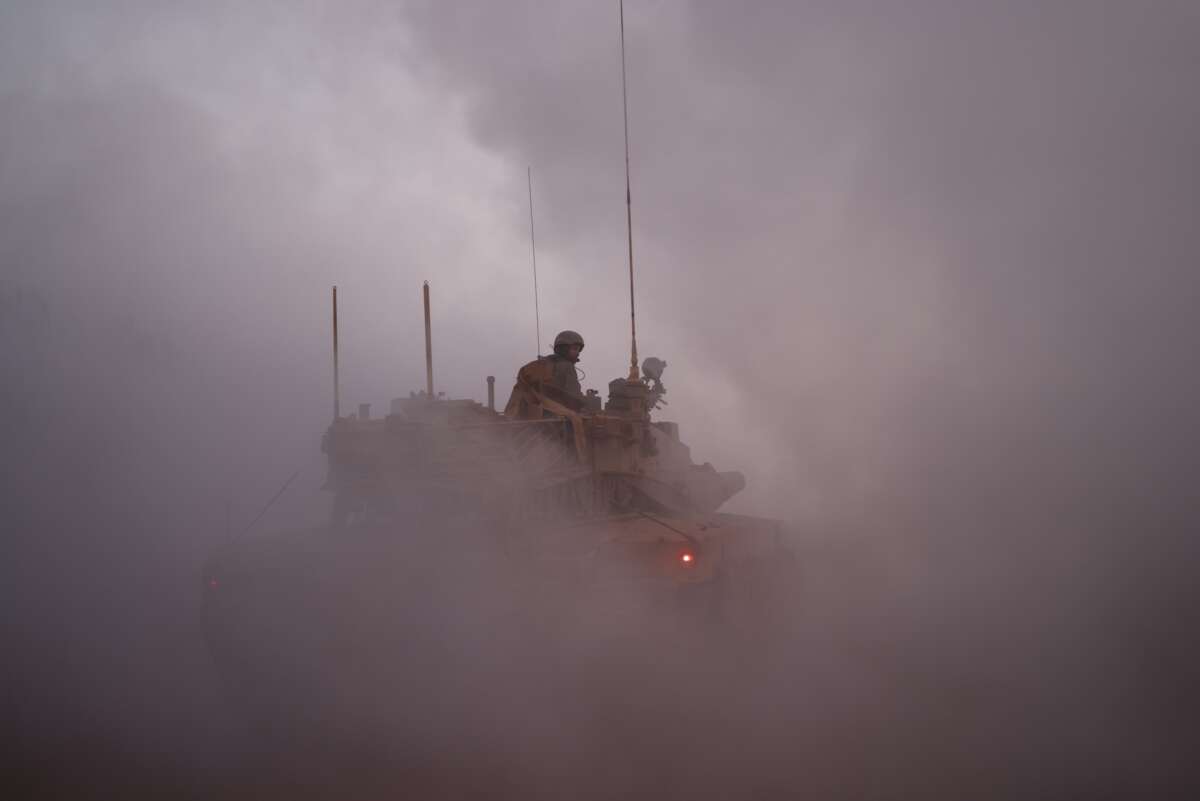
An Israeli soldier rides in the army Merkava main battle tank at a position in northern Israel along the border with southern Lebanon on November 6, 2025. JALAA MAREY / AFP VIA GETTY IMAGES Honest, paywall-free news is rare. Please support our boldly independent journalism with of any size.
Israeli forces used a munition widely banned for its impact on civilians amid their war in Lebanon, new reporting finds as Israel carries out new assaults in Lebanon despite the ceasefire agreement.
Photo evidence of Israeli munitions remnants from three different locations in southern Lebanon suggests that the weapons were cluster munitions, , citing half a dozen arms experts who examined the photos.
These munitions scatter across an area spanning several football fields. For decades, “civilians have paid dearly for [cluster munitions’] unreliability and inaccuracy,” , as the weapons .
Get our free emails
The evidence was found south of the Litani River, in Wadi Zibqin, Wadi Barghouz, and Wadi Deir Siryan, The Guardian found. The publication reports that this is the first evidence of such munitions being used in Lebanon since Israel first used them in its invasion of Lebanon in 2006.
They are especially dangerous as up to 40 percent of submunitions don’t explode on impact, leaving behind unexploded ordnance that could potentially harm civilians later if they come across them.
These munitions can travel far and wide. ICRC that “[t]heir small size, their use of parachutes and ribbons and other features mean that their descent is often affected by weather (wind, air density, etc.) and they may land far from the intended target. “
A 2008 treaty barring the use of the weapons has been signed by . Lebanon is party to the treaty, but Israel is not, nor is the United States.
Israel’s use of cluster bombs in the 2006 invasion was a major reason for the establishment of the treaty, but at the time that their use of the weapons was legal.
In recent years, human rights groups have raised alarm over Russian and Ukrainian forces’ of cluster munitions by both sides in their war, killing and injuring at least dozens of civilians. The U.S.’s widespread use of cluster bombs in its assault , Cambodia, and Laos of unexploded ordnance left behind by war.
In Lebanon, unexploded bombs from the 2006 invasion were still . Israel dropped four million cluster munitions in the last days of the invasion, and UN officials estimated that of them didn’t explode.
The finding of the munition remnants comes as Israel is escalating its attacks on Lebanon, despite the signed nearly a year ago. Israel carried out a on Tuesday and Wednesday. On Tuesday, a Palestinian refugee camp in southern Lebanon, killing 13 people, Lebanese health officials said. These attacks come days after Israeli UN peacekeepers stationed in southern Lebanon.
Lebanese officials are also to the UN Security Council over Israel’s construction of a concrete wall along Lebanon’s southern border. Officials say that it extends past the UN-established “blue line” that demarcates Lebanon from Israel and the Israeli-occupied Golan Heights.

Files
Action Filename Size Access Description License Details
Browse Subjects
PDF
Israeli Cluster Munitions Use Examined
The Department of State recently informed Congress that Israeli use of U.S.-origin cluster munitions in Lebanon last summer might have broken U.S. export rules. Washington has yet to announce if it will take any action against its close ally, but some lawmakers are proposing new U.S. cluster munitions export and use policies.
Responding to an attack by Lebanon-based Hezbollah guerrillas last July, Israel launched a military offensive into its northern neighbor. During the ensuing month-long campaign, Israel employed cluster munitions, which are weapons dropped by aircraft, shot from artillery, or launched by rockets that can scatter up to several hundred small bomblets or grenades over broad areas. The dispersed submunitions sometimes fail to explode as intended, sowing wherever they land with potentially lethal or harmful explosives.
The UN Mine Action Service recently reported that, by mid-February, some 840 cluster munitions strike areas had been identified and that an estimated one million unexploded cluster submunitions litter southern Lebanon. It also noted that 30 deaths and 186 injuries have resulted from the detonation of leftover cluster munitions and other ordnance.
The United States launched an investigation last fall into whether Israel may have used U.S.-supplied cluster munitions in Lebanon contrary to a bilateral export agreement restricting their use. The regulations are secret, but they are generally understood to bar the use of cluster munitions against targets that are in populated areas or that are not strictly military. Washington initially imposed the regulations after previously suspending cluster munitions exports to Israel from 1982 to 1988 following allegations that Israeli forces improperly used such arms in attacks against Lebanese civilians.
In a classified report delivered to the Senate Foreign Relations and House Foreign Affairs Committees, the State Department made a preliminary finding that there “could have been some violations” of U.S. export rules during last year’s war, State Department spokesperson Sean McCormack said Jan. 29. He told reporters that he would not speculate on actions Congress or the administration might take in response because the investigation was still ongoing.
A State Department official told Arms Control Today Feb. 20 that “we are continuing to gather information.” The official added, “As we learn more, we will take action as appropriate.”
Some lawmakers are not waiting on a final investigation outcome to address the cluster munitions issue. Senators Dianne Feinstein (D-Calif.), Patrick Leahy (D-Vt.), Barbara Mikulski (D-Md.), and Bernard Sanders (I-Vt.) introduced legislation Feb. 14 to prohibit U.S. use, sale, or transfer of cluster munitions that have submunitions with failure rates greater than one percent. The bill also requires that cluster munitions only be used against “clearly defined military targets” and not in areas where civilians are present or normally inhabit. The president for national security reasons could waive the first restriction on failure rates, but not the second limitation.
Feinstein and Leahy proposed similar legislation last year as an amendment to the annual defense spending bill, but the Senate rejected it 70-30. Opponents argued the measure might impair U.S. military operations.
U.S. policy since the fall of 2004 has prohibited the Pentagon from procuring new cluster munitions with submunitions that have failure rates greater than one percent. The policy, however, does not forbid U.S. armed forces from using some 5.5 million older, stockpiled cluster munitions that might not meet the higher performance standard.
“The impact of unexploded cluster bombs on civilian populations has been devastating,” Feinstein said Feb. 14, citing estimates that past U.S. use of such weapons in Afghanistan, Iraq, Kuwait, and Laos has caused thousands of civilian casualties. She also noted that she had been motivated in part by “recent developments in Lebanon.”
Israeli officials contend they took every precaution to avoid civilian casualties, including warnings to noncombatants through leaflets, talks with local leaders, and phone calls to evacuate areas where Hezbollah fighters were present. Still, the Israel Defense Forces (IDF) initiated a review last November of its cluster munitions use in Lebanon.
David Siegel, a spokesperson for the Israeli Embassy in Washington, told Arms Control Today Feb. 21 that the IDF inquiry was “still underway” but nearing completion. He also said Israel had provided “detailed responses” to U.S. investigators.
In the conflict’s aftermath, Siegel also said Israel had provided assistance “as extensive as possible,” including maps, coordinates, and training, to help locate and clear the cluster munitions remnants. Some UN officials and nongovernmental humanitarian and demining groups have contended that Israel has not given enough specific details to help with the cleanup.
Governments, including the United States, have donated at least $21.5 million for cleaning up and disposing of the cluster submunitions contaminating southern Lebanon. The UN Mine Action Service predicts the work might be completed by the end of this year.
Meanwhile, 46 governments agreed Feb. 23 in Oslo, Norway, to negotiate by 2008 a legally-binding treaty to ban cluster munitions that cause “unacceptable harm to civilians.” Participating countries, which currently do not include Israel or the United States, will meet again in May in Lima, Peru.


Geen opmerkingen:
Een reactie posten