Netanyahu’s war? Analysts say Trump’s Iran strikes benefit Israel, not US
War with Iran contradicts the US president’s own criticism of regime change policies in the Middle East, analysts say.


President Donald Trump stood in front of regional leaders during a visit to the Middle East in May and declared a new era of US foreign policy in the region, one that is not guided by trying to reshape it or change its governing systems.
“In the end, the so-called nation-builders wrecked far more nations than they built, and the interventionists were intervening in complex societies that they did not even understand themselves,” the US president said in rebuke of his hawkish predecessors.
RECOMMENDED STORIES
list of 3 items- list 1 of 3Iran confirms Supreme Leader Ali Khamenei dead after US-Israeli attacks
- list 2 of 3Iran’s Foreign Ministry defends retaliatory strikes, slams US betrayal
- list 3 of 3What US military actions has Trump taken since returning to office?
Less than a year later, Trump ordered an all-out assault on Iran with the stated goal of bringing “freedom” to the country, borrowing language from the playbook of interventionist neoconservatives, like former President George W Bush, whom he spent his political career criticising.
Analysts say the war with Iran does not fit with Trump’s stated political ideology, policy goals or campaign promises.
Instead, several Iran experts told Al Jazeera that Trump is waging a war, together with Israel, that only benefits Israel and its prime minister, Benjamin Netanyahu.
“This is, once again, a war of choice launched by the US with [a] push from Israel,” said Negar Mortazavi, a senior fellow at the Center for International Policy in Washington, DC.
“This is another Israeli war that the US is launching. Israel has pushed the US to attack Iran for two decades, and they finally got it.”
Mortazavi highlighted Trump’s criticism of his predecessors, who had waged regime-change wars in the region.
“It is ironic, because this is a president who called himself the ‘president of peace‘,” she told Al Jazeera.
- Now Playing
00:59 
‘Diplomacy was betrayed by the Americans’: Iranian FM spokesman
- Next
04:48 
Trump warns Iran of unprecedented force if it strikes 'very hard today'
03:15 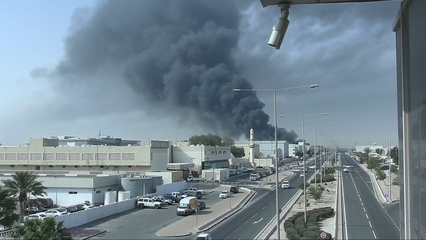
Explosions in Doha and Dubai after IRGC announces attacks on Israel, 27 US bases
09:19 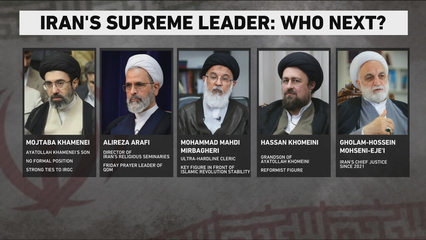
Who will rule Iran after Khamenei? Explaining supreme leader succession and IRGC power
05:01 
‘All hell will break loose’: Iran to target US bases in Middle East to avenge Khamenei’s killing
History of warnings of the Iranian ‘threat’
Netanyahu, who promoted the 2003 US invasion of Iraq, has been warning for more than two decades that Iran is on the cusp of acquiring nuclear weapons.
Iran denies seeking a nuclear bomb, and even Trump administration officials have acknowledged that Washington has no evidence that Tehran is weaponising its uranium enrichment programme.
After the US bombed Iran’s main enrichment facilities in the 12-day war in June last year – an attack that Trump says “obliterated” the country’s nuclear programme – Netanyahu pivoted to a new supposed Iranian threat: Tehran’s ballistic missiles.
“Iran can blackmail any American city,” Netanyahu told pro-Israel podcaster Ben Shapiro in October.
“People don’t believe it. Iran is developing intercontinental missiles with a range of 8,000km [5,000 miles], add another 3,000 [1,800 miles], and they can get to the East Coast of the US.”
Trump repeated that claim, which Tehran has vehemently denied and has not been backed by any public evidence or testing, in his State of the Union address earlier this week.
“They’ve already developed missiles that can threaten Europe and our bases overseas, and they’re working to build missiles that will soon reach the United States of America,” he said of the Iranians.
Trump has been building the case for a wider war with Iran since the June conflict, repeatedly threatening to bomb the country again.
But the US president’s own National Security Strategy last year called for de-prioritising the Middle East in Washington’s foreign policy and focusing on the Western Hemisphere.
Meanwhile, the US public, wary of global conflict after the wars in Iraq and Afghanistan, has also been largely opposed to new strikes against Iran, public opinion polls show.
Only 21 percent of respondents in a recent University of Maryland survey said they favoured a war with Iran.
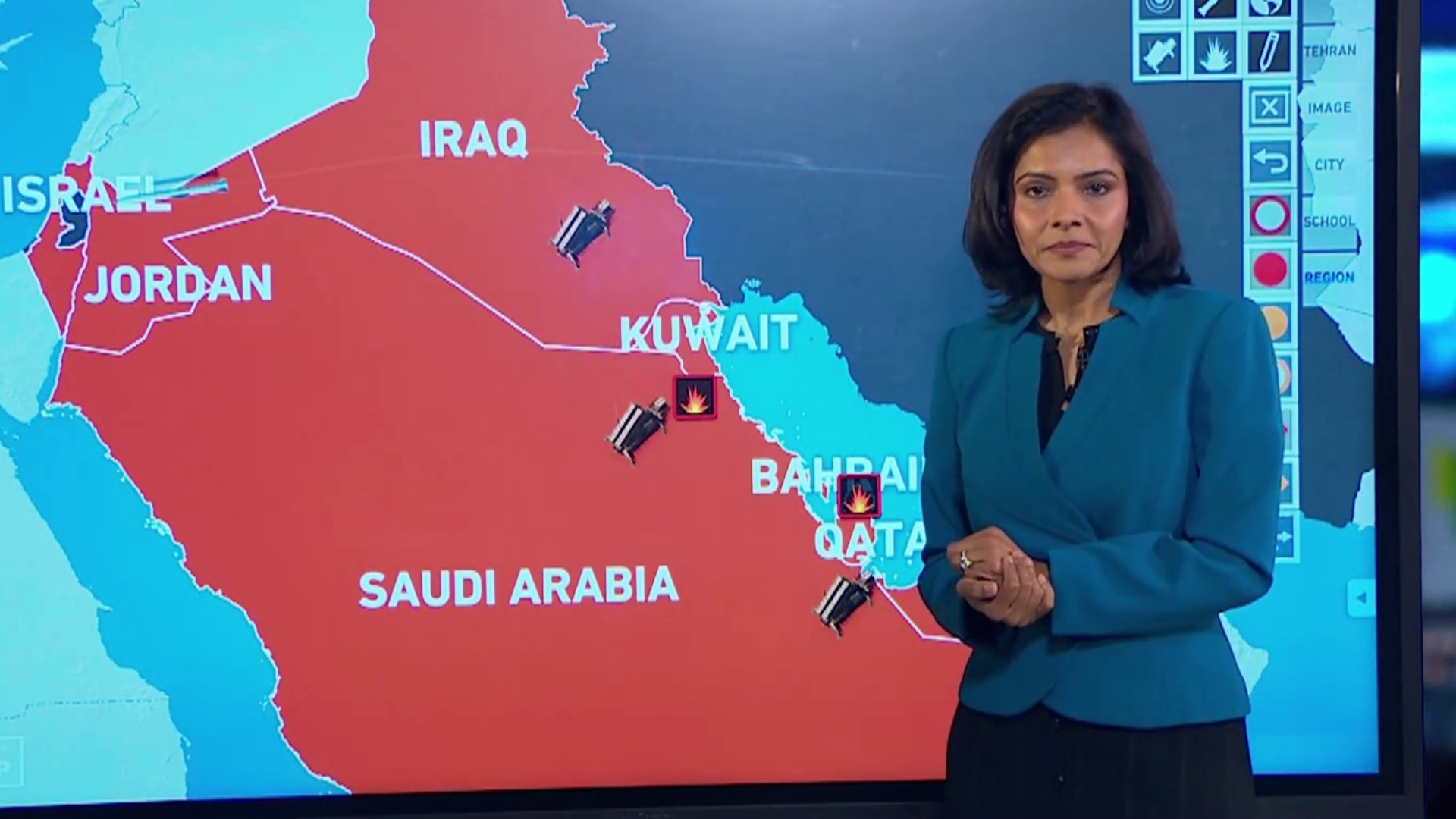
The first day of the war saw Iran fire missiles against bases and cities that host US troops and assets across the Middle East in retaliation for the joint US-Israeli strikes, plunging the region into chaos.
Trump acknowledged that US troops may suffer casualties in the conflict. “That often happens in war,” he said on Saturday. “But we’re doing this not for now. We’re doing this for the future. And it is a noble mission.”
‘Ignoring the vast majority of Americans’
The Trump administration had appeared to step back from the brink of conflict earlier this month by engaging in diplomacy with Tehran.
US and Iranian negotiators held three rounds of talks over the past week, with Tehran stressing that it is willing to agree to rigorous inspections of its nuclear programme.
Omani mediators and Iranian officials had described the last round of negotiations, which took place on Thursday, as positive, saying that it yielded significant progress.
The June 2025 war, initiated by Israel without provocation, also came in the middle of US-Iran talks.
“Netanyahu’s agenda has always been to prevent a diplomatic solution, and he feared Trump was actually serious about getting a deal, so the start of this war in the middle of negotiations is a success for him, just like it was last June,” Jamal Abdi, the president of the National Iranian American Council (NIAC), told Al Jazeera.
“Trump’s embrace of regime change rhetoric is a further victory for Netanyahu, and loss for the American people, as it suggests the US may be committed to a long and unpredictable military boondoggle.”
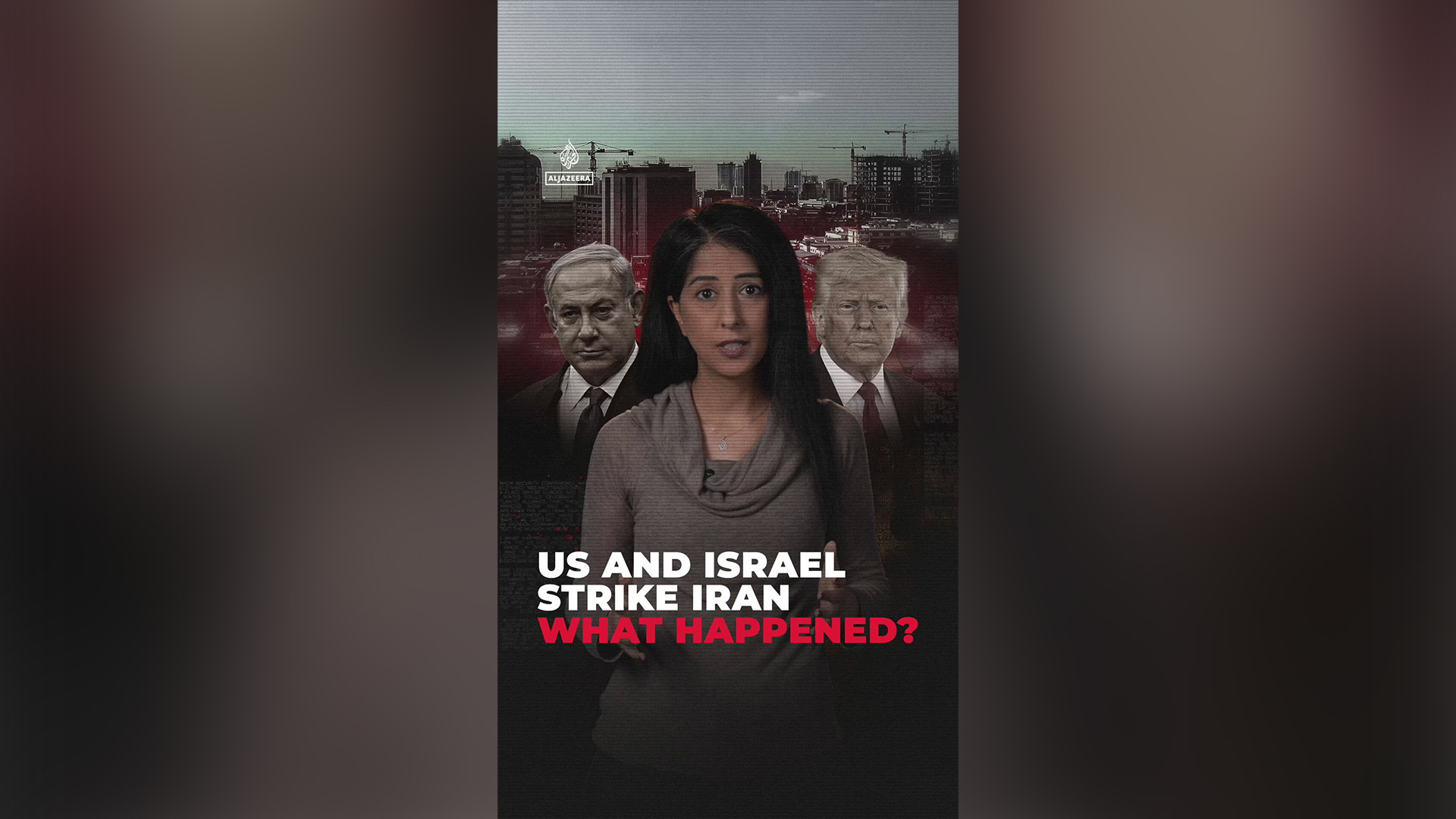
While announcing the strikes on Saturday, Trump said his aim is to prevent Iran from “threatening America and our core national security interests”.
But US critics, including some proponents of Trump’s “America first” movement, have argued that Iran – more than 10,000km (6,000 miles) away – does not pose a threat to the US.
Earlier this month, US Ambassador to Israel Mike Huckabee told conservative commentator Tucker Carlson that “if it were not for Iran, there wouldn’t be Hezbollah; we wouldn’t have the problem on the border with Lebanon”.
Carlson said, “What problem on the border with Lebanon? I’m an American. I’m not having any problems on the border with Lebanon right now. I live in Maine.”
On Saturday, Congresswoman Rashida Tlaib stressed that the US public does not want war with Iran.
“Trump is acting on the violent fantasies of the American political elite and the Israeli apartheid government, ignoring the vast majority of Americans who say loud and clear: No More Wars,” Tlaib said in a statement.
LISTEN TO THESE PODCASTS


He died in his office at home in an attack early Saturday, according to Tasnim, a semiofficial Iranian news agency. The strikes killed several other senior Iranian figures, Iranian state media said. The United States and Israel had spent months developing deep intelligence on the Iranian leadership, according to people familiar with the operation.
Large crowds of Iranians poured into the streets of Tehran and other cities across Iran to celebrate Ayatollah Khamenei’s death. Others mourned his death. The Islamic Revolutionary Guard Corps — a powerful institution that answers to the supreme leader — vowed to punish U.S. and Israeli aggression.
Iran’s president, the head of the judiciary and a jurist of the Guardian Council will be in charge during the transition period following the death, the Iranian state news agency said on Sunday, citing Mohammed Mokhbher, a senior politician. But the supreme leader’s death raises questions about who would ultimately run the country.
It is not clear whether removing Ayatollah Khamenei, who was 86, will result in significant changes to the system he led. Many people in authority owed their positions to him, and the Islamic Revolutionary Guard Corps recently demonstrated its grip on the country by brutally crushing mass protests, killing thousands of people.
Mr. Trump and Prime Minister Benjamin Netanyahu of Israel had both made clear that regime change was a goal of the initial waves of strikes on Iran that began around 1 a.m. local time on Saturday. “When we are finished, take over your government,” Mr. Trump told the Iranian people in a video statement. “It will be yours to take.”
The Iranian leader’s death is a seismic political shift that raises the prospect of chaos and a power vacuum in an already turbulent region.
In retaliation for the attacks, Iran fired waves of ballistic missiles at Israel, where the authorities reported one death. The United Arab Emirates, Qatar, Bahrain and Kuwait — all of which host U.S. military bases — said they had come under attack, as did Jordan. Falling debris from an Iranian ballistic missile attack killed at least one person in the Emirates, according to its government.
The fighting effectively shut down shipping through the Strait of Hormuz, the conduit for one-fifth of the world’s oil supply, according to shipping companies and Tasnim. Major airports, including Dubai International in the United Arab Emirates, and a wide corridor of airspace were closed.
Analysts have warned that the fighting could potentially draw the United States into a protracted conflict with no clear exit. Iran’s leadership oversees extensive military abilities and a network of regional proxy forces that could help sustain a resistance.
Many world leaders urged restraint after the strike on Saturday. But the bombing continued early Sunday, according to Iranians reporting new rounds of explosions on social media. Mr. Trump warned that U.S. strikes “will continue, uninterrupted throughout the week or, as long as necessary to achieve our objective of PEACE THROUGHOUT THE MIDDLE EAST AND, INDEED, THE WORLD!”
The effects of the attacks on Iranian civilians were not immediately clear. HRANA, a Washington-based Iranian rights group, said late Saturday that at least 133 civilians had been killed and that 200 others were injured — figures that could not be independently confirmed. The Iranian state media reported dozens of children were killed at a girl’s elementary school near a naval base. The U.S. and Israeli militaries did not immediately comment.
Here’s what else to know:
Celebrations in Tehran: As residents of Iran’s capital celebrated the supreme leader’s death, fireworks lit up the sky and loud Persian dance music filled the streets. But the threat of more attacks by U.S. and Israeli forces cast a pall over the festivities. Read more ›
Precise Targeting: The C.I.A. zeroed in on Ayatollah Khamenei’s location shortly before the United States and Israel attacked Iran. The operation reflects close coordination and intelligence sharing between the United States and Israel, as well as the failure of Iran’s leaders to avoid exposing themselves. Read more ›
Iranian Succession: The power to choose a new supreme leader rests with the Assembly of Experts, a conservative body of clerics who, given Ayatollah Khamenei’s age and infirmities, have probably given ample thought to potential successors. Read more ›
Shipping impacts: The closure of the Strait of Hormuz will almost certainly send oil prices upward. The U.S. Maritime Administration advised vessels to avoid the strait, and Iran’s Revolutionary Guards said that the passage was unsafe for commercial traffic, Tasnim reported. Read more ›
The crisis: Mr. Trump vowed in early January to aid antigovernment demonstrators there. The Iranian government quelled those protests in a bloody crackdown that killed thousands, according to rights groups. Mr. Trump has more recently focused on Iran’s nuclear program. American and Iranian officials held a last-ditch round of mediated talks on Thursday over the program that ended without a breakthrough.
Last year’s strikes: The United States bombed Iran’s nuclear facilities last June during a 12-day-war between Israel and Iran. While Mr. Trump said repeatedly that the Iranian nuclear program had been “obliterated” by those strikes, it later emerged that the effort had been degraded, not destroyed. Read more ›


ARABIA
Gulf
Sea
Kermanshah
Shiraz
Urmia
Qom
Chabahar
Isfahan

ARABIA
Gulf
Sea
Sea
Sea
in Haifa

The United States and Israel decided to adjust the timing of their attack, in part to take advantage of the new intelligence, according to officials with knowledge of the decisions.
The information provided a window of opportunity for the two countries to achieve a critical and early victory: the elimination of top Iranian officials and the killing of Ayatollah Khamenei.
The remarkably swift removal of Iran’s supreme leader reflected the close coordination and intelligence sharing between the United States and Israel in the run-up to the attack, and the deep intelligence the countries had developed on Iranian leadership, especially in the wake of last year’s 12-day war. The operation also showed the failure of Iran’s leaders to take adequate precautions to avoid exposing themselves at a time where both Israel and the U.S. sent clear signals that they were preparing for war.
The C.I.A. passed its intelligence, which offered “high fidelity” on Ayatollah Khamenei’s position, to Israel, according to people briefed on the intelligence.
They and others who shared details about the operation spoke on the condition of anonymity to discuss sensitive intelligence and military planning.
Israel, using U.S. intelligence and its own, would execute an operation it had been planning for months: the targeted killing of Iran’s senior leaders.
The United States and Israeli governments, which had originally planned to launch a strike at night under the cover of darkness, made the decision to adjust the timing to take advantage of the information about the gathering at the government compound in Tehran on Saturday morning.
The leaders were set to meet where the offices of the Iranian presidency, the supreme leader and Iran’s National Security Council are located.
Israel had determined that the gathering would include top Iranian defense officials, including Mohammad Pakpour, the commander in chief of the Islamic Revolutionary Guards Corps; Aziz Nasirzadeh, the minister of defense; Admiral Ali Shamkhani, the head of the Military Council; Seyyed Majid Mousavi, the commander of the Islamic Revolutionary Guards Corps Aerospace Force; Mohammad Shirazi, the deputy intelligence minister; and others.
The operation began around 6 a.m. in Israel, as fighter jets took off from their bases. The strike required relatively few aircraft, but they were armed with long-range and highly accurate munitions.
Two hours and five minutes after the jets took off, at around 9:40 a.m. in Tehran, the long-range missiles struck the compound. At the time of the strike, senior Iranian national security officials were in one building at the compound. Mr. Khamenei was in another nearby building.
“This morning’s strike was carried out simultaneously at several locations in Tehran, in one of which senior figures of Iran’s political-security echelon had gathered,” an Israeli defense official wrote in a message reviewed by The New York Times.
The official said that despite Iranian preparations for war, Israel managed to achieve “tactical surprise” with its attack on the compound.
The White House and the C.I.A. declined to comment.
On Sunday, Iran’s state news agency, IRNA, confirmed the deaths of two high-level military leaders Israel said it had killed on Saturday: Rear Adm. Shamkhani and Maj. Gen. Pakpour.

Killed
Ali Khamenei
Supreme leader
INNER CIRCLE
DEFENSE
OTHER LEADERS
Ali Shamkhani
Head of National Defense Council
Masoud
Pezeshkian
President
Ali Larijani
Secretary of
Supreme National Security
Council
Killed, according
to Israel
Mohammad Pakpour
Commander in chief of IRGC
Amir
Nasirzadeh
Defense
minister
Gholam-Hossein
Mohseni-Ejei
Head of the
Judiciary
Yahya Rahim Safavi
Senior aide
Majid Khademi
Head of Intelligence of IRGC
Mohammad-Ali
Movahedi
Head of Iran's
Assembly
of Experts
Esmail Qaani
IRGC's Quds
Force commander
Ali Asghar Hejazi
Senior aide
Mohammad Bagher Ghalibaf
Parliament speaker
Amir Hatami
Commander
in chief of the army
People briefed on the operation described it as a product of good intelligence and months of preparations.
Last June, with planning underway to strike Iran’s nuclear targets, President Trump asserted that the United States knew where Ayatollah Khamenei was hiding and could have killed him.
That intelligence, a former U.S. official said, was based on the same network that the United States relied on Saturday.
But since then, the information the United States has been able to gather has only improved, according to the former official and others briefed on the intelligence. During that 12-day war, the United States learned even more about how the supreme leader and the Islamic Revolutionary Guards Corps communicated and moved while under pressure, the former official said. The United States used that knowledge to hone its ability to track Ayatollah Khamenei and predict his movements.
The United States and Israel had also gathered specifics about the locations of key Iranian intelligence officers. In follow-on strikes after the attack on the leadership compound Saturday, locations where intelligence leaders were staying were hit, according to people familiar with the operation.
Iran’s top intelligence officer escaped, but the senior ranks of Iran’s intelligence agencies were decimated, according to people briefed on the operation.
Farnaz Fassihi and Ephrat Livni contributed reporting.


Instead, the president was set to cap an extraordinary day of U.S. aggression abroad by attending a glitzy fund-raising dinner at his club.
Mr. Trump’s lack of public engagement — after launching a military attack that could spur a broader conflict and put U.S. lives at risk — was a striking departure from how other presidents have handled the gravity of war.
“What Americans of our time are accustomed to is a president giving a White House speech — usually from the Oval Office — that befits the supreme importance of making war,” said Michael Beschloss, a presidential historian and the author of the book “Presidents of War: The Epic Story, from 1807 to Modern Times.”
“We are in a time where so many political traditions are being sidelined,” he said. “And this is another.”
Mr. Trump’s decision not to address the public on Saturday also came after he made little effort before the attack to lay out the case for a military assault against Iran.
The result is that the military offensive may have been a bewildering surprise to many in the United States on Saturday morning.
“The American public woke up to find the president took major military action with little public engagement or information,” said Matthew Bartlett, a Republican strategist and former State Department official who worked in the first Trump administration.
“While the element of surprise is an advantage in war, it may not be appreciated or understood by the public on such serious and consequential matters,” he added. “This certainly is shoot first and answer questions later.”
The White House did not respond to requests for comment about why the president did not deliver a formal public address.
Mr. Trump’s allies have argued that his communication strategy has adapted to the changing media landscape, where many Americans get their news and updates from social media. Steven Cheung, the White House communications director, celebrated Mr. Trump on social media on Saturday night as “focused,” invoking a term used by the MAGA base for critics of the president's approach.
“NO PANICANS!” Mr. Cheung said in a statement on X. “TRUST IN TRUMP!”
But Mr. Trump’s approach Saturday was a departure from how even Mr. Trump himself has handled other major military actions. Last year, when the United States launched strikes against Iran’s nuclear facilities, the president addressed the nation from the White House.
And when the United States conducted a major operation inside Venezuela earlier this year to capture the country’s leader, Nicolás Maduro, Mr. Trump delivered remarks and took questions from reporters at Mar-a-Lago.
On Saturday, the president did not make himself available to the press pool, a group of reporters who are assigned to follow his movements and record his remarks. Those reporters last saw him Friday night, when he waved as he descended from Air Force One after landing in Florida.
Instead, he made his case on Saturday with an eight-minute video posted on social media, which was edited and not broadcast live.
“Our objective is to defend the American people by eliminating imminent threats from the Iranian regime, a vicious group of very hard, terrible people,” Mr. Trump said, without specifying those threats. Key elements of what he and his advisers did assert in recent weeks about why Iran was a threat were false or unproven.
He later spoke to some reporters on the phone, then confirmed the death of Ayatollah Khamenei on Truth Social, his social media website. Karoline Leavitt, the White House press secretary, posted a number of statements on social media about the different leaders Mr. Trump spoke to throughout the day.
The president did not let the bombing of Iran upend his schedule, including his plans to attend a fund-raising dinner to support MAGA Inc., a pro-Trump super PAC.
Ms. Leavitt said Saturday that Mr. Trump had no intention of breaking that commitment. The fund-raiser, she said, was “more important than ever.”


Landlines and cellphone service were down across Iran, making it difficult to gauge public sentiment in the nation of more than 90 million people as U.S. and Israeli forces struck targets for a second day. Early reports of the death toll in Iran suggested that more than 100 people had been killed in the first wave of strikes.
But in neighborhoods across Tehran, the capital, pockets of exuberance emerged. In video calls with The New York Times, three residents of Tehran showed the scenes unfolding in their neighborhoods: Large crowds of men and women dancing and cheering, shouting, “Woohoo, hurrah.” Drivers passing by honked their car horns. Fireworks lit up the sky and loud Persian dance music filled the streets. Many residents, from their windows and balconies, joined in a chant of “freedom, freedom.”
Sara, a 53-year-old resident of Tehran, who like others interviewed asked that her last name not be used for fear of retaliation, said in a phone call that when she heard on the news that Mr. Khamenei had been killed, she let out a scream and jumped up and down. Her husband started pacing and they hugged, she said.
“Then we bolted outside and shouted from the top of our lungs and laughed and danced with our neighbors,” Sara said. Just a month ago, she, her husband and daughter were among protesters who took to the streets in an uprising against the government. Security forces beat her and her husband with batons and sprayed tear gas in their eyes, she said.
For Iranian supporters of Mr. Khamenei who considered him a revered religious figure, watching the celebrations was difficult, they said on social media. But they were noticeably absent from the streets.
Mr. Khamenei, who had the final say in all government decisions in Iran, personally ordered security forces to use lethal force against protesters in January, leading to a massacre that rights groups say killed at least 7,000 people, with numbers expected to rise.
“Khamenei went to hell,” one man shouted from his rooftop on Saturday, according to a video posted on BBC Persian.
For families whose loved ones were killed or jailed during Mr. Khamenei’s reign, the news felt cathartic, many said. Dr. Mohsen Assadi Lari, a physician and former senior official in the Iranian Ministry of Health, lost his son and daughter, both in their early 20s, when Iran’s Islamic Revolutionary Guards Corps shot down a Ukrainian Airlines passenger plane in 2020. On Saturday, he posted photographs of his children on his social media page with a message about freedom, “We will endure the winter, spring is near.”
In Abdanan, a Kurdish city in western Iran where the crackdown on protests was intense, young men and women cruised the streets after the announcement of the supreme leader’s death. They hung out of their car windows, showing victory signs and cheering.
“Tonight, Feb. 28, congratulations for our freedom,” said a voice narrating a video of the celebrations, which was verified by The Times. Parts of the video were already blurred.

“Am I dreaming?” screamed a man in another video, also verified by The Times. “Ah! Hello to the new world. Ah!” The footage shows people tearing down a monument bearing a man’s silhouette, possibly Mr. Khamenei’s, at a roundabout in Galleh Dar, in Fars Province, as fires burned around them.

People in Shiraz, a major Iranian city, were abandoning their cars for an impromptu dance party, whistling, cheering, clapping and screaming with joy. In many videos, celebrants joined together in a cheer that is typically reserved for weddings, symbolizing pure joy.
A video from Isfahan, another major city, in the south of Iran, shows at least a hundred people celebrating, many with their arms raised and waving white cloths. Cars can be heard honking their horns amid loud, jubilant cheering.
Iranians living abroad joined their families back home through video calls. Many sobbed from relief and happiness. Homayoun, an Iranian living in Paris, popped a bottle of champagne. Shadi, in Los Angeles, did shots with friends. Shirin, in Maryland, danced wildly at home to loud music.
“I am so happy,” Shirin said. “I don’t know what to do with myself. Is this real? Thank God I am alive to see this day.”
It remained unclear what would come next after Mr. Khamenei’s nearly four decades in power, whether a new system of government would take over or power would be transferred to successors as he had instructed before his death.
Video production by Dmitriy Khavin.
He died in his office at home in an attack early Saturday, according to Tasnim, a semiofficial Iranian news agency. The strikes killed several other senior Iranian figures, Iranian state media said. The United States and Israel had spent months developing deep intelligence on the Iranian leadership, according to people familiar with the operation.
Large crowds of Iranians poured into the streets of Tehran and other cities across Iran to celebrate Ayatollah Khamenei’s death. Others mourned his death. The Islamic Revolutionary Guard Corps — a powerful institution that answers to the supreme leader — vowed to punish U.S. and Israeli aggression.
Iran’s president, the head of the judiciary and a jurist of the Guardian Council will be in charge during the transition period following the death, the Iranian state news agency said on Sunday, citing Mohammed Mokhbher, a senior politician. But the supreme leader’s death raises questions about who would ultimately run the country.
It is not clear whether removing Ayatollah Khamenei, who was 86, will result in significant changes to the system he led. Many people in authority owed their positions to him, and the Islamic Revolutionary Guard Corps recently demonstrated its grip on the country by brutally crushing mass protests, killing thousands of people.
Mr. Trump and Prime Minister Benjamin Netanyahu of Israel had both made clear that regime change was a goal of the initial waves of strikes on Iran that began around 1 a.m. local time on Saturday. “When we are finished, take over your government,” Mr. Trump told the Iranian people in a video statement. “It will be yours to take.”
The Iranian leader’s death is a seismic political shift that raises the prospect of chaos and a power vacuum in an already turbulent region.
In retaliation for the attacks, Iran fired waves of ballistic missiles at Israel, where the authorities reported one death. The United Arab Emirates, Qatar, Bahrain and Kuwait — all of which host U.S. military bases — said they had come under attack, as did Jordan. Falling debris from an Iranian ballistic missile attack killed at least one person in the Emirates, according to its government.
The fighting effectively shut down shipping through the Strait of Hormuz, the conduit for one-fifth of the world’s oil supply, according to shipping companies and Tasnim. Major airports, including Dubai International in the United Arab Emirates, and a wide corridor of airspace were closed.
Analysts have warned that the fighting could potentially draw the United States into a protracted conflict with no clear exit. Iran’s leadership oversees extensive military abilities and a network of regional proxy forces that could help sustain a resistance.
Many world leaders urged restraint after the strike on Saturday. But the bombing continued early Sunday, according to Iranians reporting new rounds of explosions on social media. Mr. Trump warned that U.S. strikes “will continue, uninterrupted throughout the week or, as long as necessary to achieve our objective of PEACE THROUGHOUT THE MIDDLE EAST AND, INDEED, THE WORLD!”
The effects of the attacks on Iranian civilians were not immediately clear. HRANA, a Washington-based Iranian rights group, said late Saturday that at least 133 civilians had been killed and that 200 others were injured — figures that could not be independently confirmed. The Iranian state media reported dozens of children were killed at a girl’s elementary school near a naval base. The U.S. and Israeli militaries did not immediately comment.
Here’s what else to know:
Celebrations in Tehran: As residents of Iran’s capital celebrated the supreme leader’s death, fireworks lit up the sky and loud Persian dance music filled the streets. But the threat of more attacks by U.S. and Israeli forces cast a pall over the festivities. Read more ›
Precise Targeting: The C.I.A. zeroed in on Ayatollah Khamenei’s location shortly before the United States and Israel attacked Iran. The operation reflects close coordination and intelligence sharing between the United States and Israel, as well as the failure of Iran’s leaders to avoid exposing themselves. Read more ›
Iranian Succession: The power to choose a new supreme leader rests with the Assembly of Experts, a conservative body of clerics who, given Ayatollah Khamenei’s age and infirmities, have probably given ample thought to potential successors. Read more ›
Shipping impacts: The closure of the Strait of Hormuz will almost certainly send oil prices upward. The U.S. Maritime Administration advised vessels to avoid the strait, and Iran’s Revolutionary Guards said that the passage was unsafe for commercial traffic, Tasnim reported. Read more ›
The crisis: Mr. Trump vowed in early January to aid antigovernment demonstrators there. The Iranian government quelled those protests in a bloody crackdown that killed thousands, according to rights groups. Mr. Trump has more recently focused on Iran’s nuclear program. American and Iranian officials held a last-ditch round of mediated talks on Thursday over the program that ended without a breakthrough.
Last year’s strikes: The United States bombed Iran’s nuclear facilities last June during a 12-day-war between Israel and Iran. While Mr. Trump said repeatedly that the Iranian nuclear program had been “obliterated” by those strikes, it later emerged that the effort had been degraded, not destroyed. Read more ›
ARABIA
Gulf
Sea
Kermanshah
Shiraz
Urmia
Qom
Chabahar
Isfahan
ARABIA
Gulf
Sea
Sea
Sea
in Haifa
The United States and Israel decided to adjust the timing of their attack, in part to take advantage of the new intelligence, according to officials with knowledge of the decisions.
The information provided a window of opportunity for the two countries to achieve a critical and early victory: the elimination of top Iranian officials and the killing of Ayatollah Khamenei.
The remarkably swift removal of Iran’s supreme leader reflected the close coordination and intelligence sharing between the United States and Israel in the run-up to the attack, and the deep intelligence the countries had developed on Iranian leadership, especially in the wake of last year’s 12-day war. The operation also showed the failure of Iran’s leaders to take adequate precautions to avoid exposing themselves at a time where both Israel and the U.S. sent clear signals that they were preparing for war.
The C.I.A. passed its intelligence, which offered “high fidelity” on Ayatollah Khamenei’s position, to Israel, according to people briefed on the intelligence.
They and others who shared details about the operation spoke on the condition of anonymity to discuss sensitive intelligence and military planning.
Israel, using U.S. intelligence and its own, would execute an operation it had been planning for months: the targeted killing of Iran’s senior leaders.
The United States and Israeli governments, which had originally planned to launch a strike at night under the cover of darkness, made the decision to adjust the timing to take advantage of the information about the gathering at the government compound in Tehran on Saturday morning.
The leaders were set to meet where the offices of the Iranian presidency, the supreme leader and Iran’s National Security Council are located.
Israel had determined that the gathering would include top Iranian defense officials, including Mohammad Pakpour, the commander in chief of the Islamic Revolutionary Guards Corps; Aziz Nasirzadeh, the minister of defense; Admiral Ali Shamkhani, the head of the Military Council; Seyyed Majid Mousavi, the commander of the Islamic Revolutionary Guards Corps Aerospace Force; Mohammad Shirazi, the deputy intelligence minister; and others.
The operation began around 6 a.m. in Israel, as fighter jets took off from their bases. The strike required relatively few aircraft, but they were armed with long-range and highly accurate munitions.
Two hours and five minutes after the jets took off, at around 9:40 a.m. in Tehran, the long-range missiles struck the compound. At the time of the strike, senior Iranian national security officials were in one building at the compound. Mr. Khamenei was in another nearby building.
“This morning’s strike was carried out simultaneously at several locations in Tehran, in one of which senior figures of Iran’s political-security echelon had gathered,” an Israeli defense official wrote in a message reviewed by The New York Times.
The official said that despite Iranian preparations for war, Israel managed to achieve “tactical surprise” with its attack on the compound.
The White House and the C.I.A. declined to comment.
On Sunday, Iran’s state news agency, IRNA, confirmed the deaths of two high-level military leaders Israel said it had killed on Saturday: Rear Adm. Shamkhani and Maj. Gen. Pakpour.
Killed
Ali Khamenei
Supreme leader
INNER CIRCLE
DEFENSE
OTHER LEADERS
Ali Shamkhani
Head of National Defense Council
Masoud
Pezeshkian
President
Ali Larijani
Secretary of
Supreme National Security
Council
Killed, according
to Israel
Mohammad Pakpour
Commander in chief of IRGC
Amir
Nasirzadeh
Defense
minister
Gholam-Hossein
Mohseni-Ejei
Head of the
Judiciary
Yahya Rahim Safavi
Senior aide
Majid Khademi
Head of Intelligence of IRGC
Mohammad-Ali
Movahedi
Head of Iran's
Assembly
of Experts
Esmail Qaani
IRGC's Quds
Force commander
Ali Asghar Hejazi
Senior aide
Mohammad Bagher Ghalibaf
Parliament speaker
Amir Hatami
Commander
in chief of the army
People briefed on the operation described it as a product of good intelligence and months of preparations.
Last June, with planning underway to strike Iran’s nuclear targets, President Trump asserted that the United States knew where Ayatollah Khamenei was hiding and could have killed him.
That intelligence, a former U.S. official said, was based on the same network that the United States relied on Saturday.
But since then, the information the United States has been able to gather has only improved, according to the former official and others briefed on the intelligence. During that 12-day war, the United States learned even more about how the supreme leader and the Islamic Revolutionary Guards Corps communicated and moved while under pressure, the former official said. The United States used that knowledge to hone its ability to track Ayatollah Khamenei and predict his movements.
The United States and Israel had also gathered specifics about the locations of key Iranian intelligence officers. In follow-on strikes after the attack on the leadership compound Saturday, locations where intelligence leaders were staying were hit, according to people familiar with the operation.
Iran’s top intelligence officer escaped, but the senior ranks of Iran’s intelligence agencies were decimated, according to people briefed on the operation.
Farnaz Fassihi and Ephrat Livni contributed reporting.
Instead, the president was set to cap an extraordinary day of U.S. aggression abroad by attending a glitzy fund-raising dinner at his club.
Mr. Trump’s lack of public engagement — after launching a military attack that could spur a broader conflict and put U.S. lives at risk — was a striking departure from how other presidents have handled the gravity of war.
“What Americans of our time are accustomed to is a president giving a White House speech — usually from the Oval Office — that befits the supreme importance of making war,” said Michael Beschloss, a presidential historian and the author of the book “Presidents of War: The Epic Story, from 1807 to Modern Times.”
“We are in a time where so many political traditions are being sidelined,” he said. “And this is another.”
Mr. Trump’s decision not to address the public on Saturday also came after he made little effort before the attack to lay out the case for a military assault against Iran.
The result is that the military offensive may have been a bewildering surprise to many in the United States on Saturday morning.
“The American public woke up to find the president took major military action with little public engagement or information,” said Matthew Bartlett, a Republican strategist and former State Department official who worked in the first Trump administration.
“While the element of surprise is an advantage in war, it may not be appreciated or understood by the public on such serious and consequential matters,” he added. “This certainly is shoot first and answer questions later.”
The White House did not respond to requests for comment about why the president did not deliver a formal public address.
Mr. Trump’s allies have argued that his communication strategy has adapted to the changing media landscape, where many Americans get their news and updates from social media. Steven Cheung, the White House communications director, celebrated Mr. Trump on social media on Saturday night as “focused,” invoking a term used by the MAGA base for critics of the president's approach.
“NO PANICANS!” Mr. Cheung said in a statement on X. “TRUST IN TRUMP!”
But Mr. Trump’s approach Saturday was a departure from how even Mr. Trump himself has handled other major military actions. Last year, when the United States launched strikes against Iran’s nuclear facilities, the president addressed the nation from the White House.
And when the United States conducted a major operation inside Venezuela earlier this year to capture the country’s leader, Nicolás Maduro, Mr. Trump delivered remarks and took questions from reporters at Mar-a-Lago.
On Saturday, the president did not make himself available to the press pool, a group of reporters who are assigned to follow his movements and record his remarks. Those reporters last saw him Friday night, when he waved as he descended from Air Force One after landing in Florida.
Instead, he made his case on Saturday with an eight-minute video posted on social media, which was edited and not broadcast live.
“Our objective is to defend the American people by eliminating imminent threats from the Iranian regime, a vicious group of very hard, terrible people,” Mr. Trump said, without specifying those threats. Key elements of what he and his advisers did assert in recent weeks about why Iran was a threat were false or unproven.
He later spoke to some reporters on the phone, then confirmed the death of Ayatollah Khamenei on Truth Social, his social media website. Karoline Leavitt, the White House press secretary, posted a number of statements on social media about the different leaders Mr. Trump spoke to throughout the day.
The president did not let the bombing of Iran upend his schedule, including his plans to attend a fund-raising dinner to support MAGA Inc., a pro-Trump super PAC.
Ms. Leavitt said Saturday that Mr. Trump had no intention of breaking that commitment. The fund-raiser, she said, was “more important than ever.”
Landlines and cellphone service were down across Iran, making it difficult to gauge public sentiment in the nation of more than 90 million people as U.S. and Israeli forces struck targets for a second day. Early reports of the death toll in Iran suggested that more than 100 people had been killed in the first wave of strikes.
But in neighborhoods across Tehran, the capital, pockets of exuberance emerged. In video calls with The New York Times, three residents of Tehran showed the scenes unfolding in their neighborhoods: Large crowds of men and women dancing and cheering, shouting, “Woohoo, hurrah.” Drivers passing by honked their car horns. Fireworks lit up the sky and loud Persian dance music filled the streets. Many residents, from their windows and balconies, joined in a chant of “freedom, freedom.”
Sara, a 53-year-old resident of Tehran, who like others interviewed asked that her last name not be used for fear of retaliation, said in a phone call that when she heard on the news that Mr. Khamenei had been killed, she let out a scream and jumped up and down. Her husband started pacing and they hugged, she said.
“Then we bolted outside and shouted from the top of our lungs and laughed and danced with our neighbors,” Sara said. Just a month ago, she, her husband and daughter were among protesters who took to the streets in an uprising against the government. Security forces beat her and her husband with batons and sprayed tear gas in their eyes, she said.
For Iranian supporters of Mr. Khamenei who considered him a revered religious figure, watching the celebrations was difficult, they said on social media. But they were noticeably absent from the streets.
Mr. Khamenei, who had the final say in all government decisions in Iran, personally ordered security forces to use lethal force against protesters in January, leading to a massacre that rights groups say killed at least 7,000 people, with numbers expected to rise.
“Khamenei went to hell,” one man shouted from his rooftop on Saturday, according to a video posted on BBC Persian.
For families whose loved ones were killed or jailed during Mr. Khamenei’s reign, the news felt cathartic, many said. Dr. Mohsen Assadi Lari, a physician and former senior official in the Iranian Ministry of Health, lost his son and daughter, both in their early 20s, when Iran’s Islamic Revolutionary Guards Corps shot down a Ukrainian Airlines passenger plane in 2020. On Saturday, he posted photographs of his children on his social media page with a message about freedom, “We will endure the winter, spring is near.”
In Abdanan, a Kurdish city in western Iran where the crackdown on protests was intense, young men and women cruised the streets after the announcement of the supreme leader’s death. They hung out of their car windows, showing victory signs and cheering.
“Tonight, Feb. 28, congratulations for our freedom,” said a voice narrating a video of the celebrations, which was verified by The Times. Parts of the video were already blurred.
“Am I dreaming?” screamed a man in another video, also verified by The Times. “Ah! Hello to the new world. Ah!” The footage shows people tearing down a monument bearing a man’s silhouette, possibly Mr. Khamenei’s, at a roundabout in Galleh Dar, in Fars Province, as fires burned around them.
People in Shiraz, a major Iranian city, were abandoning their cars for an impromptu dance party, whistling, cheering, clapping and screaming with joy. In many videos, celebrants joined together in a cheer that is typically reserved for weddings, symbolizing pure joy.
A video from Isfahan, another major city, in the south of Iran, shows at least a hundred people celebrating, many with their arms raised and waving white cloths. Cars can be heard honking their horns amid loud, jubilant cheering.
Iranians living abroad joined their families back home through video calls. Many sobbed from relief and happiness. Homayoun, an Iranian living in Paris, popped a bottle of champagne. Shadi, in Los Angeles, did shots with friends. Shirin, in Maryland, danced wildly at home to loud music.
“I am so happy,” Shirin said. “I don’t know what to do with myself. Is this real? Thank God I am alive to see this day.”
It remained unclear what would come next after Mr. Khamenei’s nearly four decades in power, whether a new system of government would take over or power would be transferred to successors as he had instructed before his death.
Video production by Dmitriy Khavin.
Published Feb. 28, 2026Updated March 1, 2026, 2:48 a.m. ETShare full article
Video
Iran Says Supreme Leader Was Killed During U.S.-Israeli Strikes
1:43The Iranian government said on Sunday that U.S.-Israeli attacks on Iran had killed Ayatollah Ali Khamenei, the nation’s supreme leader.CreditCredit...ReutersPinned
Farnaz FassihiRonen BergmanZolan Kanno-Youngs and Richard Pérez-Peña
Here’s the latest.
The Iranian government said on Sunday that U.S.-Israeli attacks on Iran had killed Ayatollah Ali Khamenei, the nation’s supreme leader for decades and an implacable enemy of Israel and the United States.
President Trump had announced the supreme leader’s death hours earlier, and called on Iranians to take control of the government. The Iranian state news agency confirmed the death on Sunday morning, as the war entered a second day with another wave of attacks on the country.
He died in his office at home in an attack early Saturday, according to Tasnim, a semiofficial Iranian news agency. The strikes killed several other senior Iranian figures, Iranian state media said. The United States and Israel had spent months developing deep intelligence on the Iranian leadership, according to people familiar with the operation.
Large crowds of Iranians poured into the streets of Tehran and other cities across Iran to celebrate Ayatollah Khamenei’s death. Others mourned his death. The Islamic Revolutionary Guard Corps — a powerful institution that answers to the supreme leader — vowed to punish U.S. and Israeli aggression.
Iran’s president, the head of the judiciary and a jurist of the Guardian Council will be in charge during the transition period following the death, the Iranian state news agency said on Sunday, citing Mohammed Mokhbher, a senior politician. But the supreme leader’s death raises questions about who would ultimately run the country.
It is not clear whether removing Ayatollah Khamenei, who was 86, will result in significant changes to the system he led. Many people in authority owed their positions to him, and the Islamic Revolutionary Guard Corps recently demonstrated its grip on the country by brutally crushing mass protests, killing thousands of people.
Mr. Trump and Prime Minister Benjamin Netanyahu of Israel had both made clear that regime change was a goal of the initial waves of strikes on Iran that began around 1 a.m. local time on Saturday. “When we are finished, take over your government,” Mr. Trump told the Iranian people in a video statement. “It will be yours to take.”
The Iranian leader’s death is a seismic political shift that raises the prospect of chaos and a power vacuum in an already turbulent region.
In retaliation for the attacks, Iran fired waves of ballistic missiles at Israel, where the authorities reported one death. The United Arab Emirates, Qatar, Bahrain and Kuwait — all of which host U.S. military bases — said they had come under attack, as did Jordan. Falling debris from an Iranian ballistic missile attack killed at least one person in the Emirates, according to its government.
The fighting effectively shut down shipping through the Strait of Hormuz, the conduit for one-fifth of the world’s oil supply, according to shipping companies and Tasnim. Major airports, including Dubai International in the United Arab Emirates, and a wide corridor of airspace were closed.
Analysts have warned that the fighting could potentially draw the United States into a protracted conflict with no clear exit. Iran’s leadership oversees extensive military abilities and a network of regional proxy forces that could help sustain a resistance.
Many world leaders urged restraint after the strike on Saturday. But the bombing continued early Sunday, according to Iranians reporting new rounds of explosions on social media. Mr. Trump warned that U.S. strikes “will continue, uninterrupted throughout the week or, as long as necessary to achieve our objective of PEACE THROUGHOUT THE MIDDLE EAST AND, INDEED, THE WORLD!”
The effects of the attacks on Iranian civilians were not immediately clear. HRANA, a Washington-based Iranian rights group, said late Saturday that at least 133 civilians had been killed and that 200 others were injured — figures that could not be independently confirmed. The Iranian state media reported dozens of children were killed at a girl’s elementary school near a naval base. The U.S. and Israeli militaries did not immediately comment.
Here’s what else to know:
Celebrations in Tehran: As residents of Iran’s capital celebrated the supreme leader’s death, fireworks lit up the sky and loud Persian dance music filled the streets. But the threat of more attacks by U.S. and Israeli forces cast a pall over the festivities. Read more ›
Precise Targeting: The C.I.A. zeroed in on Ayatollah Khamenei’s location shortly before the United States and Israel attacked Iran. The operation reflects close coordination and intelligence sharing between the United States and Israel, as well as the failure of Iran’s leaders to avoid exposing themselves. Read more ›
Iranian Succession: The power to choose a new supreme leader rests with the Assembly of Experts, a conservative body of clerics who, given Ayatollah Khamenei’s age and infirmities, have probably given ample thought to potential successors. Read more ›
Shipping impacts: The closure of the Strait of Hormuz will almost certainly send oil prices upward. The U.S. Maritime Administration advised vessels to avoid the strait, and Iran’s Revolutionary Guards said that the passage was unsafe for commercial traffic, Tasnim reported. Read more ›
The crisis: Mr. Trump vowed in early January to aid antigovernment demonstrators there. The Iranian government quelled those protests in a bloody crackdown that killed thousands, according to rights groups. Mr. Trump has more recently focused on Iran’s nuclear program. American and Iranian officials held a last-ditch round of mediated talks on Thursday over the program that ended without a breakthrough.
Last year’s strikes: The United States bombed Iran’s nuclear facilities last June during a 12-day-war between Israel and Iran. While Mr. Trump said repeatedly that the Iranian nuclear program had been “obliterated” by those strikes, it later emerged that the effort had been degraded, not destroyed. Read more ›
Show moreAaron BoxermanMarch 1, 2026, 1:42 a.m. ETMarch 1, 2026Aaron BoxermanReporting from Jerusalem
Sayyid Abdolrahim Mousavi, the chief of staff of Iran’s armed forces, was also killed during the Israeli-American attack that began on Saturday, Iranian state media just announced. Maj. Gen. Mousavi’s death comes after several top Iranian leaders were killed, most notably Ayatollah Ali Khamenei, the country’s longtime ruler.
Aaron BoxermanMarch 1, 2026, 1:04 a.m. ETMarch 1, 2026Aaron BoxermanReporting from Jerusalem
Iran’s attacks targeting U.S. bases in the Persian Gulf appeared to have resumed Sunday morning, as well. The interior ministry of Bahrain, which hosts the U.S. Navy’s 5th Fleet, said sirens warning of incoming fire had been triggered; there were no immediate reports of casualties.
Where the U.S. and Israel hit Iran
IRANIRAQSAUDIARABIAAFGHANISTANKUWAITU.A.E.TURKMENISTANQATARBAHRAINTabrizMashhadPersianGulfCaspianSeaGulf of OmanTehranKermanshahShirazUrmiaQomChabaharIsfahanSources: Iranian state news agency, verified satellite images and video.Lazaro Gamio, Samuel Granados, Pablo Robles, Daniel Wood/The New York TimesWhere Iran has retaliated
IRANJORDANISRAELSAUDIARABIAKUWAITU.A.E.TURKMENISTANQATARBAHRAINPersianGulfCaspianSeaArabianSeaAFGHANISTANIRAQTURKEYSYRIAYEMENOMANRedSeaU.S. Navy base attackedMissile strikesin HaifaStrike on a Dubai hotelSources: Iranian state news agency, verified satellite images and video.Lazaro Gamio, Samuel Granados, Pablo Robles, Daniel Wood/The New York TimesAaron BoxermanMarch 1, 2026, 12:55 a.m. ETMarch 1, 2026Aaron BoxermanReporting from Jerusalem
Iranian officials are promising to continue the fight Sunday morning in the wake of Ayatollah Ali Khamenei’s killing. Ali Larijani, a senior leader and Khamenei confidant, vowed that Iranian forces would fight even harder on Sunday, in remarks carried by Iranian media. Larijani added that there would be continuity of governance.
Aaron BoxermanMarch 1, 2026, 12:41 a.m. ETMarch 1, 2026Aaron BoxermanReporting from Jerusalem
Iran has vowed retaliation for the death of its supreme leader. President Trump warned that if Iran “hit very hard today,” the United States would “HIT THEM WITH A FORCE THAT HAS NEVER BEEN SEEN BEFORE,” in a post on social media.
Aaron BoxermanMarch 1, 2026, 12:20 a.m. ETMarch 1, 2026Aaron BoxermanReporting from Jerusalem
Ayatollah Ali Khamenei was killed “in the opening blow” of the attack on Iran, Israel Katz, the Israeli defense minister, said on Sunday morning. “The axis of evil has sustained a critical hit,” he added.
March 1, 2026, 12:05 a.m. ETMarch 1, 2026Julian E. BarnesRonen BergmanEric Schmitt and Tyler Pager
The C.I.A. helped pinpoint a gathering of Iranian leaders. Then Israel struck.
Image
A satellite image shows black smoke rising and heavy damage at Iranian Supreme Leader Ayatollah Ali Khamenei’s compound, following strikes by the United States and Israel against Iran, on Saturday.Credit...Airbus, via ReutersShortly before the United States and Israel were poised to launch an attack on Iran, the C.I.A. zeroed in on the location of perhaps the most important target: Ayatollah Ali Khamenei, the country’s supreme leader.
The C.I.A. had been tracking Ayatollah Khamenei for months, gaining more confidence about his locations and his patterns, according to people familiar with the operation. Then the agency learned that a meeting of top Iranian officials would take place on Saturday morning at a leadership compound in the heart of Tehran. Most critically, the C.I.A. learned that the supreme leader would be at the site.
The United States and Israel decided to adjust the timing of their attack, in part to take advantage of the new intelligence, according to officials with knowledge of the decisions.
The information provided a window of opportunity for the two countries to achieve a critical and early victory: the elimination of top Iranian officials and the killing of Ayatollah Khamenei.
The remarkably swift removal of Iran’s supreme leader reflected the close coordination and intelligence sharing between the United States and Israel in the run-up to the attack, and the deep intelligence the countries had developed on Iranian leadership, especially in the wake of last year’s 12-day war. The operation also showed the failure of Iran’s leaders to take adequate precautions to avoid exposing themselves at a time where both Israel and the U.S. sent clear signals that they were preparing for war.
The C.I.A. passed its intelligence, which offered “high fidelity” on Ayatollah Khamenei’s position, to Israel, according to people briefed on the intelligence.
They and others who shared details about the operation spoke on the condition of anonymity to discuss sensitive intelligence and military planning.
Israel, using U.S. intelligence and its own, would execute an operation it had been planning for months: the targeted killing of Iran’s senior leaders.
The United States and Israeli governments, which had originally planned to launch a strike at night under the cover of darkness, made the decision to adjust the timing to take advantage of the information about the gathering at the government compound in Tehran on Saturday morning.
The leaders were set to meet where the offices of the Iranian presidency, the supreme leader and Iran’s National Security Council are located.
Israel had determined that the gathering would include top Iranian defense officials, including Mohammad Pakpour, the commander in chief of the Islamic Revolutionary Guards Corps; Aziz Nasirzadeh, the minister of defense; Admiral Ali Shamkhani, the head of the Military Council; Seyyed Majid Mousavi, the commander of the Islamic Revolutionary Guards Corps Aerospace Force; Mohammad Shirazi, the deputy intelligence minister; and others.
The operation began around 6 a.m. in Israel, as fighter jets took off from their bases. The strike required relatively few aircraft, but they were armed with long-range and highly accurate munitions.
Two hours and five minutes after the jets took off, at around 9:40 a.m. in Tehran, the long-range missiles struck the compound. At the time of the strike, senior Iranian national security officials were in one building at the compound. Mr. Khamenei was in another nearby building.
“This morning’s strike was carried out simultaneously at several locations in Tehran, in one of which senior figures of Iran’s political-security echelon had gathered,” an Israeli defense official wrote in a message reviewed by The New York Times.
The official said that despite Iranian preparations for war, Israel managed to achieve “tactical surprise” with its attack on the compound.
The White House and the C.I.A. declined to comment.
On Sunday, Iran’s state news agency, IRNA, confirmed the deaths of two high-level military leaders Israel said it had killed on Saturday: Rear Adm. Shamkhani and Maj. Gen. Pakpour.
KilledAli KhameneiSupreme leaderINNER CIRCLEDEFENSEOTHER LEADERSAli ShamkhaniHead of National Defense CouncilMasoudPezeshkianPresidentAli LarijaniSecretary ofSupreme National SecurityCouncilKilled, accordingto IsraelMohammad PakpourCommander in chief of IRGCAmirNasirzadehDefenseministerGholam-HosseinMohseni-EjeiHead of theJudiciaryYahya Rahim SafaviSenior aideMajid KhademiHead of Intelligence of IRGCMohammad-AliMovahediHead of Iran'sAssemblyof ExpertsEsmail QaaniIRGC's QudsForce commanderAli Asghar HejaziSenior aideMohammad Bagher GhalibafParliament speakerAmir HatamiCommanderin chief of the armySamuel Granados/The New York TimesPeople briefed on the operation described it as a product of good intelligence and months of preparations.
Last June, with planning underway to strike Iran’s nuclear targets, President Trump asserted that the United States knew where Ayatollah Khamenei was hiding and could have killed him.
That intelligence, a former U.S. official said, was based on the same network that the United States relied on Saturday.
But since then, the information the United States has been able to gather has only improved, according to the former official and others briefed on the intelligence. During that 12-day war, the United States learned even more about how the supreme leader and the Islamic Revolutionary Guards Corps communicated and moved while under pressure, the former official said. The United States used that knowledge to hone its ability to track Ayatollah Khamenei and predict his movements.
The United States and Israel had also gathered specifics about the locations of key Iranian intelligence officers. In follow-on strikes after the attack on the leadership compound Saturday, locations where intelligence leaders were staying were hit, according to people familiar with the operation.
Iran’s top intelligence officer escaped, but the senior ranks of Iran’s intelligence agencies were decimated, according to people briefed on the operation.
Farnaz Fassihi and Ephrat Livni contributed reporting.
Show moreAaron BoxermanFeb. 28, 2026, 11:28 p.m. ETFeb. 28, 2026Aaron BoxermanReporting from Jerusalem
It’s just after dawn in Israel, where air-raid sirens are warning of further Iranian missile launches at the country in retaliation for the U.S.-Israeli attacks. Alerts were triggered in the greater Tel Aviv area, as well as some Israeli settlements in the occupied West Bank.
Image
Credit...Avishag Shaar-Yashuv for The New York TimesZolan Kanno-YoungsFeb. 28, 2026, 11:00 p.m. ETFeb. 28, 2026Zolan Kanno-YoungsReporting from Palm Beach, Fla.
Trump stays out of public view after U.S. launches military assault on Iran.
Image
President Trump arriving in Palm Beach, Fla., on Friday.Credit...Eric Lee for The New York TimesFrom the moment he announced a massive military attack against Iran by posting an edited social media video at 2:30 a.m. Saturday, President Trump made clear that he would be taking a different tone and approach than his wartime predecessors.
Mr. Trump did not scramble back to the White House from Mar-a-Lago, his private club and residence in Palm Beach, Fla., to oversee the U.S. and Israeli strikes. He did not deliver a televised address informing the public of the killing of Ayatollah Ali Khamenei, who was the nation’s supreme leader for nearly four decades.
Instead, the president was set to cap an extraordinary day of U.S. aggression abroad by attending a glitzy fund-raising dinner at his club.
Mr. Trump’s lack of public engagement — after launching a military attack that could spur a broader conflict and put U.S. lives at risk — was a striking departure from how other presidents have handled the gravity of war.
“What Americans of our time are accustomed to is a president giving a White House speech — usually from the Oval Office — that befits the supreme importance of making war,” said Michael Beschloss, a presidential historian and the author of the book “Presidents of War: The Epic Story, from 1807 to Modern Times.”
“We are in a time where so many political traditions are being sidelined,” he said. “And this is another.”
Mr. Trump’s decision not to address the public on Saturday also came after he made little effort before the attack to lay out the case for a military assault against Iran.
The result is that the military offensive may have been a bewildering surprise to many in the United States on Saturday morning.
“The American public woke up to find the president took major military action with little public engagement or information,” said Matthew Bartlett, a Republican strategist and former State Department official who worked in the first Trump administration.
“While the element of surprise is an advantage in war, it may not be appreciated or understood by the public on such serious and consequential matters,” he added. “This certainly is shoot first and answer questions later.”
The White House did not respond to requests for comment about why the president did not deliver a formal public address.
Mr. Trump’s allies have argued that his communication strategy has adapted to the changing media landscape, where many Americans get their news and updates from social media. Steven Cheung, the White House communications director, celebrated Mr. Trump on social media on Saturday night as “focused,” invoking a term used by the MAGA base for critics of the president's approach.
“NO PANICANS!” Mr. Cheung said in a statement on X. “TRUST IN TRUMP!”
But Mr. Trump’s approach Saturday was a departure from how even Mr. Trump himself has handled other major military actions. Last year, when the United States launched strikes against Iran’s nuclear facilities, the president addressed the nation from the White House.
And when the United States conducted a major operation inside Venezuela earlier this year to capture the country’s leader, Nicolás Maduro, Mr. Trump delivered remarks and took questions from reporters at Mar-a-Lago.
On Saturday, the president did not make himself available to the press pool, a group of reporters who are assigned to follow his movements and record his remarks. Those reporters last saw him Friday night, when he waved as he descended from Air Force One after landing in Florida.
Instead, he made his case on Saturday with an eight-minute video posted on social media, which was edited and not broadcast live.
“Our objective is to defend the American people by eliminating imminent threats from the Iranian regime, a vicious group of very hard, terrible people,” Mr. Trump said, without specifying those threats. Key elements of what he and his advisers did assert in recent weeks about why Iran was a threat were false or unproven.
He later spoke to some reporters on the phone, then confirmed the death of Ayatollah Khamenei on Truth Social, his social media website. Karoline Leavitt, the White House press secretary, posted a number of statements on social media about the different leaders Mr. Trump spoke to throughout the day.
The president did not let the bombing of Iran upend his schedule, including his plans to attend a fund-raising dinner to support MAGA Inc., a pro-Trump super PAC.
Ms. Leavitt said Saturday that Mr. Trump had no intention of breaking that commitment. The fund-raiser, she said, was “more important than ever.”
Show moreEphrat LivniFeb. 28, 2026, 10:49 p.m. ETFeb. 28, 2026Ephrat Livni
Iran’s state news agency, IRNA, on Sunday confirmed the deaths of two high-level military leaders that Israel said it had killed on Saturday: Rear Adm. Ali Shamkhani, secretary of the Defense Council; and Maj. Gen. Mohammad Pakpour, commander of the Islamic Revolutionary Guard Corps. Both were killed in attacks on Saturday in Tehran, IRNA said.
Open modal at item 1 of 2Rear Adm. Ali Shamkhani, secretary of Iran’s Defense CouncilOpen modal at item 2 of 2Maj. Gen. Mohammad Pakpour, the commander of Iran’s Islamic Revolutionary Guard CorpsAtta Kenare/Agence France-Presse — Getty ImagesEphrat LivniFeb. 28, 2026, 10:16 p.m. ETFeb. 28, 2026Ephrat Livni
The Iranian state news agency IRNA said on Sunday morning that Iran’s president, the head of the judiciary and a jurist of the Guardian Council would be in charge during the transition period following the death of Iran’s supreme leader, Ayatollah Ali Khamenei. It cited Mohammed Mokhbher, a senior politician in Iran.
Ephrat LivniFeb. 28, 2026, 9:33 p.m. ETFeb. 28, 2026Ephrat Livni
Ayatollah Ali Khamenei, Iran’s deceased supreme leader, died in his office at home in an attack early on Saturday, according to Tasnim, Iran’s semiofficial state media.
Farnaz FassihiChristiaan TriebertFeb. 28, 2026, 9:22 p.m. ETFeb. 28, 2026Farnaz Fassihi and Christiaan Triebert
Iranians take to the streets to celebrate Khamenei’s death.
Video
Large crowds of Iranians poured into the streets of Tehran and other cities across Iran overnight, celebrating the news that Iran’s supreme leader, Ayatollah Ali Khamenei, had been killed during a day of coordinated U.S. and Israeli attacks.
The ayatollah’s death, after nearly 40 years of authoritarian rule, represented a historic shift for Iran’s theocratic regime. Many Iranians, inside and outside the country, rejoiced, even as the threat of more attacks by U.S. and Israeli forces cast a pall over some celebrations.
Landlines and cellphone service were down across Iran, making it difficult to gauge public sentiment in the nation of more than 90 million people as U.S. and Israeli forces struck targets for a second day. Early reports of the death toll in Iran suggested that more than 100 people had been killed in the first wave of strikes.
But in neighborhoods across Tehran, the capital, pockets of exuberance emerged. In video calls with The New York Times, three residents of Tehran showed the scenes unfolding in their neighborhoods: Large crowds of men and women dancing and cheering, shouting, “Woohoo, hurrah.” Drivers passing by honked their car horns. Fireworks lit up the sky and loud Persian dance music filled the streets. Many residents, from their windows and balconies, joined in a chant of “freedom, freedom.”
Sara, a 53-year-old resident of Tehran, who like others interviewed asked that her last name not be used for fear of retaliation, said in a phone call that when she heard on the news that Mr. Khamenei had been killed, she let out a scream and jumped up and down. Her husband started pacing and they hugged, she said.
“Then we bolted outside and shouted from the top of our lungs and laughed and danced with our neighbors,” Sara said. Just a month ago, she, her husband and daughter were among protesters who took to the streets in an uprising against the government. Security forces beat her and her husband with batons and sprayed tear gas in their eyes, she said.
For Iranian supporters of Mr. Khamenei who considered him a revered religious figure, watching the celebrations was difficult, they said on social media. But they were noticeably absent from the streets.
Mr. Khamenei, who had the final say in all government decisions in Iran, personally ordered security forces to use lethal force against protesters in January, leading to a massacre that rights groups say killed at least 7,000 people, with numbers expected to rise.
“Khamenei went to hell,” one man shouted from his rooftop on Saturday, according to a video posted on BBC Persian.
For families whose loved ones were killed or jailed during Mr. Khamenei’s reign, the news felt cathartic, many said. Dr. Mohsen Assadi Lari, a physician and former senior official in the Iranian Ministry of Health, lost his son and daughter, both in their early 20s, when Iran’s Islamic Revolutionary Guards Corps shot down a Ukrainian Airlines passenger plane in 2020. On Saturday, he posted photographs of his children on his social media page with a message about freedom, “We will endure the winter, spring is near.”
In Abdanan, a Kurdish city in western Iran where the crackdown on protests was intense, young men and women cruised the streets after the announcement of the supreme leader’s death. They hung out of their car windows, showing victory signs and cheering.
“Tonight, Feb. 28, congratulations for our freedom,” said a voice narrating a video of the celebrations, which was verified by The Times. Parts of the video were already blurred.
Video
“Am I dreaming?” screamed a man in another video, also verified by The Times. “Ah! Hello to the new world. Ah!” The footage shows people tearing down a monument bearing a man’s silhouette, possibly Mr. Khamenei’s, at a roundabout in Galleh Dar, in Fars Province, as fires burned around them.
VideoPeople in Shiraz, a major Iranian city, were abandoning their cars for an impromptu dance party, whistling, cheering, clapping and screaming with joy. In many videos, celebrants joined together in a cheer that is typically reserved for weddings, symbolizing pure joy.
A video from Isfahan, another major city, in the south of Iran, shows at least a hundred people celebrating, many with their arms raised and waving white cloths. Cars can be heard honking their horns amid loud, jubilant cheering.
Iranians living abroad joined their families back home through video calls. Many sobbed from relief and happiness. Homayoun, an Iranian living in Paris, popped a bottle of champagne. Shadi, in Los Angeles, did shots with friends. Shirin, in Maryland, danced wildly at home to loud music.
“I am so happy,” Shirin said. “I don’t know what to do with myself. Is this real? Thank God I am alive to see this day.”
It remained unclear what would come next after Mr. Khamenei’s nearly four decades in power, whether a new system of government would take over or power would be transferred to successors as he had instructed before his death.
Video production by Dmitriy Khavin.
Show moreEphrat LivniFeb. 28, 2026, 9:20 p.m. ETFeb. 28, 2026Ephrat Livni
The Islamic Revolutionary Guard Corps said in a statement on Iranian state media that the death of Iran’s supreme leader, Ayatollah Ali Khamenei, would only make Iran more determined to continue in his path. It condemned the actions of the United States and Israel and vowed to punish their aggression.
Farnaz FassihiFeb. 28, 2026, 9:02 p.m. ETFeb. 28, 2026Farnaz FassihiReporting from New York City
The anchor on Iran’s state television is wearing black and choking back tears while reading a statement from the National Supreme Council about Iran’s supreme leader. It described Ayatollah Ali Khamenei as a revered religious Islamic figure and said “his long dream of martyrdom became true,” noting that he had died during the holy month of Ramadan. The statement was both mournful and defiant, saying that Iranians were in mourning but Iran’s enemies should know that the Iran leader’s “martyrdom will spark a massive uprising in the fight against oppressors.”
Ephrat LivniFeb. 28, 2026, 8:54 p.m. ETFeb. 28, 2026Ephrat Livni
U.S. strikes on Iran are still underway, according to the U.S. Central Command. In a post on social media on Saturday night, CENTCOM said it was “now delivering swift and decisive action.”
Farnaz FassihiFeb. 28, 2026, 8:50 p.m. ETFeb. 28, 2026Farnaz FassihiReporting from New York City
Iran announced 40 days of official mourning and a seven-day national holiday to commemorate the death of Ayatollah Ali Khamenei.
Farnaz FassihiFeb. 28, 2026, 8:48 p.m. ETFeb. 28, 2026Farnaz FassihiReporting from New York City
For supporters of Iran’s leader, a day and night of anxiety and speculation about the fate of Ayatollah Ali Khamenei came to an end with a one-line announcement that he had been killed. State television broadcast melancholy verses from the Quran.
Farnaz FassihiFeb. 28, 2026, 8:44 p.m. ETFeb. 28, 2026Farnaz FassihiReporting from New York City
Ayatollah Ali Khamenei, who in more than three decades as Iran’s supreme leader turned the Islamic Republic into a regional power, brutally crushing dissent at home, flexing Iran’s muscle abroad and maintaining unswerving hostility to the United States and Israel, died on Saturday during U.S. and Israeli military strikes on his country. Read the full obituary here.Video
He died in his office at home in an attack early Saturday, according to Tasnim, a semiofficial Iranian news agency. The strikes killed several other senior Iranian figures, Iranian state media said. The United States and Israel had spent months developing deep intelligence on the Iranian leadership, according to people familiar with the operation.
Large crowds of Iranians poured into the streets of Tehran and other cities across Iran to celebrate Ayatollah Khamenei’s death. Others mourned his death. The Islamic Revolutionary Guard Corps — a powerful institution that answers to the supreme leader — vowed to punish U.S. and Israeli aggression.
Iran’s president, the head of the judiciary and a jurist of the Guardian Council will be in charge during the transition period following the death, the Iranian state news agency said on Sunday, citing Mohammed Mokhbher, a senior politician. But the supreme leader’s death raises questions about who would ultimately run the country.
It is not clear whether removing Ayatollah Khamenei, who was 86, will result in significant changes to the system he led. Many people in authority owed their positions to him, and the Islamic Revolutionary Guard Corps recently demonstrated its grip on the country by brutally crushing mass protests, killing thousands of people.
Mr. Trump and Prime Minister Benjamin Netanyahu of Israel had both made clear that regime change was a goal of the initial waves of strikes on Iran that began around 1 a.m. local time on Saturday. “When we are finished, take over your government,” Mr. Trump told the Iranian people in a video statement. “It will be yours to take.”
The Iranian leader’s death is a seismic political shift that raises the prospect of chaos and a power vacuum in an already turbulent region.
In retaliation for the attacks, Iran fired waves of ballistic missiles at Israel, where the authorities reported one death. The United Arab Emirates, Qatar, Bahrain and Kuwait — all of which host U.S. military bases — said they had come under attack, as did Jordan. Falling debris from an Iranian ballistic missile attack killed at least one person in the Emirates, according to its government.
The fighting effectively shut down shipping through the Strait of Hormuz, the conduit for one-fifth of the world’s oil supply, according to shipping companies and Tasnim. Major airports, including Dubai International in the United Arab Emirates, and a wide corridor of airspace were closed.
Analysts have warned that the fighting could potentially draw the United States into a protracted conflict with no clear exit. Iran’s leadership oversees extensive military abilities and a network of regional proxy forces that could help sustain a resistance.
Many world leaders urged restraint after the strike on Saturday. But the bombing continued early Sunday, according to Iranians reporting new rounds of explosions on social media. Mr. Trump warned that U.S. strikes “will continue, uninterrupted throughout the week or, as long as necessary to achieve our objective of PEACE THROUGHOUT THE MIDDLE EAST AND, INDEED, THE WORLD!”
The effects of the attacks on Iranian civilians were not immediately clear. HRANA, a Washington-based Iranian rights group, said late Saturday that at least 133 civilians had been killed and that 200 others were injured — figures that could not be independently confirmed. The Iranian state media reported dozens of children were killed at a girl’s elementary school near a naval base. The U.S. and Israeli militaries did not immediately comment.
Here’s what else to know:
Celebrations in Tehran: As residents of Iran’s capital celebrated the supreme leader’s death, fireworks lit up the sky and loud Persian dance music filled the streets. But the threat of more attacks by U.S. and Israeli forces cast a pall over the festivities. Read more ›
Precise Targeting: The C.I.A. zeroed in on Ayatollah Khamenei’s location shortly before the United States and Israel attacked Iran. The operation reflects close coordination and intelligence sharing between the United States and Israel, as well as the failure of Iran’s leaders to avoid exposing themselves. Read more ›
Iranian Succession: The power to choose a new supreme leader rests with the Assembly of Experts, a conservative body of clerics who, given Ayatollah Khamenei’s age and infirmities, have probably given ample thought to potential successors. Read more ›
Shipping impacts: The closure of the Strait of Hormuz will almost certainly send oil prices upward. The U.S. Maritime Administration advised vessels to avoid the strait, and Iran’s Revolutionary Guards said that the passage was unsafe for commercial traffic, Tasnim reported. Read more ›
The crisis: Mr. Trump vowed in early January to aid antigovernment demonstrators there. The Iranian government quelled those protests in a bloody crackdown that killed thousands, according to rights groups. Mr. Trump has more recently focused on Iran’s nuclear program. American and Iranian officials held a last-ditch round of mediated talks on Thursday over the program that ended without a breakthrough.
Last year’s strikes: The United States bombed Iran’s nuclear facilities last June during a 12-day-war between Israel and Iran. While Mr. Trump said repeatedly that the Iranian nuclear program had been “obliterated” by those strikes, it later emerged that the effort had been degraded, not destroyed. Read more ›
ARABIA
Gulf
Sea
Kermanshah
Shiraz
Urmia
Qom
Chabahar
Isfahan
ARABIA
Gulf
Sea
Sea
Sea
in Haifa
The United States and Israel decided to adjust the timing of their attack, in part to take advantage of the new intelligence, according to officials with knowledge of the decisions.
The information provided a window of opportunity for the two countries to achieve a critical and early victory: the elimination of top Iranian officials and the killing of Ayatollah Khamenei.
The remarkably swift removal of Iran’s supreme leader reflected the close coordination and intelligence sharing between the United States and Israel in the run-up to the attack, and the deep intelligence the countries had developed on Iranian leadership, especially in the wake of last year’s 12-day war. The operation also showed the failure of Iran’s leaders to take adequate precautions to avoid exposing themselves at a time where both Israel and the U.S. sent clear signals that they were preparing for war.
The C.I.A. passed its intelligence, which offered “high fidelity” on Ayatollah Khamenei’s position, to Israel, according to people briefed on the intelligence.
They and others who shared details about the operation spoke on the condition of anonymity to discuss sensitive intelligence and military planning.
Israel, using U.S. intelligence and its own, would execute an operation it had been planning for months: the targeted killing of Iran’s senior leaders.
The United States and Israeli governments, which had originally planned to launch a strike at night under the cover of darkness, made the decision to adjust the timing to take advantage of the information about the gathering at the government compound in Tehran on Saturday morning.
The leaders were set to meet where the offices of the Iranian presidency, the supreme leader and Iran’s National Security Council are located.
Israel had determined that the gathering would include top Iranian defense officials, including Mohammad Pakpour, the commander in chief of the Islamic Revolutionary Guards Corps; Aziz Nasirzadeh, the minister of defense; Admiral Ali Shamkhani, the head of the Military Council; Seyyed Majid Mousavi, the commander of the Islamic Revolutionary Guards Corps Aerospace Force; Mohammad Shirazi, the deputy intelligence minister; and others.
The operation began around 6 a.m. in Israel, as fighter jets took off from their bases. The strike required relatively few aircraft, but they were armed with long-range and highly accurate munitions.
Two hours and five minutes after the jets took off, at around 9:40 a.m. in Tehran, the long-range missiles struck the compound. At the time of the strike, senior Iranian national security officials were in one building at the compound. Mr. Khamenei was in another nearby building.
“This morning’s strike was carried out simultaneously at several locations in Tehran, in one of which senior figures of Iran’s political-security echelon had gathered,” an Israeli defense official wrote in a message reviewed by The New York Times.
The official said that despite Iranian preparations for war, Israel managed to achieve “tactical surprise” with its attack on the compound.
The White House and the C.I.A. declined to comment.
On Sunday, Iran’s state news agency, IRNA, confirmed the deaths of two high-level military leaders Israel said it had killed on Saturday: Rear Adm. Shamkhani and Maj. Gen. Pakpour.
Killed
Ali Khamenei
Supreme leader
INNER CIRCLE
DEFENSE
OTHER LEADERS
Ali Shamkhani
Head of National Defense Council
Masoud
Pezeshkian
President
Ali Larijani
Secretary of
Supreme National Security
Council
Killed, according
to Israel
Mohammad Pakpour
Commander in chief of IRGC
Amir
Nasirzadeh
Defense
minister
Gholam-Hossein
Mohseni-Ejei
Head of the
Judiciary
Yahya Rahim Safavi
Senior aide
Majid Khademi
Head of Intelligence of IRGC
Mohammad-Ali
Movahedi
Head of Iran's
Assembly
of Experts
Esmail Qaani
IRGC's Quds
Force commander
Ali Asghar Hejazi
Senior aide
Mohammad Bagher Ghalibaf
Parliament speaker
Amir Hatami
Commander
in chief of the army
People briefed on the operation described it as a product of good intelligence and months of preparations.
Last June, with planning underway to strike Iran’s nuclear targets, President Trump asserted that the United States knew where Ayatollah Khamenei was hiding and could have killed him.
That intelligence, a former U.S. official said, was based on the same network that the United States relied on Saturday.
But since then, the information the United States has been able to gather has only improved, according to the former official and others briefed on the intelligence. During that 12-day war, the United States learned even more about how the supreme leader and the Islamic Revolutionary Guards Corps communicated and moved while under pressure, the former official said. The United States used that knowledge to hone its ability to track Ayatollah Khamenei and predict his movements.
The United States and Israel had also gathered specifics about the locations of key Iranian intelligence officers. In follow-on strikes after the attack on the leadership compound Saturday, locations where intelligence leaders were staying were hit, according to people familiar with the operation.
Iran’s top intelligence officer escaped, but the senior ranks of Iran’s intelligence agencies were decimated, according to people briefed on the operation.
Farnaz Fassihi and Ephrat Livni contributed reporting.
Instead, the president was set to cap an extraordinary day of U.S. aggression abroad by attending a glitzy fund-raising dinner at his club.
Mr. Trump’s lack of public engagement — after launching a military attack that could spur a broader conflict and put U.S. lives at risk — was a striking departure from how other presidents have handled the gravity of war.
“What Americans of our time are accustomed to is a president giving a White House speech — usually from the Oval Office — that befits the supreme importance of making war,” said Michael Beschloss, a presidential historian and the author of the book “Presidents of War: The Epic Story, from 1807 to Modern Times.”
“We are in a time where so many political traditions are being sidelined,” he said. “And this is another.”
Mr. Trump’s decision not to address the public on Saturday also came after he made little effort before the attack to lay out the case for a military assault against Iran.
The result is that the military offensive may have been a bewildering surprise to many in the United States on Saturday morning.
“The American public woke up to find the president took major military action with little public engagement or information,” said Matthew Bartlett, a Republican strategist and former State Department official who worked in the first Trump administration.
“While the element of surprise is an advantage in war, it may not be appreciated or understood by the public on such serious and consequential matters,” he added. “This certainly is shoot first and answer questions later.”
The White House did not respond to requests for comment about why the president did not deliver a formal public address.
Mr. Trump’s allies have argued that his communication strategy has adapted to the changing media landscape, where many Americans get their news and updates from social media. Steven Cheung, the White House communications director, celebrated Mr. Trump on social media on Saturday night as “focused,” invoking a term used by the MAGA base for critics of the president's approach.
“NO PANICANS!” Mr. Cheung said in a statement on X. “TRUST IN TRUMP!”
But Mr. Trump’s approach Saturday was a departure from how even Mr. Trump himself has handled other major military actions. Last year, when the United States launched strikes against Iran’s nuclear facilities, the president addressed the nation from the White House.
And when the United States conducted a major operation inside Venezuela earlier this year to capture the country’s leader, Nicolás Maduro, Mr. Trump delivered remarks and took questions from reporters at Mar-a-Lago.
On Saturday, the president did not make himself available to the press pool, a group of reporters who are assigned to follow his movements and record his remarks. Those reporters last saw him Friday night, when he waved as he descended from Air Force One after landing in Florida.
Instead, he made his case on Saturday with an eight-minute video posted on social media, which was edited and not broadcast live.
“Our objective is to defend the American people by eliminating imminent threats from the Iranian regime, a vicious group of very hard, terrible people,” Mr. Trump said, without specifying those threats. Key elements of what he and his advisers did assert in recent weeks about why Iran was a threat were false or unproven.
He later spoke to some reporters on the phone, then confirmed the death of Ayatollah Khamenei on Truth Social, his social media website. Karoline Leavitt, the White House press secretary, posted a number of statements on social media about the different leaders Mr. Trump spoke to throughout the day.
The president did not let the bombing of Iran upend his schedule, including his plans to attend a fund-raising dinner to support MAGA Inc., a pro-Trump super PAC.
Ms. Leavitt said Saturday that Mr. Trump had no intention of breaking that commitment. The fund-raiser, she said, was “more important than ever.”
Landlines and cellphone service were down across Iran, making it difficult to gauge public sentiment in the nation of more than 90 million people as U.S. and Israeli forces struck targets for a second day. Early reports of the death toll in Iran suggested that more than 100 people had been killed in the first wave of strikes.
But in neighborhoods across Tehran, the capital, pockets of exuberance emerged. In video calls with The New York Times, three residents of Tehran showed the scenes unfolding in their neighborhoods: Large crowds of men and women dancing and cheering, shouting, “Woohoo, hurrah.” Drivers passing by honked their car horns. Fireworks lit up the sky and loud Persian dance music filled the streets. Many residents, from their windows and balconies, joined in a chant of “freedom, freedom.”
Sara, a 53-year-old resident of Tehran, who like others interviewed asked that her last name not be used for fear of retaliation, said in a phone call that when she heard on the news that Mr. Khamenei had been killed, she let out a scream and jumped up and down. Her husband started pacing and they hugged, she said.
“Then we bolted outside and shouted from the top of our lungs and laughed and danced with our neighbors,” Sara said. Just a month ago, she, her husband and daughter were among protesters who took to the streets in an uprising against the government. Security forces beat her and her husband with batons and sprayed tear gas in their eyes, she said.
For Iranian supporters of Mr. Khamenei who considered him a revered religious figure, watching the celebrations was difficult, they said on social media. But they were noticeably absent from the streets.
Mr. Khamenei, who had the final say in all government decisions in Iran, personally ordered security forces to use lethal force against protesters in January, leading to a massacre that rights groups say killed at least 7,000 people, with numbers expected to rise.
“Khamenei went to hell,” one man shouted from his rooftop on Saturday, according to a video posted on BBC Persian.
For families whose loved ones were killed or jailed during Mr. Khamenei’s reign, the news felt cathartic, many said. Dr. Mohsen Assadi Lari, a physician and former senior official in the Iranian Ministry of Health, lost his son and daughter, both in their early 20s, when Iran’s Islamic Revolutionary Guards Corps shot down a Ukrainian Airlines passenger plane in 2020. On Saturday, he posted photographs of his children on his social media page with a message about freedom, “We will endure the winter, spring is near.”
In Abdanan, a Kurdish city in western Iran where the crackdown on protests was intense, young men and women cruised the streets after the announcement of the supreme leader’s death. They hung out of their car windows, showing victory signs and cheering.
“Tonight, Feb. 28, congratulations for our freedom,” said a voice narrating a video of the celebrations, which was verified by The Times. Parts of the video were already blurred.
“Am I dreaming?” screamed a man in another video, also verified by The Times. “Ah! Hello to the new world. Ah!” The footage shows people tearing down a monument bearing a man’s silhouette, possibly Mr. Khamenei’s, at a roundabout in Galleh Dar, in Fars Province, as fires burned around them.
People in Shiraz, a major Iranian city, were abandoning their cars for an impromptu dance party, whistling, cheering, clapping and screaming with joy. In many videos, celebrants joined together in a cheer that is typically reserved for weddings, symbolizing pure joy.
A video from Isfahan, another major city, in the south of Iran, shows at least a hundred people celebrating, many with their arms raised and waving white cloths. Cars can be heard honking their horns amid loud, jubilant cheering.
Iranians living abroad joined their families back home through video calls. Many sobbed from relief and happiness. Homayoun, an Iranian living in Paris, popped a bottle of champagne. Shadi, in Los Angeles, did shots with friends. Shirin, in Maryland, danced wildly at home to loud music.
“I am so happy,” Shirin said. “I don’t know what to do with myself. Is this real? Thank God I am alive to see this day.”
It remained unclear what would come next after Mr. Khamenei’s nearly four decades in power, whether a new system of government would take over or power would be transferred to successors as he had instructed before his death.
Video production by Dmitriy Khavin.
He died in his office at home in an attack early Saturday, according to Tasnim, a semiofficial Iranian news agency. The strikes killed several other senior Iranian figures, Iranian state media said. The United States and Israel had spent months developing deep intelligence on the Iranian leadership, according to people familiar with the operation.
Large crowds of Iranians poured into the streets of Tehran and other cities across Iran to celebrate Ayatollah Khamenei’s death. Others mourned his death. The Islamic Revolutionary Guard Corps — a powerful institution that answers to the supreme leader — vowed to punish U.S. and Israeli aggression.
Iran’s president, the head of the judiciary and a jurist of the Guardian Council will be in charge during the transition period following the death, the Iranian state news agency said on Sunday, citing Mohammed Mokhbher, a senior politician. But the supreme leader’s death raises questions about who would ultimately run the country.
It is not clear whether removing Ayatollah Khamenei, who was 86, will result in significant changes to the system he led. Many people in authority owed their positions to him, and the Islamic Revolutionary Guard Corps recently demonstrated its grip on the country by brutally crushing mass protests, killing thousands of people.
Mr. Trump and Prime Minister Benjamin Netanyahu of Israel had both made clear that regime change was a goal of the initial waves of strikes on Iran that began around 1 a.m. local time on Saturday. “When we are finished, take over your government,” Mr. Trump told the Iranian people in a video statement. “It will be yours to take.”
The Iranian leader’s death is a seismic political shift that raises the prospect of chaos and a power vacuum in an already turbulent region.
In retaliation for the attacks, Iran fired waves of ballistic missiles at Israel, where the authorities reported one death. The United Arab Emirates, Qatar, Bahrain and Kuwait — all of which host U.S. military bases — said they had come under attack, as did Jordan. Falling debris from an Iranian ballistic missile attack killed at least one person in the Emirates, according to its government.
The fighting effectively shut down shipping through the Strait of Hormuz, the conduit for one-fifth of the world’s oil supply, according to shipping companies and Tasnim. Major airports, including Dubai International in the United Arab Emirates, and a wide corridor of airspace were closed.
Analysts have warned that the fighting could potentially draw the United States into a protracted conflict with no clear exit. Iran’s leadership oversees extensive military abilities and a network of regional proxy forces that could help sustain a resistance.
Many world leaders urged restraint after the strike on Saturday. But the bombing continued early Sunday, according to Iranians reporting new rounds of explosions on social media. Mr. Trump warned that U.S. strikes “will continue, uninterrupted throughout the week or, as long as necessary to achieve our objective of PEACE THROUGHOUT THE MIDDLE EAST AND, INDEED, THE WORLD!”
The effects of the attacks on Iranian civilians were not immediately clear. HRANA, a Washington-based Iranian rights group, said late Saturday that at least 133 civilians had been killed and that 200 others were injured — figures that could not be independently confirmed. The Iranian state media reported dozens of children were killed at a girl’s elementary school near a naval base. The U.S. and Israeli militaries did not immediately comment.
Here’s what else to know:
Celebrations in Tehran: As residents of Iran’s capital celebrated the supreme leader’s death, fireworks lit up the sky and loud Persian dance music filled the streets. But the threat of more attacks by U.S. and Israeli forces cast a pall over the festivities. Read more ›
Precise Targeting: The C.I.A. zeroed in on Ayatollah Khamenei’s location shortly before the United States and Israel attacked Iran. The operation reflects close coordination and intelligence sharing between the United States and Israel, as well as the failure of Iran’s leaders to avoid exposing themselves. Read more ›
Iranian Succession: The power to choose a new supreme leader rests with the Assembly of Experts, a conservative body of clerics who, given Ayatollah Khamenei’s age and infirmities, have probably given ample thought to potential successors. Read more ›
Shipping impacts: The closure of the Strait of Hormuz will almost certainly send oil prices upward. The U.S. Maritime Administration advised vessels to avoid the strait, and Iran’s Revolutionary Guards said that the passage was unsafe for commercial traffic, Tasnim reported. Read more ›
The crisis: Mr. Trump vowed in early January to aid antigovernment demonstrators there. The Iranian government quelled those protests in a bloody crackdown that killed thousands, according to rights groups. Mr. Trump has more recently focused on Iran’s nuclear program. American and Iranian officials held a last-ditch round of mediated talks on Thursday over the program that ended without a breakthrough.
Last year’s strikes: The United States bombed Iran’s nuclear facilities last June during a 12-day-war between Israel and Iran. While Mr. Trump said repeatedly that the Iranian nuclear program had been “obliterated” by those strikes, it later emerged that the effort had been degraded, not destroyed. Read more ›
ARABIA
Gulf
Sea
Kermanshah
Shiraz
Urmia
Qom
Chabahar
Isfahan
ARABIA
Gulf
Sea
Sea
Sea
in Haifa
The United States and Israel decided to adjust the timing of their attack, in part to take advantage of the new intelligence, according to officials with knowledge of the decisions.
The information provided a window of opportunity for the two countries to achieve a critical and early victory: the elimination of top Iranian officials and the killing of Ayatollah Khamenei.
The remarkably swift removal of Iran’s supreme leader reflected the close coordination and intelligence sharing between the United States and Israel in the run-up to the attack, and the deep intelligence the countries had developed on Iranian leadership, especially in the wake of last year’s 12-day war. The operation also showed the failure of Iran’s leaders to take adequate precautions to avoid exposing themselves at a time where both Israel and the U.S. sent clear signals that they were preparing for war.
The C.I.A. passed its intelligence, which offered “high fidelity” on Ayatollah Khamenei’s position, to Israel, according to people briefed on the intelligence.
They and others who shared details about the operation spoke on the condition of anonymity to discuss sensitive intelligence and military planning.
Israel, using U.S. intelligence and its own, would execute an operation it had been planning for months: the targeted killing of Iran’s senior leaders.
The United States and Israeli governments, which had originally planned to launch a strike at night under the cover of darkness, made the decision to adjust the timing to take advantage of the information about the gathering at the government compound in Tehran on Saturday morning.
The leaders were set to meet where the offices of the Iranian presidency, the supreme leader and Iran’s National Security Council are located.
Israel had determined that the gathering would include top Iranian defense officials, including Mohammad Pakpour, the commander in chief of the Islamic Revolutionary Guards Corps; Aziz Nasirzadeh, the minister of defense; Admiral Ali Shamkhani, the head of the Military Council; Seyyed Majid Mousavi, the commander of the Islamic Revolutionary Guards Corps Aerospace Force; Mohammad Shirazi, the deputy intelligence minister; and others.
The operation began around 6 a.m. in Israel, as fighter jets took off from their bases. The strike required relatively few aircraft, but they were armed with long-range and highly accurate munitions.
Two hours and five minutes after the jets took off, at around 9:40 a.m. in Tehran, the long-range missiles struck the compound. At the time of the strike, senior Iranian national security officials were in one building at the compound. Mr. Khamenei was in another nearby building.
“This morning’s strike was carried out simultaneously at several locations in Tehran, in one of which senior figures of Iran’s political-security echelon had gathered,” an Israeli defense official wrote in a message reviewed by The New York Times.
The official said that despite Iranian preparations for war, Israel managed to achieve “tactical surprise” with its attack on the compound.
The White House and the C.I.A. declined to comment.
On Sunday, Iran’s state news agency, IRNA, confirmed the deaths of two high-level military leaders Israel said it had killed on Saturday: Rear Adm. Shamkhani and Maj. Gen. Pakpour.
Killed
Ali Khamenei
Supreme leader
INNER CIRCLE
DEFENSE
OTHER LEADERS
Ali Shamkhani
Head of National Defense Council
Masoud
Pezeshkian
President
Ali Larijani
Secretary of
Supreme National Security
Council
Killed, according
to Israel
Mohammad Pakpour
Commander in chief of IRGC
Amir
Nasirzadeh
Defense
minister
Gholam-Hossein
Mohseni-Ejei
Head of the
Judiciary
Yahya Rahim Safavi
Senior aide
Majid Khademi
Head of Intelligence of IRGC
Mohammad-Ali
Movahedi
Head of Iran's
Assembly
of Experts
Esmail Qaani
IRGC's Quds
Force commander
Ali Asghar Hejazi
Senior aide
Mohammad Bagher Ghalibaf
Parliament speaker
Amir Hatami
Commander
in chief of the army
People briefed on the operation described it as a product of good intelligence and months of preparations.
Last June, with planning underway to strike Iran’s nuclear targets, President Trump asserted that the United States knew where Ayatollah Khamenei was hiding and could have killed him.
That intelligence, a former U.S. official said, was based on the same network that the United States relied on Saturday.
But since then, the information the United States has been able to gather has only improved, according to the former official and others briefed on the intelligence. During that 12-day war, the United States learned even more about how the supreme leader and the Islamic Revolutionary Guards Corps communicated and moved while under pressure, the former official said. The United States used that knowledge to hone its ability to track Ayatollah Khamenei and predict his movements.
The United States and Israel had also gathered specifics about the locations of key Iranian intelligence officers. In follow-on strikes after the attack on the leadership compound Saturday, locations where intelligence leaders were staying were hit, according to people familiar with the operation.
Iran’s top intelligence officer escaped, but the senior ranks of Iran’s intelligence agencies were decimated, according to people briefed on the operation.
Farnaz Fassihi and Ephrat Livni contributed reporting.
Instead, the president was set to cap an extraordinary day of U.S. aggression abroad by attending a glitzy fund-raising dinner at his club.
Mr. Trump’s lack of public engagement — after launching a military attack that could spur a broader conflict and put U.S. lives at risk — was a striking departure from how other presidents have handled the gravity of war.
“What Americans of our time are accustomed to is a president giving a White House speech — usually from the Oval Office — that befits the supreme importance of making war,” said Michael Beschloss, a presidential historian and the author of the book “Presidents of War: The Epic Story, from 1807 to Modern Times.”
“We are in a time where so many political traditions are being sidelined,” he said. “And this is another.”
Mr. Trump’s decision not to address the public on Saturday also came after he made little effort before the attack to lay out the case for a military assault against Iran.
The result is that the military offensive may have been a bewildering surprise to many in the United States on Saturday morning.
“The American public woke up to find the president took major military action with little public engagement or information,” said Matthew Bartlett, a Republican strategist and former State Department official who worked in the first Trump administration.
“While the element of surprise is an advantage in war, it may not be appreciated or understood by the public on such serious and consequential matters,” he added. “This certainly is shoot first and answer questions later.”
The White House did not respond to requests for comment about why the president did not deliver a formal public address.
Mr. Trump’s allies have argued that his communication strategy has adapted to the changing media landscape, where many Americans get their news and updates from social media. Steven Cheung, the White House communications director, celebrated Mr. Trump on social media on Saturday night as “focused,” invoking a term used by the MAGA base for critics of the president's approach.
“NO PANICANS!” Mr. Cheung said in a statement on X. “TRUST IN TRUMP!”
But Mr. Trump’s approach Saturday was a departure from how even Mr. Trump himself has handled other major military actions. Last year, when the United States launched strikes against Iran’s nuclear facilities, the president addressed the nation from the White House.
And when the United States conducted a major operation inside Venezuela earlier this year to capture the country’s leader, Nicolás Maduro, Mr. Trump delivered remarks and took questions from reporters at Mar-a-Lago.
On Saturday, the president did not make himself available to the press pool, a group of reporters who are assigned to follow his movements and record his remarks. Those reporters last saw him Friday night, when he waved as he descended from Air Force One after landing in Florida.
Instead, he made his case on Saturday with an eight-minute video posted on social media, which was edited and not broadcast live.
“Our objective is to defend the American people by eliminating imminent threats from the Iranian regime, a vicious group of very hard, terrible people,” Mr. Trump said, without specifying those threats. Key elements of what he and his advisers did assert in recent weeks about why Iran was a threat were false or unproven.
He later spoke to some reporters on the phone, then confirmed the death of Ayatollah Khamenei on Truth Social, his social media website. Karoline Leavitt, the White House press secretary, posted a number of statements on social media about the different leaders Mr. Trump spoke to throughout the day.
The president did not let the bombing of Iran upend his schedule, including his plans to attend a fund-raising dinner to support MAGA Inc., a pro-Trump super PAC.
Ms. Leavitt said Saturday that Mr. Trump had no intention of breaking that commitment. The fund-raiser, she said, was “more important than ever.”
Landlines and cellphone service were down across Iran, making it difficult to gauge public sentiment in the nation of more than 90 million people as U.S. and Israeli forces struck targets for a second day. Early reports of the death toll in Iran suggested that more than 100 people had been killed in the first wave of strikes.
But in neighborhoods across Tehran, the capital, pockets of exuberance emerged. In video calls with The New York Times, three residents of Tehran showed the scenes unfolding in their neighborhoods: Large crowds of men and women dancing and cheering, shouting, “Woohoo, hurrah.” Drivers passing by honked their car horns. Fireworks lit up the sky and loud Persian dance music filled the streets. Many residents, from their windows and balconies, joined in a chant of “freedom, freedom.”
Sara, a 53-year-old resident of Tehran, who like others interviewed asked that her last name not be used for fear of retaliation, said in a phone call that when she heard on the news that Mr. Khamenei had been killed, she let out a scream and jumped up and down. Her husband started pacing and they hugged, she said.
“Then we bolted outside and shouted from the top of our lungs and laughed and danced with our neighbors,” Sara said. Just a month ago, she, her husband and daughter were among protesters who took to the streets in an uprising against the government. Security forces beat her and her husband with batons and sprayed tear gas in their eyes, she said.
For Iranian supporters of Mr. Khamenei who considered him a revered religious figure, watching the celebrations was difficult, they said on social media. But they were noticeably absent from the streets.
Mr. Khamenei, who had the final say in all government decisions in Iran, personally ordered security forces to use lethal force against protesters in January, leading to a massacre that rights groups say killed at least 7,000 people, with numbers expected to rise.
“Khamenei went to hell,” one man shouted from his rooftop on Saturday, according to a video posted on BBC Persian.
For families whose loved ones were killed or jailed during Mr. Khamenei’s reign, the news felt cathartic, many said. Dr. Mohsen Assadi Lari, a physician and former senior official in the Iranian Ministry of Health, lost his son and daughter, both in their early 20s, when Iran’s Islamic Revolutionary Guards Corps shot down a Ukrainian Airlines passenger plane in 2020. On Saturday, he posted photographs of his children on his social media page with a message about freedom, “We will endure the winter, spring is near.”
In Abdanan, a Kurdish city in western Iran where the crackdown on protests was intense, young men and women cruised the streets after the announcement of the supreme leader’s death. They hung out of their car windows, showing victory signs and cheering.
“Tonight, Feb. 28, congratulations for our freedom,” said a voice narrating a video of the celebrations, which was verified by The Times. Parts of the video were already blurred.
“Am I dreaming?” screamed a man in another video, also verified by The Times. “Ah! Hello to the new world. Ah!” The footage shows people tearing down a monument bearing a man’s silhouette, possibly Mr. Khamenei’s, at a roundabout in Galleh Dar, in Fars Province, as fires burned around them.
People in Shiraz, a major Iranian city, were abandoning their cars for an impromptu dance party, whistling, cheering, clapping and screaming with joy. In many videos, celebrants joined together in a cheer that is typically reserved for weddings, symbolizing pure joy.
A video from Isfahan, another major city, in the south of Iran, shows at least a hundred people celebrating, many with their arms raised and waving white cloths. Cars can be heard honking their horns amid loud, jubilant cheering.
Iranians living abroad joined their families back home through video calls. Many sobbed from relief and happiness. Homayoun, an Iranian living in Paris, popped a bottle of champagne. Shadi, in Los Angeles, did shots with friends. Shirin, in Maryland, danced wildly at home to loud music.
“I am so happy,” Shirin said. “I don’t know what to do with myself. Is this real? Thank God I am alive to see this day.”
It remained unclear what would come next after Mr. Khamenei’s nearly four decades in power, whether a new system of government would take over or power would be transferred to successors as he had instructed before his death.
Video production by Dmitriy Khavin.


Geen opmerkingen:
Een reactie posten