The
world's richest 1% own 43% of global financial assets, and the wealth
of the top five billionaires has doubled since 2020, while 60% of
humanity got poorer, according to a report by Oxfam.
The
world's richest 1% own 43% of global financial assets, and the wealth
of the top five billionaires has doubled since 2020, while 60% of
humanity - nearly 5 billion people - collectively got poorer, according
to a report by Oxfam, a leading international humanitarian organization.
Oxfam published the study, "Inequality Inc.”,
to coincide with the World Economic Forum meeting of corporate
oligarchs and Western government officials in Davos, Switzerland this
January.
The
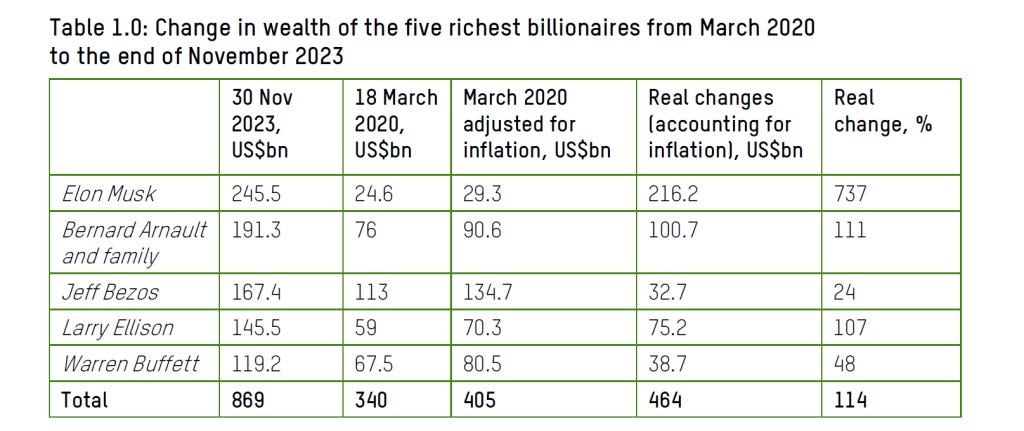
five richest people on Earth in 2023 were Elon Musk, Bernard Arnault,
Jeff Bezos, Larry Ellison, and Warren Buffett. Their combined wealth
skyrocketed from $340 billion in 2020 to $869 billion just three years
later.
Adjusted for inflation, this was a real increase of 114%.
Oxfam
found that the wealthiest 1% of the world population emit as much
carbon pollution as the poorest two-thirds of the entire human
population.
"Only 0.4 percent of the world’s largest corporations
are publicly committed to paying workers a living wage and support a
living wage in their value chains", the organization wrote.
"While
corporate profits are soaring, the wages of nearly 800 million workers
around the world have failed to keep up with inflation, resulting in a
loss of $1.5 trillion for those workers over the last two years".
Oxfam
likewise discovered that seven out of 10 of the largest corporations on
the planet either have a billionaire as their CEO or have a billionaire
as their principal shareholder.
"We
are living through an era of monopoly power that enables corporations
to control markets, set the terms of exchange, and profit without fear
of losing business", Oxfam cautioned.
This growing inequality is especially clear in the differences between the Global North and South.
"Rich people in the Global North still own the world", Oxfam wrote.
A staggering 69.3% of the world's wealth is located in the Global North, which has just 20.6% of the planet's population.
Oxfam warned that the world capitalist "economic system has created a new type of colonialism".
"Many
of the world’s super-rich are concentrated in countries that were once
colonial superpowers. Neocolonial relationships persist, perpetuating
economic imbalances and rigging the economic rules in favor of rich
nations", the anti-poverty organization wrote.
It added, "Low- and
lower-middle-income countries are set to pay nearly half a billion U.S.
dollars a day in interest and debt payments between now and 2029, and
they are having to make severe spending cuts to be able to pay their
creditors".
Why is the real story of October 7 off-limits to western, but not Israeli, media?
Israeli
army 'ethics' chief says crimes committed by soldiers against Israel's
own civilians are 'horrifying'. How is this not newsworthy for British
journalists?
The Israeli Haaretz newspaper interviewed this week the army's “ethics” chief, Asa Kasher, of Tel Aviv university, about two major incidents on October 7:
1.
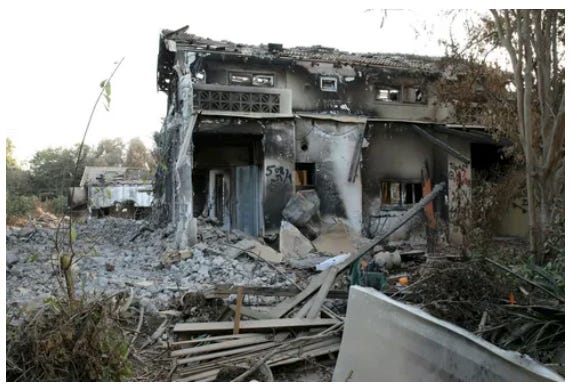
An Israeli commander ordered a tank to fire into a home in Kibbutz
Be'eri knowing that there were 14 Israeli civilians inside, incinerating
them.
2. Israeli helicopters fired missiles at
dozens of cars with Israeli hostages inside, killing the inhabitants,
again often by incinerating them.
In both cases, the
official Israeli narrative is that Hamas was responsible for these
“barbaric” acts, supposedly justifying the genocide Israel is carrying
out – “in response” – against the civilian Palestinian population of
Gaza.
Haaretz and Kasher ascribe these “friendly fire” incidents
to Israel's classified “Hannibal directive”, which requires soldiers to
stop Israelis being taken hostage at all costs. Kasher thinks – probably
wrongly – that the directive was misunderstood and misapplied by
commanders on the day.
Urging
an immediate investigation, Kasher says of the first incident: "How is
it possible that a high ranking army official would give a command that
so immediately and definitely endangers the life of so many civilians?
It's just horrifying."
And of the second incident, he says: "This
sounds totally unacceptable from every aspect. Against orders. Against
procedure. Against values. Against ethics. And possibly against the
law."
Efforts to re-examine the Israeli government's October 7 narrative are all over the Israeli media. Many of the families of the Israelis killed on October 7 are demanding an investigation.
So how is it possible that the BBC and the rest of the western media keep revisiting the horrors of October 7 but never to raise these issues , even though they have been so prominent in the Israeli public space for many weeks?
The only possible answer is that western media outlets are consciously
censoring this story because it directly conflicts with the West's
ideological and strategic agenda. It raises disturbing questions about
western complicity in genocide.
Once again, the
establishment media's unwillingness to report the real story starkly
gives the lie to their claim to be 'free and fearless'.
In truth,
they are there to uphold a narrative of western moral and
civilisational superiority. They are there to justify the West's wars –
and the war industry and resource-grab portfolios that our economies,
and the media corporations themselves, are so heavily invested in.
My own discussion of Israel's killing of its citizens on October 7 can be read here:
The shocking inhumanity of Israel’s crimes in Gaza
Survivors of Israel’s ground invasion in
northern Gaza tell chilling stories of kidnappings, torture, and the
rampant use of civilians as bait and human shields. The world still has
no idea how inhumane Israel’s genocidal war really has been.
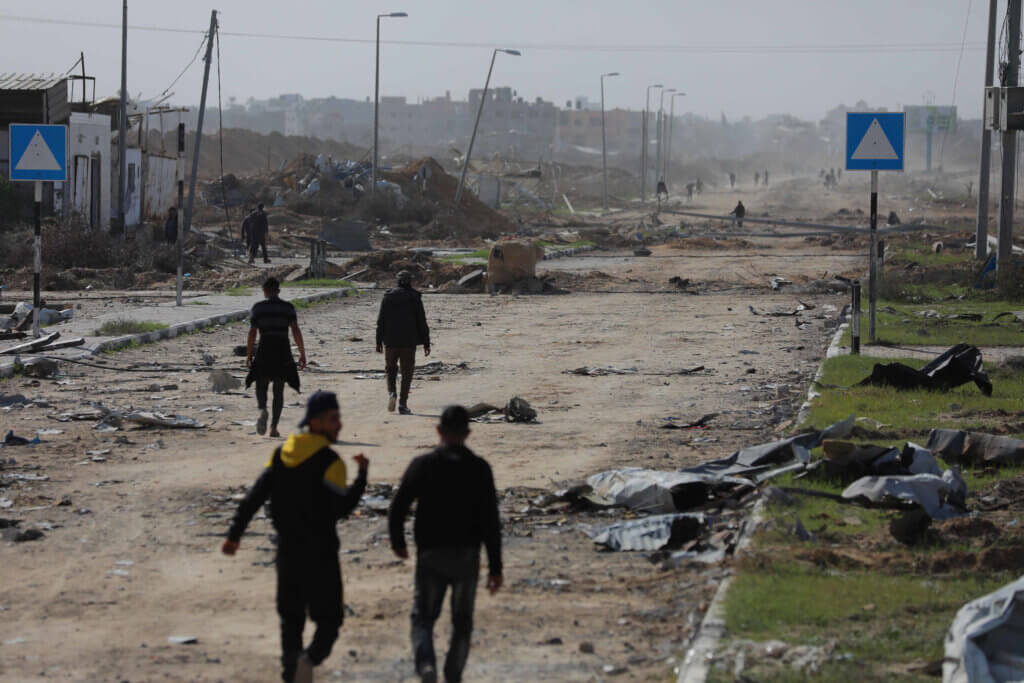
The ruins of the Matahen area in Khan Younis in the southern Gaza
Strip, January 10, 2024. (Photo: Omar Ashtawy/APA Images)
Dozens of patients stand in line for hours outside the pharmacy booth
in the Kuwaiti Hospital compound. They all start out by asking the
pharmacist the same question: is my medication available? The answer for
most is no.
Amid the long lines of the elderly, the ill, and mothers carrying
their children, a man appearing to be middle-aged leaning on a young boy
arrives, speaking in a loud voice and asking to be allowed to jump the
line — he’s just been released from prison, and can barely stand.
“I spent sixty days of constant beating and humiliated,” he says.
“They just released me, and I need to just get my medicine. Please let
me take it without having to wait any longer.”
Advertisement
Everyone lets him through, allowing him to collect his medications from the booth and leave.
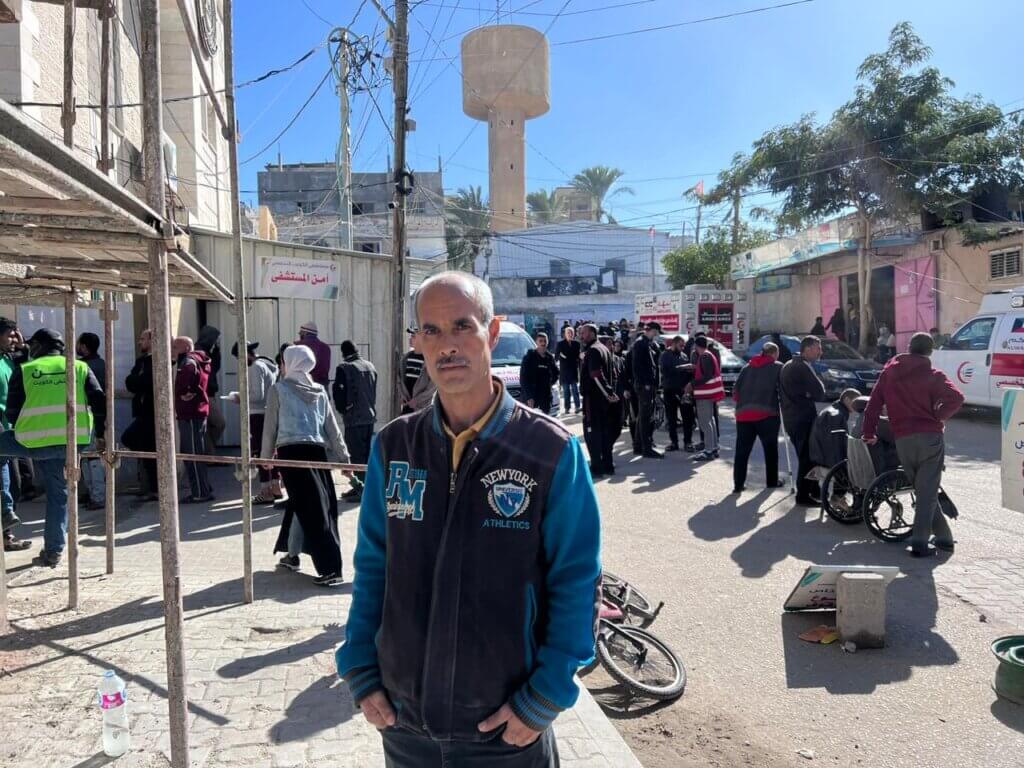
I stand beside him in the hospital courtyard and ask him how he came
to be arrested by the Israeli army — and how he was eventually released.
Haytham al-Hilou in the Kuwaiti Hospital courtyard in Rafah, January 2024. (Photo: Tareq Hajjaj/Mondoweiss)
Haytham al-Hilou, 56, was displaced from Beit Hanoun to southern Gaza
on October 27 of last year. He says that on his journey south, he was
made to pass through a mechanized checkpoint that the Israeli army had
set up at the Netzarim junction on Salah al-Din Street. When he passed
through the metal doors, and the Israeli cameras picked up his image,
Israeli soldiers called out his name through a microphone, instructing
him to step aside. Al-Hilou was sent to an Israeli detention center,
where he would endure sixty days of torture and humiliation interspersed
with interrogations for any piece of information that might be of use
to the army in identifying and reaching specific targets.
“When I reached the detention point, the soldiers ordered me to take
off all my clothes,” he says. “They told us to go wait in a ditch dug by
the army a distance away from the checkpoint.”
When he slid down into the ditch, he noticed it was already occupied
by dozens of Palestinians who had also been detained, all of them naked
and blindfolded. Not much time had passed before soldiers arrived and
blindfolded him as well.
Haytham had been fleeing south with his wife and five children, and
when he was arrested, there was no one left to look after them. Al-Hilou
says his family suffered immensely during his period of imprisonment,
struggling to find any shelter that would take them in.
“When I was released, I found my family homeless and in the streets,”
he continues. “No shelter, no food, no drink. Every drop of water and
piece of bread that they managed to find was after a long period of
suffering.”
He says it was a miracle that he found his family alive at all,
especially since all his children were very young, including his three
daughters and two young boys.
When he was first arrested, he didn’t know where he was being taken.
After a long journey, he found himself in Ofer Prison, outside of
Ramallah in the West Bank.
At Ofer, he was interrogated and subjected to physical and
psychological torture. Israeli intelligence officers denied him food for
long periods, holding interrogation sessions for hours on end. They
would ask him about the hiding places of Hamas leaders like Yahya Sinwar
and demand to know whether there were openings to tunnels inside his
home. He kept repeating the same answer.
I am a normal civilian. I am uninvolved in any military activity.
The interrogators would beat him severely and often. As an older man
with graying hair, a short frame, and a fragile build, he was unable to
endure what had become standard treatment by the Shin Bet.
And the questions would continue. Where are the Hamas leaders? Where are they hiding?
His answers turned into shouts at one point. I don’t know! I
don’t know! I am not a Hamas member! I have nothing to do with
resistance. I have nothing to do with military activity. I don’t know
where the Hamas leaders are, I don’t know anything about them. Civilians
don’t know these things, only leaders do. Normal people don’t know who
they are. They’re always in hiding.
Despite all this, al-Hilou is grateful that he was eventually
released and allowed to return home and that he is now in his family’s
arms.
He says that prison during the war is different than in any other
period. Prisoners from Gaza are worried about their families, wondering
whether they’ve been able to find shelter, whether they were able to
secure food, or whether they were dead or alive.
Haytham maintains that there was no reason for his arrest, and no
evidence pointed to his involvement in any resistance or military
activity. He does mention that between the ages of 17 and 20, he engaged
in public activities that supported the resistance but which were not
military by any stretch.
“Maybe Israel wanted to punish me for my youth, years that are behind me and well in the past,” he speculates.
In those youthful years, the activities showing support for the
resistance that he and his friends had participated in were not at all
uncommon. After all, who, in all of Palestine, doesn’t support
resistance against the occupation?
Arrested twice in the same day
There are endless stories of arbitrary incarcerations that have taken
place at the numerous Israeli military checkpoints throughout the Gaza
Strip, where the army maintains control. Some people were arrested once,
twice, and even three times during their stay in Gaza City, having
refused to leave as part of Israel’s ethnic cleansing of northern Gaza.
Eyad Eleywa is one of those residents. He is still in Gaza City, while
several of his children chose to flee south. They are now in Rafah.
Eleywa resides in the Sheikh Radwan neighborhood along with his wife,
three of his children, his daughter-in-law, and a number of his other
relatives who had fled from the areas north of Gaza City to the city
itself. His son Muhammad lives in a tent in the neighborhood of Tal
al-Sultan in Rafah. I get to see him every now and again. He recounts
the time his father was most recently arrested in northern Gaza.
Muhammad’s father has already been arrested three times, and two of
those arrests happened on the same day. Muhammad says that at the
beginning of the ground operation in Gaza City, soldiers took his father
from his home in Sheikh Radwan and ordered him to take off all his
clothes before blindfolding him and leaving him out in the cold while
conducting field interrogations.
Where are the tunnel openings? Where are the Hamas fighters? Who do you know who owns weapons in the city?
The questions weren’t asked only once, and he was detained from the
early morning until the late afternoon. When the soldiers were done with
him, they dropped him off in al-Tuwan, far away from his home in Sheikh
Radwan. They ordered the elderly man, naked and beaten, deprived of
food and water for that entire period, to walk back.
On that same evening, as he returned home on foot, he was arrested a
second time at another checkpoint in the area separating al-Tuwan from
the al-Nasr neighborhood. He spent the entire night in Israeli custody
and was released the following day.
“When they gather the detainees in one place, they line them up one
by one and terrorize them,” Muhammad says, relaying his father’s account
of his treatment while under arrest. “They move from one person to the
next, telling each of them, ‘We’re going to send you to your God,’ and
‘We’re going to send you to heaven to marry the virgins.’”
Horror hidden from the world
Those who have gone through these ordeals and lived to tell the tale
consider themselves lucky because they were eventually released and
returned to their families. Countless others have effectively been
disappeared, abducted one day at an army checkpoint and with no further
news of their fate or whereabouts.
Every time I scroll through social media, I come across people
posting about their missing family members, all of them saying that
their loved ones were lost at an Israeli checkpoint. The Israeli army
releases very little information about who it has arrested at these
checkpoints. The arrested include doctors, journalists, patients,
fathers, mothers, brothers, sisters, and people from all walks of life.
Their loved ones are constantly putting out announcements and calling on
international bodies and human rights organizations to intervene and
force Israel to reveal their loved ones’ whereabouts.
Eyewitnesses who were able to escape death and reach Rafah tell
horrific stories of how Israeli soldiers used civilians, especially male
adolescents, as human shields or worse. One eyewitness who preferred to
remain anonymous relayed a harrowing story of how Israeli soldiers,
upon discovering a tunnel opening in northern Gaza, strapped explosives
to a young 17-year-old man’s chest, legs, and arms and forced him to go
down into the tunnel, lowering him with a rope and fastening a camera to
his head. They would give him orders to go left, right, or forward as
they observed from a screen aboveground.
The eyewitness says that when the soldiers were fitting him with
explosives, they were laughing and cracking jokes, boasting that they
would “send him to his God piece by piece,” and that he would “meet the
virgins in the tunnels.” The eyewitness says that this practice was
common in Beit Hanoun, as the army made use of thin young men capable of
moving with agility in small spaces. The eyewitness says that when
soldiers noticed suspicious movements through the camera fastened to
their captives, they would blow up the tunnel and the young man along
with it. Whenever the tunnel was revealed to lead to a dead end or was
discovered to be deserted, the young man would return unharmed, and the
soldiers would remove the explosives from him.
While these harrowing details that continue to emerge from survivors
are so horrific as to beggar belief, the reality is that the occupation
has succeeded in isolating the Gaza Strip from the rest of the world and
rendering the majority of the crimes of its troops on the ground
invisible. Israel is systematically blocking foreign journalists from
reaching Gaza, assassinating Palestinian journalists, and enforcing a
total information blackout through the cutting off of electricity,
internet, and telecommunications.
In other words, Israel’s blackout strategy has worked, even with all
the gory images that still manage to make their way to your screens. The
relative scale of the killing has prompted the world to recognize that a
genocide is unfolding, but the horrific character of Israel’s crimes
and the abject inhumanity of the army’s conduct still remain largely
unknown to most of the world.
Zet je schrap, de strijd is begonnen! Christine Anderson aan de globalisten - "Laten we vechten!
"Wij zijn met miljoenen over de hele wereld. Jullie zijn de kleine marginale minderheid. We zullen jullie ten val brengen en we zullen niet rusten voordat we dat gedaan hebben".l brengen en we zullen niet rusten voordat we dat gedaan hebben".