The US is a military industrial complex that spends at least 43 percent of its federal budget on something vaguely called 'the national security' which boils down to the fact that the rich can only get richer by creating wars, and this complex needs wars and enemies, and don't forget: Obama's. The US got it all:
Exporting Death And Destruction
Obama Seeks to Expand Arms Exports
By Maggie Bridgeman
July 30, 2010 "McClatchy" -- WASHINGTON — The United States is currently the world biggest weapons supplier — holding 30 per cent of the market — but the Obama administration has begun modifying export control regulations in hopes of enlarging the U.S. market share, according to U.S. officials.
President Barack Obama already has taken the first steps by tucking new language into the Iran sanctions bill signed in early July. His aides are now compiling the "munitions list," which regulates the sale of military items.
The administration's stated reason for the changes is to simplify the sale of weapons to U.S. allies, but potential spinoffs include generating business for the U.S. defense industry, creating jobs and contributing to Obama's drive to double U.S. exports by 2015.
Critics say the reforms are being rushed and warn that the expedited procedures could allow weapons technology to fall into the wrong hands.
India, which currently is seeking 126 fighter-jets worth over $10 billion, 10 large transport aircraft worth $6 billion, and other multi-billion dollar defense sales, could be among the possible beneficiaries. Allies seeking advanced U.S. weaponry and equipment, who now often buy elsewhere due to the cumbersome U.S. approval process, would draw immediate benefit from the reforms, U.S. officials said.
Obama first called for the reforms in August 2009, then referred to them in his Jan. 27 State of the Union address as an element toward doubling exports by 2015.
In the House of Representatives, Foreign Affairs Committee Chairman Howard Berman, (D-Calif.), is drafting a bill that parallels the president's plan.
However, it isn't clear that the Senate will go along, as it is still reviewing the president's proposals.
"It is probably going to be some time yet before there is movement in the relevant committees on formal hearings or writing or legislation," said Andy Fisher, spokesperson for the Senate Committee on Foreign Relations.
Obama's plan, according to top officials, is to ask Congress to streamline the bureaucratic process for approving arms sales by setting up a single new agency to oversee one list of exportable weapons, "tiered" according to the sensitivity of the technology. Currently the State and Commerce Departments maintain separate lists, and the State Department list contains many restrictions.
"Our aim is to make the system more transparent, efficient, and effective," said Ben Chang, a White House spokesman. "This means we are improving our ability to administer our controls, which improves our ability to enforce them, and equally important, improves the ability of companies to comply."
Critics say decontrolling weapons systems could fuel regional arms races, allow technology to fall into the wrong hands and, because arms purchasers often want to set up their own industries, end up exporting jobs abroad.
"The concern that we have is that the net result of this process would be to open the floodgates for military sales to states that do not meet the standards established in years previous," said Daryl Kimball, executive director of the Arms Control Association.
"We're No. 1 in weapons in the world, so I don't understand what the problem is we need to fix," said a Republican staffer for the Senate Committee on Foreign Relations, who asked to remain anonymous due to the sensitivity of the topic.
Defense Secretary Robert Gates, the most outspoken administration advocate for the new system, said it will "build high walls around a smaller yard" by narrowing in on the nation's "crown jewels."
However, critics point out that what those crown jewels are depends on decisions yet to be made.
"There's nothing in their top tier currently," the Senate GOP staffer said. "They can't figure out what should be in their top tier."
Senior officials have said possible "top tier" items include certain night vision technology and advanced stealth technology, which makes aircraft invisible to radar, infrared, and sonar.
The new system would allow older technology such as Lockheed Martin's F-16 fighter to fall to a lower tier as newer, more advanced technology emerges. The staffer said that some versions of the plan currently circulating don't include the F-16 in the top tier of the secured list.
The F-16 may no longer be top technology for the U.S., but as is the case with much of the aging technology that will be decontrolled, the Senate GOP staffer said, "It's often a question of what China, a terrorist, or even a rogue state would do with these things."
Members of the Obama administration say that changes will enhance national security.
"In fact, our system itself poses a potential national security risk based on the fact that its structure is overly complicated, contains too many redundancies, and tries to protect too much," United States National Security Advisor General James Jones said in a speech introducing the plans.
The administration hopes that by streamlining the process, allies will be able to receive more weapons and technology faster, making their equipment more compatible with that of the United States, and making it easier to complete joint operations.
"It spells the difference between U.S. forces going it alone or having allies who are able to operate in the lethal battle space with U.S. military forces," said former Bush administration arms regulator Amb. Lincoln Bloomfield Jr.
Rep. Donald Manzullo, R-Ill., represents a district with aerospace and other manufacturers, and said reform is needed for the survival of U.S. manufacturing.
"We can begin to manufacture our way out of this recession by reforming our export controls," Manzullo said in a speech at the American Enterprises Institute, a conservative think tank.
Manzullo has worked for export control reform throughout his career and says that the job creation benefits make the initiative worthwhile, but he retains doubts about the current review.
"I have a problem with giving all that power to one agency," Manzullo said.
Manzullo explained that having one agency to govern export controls could be dangerous if the wrong person were put in charge.
Similarly, Christopher Wall, former assistant secretary of commerce, said he supports reform but thought initially that the changes were being rushed. In recent weeks, he said, the administration appears to have a better understanding of the immensity of the task.
"Whether it has to do with the possible departure of Secretary Gates or the election timetable coming up, neither of these should drive the reform process," Wall said.
The Senate GOP staffer said that if the United States decontrols as the number one seller in the market, then others with less scrupulous records will follow suit.
The Obama administration isn't the first executive to see the benefits of export control reform; both former President Bill Clinton and George W. Bush undertook similar reviews, which according to Gregory Suchan, a former deputy assistant secretary of state, "crashed and burned essentially because of opposition from Congress."
"Anybody who thinks that they can come to a conclusion as to whether this is a good thing or a bad thing," Suchan said, "such a judgment is premature"
http://www.informationclearinghouse.info/article26049.htm
Zoeken in deze blog 🔎🔎
zaterdag 31 juli 2010
The Empire 615
Traveling through the US and talking with ordinary people I realize that the situation in the US is much more dramatic than the Dutch mainstream media suggest. The system is fundamentally bankrupt, and the citizens know it. Only an external enemy and a new war offer a temporary 'solution':
Newt Gingrich Suggests Attacking Rest Of 'Axis Of Evil'
By Jeremy Binckes
July 30, 2010 " Huffington Post" -- Former Speaker of the House Newt Gingrich twice called on the United States to attack North Korea and Iran Thursday because the United States has only attacked "one out of three" of so-called "http://en.wikipedia.org/wiki/Axis_of_evilAxis of Evil" members by invading Iraq. He also claimed that Muslims are trying to install Sharia law on America and said that the "War on Terror" should have been a war on "radical Islamists" instead.
Newt Gingrich Suggests Attacking Rest Of 'Axis Of Evil'
By Jeremy Binckes
July 30, 2010 " Huffington Post" -- Former Speaker of the House Newt Gingrich twice called on the United States to attack North Korea and Iran Thursday because the United States has only attacked "one out of three" of so-called "http://en.wikipedia.org/wiki/Axis_of_evilAxis of Evil" members by invading Iraq. He also claimed that Muslims are trying to install Sharia law on America and said that the "War on Terror" should have been a war on "radical Islamists" instead.
Speaking at an American Enterprise Institute event, Gingrich compared not following through on President George W. Bush's "Axis of Evil" agenda with not fully engaging the Axis power in World War II.
"If Franklin Roosevelt had done that in '41, either the Japanese or the Germans would have won," Gingrich said, adding that Americans should "over-match the problem."
On the reaction to Bush's declaration of an "Axis of Evil," Gingrich blamed Democrats because Americans had not followed through on President Bush's words:
I believe he was right but in fact could not operationalize what he said. That is, there was an Axis of Evil, Iran, Iraq, North Korea. Well we're one out of three. And people ought to think about that. If Bush was right in January of 2002 -- and by the way virtually the entire Congress gave him a standing ovation when he said it -- then why is it that the other two parts of the Axis of Evil are still visibly, cheerfully making nuclear weapons? And it's because we've stood at brink, looked over and thought, "Too big a problem."
In a separate interview with Newsmax Thursday, Gingrich said that the "secular elites" haven't taken "threats to America" seriously and that newly-appointed Supreme Court Justice Elena Kagan has "no real appreciation of the danger of Sharia," because she "welcomed Saudi money" while serving as the Dean of Harvard University Law School.
"Radical Islamists are people who want to impose on the rest of us Sharia, which is a form of medieval law which would fundamentally end America as we've known it," he said. "There are disturbing signs that some places ... you see judges succumb to this line of reasoning." He called on "isolating and defeating radicals," while "modernizing" moderates.
Gingrich told Newsmax that the planned mosque and community center in Lower Manhattan should be stopped. He suggested that, were he president, he would "declare the area around the World Trade Center a national military battlefield because that was a battle and it part of a real war."
The former Speaker has been aggressively attacking Islam in the past weeks. Last week, he came out against the "Ground Zero Mosque," saying that it "showed hypocrisy" because there are no churches in Saudi Arabia.
Gingrich's Renewing American Leadership Action PAC has used the controversy as a fund raising platform, Salon's Justin Elliott reports. In a blast email sent to the World Net Daily list, a Gingrich-signed letter reads, "Please SELECT HERE to STOP the Ground Zero mosque! Your decisive DONATION to Real Action will help us to RALLY and ACTIVATE all Americans, to TAKE REAL ACTION!"
Gingrich also told Newsmax that he expects Sarah Palin to run for President in 2012 in a large Republican field. Gingrich is rumored to be running for President in 2012, but did not say whether or not he's running.
"She's already a very strong personality and has the potential to be a very strong candidate," he said.
WATCH: Newt Gingrich speak about the American reaction to Bush's "Axis of Evil" speech, (from Think Progress).
vrijdag 30 juli 2010
Tom Engelhardt 3
The Opposites Game: All the Strangeness of Our American World in One Article
Monday 26 July 2010
Have you ever thought about just how strange this country's version of normal truly is? Let me make my point with a single, hardly noticed Washington Post news story that's been on my mind for a while. It represents the sort of reporting that, in our world, zips by with next to no reaction, despite the true weirdness buried in it.
The piece by Craig Whitlock appeared on June 19th and was headlined, "U.S. military criticized for purchase of Russian copters for Afghan air corps." Maybe that's strange enough for you right there. Russian copters? Of course, we all know, at least vaguely, that by year's end U.S. spending on its protracted Afghan war and nation-building project will be heading for $350 billion dollars. And, of course, those dollars do have to go somewhere.
Admittedly, these days in parts of the U.S., state and city governments are having a hard time finding the money just to pay teachers or the police. The Pentagon, on the other hand, hasn't hesitated to use at least $25-27 billion to "train" and "mentor" the Afghan military and police -- and after each round of training failed to produce the expected results, to ask for even more money, and train them again. That includes the Afghan National Army Air Corps which, in the Soviet era of the 1980s, had nearly 500 aircraft and a raft of trained pilots. The last of that air force -- little used in the Taliban era -- was destroyed in the U.S. air assault and invasion of 2001. As a result, the "Afghan air force" (with about 50 helicopters and transport planes) is now something of a misnomer, since it is, in fact, the U.S. Air Force.
Still, there are a few Afghan pilots, mostly in their forties, trained long ago on Russian Mi-17 transport helicopters, and it's on a refurbished version of these copters, Whitlock tells us, that the Pentagon has already spent $648 million. The Mi-17 was specially built for Afghanistan's difficult flying environment back when various Islamic jihadists, some of whomwe're now fighting under the rubric of "the Taliban," were allied with us against the Russians.
Here's the first paragraph of Whitlock's article: "The U.S. government is snapping up Russian-made helicopters to form the core of Afghanistan's fledgling air force, a strategy that is drawing flak from members of Congress who want to force the Afghans to fly American choppers instead."
So, various congressional representatives are upset over the lack of a buy-American plan when it comes to the Afghan air force. That's the story Whitlock sets out to tell, because the Pentagon has been planning to purchase dozens more of the Mi-17s over the next decade, and that, it seems, is what's worth being upset about when perfectly good American arms manufacturers aren't getting the contracts.
But let's consider three aspects of Whitlock's article that no one is likely to spend an extra moment on, even if they do capture the surpassing strangeness of the American way of war in distant lands -- and in Washington.
1. The Little Training Program That Couldn't: There are at present an impressive 450 U.S. personnel in Afghanistan training the Afghan air force. Unfortunately, there's a problem. There may be no "buy American" program for that air force, but there is a "speak American" one. To be an Afghan air force pilot, you must know English -- "the official language of the cockpit," Whitlock assures us (even if to fly Russian helicopters). As he points out, however, the trainees, mostly illiterate, take two to five years simply to learn the language. (Imagine a U.S. Air Force in which, just to take off, every pilot needed to know Dari!)
Thanks to this language barrier, the U.S. can train endlessly and next to nothing is guaranteed to happen. "So far," reports Whitlock, "only one Afghan pilot has graduated from flight school in the United States, although dozens are in the pipeline. That has forced the air corps to rely on pilots who learned to fly Mi-17s during the days of Soviet and Taliban rule." In other words, despite the impressive Soviet performance in the 1980s, the training of the Afghan Air Force has been re-imagined by Americans as a Sisyphean undertaking.
And this offers but a hint of how bizarre U.S. training programs for the Afghan military and police have proven to be. In fact, sometimes it seems as if exactly the same scathing report, detailing the same training problems and setbacks, has been recycled yearly without anyone who mattered finding it particularly odd -- or being surprised that the response to each successive piece of bad news is to decide to pour yet more money and trainers into the project.
For example, in 2005, at a time when Washington had already spent $3.3 billion training and mentoring the Afghan army and police, the U.S. Government Accounting Office (GAO) issued a report indicating that "efforts to fully equip the increasing number of [Afghan] combat troops have fallen behind, and efforts to establish sustaining institutions, such as a logistics command, needed to support these troops have not kept pace." Worse yet, the report fretted, it might take "up to $7.2 billion to complete [the training project] and about $600 million annually to sustain [it]."
In 2006, according to the New York Times, "a joint report by the Pentagon and the State Department... found that the American-trained police force in Afghanistan is largely incapable of carrying out routine law enforcement work, and that managers of the $1.1 billion training program cannot say how many officers are actually on duty or where thousands of trucks and other equipment issued to police units have gone." At best, stated the report, fewer than half of the officially announced number of police were "trained and equipped to carry out their police functions."
In 2008, by which time $16.5 billion had been spent on Army and police training programs, the GAO chimed in again, indicating that only two of 105 army units were "assessed as being fully capable of conducting their primary mission," while "no police unit is fully capable." In 2009, the U.S. Special Inspector General for Afghan Reconstruction reported that "only 24 of 559 Afghan police units are considered ready to operate without international help." Such reports, as well as repeated (and repetitive) news investigations and stories on the subject, invariably are accompanied by a litany of complaints about corruption, indiscipline, illiteracy, drug taking, staggering desertion rates, Taliban infiltration, ghost soldiers, and a host of other problems. In 2009, however, the solution remained as expectable as the problems: "The report called for more U.S. trainers and more money."
This June, a U.S. government audit, again from the Special Inspector General, contradicted the latest upbeat American and NATO trainingassessments, reporting that "the standards used to appraise the Afghan forces since 2005 were woefully inadequate, inflating their abilities." The usual litany of training woes followed. Yet, according to Reuters, President Obama wants another $14.2 billion for the training project "for this year and next." And just last week, the Wall Street Journal's Julian Barnes reported that new Afghan war commander General David Petraeus is planning to "retool" U.S. strategy to include "a greater focus on how Afghanistan's security forces are being trained."
When it comes to U.S. training programs then, you might conclude that Afghanistan has proved to be Catch-22-ville, the land where time stood still -- and so, evidently, has the Washington national security establishment's collective brain. For Washington, there seems to be no learning curve in Afghanistan, not when it comes to "training" Afghans anyway.
And here is the oddest thing of all, though no one even bothers to mention it in this context: the Taliban haven't had tens of billions of dollars in foreign training funds; they haven't had years of advice from the best U.S. and NATO advisors that money can buy; they haven't had private contractors like DynCorp teaching them how to fight and police, and strangely enough, they seem to have no problem fighting. They are not undermanned, infiltrated by followers of Hamid Karzai, or particularly corrupt. They may be illiterate and may not be fluent in English, but they are ready, in up-to platoon-sized units, to attack heavily fortified U.S. military bases, Afghan prisons, a police headquarters, and the like with hardly a foreign mentor in sight.
Consider it, then, a modern miracle in reverse that the U.S. has proven incapable of training a competent Afghan force in a country where arms are the norm, fighting has for decades seldom stopped, and the locals are known for their war-fighting traditions. Similarly, it's abidingly curious that the U.S. has so far failed to train a modest-sized air force, even flyingrefurbished Italian light transport planes from the 1980s and those Russian helicopters, when the Soviet Union, the last imperial power to try this, proved up to creating an Afghan force able to pilot aircraft ranging from helicopters to fighter planes.
2. Non-Exit strategies: Now, let's wade a little deeper into the strangeness of what Whitlock reported by taking up the question of when we're actually planning to leave Afghanistan. Consider this passage from the Whitlock piece: "U.S. military officials have estimated that the Afghan air force won't be able to operate independently until 2016, five years after President Obama has said he intends to start withdrawing U.S. troops from Afghanistan. But [U.S. Air Force Brig. Gen. Michael R.] Boera said that date could slip by at least two years if Congress forces the Afghans to fly U.S. choppers."
In other words, while Americans argue over what the president's July 2011 drawdown date really means, and while Afghan President Hamid Karzai suggests that Afghan forces will take over the country's security duties by 2014, Whitlock's anonymous "U.S. military officials" are clearly operating on a different clock, on, in fact, Pentagon time, and so are planning for a 2016-2018 target date for that force simply to "operate independently" (which by no means indicates "without U.S. support.")
If you were of a conspiratorial mind, you might almost think that the Pentagon preferred not to create an effective Afghan air force and instead -- as has also been the case in Iraq, a country that once had the world's sixth largest air force and now, after years of U.S. mentoring, has next to nothing -- remain the substitute Afghan air force forever and a day.
3. Who Are the Russians Now?: Okay, let's move even deeper into American strangeness with a passage that makes up most of the 20th and 21st paragraphs of Whitlock's 25-paragraph piece: "In addition," he reports, "the U.S. Special Operations Command would like to buy a few Mi-17s of its own, so that special forces carrying out clandestine missions could cloak the fact that they are American. 'We would like to have some to blend in and do things,' said a senior U.S. military official, speaking on condition of anonymity to discuss the clandestine program."
No explanation follows on just how -- or where -- those Russian helicopters will help "cloak" American Special Operations missions, or what they are to "blend" into, or the "things" they are to do. There's no further discussion of the subject at all.
In other words, the special op urge to Russianize its air transport has officially been reported, and a month later, as far as I know, not a single congressional representative has made a fuss over it; no mainstream pundit has written a curious, questioning, or angry editorial questioning its appropriateness; and no reporter has, as yet, followed up.
As just another little factoid of no great import buried deep in an article focused on other matters, undoubtedly no one has given it a thought. But it's worth stopping a moment and considering just how odd this tiny bit of news-that-won't-ever-rise-to-the-level-of-news actually is. One way to do this is to play the sort of opposites game that never quite works on this still one-way planet of ours.
Just imagine a similar news item coming out of another country.
- *Hot off the wires from Tehran: Iranian special forces teams are scouring the planet for old American Chinook helicopters so they can be well "cloaked" in planned future forays into Afghanistan and Pakistan's Baluchistan Province.
- *The People's Daily reports: Chinese special forces operatives are buying relatively late model American helicopters so that... Well, here's one problem in the opposites game, and a clue to the genuine strangeness of American activities globally: why would the Chinese need to do such a thing (and, in fact, why would we)? Where might they want to venture militarily without being mistaken for Chinese military personnel?
- That might be a little hard to imagine right now, but I guarantee you one thing: had some foreign news source reported such a plan, or had Craig Whitlock somehow uncovered it and included it in a piece -- no matter how obscurely nestled -- there would have been pandemonium in Washington. Congress would have held hearings. Pundits would have opined on the infamy of Iranian or Chinese operatives masking themselves in our choppers. The company or companies that sold the helicopters would have been investigated. And you can imagine what Fox News commentators would have had to say.
When we do such things, however, and a country like Pakistan reacts with what's usually described as "anti-Americanism," we wonder at the nationalistic hair-trigger they're on; we comment on their over-emotionalism; we highlight their touchy "sensibilities"; and our reporters and pundits then write empathetically about the difficulties American military and civilian officials have dealing with such edgy natives.
Just the other day, for instance, the Wall Street Journal's Barnes reportedthat U.S. Special Operations Forces are expanding their role in the Pakistani tribal borderlands by more regularly "venturing out with Pakistani forces on aid projects, deepening the American role in the effort to defeat Islamist militants in Pakistani territory that has been off limits to U.S. ground troops." The Pakistani government has not been eager to have American boots visibly on the ground in these areas, and so Barnes writes: "Because of Pakistan's sensitivities, the U.S. role has developed slowly."
Imagine how sensitive they might prove to be if those same forces began to land Russian helicopters in Pakistan as a way to "cloak" their operations and blend in? Or imagine just what sort of hair-trigger the natives of Montana might be on if Pakistani special operations types were roaming Glacier National Park and landing old American helicopters outside Butte.
Then consider the sensitivities of Pakistanis on learning that the just appointed head of the CIA's National Clandestine Service turns out to be a man of "impeccable credentials" (so says CIA Director Leon Panetta). Among those credentials are his stint as the CIA station chief in Pakistan until sometime in 2009, his involvement in the exceedingly unpopulardrone war in that country's tribal borderlands, and the way, as the Director put it a tad vaguely, he "guided complex operations under some of the most difficult circumstances imaginable."
Here's the truth of the matter, as Whitlock's piece makes clear: we carry on in the most bizarre ways in far-off lands and think nothing of it. Historically, it has undoubtedly been the nature of imperial powers to consider every strange thing they do more or less the norm. For a waning imperial power, however, such an attitude has its own dangers. If we can't imagine the surpassing strangeness of our arrangements for making war in lands thousands of miles from the U.S., then we can't begin to imagine how the world sees us, which means that we're blind to our own madness. Russian helicopters, that's nuthin' by comparison.
Tom Engelhardt, co-founder of the American Empire Project, runs the Nation Institute's TomDispatch.com. His latest book, The American Way of War: How Bush's Wars Became Obama's (Haymarket Books), has just been published. You can catch him discussing it on a TomCast video by clicking here.
[Note for readers: On the folly of American training programs for the Afghanistan Army, TomDispatch had an on-the-spot report that still shouldn't be missed, Ann Jones's September 20, 2009, piece "Meet the Afghan Army, Is It a Figment of Washington's Imagination?"]
The Empire 614
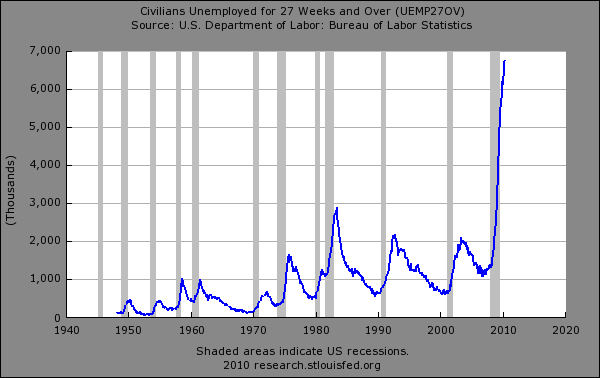
Middle class financially squeezed by the plutocracy – 13 million people added to food assistance from 2007 to 2010. Nearly 40 percent of all unemployed have been out of work for 27 weeks or more.
- Posted by mybudget360 in bailout, corporate power, debt, economy, food stamps,gimmicks, income, middle class
- 3 Comment
The mainstream press and their lack of focus or even caring about a shrinkingmiddle class is disturbing. Yet this shouldn’t be a surprise given that their focus of appeasing their sponsors is directly focused at keeping people stuck in a debt induced sleepwalking financial nightmare. Wall Street has successfully infiltrated our government and most policies are vetted to ensure banking success before ever becoming law or what we now pass as reform. Take this sobering figure as a measure of how deep this recession has impacted our national economy; in December of 2007 at the start of the recession 27 million Americans were receiving food assistance (already high in a supposed recovery). Today, we have over 40 million receiving food assistance and we are supposedly in a recovery. From March to April of 2010 we added 300,000 people to the food assistance column. This is what passes as recovery. Also, the persistent long-term unemployment is a perplexing issue facing the middle class:
This chart is daunting:
The amount of people that are long-term unemployed is at record levels. The chart above shows that we have never been close to a similar situation going back to the late 1940s when records started being kept. These are structural problems. Nearly 7 million of the officially unemployed today have been out of work for 27 weeks or more. The working and middle class saddled with incredible amounts of debt are losing any ability to stay above water. This is why we see those jumping on food assistance exploding even at a faster rate than those losing their jobs. Why? We have a giant class of working poor in the United States.
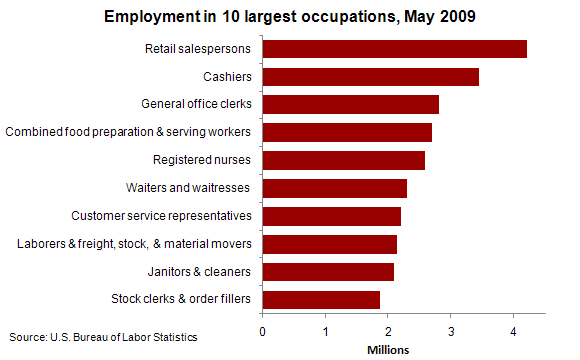
9 of the top 10 industries in the United States are low paying service sector work:
Source: BLS
There are many Americans that are actually counted as officially employed but are also receiving food assistance. Think about the data for a second:
People receiving food assistance: 40.4 millionOfficial unemployed: 14.6 million
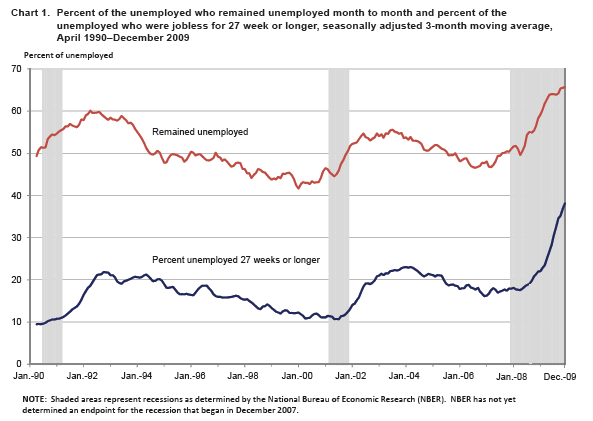
Part of the gap comes from the data of counting children in the food assistance figures. Yet many people today are labeled as fully employed but are barely scraping by. The median household income in the U.S. is roughly $52,000 – I’m sure this figure is lower or stagnant once data is released in September from the Census. The economy is extremely weak for certain sectors. If we crunch the data on the long-term unemployed future prospects do not look promising:
What does the above chart tell us? The above chart shows very little recovery going on in the real economy. Those that stay unemployed 27 weeks or more are likely to stay that way for a long period of time. Now if we really want to see where things are heading, we can look at a few major sectors of our economy:
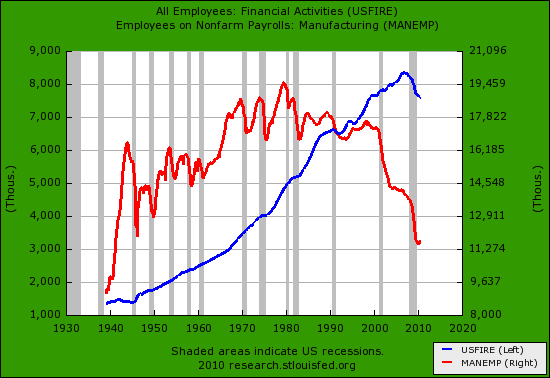
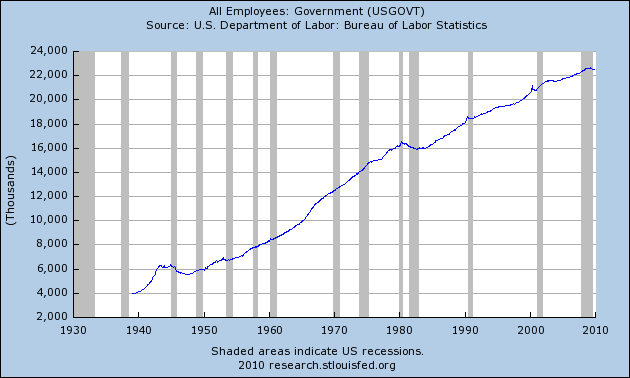
What you’ll notice in the chart above is that the manufacturing sector in the U.S. has been taken apart and this goes back to the 1970s. These were quality jobs that are not coming back. If you take a look at the actual FIRE side of things (finance, insurance, and real estate) job losses are showing up in good numbers but this sector has gone up on a very clear path since the 1950s. We have decided to push real estate and toxic loan products instead of making things. Thebanking sector has outsourced our workforce. Why else are the top 10 job sectors in low paying service sector work like cashiers or servers? This correlation did not happen by accident.
You really don’t want to see the government sector expanding at the same time the overall employment base is going lower. Yet this recession is striking at the core of the working and middle class. There was a recent story of a city manager in Bell California making $800,000 a year in a city of roughly 30,000 people. The city is working class and people are rightfully outraged. This is no different than a CEO making millions of dollars creating toxic mortgage products that required taxpayers to bail them out. The country is being run by plutocrats on both sides of the aisle. The middle is getting squeezed out.
It is no wonder that anger against both political parties is at record levels. People are rightfully disenfranchised. With no solid job growth we can expect further problems in many sectors of our economy and we will see even more incredible financial problems come to the surface that were hidden during the halcyon days of the credit bubble. When the light comes on, the roaches scatter.
Catherine Austin Fitts
<http://www.solari.com>
"The federal government just passed a bill that is well over a
thousand pages long and requires 533 new regulations, claiming it will
provide financial reform. However, it still has not complied with the
laws related to its own financial management, accounting and
disclosure, let alone found more than $4 trillion missing from its own
accounts.
So cheap federal credit continues to finance the Wall Street banks
blowing bubbles and building global empire without concern for
Constitutional and statutory requirements that expenditures be
approved by Congress and reported to the citizenry."
~ Catherine Austin Fitts
<http://silverandgoldaremoney.
<http://solari.com/solari_
<http://solarisilverandgold.
<http://solari.com/store/the_
<http://solari.com/store/
<http://solari.com/podcasts/>
<http://solari.com/>
The Solari Report Digest is a podcast featuring highlights from the
live one-hour Solari Report briefings. In the rapidly changing
political and economic landscape the Solari Report Digest provides up
to date analysis of money and markets, insightful commentary on
current events, as well as interviews with leaders in the world of
business, politics, health, finance, and more.
Highlights of Solari Report Digest #14 include:
Taking the Leap - Moving from paper to precious metals in the local
economy with Franklin Sanders and James Turk.
Digital Voodoo - Identity theft expert Bob Sullivan on keeping track
of your "Digital Twin."
Control Freaks - Author and activist Dr. Nick Begich discusses the
new high tech tools of the trade for those in the World domination
business.
More <http://solari.com/podcasts/14
at the Solari Report Digest website.
Subscribers to The Solari Report receive access to our complete
archive of calls via MP3 recordings and Solari Audio Seminars. You can
learn more and subscribe here
<http://solari.com/store/the_
.
You can dial into calls by phone or access live calls through your
web browser, making it easy and low cost to participate live no matter
where you live.
View The Solari Report Archives
<http://solari.com/store/
Listen to the latest Podcast <http://solari.com/podcasts/14
<http://solari.com/blog/>
Memories on the Half Shell <http://solari.com/blog/?p=
The Shrinking Middle Class <http://solari.com/blog/?p=
U.S. Rescue May Reach $23.7 Trillion
<http://solari.com/blog/?p=
Rising Profits Boost Dividend And Cash But Not Hiring
<http://www.smartbrief.com/
U.S. Military Strike On Iran Likely, Ex-CIA Chief Says
<http://www.huffingtonpost.
Afghanistan: The War Logs
<http://www.guardian.co.uk/
LA is Armed Against Yogurt <http://solari.com/blog/?p=
Mises Institute Offers A Free Week-Long Economics Seminar
<http://solari.com/blog/?p=
Russia's Drought Raises Bondholder Risk on Prices
<http://www.bloomberg.com/
Stock Buying Hits Bull Market Record at Mutual Funds
<http://www.bloomberg.com/
A Solari Report - The Coming Avalanche of 1099 Forms
<http://solari.com/blog/?p=
Congress has slipped a provision into the new Patient Protection &
Affordable Care Act that requires every non-tax-exempt business in the
US to provide an information return (usually, a 1099) to every payee
to which it makes aggregate payments of $600 or more during a calendar
year.
Franklin Sanders on the Coming Avalanche of 1099 Form
<http://solari.com/blog/?p=
I have now lost count of all the emails, hysterical and otherwise, I
have received about the "new tax on silver and gold" that was slipped
into the Obamacare bill. WHOA. Stop. It is nothing of the kind, and in
truth is MUCH worse than a mere tax on silver and gold.
<http://solari.com/blog/>
Frank-Dodd Financial Reform Bill
Norm Dodd on Tax Exempt Foundations
How to Resist Federal Tyranny
Coyote Creek Organic Feed Mill
Trouble reading this message? View it at solari.com
<http://solari.com/updates/
If videos do not appear in your e-Mail message, view them here
<http://solari.com/updates/
If someone you know wants to sign up for Solari Update, you can send
him or her to: http://mail.solari.com/?p=
Nothing in this Solari Update should be taken as individual
investment advice. Anyone seeking investment advice for his or her
personal financial situation is advised to seek out a qualified
advisor or advisors and provide as much information as possible to the
advisor in order that such advisor can take into account all relevant
circumstances, objectives, and risks before rendering an opinion as to
the appropriate investment strategy.
© Solari, Inc. 2010
Abonneren op:
Posts (Atom)
Dr Hysterische Zionistische Haat
Richard @ricwe123 That moment when Israeli police officers decided it would be a good idea to attack the Christian funeral procession of P...
-
SKIP TO CONTENT Site Navigation Popular Latest Sign In Subscribe GLOBAL THE WAR PHOTO NO ONE WOULD PUBLISH When Kenneth Jarecke photograph...
-
Paul2 heeft een nieuwe reactie op uw bericht "De Israelische Terreur 938" achtergelaten: Nou Stan ,dat wordt gevangenisstraf voor ...
-
Going Underground heeft deze post opnieuw geplaatst Afshin Rattansi @afshinrattansi · 5 u Col. Lawrence Wilkerson: ‘I WATCHED MOSSAD TAKE...